Minimal Dependency Length in Realization Ranking
Michael White and Rajakrishnan Rajkumar Department of Linguistics
The Ohio State University Columbus, OH, USA
{mwhite,raja}@ling.osu.edu
Abstract
Comprehension and corpus studies have found that the tendency to minimize dependency length has a strong influence on constituent or-dering choices. In this paper, we investigate dependency length minimization in the con-text of discriminative realization ranking, fo-cusing on its potential to eliminate egregious ordering errors as well as better match the dis-tributional characteristics of sentence order-ings in news text. We find that with a state-of-the-art, comprehensive realization rank-ing model, dependency length minimization yields statistically significant improvements in BLEU scores and significantly reduces the number of heavy/light ordering errors. Through distributional analyses, we also show that with simpler ranking models, dependency length minimization can go overboard, too of-ten sacrificing canonical word order to shorof-ten dependencies, while richer models manage to better counterbalance the dependency length minimization preference against (sometimes) competing canonical word order preferences.
1 Introduction
In this paper, we show that for the constituent or-dering problem in surface realization, incorporating insights from the minimal dependency length the-ory of language production (Temperley, 2007) into a discriminative realization ranking model yields sig-nificant improvements upon a state-of-the-art base-line. We demonstrate empirically using OpenCCG, our CCG-based (Steedman, 2000) surface realiza-tion system, the utility of a global feature encoding
the total dependency length of a given derivation. Although other works in the realization literature have used phrase length or head-dependent distances in their models (Filippova and Strube, 2009; Velldal and Oepen, 2005; White and Rajkumar, 2009, i.a.), to the best of our knowledge, this paper is the first to use insights from the minimal dependency length theory directly and study their effects, both qualita-tively and quantitaqualita-tively.
The impetus for this paper was the discovery that despite incorporating a sophisticated syntac-tic model borrowed from the parsing literature— including features with head-dependent distances at various scales—White & Rajkumar’s (2009) real-ization ranking model still often performed poorly on weight-related decisions such as when to em-ploy heavy-NP shift. Table 1 illustrates this point. In wsj 0034.9, the full model (incorporating numer-ous syntactic features) succeeds in reproducing the reference sentence, which is clearly preferable to the rather awkward variant selected by the base-line model (using various n-gram models). How-ever, in wsj 0013.16, the full model fails to shift the temporal modifierfor now next to the phrasal verb
turned down, leaving it at the end of its very long verb phrase where it is highly ambiguous (with mul-tiple intervening attachment sites). Conversely, in wsj 0044.3, the full model shiftsbeforenext to the verb, despite the NPcheatingbeing very light, yield-ing a very confusyield-ing orderyield-ing given that before is meant to be intransitive.
The syntactic features in White & Rajku-mar’s (2009) realization ranking model are taken from Clark & Curran’s (2007) normal form model
wsj 0034.9 they fellinto oblivion after the 1929 crash. FULL [same]
BASELINE they fellafter the 1929 crash into oblivion.
wsj 0013.16 separately , the Federal Energy Regulatory Commission [V P turned downfor now[N P a request
by Northeast [V P seeking approval of [N P its possible purchase of PS of New Hampshire]]]] .
FULL separately , the Federal Energy Regulatory Commission [V P turned down [N P a request by
North-east [V P seeking approval of [N P its possible purchase of PS of New Hampshire]]]for now] .
wsj 0044.3 she had seencheating before, but these notes were uncanny . FULL she had seenbefore cheating, but these notes were uncanny .
Table 1: Examples of OpenCCG output with White & Rajkumar’s (2009) models—the first represents a successful case, the latter two egregious ordering errors
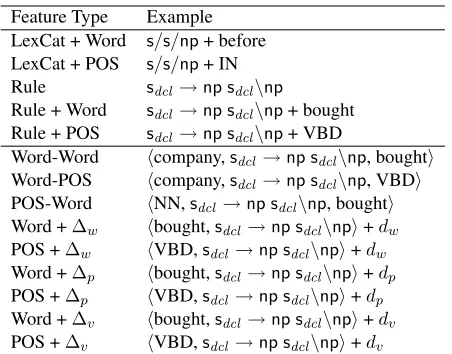
(Table 3; see Section 3). In this model, head-dependenct distances are considered in conjunc-tion with lexicalized and unlexicalized CCG deriva-tion steps, thereby appearing in numerous features. As such, the model takes into account the inter-action of dependency length with derivation steps, but in essence does not consider the main ef-fect of dependency length itself. In this light, our investigation of dependency length minimiza-tion can be viewed as examining the quesminimiza-tion of whether realization ranking models can be made more accurate—and in particular, avoid egregious ordering errors—by incorporating a feature to ac-count for the main effect of dependency length.
It is important to observe at this point that de-pendency length minimization is more of a prefer-ence than an optimization objective, which must be balanced against other order preferences at times. A closer reading of Temperley’s (2007) study re-veals that dependency length can sometimes run counter to many canonical word order choices. A case in point is the class of examples involving pre-modifying adjunct sequences that precede both the subject and the verb. Assuming that their par-ent head is the main verb of the spar-entence, a long-short sequence would minimize overall dependency length. However, in 613 examples found in the Penn Treebank, the average length of the first adjunct was 3.15 words while the second adjunct was 3.48 words long, thus reflecting a short-long pattern, as illus-trated in the Temperley p.c. example in Table 2. Apart from these, Hawkins (2001) shows that argu-ments are generally located closer to the verb than adjuncts. Gildea and Temperley (2007) also suggest
that adverb placement might involve cases which go against dependency length minimization. An exam-ination of 295 legitimate long-short post-verbal con-stituent orders (counter to dependency length) from Section 00 of the Penn Treebank revealed that tem-poral adverb phrases are often involved in long-short orders, as shown in wsj 0075.13 in Table 2. In our setup, the preference to minimize dependency length can be balanced by features capturing preferences for alternate choices (e.g. the argument-adjunct dis-tinction in our dependency ordering model, Table 4). Via distributional analyses, we show that while sim-pler realization ranking models can go overboard in minimizing dependency length, richer models largely succeed in overcoming this issue, while still taking advantage of dependency length minimiza-tion to avoid egregious ordering errors.
2 Background
2.1 Minimal Dependency Length
Temperley (p.c.) [In 1976], [as a film student at the Purchase campus of the State University of New York], Mr. Lane, shot ...
wsj 0075.13 The Treasury also said it plans to sell [$ 10 billion] [in 36-day cash management bills] [on Thursday].
Table 2: Counter-examples to dependency length minimization
comprehension (Lewis et al., 2006; Lewis and Va-sishth, 2005).
Extending these ideas from comprehension, Tem-perley (2007) poses the question: Does language production reflect a preference for shorter dependen-cies as well so as to facilitate comprehension? By means of a study of Penn Treebank data, Temperley shows that English sentences do display a tendency to minimize the sum of all their head-dependent distances as illustrated by a variety of construc-tions. Further, Gildea and Temperley (2007) report that random linearizations have higher dependency lengths compared to actual English, while an “opti-mal” algorithm (from the perspective of dependency length minimization), which places dependents on either sides of a head in order of increasing length, is closer to actual English. Tily (2010) also applies insights from the above cited papers to show that dependency length constitutes a significant pressure towards language change. For head-final languages (e.g., Japanese), dependency length minimization results in the “long-short” constituent ordering in language production (Yamashita and Chang, 2001). More generally, Hawkins’s (1994; 2000) processing domains, dependency length minimization and end-weight effects in constituent ordering (Wasow and Arnold, 2003) are all very closely related. The de-pendency length hypothesis goes beyond the predic-tions made by Hawkins’Minimize Domains princi-ple in the case of English clauses with three post-verbal adjuncts: Gibson’s DLT correctly predicts that the first constituent tends to be shorter than the second, while Hawkins’ approach does not make predictions about the relative orders of the first two constituents.
However, it would be very reductive to consider dependency length minimization as the sole factor in language production. In fact, a large body of prior work discusses a variety of other factors in-volved in language production. These other
prefer-ences are either correlated with dependency length or can override the minimal dependency length pref-erence. Complexity (Wasow, 2002; Wasow and Arnold, 2003), animacy (Snider and Zaenen, 2006; Branigan et al., 2008), information status consid-erations (Wasow and Arnold, 2003; Arnold et al., 2000), the argument-adjunct distinction (Hawkins, 2001) and lexical bias (Wasow and Arnold, 2003; Bresnan et al., 2007) are a few prominent factors. More recently, Anttila et al. (2010) argued that the principle of end weight can be revised by calculat-ing weight in prosodic terms to provide more ex-planatory power. As Temperley (2007) suggests, a satisactory model should combine insights from multiple approaches, a theme which we investigate in this work by means of a rich feature set adapted from the parsing and realization literature. Our fea-ture design has been inspired by the conclusions of the above-cited works pertaining to the role of de-pendency length minimization in syntactic choice in conjuction with other factors influencing con-stituent order. However, going beyond Temper-ley’s corpus study, we confirm the utility of incor-porating a feature for minimizing dependency length into machine-learned models with hundreds of thou-sands of features found to be useful in previous pars-ing and realization work, and investigate the extent to which these features can counterbalance a de-pendency length minimization preference in cases where canonical word order considerations should prevail.
2.2 Surface Realization with Combinatory Categorial Grammar (CCG)
We provide here a brief overview of CCG and the OpenCCG realizer; for further details, see the works cited below.
sub-Feature Type Example LexCat + Word s/s/np+ before LexCat + POS s/s/np+ IN Rule sdcl →np sdcl\np
Rule + Word sdcl →np sdcl\np+ bought Rule + POS sdcl →np sdcl\np+ VBD
Word-Word hcompany,sdcl →np sdcl\np, boughti Word-POS hcompany,sdcl →np sdcl\np, VBDi POS-Word hNN,sdcl →np sdcl\np, boughti Word +∆w hbought,sdcl→np sdcl\npi+dw
POS +∆w hVBD,sdcl →np sdcl\npi+dw
Word +∆p hbought,sdcl→np sdcl\npi+dp
POS +∆p hVBD,sdcl →np sdcl\npi+dp
Word +∆v hbought,sdcl→np sdcl\npi+dv
[image:4.612.74.300.55.232.2]POS +∆v hVBD,sdcl →np sdcl\npi+dv Table 3: Basic and dependency features from Clark & Curran’s (2007) normal form model; distances are in in-tervening words, punctuation marks and verbs, and are capped at 3, 3 and 2, respectively
categorization as well as syntactic features (e.g. number and agreement). OpenCCG is a pars-ing/generation library which includes a hybrid symbolic-statistical chart realizer (White, 2006; White and Rajkumar, 2009). The input to the OpenCCG realizer is a semantic graph, where each node has a lexical predication and a set of seman-tic features; nodes are connected via dependency re-lations. Internally, such graphs are represented us-ing Hybrid Logic Dependency Semantics (HLDS), a dependency-based approach to representing lin-guistic meaning (Baldridge and Kruijff, 2002). Al-ternative realizations are ranked using integratedn -gram or averaged perceptron scoring models. In the experiments reported below, the inputs are derived from the gold standard derivations in the CCGbank (Hockenmaier and Steedman, 2007), and the outputs are the highest-scoring realizations found during the realizer’s chart-based search.1
3 Feature Design
In the realm of paraphrasing using tree lineariza-tion, Kempen and Harbusch (2004) explore features which have later been appropriated into classifica-tion approaches for surface realizaclassifica-tion (Filippova and Strube, 2007). Prominent features include
in-1
The realizer can also be run using inputs derived from OpenCCG’s parser, though informal experiments suggest that parse errors tend to decrease generation quality.
formation status, animacy and phrase length. In the case of ranking models for surface realization, by far the most comprehensive experiments involving lin-guistically motivated features are reported in work of Cahill for German realization ranking (Cahill et al., 2007; Cahill and Riester, 2009). Apart from language model and Lexical Functional Grammar (LFG) c-structure and f-structure based features, Cahill also designed and incorporated features mod-eling information status considerations.
The feature sets explored in this paper ex-tend those in previous work on realization ranking with OpenCCG using averaged perceptron models (White and Rajkumar, 2009; Rajkumar et al., 2009; Rajkumar and White, 2010) to include more com-prehensive ordering features. The feature classes are listed below, where DEPLEN, HOCKENMAIER
and DEPORD are novel, and the rest are as in ear-lier OpenCCG models. The inclusion of the DE
-PORD features is intended to yield a model with a similarly rich set of ordering features as Cahill and Forster’s (2009) realization ranking model for Ger-man. Except where otherwise indicated, features are integer-valued, representing counts of occurrences in a derivation.
DEPLEN The total of the length between all se-mantic heads and dependents for a realization, where length is in intervening words2 exclud-ing punctuation. For length purposes, collapsed named entities were counted as a single word in the experiments reported here.
NGRAMS The log probabilities of the word se-quence scored using three different n-gram models: a trigram word model, a trigram word model with named entity classes replac-ing words, and a trigram model over POS tags and supertags.
HOCKENMAIER As an extra component of the generative baseline, the log probability of the derivation according to (a reimplementation
2
Feature Type Example HeadBroadPos + Rel + Precedes + HeadWord + DepWord hVB, Arg0, dep, wants, hei
. . . + HeadWord + DepPOS hVB, Arg0, dep, wants, PRPi . . . + HeadPOS + DepWord hVB, Arg0, dep, VBZ, hei . . . + HeadWord + DepPOS hVB, Arg0, dep, VBZ, PRPi HeadBroadPos + Side + DepWord1 + DepWord2 hNN, left, an, importanti
. . . + DepWord1 + DepPOS2 hNN, left, an, JJi
. . . + DepPOS1 + DepWord2 hNN, left, DT, importanti . . . + DepPOS1 + DepPOS2 hNN, left, DT, JJi
[image:5.612.115.494.58.180.2]. . . + Rel1 + Rel2 hNN, left, Det, Modi
Table 4: Basic head-dependent and sibling dependent ordering features
of) Hockenmaier’s (2003) generative syntactic model.
DISCRIMINATIVE NGRAMS Sequences from each of then-gram models in the perceptron model.
AGREEMENT Features for subject-verb and ani-macy agreement as well as balanced punctua-tion.
C&C NF BASE The features from Clark & Cur-ran’s (2007) normal form model, listed in Ta-ble 3, minus the distance features.
C&C NF DISTANCE The distance features from the C&C normal form model, where the dis-tance between a head and its dependent is mea-sured in intervening words, punctuation marks or verbs; caps of 3, 3 and 2 (resp.) on the distances have the effect of binning longer dis-tances.
DEPORD Several classes of features for ordering heads and dependents as well as sibling depen-dents on the same side of the head. The ba-sic features—using words, POS tags and de-pendency relations, grouped by the broad POS tag of the head—are shown in Table 4. There are also similar features using words and a word class (instead of words and POS tags), where the class is either the named entity class, COLOR for color words, PRO for pronouns, one of 60-odd suffixes culled from the web, or HYPHEN or CAP for hyphenated or capital-ized words. Additionally, there are features for detecting definiteness of an NP or PP (where the definiteness value is used in place of the POS tag).
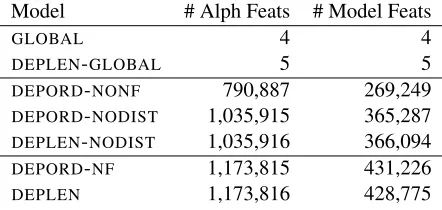
Model # Alph Feats # Model Feats
GLOBAL 4 4
DEPLEN-GLOBAL 5 5
DEPORD-NONF 790,887 269,249
DEPORD-NODIST 1,035,915 365,287
DEPLEN-NODIST 1,035,916 366,094
DEPORD-NF 1,173,815 431,226
DEPLEN 1,173,816 428,775
Table 6: Model sizes—number of features in alphabet for each model (satisfying count cutoff of 5) along with num-ber active in model after 5 training epochs
4 Evaluation
4.1 Experimental Conditions
We followed the averaged perceptron training proce-dure of White and Rajkumar (2009) with a couple of updates. First, as noted earlier, we used a reimple-mentation of Hockenmaier’s (2003) generative syn-tactic model as an extra component of our genera-tive baseline; and second, only five epochs of train-ing were used, which was found to work as well as using additional epochs on the development set. As in the earlier work, the models were trained on the standard training sections (02–21) of an enhanced version of the CCGbank, using a lexico-grammar extracted from these sections.
[image:5.612.316.537.220.325.2]mod-Model Dep Ngram Hocken- Discr Agree- C&C NF C&C NF Dep Len Mods maier Ngrams ment Base Dist Ord
GLOBAL N Y Y N N N N N
DEPLEN-GLOBAL Y Y Y N N N N N
DEPORD-NONF N Y Y Y Y N N Y
DEPORD-NODIST N Y Y Y Y Y N Y
DEPLEN-NODIST Y Y Y Y Y Y N Y
DEPORD-NF N Y Y Y Y Y Y Y
[image:6.612.90.524.57.185.2]DEPLEN Y Y Y Y Y Y Y Y
Table 5: Legend for experimental conditions
els used in the earlier work along with the Hock-enmaier model (and the dependency length feature, in DEPLEN-GLOBAL). The second group is cen-tered on DEPORD-NODIST, which contains all fea-tures except the dependency length feature and the distance features in Clark & Curran’s normal form model, which may indirectly capture some depen-dency length minimization preferences. In addition toDEPLEN-NODIST—where the dependency length feature is added—this group also containsDEPORD
[image:6.612.316.540.225.461.2]-NONF, which is designed to test (as a side compari-son) whether the Clark & Curran normal form base features are still useful even when used in conjunc-tion with the new dependency ordering features. In the final group,DEPORD-NFcontains all the features examined in this paper except the dependency length feature, while DEPLEN contains all the features in-cluding the dependency length feature. Note that the learned weight of the total dependency length fea-ture was negative in each case, as expected.
Table 6 shows the sizes of the various models. For each model, the alphabet—whose size increases to over a million features—is the set of applicable fea-tures found to have discriminative value in at least 5 training examples; from these, a subset are made ac-tive (i.e., take on a non-zero weight) through percep-tron updates when the feature value differs between the model-best and oracle-best realization.
4.2 BLEU Results
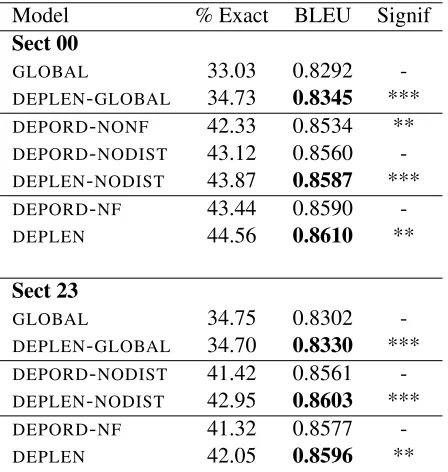
Following the usual practice in the realization rank-ing, we first evaluate our results quantitatively us-ing exact matches and BLEU (Papineni et al., 2002), a corpus similarity metric developed for MT evalu-ation. Realization results for the development and
Model % Exact BLEU Signif
Sect 00
GLOBAL 33.03 0.8292
-DEPLEN-GLOBAL 34.73 0.8345 ***
DEPORD-NONF 42.33 0.8534 **
DEPORD-NODIST 43.12 0.8560 -DEPLEN-NODIST 43.87 0.8587 ***
DEPORD-NF 43.44 0.8590
-DEPLEN 44.56 0.8610 **
Sect 23
GLOBAL 34.75 0.8302
-DEPLEN-GLOBAL 34.70 0.8330 *** DEPORD-NODIST 41.42 0.8561 -DEPLEN-NODIST 42.95 0.8603 ***
DEPORD-NF 41.32 0.8577
-DEPLEN 42.05 0.8596 **
Table 7: Development (Section 00) & test (Section 23) set results—exact match percentage and BLEU scores, along with statistical significance of BLEU compared to the unmarked model in each group (* =p < 0.1, ** =
p < 0.05, *** = p < 0.01); significant within-group winners (atp <0.05) are shown in bold
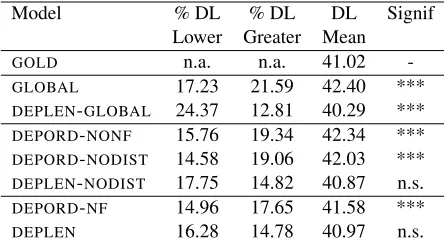
Model % DL % DL DL Signif Lower Greater Mean
GOLD n.a. n.a. 41.02
-GLOBAL 17.23 21.59 42.40 ***
DEPLEN-GLOBAL 24.37 12.81 40.29 ***
DEPORD-NONF 15.76 19.34 42.34 ***
DEPORD-NODIST 14.58 19.06 42.03 ***
DEPLEN-NODIST 17.75 14.82 40.87 n.s.
DEPORD-NF 14.96 17.65 41.58 ***
DEPLEN 16.28 14.78 40.97 n.s.
Table 8: Dependency length compared to corpus— percentage of realizations with dependency length less than and greater than gold standard, along with mean dependency length, whose significance is tested against gold; 1671 development set (Section 00) complete real-izations analyzed
the new dependency ordering model, as DEPORD
-NONF is significantly worse thanDEPORD-NODIST
(the impact of the distance features is evident in the increases from the second group to the third group). As with the dev set, the dependency length feature yielded a significant increase in BLEU scores for each comparison on the test set also.
For each group, the statistical significance of the difference in BLEU scores between a model and the unmarked model (-) is determined by bootstrap re-sampling (Koehn, 2004).3 Note that although the differences in BLEU scores are small, they end up being statistically significant because the mod-els frequently yield the same top scoring realiza-tion, and reliably deliver improvements in the cases where they differ. In particular, note that DEPLEN
andDEPORD-NFagree on the best realization 81%
of the time, while DEPLEN-NODIST and DEPORD
-NODIST have 78.1% agreement, and DEPLEN
-GLOBAL and GLOBAL show 77.4% agreement; by
comparison, DEPORD-NODIST and GLOBAL only agree on the best realization 51.1% of the time.
4.3 Detailed Analyses
The effect of the dependency length feature on the distribution of dependency lengths is illustrated in Table 8. The table shows the mean of the total de-pendency length of each realized derivation
com-3
Kudos to Kevin Gimpel for making his resampling scripts available from http://www.ark.cs.cmu.edu/
MT/paired_bootstrap_v13a.tar.gz.
Model % Short % Long % Eq % Single / Long / Short Constit
GOLD 25.25 4.87 4.08 65.79
GLOBAL 23.15 7.86 3.94 65.04
DEPLEN-GLOBAL 24.58 5.57 4.09 65.76
DEPORD-NONF 23.13 6.61 4.03 66.23
DEPORD-NODIST 23.38 6.52 3.94 66.15
DEPLEN-NODIST 24.03 5.38 4.01 66.58
DEPORD-NF 23.74 5.92 3.96 66.40
[image:7.612.74.296.57.180.2]DEPLEN 24.36 5.36 4.07 66.21
Table 9: Distribution of various kinds of post-verbal con-stituents in the development set (Section 00); 4692 gold cases considered
pared to the corresponding gold standard derivation, as well as the number of derivations with greater and lower dependency length. According to paired t-tests, the mean dependency lengths for theDEPLEN -NODIST and DEPLEN models do not differ signifi-cantly from the gold standard. In contrast, the mean dependency length of all the models that do not in-clude the dependency length feature does differ sig-nificantly (p < 0.001) from the gold standard. Ad-ditionally, all these models have more realizations with dependency length greater than the gold stan-dard, in comparison to the dependency length min-imizing models; this shows the efficacy of the de-pendency length feature in approximating the gold standard. Interestingly, theDEPLEN-GLOBALmodel significantly undershoots the gold standard on mean dependency length, and has the most skewed dis-tribution of sentences with greater vs. lesser depen-dency length than the gold standard.
re-Model % Light % Heavy Signif / Heavy / Light
GOLD 8.60 0.36
-GLOBAL 7.73 2.02 ***
DEPLEN-GLOBAL 8.35 0.75 **
DEPORD-NONF 7.98 1.15 ***
DEPORD-NODIST 8.04 1.12 ***
DEPLEN-NODIST 8.23 0.45 n.s.
DEPORD-NF 8.26 0.71 **
DEPLEN 8.36 0.51 n.s.
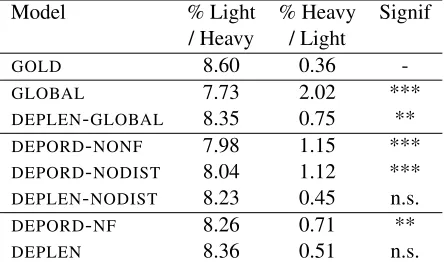
Table 10: Distribution of heavy unequal constituents (length difference> 5) in Section 00; 4692 gold cases considered and significance tested against the gold stan-dard using aχ-square test
ported by previous corpus studies of English (Tem-perley, 2007; Wasow and Arnold, 2003). The figures reported here show the tendency of the DEPLEN* models to be closer to the gold standard than the other models, especially in the case of short-long constituents.
We also performed an analysis of relative con-stituent lengths focusing on light-heavy and heavy-light cases; specifically, we examined unequal length constituent sequences where the length dif-ference of the constituents was greater than 5, and the shorter constituent was under 5 words. Table 10 shows the results. Using aχ-square test, the distri-bution of heavy unequal length constituent counts in theDEPLEN-NODISTandDEPLENmodels does not
significantly differ from that of the gold standard. In contrast, for all the other models, the counts do dif-fer significantly from the gold standard.
4.4 Examples
Table 11 shows examples of how the dependency length feature (DEPLEN) affects the output even in
comparison to a model (DEPORD) with a rich set of discriminative syntactic and dependency order-ing features, but no features directly targetorder-ing rel-ative weight. In wsj 0015.7, the dependency length model produces an exact match, while theDEPORD
model fails to shift the short temporal adverbialnext year next to the verb, leaving a confusingly repeti-tive this year next year at the end of the sentence. In wsj 0020.1, the dependency length model pro-duces a nearly exact match with just an equally
ac-ceptable inversion ofclosely watching. By contrast, theDEPORD model mistakenly shifts the direct
ob-jectSouth Korea, Taiwan and Saudia Arabiato the end of the sentence where it is difficult to under-stand following two very long intervening phrases. In wsj 0021.8, both models mysteriously putnotin front of the auxiliary and leave out the complemen-tizer, but DEPORD also mistakenly leaves beforeat the end of the verb phrase where it is again apt to be interpreted as modifying the preceding verb. In wsj 0075.13, both models put the temporal modi-fieron Thursday in its canonical VP-final position, despite this order running counter to dependency length minimization. Finally, wsj 0014.2 shows a case whereDEPORDis nearly an exact match (except for a missing comma), but the dependency length model fronts the PPon the 12-member board, where it is grammatical but rather marked (and not moti-vated in the discourse context).
4.5 Interim Discussion
The experiments show a consistent positive effect of the dependency length feature in improving BLEU scores and achieving a better match with the corpus distributions of dependency length and short/long constituent orders. The results in Table 10 are partic-ulary encouraging, as they show that minimizing de-pendency length reduces the number of realizations in which a heavy constituent precedes a light one down to essentially the level of the corpus, thereby eliminating many realizations that can be expected to have egregious errors like those shown in Ta-ble 11.
Intriguingly, there is some evidence that a nega-tively weighted total dependency length feature can go too far in minimizing dependency length, in the absence of other informative features to counterbal-ance it. In particular, theDEPLEN-GLOBALmodel in
[image:8.612.75.297.58.189.2]wsj 0015.7 the exact amount of the refund will be determinednext yearbased on actual collections made until Dec. 31 of this year .
DEPLEN [same]
DEPORD the exact amount of the refund will be determined based on actual collections made until Dec. 31 of this yearnext year.
wsj 0020.1 the U.S. , claiming some success in its trade diplomacy , removed South Korea , Taiwan and Saudi Arabia from a list of countries it is closely watching for allegedly failing to honor U.S. patents , copyrights and other intellectual-property rights .
DEPLEN the U.S. claiming some success in its trade diplomacy , removedSouth Korea , Taiwan and Saudi
Arabiafrom a list of countries it iswatching closelyfor allegedly failing to honor U.S. patents , copyrights and other intellectual-property rights .
DEPORD the U.S. removed from a list of countries it iswatching closelyfor allegedly failing to honor U.S. patents , copyrights and other intellectual-property rights , claiming some success in its trade diplo-macy ,South Korea , Taiwan and Saudi Arabia.
wsj 0021.8 but he has not said before that the country wants half the debt forgiven . DEPLEN but henothas saidbefore∅the country wants half the debt forgiven . DEPORD but henothas said∅the country wants half the debt forgivenbefore.
wsj 0075.13 The Treasury also said it plans to sell [$ 10 billion] [in 36-day cash management bills] [on Thurs-day].
DEPLEN [same]
DEPORD [same]
wsj 0014.2 they succeed Daniel M. Rexinger , retired Circuit City executive vice president , and Robert R. Glauber , U.S. Treasury undersecretary , on the 12-member board .
DEPORD they succeed Daniel M. Rexinger , retired Circuit City executive vice president , and Robert R.
Glauber , U.S. Treasury undersecretary∅on the 12-member board .
DEPLEN on the 12-member board they succeed Daniel M. Rexinger , retired Circuit City executive vice
president , and Robert R. Glauber , U.S. Treasury undersecretary .
Table 11: Examples of realized output for full models with and without the dependency length feature
4.6 Targeted Human Evaluation
To determine whether heavy-light ordering differ-ences often represent ordering errors (including egregious ones), rather than simply representing ac-ceptable variation, we conducted a targeted human evaluation on examples of this kind. Specifically, for each of the DEPLEN* models and their
corre-sponding models without the dependency length fea-ture, we chose the 25 sentences from the develop-ment section whose realizations exhibited the great-est difference in dependency length between sibling constituents appearing in opposite orders, and asked two judges (not the authors) to choose which of the two realizations best expressed the meaning of the reference sentence in a grammatical and fluent way, with the choice forced (2AFC). Table 12 shows the results. Agreement between the judges was high,
Model % Preferred % Agr Signif
GLOBAL 22 -
-DEPLEN-GLOBAL 78 84 ***
DEPORD-NODIST 24 -
-DEPLEN-NODIST 76 92 ***
DEPORD-NF 26 -
[image:9.612.72.541.57.443.2]-DEPLEN 74 96 ***
with only one disagreement on the realizations from theDEPLEN andDEPORD-NFmodels (involving an
acceptable paraphrase in our judgment), and only four disagreements on the DEPLEN-GLOBAL and
GLOBAL realizations. Pooling the judgments, the
preference for theDEPLEN* models was well above the chance level of 50% according to a binomial test (p < 0.001in each case). Inspecting the data our-selves, we found that many of the items did indeed involve egregious ordering errors that theDEPLEN* models managed to avoid.
5 Related Work
As noted in the introduction, to the best of our knowledge this paper is the first to examine the im-pact of dependency length minimization on realiza-tion ranking. While there have been quite a few papers to date reporting results on Penn Treebank data, since the various systems make different as-sumptions regarding the specificity of their inputs, all but the most broad-brushed comparisons remain impossible at present, and thus detailed studies such as the present one can only be made within the con-text of different models for the same system. Some progress on this issue has been made in the con-text of the Generation Challenges Surface Realiza-tion Shared Task (Belz et al., 2011), but it remains to be seen to what extent fair cross-system compar-isons using common inputs can be achieved.
For (very) rough comparison purposes, Table 13 lists our results in the context of those reported for various other systems on PTB Section 23. As the table shows, the OpenCCG scores are quite com-petitive, exceeded only by Callaway’s (2005) ex-tensively hand-crafted system as well as Bohnet et al.’s (2011) system on shared task shallow inputs (-S), which performs much better than their sys-tem on deep inputs (-D) that more closely resemble OpenCCG’s.
6 Conclusions
In this paper, we have investigated dependency length minimization in the context of realization ranking, focusing on its potential to eliminate egre-gious ordering errors as well as better match the dis-tributional characteristics of sentence orderings in news text. When added to a state-of-the-art,
com-System Coverage BLEU % Exact Callaway (05) 98.5% 0.9321 57.5 Bohnet et al.-S (11) 100% 0.8911
OpenCCG (12) 97.1% 0.8596 42.1
OpenCCG (09) 97.1% 0.8506 40.5 Ringger et al. (04) 100% 0.836 35.7 Bohnet et al.-D (11) 100% 0.7943
Langkilde-Geary (02) 83% 0.757 28.2 Guo et al. (08) 100% 0.7440 19.8 Hogan et al. (07) ≈100% 0.6882
[image:10.612.316.536.57.204.2]OpenCCG (08) 96.0% 0.6701 16.0 Nakanishi et al. (05) 90.8% 0.7733
Table 13: PTB Section 23 BLEU scores and exact match percentages in the NLG literature (Nakanishi et al.’s re-sults are for sentences of length 20 or less)
prehensive realization ranking model, we showed that including a dense, global feature for minimiz-ing total dependency length yields statistically sig-nificant improvements in BLEU scores and signif-icantly reduces the number of heavy-light ordering errors. Going beyond the BLEU metric, we also conducted a targeted human evaluation to confirm the utility of the dependency length feature in mod-els of varying richness. Interestingly, even with the richest model, in some cases we found that the de-pendency length feature still appears to go too far in minimizing dependency length, suggesting that fur-ther counter-balancing features—especially ones for the sentence-initial position (Filippova and Strube, 2009)—warrant investigation in future work.
Acknowledgments
References
Arto Anttila, Matthew Adams, and Mike Speriosu. 2010. The role of prosody in the English dative alternation. Language and Cognitive Processes.
Jennifer E. Arnold, Thomas Wasow, Anthony Losongco, and Ryan Ginstrom. 2000. Heaviness vs. newness: The effects of structural complexity and discourse sta-tus on constituent ordering.Language, 76:28–55. Jason Baldridge and Geert-Jan Kruijff. 2002. Coupling
CCG and Hybrid Logic Dependency Semantics. In Proc. ACL-02.
Anja Belz, Mike White, Dominic Espinosa, Eric Kow, Deirdre Hogan, and Amanda Stent. 2011. The first surface realisation shared task: Overview and evaluation results. In Proceedings of the Genera-tion Challenges Session at the 13th European Work-shop on Natural Language Generation, pages 217– 226, Nancy, France, September. Association for Com-putational Linguistics.
Bernd Bohnet, Simon Mille, Benoˆıt Favre, and Leo Wan-ner. 2011. <stumaba>: From deep representation to surface. InProceedings of the Generation Challenges Session at the 13th European Workshop on Natural Language Generation, pages 232–235, Nancy, France, September. Association for Computational Linguis-tics.
H Branigan, M Pickering, and M Tanaka. 2008. Con-tributions of animacy to grammatical function assign-ment and word order during production. Lingua, 118(2):172–189.
Joan Bresnan, Anna Cueni, Tatiana Nikitina, and R. Har-ald Baayen. 2007. Predicting the Dative Alternation. Cognitive Foundations of Interpretation, pages 69–94. Aoife Cahill and Arndt Riester. 2009. Incorporating in-formation status into generation ranking. In Proceed-ings of, ACL-IJCNLP ’09, pages 817–825, Morris-town, NJ, USA. Association for Computational Lin-guistics.
Aoife Cahill, Martin Forst, and Christian Rohrer. 2007. Designing features for parse disambiguation and real-isation ranking. In Miriam Butt and Tracy Holloway King, editors, Proceedings of the 12th International Lexical Functional Grammar Conference, pages 128– 147. CSLI Publications, Stanford.
Charles Callaway. 2005. The types and distributions of errors in a wide coverage surface realizer evalua-tion. InProceedings of the 10th European Workshop on Natural Language Generation.
Stephen Clark and James R. Curran. 2007. Wide-Coverage Efficient Statistical Parsing with CCG and Log-Linear Models. Computational Linguistics, 33(4):493–552.
Vera Demberg and Frank Keller. 2008. Data from eye-tracking corpora as evidence for theories of syntactic processing complexity. Cognition, 109(2):193–210. Katja Filippova and Michael Strube. 2007. Generating
constituent order in German clauses. In ACL 2007, Proceedings of the 45th Annual Meeting of the As-sociation for Computational Linguistics, June 23-30, 2007, Prague, Czech Republic. The Association for Computer Linguistics.
Katja Filippova and Michael Strube. 2009. Tree lin-earization in English: Improving language model based approaches. In Proceedings of Human Lan-guage Technologies: The 2009 Annual Conference of the North American Chapter of the Association for Computational Linguistics, Companion Volume: Short Papers, pages 225–228, Boulder, Colorado, June. As-sociation for Computational Linguistics.
Edward Gibson. 1998. Linguistic complexity: Locality of syntactic dependencies. Cognition, 68:1–76. Edward Gibson. 2000. Dependency locality theory:
A distance-based theory of linguistic complexity. In Alec Marantz, Yasushi Miyashita, and Wayne O’Neil, editors,Image, Language, brain: Papers from the First Mind Articulation Project Symposium. MIT Press, Cambridge, MA.
Daniel Gildea and David Temperley. 2007. Optimizing grammars for minimum dependency length. In Pro-ceedings of the 45th Annual Meeting of the Association of Computational Linguistics, pages 184–191, Prague, Czech Republic, June. Association for Computational Linguistics.
Yuqing Guo, Josef van Genabith, and Haifeng Wang. 2008. Dependency-based n-gram models for general purpose sentence realisation. InProc. COLING-08. John A. Hawkins. 1994.A Performance Theory of Order
and Constituency. Cambridge University Press, New York.
John A. Hawkins. 2000. The relative order of prepositional phrases in English: Going beyond manner-place-time. Language Variation and Change, 11(03):231–266.
John A. Hawkins. 2001. Why are categories adjacent? Journal of Linguistics, 37:1–34.
Julia Hockenmaier and Mark Steedman. 2007. CCG-bank: A Corpus of CCG Derivations and Dependency Structures Extracted from the Penn Treebank. Com-putational Linguistics, 33(3):355–396.
Julia Hockenmaier. 2003. Data and models for statis-tical parsing with Combinatory Categorial Grammar. Ph.D. thesis, University of Edinburgh.
Gerard Kempen and Karin Harbusch. 2004. Generat-ing natural word orders in a semi-free word order lan-guage: Treebank-based linearization preferences for German. In Alexander F. Gelbukh, editor, CICLing, volume 2945 of Lecture Notes in Computer Science, pages 350–354. Springer.
Philipp Koehn. 2004. Statistical significance tests for machine translation evaluation. In Dekang Lin and Dekai Wu, editors, Proceedings of EMNLP 2004, pages 388–395, Barcelona, Spain, July. Association for Computational Linguistics.
Irene Langkilde-Geary. 2002. An empirical verification of coverage and correctness for a general-purpose sen-tence generator. InProc. INLG-02.
R. L. Lewis and S. Vasishth. 2005. An activation-based model of sentence processing as skilled memory re-trieval. Cognitive Science, 29:1–45, May.
Richard L. Lewis, Shravan Vasishth, and Julie Van Dyke. 2006. Computational principles of working memory in sentence comprehension. Trends in Cognitive Sci-ences, 10(10):447–454.
Hiroko Nakanishi, Yusuke Miyao, and Jun’ichi Tsujii. 2005. Probabilistic methods for disambiguation of an HPSG-based chart generator. InProc. IWPT-05. Kishore Papineni, Salim Roukos, Todd Ward, and
Wei-Jing Zhu. 2002. BLEU: a method for automatic eval-uation of machine translation. InProc. ACL-02. Rajakrishnan Rajkumar and Michael White. 2010.
De-signing agreement features for realization ranking. In Coling 2010: Posters, pages 1032–1040, Beijing, China, August. Coling 2010 Organizing Committee. Rajakrishnan Rajkumar, Michael White, and Dominic
Espinosa. 2009. Exploiting named entity classes in CCG surface realization. In Proceedings of Human Language Technologies: The 2009 Annual Conference of the North American Chapter of the Association for Computational Linguistics, Companion Volume: Short Papers, pages 161–164, Boulder, Colorado, June. As-sociation for Computational Linguistics.
Eric Ringger, Michael Gamon, Robert C. Moore, David Rojas, Martine Smets, and Simon Corston-Oliver. 2004. Linguistically informed statistical models of constituent structure for ordering in sentence realiza-tion. InProc. COLING-04.
Neal Snider and Annie Zaenen. 2006. Animacy and syn-tactic structure: Fronted NPs in English. In M. Butt, M. Dalrymple, and T.H. King, editors,Intelligent Lin-guistic Architectures: Variations on Themes by Ronald M. Kaplan. CSLI Publications, Stanford.
Mark Steedman. 2000. The Syntactic Process. MIT Press.
David Temperley. 2007. Minimization of dependency length in written English. Cognition, 105(2):300 – 333.
Harry Tily. 2010. The Role of Processing Complexity in Word Order Variation and Change. Ph.D. thesis, Stanford University.
Erik Velldal and Stefan Oepen. 2005. Maximum entropy models for realization ranking. InProc. MT-Summit X.
Thomas Wasow and Jennifer Arnold. 2003. Post-verbal Constituent Ordering in English. Mouton.
Tom Wasow. 2002. Postverbal Behavior. CSLI Publica-tions, Stanford.
Michael White and Rajakrishnan Rajkumar. 2009. Per-ceptron reranking for CCG realization. InProceedings of the 2009 Conference on Empirical Methods in Nat-ural Language Processing, pages 410–419, Singapore, August. Association for Computational Linguistics. Michael White. 2006. Efficient Realization of
Coordi-nate Structures in Combinatory Categorial Grammar. Research on Language & Computation, 4(1):39–75. Hiroko Yamashita and Franklin Chang. 2001. “Long