Proceedings of the 9th Workshop on Computational Approaches to Subjectivity, Sentiment and Social Media Analysis, pages 309–315 309
Super Characters: A Conversion from Sentiment Classification to Image
Classification
Baohua Sun, Lin Yang, Patrick Dong, Wenhan Zhang, Jason Dong, Charles Young Gyrfalcon Technology Inc.
1900 McCarthy Blvd. Milpitas, CA 95035
{baohua.sun,lin.yang,patrick.dong,wenhan.zhang}@gyrfalcontech.com
Abstract
We propose a method named Super Charac-ters for sentiment classification. This method converts the sentiment classification problem into image classification problem by project-ing texts into images and then applyproject-ing CNN models for classification. Text features are ex-tracted automatically from the generated Su-per Characters images, hence there is no need of any explicit step of embedding the words or characters into numerical vector represen-tations. Experimental results on large so-cial media corpus show that the Super Char-acters method consistently outperforms other methods for sentiment classification and topic classification tasks on ten large social media datasets of millions of contents in four dif-ferent languages, including Chinese, Japanese, Korean and English.
1 Introduction
Sentiment classification is an interest-ing topic that has been studied for many years (Hatzivassiloglou and McKeown, 1997;
Pang et al., 2002; Hong and Fang, 2015). Word embedding is a widely used technique for sen-timent classification tasks, which embeds the words into numerical vector representation before the sentences are fed into models for classifi-cation (Mikolov et al., 2013; Le and Mikolov,
2014; Pennington et al., 2014; Yu et al., 2017;
Cao et al.,2018). For sequential input, RNNs are usually used and have very good results for text classification tasks (Lai et al., 2015; Tang et al.,
2015). Recently, there are also works using Convolutional Neural Networks (CNN) for text classification (Kim,2014;Severyn and Moschitti,
2015; Vaswani et al., 2017; Bai et al., 2018). CNN models have feature extraction and classifi-cation in a whole model, which require no need of manually extracting features from images and
are proved to be successful in image classification tasks (LeCun et al.,1998;Krizhevsky et al.,2012;
Simonyan and Zisserman, 2014; Szegedy et al.,
2015; He et al., 2016a; Hu et al., 2017). There are also works on character level text classifi-cations (Zhang et al., 2015; Zhang and LeCun,
2015;Kim et al., 2016). However, the input for CNNs are still using the embedding vectors.
Zhang and LeCun(2017) had studied the differ-ent ways of encoding Chinese, Japanese, Korean (CJK) and English languages for text classifica-tion. These encoding mechanisms include One-hot encoding, embedding and images of charac-ter glyphs. Comparisons with linear models, fast-Text (Joulin et al., 2016), and convolutional net-works were provided. This work studied 473 models, using 14 large-scale text classification datasets in 4 languages including Chinese, En-glish, Japanese and Korean.
Our work in this paper is based on the datasets provided in (Zhang and LeCun,2017) and down-loadable at (Zhang,2017). Different from existing methods, our method has no explicit step of em-bedding the text into numerical vector representa-tions. Instead, we project the text into images and then directly feed the images into CNN models to classify the sentiments.
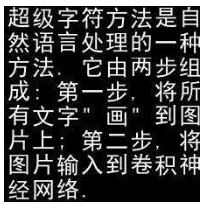
Figure 1: A Super Character example.
results. During the processing, the human brain may recognize words and phrases as the interme-diate results, in order to further analyze the senti-ment. However, if we treat the human brain as a black box system, its input is the image of texts re-ceived by the eyes, and its output is the sentiment classification result.
In this paper, we propose a two-step method that is similar to how humans do sentiment classifica-tion. We tested our method using the datasets pro-vided byZhang and LeCun(2017) on text classi-fication tasks for social media contents from dif-ferent countries in four languages, including En-glish, Chinese, Japanese, and Korean. And com-pared with other existing methods, including fast-Text, EmbedNet, OnehotNet, and linear models. The results show our method consistently outper-forms other method on these datasets for sentiment classification tasks.
2 Super Characters Method
The Super Characters method converts the senti-ment classification problem into an image classifi-cation problem. It is defined in two steps.
• First, the texts, e.g. sentences or paragraphs, are “drawn” onto blank images, character by character. For example, a generated Super Characters image from Chinese text inputs (including punctuation marks) is shown in Figure 1. The Chinese text means “Super characters are a method for NLP. It consists of two steps: Frist, “draw” text onto images; second, feed images into CNN”. Each gener-ated Super Character image is attached with the same sentiment labels as its original text.
• Second, feed the generated Super Characters images with its labels to train CNN models.
The information embedded in the Super Char-acters image is near identical to that in the
orig-inal text, so we convert the sentiment classifica-tion problem into image classificaclassifica-tion problem. The Super Characters images are similar to how humans perceive text: as whole pictures contain-ing text, whether printed on paper, projected on a screen, or written by hand. After the texts are con-verted to images, the performance of our text clas-sification method is determined by the accuracy of image classification models. For large scale image classification tasks, CNN models such as ResNet(He et al., 2016b) have outperformed hu-mans in image classification tasks as an end to end solution. Thus, if we feed the Super Char-acters images into CNN models such as ResNet, we expect the text classification using this 2-step pipeline to have a high accuracy.
For detailed implementation of projecting text into Super Characters image, there are a few set-tings to configure, including the image size of the whole Super Characters image; number of characters per row/column; size of each charac-ter; cut-length, which is the length of sentence to cut/padding in order to fit into the image; the fonts used to project each character into an image, and so on.
For Latin languages, we have the option of pro-jecting text at the word level or at the alphabet level, which will make differences at some cases. For example, how to handle line-change if a word is at the end of a row in the Super Characters im-age and can’t fit in the residual space in that row. If we separate the words into separate alphabets, we can fit as many characters in the residual space in that row and change to the next row for the rest of the alphabets in that word. Or, if we keep the word as a whole entity and avoid spliting, we have to change to the next line for that word.
From the definition and description of Super Character, we can see it has the following advan-tages. 1. Its speed is not sensitive to the length of the text input, so it can easily handle long and short texts input. This advantage will be more obvious when the input text is long, because super charac-ter using CNN as model will be parallel processing the input. And the processing time is invariant for training and inference. 2. The feature engineering work is no longer needed, which includes gener-ating manmade features of each character related to the culture behind each language. The Super Characters image is treated as an input for CNN models, and the feature extraction task are han-dled automatically by CNN models. 3. Similar to image classification using CNN networks which requires large amount of labeled image data, this method of Super Characters for sentiment analysis also requires large amount of labeled text data.
3 Experiments
3.1 Sentiment Classification on Large Datasets from Online Social Media
Ten of 14 datasets provided by (Zhang and LeCun,
2017) were tested on, a brief description of which is provided:
Dianping: Chinese restaurant reviews were evenly split as follows: 4 and 5 star reviews were assigned to the positive class while 1-3 star re-views were in the negative class.
JD Full: Chinese shopping reviews wer evenly split for predicting full five stars. JD Binary Chi-nese shopping reviews are evenly split into posi-tive (4-and-5 star reviews) and negaposi-tive (1-and-2 star reviews) sentiments, ignoring 3-star reviews.
Rakuten FullJapanese shopping reviews were evenly split into predicting full five stars.Rakuten Binary Japanese shopping reviews were evenly split into positive (4-and-5 star reviews) and neg-ative (1-and-2 star reviews) sentiments, removing duplicates and ignoring 3-star reviews.
11st FullKorean shopping reviews were evenly split into predicting full five stars. 11st Binary
Korean shopping reviews were evenly split into identifying positive (4-and-5 star reviews) or neg-ative (1-3 star reviews) sentiments.
Amazon Full: English shopping reviews were evenly split into predicting full five stars.
Ifeng: First paragraphs of Chinese news arti-cles from 2006-2016 were evenly split into 5 news channels.
Chinanews: Chinese news articles from 2008-2016 were evenly split into 7 news channels, re-moving duplicates.
The statistics of these datasets are given in Table
1. We can see that eight out of the ten datasets has more than millions of samples in training, and the largest datasets have 4 millions of samples in train-ing set. The test datasets are in the range of 1/4 to 1/16 of the training datasets respectively. The languages used in these datasets include Chinese, Japanese, Korean, and English. And the number of classes ranges from 2, 5 to 7.
For each dataset, we generate Super Characters images first. We draw text with the Python Imag-ing Library (PIL) (Lundh, 2009), and set all the Super Character image sizes to 224x224 pixels, the background set to black. For long text in-puts such as paragraphs or articles, the length of which is different so we set a cut-length from the beginning of the news article. Although we may forcely cut the input and ignore the rest, this cut-length still works well since the first few sentences usually convey the general information about the whole contents. For other text sources and tasks, the starting point of the text for the cut-length may change accordingly. For each experiment, we de-termine the estimated cut-length by using a thresh-old on sentence lengths. We have only tried one cut-length of 14x14=196 for every experimental data set. We set the size of each character as 224/14=16 square pixels.
And then, we feed the generated Super Charac-ters to train CNN models. We use successful pre-trained model SENet-154 (Hu et al., 2017) in the ImageNet competition (Russakovsky et al.,2015), which is the winner in ImageNet2017 competition and achieves 81.32% Top1 accuracy and 95.53% Top5 accuracy. We used pretrained model down-loadable at (Hu,2017) because it gave a good ini-tialization for transfer learning tasks. We changed the last layer to the corresponding number of cat-egories in each data set to train on the Super Char-acters images.
uses 10, Linear Models uses 11, and fastText uses 10. We only listed the best results for each ex-isting method across different encodings. And compare our results with the best of them. That means we compare our results with the finetuned best encoding of each existing model in2. From the results we can see that our Super Characters method (short as S.C.) consistently outperforms other methods, even with their best encodings.
3.2 Experiments on THUCTC corpus
THUCTC (Sun et al.,2016) was provided by the Tsinghua University NLP lab in 2016. It to-tals 836075 documents after downloaded, cov-ering 14 topics including 24373 Game, 37098 Finance, 63086 Politics, 50849 Society, 32586 Living, 20050 Real Estate, 7588 Lottery, 92632 Entertainment, 41936 Education, 13368 Fashion, 3578 Constellation, 162929 Technology, 131604 Sports and 154398 Stocks. The majority of the documents are long articles with hundreds or sometimes thousands of characters in mul-tiple sentences or paragraphs. We use a cut-length of 28x28=784, each having an 8x8 pixel size and utilize simhei font for Super Characters on the THUCTC data. In Table 3, we showed our Super Character method using ResNet-50 (SC+ResNet50) attained an accuracy of 94.85% and our Super Character method using ResNet-152 (SC+ResNetResNet-152) attained an accuracy of 94.35%, while the result given by Sun et al. (2016) achieved only an accuracy of 88.6% using LibLin-ear. LibLinear (Fan et al., 2008) implements lin-ear SVMs and logistic regression models trained using a coordinate descent algorithm. Our models reduce the error by 50.4% compared to this exist-ing model.
3.3 Experiments on Fudan Corpus
The Fudan corpus (Li,2011) contains 9804 doc-uments of long sentences and paragraphs in 20 categories. We use the same split as (Xu et al.,
2016;Cao et al.,2018) in selecting the same 5 cat-egories: 1218 environmental, 1022 agricultural, 1601 economical, 1025 political and 1254 sport documents; 70% of the total data is used for train-ing and the rest for testtrain-ing.
• SC+ResNet-50: Using a ResNet-50 model pretrained on the ImageNet dataset, we fine-tuned the transfer learning model on the new generated super character dataset.
• SC+50-THUCTC: Using a ResNet-50 model pretrained on THUCTC data, we fine-tuned the trasfere learning model on the new generated super character dataset.
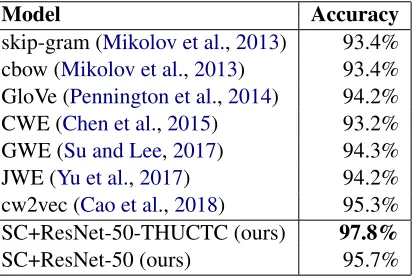
We used a cut-length of 28x28=784 and words of pixel size 8x8 with the simhei font for our Su-per Characters in this exSu-periment. In Table4, the first 7 rows of model accuracies for different al-gorithms are given by (Cao et al., 2018). We can see that our SC+ResNet-50-THUCTC model at-tained an accuracy of 97.8% while the best exist-ing method achieved only a 95.3% accuracy. Our SC+ResNet50-THUCTC model reduces the error by 53.2% compared with the best existing model. The SC+ResNet-50 model with 95.7% accuracy also outperforms the best existing model. The pre-trained model on THUCTC dataset gives 2.1% ac-curacy improvement than SC+ResNet-50 model, which means pretrained models on the same lan-guage and a larger dataset will help for a better ini-tialization and better model. For this data set, we did not delete the non-Chinese characters as (Cao et al., 2018) did. The result shows that our simple projection from text to Super Characters image is easy to implement and very robust. Users do not even need to perform complicated preprocessing techniques for the data.
3.4 Analysis on the Impact of the Cut-length for Configuring Super Characters Image
Dataset Short Name Language Classes Train Test
Dianping D.P. Chinese 2 2,000,000 500,000
JD full JD.f Chinese 5 3,000,000 250,000
JD binary JD.b Chinese 2 4,000,000 360,000
Rakuten full RKT.f Japanese 5 4,000,000 500,000
Rakuten binary RKT.b Japanese 2 3,400,000 400,000
11st full 11st.f Korean 5 750,000 100,000
11st binary 11st.b Korean 2 4,000,000 400,000
Amazon full AMZ.f English 5 3,000,000 650,000
Ifeng Ifeng Chinese 5 800,000 50,000
[image:5.595.124.473.61.214.2]Chinanews Cnews Chinese 7 1,400,000 112,000
Table 1: Datasets statistics used in Table2and short names used for convenience.
Model D.P. JD.f JD.b RKT.f RKT.b 11st.f 11st.b AMZ.f Ifeng Cnews
OnehotNet 76.83 51.90 90.69 54.90 94.07 67.57 86.70 57.79 83.51 89.38
EmbedNet 76.40 51.71 90.81 54.80 93.93 67.71 86.75 56.30 82.99 89.45
Linear 76.97 51.82 91.18 54.74 93.37 56.58 86.60 57.30 81.70 89.24
fastText 77.66 52.01 91.28 56.73 94.55 61.42 86.89 59.98 83.69 90.90
[image:5.595.72.526.247.332.2]S.C.(ours) 77.80 54.10 92.20 57.70 94.85 68.70 87.60 60.70 84.40 92.00
Table 2: Results of our Super Character (SC) method against other models on datasets provided by (Zhang and LeCun,2017).
Model Accuracy
LibLinear (Sun et al.,2016) 88.6%
SC+ResNet-50 (ours) 94.85%
[image:5.595.87.281.386.444.2]SC+ResNet-152 (ours) 94.35%
Table 3: Results of our Super Character (SC) method against other models on THUCTC data set.
Model Accuracy
skip-gram (Mikolov et al.,2013) 93.4% cbow (Mikolov et al.,2013) 93.4% GloVe (Pennington et al.,2014) 94.2%
CWE (Chen et al.,2015) 93.2%
GWE (Su and Lee,2017) 94.3%
JWE (Yu et al.,2017) 94.2%
cw2vec (Cao et al.,2018) 95.3%
SC+ResNet-50-THUCTC (ours) 97.8%
SC+ResNet-50 (ours) 95.7%
Table 4: Results of our Super Character (SC) method against other models on the Fudan dataset.
indicates that setting the cut-length according to the median or average sentence length could be a good option.
Cut-length 196 256 784 1024
Accuracy(%) 93.45 93.3 95.7 89.35
Table 5: Cut-length Impact on Accuracy.
4 Conclusion and Future Work
In this paper, we proposed the Super Characters method for sentiment classification. It converts text into images and then applies CNN models to classify the sentiment. The text features are au-tomatically extracted by CNN models. We have tested our method on social media text contents from four different languages. The experimen-tal results showed that our method consistently outperforms other methods for Chinese, English, Japanese, and Korean text contents for sentiment classification tasks. We also showed that pre-trained Chinese text classification models on large datasets helps attain a higher accuracy for text classification on other Chinese datasets.
[image:5.595.81.288.511.650.2]References
Shaojie Bai, J Zico Kolter, and Vladlen Koltun. 2018. An empirical evaluation of generic convolu-tional and recurrent networks for sequence model-ing. arXiv preprint arXiv:1803.01271.
Shaosheng Cao, Wei Lu, Jun Zhou, and Xiaolong Li. 2018. cw2vec: Learning chinese word embeddings with stroke n-gram information.
Heng Chen, Junying Liang, and Haitao Liu. 2015. How does word length evolve in written chinese? PloS one, 10(9):e0138567.
Rong-En Fan, Kai-Wei Chang, Cho-Jui Hsieh, Xiang-Rui Wang, and Chih-Jen Lin. 2008. Liblinear: A library for large linear classification. Journal of ma-chine learning research, 9(Aug):1871–1874.
Vasileios Hatzivassiloglou and Kathleen R McKeown. 1997. Predicting the semantic orientation of adjec-tives. In Proceedings of the 35th annual meeting of the association for computational linguistics and eighth conference of the european chapter of the as-sociation for computational linguistics, pages 174– 181. Association for Computational Linguistics.
Kaiming He, Xiangyu Zhang, Shaoqing Ren, and Jian Sun. 2016a. Deep residual learning for image recog-nition. In Proceedings of the IEEE conference on computer vision and pattern recognition, pages 770– 778.
Kaiming He, Xiangyu Zhang, Shaoqing Ren, and Jian Sun. 2016b. Deep residual learning for image recog-nition. In Proceedings of the IEEE conference on computer vision and pattern recognition, pages 770– 778.
James Hong and Michael Fang. 2015. Sentiment anal-ysis with deeply learned distributed representations of variable length texts. Technical report, Technical report, Stanford University.
Jie Hu. 2017. Senet-154. Github and model download: https://github.com/hujie-frank/SENet.
Jie Hu, Li Shen, and Gang Sun. 2017. Squeeze-and-excitation networks. arXiv preprint arXiv:1709.01507, 7.
Armand Joulin, Edouard Grave, Piotr Bojanowski, and Tomas Mikolov. 2016. Bag of tricks for efficient text classification. arXiv preprint arXiv:1607.01759.
Yoon Kim. 2014. Convolutional neural net-works for sentence classification. arXiv preprint arXiv:1408.5882.
Yoon Kim, Yacine Jernite, David Sontag, and Alexan-der M Rush. 2016. Character-aware neural language models. InAAAI, pages 2741–2749.
Alex Krizhevsky, Ilya Sutskever, and Geoffrey E Hin-ton. 2012. Imagenet classification with deep con-volutional neural networks. In Advances in neural information processing systems, pages 1097–1105.
Siwei Lai, Liheng Xu, Kang Liu, and Jun Zhao. 2015. Recurrent convolutional neural networks for text classification. In AAAI, volume 333, pages 2267– 2273.
Quoc Le and Tomas Mikolov. 2014. Distributed rep-resentations of sentences and documents. In Inter-national Conference on Machine Learning, pages 1188–1196.
Yann LeCun, L´eon Bottou, Yoshua Bengio, and Patrick Haffner. 1998. Gradient-based learning applied to document recognition. Proceedings of the IEEE, 86(11):2278–2324.
Ronglu Li. 2011. Fudan corpus for text classification. Data download: http://www.datatang.com/data/44139.
Fredrik Lundh. 2009. Python imag-ing library (pil). Webpage: http://www.pythonware.com/products/pil/.
Tomas Mikolov, Ilya Sutskever, Kai Chen, Greg S Cor-rado, and Jeff Dean. 2013. Distributed representa-tions of words and phrases and their compositional-ity. InAdvances in neural information processing systems, pages 3111–3119.
Bo Pang, Lillian Lee, and Shivakumar Vaithyanathan. 2002. Thumbs up?: sentiment classification using machine learning techniques. InProceedings of the ACL-02 conference on Empirical methods in natural language processing-Volume 10, pages 79–86. As-sociation for Computational Linguistics.
Jeffrey Pennington, Richard Socher, and Christopher Manning. 2014. Glove: Global vectors for word representation. InProceedings of the 2014 confer-ence on empirical methods in natural language pro-cessing (EMNLP), pages 1532–1543.
Olga Russakovsky, Jia Deng, Hao Su, Jonathan Krause, Sanjeev Satheesh, Sean Ma, Zhiheng Huang, An-drej Karpathy, Aditya Khosla, Michael Bernstein, Alexander C. Berg, and Li Fei-Fei. 2015. Ima-geNet Large Scale Visual Recognition Challenge. International Journal of Computer Vision (IJCV), 115(3):211–252.
Aliaksei Severyn and Alessandro Moschitti. 2015. Twitter sentiment analysis with deep convolutional neural networks. InProceedings of the 38th Inter-national ACM SIGIR Conference on Research and Development in Information Retrieval, pages 959– 962. ACM.
Karen Simonyan and Andrew Zisserman. 2014. Very deep convolutional networks for large-scale image recognition.arXiv preprint arXiv:1409.1556.
Maosong Sun, Jingyang Li, Zhipeng Guo, Yu Zhao, Yabin Zheng, Xiance Si, and Zhiyuan Liu. 2016. Thuctc: An efficient chi-nese text classifier. Github and data download: https://github.com/thunlp/THUCTC.
Christian Szegedy, Wei Liu, Yangqing Jia, Pierre Sermanet, Scott Reed, Dragomir Anguelov, Du-mitru Erhan, Vincent Vanhoucke, and Andrew Ra-binovich. 2015. Going deeper with convolutions. In Proceedings of the IEEE conference on computer vi-sion and pattern recognition, pages 1–9.
Duyu Tang, Bing Qin, and Ting Liu. 2015. Docu-ment modeling with gated recurrent neural network for sentiment classification. In Proceedings of the 2015 conference on empirical methods in natural language processing, pages 1422–1432.
Ashish Vaswani, Noam Shazeer, Niki Parmar, Jakob Uszkoreit, Llion Jones, Aidan N Gomez, Łukasz Kaiser, and Illia Polosukhin. 2017. Attention is all you need. InAdvances in Neural Information Pro-cessing Systems, pages 6000–6010.
Jian Xu, Jiawei Liu, Liangang Zhang, Zhengyu Li, and Huanhuan Chen. 2016. Improve chinese word em-beddings by exploiting internal structure. In Pro-ceedings of the 2016 Conference of the North Amer-ican Chapter of the Association for Computational Linguistics: Human Language Technologies, pages 1041–1050.
Jinxing Yu, Xun Jian, Hao Xin, and Yangqiu Song. 2017. Joint embeddings of chinese words, char-acters, and fine-grained subcharacter components. In Proceedings of the 2017 Conference on Empiri-cal Methods in Natural Language Processing, pages 286–291.
Xiang Zhang. 2017. Which encoding is the best for text classification in chinese, english, japanese and korean? Github and data download: https://github.com/zhangxiangxiao/glyph.
Xiang Zhang and Yann LeCun. 2015. Text understand-ing from scratch.arXiv preprint arXiv:1502.01710.
Xiang Zhang and Yann LeCun. 2017. Which en-coding is the best for text classification in chinese, english, japanese and korean? arXiv preprint arXiv:1708.02657.