Building Specialized Bilingual Lexicons Using Large-Scale Background
Knowledge
Dhouha Bouamor1, Adrian Popescu1, Nasredine Semmar1, Pierre Zweigenbaum2 1 CEA, LIST, Vision and Content Engineering Laboratory, 91191
Gif-sur-Yvette CEDEX, France;[email protected] 2LIMSI-CNRS, F-91403 Orsay CEDEX, France;[email protected]
Abstract
Bilingual lexicons are central components of machine translation and cross-lingual infor-mation retrieval systems. Their manual con-struction requires strong expertise in both lan-guages involved and is a costly process. Sev-eral automatic methods were proposed as an alternative but they often rely on resources available in a limited number of languages and their performances are still far behind the quality of manual translations. We intro-duce a novel approach to the creation of spe-cific domain bilingual lexicon that relies on Wikipedia. This massively multilingual en-cyclopedia makes it possible to create lexi-cons for a large number of language pairs. Wikipedia is used to extract domains in each language, to link domains between languages and to create generic translation dictionaries. The approach is tested on four specialized do-mains and is compared to three state of the art approaches using two language pairs: French-English and Romanian-French-English. The newly in-troduced method compares favorably to exist-ing methods in all configurations tested.
1 Introduction
The plethora of textual information shared on the Web is strongly multilingual and users’ information needs often go well beyond their knowledge of for-eign languages. In such cases, efficient machine translation and cross-lingual information retrieval systems are needed. Machine translation already has a decades long history and an array of commercial systems were already deployed, including Google
Translate1and Systran2. However, due to the intrin-sic difficulty of the task, a number of related prob-lems remain open, including: the gap between text semantics and statistically derived translations, the scarcity of resources in a large majority of languages and the quality of automatically obtained resources and translations. While the first challenge is general and inherent to any automatic approach, the second and the third can be at least partially addressed by an appropriate exploitation of multilingual resources that are increasingly available on the Web.
In this paper we focus on the automatic creation of domain-specific bilingual lexicons. Such resources play a vital role in Natural Language Processing (NLP) applications that involve different languages. At first, research on lexical extraction has relied on the use of parallel corpora (Och and Ney, 2003). The scarcity of such corpora, in particular for spe-cialized domains and for language pairs not involv-ing English, pushed researchers to investigate the use of comparable corpora (Fung, 1998; Chiao and Zweigenbaum, 2003). These corpora include texts which are not exact translation of each other but share common features such as domain, genre, sam-pling period, etc.
The basic intuition that underlies bilingual lexi-con creation is thedistributional hypothesis(Harris, 1954) which puts that words with similar meanings occur in similar contexts. In a multilingual formu-lation, this hypothesis states that the translations of a word are likely to appear in similar lexical envi-ronments across languages (Rapp, 1995). The stan-dard approachto bilingual lexicon extraction builds
1http://translate.google.com/ 2http://www.systransoft.com/
on the distributional hypothesis and compares con-text vectors for each word of the source and tar-get languages. In this approach, the comparison of context vectors is conditioned by the existence of a seed bilingual dictionary. A weakness of the method is that poor results are obtained for language pairs that are not closely related (Ismail and Manandhar, 2010). Another important problem occurs whenever the size of the seed dictionary is small due to ignor-ing many context words. Conversely, when dictio-naries are detailed, ambiguity becomes an important drawback.
We introduce a bilingual lexicon extraction ap-proach that exploits Wikipedia in an innovative manner in order to tackle some of the problems mentioned above. Important advantages of using Wikipedia are:
• The resource is available in hundreds of lan-guages and it is structured as unambiguous con-cepts (i.e. articles).
• The languages are explicitly linked through concept translations proposed by Wikipedia contributors.
• It covers a large number of domains and is thus potentially useful in order to mine a wide array of specialized lexicons.
Mirroring the advantages, there are a number of challenges associated with the use of Wikipedia:
• The comparability of concept descriptions in different languages is highly variable.
• The translation graph is partial since, when considering any language pair, only a part of the concepts are available in both languages and explicitly connected.
• Domains are unequally covered in Wikipedia (Halavais and Lackaff, 2008) and efficient do-main targeting is needed.
The approach introduced in this paper aims to draw on Wikipedia’s advantages while appropri-ately addressing associated challenges. Among the techniques devised to mine Wikipedia content, we hypothesize that an adequate adaptation of Ex-plicit Semantic Analysis (ESA) (Gabrilovich and
Markovitch, 2007) is fitted to our application con-text. ESA was already successfully tested in differ-ent NLP tasks, such as word relatedness estimation or text classification, and we modify it to mine spe-cialized domains, to characterize these domains and to link them across languages.
The evaluation of the newly introduced approach is realized on four diversified specialized domains (Breast Cancer, Corporate Finance, Wind Energy
and Mobile Technology) and for two pairs of lan-guages: French-English and Romanian-English. This choice allows us to study the behavior of dif-ferent approaches for a pair of languages that are richly represented and for a pair that includes Roma-nian, a language that has fewer associated resources than French and English. Experimental results show that the newly introduced approach outperforms the three state of the art methods that were implemented for comparison.
2 Related Work
In this section, we first give a review of the stan-dard approach and then introduce methods that build upon it. Finally, we discuss works that rely on Ex-plicit Semantic Analysis to solve other NLP tasks.
2.1 Standard Approach (SA)
Most previous approaches that address bilingual lex-icon extraction from comparable corpora are based on the standard approach (Fung, 1998; Chiao and Zweigenbaum, 2002; Laroche and Langlais, 2010). This approach is composed of three main steps:
1. Building context vectors: Vectors are first extracted by identifying the words that ap-pear around the term to be translated Wcand in a window of n words. Generally, asso-ciation measures such as the mutual infor-mation (Morin and Daille, 2006), the log-likelihood (Morin and Prochasson, 2011) or the Discounted Odds-Ratio (Laroche and Langlais, 2010) are employed to shape the context vec-tors.
all translation variants are taken into account. Words not included in the seed dictionary are simply ignored.
3. Comparison of source and target vectors: GivenWcand, its automatically translated con-text vector is compared to the concon-text vectors of all possible translations from the target lan-guage. Most often, the cosine similarity is used to rank translation candidates but alterna-tive metrics, including the weighted Jaccard in-dex (Prochasson et al., 2009) and the city-block distance (Rapp, 1999), were studied.
2.2 Improvements of the Standard Approach
Most of the improvements of the standard approach are based on the observation that the more repre-sentative the context vectors of a candidate word are, the better the bilingual lexicon extraction is. At first, additional linguistic resources, such as special-ized dictionaries (Chiao and Zweigenbaum, 2002) or transliterated words (Prochasson et al., 2009), were combined with the seed dictionary to translate con-text vectors.
The ambiguities that appear in the seed bilingual dictionary were taken into account more recently. (Morin and Prochasson, 2011) modify the standard approach by weighting the different translations ac-cording to their frequency in the target corpus. In (Bouamor et al., 2013), we proposed a method that adds a word sense disambiguation process relying on semantic similarity measurement from WordNet to the standard approach. Given a context vector in the source language, the most probable translation of polysemous words is identified and used for build-ing the correspondbuild-ing vector in the target language. The most probable translation is identified using the monosemic words that appear in the same lexical en-vironment.
On specialized French-English comparable cor-pora, this approach outperforms the one proposed in (Morin and Prochasson, 2011), which is itself bet-ter than the standard approach. The main weakness of (Bouamor et al., 2013) is that the approach relies on WordNet and its application depends on the ex-istence of this resource in the target language. Also, the method is highly dependent on the coverage of the seed bilingual dictionary.
2.3 Explicit Semantic Analysis
Explicit Semantic Analysis (ESA) (Gabrilovich and Markovitch, 2007) is a method that maps textual documents onto a structured semantic space using classical text indexing schemes such as TF-IDF. Ex-amples of semantic spaces used include Wikipedia or the Open Directory Project but, due to superior performances, Wikipedia is most frequently used. In the original evaluation, ESA outperformed state of the art methods in a word relatedness estimation task.
Subsequently, ESA was successfully exploited in other NLP tasks and in information retrieval. Radin-sky and al. (2011) added a temporal dimension to word vectors and showed that this addition improves the results of word relatedness estimation. (Hassan and Mihalcea, 2011) introduced Salient Semantic Analysis (SSA), a development of ESA that relies on the detection of salient concepts prior to map-ping words to concepts. SSA and the original ESA implementation were tested on several word related-ness datasets and results were mixed. Improvements were obtained for text classification when compar-ing SSA with the authors’ in-house representation of the method. ESA has weak language depen-dence and was already deployed in multilingual con-texts. (Sorg and Cimiano, 2012) extended ESA to other languages and showed that it is useful in cross-lingual and multicross-lingual retrieval task. Their focus was on creating a language independent conceptual space in which documents would be mapped and then retrieved.
Some open ESA topics related to bilingual lex-icon creation include: (1) the document represen-tation which is simply done by summing individ-ual contributions of words, (2) the adaptation of the method to specific domains and (3) the coverage of the underlying resource in different language.
3 ESA for Bilingual Lexicon Extraction
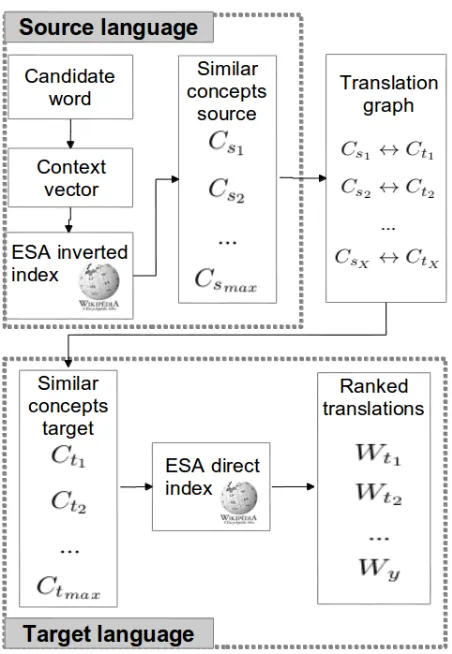
Figure 1: Overview of the Explicit Semantic Analysis enabled bilingual lexicon extraction.
(Gabrilovich and Markovitch, 2007) was exploited in a number of NLP tasks but not in bilingual lexi-con extraction.
Figure 1 shows the overall architecture of the lex-ical extraction process we propose. The process is completed in the following three steps:
1. Given a word to be translated and its con-text vector in the source language, we derive a ranked list of similar Wikipedia concepts (i.e. articles) using the ESA inverted index.
2. Then, a translation graph is used to retrieve the corresponding concepts in the target language.
3. Candidate translations are found through a sta-tistical processing of concept descriptions from the ESA direct index in the target language.
In this section, we first introduce the elements of the original formulation of ESA necessary in our
ap-proach. Then, we detail the three steps that com-pose the main bilingual lexicon extraction method illustrated in Figure 1. Finally, as a complement to the main method we introduce a measure for domain word specificity and present a method for extracting generic translation lexicons.
3.1 ESA Word and Concept Representation
Given a semantic space structured using a set ofM concepts and including a dictionary of N words, a mapping between words and concepts can be expressed as the following matrix:
w(W1, C1) w(W2, C1) ... w(WN, C1)
w(W1, C2) w(W2, C2) ... w(WN, C2)
... ... ...
w(W1, CM) w(W2, CM) ... w(WN, CM)
When Wikipedia is exploited concepts are equated to Wikipedia articles and the texts of the ar-ticles are processed in order to obtain the weights that link words and concepts. In (Gabrilovich and Markovitch, 2007), the weights w that link words and concepts were obtained through a classical TF-IDF weighting of Wikipedia articles. A series of tweaks destined to improve the method’s perfor-mance were used and disclosed later3. For instance, administration articles, lists, articles that are too short or have too few links are discarded. Higher weight is given to words in the article title and more longer articles are favored over shorter ones. We implemented a part of these tweaks and tested our own version of ESA with the Wikipedia ver-sion used in the original implementation. The cor-relation with human judgments of word relatedness was 0.72 against 0.75 reported by (Gabrilovich and Markovitch, 2007). The ESA matrix is sparse since theN size of the dictionary, is usually in the range of hundreds of thousands and each concept is usu-ally described by hundreds of distinct words. The direct ESA index from Figure 1 is obtained by read-ing the matrix horizontally while the inverted ESA index is obtained by reading the matrix vertically.
3
Terme Concepts
action ´evaluation d’action, communisme, actionnaire activiste, socialisme, d´evelopement durable . . .
d´eficit crise de la dette dans la zone euro, dette publique, r`egle d’or budg´etaire, d´eficit, trouble du d´eficit de l’attention . . .
cisaillement taux de cisaillement, zone de cisaillement, cisaillement, contrainte de cisaille-ment, viscoanalyseur . . .
turbine ffc turbine potsdam, turbine `a gaz, turbine, urbine hydraulique, cog´en´eration . . .
cryptage TEMPEST, chiffrement, liaison 16, Windows Vista, transfert de fichiers . . .
protocole Ad-hoc On-demand Distance Vector, protocole de Kyoto, optimized link state routing protocol, liaison 16, IPv6 . . .
biopsie biopsie, maladie de Horton, cancer du sein, cancer du poumon, imagerie par r´esonance magn´etique . . .
[image:5.612.97.518.56.263.2]palpation cancer du sein, cellulite, examen clinique, appendicite, t´enosynovite . . .
Table 1: The five most similar Wikipedia concepts to the French terms action[share], d´eficit[deficit], ci-saillement[shear], turbine[turbine], cryptage[encryption], biopsie[biopsie] andpalpation[palpation]and their context vectors.
3.2 Source Language Processing
The objective of the source language processing is to obtain a ranked list of similar Wikipedia concepts for each candidate word (Wcand) in a specialized do-main. To do this, a context vector is first built for eachWcandfrom a specialized monolingual corpus. The association measure betweenWcandand context words is obtained using the Odds-Ratio (defined in equation 5). Wikipedia concepts in the source lan-guageCsthat are similar toWcandand to a part of its context words are extracted and ranked using equa-tion 1.
Rank(Cs) = (10∗max(OddsWWcandsi )
∗w(Wcand, Cs)) + n
X
i=1
OddsWcand
Wsi ∗w(Wsi, Cs)
(1)
where max(OddsWcand
Wsi ) is the highest Odds-Ratio association between Wcand and any of its context words Wsi; the factor 10 was empirically set to
give more importance toWcandover context words;
w(Wcand, Cs) is the weight of the association be-tweenWcand andCsfrom the ESA matrix;nis the total number of wordsWsi in the context vector of
Wcand;OddsWWcandsi is the association value between
Wcand andWsi andw(Wsi, Cs) are the weights of
the associations between each context wordWsiand
Cs from the ESA matrix. The use of contextual in-formation in equation 1 serves to characterize the candidate word in the target domain.
In table 1, we present the five most similar Wikipedia concepts to the French terms action, d´eficit, cisaillement, turbine, cryptage, biopsieand
palpationand their context vectors. These terms are part of the four specialized domains we are studying here. From observing these examples, we note that despite the difference between the specialized do-mains and word ambiguity (wordsactionand proto-cole), our method has the advantage of successfully representing each word to be translated by relevant conceptual spaces.
3.3 Translation Graph Construction
the conceptual space in the target language is usu-ally smaller than the space in the source language. For instance, the French-English translation graph contains 940,215 pairs of concepts while the French and English Wikipedias contain approximately 1.4 million articles, respectively 4.25 million articles.
3.4 Target Language Processing
The third step of the approach takes place in the tar-get language. Using the translation graph, we select the 100 most similar concept translations (thresh-old determined empirically after preliminary exper-iments) from the target language and use their di-rect ESA representations in order to retrieve poten-tial translations for the candidate wordWcand from source language. These candidate translations Wt are ranked using equation 2.
Rank(Wt) = ( n
X
i=1
w(Wt, Cti)
avg(Cti)
)
∗log(count(Wt,S)) (2)
withw(Wt, Cti)is the weight of the translation
can-didate WT for concept Cti from the ESA matrix
in the target language;avg(Cti)is the average
TF-IDF score of words that appear inCti; Sis the set
of similar concepts Cti in the target language and
count(Wt,S) accounts for the number of different concepts from Sin which the candidate translation WT appears.
The accumulation of weights w(Wt, Cti)
fol-lows the way original ESA text representations are calculated (Gabrilovich and Markovitch, 2007) and avg(Cti) is used in order to correct the
bias of the TF-IDF scheme towards short articles. log(count(Wt,S)) is used to favor words that are associated with a larger number of concepts. log weighting was chosen after preliminary experiments with a wide range of functions.
3.5 Domain Specificity
In previous works, ESA was usually exploited in generic tasks that did not require any domain adaptation. Here we process information from specific domains and we need to measure the specificity of words in those domains. The domain extraction is seeded by using Wikipedia concepts (noted Cseed) that best describes the domain in
the target language. For instance, in English, the Corporate Finance domain is seeded with
https://en.wikipedia.org/wiki/Corporate finance. We extract a set of 10 words with the highest TF-IDF score from this article (notedSW) and use them to retrieve a domain ranking of concepts in the target languageRankdom(Ct)with equation 3.
Rankdom(Ct) = ( n
X
i=1
w(Wti, Ct)
∗w(Cseed, Wti))∗count(SW, Ct) (3)
where n is size of the seed list of words (i.e. 10 items), w(Wti, Ct) is the weight of the domain
words in the concept Ct ; w(Cseed, Wti) is the
weight ofWti inCseed, the seed concept of the
do-main, andcount(SW, Ct)is the number of distinct seed words fromSW that appear inCt.
The first part of equation 3 sums up the contribu-tions of different words fromSW that appear inCt while the second part is meant to further reinforce articles that contain a larger number of domain key-words fromSW.
Domain delimitation is performed by retaining articles whose Rankdom(Ct) is at least 1% or the score of the topRankdom(Ct)score. This threshold was set up during preliminary experiments. Given the delimitation obtained with equation 3, we calcu-late a domain specificity score (specifdom(Wt)) for each word that occurs in the domain ( equation 4). specifdom(Wt)estimates how much of a word’s use in an underlying corpus is related to a target domain.
specifdom(Wt) =
DFdom(Wt)
DFgen(Wt)
(4)
whereDFdomandDFgenstand for the domain and the generic document frequency of the wordWt.
3.6 Generic Dictionaries
Generic translation dictionaries, already used by ex-isting bilingual lexicon extraction approaches, can also be integrated in the newly proposed approach. The Wikipedia translation graph is transformed into a translation dictionary by removing the disam-biguation marks from ambiguous concept titles, as well as lists, categories and other administration pages. Moreover, since the approach does not han-dle multiword units, we retain only translation pairs that are composed of unigrams in both languages. When existing, unigram redirections are also added in each language.
The obtained dictionaries are incomplete since: (1) Wikipedia focuses on concepts that are most of-ten nouns, (2) specialized domain terms ofof-ten do not have an associated Wikipedia entry and (3) the trans-lation graph covers only a fraction of the concepts available in a language. For instance, the result-ing translation dictionaries have 193,543 entries for French-English and 136,681 entries for Romanian-English. They can be used in addition to or instead of other resources available and are especially useful when there are only few other resources that link the pair of languages processed.
4 Evaluation
The performances of our approach are evaluated against the standard approach and its developments proposed by (Morin and Prochasson, 2011) and (Bouamor et al., 2013). In this section, we first describe the data and resources we used in our ex-periments. We then present differents parameters needed in the implementation of the different meth-ods tested. Finally, we discuss the obtained results.
4.1 Data and Resources
Comparable corpora
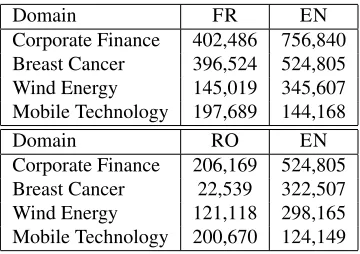
We conducted our experiments on four French-English and Romanian-French-English specialized compa-rable corpora: Corporate Finance, Breast Can-cer, Wind Energy and Mobile Technology. For the Romanian-English language pair, we used Wikipedia to collect comparable corpora for all do-mains since they were not already available. The Wikipedia corpora are harvested using a category-based selection. We consider the topic in the source
Domain FR EN
Corporate Finance 402,486 756,840 Breast Cancer 396,524 524,805 Wind Energy 145,019 345,607 Mobile Technology 197,689 144,168
Domain RO EN
[image:7.612.337.517.53.180.2]Corporate Finance 206,169 524,805 Breast Cancer 22,539 322,507 Wind Energy 121,118 298,165 Mobile Technology 200,670 124,149
Table 2: Number ofcontent wordsin the comparable corpora.
language (for instanceCancer Mamar[Breast Can-cer]) as a query to Wikipedia and extract all its sub-topics (i.e., sub-categories) to construct a domain-specific category tree. Then, based on the con-structed tree, we collect all Wikipedia articles be-longing to at least one of these categories and use
inter-language links to build the comparable cor-pora.
Concerning the French-English pair, we followed the strategy described above to extract the compa-rable corpora related to theCorporate Financeand
Breast Cancer domains since they were otherwise unavailable. For the two other domains, we used the corpora released in the TTC project4. All cor-pora were normalized through the following linguis-tic preprocessing steps: tokenization, part-of-speech tagging, lemmatization, and function word removal. The resulting corpora5 sizes are presented in Table
2. The size of the domain corpora vary within and across languages, with the corporate finance domain being the richest in both languages. In Romanian,
Breast Cancer is particularly small, with approxi-mately 22,000 tokens included. This variability will allow us to test if there is a correlation between cor-pus size and quality of results.
Bilingual dictionary
The seed generic French-English dictionary used to translate French context vectors consists of an in-house manually built resource which contains approximately 120,000 entries. For
Romanian-4
http://www.ttc-project.eu/index.php/ releases-publications
Domain FR-EN RO-EN
Corporate Finance 125 69
Breast Cancer 96 38
Wind Energy 89 38
[image:8.612.92.282.53.125.2]Mobile Technology 142 94
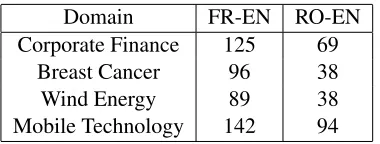
Table 3: Sizes of the evaluation lists.
English, we used the generic dictionary extracted following the procedure described in Subsection 3.6.
Gold standard
In bilingual terminology extraction from compara-ble corpora, a reference list is required to evaluate the performance of the alignment. Such lists are usu-ally composed of around 100single terms (Hazem and Morin, 2012; Chiao and Zweigenbaum, 2002). Reference lists6were created for the four specialized domains and the two pairs of languages. For the French-English, reference words from the Corpo-rate Financedomain were extracted from the glos-sary of bilingual micro-finance terms7. For Breast Cancer, the list is derived from the MESH and the UMLS thesauri8. ConcerningWind Energyand Mo-bile Technology, lists were extracted from special-ized glossaries found on the Web. The Romanian-English gold standard was manually created by a na-tive speaker starting from the French-English lists. Table 3 displays the sizes of the obtained lists. Ref-erence terms pairs were retained if each word posing them appeared at least five times in the com-parable domain corpora.
4.2 Experimental setup
Aside from those already mentioned, three param-eters need to be set up: (1) the window size that defines contexts, (2) the association measure that measures the strength of the association between words and the (3) similarity measure that ranks can-didate translations for state of the art methods. Con-text vectors are defined using a seven-word window which approximates syntactic dependencies. The association and the similarity measures (Discounted Log-Odds ratio (equation 5) and the cosine
simi-6
Reference lists will be shared publicly 7http://www.microfinance.lu/en/ 8http://www.nlm.nih.gov/
larity) were set following Laroche and Langlais (2010), a comprehensive study of the influence of these parameters on the bilingual alignment.
Odds-Ratiodisc= log
(O11+12)(O22+12)
(O12+12)(O21+12) (5)
whereOij are the cells of the2×2contingency ma-trix of a tokensco-occurring with the termSwithin a given window size.
The F-measure of the Top 20 results (F-Measure@20), which measures the harmonic mean of precision and recall, is used as evaluation metric. Precision is the total number of correct translations divided by the number of terms for which the system returned at least one answer. Recall is equal to the ratio between the number of correct translation and the total number of words to translate (Wcand).
4.3 Results and discussion
In addition to the basic approach based on ESA (denoted ESA), we evaluate the performances of a method so-called DicoSpec in which the transla-tions are extracted from a generic dictionary and a method we called ESASpec which combine ESA and DicoSpec. DICOSpec is based on the generic dictionary we presented in subsection 3.6 and pro-ceeds as follows: we extract a list of translations for each word to be translated from the generic dictio-nary. The domain specificity introduced in subsec-tion 3.5 is then used to rank these translasubsec-tions. For instance, the french termportreferring in theMobile Technologydomain, to the system that allows com-puters to receive and transmit information is trans-lated into port and seaport. According to domain specificity values, the following ranking is obtained: the English termport obtain the highest specificity value (0.48). seaportcomes next with a specificity value of 0.01. In ESASpec, the translations set out in the translations lists proposed by both ESA and the generic dictionary are weighted according to their domain specificity values. The main intuition be-hind this method is that by adding the information about the domain specificity, we obtain a new rank-ing of the bilrank-ingual extraction results.
a)
FR-EN
Method F-Measure@20
Breast Cancer Corporate Finance Wind Eenrgy Mobile Technology
STAPP 0.49 0.17 0.08 0.06
MP11 0.55 0.33 0.24 0.05
BA13 0.61 0.37 0.30 0.24
Dicospec 0.50 0.20 0.36 0.25
ESA 0.74 0.50 0.83 0.72
ESAspec 0.81 0.56 0.86 0.75
b)
R
O-EN
Method F-Measure@20
Breast Cancer Corporate Finance Wind Eenrgy Mobile Technology
STAPP 0.21 0.13 0.08 0.16
MP11 0.21 0.13 0.08 0.16
BA13 0.21 0.14 0.08 0.17
Dicospec 0.44 0.11 0.21 0.16
ESA 0.76 0.17 0.58 0.53
[image:9.612.128.494.50.278.2]ESAspec 0.78 0.24 0.58 0.55
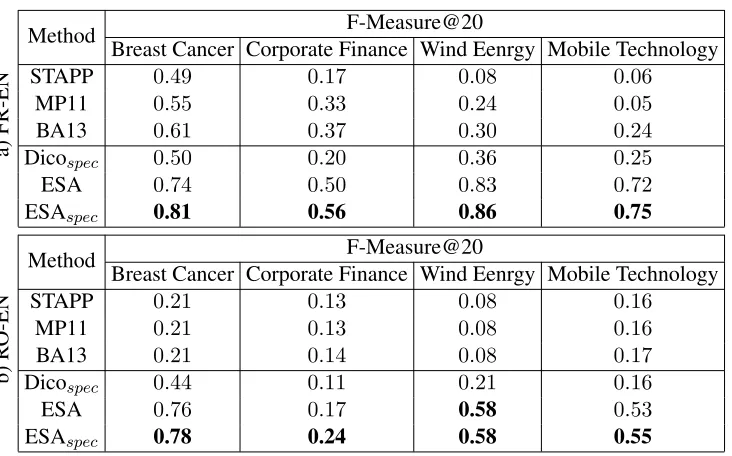
Table 4: Results of the specialized dictionary creation on four specific domains, two pairs of languages.Three state of the art methods were used for comparison: STAPP is the standard approach, MP11 is the improve-ment of the standard approach introduced in (Morin and Prochasson, 2011), BA13 is a recent method that we developed (Bouamor et al., 2013). Dicospecexploits a generic dictionary, combined with the use of do-main specificity (see Subsection 3.5). ESA stands for the ESA based approach introduced in this paper (see Figure 1). ESAspeccombines the results of Dicospecand ESA.
for RO-EN. Consequently, we will use BA13 as the main baseline for discussing the newly introduced approach. The results presented in Table 4 show that ESAspec clearly outperforms the three base-lines for the four domains and the two pairs of lan-guages tested. When comparing ESAspecto BA13 for French-English, improvements range between 0.19 forCorporate Finance and 0.56 for Wind En-ergy. For RO-EN, the improvements vary from 0.1 forCorporate Financeto 0.5 forWind Energy. Also, except for theCorporate Financedomain in Roma-nian, the performance variation across domains is much smaller for ESAspec than for the three state of the art methods. This shows that ESAspecis more robust to domain change and thus more generic.
The results obtained with ESA are signifi-cantly better than those obtained with Dicospec and ESAspec, their combination, further improves the results. The main contribution to ESAspec perfor-mances comes from ESA, a finding that validates our assumption that the adequate use of a rich multi-lingual resource such as Wikipedia is appropriate for specialized lexicon translation. Dicospec is a
sim-ple method that ranks the different meanings of a candidate word available in a generic dictionary but its average performances are comparable to those of BA13 for FR-EN and higher for RO-EN. This finding advocates for the importance of good qual-ity generic dictionaries in specialized lexicon trans-lation approaches. However, it is clear that such dictionaries are far from being sufficient in order to cover all possible domains. There is no clear correlation between domain size and quality of re-sults. Although richer than the other three domains,
Corporate Finance has the lowest associated per-formances. This finding is probably explained by the intrinsic difficulty of each domain. When pass-ing from FR-EN to RO-EN the average performance drop is more significant for BA13 than for the ESA based methods. The result indicates that our ap-proach is more robust to language change.
5 Conclusion
building blocks of machine translation systems. The proposed approach directly tackles two of the ma-jor challenges identified in the Introduction. The scarcity of resources is addressed by an adequate exploitation of Wikipedia, a resource that is avail-able in hundreds of languages. The quality of auto-matic translations was improved by appropriate do-main delimitation and linking across languages, as well as by an adequate statistical processing of con-cepts similar to a word in a given context.
The main advantages of our approach compared to state of the art methods come from: the increased number of languages that can be processed, from the smaller sensitivity to structured resources and the appropriate domain delimitation. Experimental validation is obtained through evaluation with four different domains and two pairs of languages which shows consistent performance improvement. For French-English, two languages that have rich asso-ciated Wikipedia representations, performances are very interesting and are starting to approach those of manual translations for three domains out of four (F-Measure@20 around 0.8). For Romanian-English, a pair involving a language with a sparser Wikipedia representation, the performances of our method drop compared to French-English . However, they do not decrease to the same extent as those of the best state of the art method tested. This finding indicates that our approach is more general and, given its low lan-guage dependence, it can be easily extended to a large number of language pairs.
The results presented here are very encouraging and we will to pursue work in several directions. First, we will pursue the integration of our method, notably through comparable corpora creation using the data driven domain delimitation technique de-scribed in Subsection 3.5. Equally important, the size of the domain can be adapted so as to find enough context for all the words in domain reference lists. Second, given a word in a context, we currently exploit all similar concepts from the target language. Given that comparability of article versions in the source and the target language varies, we will eval-uate algorithms for filtering out concepts from the target language that have low alignment with their source language versions. A final line of work is constituted by the use of distributional properties of texts in order to automatically rank parts of concept
descriptions (i.e. articles) by their relatedness to the candidate word. Similar to the second direction, this process involves finding comparable text blocks but rather at a paragraph or sentence level than at the article level.
References
Dhouha Bouamor, Nasredine Semmar, and Pierre Zweigenbaum. 2013. Context vector disambiguation for bilingual lexicon extraction. InProceedings of the 51st Association for Computational Linguistics (ACL-HLT), Sofia, Bulgaria, August.
Yun-Chuang Chiao and Pierre Zweigenbaum. 2002. Looking for candidate translational equivalents in spe-cialized, comparable corpora. InProceedings of the 19th international conference on Computational lin-guistics - Volume 2, COLING ’02, pages 1–5. Associ-ation for ComputAssoci-ational Linguistics.
Yun-Chuang Chiao and Pierre Zweigenbaum. 2003. The effect of a general lexicon in corpus-based identifi-cation of french-english medical word translations. In Proceedings Medical Informatics Europe, volume 95 of Studies in Health Technology and Informatics, pages 397–402, Amsterdam.
Pascale Fung. 1998. A statistical view on bilingual lexi-con extraction: From parallel corpora to non-parallel corpora. In Parallel Text Processing, pages 1–17. Springer.
Evgeniy Gabrilovich and Shaul Markovitch. 2007. Com-puting semantic relatedness using wikipedia-based explicit semantic analysis. In Proceedings of the 20th international joint conference on Artifical intel-ligence, IJCAI’07, pages 1606–1611, San Francisco, CA, USA. Morgan Kaufmann Publishers Inc.
Alexander Halavais and Derek Lackaff. 2008. An Anal-ysis of Topical Coverage of Wikipedia. Journal of Computer-Mediated Communication, 13(2):429–440. Z.S. Harris. 1954. Distributional structure.Word. Samer Hassan and Rada Mihalcea. 2011. Semantic
re-latedness using salient semantic analysis. InAAAI. Amir Hazem and Emmanuel Morin. 2012. Adaptive
dic-tionary for bilingual lexicon extraction from compara-ble corpora. InProceedings, 8th international confer-ence on Language Resources and Evaluation (LREC), Istanbul, Turkey, May.
Audrey Laroche and Philippe Langlais. 2010. Revisiting context-based projection methods for term-translation spotting in comparable corpora. In 23rd Interna-tional Conference on ComputaInterna-tional Linguistics (Col-ing 2010), pages 617–625, Beijing, China, Aug. Emmanuel Morin and B´eatrice Daille. 2006.
Compara-bilit´e de corpus et fouille terminologique multilingue. InTraitement Automatique des Langues (TAL). Emmanuel Morin and Emmanuel Prochasson. 2011.
Bilingual lexicon extraction from comparable corpora enhanced with parallel corpora. In Proceedings, 4th Workshop on Building and Using Comparable Cor-pora (BUCC), page 27–34, Portland, Oregon, USA. Franz Josef Och and Hermann Ney. 2003. A
system-atic comparison of various statistical alignment mod-els. Comput. Linguist., 29(1):19–51, March.
Emmanuel Prochasson, Emmanuel Morin, and Kyo Kageura. 2009. Anchor points for bilingual lexi-con extraction from small comparable corpora. In Proceedings, 12th Conference on Machine Translation Summit (MT Summit XII), page 284–291, Ottawa, On-tario, Canada.
Kira Radinsky, Eugene Agichtein, Evgeniy Gabrilovich, and Shaul Markovitch. 2011. A word at a time: com-puting word relatedness using temporal semantic anal-ysis. InProceedings of the 20th international confer-ence on World wide web, WWW ’11, pages 337–346, New York, NY, USA. ACM.
Reinhard Rapp. 1995. Identifying word translations in non-parallel texts. InProceedings of the 33rd annual meeting on Association for Computational Linguistics, ACL ’95, pages 320–322. Association for Computa-tional Linguistics.
Reinhard Rapp. 1999. Automatic identification of word translations from unrelated english and german cor-pora. InProceedings of the 37th annual meeting of the Association for Computational Linguistics on Compu-tational Linguistics, ACL ’99, pages 519–526. Asso-ciation for Computational Linguistics.
![Table 1: The five most similar Wikipedia concepts to the French terms action[share], d´eficit[deficit], ci-saillement[shear], turbine[turbine], cryptage[encryption], biopsie[biopsie] and palpation[palpation] andtheir context vectors.](https://thumb-us.123doks.com/thumbv2/123dok_us/1367605.669922/5.612.97.518.56.263/wikipedia-concepts-decit-saillement-encryption-palpation-palpation-andtheir.webp)