Automatically Determining a Proper Length for Multi-document
Summarization: A Bayesian Nonparametric Approach
Tengfei Ma and Hiroshi Nakagawa
The University of Tokyo 7-3-1 Hongo, Bunkyo-ku, Tokyo
{matf@r., nakagawa@}dl.itc.u-tokyo.ac.jp
Abstract
Document summarization is an important task in the area of natural language processing, which aims to extract the most important in-formation from a single document or a clus-ter of documents. In various summarization tasks, the summary length is manually de-fined. However, how to find the proper sum-mary length is quite a problem; and keeping all summaries restricted to the same length is not always a good choice. It is obvi-ously improper to generate summaries with the same length for two clusters of docu-ments which contain quite different quantity of information. In this paper, we propose a Bayesian nonparametric model for multi-document summarization in order to automat-ically determine the proper lengths of sum-maries. Assuming that an original document can be reconstructed from its summary, we describe the ”reconstruction” by a Bayesian framework which selects sentences to form a good summary. Experimental results on DUC2004 data sets and some expanded data demonstrate the good quality of our sum-maries and the rationality of the length deter-mination.
1 Introduction
Text summarization is the process of generating a short version of a given text to indicate its main top-ics. As the number of documents on the web expo-nentially increases, text summarization has attracted increasing attention, because it can help people get the most important information within a short time.
In most of the existing summarization systems, people need to first define a constant length to re-strict all the output summaries. However, in many cases it is improper to require all summaries are of the same length. Take the multi-document summa-rization as an example, generating the summaries of the same length for a 5-document cluster and a 50-document cluster is intuitively improper. More specifically, consider two different clusters of doc-uments: one cluster contains very similar articles which all focus on the same event at the same time; the other contains different steps of the event but each step has its own topics. The former cluster may need only one or two sentences to explain its infor-mation, while the latter needs to include more.
Research on summary length dates back in the late 90s. Goldstein et al. (1999) studied the char-acteristics of a good summary (single-document summarization for news) and showed an empiri-cal distribution of summary length over document size. However, the length problem has been grad-ually ignored later, since researchers need to fix the length so as to estimate different summarization models conveniently. A typical instance is the
Doc-ument Understanding Conferences (DUC)1, which
provide authoritative evaluation for summarization systems. The DUC conferences collect news arit-cles as the input data and define various summariza-tion tasks, such as generic multi-document summa-rization, query-focused summarization and update summarization. In all the DUC tasks, the output is restricted within a length. Then human-generated
1
After 2007, the DUC tasks are incorporated into the Text Analysis Conference (TAC).
summaries are provided to evaluate the results of dif-ferent summarization systems. Limiting the length of summaries contributed a lot to the development of summarization techniques, but as we discussed before, in many cases keeping the summaries of the same size is not a good choice.
Moreover, even in constant-length summariza-tion, how to define a proper size of summaries for the summarization tasks is quite a problem. Why does DUC2007 main task require 250 words while Update task require 100 words? Is it reasonable? A short summary may sacrifice the coverage, while a long summary may cause redundance. Automati-cally determining the best size of summaries accord-ing to the input documents is valuable, and it may deepen our understanding of summarization.
In this work, we aim to find the proper length for document summarization automatically and gen-erate varying-length summaries based on the doc-ument itself. The varying-length summarization is
more robust for unbalanced clusters. It can also
provide a recommended size as the predefined sum-mary length for general constant-length summariza-tion systems. We advance a Bayesian nonparametric model of extractive multi-document summarization to achieve this goal. As far as we are concerned, it is the first model that can learn appropriate lengths of summaries.
Bayesian nonparametric (BNP) methods are pow-erful tools to determine the size of latent vari-ables (Gershman and Blei, 2011). They let the data ”speak for itself” and allow the dimension of la-tent variables to grow with the data. In order to integrate the BNP methods into document summa-rization, we follow the assumption that the original documents should be recovered from the reconstruc-tion of summaries (Ma and Wan, 2010; He et al., 2012). We use the Beta process as a prior to gen-erate binary vectors for selecting active sentences that reconstruct the original documents. Then we construct a Bayesian framework for summarization and use the variational approximation for inference. Experimental results on DUC2004 dataset demon-strate the effectiveness of our model. Besides, we reorganize the original documents to generate some new datasets, and examine how the summary length changes on the new data. The results prove that our summary length determination is rational and
neces-sary on unbalanced data.
2 Related Work
2.1 Research on Summary Length
Summary length is an important aspect for gener-ating and evalugener-ating summaries. Early research on summary length (Goldstein et al., 1999) focused on discovering the properties of human-generated sum-maries and analyzing the effect of compression ratio. It demonstrated that an evaluation of summarization systems must take into account both the compres-sion ratios and the characteristics of the documents. Radev and Fan (2000) compared the readability and
speedup in reading time of10%summaries and20%
summaries2 for topic sets with different number of documents. Sweeney et al. (2008) developed an in-cremental summary containing additional sentences that provide context. Kaisser et al. (2008) studied the impact of query types on summary length of search results. Other than the content of original documents, there are also some other factors affect-ing summary length especially in specific applica-tions. For example, Sweeney and Crestani (2006) studied the relation between screen size and sum-mary length on mobile platforms. The conclusion of their work is the optimal summary size always falls into the shorter one regardless of the screen size.
In sum, the previous works on summary length mostly put their attention on the empirical study of the phenomenon, factors and impacts of summary length. None of them automatically find the best length, which is our main task in this paper. Nev-ertheless, they demonstrated the importance of sum-mary length in summarization and the reasonability of determining summary length based on content of news documents (Goldstein et al., 1999) or search results (Kaisser et al., 2008). As our model is mainly applied for generic summarization of news articles, we do not consider the factor of screen size in mo-bile applications.
2.2 BNP Methods in Document Summarization
Bayesian nonparametric methods provide a
Bayesian framework for model selection and adaptation using nonparametric models (Gershman
2
and Blei, 2011). A BNP model uses an infinite-dimensional parameter space, but invokes only a finite subset of the available parameters on any given finite data set. This subset generally grows with the data set. Thus BNP models address the problem of choosing the number of mixture compo-nents or latent factors. For example, the hierarchical Dirichlet process (HDP) can be used to infer the number of topics in topic models or the number of states in the infinite Hidden Markov model (Teh et al., 2006).
Recently, some BNP models are also involved in document summarization approaches (Celikyilmaz and Hakkani-T¨ur, 2010; Chang et al., 2011; Darling and Song, 2011). BNP priors such as the nested Chi-nese restaurant process (nCRP) are associated with topic analysis in these models. Then the topic dis-tributions are used to get the sentence scores and rank sentences. BNP here only impacts the number and the structure of the latent topics, but the sum-marization framework is still constant-length. Our BNP summarization model differs from the previous models. Besides using the HDP for topic analysis, our approach further integrates the beta process into sentence selection. The BNP method in our model are directly used to determine the number of sum-mary sentences but not latent topics.
3 BNP Summarization
In this section, we first introduce the BNP priors which will be used in our model. Then we propose our model called BNP summarization.
3.1 The Beta Process and the Bernoulli process
The beta process(BP) (Thibaux and Jordan, 2007; Paisley and Carin, 2009) and the related Indian buf-fet process(IBP) (Griffiths and Ghahramani, 2005) are widely applied to factor/feature analysis. By defining the infinite dimensional priors, these factor analysis models need not to specify the number of latent factors but automatically determine it.
Definition of BP(Paisley et al., 2010): LetB0be a continuous measure on a spaceΘandB0(Θ) =γ.
IfBkis defined as follows,
Bk =
N
k=1
πkδθk,
πk ∼ Beta(αγ
N , α(1− γ N)) θk ∼
1
γB0 (1)
(whereδθk is the atom at the locationθk; andαis a positive scalar), then asN → ∞, Bk→BandBis a beta process:B ∼BP(αB0).
Finite Approximation: The beta process is de-fined on an infinite parameter space, but sometimes we can also use its finite approximation by sim-ply settingN to a large number (Paisley and Carin, 2009).
Bernoulli Process: The beta process is conju-gate to a class of Bernoulli processes, denoted by
X ∼ Bep(B). If B is discrete, of the form in
(1), thenX = kbkδθk where thebkare indepen-dent Bernoulli variables with the probabilityp(bk=
1) = πk. Due to the conjugation between the
beta process priors and Bernoulli process, the pos-terior ofB givenM samples X1, X2, ...XM where
Xi ∼Bep(B)fori= 1, , , M.is also a beta process which has updated parameters:
B|X1, X2, ..., XM
∼BP(α+M,α+αMB0+c+1M iXi) (2)
Application of BP: Furthermore, marginalizing
over the beta process measure B and taking α =
1, provides a predictive distribution on indicators known as the Indian buffet process (IBP) (Thibaux and Jordan, 2007). The beta process or the IBP is often used in a feature analysis model to generate infinite vectors of binary indicator variables(Paisley and Carin, 2009), which indicates whether a feature is used to represent a sample. In this paper, we use the beta process as the prior to select sentences.
3.2 Framework of BNP Summarization
2012). Some global optimization algorithms are de-veloped, instead of greedy search, to select the best overall summaries (Nenkova and McKeown, 2012). One approach to global optimization of summariza-tion is to regard the summarizasummariza-tion as a reconstruc-tion process (Ma and Wan, 2010; He et al., 2012) . Considering a good summary must catch most of the important information in original documents, the original documents are assumed able to be recov-ered from summaries with some information loss. Then the summarization problem is turned into find-ing the sentences that cause the least reconstruction error (or information loss). In this paper, we fol-low the assumption and formulate summarization as a Bayesian framework.
First we review the models of (Ma and Wan,
2010) and (He et al., 2012). Given a cluster of
M documents x1, x2, ..., xM and the sentence set contained in the documents asS = [s1, s2, ..., sN], we denote all corresponding summary sentences as
V = [v1, ..., vn], wherenis the number of summary sentences and N is the number of all sentences in the cluster. A documentxi and a sentencevi orsi here are all represented by weighted term frequency vectors in the space Rd, where d is the number of total terms (words).
Following the reconstruction assumption, a
can-didate sentence vi can be approximated by the
linear combination of summary sentences: si
n
j=1wjvj, where wj is the weight for summary
sentence vj. Thus the document can also be
ap-proximately represented by a linear combination of summary sentences (because it is the sum of the sen-tences).
xi n
j=1
wjvj. (3)
Then the work in (He et al., 2012) aims to find the summary sentence set that can minimize the re-construction errorNi=1||si−nj=1wjvj||2; while the work in (Ma and Wan, 2010) defines the prob-lem as finding the sentences that minimize the dis-tortion between documents and its reconstruction
dis(xi,nj=1wjvj) where this distortion function can also be a squared error function.
Now we consider the reconstruction for each doc-ument, if we see the documentxi as the dependent
variable, and the summary sentence set S as the
independent variable, the problem to minimize the reconstruction error can be seen as a linear regres-sion model. The model can be easily changed to a Bayesian regression model by adding a zero-mean Gaussian noise(Bishop, 2006), as follows.
xi= n
j=1
wjvj+i (4)
where the weightswj are also assigned a Gaussian prior.
The next step is sentence selection. As our sys-tem is an extractive summarization model, all the summary sentences are from the original document cluster. So we can use a binary vector zi =<
zi1, ..., ziN >T to choose the active sentences V
(i.e. summary sentences) from the original
sen-tence set S. The Equation (4) is turned into xi =
N
j=1φij∗zijsj+i. Using a beta process as a prior for the binary vectorzi, we can automatically infer the number of active component associated withzi. As to the weights of the sentences, we use a random vector φi which has the multivariate normal
distri-bution because of the conjugacy. φi ∈ RN is an
extension to the weights{w1, ...wn}in (4).
Integrating the linear reconstruction (4) and the
beta process3 (1), we get the complete process of
summary sentence selection as follows.
xi = S(φi◦zi) +i
S = [s1, s2, ..., sN]
zij ∼ Bernoulli(πj)
πj ∼ Beta(αγ
N , α(1− γ N)) φi ∼ N(0, σφ2I)
i ∼ N(0, σ2I) (5)
where N is the number of sentences in the whole
document cluster. The symbol◦represents the ele-mentwise multiplication of two vectors.
One problem of the reconstruction model is that the word vector representation of the sentences are sparse, which dramatically increase the reconstruc-tion error. So we bring in topic models to reduce the
3
dimension of the data. We use a HDP-LDA (Teh et al., 2006) to get topic distributions for each sentence, and we represent the sentences and documents as the topic weight vectors instead of word weight vec-tors. Finallyxi is aK-dimensional vector andS is aK∗N matrix, whereKis the number of topics in topic models.
4 Variational Inference
In this section, we derive a variational Bayesian al-gorithm for fast inference of our sentence selec-tion model. Variaselec-tional inference (Bishop, 2006) is a framework for approximating the true posterior with the best from a set of distributions Q :q∗ = arg minq∈QKL(q(Z)|p(Z|X)).Supposeq(Z)can be partitioned into disjoint groups denoted by Zj, and theqdistribution factorizes with respect to these groups: q(Z) =Mj=1q(Zj). We can obtain a gen-eral expression for the optimal solutionqj∗(Zj)given by
lnq∗j(Zj) =Ei=j[lnp(X, Z)] +const. (6)
whereEi=j[lnp(X, Z)]is the expectation of the log-arithm of the joint probability of the data and latent variables, taken over all variables not in the parti-tion. We will therefore seek a consistent solution by first initializing all of the factors qj(Zj) appro-priately and then cycling through the factors and re-placing each in turn with a revised estimate given by (6) evaluated using the current estimates for all of the other factors.
Update forZ
p(zij|πj, xi, S, φi)∝p(xi|zij, sj, φi)p(zij|πj)
We useq(zij)to approximate the posterior:
q(zij)
∝exp{E[ln(p(xi|zij, zi−j, S, φi)) + ln(p(zij|π))]}
∝exp{E[ln(πj)]}∗
exp{E[− 1 2σ2
x−i j−sjzijφij T
x−i j−sjzijφij
]}
∝exp{ln(πj)}∗
exp{−
φ2ij∗zij2 ∗sT
jsj−2φij ∗zij ∗sjT ∗x
−j
i
2σ2 }
(7)
wherex−ij =xi−S−j(φ−i j◦zi−j), and the symbol ¯ indicates the expectation value. The φ2ij can be extended to this form:
φ2ij =φij2+ Δji (8)
where Δji means the jth diagonal element of Δi which is defined by Equation 13.
As zi is a binary vector, we only calculate the probability ofzij = 1andzij = 0.
q(zij = 1)∝exp{ln(πj)} ∗
exp{− 1 2σ2
φ2ij∗sT
jsj−2φij ∗sjT ∗x−i j
}
q(zij = 0)∝exp{ln(1−πj)} (9)
The expectations can be calculated as
ln(πj) =ϕ(αγ
N +nj)−ϕ(α+M) (10)
ln(1−πj) =ϕ(α(1− γ
N) +M−nj)−ϕ(α+M)
(11) wherenj =Mi=1zij.
Update forπ
p(πj|Z)∝p(πj|α, γ, N)p(Z|πj)
Because of the conjugacy of the beta to Bernoulli distribution, the posterior ofπis still a beta distribu-tion:
πj ∼Beta(αγ
N +nj, α(1− γ
N) +M−nj) (12)
Update forΦ
p(φi|xi, Z, S)∝p(xi|φi, Z, S)p(φi|σφ2)
The posterior is also a normal distribution with mean
μiand covarianceΔi.
Δi= 1
σ2S˜i
T ˜
Si+ 1
σφ2I
−1
(13)
μi= Δi
1
σ2 ˜
Si T
xi
(14)
HereS˜i ≡ S◦z˜i andz˜i ≡[zi, ..., zi]T is aK×N matrix with the vectorzirepeatedK(the number of the latent topics) times.
˜
˜
SiTS˜i = (STS)◦(zi∗ziT +Bcovi) (16)
Bcovi= diag[zi1(1−zi1), ..., ziN(1−ziN)] (17)
Update forσ2
p(σ2|Φ, X, Z, S)∝p(X|Φ, Z, S, σ2)p(σ2)
By using a conjugate prior, inverse gamma prior
InvGamma(u, v), the posterior can be calculated as a new inverse gamma distribution with parame-ters
u =u+M K/2
v =v+1 2
M
i=1
(||xi−S(zi◦φi)||+ξi)
(18)
where
ξi =
N
j=1(zij2 ∗φ2ij∗sTjsj−zij2∗φij2∗sTjsj) +j=lzij∗zil∗Δi,jl∗sTjsl
Update forσφ2
p(σ2φ|Φ)∝p(Φ|σφ2)p(σ2φ)
By using a conjugate prior, inverse gamma prior
InvGamma(e, f), the posterior can be calculated as a new inverse gamma distribution with parame-ters
e = e+M N/2
f = f+1
2 M
i=1
(Φ)TΦ +trace(Δi)
(19)
5 Experiments
To test the capability of our BNP summarization sys-tems, we design a series of experiments. The aim of the experiments mainly includes three aspects:
1. To demonstrate the summaries extracted by our model have good qualities and the summary length determined by the model is reasonable.
2. To give examples where varying summary length is necessary.
3. To observe the distribution of summary length.
We evaluate the performance on the dataset of DUC2004 task2. The data contains 50 document clusters, with 10 news articles in each cluster. Be-sides, we construct three new datasets from the DUC2004 dataset to further prove the advantage of variable-length summarization. We separate each cluster in the original dataset into two parts where
each has 5 documents, hence getting the Separate
Dataset; Then we randomly combine two origi-nal clusters in the DUC2004 dataset, and get two
datasets called Combined1 and Combined2. Thus
each of the clusters in the combined datasets include 20 documents with two different themes.
5.1 Evaluation of Summary Qualities
First, we implement our BNP summarization model on the DUC2004 dataset, with summary length not limited. At the topic analysis step, we use the HDP model and follow the inference in (Teh et al., 2006). For the sentence selection step, we use the varia-tional inference described in Section 4, where the parameters in the beta process (5) are set as γ = 1, α = 1. The summaries that we finally generate have an average length of 164 words. We design sev-eral popular unsupervised summarization systems and compare them with our model.
• TheRandommodel selects sentences randomly
for each document cluster.
• The MMR (Carbonell and Goldstein, 1998)
strives to reduce redundancy while maintaining relevance. For generic summarization, we re-place the query relevance with the relevance to documents.
• TheLexrankmodel (Erkan and Radev, 2004) is
a graph-based method which choose sentences based on the concept of eigenvector centrality.
• The Linear Representation model (Ma and
Ϭ͘Ϯϱ Ϭ͘ϯ Ϭ͘ϯϱ Ϭ͘ϰ
ZŽ
ƵŐ
ĞͲϭ ZĂŶĚŽŵDDZ
>ĞdžƌĂŶŬ
Ϭ͘ϭϱ Ϭ͘Ϯ
Ϭ ϭϬϬ ϮϬϬ ϯϬϬ ϰϬϬ
^ƵŵŵĂƌLJůĞŶŐƚŚ;EƵŵďĞƌŽĨtŽƌĚƐͿ
>ŝŶĞĂƌ EW
Figure 1: Rouge-1 values on DUC2004 dataset.
Ϭ͘Ϭϱ Ϭ͘Ϭϲ Ϭ͘Ϭϳ Ϭ͘Ϭϴ Ϭ͘Ϭϵ Ϭ͘ϭ
ZŽ
ƵŐ
ĞͲ
Ϯ ZĂŶĚŽŵ
DDZ >ĞdžƌĂŶŬ
Ϭ͘ϬϮ Ϭ͘Ϭϯ Ϭ͘Ϭϰ
Ϭ ϭϬϬ ϮϬϬ ϯϬϬ ϰϬϬ
^ƵŵŵĂƌLJ>ĞŶŐƚŚ;EƵŵďĞƌŽĨtŽƌĚƐͿ
[image:7.612.74.299.59.196.2]>ŝŶĞĂƌ EW
Figure 2: Rouge-2 values on DUC2004 dataset.
Ϭ͘Ϯ Ϭ͘Ϯϱ Ϭ͘ϯ Ϭ͘ϯϱ
ZŽƵ
ŐĞ
Ͳ> ZĂŶĚŽŵ
DDZ >ĞdžƌĂŶŬ
Ϭ͘ϭ Ϭ͘ϭϱ
Ϭ ϭϬϬ ϮϬϬ ϯϬϬ ϰϬϬ
^ƵŵŵĂƌLJ>ĞŶŐƚŚ;EƵŵďĞƌŽĨtŽƌĚƐͿ
[image:7.612.73.300.250.395.2]>ŝŶĞĂƌ EW
Figure 3: Rouge-L values on DUC2004 dataset.
All the compared systems are implemented at dif-ferent predefined lengths from 50 to 300 words.
Then we evaluate the summaries with ROUGE4
tools (Lin and Hovy, 2003) in terms of the f-measure
4we use ROUGE1.5.5 in this work.
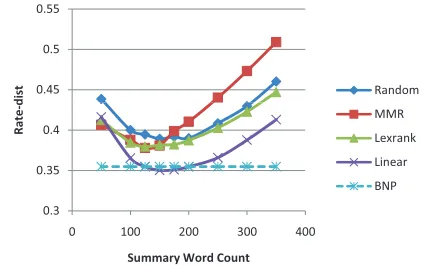
scores of Rouge-1 Rouge-2, and Rouge-L. The met-ric of Rouge f-measure takes into consideration the summary length in evaluation, so it is proper for our experiments. From Fig.1, Fig.2 and Fig.3, we can see that the result of BNP summarization (the dashed line) gets the second best value among all
systems. It is only defeated by the Linear model
but the result is comparable to the best in Fig.1 and Fig.3; while it exceeds other systems at all lengths. This proves the good qualities of our BNP
sum-maries. The reason that the Linear system gets a
little better result may be its weights for linear com-bination of summary sentences are guaranteed non-negative while in our model the weights are zero-mean Gaussian variables. This may lead to less re-dundance in sentence selection for the Linear Rep-resentation model.
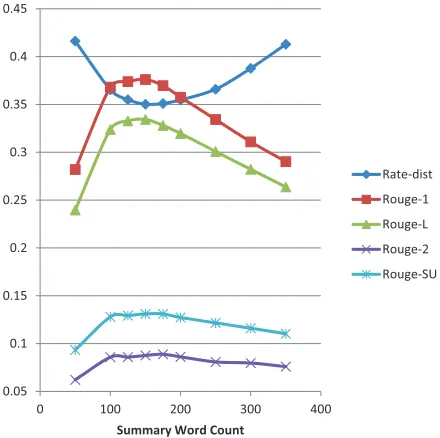
Turn to the length determination. We take ad-vantage of the Linear Representation model to ap-proximate the constant-length version of our model. Comparing the summaries generated at different predefined lengths, Fig.4 shows the the model gets the best performance (Rouge values) at the length around 164 words, the length learned by our BNP model. This result partly demonstrates our length determination is rational and it can be used as the recommended length for some constant-length sum-marization systems, such as theLinear.
Ϭ͘ϰ Ϭ͘ϰϱ
Ϭ ϯ Ϭ͘ϯϱ
Ϭ͘Ϯϱ Ϭ͘ϯ
ZĂƚĞͲĚŝƐƚ ZŽƵŐĞͲϭ ZŽƵŐĞͲ>
Ϭ͘ϭϱ
Ϭ͘Ϯ ZŽƵŐĞͲϮ
ZŽƵŐĞͲ^h
Ϭ͘Ϭϱ Ϭ͘ϭ
Ϭ ϭϬϬ ϮϬϬ ϯϬϬ ϰϬϬ
Ϭ ϭϬϬ ϮϬϬ ϯϬϬ ϰϬϬ
[image:7.612.73.300.447.592.2]^ƵŵŵĂƌLJtŽƌĚŽƵŶƚ
[image:7.612.314.534.459.678.2]5.2 A New Evaluation Metric
The Rouge evaluation requires golden standard sum-maries as the base. However, in many cases we cannot get the reference summaries. For example, when we implement experiments on our expanded datasets (the separate and combined clusters of doc-uments), we do not have exact reference summaries. Louis and Nenkova (2009) advanced an automatic summary evaluation without human models. They used the Jensen-Shannon divergence(JSD) between the input documents and the summaries as a fea-ture, and got high correlation with human evalua-tions and the rouge metric. Unfortunately, it was designed for comparison at a constant-length, which cannot meet our needs. To extend the JSD evaluation to compare varying-length summaries, we propose a new measure based on information theory, the rate-distortion (Cover and Thomas, 2006).
Rate-Distortion: The distortion functiond(x,xˆ) is a measure of the cost of representing the symbol
xto a new symbolxˆ; and the rate can indicate how much compression can be achieved. The problem of finding the minimum rate can be solved by minimiz-ing the functional
F[p(ˆx|x)] =I(X; ˆX) +βE(d(x,xˆ)). (20)
where I(X; ˆX) denotes the mutual information. The rate-distortion theory is a fundamental
the-ory for lossy data compression. Recently, it has
also been successfully employed for text cluster-ing (Slonim, 2002) and document summarization (Ma and Wan, 2010). Slonim (2002) claims that the mutual informationI(X; ˆX)measures the com-pactness of the new representation. Thus the rate-distortion function is a trade-off between the com-pactness of new representation and the expected
dis-tortion. Specifically in summarization, the
sum-maries can be seen as the new representationXˆ of
original documents X. A good summary balances
the compression ratio and the information loss, thus minimizing the function (20). So we use the func-tion (20)(we setβ= 1) to compare which summary is a better compression. The JS-divergence (JSD), which has been proved to have high correlation with manual evaluation (Louis and Nenkova, 2009) for constant-length summary evaluation, is utilized as the distortion in the function. In the following
sec-tions, we simply call the values of the function (20)
rate-dist. In fact, the rate-dist values can be seen as
the JSD measure with length regularization.
To check the effectiveness of rate-dist measure, we evaluate all summaries generated in Section 5.1 with the new measure (the lower the better). Fig. 5 shows that the results accord with the ones in Fig. 1 and Fig. 3. Moreover, in Fig. 4, the curve of rate-dist values has a inverse tendency of Rouge mea-sures (Rouge-1, Rouge-2, Rouge-L and Rouge-SU4 are all listed here), and the best performance also oc-curs around the summary length of 164 words. This even more clearly reveals that the BNP summariza-tion achieves a perfect tradeoff between compact-ness and informativecompact-ness. Due to the accordance with rouge measures, it is promising to be regarded as an alternative to the rouge measures in case we do not have reference summaries.
Ϭ͘ϰϱ Ϭ͘ϱ Ϭ͘ϱϱ
ĚŝƐƚ ZĂŶĚŽŵ
Ϭ͘ϯ Ϭ͘ϯϱ Ϭ͘ϰ
Ϭ ϭϬϬ ϮϬϬ ϯϬϬ ϰϬϬ
ZĂƚĞͲ
Ě
^ƵŵŵĂƌLJtŽƌĚŽƵŶƚ
[image:8.612.318.536.314.447.2]DDZ >ĞdžƌĂŶŬ >ŝŶĞĂƌ EW
Figure 5: Comparison of BNP Summarization with other systems using rate-dist measure.
5.3 Necessity of Varying Summary Length
In this section, we discuss the necessity of length determination and how summary length changes
ac-cording to the input data. As explained before,
we generate three new datasets from the original DUC2004 dataset. Now we use them to indicate varying summary length is necessary when the in-put data varies a lot.
because all the documents concentrate on the same themes. When we combine two clusters into one, the summary length should be smaller than the sum of the summary lengths of two original clusters due to some unavoidable common background information but much larger than the summary length of original clusters.
Original Separate Combined1 Combined2
[image:9.612.314.539.246.414.2]164 115 250 231
Table 1: Average summary length (number of words) on different datasets
We also run the Linear Representation system at different lengths on the new datasets and evaluate the qualities. As we do not have golden standard for the new datasets, so we only use the rate-dist measure here. Results in Table 2,3,4 show the sum-maries which do not change the predefined length
5 perform significantly worse than the BNP
sum-marization. All the comparison is statistically sig-nificant. So varying summary length is necessary when the input changes a lot, and our model can just give a good match to the new data. This characteris-tic also can be used to give recommended summary length for extractive summarization systems when given unknown data.
Predefined Unchanged BNP
Length 665 bytes 164 words 115 words
[image:9.612.312.540.474.652.2]Rate-dist 0.4130 0.4404 0.4007
Table 2: Comparison of summary lengths on Separate Dataset.
Predefined Unchanged BNP
Length 665 bytes 164 words 250 words
Rate-dist 0.3768 0.3450 0.3238
Table 3: Comparison of summary lengths on Combined1 Dataset.
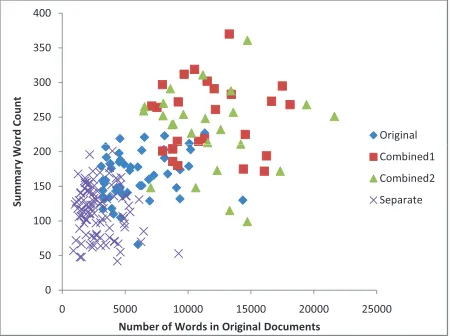
Then we observe the summary length distribu-tions and compression ratios according to document size(the length of the whole documents in a clus-ter). The average summary length increases (Fig. 6),
5
665 bytes is the DUC2004 requirement and 164 words is the best length on original data
Predefined Unchanged BNP
Length 665 bytes 164 words 231 words
Rate-dist 0.3739 0.3464 0.3326
Table 4: Comparison of summary lengths on Combined2 Dataset.
while the compression ratios decreases (Fig. 7) as
document size grows. The rule of the
compres-sion ratio here agrees with the rule in (Goldstein et al., 1999), although that work is done for single-document summarization.
ϮϱϬ ϯϬϬ ϯϱϬ ϰϬϬ
ŽƌĚ
Ž
ƵŶƚ
KƌŝŐŝŶĂů
Ϭ ϱϬ ϭϬϬ ϭϱϬ ϮϬϬ
Ϭ ϱϬϬϬ ϭϬϬϬϬ ϭϱϬϬϬ ϮϬϬϬϬ ϮϱϬϬϬ
^Ƶ
ŵ
ŵ
Ăƌ
LJ
t
Ž
EƵŵďĞƌŽĨtŽƌĚƐŝŶKƌŝŐŝŶĂůŽĐƵŵĞŶƚƐ
ŽŵďŝŶĞĚϭ ŽŵďŝŶĞĚϮ ^ĞƉĂƌĂƚĞ
Figure 6: The distribution of summary word length.
Ϭ͘Ϭϴ Ϭ͘ϭ Ϭ͘ϭϮ Ϭ͘ϭϰ
ŽŶ
ZĂ
ƚŝŽ
KƌŝŐŝŶĂů
Ϭ Ϭ͘ϬϮ Ϭ͘Ϭϰ Ϭ͘Ϭϲ
Ϭ ϱϬϬϬ ϭϬϬϬϬ ϭϱϬϬϬ ϮϬϬϬϬ ϮϱϬϬϬ
Ž
ŵ
Ɖƌ
ĞƐƐŝ
Ž
EƵŵďĞƌŽĨtŽƌĚƐŝŶKƌŝŐŝŶĂůŽĐƵŵĞŶƚƐ
ŽŵďŝŶĞĚϭ ŽŵďŝŶĞĚϮ ^ĞƉĞƌĂƚĞ
Figure 7: Compression ratio versus document word
6 Conclusion and Future Work
In this paper, we present a new problem of finding a proper summary length for multi-document summa-rization based on the document content. A Bayesian nonparametric model is proposed to solve this prob-lem. We use the beta process as the prior to construct a Bayesian framework for summary sentence selec-tion. Experimental results are shown on DUC2004
dataset, as well as some expanded datasets. We
demonstrate the summaries we extract have good qualities and the length determination of our system is rational.
However, there is still much work to do for
variable-length summarization. First, Our
sys-tem is extractive-base summarization, which cannot achieve the perfect coherence and readability. A sys-tem which can determine the best length even for abstractive summarization will be better. Moreover, in this work we only consider the aspect of data compression and evaluate the performance using an information-theoretic measure. In future we may consider more human factors, and prove the sum-mary length determined by our system agrees with human preference. In addition, in the experiments, we only use the imbalanced datasets as the example that intuitively needs varying the summary length. However, the data type is also important to impact the summary length. In future, we may extend the work by studying more cases that need varying sum-mary length.
References
Christopher M. Bishop. 2006. Pattern recognition and machine learning. . Vol. 4. No. 4. New York: springer. Jaime Carbonell, and Jade Goldstein. 1998. The Use Of Mmr, Diversity-Based Reranking For Reordering Documents And Producing Summaries. Proceedings of the 21st annual international ACM SIGIR confer-ence on Research and development in information re-trieval. ACM, 1998.
Asli Celikyilmaz and Dilek Hakkani-T¨ur. 2010. A Hy-brid Hierarchical Model for Multi-Document Summa-rization. Proceedings of the 48th Annual Meeting of the Association for Computational Linguistics, pages 815-824.
Ying-Lan Chang, Jui-Jung Hung and Jen-Tzung Chien 2011. Bayesian Nonparametric Modeling Of Hier-archical Topics And Sentences. IEEE International
Workshop on Machine Learning for Signal Processing, September 18-21, 2011, Beijing, China.
Thomas M. Cover, and Joy A. Thomas. 2006. Elements of information theory. Wiley-interscience, 2006.
William M. Darling and Fei Song. 2011. PathSum:
A Summarization Framework Based on Hierarchical Topics. Canadian AI Workshop on Text Summariza-tion, St. John’s, Newfoundland.
Samuel J. Gershman and David M. Blei. 2011. A Tuto-rial On Bayesian Nonparametric Models. Journal of Mathematical Psychology(2011).
Thomas L. Griffiths and Zoubin Ghahramani. 2005. Infi-nite Latent Feature Models and the Indian Buffet Pro-cess.Advances in Neural Information Processing Sys-tems 18.
Jade Goldstein, Mark Kantrowitz, Vibhu Mittal and
Jaime Carbonelly. 1999. Summarizing Text
Doc-uments: Sentence Selection and Evaluation Metrics.
Proceedings of SIGIR’99, pages 121-128.
Zhanying He, Chun Chen, Jiajun Bu, CanWang, Lijun Zhang, Deng Cai and Xiaofei He. 2012. Document Summarization Based on Data Reconstruction. Pro-ceedings of the Twenty-Sixth AAAI Conference on Ar-tificial Intelligence.
Michael Kaisser, Marti A. Hearst, John B. Lowe. 2008. Improving Search Results Quality by Customizing
Summary Lengths. Proceedings of ACL-08: HLT,
pages 701-709.
Chin-Yew Lin, Guihong Cao, Jianfeng Gao, and Jian-Yun Nie. 2006. An Information-Theoretic Approach to Automatic Evaluation of Summaries. Proceedings of NAACL2006, pages 463-470.
Chin-Yew Lin, and Eduard Hovy. 2003. Automatic
evaluation of summaries using n-gram co-occurrence statistics.Proceedings of NAACL2003.
Annie Louis and Ani Nenkova. 2009. Automatically Evaluating Content Selection in Summarization with-out Human Models. Proceedings of the 2009 Confer-ence on Empirical Methods in Natural Language Pro-cessing, pages 306-314. Singapore, 6-7 August 2009.
Tengfei Ma and Xiaojun Wan. 2010.
Multi-document Summarization Using Minimum Distortion.
IEEE 10th International Conference on Data Mining (ICDM).
Ani Nenkova and Kathleen McKeown. 2012. A sur-vey of text summarization techniques. Mining Text Data, Chapter 3, Springer Science+Business Media, LLC(2012).
John Paisley, Aimee Zaas, Christopher W. Woods, Geof-frey S. Ginsburg and Lawrence Carin. 2010. A Stick-Breaking Construction of the Beta Process. Proceed-ings of the 27 th International Confer- ence on Ma-chine Learning, Haifa, Israel, 2010.
Dragomir R. Radev and Weiguo Fan. 2000. Effective search results summary size and device screen size: Is there a relationship. Proceedings of the ACL-2000 workshop on Recent advances in natural language processing and information retrieval
G¨unes Erkan, and Dragomir R. Radev. 2004. LexRank: Graph-based Lexical Centrality as Salience in Text Summarization. Journal of Artificial Intelligence Re-search, 22 (2004) 457-479.
Noam Slonim. 2002. The Information Bottleneck: The-ory and Applications.PHD Thesis of the Hebrew Uni-versity.
Simon Sweeney and Fabio Crestani. 2006. Effective search results summary size and device screen size: Is there a relationship.Information Processing and Man-agement42 (2006) 1056-1074.
Simon Sweeney, Fabio Crestani and David E. Losada. 2008. ’Show me more’: Incremental length summari-sation using novelty detection. Information Process-ing and Management44 (2008) 663-686.
Yee Whye Teh, Dilan G¨or¨ur, and Zoubin Ghahramani. 2007. Stick-breaking Construction for the Indian Buf-fet Process. Proceedings of the International Confer-ence on Artificial IntelligConfer-ence and Statistics.
Y.W. Teh, M.I. Jordan, M.J. Beal and D.M. Blei. 2006. Hierarchical Dirichlet Processes. JASA , 101(476):1566-1581.
Romain Thibaux and Michael I. Jordan. 2009. Hierar-chical Beta Processes and the Indian Buffet Process.