A Constrained Latent Variable Model for Coreference Resolution
Kai-Wei Chang Rajhans Samdani Dan Roth
University of Illinois at Urbana-Champaign {kchang10|rsamdan2|danr}@illinois.edu
Abstract
Coreference resolution is a well known clus-tering task in Natural Language Processing. In this paper, we describe the Latent Left Linking model (L3M), a novel, principled, and linguis-tically motivated latent structured prediction approach to coreference resolution. We show that L3M admits efficient inference and can be augmented with knowledge-based constraints; we also present a fast stochastic gradient based learning. Experiments on ACE and Ontonotes data show that L3M and its constrained ver-sion, CL3M, are more accurate than several state-of-the-art approaches as well as some structured prediction models proposed in the literature.
1 Introduction
Coreference resolution is a challenging task, that in-volves identification and clustering of noun phrases mentions that refer to the same real-world entity. Most machine learning approaches to coreference resolution learn a scoring function to estimate the compatibility between two mentions or two sets of previously clustered mentions. Then, a decoding al-gorithm is designed to aggregate these scores and find an optimal clustering assignment.
The most popular of these frameworks is the pair-wise mention model (Soon et al., 2001; Ng and Cardie, 2002; Bengtson and Roth, 2008), which learns a compatibility score of mention-pairs and uses these pairwise scores to obtain a global cluster-ing. Recently, efforts have been made (Haghighi and Klein, 2010; Rahman and Ng, 2011b; Rahman and Ng, 2011c) to consider models that capture higher order interactions, in particular, between mentions
and previously identified entities (that is, between mentions and clusters). While such models are po-tentially more expressive, they are largely based on heuristics to achieve computational tractability.
This paper focuses on a novel and principled ma-chine learning framework that pushes the state-of-the-art while operating at a mention-pair granularity. We present two models — the Latent Left-Linking Model (L3M), and a version of that is augmented with domain knowledge-based constraints, the Con-strained Latent Left-Linking Model (CL3M). L3M admits efficient inference, linking each mention to a previously occurring mention to its left, much like the existing best-left-link inference models (Ng and Cardie, 2002; Bengtson and Roth, 2008). How-ever, unlike previous best-link techniques, learning in our case is performed jointly with decoding — we present a novel latent structural SVM approach, op-timized using a fast stochastic gradient-based tech-nique. Furthermore, we present a probabilistic gen-eralization of L3M that is more expressive in that it is capable of considering mention-entity interac-tions using scores at the mention-pair granularity. We augment this model with a temperature-like pa-rameter (Samdani et al., 2012) to provide additional flexibility.
CL3M augments L3M with knowledge-based constraints following (Roth and Yih, 2004; Denis and Baldridge, 2007). This capability is very sirable as shown by the success of the rule-based de-terministic approach of Raghunathan et al. (2010) in the CoNLL shared task 2011 (Pradhan et al., 2011). In L3M, domaspecific constraints are in-corporated into learning and inference in a straight-forward way. CL3M scores a mention’s contribution to its cluster by combining the corresponding score
of the underlying L3M model with that from a set of constraints.
Most importantly, in our experiments on bench-mark coreference datasets, we show that CL3M, with just five constraints, compares favorably with other, more complicated, state-of-the-art algorithms on a variety of evaluation metrics. Over-all, the main contribution of this paper is a principled machine learning model operating at mention-pair granularity, using easy to implement constraint-augmented inference and learning, that yields competitive results on coreference resolution on Ontonotes-5.0 (Pradhan et al., 2012) and ACE 2004 (NIST, 2004).
2 Related Work
The idea of Latent Left-linking Model (L3M) is in-spired by a popular inference approach to corefer-ence which we call the Best-Left-Link approach (Ng and Cardie, 2002; Bengtson and Roth, 2008). In the best-left-link strategy, each mention iis connected to the best antecedent mentionj withj < i(i.e. a mention occurring to the left ofi, assuming a left-to-right reading order), thereby creating a left-link. The “best” antecedent mention is the one with the highest pairwise score, wij; furthermore, if wij is below some threshold, say 0, theniis not connected to any antecedent mention. The final clustering is a transitive closure of these “best” links. The intu-ition behind best-left-link strategy is based on how humans read and decipher coreference links – they mostly rely on information to the left of the men-tion when deciding whether to add it to a previously constructed cluster or not. This strategy has been successful and commonly used in coreference res-olution (Ng and Cardie, 2002; Bengtson and Roth, 2008; Stoyanov et al., 2009). However, most works have developed ad-hoc approaches to implement this idea. For instance, Bengtson and Roth (2008) train a modelwon binary training data generated by tak-ing for each mention, the closest antecedent corefer-ent mcorefer-ention as a positive example, and all the other mentions as negative examples. Similar approaches to training and, additionally, decoupling the training stage from the clustering stage were used by other systems. In this paper, we formalize the learning problem of the best-left-link model as a structured
prediction problem and analyze our system with de-tailed experiments. Furthermore, we generalize this approach by considering multiple pairwise left-links instead of just the best link, efficiently capturing the notion of a mention-to-cluster link.
Many techniques in the coreference literature break away from the mention pair-based, best-left-link paradigm. Denis and Baldridge (2008) and Ng (2005) learn a local ranker to rank the mention pairs based on their compatibility. While these ap-proaches achieve decent empirical performance, it is unclear why these are the right ways to train the model. Some techniques consider a more expres-sive model by using features defined over mention-cluster or mention-cluster-mention-cluster (Rahman and Ng, 2011c; Stoyanov and Eisner, 2012; Haghighi and Klein, 2010). For these models, the inference and learn-ing algorithms are usually complicated. Very re-cently, Durrett et al. (2013) propose a probabilis-tic model which enforces structural agreement con-straints between specified properties of mention cluster when using a mention-pair model. This ap-proach is very related to the probabilistic extension of our method as both models attempt to leverage entity-level information from mention-pair features. However, our approach is simpler because it directly considers the probabilities of multiple links. Fur-thermore, while their model performs only slightly better than the Stanford rule-based system (Lee et al., 2011), we significantly outperform this system. Most importantly, our model obtains state-of-the-art performance on OntoNotes-5.0 while still operating at the mention-pair granularity. We believe that this is due to our novel and principled structured predic-tion framework which results in accurate (and effi-cient) training.
formu-lates coreference with latent spanning trees. How-ever, their approach has no directionality between mentions, whereas our latent structure captures the natural left-to-right ordering of mentions. In our experiments (Sec. 5), we show that our technique vastly outperforms both the spanning tree and the correlational clustering techniques. We also com-pare with (Fernandes et al., 2012) and the pub-licly available Stanford coreference system (Raghu-nathan et al., 2010; Lee et al., 2011), a state-of-the-art rule-based system.
Finally, some research (Ratinov and Roth, 2012; Bansal and Klein, 2012; Rahman and Ng, 2011a) has tried to integrate world knowledge from web-based statistics or knowledge bases into a corefer-ence system. World knowledge is potentially use-ful for resolving coreference and can be injected into our system in a straightforward way via the constraints framework. We will show an example of incorporating our system with name-entity and WordNet-based similarity metric (Q. Do, 2009) in Sec. 5. Including massive amount of information from knowledge resources is not the focus of this paper and may distort the comparison with other relevant models but our results indicate that this is doable in our model, and may provide significant improvements.
3 Latent Left-Linking Model with
Constraints
In this section, we describe our Constrained Latent Left-Linking Model (CL3M). CL3M is inspired by a few ideas from the literature: (a) the popular Best-Left-Link inference approach to coreference (Ng and Cardie, 2002; Bengtson and Roth, 2008), and (b) the injection of domain knowledge-based constraints for structured prediction (Roth and Yih, 2004; Clarke and Lapata, 2006; Chang et al., 2012b; Ganchev et al., 2010; Koo et al., 2010; Pascal and Baldridge, 2009).
We first introduce the notion of a pairwise mention-scorer, then introduce our Left-Linking Model (L3M), and finally describe how to inject con-straints into our model.
Letdbe a document withmdmentions. Mentions are denoted solely using their indices, ranging from 1 to md. A coreference clusteringC for document
dis a collection of disjoint sets partitioning the set {1, . . . , md}. We represent C as a binary function withC(i, j) = 1if mentionsiandj are coreferent, otherwiseC(i, j) = 0. Lets(C;w, d) be the score of a given clusteringC for a given document and a given pairwise weight vectorw. Then, during infer-ence, a clusteringC is predicted by maximizing the scoring functions(C;w, d), over all valid (i.e. sat-isfying symmetry and transitivity) clustering binary functionsC :{1, . . . , md} × {1, . . . , md} → {0,1}.
3.1 Mention Pair Scorer
We model the task of coreference resolution using a pairwise scorer which indicates the compatibility of a pair of mentions. The inference routine then pre-dicts the final clustering — a structured prediction problem — using these pairwise scores.
Specifically, for any two mentionsiandj(w.l.o.g.
j < i), we produce a pairwise compatibility score
wjiusing extracted featuresφ(j, i)as
wji =w·φ(j, i) , (1)
wherewis a weight parameter that is learned.
3.2 Latent Left-Linking Model
Our inference algorithm is inspired by the best-left-link approach. In particular, the scores(C;d,w)is defined so that each mention links to the antecedent mention (to its left) with the highest score (as long as the score is above some threshold, say, 0). Specif-ically:
s(C;d,w) = md
X
i=1
max
0≤j<i,C(i,j)=1
w·φ(j, i) . (2)
In order to simplify the notation, we introduce a dummy mention with index0, which is to the left (i.e. appears before) of all other mentions and has
by the best-left-link inference, as it maximizes indi-vidual left link scores and the creation of one left-link does not affect the creation of other left-left-links.
3.3 Learning
We use a max-margin approach to learnw. We are given a training setDof documents where for each documentd∈D,Cdrefers to the annotated ground truth clustering. Then we learnwby minimizing
L(w) = λ
2kwk
2+ 1
|D|
X
d∈D 1
md
³
max C
¡
s(C;d,w)
+ ∆(C,Cd)¢
−s(Cd;d,w)´ ,
where ∆(C,Cd) is a loss function used in corefer-ence. In order to achieve tractable loss-augmented minimization — something not possible with stan-dard loss functions used in coreference (e.g. B3 (Bagga and Baldwin, 1998)) — we use a de-composable loss function that just counts the num-ber of mention pairs on which C and Cd disagree:
∆(C,Cd) = Pmd
i,j=0,j<iIC(i,j)=Cd(i,j), where I is a binary indicator function. This loss function is equivalent to the numerator of the Rand index loss (Rand, 1971). With this form of loss function and using the scoring function in Eq. (2), we can writeL(w)as
λ
2kwk
2+ 1
|D|
X
d∈D 1
md
md
X
i=1 ³
max
0≤j<i
¡
w·φ(j, i)
+δ(Cd, i, j)¢− max
0≤j<i,C(i,j)=1(
w·φ(j, i))´ , (3)
where δ(Cd, i, j) = 1 − Cd(i, j) is the loss-based margin that is 1 ifiandj are not coreferent inCd, and is 0 otherwise. In the above objective function, the left-links remain latent while we get to observe the clustering. This objective function is related to latent structural SVMs (Yu and Joachims, 2009). However Yu and Joachims (2009) use a spanning tree based latent structure which does not have the left-to-right directionality we exploit. We can mini-mize the above function using Concave Convex Pro-cedure (Yuille and Rangarajan, 2003), which is guar-anteed to reach the local minima. However, such a procedure is costly as it requires doing inference on all the documents to compute a single gradient up-date. Consequently, we choose a faster stochastic
sub-gradient descent (SGD) approach. SinceL(w) in Eq. (3) decomposes not only over training doc-uments, but also over individual mentions in each document, we can perform SGD on a per-mention basis. The stochastic sub-gradient w.r.t. mentioni
in documentdis given by
∇L(w)i
d ∝ φ(j′, i)−φ(j′′, i) +λw, where (4)
j′ = arg max
0≤j<i
(w·φ(j, i) + 1− Cd(i, j))
j′′ = arg max
0≤j<i,C(i,j)=1
w·φ(j, i)
While SGD has no theoretically convergence guar-antee, it works excellently in our experiments. Specifically, we observe that SGD achieves similar training performance to CCCP with a speed-up of around 10,000.
3.4 Incorporating Constraints
Next, we show how to incorporate domain knowledge-based constraints into L3M and gener-alize it to CL3M. In CL3M, we obtain a cluster-ing by maximizcluster-ing a constraint-augmented scorcluster-ing functionf given by
s(C;d,w) + nc
X
p=1
ρpψp(d,C),
where the second term on the R.H.S. is the score contributed by domain specific constraints
ψ1, . . . , ψncwith their respective scoresρ1, . . . , ρnc. In particular,ψp(d,C)measures the extent to which a given clusteringCsatisfies thepthconstraint. Note that this framework is general and can be applied to inject mention-to-cluster or cluster-to-cluster level constraints too. However, for simplicity, we con-sider here only constraints between mention pairs. This allows us derive fast greedy algorithm to solve the inference problem. The details of our constraints are presented in Sec. 5.
solve the inference problem with these two types of constraints.
We slightly abuse notations and useψp(j, i)to in-dicate thepthconstraint on a pair of mentions(i, j). ψp(j, i)is a binary function that is 1 iff two mentions iandj satisfy the conditions specified in constraint
p. Chang et al. (2011) shows that best-left-link in-ference can be formulated as an ILP problem. When we add constraints, the ILP becomes:
arg max B,C∈{0,1}
X
i,j:j<iwjiBji+
X
i,jρpψp(j, i)Cij
s.t Ckj≥Cij+Cki−1, ∀i, j, k,
Xi−1
j=0Bji= 1, ∀i Bji< Cji, Cji=Cji,∀i, j,
(5) whereCij ≡ C(i, j)is a binary variable indicating whetheri andj are in the same cluster or not and
Bji is an auxiliary variable indicating the best-left-link for mention i. The first set of inequality con-straints in (5) enforces the transitive closure of the clustering. The constraintsBji < Cji,∀i, jenforce the consistency between these two sets of variables. One can use an off-the-shelf solver to solve Eq. (5). However, when the absolute values of the con-straint scores (|ρp|) are high (the hard constraint case), then the following greedy algorithm approxi-mately solves the inference efficiently. We scan the document from left-to-right (or in any other arbitrary order). When processing mentioni, we find
j∗= arg max
j<i wji+
X
k: ˆC(k,j)=1 X
pρpψp(k, i), (6) whereCˆ is the current clustering obtained from the previous inference steps. Then, we add a link be-tween mention i and j∗. The rest of the
infer-ence process is the same as in the original best-left-link inference. Specifically, this inference procedure combines the classifier score for mention pair i, j, with the constraints score of all mentions currently co-clustered withj. We discuss this further in Sec-tion 5.
4 Probabilistic Latent Left-Linking Model
In this section, we extend and generalize our left-linking model approach to a probabilistic model,
Probabilistic Latent Left-Linking Model (PL3M), that allows us to naturally consider mention-to-entity (or mention-to-cluster) links. While in L3M, we assumed that each mention links determinis-tically to the max-scoring mention on its left, in PL3M, we assume that mention ilinks to mention
j,j≤i, with probability given by
P r[j ←i;d,w] = e
1
γ(w·φ(i,j))
Zi(w, γ)
. (7)
HereZi(w, γ) = P0≤k<ie
1
γ(w·φ(i,k)) is a normal-izing constant and γ ∈ (0,1] is a constant tem-perature parameter that is tuned on a development set (Samdani et al., 2012). We assume that the event that mentionilinks to a mentionjis independent of the event that mentioni′links toj′ fori6=i′.
Inference with PL3M: Given the probability of a link as in Eq. (7), the probability that mentionijoins an existing clusterc, P r[c⊙i;d,w], is simply the sum of the probabilities ofilinking to the mentions insidec:
P r[c⊙i;d,w] = X j∈c,0≤j<i
P r[j←i;d,w]
= X
j∈c,0≤j<i
eγ1(w·φ(i,j))
Zi(d,w, γ) . (8)
Based on Eq. (8) and making use of the indepen-dence assumption of left-links, we follow a simple greedy clustering (or inference) algorithm: sequen-tially add each mention i to a previously formed cluster c∗, where c∗ = arg maxcP r[c ⊙i;d,w]. If thearg max cluster is the singleton cluster with the dummy mention 0 (i.e. the score of all other clusters is below the threshold of 0), thenistarts a new cluster and is not included in the dummy clus-ter. Note that we link a mention to a cluster tak-ing into account all the mentions inside that cluster, mimicking the notion of a mention-to-cluster link. This provides more expressiveness than the Best-Left-Link inference, where a mention connects to a cluster solely based on a single pairwise link to some antecedent mention (the best-link mention) in that cluster.
in Eq. (7) approaches a Kronecker delta function that puts probability 1 on the max-scoring mention
j= arg max0≤k<iw·φ(i, j)(assuming no ties), and 0 everywhere else (Pletscher et al., 2010; Samdani et al., 2012). Consequently, asγ → 0,P r[c⊙i;d,w] in Eq. 8 approaches a Kronecker delta function cen-tered on the cluster containing the max-scoring men-tion, thus reducing to the best-link case of L3M. Thus, PL3M, when tuning the value ofγ, is a strictly more general model than L3M.
Learning with PL3M We use a likelihood-based approach to learning with PL3M, and first compute the probability P r[C;d,w]of generating a cluster-ing C, given w. We then learn w by minimizing the regularized negative log-likelihood of the data, augmenting the partition function with a loss-based margin (Gimpel and Smith, 2010). We omit the de-tails of likelihood computation due to lack of space. With PL3M, we again follow a stochastic gradi-ent descgradi-ent technique instead of CCCP for the same reasons mentioned in Sec. 3.3. The stochastic gra-dient (subgragra-dient whenγ = 0) w.r.t. mentioniin documentdis given by
∇LL(w)i d ∝
X
0≤j<i
pjφ(i, j)−
X
0≤j<i
p′jφ(i, j) +λw,
wherepj andp′j,j = 0, . . . , i−1, are non-negative weights that sum to one and are given by
pj =
e1γ(w·φ(i,j)+δ(Cd,i,j))
P 0≤k<ie
1
γ(w·φ(i,k)+δ(Cd,i,k))
and
p′j = Cd(i, j)Zi(d,w, γ)
Zi(Cd;d,w, γ) P r[j←i;d, w] .
Interestingly, the above update rule generalizes the one for L3M, as we are incorporating a weighted sum of all previous mentions in the update rule. With γ → 0, the SGD in Eq. (4) converges to the SGD update in L3M (Eq. (4)). Finally, in the pres-ence of constraints, we can fold them inside the pair-wise link probabilities as in Eq. (6).
5 Experiments and Results
In this section, we present our experiments on the two commonly used benchmarks for coreference — Ontonotes-5.0 (Pradhan et al., 2012) and ACE
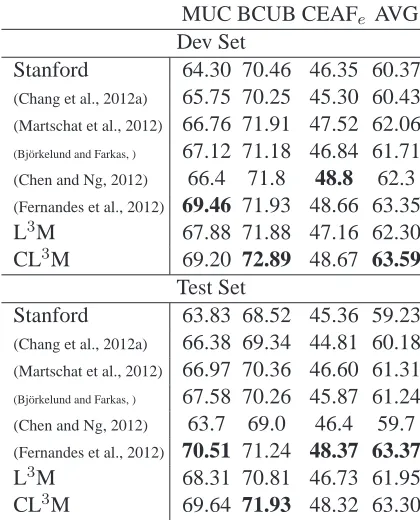
2004 (NIST, 2004). Table 1 exhibits our bottom line results: CL3M achieves the best result reported on Ontonotes-5.0 development set and essentially ties with (Fernandes et al., 2012) on the test set. As shown in Table 3, CL3M is also the best algorithm on ACE and when evaluated on the gold mentions of Ontonotes. We show that CL3M performs partic-ularly well on clusters containing named entity men-tions, which are more important for many informa-tion extracinforma-tion applicainforma-tions. In the rest of this sec-tion, after describing our experimental setting, we provide careful analysis of our algorithms and com-pare them to competitive coreference approaches in the literature.
5.1 Experimental Setup
Datasets: ACE 2004 contains 443 documents —
we used a standard split of these documents into 268 training, 68 development, and 106 testing doc-uments used by Culotta et al. (2007) and Bengt-son and Roth (2008). OntoNotes-5.0 dataset, re-leased for the CoNLL 2012 Shared Task (Pradhan et al., 2012), is by far the largest annotated corpus on coreference. It contains 3,145 annotated documents drawn from a wide variety of sources — newswire, bible, broadcast transcripts, magazine articles, and web blogs. We report results on both development set and test set. To test on the development set, we further split the training data into training and devel-opment sets.
Classifier details: For each of the pairwise
ap-proaches, we assume the pairwise score is given by w·φ(·,·)+twhereφare the features,wis the weight vector learned by the approach, andtis a threshold which we set to0during learning (as in Eq. (1)), but use a tuned value (tuned on a development set) dur-ing testdur-ing. For learndur-ing with L3M, we do stochastic gradient descent with 5 passes over the data. Empir-ically, we observe that this is enough to generate a stable model. For PL3M (Sec. 4), we tune the value of γ using the development set picking the best γ
from{0.0,0.2, . . . ,1.0}. Recall that whenγ = 0, PL3M is the same as L3M. We refer to L3M and PL3M with incorporating constraints during infer-ence as CL3M and CPL3M (Sec. 3.4), respectively.
Metrics: We compare the systems using three
Entity-based CEAF (CEAFe) (Luo, 2005). Follow-ing, the CoNLL shared tasks (Pradhan et al., 2012), we use the average F1 scores of these three metrics as the main metric of comparison.
Features: We build our system on the publicly
available Illinois-Coref system1primarily because it contains a rich set of features presented in Bengtson and Roth (2008) and Chang et al. (2012a) (the latter adds features for pronominal anaphora resolution). We also compare with the Best-Left-Link approach described by Bengtson and Roth (2008).
Constraints: We consider the following
con-straints in CL3M and CPL3M.
• SameSpan: two mentions must be linked to each other if they share the same surface text span and the number of words in the text span is larger than a threshold (set as 5 in our imple-mentation).
• SameDetNom: two mentions must be linked to each other if both mentions start with a de-terminer and the [0,1] wordnet-based similarity score between the mention head words is above a threshold (set to 0.8).
• SameProperName: two mentions must be linked if they are both proper names and the similarity score measured by a named entity-based similarity metric, Illinois NESim2, are
higher than a threshold (set to 0.8). For a per-son entity we add additional rules to extract the first name, last name and professional title as properties.
• ModifierMismatch: the constraint prevents two mentions to be linked if the head modifiers conflict. For example, the constraint prevents “northern Taiwan” from linking to “southern Taiwan”. We gather a list of mutual exclusive modifiers from the training data.
• PropertyMismatch: the constraint prevents two mentions to be linked if their properties con-flict. For example, it prevents male pronouns to link to female pronouns and “Mr. Clinton” to link to “Mrs. Clinton” by checking the gen-der property. The properties we consigen-der are gender, number, professional title and the
na-1
The system is available at http://cogcomp.cs. illinois.edu/page/software_view/Coref/
2http://cogcomp.cs.illinois.edu/page/
software_view/NESim
MUC BCUB CEAFe AVG Dev Set
Stanford 64.30 70.46 46.35 60.37
(Chang et al., 2012a) 65.75 70.25 45.30 60.43
(Martschat et al., 2012) 66.76 71.91 47.52 62.06
(Bj¨orkelund and Farkas, ) 67.12 71.18 46.84 61.71
(Chen and Ng, 2012) 66.4 71.8 48.8 62.3 (Fernandes et al., 2012) 69.46 71.93 48.66 63.35
L3M 67.88 71.88 47.16 62.30 CL3M 69.20 72.89 48.67 63.59
Test Set
Stanford 63.83 68.52 45.36 59.23
(Chang et al., 2012a) 66.38 69.34 44.81 60.18
(Martschat et al., 2012) 66.97 70.36 46.60 61.31
(Bj¨orkelund and Farkas, ) 67.58 70.26 45.87 61.24
(Chen and Ng, 2012) 63.7 69.0 46.4 59.7
(Fernandes et al., 2012) 70.51 71.24 48.37 63.37
[image:7.612.321.531.56.316.2]L3M 68.31 70.81 46.73 61.95 CL3M 69.64 71.93 48.32 63.30
Table 1: Performance on OntoNotes-5.0 with predicted mentions. We report the F1 scores (%) on various coref-erence metrics (MUC, BCUB, CEAF). The column AVG shows the average scores of the three. We observe that PL3M and CPL3M (see Sec. 4) yields the same perfor-mance as L3M and CL3M, respectively as the tunedγfor all the datasets turned out to be 0.
tionality.
While the “must-link” constraints described in the paper can be treated as features, due to their high precision, treating them as hard constraints (setρto a high value) is a safe and direct way to inject hu-man knowledge into the learning model. Moreover, our framework allows a constraint to use informa-tion from previous decisions (such as “cannot-link” constraints). Treating such constraints as features will complicate the learning model.
5.2 Performance of the End-to-End System
However, each system implements its own mention detector and pipelines the identified mentions into the coreference clustering component. Moreover, different systems use a different set of features. In order to partially control for errors on mention de-tection and better evaluate the clustering component in our coreference system, we will also present re-sults on correct (gold) mentions in the next section.
Table 1 shows the end-to-end results. On the development set, only the best performing system of Fernandes et al. (2012) is better than L3M, but this difference disappears when we use our system with constraints, CL3M. Although our system is much simple, it achieves the bestB3 score on the test set and is competitive with the best system participated in the CoNLL shared task 2012.
Performance on named entities: The
corefer-ence annotation in Ontonotes 5.0 includes various types of mentions. However, not all mention types are equally interesting. In particular, clusters which contain at least one proper name or a named entity mention are more important for information extrac-tion tasks like Wikificaextrac-tion (Mihalcea and Csomai, 2007; Ratinov et al., 2011), cross-document coref-erence resolution (Bagga and Baldwin, 1998), and entity linking and knowledge based population (Ji and Grishman, 2011).
Inspired by this, we compare our system to the best systems in the CoNLL shared task of 2011 (Stanford (Lee et al., 2011)) and 2012 (Fernan-des (Fernan(Fernan-des et al., 2012)) on the following spe-cific tasks on Ontonotes-5.0.
• ENT-C: Evaluate the system on clusters that
contain at least one proper name mention. We generate the gold annotation and system out-puts by using the gold and predicted name en-tity tag annotations provided by the CoNLL shard task 2012. That is, if a cluster does not include any name entity mention, then it will be removed from the final clustering.
• PER-C: As in the construction of ENT-C, but
here we only consider clusters which contain at least one “Person (PER)” entity.
• ORG-C: As in the construction of Entity-C, but
here we only consider clusters which contain at least one “Organization (ORG)” entity.
Typically, the clusters that get ignored in the above definitions contain only first and second person
Task Stanford Fernandes L3M CL3M ENT-C 44.06 47.05 46.63 48.02
PER-C 34.04 36.43 37.01 37.57
[image:8.612.315.536.56.110.2]ORG-C 25.02 26.23 26.22 27.01
Table 2: Performance on named entities for OntoNotes-5.0 data. We compare our system to Fernandes (Fernan-des et al., 2012) and Stanford (Lee et al., 2013) systems.
pronouns (which often happens in transcribed dis-course.) Also note that all the systems are trained with the same name entity tags, provided by the shared task organizers, and we use the same name entity tags to construct the specific clustering. Also, in order to further ensure fairness, we do not tune our system to favor the evaluation of these specific types of clusters. We chose to do so because we only have access to the system output of Fernandes et al. (2012).
Table 2 shows the results. The performance of all systems degrades when considering only clusters that contain name entities, indicating that ENT-C is actually a harder task than the original coreference resolution problem. In particular, resolving ORG coreferent clusters is hard, because names of organi-zations are sometimes confused with person names, and they can be referred to using a range of pronouns (including “we” and “it”). Overall, CL3M outper-forms all the competing systems on the clusters that contain at least one specific type of entity by a mar-gin larger than that for the overall coreference.
5.3 Analysis on Gold Mentions
MUC BCUB CEAFeAVG ACE 2004 Gold Ment.
All-Link-Red. 77.45 81.10 77.57 78.71 Spanning 73.31 79.25 74.66 75.74 IllinoisCoref 76.02 81.04 77.6 78.22 Stanford 75.04 80.45 76.75 77.41
(Stoyanov and Eisner, 2012) 80.1 81.8 -
-L3M 77.57 81.77 78.15 79.16
PL3M 78.18 82.09 79.21 79.83 CL3M 78.17 81.64 78.45 79.42 CPL3M 78.29 82.20 79.26 79.91
Ontonotes 5.0 Gold Ment.
All-Link-Red. 83.72 75.59 64.00 74.44 Spanning 83.64 74.83 61.07 73.18 IllinoisCoref 80.84 74.29 65.96 73.70 Stanford 82.26 76.82 61.69 73.59
L3M 83.44 78.12 64.56 75.37
PL3M 83.97 78.25 65.69 75.97 CL3M 84.10 78.30 68.74 77.05 CPL3M 84.80 78.74 68.75 77.43
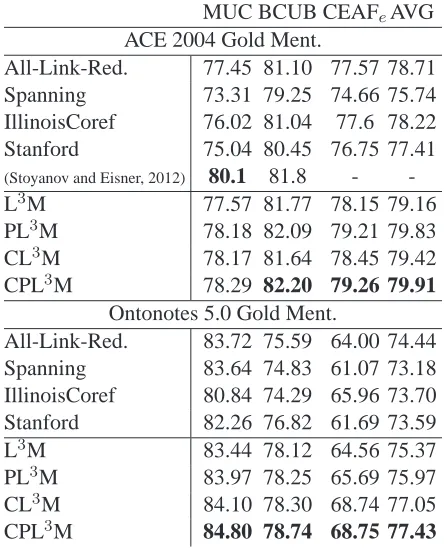
Table 3: Performance on ACE 2004 and OntoNotes-5.0. All-Link-Red. is based on correlational clustering; Span-ning is based on latent spanSpan-ning forest based clustering (see Sec. 2). Our proposed approach is L3M (Sec. 3) and PL3M (sec. 4). CL3M and CPL3M are the version with incorporating constraints.
1. All-Link-Red: a reduced and faster alterna-tive to the correlational clustering based ap-proach (Finley and Joachims, 2005). We im-plemented this algorithm as an ILP and droped one of the three transitivity constraints for each triplet of mention variables. Following Pascal and Baldridge (2009) and Chang et al. (2011) we observe that this slightly improves the ac-curacy over a pure correlation clustering ap-proach, in addition to speeding up inference. 2. Spanning: the latent spanning forest based
ap-proach presented by Yu and Joachims (2009). We use the publicly available implementation provided by the authors3 for the ACE data; since their CCCP implementation is slow, we implemented our own stochastic gradient de-scent version to scale it to the much larger Ontonotes data.
[image:9.612.70.294.57.331.2]3Available at http://www.cs.cornell.edu/ cnyu/latentssvm/
Table 3 lists the results. Although L3M is simple and use only the features defined on pairwise men-tions, it compares favorably with all recently pub-lished results. Moreover, the probabilistic general-ization of L3M, PL3M, achieves even better perfor-mance. For example, L3M withγ = 0.2 improves L3M withγ = 0by 0.7 points in ACE 2004. In par-ticular, This shows that considering more than a one left-links is helpful. This is in contrast with the pre-dicted mentions whereγ = 0 performed best. We suspect that this is because noisy mentions can hurt the performance of PL3M that takes into account not just the best scoring links, but also weaker links which are likely to be less reliable (more false pos-itives). Also, as opposed to what is reported by Yu and Joachims (2009), the correlation clustering proach performs better than the spanning forest ap-proach. We think that this is because we compare the systems on different metrics than they did and also because we use exact ILP inference for corre-lational clustering whereas Yu and Joachims (2009) used approximate greedy inference.
Both L3M and PL3M can be benefit from using constraints. However, The constraints improve only marginally on the ACE 2004 data because ACE uses shorter phrases as mentions. Consequently, con-straints designed for leveraging information from long mention spans are less effective. Overall, the experiments show that L3M and PL3M perform well on modeling coreference clustering.
5.4 Ablation Study of Constrains
MUC BCUB CEAFe AVG
L3M 67.88 71.88 47.16 62.30
+SameSpan 68.27 72.27 47.73 62.75 +SameDetNom 68.79 72.57 48.30 63.22 +SameProperName 69.11 72.81 48.56 63.49 +ModifierMismatch 69.11 72.81 48.58 63.50 +PropertyMismatch
69.20 72.89 48.67 63.59 (i.e. CL3M)
[image:10.612.75.296.56.232.2]-SameSpan 68.91 72.66 48.36 63.31 -SameDetNom 68.62 72.51 48.06 63.06 -SameProperName 68.97 72.69 48.50 63.39 -ModifierMismatch 69.12 72.80 48.63 63.52 -PropertyMismatch 69.11 72.81 48.58 63.50
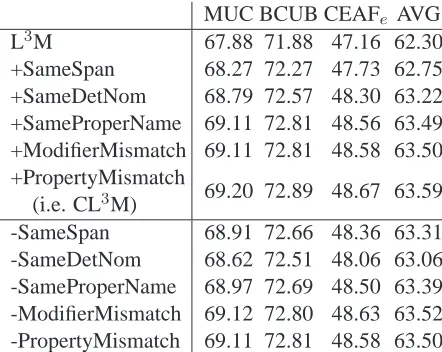
Table 4: Ablation study on constraints. We first show cumulative performance on OntoNotes-5.0 data with pre-dicted mentions as constraints are added one at a time into the coreference system. Then we demonstrate the value of individual constraints by leaving out one constraint at each time.
recall of L3M are 78.38% and 67.96%, respectively inB3). As a result, the must-link constraints, which aim at improving the recall, do better when optimiz-ing F1.
6 Conclusions
We presented a principled yet simple framework for coreference resolution. Furthermore, we showed that our model can be augmented in a straightfor-ward way with knowledge based constraints, to im-prove performance. We also presented a probabilis-tic generalization of this model that can take into account entity-mention links by considering mul-tiple possible coreference links. We proposed a fast stochastic gradient-based learning technique for our model. Our model, while operating at men-tion pair granularity, obtains state-of-the-art results on OntoNotes-5.0, and performs especially well on mention clusters containing named entities. We pro-vided a detailed analysis of our experimental results.
Acknowledgments Supported by the Intelligence Advanced Research Projects Activity (IARPA) via Department of Interior National
Business Center contract number D11PC20155. The U.S. Government
is authorized to reproduce and distribute reprints for Governmental
pur-poses notwithstanding any copyright annotation thereon. Disclaimer:
The views and conclusions contained herein are those of the authors and
should not be interpreted as necessarily representing the official policies
or endorsements, either expressed or implied, of IARPA, DoI/NBC, or
the U.S. Government.
References
A. Bagga and B. Baldwin. 1998. Algorithms for scoring coreference chains. In In The First International Con-ference on Language Resources and Evaluation Work-shop on Linguistics Coreference.
M. Bansal and D. Klein. 2012. Coreference semantics from web features. In Proceedings of ACL, Jeju Island, South Korea, July.
N. Bansal, A. Blum, and S. Chawla. 2002. Correlation clustering. In Proceedings of the 43rd Symposium on Foundations of Computer Science.
E. Bengtson and D. Roth. 2008. Understanding the value of features for coreference resolution. In EMNLP, 10. A. Bj¨orkelund and R. Farkas.
K.-W. Chang, R. Samdani, A. Rozovskaya, N. Rizzolo, M. Sammons, and D. Roth. 2011. Inference protocols for coreference resolution. In CoNLL Shared Task. K.-W. Chang, R. Samdani, A. Rozovskaya, M. Sammons,
and D. Roth. 2012a. Illinois-coref: The UI system in the CoNLL-2012 Shared Task. In CoNLL Shared Task.
M. Chang, L. Ratinov, and D. Roth. 2012b. Structured learning with constrained conditional models. Ma-chine Learning, 88(3):399–431, 6.
C. Chen and V. Ng. 2012. Combining the best of two worlds: A hybrid approach to multilingual corefer-ence resolution. In Joint Confercorefer-ence on EMNLP and CoNLL - Shared Task.
J. Clarke and M. Lapata. 2006. Constraint-based sentence compression: An integer programming ap-proach. In Proceedings of the Annual Meeting of the Association for Computational Linguistics (ACL), pages 144–151, Sydney, Australia, July. ACL. A. Culotta, M. Wick, R. Hall, and A. McCallum. 2007.
First-order probabilistic models for coreference reso-lution. In HLT/NAACL.
P. Denis and J. Baldridge. 2007. Joint determination of anaphoricity and coreference resolution using integer programming. In Proceedings of the Annual Meeting of the North American Association of Computational Linguistics (NAACL).
P. Denis and J. Baldridge. 2008. Specialized models and ranking for coreference resolution. In EMNLP, pages 660–669.
E. R. Fernandes, C. N. dos Santos, and R. L. Milidi´u. 2012. Latent structure perceptron with feature induc-tion for unrestricted coreference resoluinduc-tion. In Joint Conference on EMNLP and CoNLL - Shared Task. T. Finley and T. Joachims. 2005. Supervised
cluster-ing with support vector machines. In Proceedings of the International Conference on Machine Learning (ICML).
K. Ganchev, J. Grac¸a, J. Gillenwater, and B. Taskar. 2010. Posterior regularization for structured latent variable models. Journal of Machine Learning Re-search.
K. Gimpel and N. A. Smith. 2010. Softmax-margin CRFs: Training log-linear models with cost functions. In NAACL.
A. Haghighi and D. Klein. 2010. Coreference resolution in a modular, entity-centered model. In NAACL. H. Ji and R. Grishman. 2011. Knowledge base
popula-tion: successful approaches and challenges. In Pro-ceedings of the 49th Annual Meeting of the Associa-tion for ComputaAssocia-tional Linguistics: Human Language Technologies - Volume 1.
T. Koo, A. M. Rush, M. Collins, T. Jaakkola, and D. Son-tag. 2010. Dual decomposition for parsing with non-projective head automata. In EMNLP.
H. Lee, Y. Peirsman, A. Chang, N. Chambers, M. Sur-deanu, and D. Jurafsky. 2011. Stanford’s multi-pass sieve coreference resolution system at the conll-2011 shared task. In Proceedings of the CoNLL-conll-2011 Shared Task.
H. Lee, A. Chang, Y. Peirsman, N. Chambers, M. Sur-deanu, and D. Jurafsky. 2013. Deterministic coref-erence resolution based on entity-centric, precision-ranked rules. Computational Linguistics, 39(4). X. Luo. 2005. On coreference resolution performance
metrics. In EMNLP.
S. Martschat, J. Cai, S. Broscheit, ´E. M´ujdricza-Maydt, and M. Strube. 2012. A multigraph model for corefer-ence resolution. In Joint Confercorefer-ence on EMNLP and CoNLL - Shared Task, July.
A. McCallum and B. Wellner. 2003. Toward condi-tional models of identity uncertainty with application to proper noun coreference. In The Conference on Advances in Neural Information Processing Systems (NIPS).
R. Mihalcea and A. Csomai. 2007. Wikify!: linking doc-uments to encyclopedic knowledge. In CIKM. V. Ng and C. Cardie. 2002. Improving machine learning
approaches to coreference resolution. In ACL. Vincent Ng. 2005. Supervised ranking for pronoun
res-olution: Some recent improvements. In AAAI, pages 1081–1086.
NIST. 2004. The ACE evaluation plan.
D. Pascal and J. Baldridge. 2009. Global joint models for coreference resolution and named entity classification. In Procesamiento del Lenguaje Natural.
P. Pletscher, C. S. Ong, and J. M. Buhmann. 2010. En-tropy and margin maximization for structured output learning. In ECML PKDD.
S. Pradhan, L. Ramshaw, M. Marcus, M. Palmer, R. Weischedel, and N. Xue. 2011. Conll-2011 shared task: Modeling unrestricted coreference in ontonotes. In CoNLL.
S. Pradhan, A. Moschitti, N. Xue, O. Uryupina, and Y. Zhang. 2012. CoNLL-2012 shared task: Modeling multilingual unrestricted coreference in OntoNotes. In CoNLL 2012.
M. Sammons Y. Tu V. Vydiswaran Q. Do, D. Roth. 2009. Robust, light-weight approaches to compute lexical similarity. Technical report.
K. Raghunathan, H. Lee, S. Rangarajan, N. Chambers, M. Surdeanu, D. Jurafsky, and C. Manning. 2010. A multi-pass sieve for coreference resolution. In EMNLP.
A. Rahman and V. Ng. 2011a. Coreference resolution with world knowledge. In ACL, pages 814–824. A. Rahman and V. Ng. 2011b. Ensemble-based
corefer-ence resolution. In IJCAI.
A. Rahman and V. Ng. 2011c. Narrowing the modeling gap: a cluster-ranking approach to coreference resolu-tion. JAIR.
W.M. Rand. 1971. Objective criteria for the evaluation of clustering methods. Journal of the American Statis-tical Association, 66(336):846–850.
L. Ratinov and D. Roth. 2012. Learning-based multi-sieve co-reference resolution with knowledge. In EMNLP.
L. Ratinov, D. Roth, D. Downey, and M. Anderson. 2011. Local and global algorithms for disambiguation to wikipedia. In Proc. of the Annual Meeting of the Association for Computational Linguistics (ACL). Dan Roth and Wen Tau Yih. 2004. A linear
program-ming formulation for global inference in natural lan-guage tasks. In Proceedings of CoNLL-04, pages 1–8. R. Samdani, M. Chang, and D. Roth. 2012. Unified
ex-pectation maximization. In NAACL.
W. M. Soon, H. T. Ng, and D. C. Y. Lim. 2001. A ma-chine learning approach to coreference resolution of noun phrases. Comput. Linguist.
V. Stoyanov and J. Eisner. 2012. Easy-first coreference resolution. In COLING, pages 2519–2534.
V. Stoyanov, N. Gilbert, C. Cardie, and E. Riloff. 2009. Conundrums in noun phrase coreference resolution: making sense of the state-of-the-art. In ACL.
scoring scheme. In Proceedings of the 6th conference on Message understanding.
C. Yu and T. Joachims. 2009. Learning structural svms with latent variables. In Proceedings of the Interna-tional Conference on Machine Learning (ICML). A. L. Yuille and A. Rangarajan. 2003. The