Construction of an Idiom Corpus and its Application to Idiom Identification
based on WSD incorporating Idiom-Specific Features
Chikara Hashimoto
Graduate School of Science and Engineering Yamagata University
Yonezawa, Yamagata, 992-8510, JAPAN
Daisuke Kawahara
National Institute of Information and Communications Technology Sorakugun, Kyoto, 619-0289, JAPAN
Abstract
Some phrases can be interpreted either id-iomatically (figuratively) or literally in con-text, and the precise identification of idioms is indispensable for full-fledged natural lan-guage processing (NLP). To this end, we have constructed an idiom corpus for Japanese. This paper reports on the corpus and the re-sults of an idiom identification experiment us-ing the corpus. The corpus targets 146 am-biguous idioms, and consists of 102,846 sen-tences, each of which is annotated with a lit-eral/idiom label. For idiom identification, we targeted 90 out of the 146 idioms and adopted a word sense disambiguation (WSD) method using both common WSD features and idiom-specific features. The corpus and the experi-ment are the largest of their kind, as far as we know. As a result, we found that a standard supervised WSD method works well for the idiom identification and achieved an accuracy of 89.25% and 88.86% with/without idiom-specific features and that the most effective idiom-specific feature is the one involving the adjacency of idiom constituents.
1 Introduction
Some phrases like kick the bucket are ambiguous with regard to whether they carry literal or idiomatic meaning in a certain context. This ambiguity needs to be resolved in the same manner as ambiguous words that have been dealt with in the WSD liter-ature. We term the resolution of the literal/idiomatic ambiguity as idiom identification, hereafter.
Idiom identification is classified into two kinds; one is for idiom types and the other is for idiom
to-kens. With the former, phrases that can be inter-preted as idioms are found in text corpora, typically for compiling idiom dictionaries. On the other hand, the latter helps identify a phrase in context as a true idiom or a phrase that should be interpreted literally (a literal phrase, henceforth). In this paper, we deal with the latter, i.e., idiom token identification.
Despite the recent enthusiasm for multiword ex-pressions (MWEs) (Gr´egoire et al., 2007; Gr´egoire et al., 2008), the idiom token identification is in an early phase of its development. Given that many NLP tasks like machine translation or parsing have been developed as a result of the availability of lan-guage resources, idiom token identification should also be developed when adequate idiom resources are provided. To this end, we have constructed a Japanese idiom corpus. We have also conducted an idiom identification experiment using the corpus that we hope will be a good reference point for fu-ture studies on the task. We drew on a standard WSD framework with machine learning exploiting both features commonly used in the WSD studies and idiom-specific features. This paper reports in detail the corpus and the result of the experiment; herein, it must be noted that to the best of our knowl-edge, the corpus and the experiment are the largest ever of their kind.
We only deal with the ambiguity between lit-eral and idiomatic interpretations. However, some phrases have two or more idiomatic meanings with-out context. For example, a Japanese idiom te-o dasu (hand-ACC stretch)1 can be interpreted as
ei-1
ACC is the accusative case marker. Likewise we use the following notation in this paper;NOMfor the nominative case
ther “punch,” “steal” or “make moves on.” This kind of ambiguity should be placed on the agenda.
We do not tackle the problem of what constitutes the notion of “idiom.” We simply regard phrases listed in Sato (2007) as idioms.
The reminder of this paper is organized as fol-lows. In§2 we present related works. §3 shows the target idioms. After the idiom corpus is described in§4, we detail our idiom identification method and experiment in§5. Finally§6 concludes the paper.
2 Related Work
There have only been a few works on the con-struction of an idiom corpus. In this regard, Birke and Sarkar (2006) and Cook et al. (2008) are no-table exceptions. Birke and Sarkar (2006) auto-matically constructed a corpus of English idiomatic expressions (words that can be used non-literally). They targeted 50 expressions and collected about 6,600 examples. They call the corpus TroFi Exam-ple Base, which is available on the Web.2 Cook et al. (2008) compiled a corpus of English verb-noun combinations (VNCs) tokens. Their corpus deals with 53 VNC expressions and consists of about 3,000 example sentences. Like ours, they assigned each example with a label indicating whether an ex-pression in the example is used literally or idiomati-cally. Our corpus can be regarded as the Japanese idiom counterpart of these works. However, note that our corpus targets 146 idioms and consists of as many as 102,846 example sentences. Another ex-ception is Tsuchiya et al. (2006), who manually con-structed an example database of Japanese compound functional expressions named MUST. They provide it on the Web.3 Some of the compound functional expressions in Japanese are ambiguous like idioms are.4
marker,DATfor the dative case marker, andGENfor the genitive case marker. FROMandTOstand for the Japanese counterparts offromandto.NEGrepresents a verbal negation morpheme.
2http://www.cs.sfu.ca/
∼anoop/students/jbirke/
3http://nlp.iit.tsukuba.ac.jp/must/
4For example, (something)-ni-atatte ((something)-DAT -run.into) means either “run into (something)” or “on the occa-sion of (something).” The former is the literal interpretation and the latter is the idiomatic interpretation of the compound func-tional expression.
The SAID dataset5 provides data about the syn-tactic flexibility of English idioms. It does not con-cern itself with idiom token identification. How-ever, as in Hashimoto et al. (2006b), Hashimoto et al. (2006a) and Cook et al. (2007) among others, the syntactic behavior of idioms is an important clue to idiom token identification.
Previous studies have mostly focused on the id-iom type identification (Lin, 1999; Krenn and Evert, 2001; Baldwin et al., 2003; Shudo et al., 2004; Fa-zly and Stevenson, 2006). However, there has been a growing interest in idiom token identification in re-cent times (Katz and Giesbrecht, 2006; Hashimoto et al., 2006b; Hashimoto et al., 2006a; Birke and Sarkar, 2006; Cook et al., 2007). Katz and Gies-brecht (2006) compared the word vector of an id-iom in context and that of the constituent words of the idiom using LSA in order to determine if the expression is idiomatic. Hashimoto et al. (2006b) and Hashimoto et al. (2006a) (HSU henceforth) fo-cused their attention on the differences in gram-matical constraints imposed on idioms and their lit-eral counterparts such as the possibility of passiviza-tion, and developed handcrafted rules for Japanese idiom identification. Although their task is ex-actly the same as ours and we draw on the gram-matical knowledge provided by them, the scale of their experiment is very small, since only 108 sen-tences were used for idiom identification in their pa-per. Further, unlike HSU, we employ matured WSD technologies. Cook et al. (2007) (CFS henceforth) propose an unsupervised method for English on the basis of the observation that idioms tend to be ex-pressed in a small number of fixed forms.
These studies used only the characteristics of id-ioms (or MWEs). On the other hand, we exploit a WSD method, for which there have been many studies and matured technologies, in addition to the characteristics of idioms. Birke and Sarkar (2006) also used WSD. However, they employed an unsu-pervised method, while ours is a completely super-vised one.
Apart from idioms, Uchiyama et al. (2005) con-ducted the token classification of Japanese com-pound verbs exploiting supervised method.
5
3 Target Idioms
For this study, we selected 146 idioms through the following procedure. 1 We extracted basic idioms from Sato (2007). Sato compiled about 3,600 basic idioms of Japanese from five books: two dictionaries for elementary school, two idiom dictionaries, and one linguistics book on idioms. We extracted those idioms that were described in more than two of these five books. The total number of such idioms added up to 926. 2 From among these idioms, we chose ambiguous ones.6 As a result, 146 idioms were se-lected.
As for 2, sometimes it is not trivial to determine if an idiom is ambiguous or not. Some idioms are rarely interpreted literally, while others, in all likeli-hood, take on the literal meaning. Is it meaningful to regard them as ambiguous and deal with them in this study? If not, how does one assuredly distinguish truly ambiguous idioms from those that are mostly interpreted either literally or figuratively? This can only be done if there is an accurate idiom identifica-tion system.
After all, we asked two native speakers of Japanese (Group A) to classify idioms into two classes: 1) truly ambiguous ones and 2) completely unambiguous or practically unambiguous ones. On the basis of the classification, one of the authors made final judgments.
To verify how stable this ambiguity endorsement was, we asked another two other native speakers of Japanese (Group B) to perform the same task and calculated the Kappa statistic between the two speakers. First, we sampled 101 idioms from the 926 chosen earlier. Then, the two members of Group B classified the sampled idioms into the two classes. The Kappa statistic was found to be 0.6576, which indicates middling stability.
Tables 2 and 3 list some of the target idioms.
4 Idiom Corpus
4.1 Corpus Specification
The corpus is designed for the idiom token iden-tification task. That is, each example sentence in the corpus is annotated with a label that indicates
6Some idioms likeby and largedo not have a literal mean-ing. They are not dealt with in this paper.
whether the corresponding phrase in the example is used as an idiom or a literal phrase. We call the for-mer the positive example and the latter the negative example. More specifically, the corpus consists of lines that each represent one example. A line con-sists of four fields as follows: 1 Label indicates whether the example is positive or negative. Labeli is used for positive examples andlfor negative ones. 2 IDdenotes the idiom that is included in the exam-ple. In this study, each idiom has a unique num-ber, which is based on Sato (2007). 3 Lemmaalso shows the idiom in the example. We assigned each idiom its canonical (or standard) form on the basis of Sato (2007). 4 Exampleis the example itself.
Given below is a sample of a negative example of goma-o suru(sesame-ACCcrush) ’flatter’.
• l 1417 !"#$% $&'(!"#$&· · ·
The third field is the lemma of the idiom. The last one is the example that says ’crushing sesame in a mortar...’
Before working on the corpus construction, we prepared a reference by which human annotators could consistently distinguish between the literal and figurative meanings of idioms. To be more pre-cise, this reference specified literal and idiomatic meanings for each idiom like dictionaries do. For example, the entry forgoma-o suruin the reference is as follows.
Idiom:To flatter people. Literal: To crush sesame.
As for the corpus size, we continued to anno-tate examples for each idiom, regardless of the pro-portion of idioms and literal phrases, until the total number of examples for each idiom reached 1,000.7 In the case of a shortage of original data, we anno-tated as many examples as possible. The original data were sourced from the Japanese Web corpus (Kawahara and Kurohashi, 2006).
4.2 Corpus Construction
We constructed the corpus in the following man-ner: 1 From the Web corpus, we collected exam-ple sentences that contained one of our target id-ioms whichever meaning (positive or negative) they
7For idioms that we sampled for preliminary annotation, we
0 10 20 30 40 50 60
0 500 1000 1500 2000 2500 3000
# of Types
[image:4.612.316.533.56.234.2]# of Examples
Figure 1: Distribution of the number of examples
take on. Concretely speaking, we automatically col-lected sentences in which constituent words of one of our targets appeared in a canonical dependency relationship by using KNP8, a Japanese dependency parser. 2 We classified the collected examples as positive and negative. This was done by human an-notators and was based on the reference to distin-guish the two meanings. For annotation, longer amples were given higher priority than shorter ex-amples. Note that we discarded examples that were collected by mistake due to dependency parsing er-rors and those that lacked a context that could help them be interpreted correctly.
This was done by the two members of Group A and took 230 hours.
4.3 Status of Corpus
The corpus consists of 102,846 examples.9 Figure 1 shows the distribution of the number of examples. For 68 idioms, we annotated more than 1,000 exam-ples. However, we annotated less than 100 examples for 17 idioms because of inadequate original data.
The average number of words in a sentence is 46. Idiom in Figure 2 shows the distribution of sen-tence length (the number of words) in the corpus. Weband Newsindicate the sentence length in the Web and a newspaper corpora, respectively. This is drawn from Kawahara and Kurohashi (2006). As
8http://nlp.kuee.kyoto-u.ac.jp/nl-resource/knp.html
9Note that the figures reported here are for the corpus of the
2008-06-25 version and will be slightly changed over time.
0 0.05 0.1 0.15 0.2 0.25 0.3
76-80 71-75 66-70 61-65 56-60 51-55 46-50 41-45 36-40 31-35 26-30 21-25 16-20 11-15 6-10 1-5
Sentence Ratio
# of Words in a Sentence
[image:4.612.76.298.58.234.2]Web News Idiom
Figure 2: Distribution of sentence length
you see, our corpus contains many more long sen-tences. This is because longer sentences were given priority for annotation, as stated in §4.2. Figure 3 shows the longest and shortest examples each for lit-eral and idiomatic meanings ofgoma-o surudrawn from the corpus.
To determine how consistent the positive/negative annotation is across different human annotators, we sampled 1,421 examples from the corpus, asked the two members of Group B to do the same annota-tion, and calculated the Kappa statistic between the two. The value was 0.8519, which indicates very high agreement.
The corpus is available on the Web.10 Currently we provide the list of the basic Japanese idioms we are dealing with, the idiom corpus, and the vector representation data used for the idiom identification experiment. The corpus is protected under the BSD license.
5 Idiom Identification Experiment
5.1 Method of Idiom Identification
We adopted a standard WSD method using machine learning. More specifically, we used SVM (Vap-nik, 1995) with a quadratic kernel implemented in TinySVM.11The features we used are classified into either those that have been commonly used in WSD on the lines of Lee and Ng (2002) (LN hereafter),
10http://openmwe.sourceforge.jp/
• )*+,-./012345678-./012,9:;<=>?(@A$%BC>?#
D2$%0EF;GHIJK$%LMNOGHI@A2P&,QROGH8STUV%L WXY34567;Z[\#]^+_W%`Lab,cdI+))a(ef)gX2,hi
jklmnopo2!"#$%,qr;st2`u#v&,wxIyz_m{|}*~(,
•€+W•‚;ƒ"„…W(,N†,‡ˆ+z,‰Š({‹Œ~%`L*•XŽ
(But I suspect that the show managers of IT ventures will remain sly and audacious, and survive byflatteringmanufacturers, bending over themselves to accede to the demands of governmental agencies, and talking glibly about buzz terms, without intelligence but with vitality, just like the brokers of prostitutes in the Edo period were, because Gresham’s law of 1562 says that any circulating currency consisting of both good and bad money quickly becomes dominated by the bad money.)
• •2!"#$&•‘’“”•Ž
(Just like a pretty officialflatteringhis boss.)
• –)—˜#ƒ™$28,š›œ„)WO•žIeVŸWW;($I,OW ¡¢8,!"
#$&m;(£$a,mfL¤¥O¦ZL+_8,§¨o© ª2—˜#«V,¬#+_
“-©#a~_®;•ab¯(`$%gX2$ %LWW(+°XŽ
(In order to mash boiled soybeans, it is the best to use a meat chopper, but if you don’t have one, use the thing tocrush sesame, or put them into a plastic bag, cover it with a towel, then mash it with a glass bottle, which is easier.)
• !"#$%±²³Le´%
[image:5.612.70.530.53.395.2](Crushing sesame, then adding seasonings to it.)
Figure 3: The longest and shortest examples for both literal and idiomatic meanings ofgoma-o suru
or those that have been designed for Japanese idiom identification proposed by HSU.12
• Common WSD Features
f1: POS of three words on the left side of idiom and three words on the right side
f2: Local collocations
f3: Single words in the surrounding context f4a: Lemma of the rightmost word among
those words that are the dependents of the leftmost constituent word of idiom13 f4b: POS of the rightmost word among those
words that are the dependents of the left-most constituent word of idiom
f5a: Lemma of the word which the rightmost constituent word of idiom is the dependent of
12Remember that HSU implemented them in handcrafted
rules. We adapted them to a machine learning framework. 13Note that Japanese is a head final language.
f5b: POS of the word which the rightmost con-stituent word of idiom is the dependent of f6: Hypernyms of words in the surrounding
context
f7: Domains of words (Hashimoto and Kuro-hashi, 2007; Hashimoto and KuroKuro-hashi, 2008) in the surrounding context
• Idiom-Specific Features
f8: Adnominal modification flag f9: Topic case marking flag f10: Voice alternation flag f11: Negation flag
f12: Volitional modality flag f13: Adjacency flag
We used JUMAN,14a morphological analyzer of Japanese, and KNP to extract these features.
f2andf3are the same as those described in LN. Butf1is slightly different in that we did not use the P0 of LN.f4andf5roughly correspond to the syn-tactic relations of LN. We adapted it to Japanese id-ioms along with some simplifications. In the case of the example ofmune-o utu(chest-ACChit) ‘impress’ below,15f4is the POS and lemma oftyousyuandf5 corresponds to those ofuta.16
• tyousyu-no audience-GEN
mune-o chest-ACC
utu hit
utukusi beautiful
uta song ‘A beautiful song thatimpressesthe audience’
f6 and f7 are available from JUMAN’s output. For example, the hypernym of tyousyu (audience) is human and its domain is culture/media. Those of uta (song) are abstract-thing and culture/recreation. They are not used in LN, but they are known to be useful for WSD (Tanaka et al., 2007; Magnini et al., 2002).
f8indicates whether a nominal constituent of an idiom, if any, undergoes adnominal modification. f9 indicates whether one of Japanese topic case mark-ers is attached to a nominal constituent of an idiom, if any. f10is turned on when a passive or causative suffix is attached to a verbal constituent of an idiom, if any.17 f11andf12are similar tof10. The former is used for negated forms and the latter for volitional modality suffixes of a predicate part of an idiom, if any.18 Volitional modality includes expressions like order, request, permission, prohibition, and volition. Finally,f13indicates whether the constituents of an idiom is adjacent to each other.
As discussed in HSU, the idiom-specific fea-tures are effective to distinguish idioms from lit-eral phrases. For example, the idiom goma-o suru does not allow adnominal modification, while its lit-eral counterpart does. Similarly, the idiom mune-o utucannot take volitional modality unlike its literal counterpart.
15The arrows indicate dependency relations.
16Functional words attaching to either thef4word or thef5 word are ignored. In the example,no(GEN) is ignored.
17Passivization is indicated by the suffix(r)arein Japanese. But the same suffix is also used for honorification, potentials and spontaneous potentials. Since it is beyond the current tech-nology, we gave up distinguishing them.
18Note thatf10,f11andf12are applied to only those idioms that can be used as predicates.
5.2 Experimental Condition
In the experiment, we dealt with 90 idioms for which more than 50 examples for both idiomatic and literal usages were available.19 We conducted experiments for each idiom.
The performance measure is the accuracy.
Accuracy=
# of examples correctly identified # of all example
The baseline system uniformly regards all ex-amples as either positive or negative depending on which is more dominant in the idiom corpus. Natu-rally, this is prepared for each idiom.
Baseline=
max(# of positive, # of negative) # of all example
The accuracy and the baseline accuracy for each idiom are calculated in a 10-fold cross validation style; we split examples of an idiom into 10 pieces in advance of the experiment.
Also, we calculated the overall accuracy and baseline accuracy from the individual results. We summed up all accuracy scores of all the 90 idioms and then divided it by 90, which is called the macro-average. We did this for the baseline accuracy, too.
Another performance measure is the relative error reduction (RER).20
RER=
ER of baseline−ER of system ER of baseline
The overall RER is calculated from the overall ac-curacy and baseline by the above formula.
5.3 Experimental Result
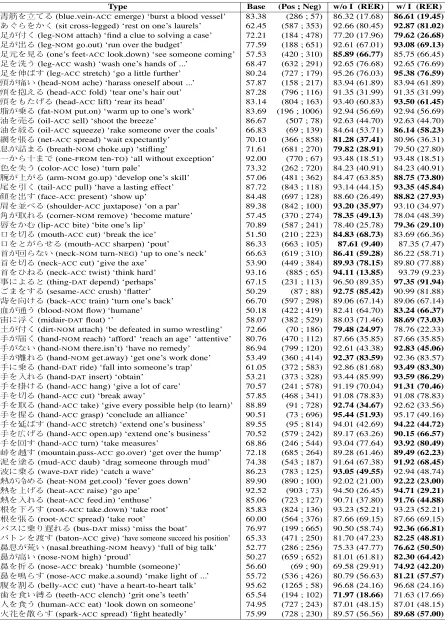
Table 1 shows the overall performance. The first umn is the baseline accuracy (%). The second col-umn is the accuracy (%) and relative error reduction (%) of the system without the idiom-specific fea-tures. The third column is those of the system with the idiom features. Tables 2 and 3 show the individ-ual results of the 90 idioms. The first column shows
19Some examples were unavailable due to the feature
extrac-tion failure. Thus, examples used for the experiment are fewer in number than those included in the corpus.
Table 2: Individual Results (1/2)
Type Base (Pos ; Neg) w/o I (RER) w/ I (RER) µ¶#·_%(blue.vein-ACCemerge) ‘burst a blood vessel’ 83.38 (286 ; 57) 86.32 (17.68) 86.61 (19.45) e¸b#az(sit cross-legged) ‘rest on one’s laurels’ 62.45 (587 ; 353) 92.66 (80.45) 92.87 (81.02) ¹Iºz(leg-NOMattach) ‘find a clue to solving a case’ 72.21 (184 ; 478) 77.20 (17.96) 79.62 (26.68) ¹I»%(leg-NOMgo.out) ‘run over the budget’ 77.59 (188 ; 651) 92.61 (67.01) 93.08 (69.13) ¹¼#½%(one’s feet-ACClook.down) ‘see someone coming’ 57.53 (420 ; 310) 85.89 (66.77) 85.75 (66.45) ¹#¾X(leg-ACCwash) ‘wash one’s hands of ...’ 68.47 (632 ; 291) 92.65 (76.68) 92.65 (76.69) ¹#¿Ÿ$(leg-ACCstretch) ‘go a little further’ 80.24 (727 ; 179) 95.26 (76.03) 95.38 (76.59) ÀIÁW(head-NOMache) ‘harass oneself about ...’ 57.87 (158 ; 217) 83.94 (61.89) 83.94 (61.89) À#´%(head-ACCfold) ‘tear one’s hair out’ 87.28 (796 ; 116) 91.35 (31.99) 91.35 (31.99) À#m)Ã%(head-ACClift) ‘rear its head’ 83.14 (804 ; 163) 93.40 (60.83) 93.50 (61.45) ÄIÅ%(fat-NOMput.on) ‘warm up to one’s work’ 83.69 (196 ; 1006) 92.94 (56.69) 92.94 (56.69) Æ#v%(oil-ACCsell) ‘shoot the breeze’ 86.67 (507 ; 78) 92.63 (44.70) 92.63 (44.70) Æ#Ç%(oil-ACCsqueeze) ‘rake someone over the coals’ 66.83 (69 ; 139) 84.64 (53.71) 86.14 (58.23) È#É%(net-ACCspread) ‘wait expectantly’ 70.10 (366 ; 858) 81.28 (37.41) 80.96 (36.31) ÊIË"%(breath-NOMchoke.up) ‘stifling’ 71.61 (681 ; 270) 79.82 (28.91) 79.50 (27.80) :abÌ"((one-FROMten-TO) ‘all without exception’ 92.00 (770 ; 67) 93.48 (18.51) 93.48 (18.51) Í#ÎX(color-ACClose) ‘turn pale’ 73.32 (262 ; 720) 84.23 (40.91) 84.23 (40.91) ÏI•I%(arm-NOMgo.up) ‘develop one’s skill’ 57.06 (481 ; 362) 84.47 (63.85) 88.75 (73.80) Ð#Ñz(tail-ACCpull) ‘have a lasting effect’ 87.72 (843 ; 118) 93.14 (44.15) 93.35 (45.84) Ò#»$(face-ACCpresent) ‘show up’ 84.48 (697 ; 128) 88.60 (26.49) 88.82 (27.93) Ó#ÔÕ%(shoulder-ACCjuxtapose) ‘on a par’ 89.38 (842 ; 100) 93.20 (35.97) 93.10 (34.97) ÖI×V%(corner-NOMremove) ‘become mature’ 57.45 (370 ; 274) 78.35 (49.13) 78.04 (48.39) Ø#aÙ(lip-ACCbite) ‘bite one’s lip’ 70.89 (587 ; 241) 78.40 (25.78) 79.36 (29.10) Ú#Û%(mouth-ACCcut) ‘break the ice’ 51.50 (210 ; 223) 84.83 (68.73) 83.69 (66.36) Ú#LIbÜ%(mouth-ACCsharpen) ‘pout’ 86.33 (663 ; 105) 87.61 (9.40) 87.35 (7.47) ÝIÞbOW(neck-NOMturn-NEG) ‘up to one’s neck’ 66.63 (619 ; 310) 86.41 (59.28) 86.22 (58.71) Ý#Û%(neck-ACCcut) ‘give the axe’ 53.90 (449 ; 384) 89.93 (78.15) 89.80 (77.88) Ý#ßà%(neck-ACCtwist) ‘think hard’ 93.16 (885 ; 65) 94.11 (13.85) 93.79 (9.23) á2g%L(thing-DATdepend) ‘perhaps’ 67.15 (231 ; 113) 96.50 (89.35) 97.35 (91.94) !"#$%(sesame-ACCcrush) ‘flatter’ 50.29 (87 ; 88) 92.75 (85.42) 90.99 (81.88) â#ã~%(back-ACCtrain) ‘turn one’s back’ 66.70 (597 ; 298) 89.06 (67.14) 89.06 (67.14) äIAX(blood-NOMflow) ‘humane’ 50.18 (422 ; 419) 82.41 (64.70) 83.24 (66.37) å2æz(midair-DATfloat) ‘’ 58.07 (382 ; 529) 88.03 (71.46) 88.69 (73.03) çIºz(dirt-NOMattach) ‘be defeated in sumo wrestling’ 72.66 (70 ; 186) 79.48 (24.97) 78.76 (22.33) èIéz(hand-NOMreach) ‘afford’ ‘reach an age’ ‘attentive’ 80.76 (470 ; 112) 87.66 (35.85) 87.66 (35.85) èIOW(hand-NOMthere.isn’t) ‘have no remedy’ 86.94 (799 ; 120) 92.61 (43.38) 92.83 (45.06) èIêV%(hand-NOMget.away) ‘get one’s work done’ 53.49 (360 ; 414) 92.37 (83.59) 92.36 (83.57) è2Å%(hand-DATride) ‘fall into someone’s trap’ 61.05 (372 ; 583) 92.86 (81.68) 93.49 (83.30) è#«V%(hand-DATinsert) ‘obtain’ 53.21 (373 ; 328) 93.44 (85.99) 93.59 (86.29) è#ë~%(hand-ACChang) ‘give a lot of care’ 70.57 (241 ; 578) 91.19 (70.04) 91.31 (70.46) è#Û%(hand-ACCcut) ‘break away’ 57.85 (468 ; 341) 91.08 (78.83) 91.08 (78.83) è#×%(hand-ACCtake) ‘give every possible help (to learn)’ 88.89 (91 ; 728) 92.74 (34.67) 92.62 (33.56) è#ì%(hand-ACCgrasp) ‘conclude an alliance’ 90.51 (73 ; 696) 95.44 (51.93) 95.17 (49.16) è#íŸ$(hand-ACCstretch) ‘extend one’s business’ 89.55 (95 ; 814) 94.01 (42.69) 94.22 (44.72) è#îÃ%(hand-ACCopen.up) ‘extend one’s business’ 70.52 (579 ; 242) 89.17 (63.26) 90.15 (66.57) è#Þ$(hand-ACCturn) ‘take measures’ 68.86 (246 ; 544) 93.04 (77.64) 93.92 (80.49) ï#ð$(mountain.pass-ACCgo.over) ‘get over the hump’ 72.18 (685 ; 264) 89.28 (61.46) 89.49 (62.23) ñ#ò%(mud-ACCdaub) ‘drag someone through mud’ 74.38 (543 ; 187) 91.64 (67.38) 91.92 (68.45) ó2Å%(wave-DATride) ‘catch a wave’ 86.23 (783 ; 125) 93.05 (49.55) 92.94 (48.74) ôIõö%(heat-NOMget.cool) ‘fever goes down’ 89.90 (890 ; 100) 92.02 (21.00) 92.22 (23.00) ô#•Ã%(heat-ACCraise) ‘go ape’ 92.52 (903 ; 73) 94.50 (26.45) 94.71 (29.21) ô#«V%(heat-ACCfeed.in) ‘enthuse’ 85.06 (723 ; 127) 90.71 (37.80) 91.76 (44.88) ÷#ø•$(root-ACCtake.down) ‘take root’ 85.83 (824 ; 136) 93.23 (52.21) 93.23 (52.21) ÷#É%(root-ACCspread) ‘take root’ 60.00 (564 ; 376) 87.66 (69.15) 87.66 (69.15) ùú2Å&ûV%(bus-DATmiss) ‘miss the boat’ 76.97 (199 ; 665) 90.50 (58.74) 92.36 (66.81) ùü›#ý$(baton-ACCgive) ‘have someone succeed his position’ 65.33 (471 ; 250) 81.70 (47.23) 82.25 (48.81) þÊIÿW(nasal.breathing-NOMheavy) ‘full of big talk’ 52.77 (286 ; 256) 75.33 (47.77) 76.62 (50.50) þI!W(nose-NOMhigh) ‘proud’ 50.27 (659 ; 652) 81.01 (61.81) 82.30 (64.42) þ#"%(nose-ACCbreak) ‘humble (someone)’ 56.60 (69 ; 90) 69.58 (29.91) 74.92 (42.20) þ##b$(nose-ACCmake.a.sound) ‘make light of ...’ 55.72 (536 ; 426) 80.79 (56.63) 81.21 (57.57)
$#%%(belly-ACCcut) ‘have a heart-to-heart talk’ 95.62 (1265 ; 58) 96.68 (24.16) 96.68 (24.16)
&#…W'%(teeth-ACCclench) ‘grit one’s teeth’ 65.54 (194 ; 102) 71.97 (18.66) 71.63 (17.66) ’#…X(human-ACCeat) ‘look down on someone’ 74.95 (727 ; 243) 87.01 (48.15) 87.01 (48.15)
Table 3: Individual Results (2/2)
Type Base (Pos ; Neg) w/o I (RER) w/ I (RER)
+#«V%(painting.brush-ACCadd) ‘correct (writings or paintings)’ 75.80 (213 ; 68) 83.99 (33.84) 84.70 (36.79)
,#`¸(ship-ACCrow) ‘nod’ 50.76 (167 ; 162) 75.82 (50.88) 76.37 (52.01)
-I"V%(bone-NOMbreak) ‘have difficulty’ 62.30 (575 ; 348) 94.14 (84.46) 94.14 (84.47)
-#.ö%(bone-ACCbury) ‘make it one’s final home’ 82.82 (757 ; 157) 89.84 (40.85) 90.60 (45.31)
-#"%(bone-ACCbreak) ‘make efforts’ 60.89 (350 ; 545) 92.74 (81.43) 92.96 (82.01)
/I0z(curtain-NOMopen) ‘start’ 55.64 (533 ; 425) 86.32 (69.17) 86.22 (68.94)
1ab2(right-FROMleft) ‘passing through without staying’ 73.88 (794 ; 2246) 89.90 (61.34) 89.87 (61.21)
3LÆ(water-ANDoil) ‘oil and water’ 55.66 (1053 ; 839) 83.19 (62.10) 85.84 (68.07)
32@$(water-DATflush) ‘forgive and forget’ 67.08 (652 ; 320) 85.91 (57.19) 89.40 (67.81)
42º~%(body-DATput.on) ‘learn’ 90.29 (725 ; 78) 96.51 (64.11) 96.39 (62.82)
5IÁW(ear-NOMache) ‘make one’s ears burn’ 59.49 (333 ; 489) 88.69 (72.08) 89.54 (74.19)
52«V%(ear-DATinsert) ‘get word of ...’ 74.89 (501 ; 168) 89.50 (58.20) 90.38 (61.67)
6#7™(fruit-ACCbear) ‘bear fruit’ 89.39 (826 ; 98) 95.79 (60.33) 95.68 (59.31)
8IÁÙ(chest-NOMache) ‘suffer heartache’ 93.59 (876 ; 60) 95.82 (34.78) 95.93 (36.46)
8I9bÙ(chest-NOMexpand) ‘feel one’s heart leap’ 55.58 (338 ; 423) 94.08 (86.68) 94.48 (87.57)
8#:ƒ(chest-ACChit) ‘impress’ 92.39 (801 ; 66) 96.45 (53.34) 96.68 (56.39)
;I»%(germ-NOMcome.out) ‘close to making the top’ 56.57 (377 ; 491) 91.33 (80.03) 91.55 (80.55) •IOW(eye-NOMthere.isn’t) ‘have a passion for ...’ 91.81 (829 ; 74) 95.70 (47.47) 95.25 (42.05) nú#«V%(scalpel-ACCinsert) ‘take drastic measures’ 88.96 (741 ; 92) 96.28 (66.30) 96.28 (66.30) •2«%(eye-DATenter) ‘catch sight of ...’ 84.76 (623 ; 112) 90.22 (35.79) 91.16 (41.97) •#<X(eye-ACCcover) ‘be in a shambles’ 87.24 (725 ; 106) 91.45 (32.99) 92.06 (37.72) •#="$(eye-ACCawake) ‘snap out of ..’ 83.26 (118 ; 587) 87.92 (27.85) 88.64 (32.12) •#ƒ™%(eye-ACCclose) ‘turn a blind eye’ 70.13 (533 ; 227) 90.26 (67.40) 90.26 (67.40) •#>z$%(eye-ACCthin) ‘one’s eyes light up’ 53.44 (115 ; 132) 75.20 (46.74) 75.11 (46.54)
?#z@´%(finger-ACCsuck) ‘look enviously’ 92.50 (876 ; 71) 95.68 (42.41) 95.58 (41.09)
A#Ñz(bow-ACCdraw) ‘defy’ 88.06 (138 ; 1018) 95.51 (62.41) 95.43 (61.68)
Table 1: Overall Result
Base w/o I (RER) w/ I (RER)
72.92 88.86 (58.87) 89.25 (60.30)
the target idioms. The second column shows base-line accuracy (%) and the numbers of positive and negative examples for each idiom. The accuracy (%) and relative error reduction (%) of the system with-out the idiom-specific features are described in the third column. The fourth column is those of the sys-tem with the idiom features. Bold face indicates a better performance.
[image:8.612.83.535.79.340.2]All in all, we see relatively high baseline perfor-mances. Nevertheless, both systems outperformed the baseline. Especially, the system without the idiom-specific features has a noticeable lead over the baseline, showing that WSD technologies are effec-tive in the idiom identification. Incorporating the id-iom features into the system improved the overall performance, which is statistically significant (Mc-Nemar test, p<0.01). But performances of some id-ioms slightly degraded by the incorporation of the idiom features.
Table 4: Overall Results without Using One of the Idiom Features
Feature Type Acc
All 89.25
−f8 (w/o Adnominal modification flag) 89.24
−f9 (w/o Topic case marking flag) 89.22
−f10 (w/o Voice alternation flag) 89.15
−f11 (w/o Negation flag) 89.17
−f12 (w/o Volitional modality flag) 89.19
−f13 (w/o Adjacency flag) 89.09
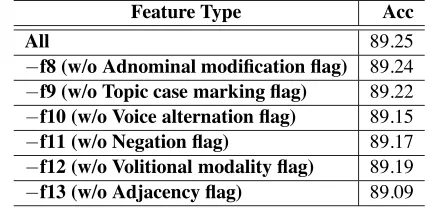
Table 4 shows overall results without using one of the idiom features.21 As you see, the adjacency flag (f13) contributes to idiom identification accuracy the most.22 On the other hand, the adnominal modifica-tion flag (f8) contributes to the task only slightly.23
21The first row shows the result with all idiom features used,
just for ease of reference.
22Note that greater performance drop indicates greater
con-tribution.
23This result is inconsistent with the result obtained in HSU,
[image:8.612.317.532.397.502.2]Table 5: Results reported in CFS
Accu RER
Baseline 61.9 —
Unsupervised 72.4 27.6
Supervised 76.2 37.5
Table 5 shows the results reported in CFS. Their baseline system regards all instances as idioms. The performance of the supervised one is obtained by the method of Katz and Giesbrecht (2006). Though we cannot simply compare this with our results due to the difference in experimental conditions, this im-plies that our WSD-based method was equally good or possibly better than their methods that are tailored to MWEs.
6 Conclusion
In this paper, we reported on the idiom corpus we have constructed and the idiom identification exper-iment using the corpus.
As mentioned in §4.3, some idioms are short of examples in the current idiom corpus. We plan to collect more examples by using different characters. In the Japanese language, there are basically three character systems: Hiragana, Katakana, and Chinese characters. Thus, you can write an idiom in different characters. For example,mune-o utu(chest-ACChit)
‘impress’ can be either8#:ƒor8#Xƒ. In spite of its imperfection, we are sure that we can learn a lot about the idiom identification from the corpus, since, as far as we know, it is the largest-ever one, and so is the idiom identification experi-ment reported in§5.
Also, we showed that a standard supervised WSD method works well for the idiom identification. Our system achieved the accuracy of 89.25% and 88.86% with/without idiom-specific features.
Though we dealt with as many as 90 idioms, prac-tical NLP systems are required to deal with many more idioms. Toward a scalable idiom identifica-tion, we have to develop an unsupervised or semi-supervised method. The unsemi-supervised method of
for the experiment, while 75,011 sentences were used for our experiment. Also, the dataset of HSU came from newspaper articles, while our dataset came from the web.
Birke and Sarkar (2006) requires WordNet. Fortu-nately, the Japanese WordNet is now available (Isa-hara et al., 2008), thus we can try their method. Also, CFS propose a language-independent unsu-pervised method. These could be of help.
At any rate, our idiom corpus will play an im-portant role in the development of unsupervised or semi-supervised methods, and the experimental re-sults obtained in this study will be a good reference point to evaluate those methods.
Acknowledgments
This work was conducted as a part of the collabora-tive research project of Kyoto University and NTT Communication Science Laboratories.
The work was supported from NTT Communica-tion Science Laboratories and JSPS Grants-in-Aid for Young Scientists (B) 19700141.
We would like to thank the members of the collab-orative research group of Kyoto University and NTT Communication Science Laboratories and Francis Bond for their stimulating discussion. Our thanks go as well to Prof. Sato Satoshi, who kindly gave us the list of basic idioms of Japanese.
References
Timothy Baldwin, Colin Bannard, Takaaki Tanaka, and Dominic Widdows. 2003. An empirical model of multiword expression decomposability. In Proceed-ings of the ACL 2003 workshop on Multiword expres-sions, pages 89–96.
Julia Birke and Anoop Sarkar. 2006. A clustering approach for the nearly unsupervised recoginition of nonliteral language. InProceedings of the 11th Con-ference of the European Chapter of the Association for Computational Linguistics (EACL 2006), pages 329– 336.
Paul Cook, Afsaneh Fazly, and Suzanne Stevenson. 2007. Pulling their weight: Exploiting syntactic forms for the automatic identification of idiomatic expres-sions in context. In Proceedings of the ACL 2007 Workshop on A Broader Perspective on Multiword Ex-pressions, pages 41–48.
Paul Cook, Afsaneh Fazly, and Suzanne Stevenson. 2008. The VNC-Tokens Dataset. InProceedings of the LREC Workshop Towards a Shared Task for Multi-word Expressions (MWE2008), pages 19–22.
of the European Chapter of the Association for Com-putational Linguistics (EACL-2006), pages 337–344. Nicole Gr´egoire, Stefan Evert, and Su Nam Kim, editors.
2007.Proceedings of the Workshop on A Broader Per-spective on Multiword Expressions. Association for Computational Linguistics, Prague.
Nicole Gr´egoire, Stefan Evert, and Brigitte Krenn, edi-tors. 2008. Proceedings of the LREC Workshop To-wards a Shared Task for Multiword Expressions. ACL Special Interest Group on the Lexicon (SIGLEX), Marrakech.
Chikara Hashimoto and Sadao Kurohashi. 2007. Con-struction of Domain Dictionary for Fundamental Vo-cabulary. In Proceedings of the 45th Annual Meet-ing of the Association for Computational LMeet-inguistics (ACL’07) Poster, pages 137–140.
Chikara Hashimoto and Sadao Kurohashi. 2008. Blog Categorization Exploiting Domain Dictionary and Dy-namically Estimated Domains of Unknown Words. In
Proceedings of the 46th Annual Meeting of the Asso-ciation for Computational Linguistics (ACL’08) Short paper, Poster, pages 69–72.
Chikara Hashimoto, Satoshi Sato, and Takehito Utsuro. 2006a. Detecting Japanese idioms with a linguistically rich dictionary. Language Resources and Evaluation, 40(3–4):243–252.
Chikara Hashimoto, Satoshi Sato, and Takehito Utsuro. 2006b. Japanese Idiom Recognition: Drawing a Line between Literal and Idiomatic Meanings. InThe Joint 21st International Conference on Computational Lin-guistics and 44th Annual Meeting of the Association for Computational Linguistics (COLING/ACL 2006) Poster, pages 353–360, Sydney, July.
Hitoshi Isahara, Francis Bond, Kiyotaka Uchimoto, Masao Utiyama, and Kyoko Kanzaki. 2008. Devel-opment of the Japanese WordNet. InThe sixth inter-national conference on Language Resources and Eval-uation (LREC2008).
Graham Katz and Eugenie Giesbrecht. 2006. Auto-matic identification of non-compositional multi-word expressions using latent semantic analysis. In Pro-ceedings of the Workshop, COLING/ACL 2006, Multi-word Expressions: Identifying and Exploiting Under-lying Properties, pages 12–19, July.
Daisuke Kawahara and Sadao Kurohashi. 2006. Case Frame Compilation from the Web using High-Performance Computing. In Proceedings of The 5th International Conference on Language Resources and Evaluation (LREC-06), pages 1344–1347.
Brigitte Krenn and Stefan Evert. 2001. Can we do better than frequency? a case study on extracting pp-verb collocations. InProceedings of the ACL-01 Workshop on Collocations, pages 39–46.
Yoong Keok Lee and Hwee Tou Ng. 2002. An empir-ical evaluation of knowledge sources and learning al-gorithms for word sense disambiguation. InEMNLP
’02: Proceedings of the ACL-02 conference on Em-pirical methods in natural language processing, pages 41–48.
Dekang Lin. 1999. Automatic identification of non-compositional phrases. InProceeding of the 37th An-nual Meeting of the Association for Computational Linguistics, pages 317–324.
Bernardo Magnini, Carlo Strapparava, Giovanni Pezzulo, and Alfio Gliozzo. 2002. The Role of Domain Infor-mation in Word Sense Disambiguation. Natural Lan-guage Engineering, special issue on Word Sense Dis-ambiguation, 8(3):359–373.
Satoshi Sato. 2007. Compilation of a comparative list of basic Japanese idioms from five sources. In IPSJ 2007-NL-178, pages 1–6. (in Japanese).
Kosho Shudo, Toshifumi Tanabe, Masahito Takahashi, and Kenji Yoshimura. 2004. MWEs as Non-propositional Content Indicators. In the 2nd ACL Workshop on Multiword Expressions: Integrating Pro-cessing, pages 32–39.
Takaaki Tanaka, Francis Bond, Timothy Baldwin, Sanae Fujita, and Chikara Hashimoto. 2007. Word Sense Disambiguation Incorporating Lexical and Structural Semantic Information. In Proceedings of the 2007 Joint Conference on Empirical Methods in ral Language Processing and Computational Natu-ral Language Learning (EMNLP-CoNLL), pages 477– 485.
Masatoshi Tsuchiya, Takehito Utsuro, Suguru Mat-suyoshi, Satoshi Sato, and Seiichi Nakagawa. 2006. Development and analysis of an example database of Japanese compound functional expressions. Trans-actions of Information Processing Society of Japan, 47(6):1728–1741. (in Japanese).
Kiyoko Uchiyama, Timothy Baldwin, and Shun Ishizaki. 2005. Disambiguating Japanese compound verbs.
Computer Speech and Language, Special Issue on Multiword Expressions, 19(4):497–512.