An Exploration of Document Impact on Graph-Based Multi-Document
Summarization
Xiaojun Wan
Institute of Compute Science and Technology Peking University
Beijing 100871, China
Abstract
The graph-based ranking algorithm has been recently exploited for multi-document sum-marization by making only use of the sen-tence-to-sentence relationships in the documents, under the assumption that all the sentences are indistinguishable. However, given a document set to be summarized, dif-ferent documents are usually not equally im-portant, and moreover, different sentences in a specific document are usually differently im-portant. This paper aims to explore document impact on summarization performance. We propose a document-based graph model to in-corporate the document-level information and the sentence-to-document relationship into the graph-based ranking process. Various meth-ods are employed to evaluate the two factors. Experimental results on the DUC2001 and DUC2002 datasets demonstrate that the good effectiveness of the proposed model. More-over, the results show the robustness of the proposed model.
1
Introduction
Multi-document summarization aims to produce a summary describing the main topic in a document set, without any prior knowledge. Multi-document summary can be used to facilitate users to quickly understand a document cluster. For example, a number of news services (e.g. NewsInEssence1) have been developed to group news articles into news topics, and then produce a short summary for each news topic. Users can easily understand the topic they have interest in by taking a look at the short summary, without looking into each individ-ual article within the topic cluster.
1http://lada.si.umich.edu:8080/clair/nie1/nie.cgi
Automated multi-document summarization has drawn much attention in recent years. In the com-munities of natural language processing and infor-mation retrieval, a series of workshops and conferences on automatic text summarization (e.g. NTCIR, DUC), special topic sessions in ACL, COLING, and SIGIR have advanced the summari-zation techniques and produced a couple of ex-perimental online systems.
A particular challenge for multi-document sum-marization is that a document set might contain diverse information, which is either related or un-related to the main topic, and hence we need effec-tive summarization methods to analyze the information stored in different documents and ex-tract the globally important information to reflect the main topic. In recent years, both unsupervised and supervised methods have been proposed to analyze the information contained in a document set and extract highly salient sentences into the summary, based on syntactic or statistical features.
Most recently, the graph-based models have been successfully applied for multi-document summarization by making use of the “voting” or “recommendations” between sentences in the documents (Erkan and Radev, 2004; Mihalcea and Tarau, 2005; Wan and Yang, 2006). The model first constructs a directed or undirected graph to reflect the relationships between the sentences and then applies the graph-based ranking algorithm to compute the rank scores for the sentences. The sentences with large rank scores are chosen into the summary. However, the model makes uniform use of the sentences in different documents, i.e. all the sentences are ranked without considering the document-level information and the sentence-to-document relationship. Actually, given a sentence-to-document set, different documents are not equally important. For example, the documents close to the main top-ics of the document set are usually more important than the documents far away from the main topics
of the document set. This document-level informa-tion is deemed to have great impact on the sen-tence ranking process. Moreover, the sensen-tences in the same document cannot be treated uniformly, because some sentences in the document are more important than other sentences because of their different positions in the document or different distances to the document’s centroid. In brief, nei-ther the document-level information nor the sen-tence-to-document relationship has been taken into account in the previous graph-based model.
In order to overcome the limitations of the pre-vious graph-based model, this study proposes the document-based graph model to explore document impact on the graph-based summarization, by in-corporating both the document-level information and the sentence-to-document relationship in the graph-based ranking process. We develop various methods to evaluate the document-level informa-tion and the sentence-to-document relainforma-tionship. Experiments on the DUC2001 and DUC2002 data-sets have been performed and the results demon-strate the good effectiveness of the proposed model, i.e., the incorporation of document impact can much improve the performance of the graph-based summarization. Moreover, the proposed model is robust with respect to most incorporation schemes.
The rest of this paper is organized as follows. We first introduce the related work in Section 2. The basic graph-based summarization model and the proposed document-based graph model are de-scribed in detail in Sections 3 and 4, respectively. We show the experiments and results in Section 5 and finally we conclude this paper in Section 6.
2
Related Work
Generally speaking, summarization methods can be abstractive summarization or extractive summa-rization. Extractive summarization is a simple but robust method for text summarization and it in-volves assigning saliency scores to some units (e.g. sentences, paragraphs) of the documents and ex-tracting those with highest scores, while abstrac-tion summarizaabstrac-tion usually needs informaabstrac-tion fusion (Barzilay et al., 1999), sentence compres-sion (Knight and Marcu, 2002) and reformulation (McKeown et al., 1999). In this study, we focus on extractive summarization.
The centroid-based method (Radev et al., 2004) is one of the most popular extractive
summariza-tion methods. MEAD2 is an implementation of the
centroid-based method that scores sentences based on sentence-level and inter-sentence features, in-cluding cluster centroids, position, TFIDF, etc. NeATS (Lin and Hovy, 2002) is a project on multi-document summarization at ISI based on the sin-gle-document summarizer-SUMMARIST. Sen-tence position, term frequency, topic signature and term clustering are used to select important content. MMR (Goldstein et al., 1999) is used to remove redundancy and stigma word filters and time stamps are used to improve cohesion and coher-ence. To further explore user interface issues, iNeATS (Leuski et al., 2003) is developed based on NeATS. XDoX (Hardy et al., 1998) is a cross document summarizer designed specifically to summarize large document sets. It identifies the most salient themes within the set by passage clus-tering and then composes an extraction summary, which reflects these main themes. Much other work also explores to find topic themes in the documents for summarization, e.g. Harabagiu and Lacatusu (2005) investigate five different topic representations and introduce a novel representa-tion of topics based on topic themes. In addirepresenta-tion, Marcu (2001) selects important sentences based on the discourse structure of the text. TNO’s system (Kraaij et al., 2001) scores sentences by combining a unigram language model approach with a Bayes-ian classifier based on surface features. Nenkova and Louis (2008) investigate how summary length and the characteristics of the input influence the summary quality in multi-document summarization.
Graph-based models have been proposed to rank sentences or passages based on the PageRank algo-rithm (Page et al., 1998) or its variants. Websumm (Mani and Bloedorn, 2000) uses a graph-connectivity model and operates under the assump-tion that nodes which are connected to many other nodes are likely to carry salient information. Lex-PageRank (Erkan and Radev, 2004) is an approach for computing sentence importance based on the concept of eigenvector centrality. It constructs a sentence connectivity matrix and compute sentence importance based on an algorithm similar to Pag-eRank. Mihalcea and Tarau (2005) also propose a similar algorithm based on PageRank to compute sentence importance for document summarization. Wan and Yang (2006) improve the ranking
rithm by differentiating intra-document links and inter-document links between sentences. All these methods make use of the relationships between sentences and select sentences according to the “votes” or “recommendations” from their neighboring sentences, which is similar to PageR-ank.
Other related work includes topic-focused multi-document summarization (Daumé. and Marcu, 2006; Gupta et al., 2007; Wan et al., 2007), which aims to produce summary biased to a given topic or query. It is noteworthy that our proposed ap-proach is inspired by (Liu and Ma, 2005), which proposes the Conditional Markov Random Walk Model based on two-layer web graph in the tasks of web page retrieval.
3
The Basic Graph-Based Model (GM)
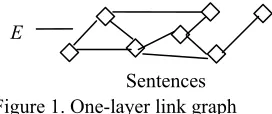
[image:3.612.128.264.425.482.2]The basic graph-based model is essentially a way of deciding the importance of a vertex within a graph based on global information recursively drawn from the entire graph. The basic idea is that of “voting” or “recommendation” between the ver-tices. A link between two vertices is considered as a vote cast from one vertex to the other vertex. The score associated with a vertex is determined by the votes that are cast for it, and the score of the verti-ces casting these votes.
Figure 1. One-layer link graph
Formally, given a document set D, let G=(V, E) be an undirected graph to reflect the relationships be-tween sentences in the document set, as shown in Figure 1. V is the set of vertices and each vertex vi
in V is a sentence in the document set. E is the set of edges. Each edge eij in E is associated with an
affinity weight f(vi, vj) between sentences vi and vj
(i≠j). The weight is computed using the standard cosine measure between the two sentences.
j i
j i j i ine j
i
v v
v v v v sim v v
f r r
r r
× ⋅ =
= ( , )
) ,
( cos (1)
where vri and vrj are the corresponding term
vec-tors of vi and vj. Here, we have f(vi, vj)=f(vj, vi).
Two vertices are connected if their affinity weight is larger than 0 and we let f(vi, vi)=0 to avoid self
transition.
We use an affinity matrix M to describe G with each entry corresponding to the weight of an edge in the graph. M = (Mi,j)|V|×|V|is defined as follows:
otherwise 0
; and
connected is
and if ) , (
⎪ ⎩ ⎪ ⎨ ⎧
≠ =
,
j i
v v , v v f M
j i j
i
i,j
(2)
Then M is normalized to M~as follows to make the sum of each row equal to 1:
⎪ ⎩ ⎪ ⎨ ⎧
≠
=
∑
=∑
=otherwise 0
0 if
~
| V |
1 |
V |
1
,
M , M M
M j
i,j j
i,j i,j
i,j (3)
Based on matrix M~ , the saliency score
Sen-Score(vi) for sentence vi can be deduced from those
of all other sentences linked with it and it can be formulated in a recursive form as in the PageRank algorithm:
∑
≠− + ⋅ ⋅
= i all j
j,i j i
V M v SenScore v
SenScore
| |
) 1 ( ~ ) ( )
( µ µ (4)
And the matrix form is:
e V
λ
M
λr Tr r
| |
) 1 (
~ µ
µ + −
= (5)
where λ =[SenScore(vi)]|V|×1
r is the vector of
sen-tence saliency scores. er is a vector with all ele-ments equaling to 1. µ is the damping factor usually set to 0.85, as in the PageRank algorithm.
The above process can be considered as a Markov chain by taking the sentences as the states and the corresponding transition matrix is given
by T eeT
|V| M
A=µ ~ + (1−µ) rr . The stationary
prob-ability distribution of each state is obtained by the principal eigenvector of the transition matrix.
For implementation, the initial scores of all sen-tences are set to 1 and the iteration algorithm in Equation (4) is adopted to compute the new scores of the sentences. Usually the convergence of the iteration algorithm is achieved when the difference between the scores computed at two successive iterations for any sentences falls below a given threshold (0.0001 in this study).
We can see that the basic graph-based model is built on the single-layer sentence graph and the transition probability between two sentences in the Markov chain depends only on the sentences them-selves, not taking into account the document-level information and the sentence-to-document rela-tionship.
E
4
The Document-Based Graph Model
(DGM)
4.1 Overview
As we mentioned in previous section, there may be many factors that can have impact on the impor-tance analysis of the sentences. This study aims to examine the document impact by incorporating the document importance and the sentence-to-document correlation into the sentence ranking process. Our assumption is that the sentences, whi-ch belong to an important document and are highly correlated with the document, will be more likely to be chosen into the summary.
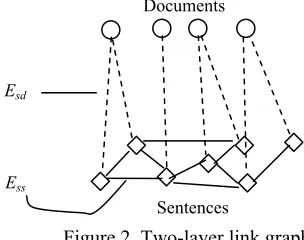
[image:4.612.92.244.397.517.2]In order to incorporate the document-level in-formation and the sentence-to-document relation-ship, the document-based graph model is proposed based on the two-layer link graph including both sentences and documents. The novel representation is shown in Figure 2. As can be seen, the lower layer is just the traditional link graph between sen-tences that has been well studied in previous work. And the upper layer represents the documents. The dashed lines between these two layers indicate the conditional influence between the sentences and the documents.
Figure 2. Two-layer link graph
Formally, the new representation for the two-layer graph is denoted as G*=<V
s, Vd, Ess, Esd>,
where Vs=V={vi} is the set of sentences and
Vd=D={dj} is the set of documents; Ess=E={eij|vi,
vj∈Vs} includes all possible links between
sen-tences and Esd={eij|vi∈Vs, dj∈Vd and dj=doc(vi)}
includes the correlation link between any sentence and its belonging document. Here, we use doc(vi)
to denote the document containing sentence vi. For
further discussions, we let π(doc(vi)) ∈[0,1]
de-note the importance of document doc(vi) in the
document set, and let ω(vi, doc(vi)) ∈[0,1] denote
the strength of the correlation between sentence vi
and its document doc(vi).
The two factors are incorporated into the affinity weight between sentences and the new sentence-to-sentence affinity weight is denoted as f(vi, vj|doc(vi),
doc(vj)), which is conditioned on the two
docu-ments containing the two sentences. The new con-ditional affinity weight is computed by linearly combining the affinity weight conditioned on the first document (i.e. f(vi,vj|doc(vi))) and the affinity
weight conditioned on the second document (i.e. f(vi,vj|doc(vj))).
Formally, the conditional affinity weight is computed as follows to incorporate the two factors:
))) ( , ( )) ( ( ) 1 ( )) ( , ( )) ( ( ( ) , ( ))) ( , ( )) ( ( ) 1 ( )) ( , ( )) ( ( ( ) , ( )) ( , ( )) ( ( ) , ( ) 1 ( )) ( , ( )) ( ( ) , ( )) ( | , ( ) 1 ( )) ( | , ( )) ( ), ( | , ( cos j j j i i i j i ine j j j i i i j i j j j j i i i i j i j j i i j i j i j i v doc v v doc v doc v v doc v v sim v doc v v doc v doc v v doc v v f v doc v v doc v v f v doc v v doc v v f v doc v v f v doc v v f v doc v doc v v f ω π λ ω π λ ω π λ ω π λ ω π λ ω π λ λ λ ⋅ ⋅ − + ⋅ ⋅ ⋅ = ⋅ ⋅ − + ⋅ ⋅ ⋅ = ⋅ ⋅ ⋅ − + ⋅ ⋅ ⋅ = ⋅ − + ⋅ = (6)
where λ∈[0,1] is the combination weight control-ling the relative contributions from the first docu-ment and the second docudocu-ment. Note that usually f(vi, vj|doc(vi), doc(vj)) is not equal to f(vj, vi|doc(vj),
doc(vi)), but the two scores are equal when λ is set
to 0.5. Various methods can be used to evaluate the document importance and the sentence-document correlation, which will be described in next sec-tions.
The new affinity matrix M* is then constructed
based on the above conditional sentence-to-sentence affinity weight.
otherwise 0 and connected is and if if )) ( ), ( | , ( * ⎪ ⎩ ⎪ ⎨ ⎧ ≠ = , j i v v , v doc v doc v v f M j i j i j i i,j (7)
Likewise, M* is normalized to M~* and the
itera-tive computation as in Equation (4) is then based on M~*. The transition matrix in the Markov chain
is then denoted by T eeT
|V| M
A* = µ ~* + (1− µ) rr and
the sentence scores is obtained by the principle eigenvector of the new transition matrix A*.
4.2
Evaluating Document Importance (
π
)
The function π(doc(vi)) aims to evaluate the
impor-tance of document doc(vi) in the document set D.
The following three methods are developed to evaluate the document importance.
Sentences Documents
Esd
π1: It uses the cosine similarity value between
the document and the whole document set as the importance score of the document3:
) ), ( ( ))
(
( cos
1 doc vi =sim ine doc vi D
π (8)
π2: It uses the average similarity value between
the document and any other document in the document set as the importance score of the docu-ment:
1 | |
) ' ), ( ( ))
(
( ' and ' ( )
cos
2
−
= ∈
∑
≠D
d v doc sim
v
doc d D d docvi
i ine i
π (9)
π3: It constructs a weighted graph between
docu-ments and uses the PageRank algorithm to com-pute the rank scores of the documents as the importance scores of the documents. The link weight between two documents is computed using the cosine measure. The equation for iterative computation is the same with Equation (4).
4.3
Evaluating Sentence-Document
Cor-relation (
ω
)
The function ω(vi, doc(vi)) aims to evaluate the
correlation between sentence vi and its document
doc(vi). The following four methods are developed
to compute the strength of the correlation. The first three methods are based on sentence position in the document, under the assumption that the first sen-tences in a document are usually more important than other sentences. The last method is based on the content similarity between the sentence and the document.
ω1: The correlation strength between sentence vi
and its document doc(vi) is based on the position of
the sentence as follows:
⎩ ⎨
⎧ ≤
=
Otherwise
5 . 0
3 ) ( if 1 )) ( , (
1
i i
i
v pos v
doc v
ω (10)
where pos(vi) returns the position number of
sen-tence vi in its document. For example, if vi is the
first sentence in its document, pos(vi) is 1.
ω2: The correlation strength between sentence vi
and its document doc(vi) is based on the position of
the sentence as follows:
)) ( ( _
1 ) ( 1
)) ( , ( 2
i i i
i
v doc count sen
v pos v
doc
v = − −
ω (11)
where sen_count(doc(vi)) returns the total number
of sentences in document doc(vi).
3 A document set is treated as a single text by concatenating all the document texts in the set.
ω3: The correlation strength between sentence vi
and its document doc(vi) is based on the position of
the sentence as follows:
1 ) (
1 5
. 0 )) ( , ( 3
+ +
=
i i
i
v pos v
doc v
ω (12)
ω4: The correlation strength between sentence vi
and its document doc(vi) is based on the cosine
similarity between the sentence and the document: ))
( , ( ))
( ,
( cos
4 vi doc vi =sim ine vi doc vi
ω (13)
5
Empirical Evaluation
5.1
Dataset and Evaluation Metric
Generic multi-document summarization has been one of the fundamental tasks in DUC 20014 and DUC 20025 (i.e. task 2 in DUC 2001 and task 2 in DUC 2002), and we used the two tasks for evalua-tion. DUC2001 provided 30 document sets and DUC 2002 provided 59 document sets (D088 is excluded from the original 60 document sets by NIST) and generic abstracts of each document set with lengths of approximately 100 words or less were required to be created. The documents were news articles collected from TREC-9. The sen-tences in each article have been separated and the sentence information has been stored into files. The summary of the two datasets are shown in Ta-ble 1.
DUC 2001 DUC 2002
Task Task 2 Task 2
Number of documents 309 567
Number of clusters 30 59
Data source TREC-9 TREC-9
Summary length 100 words 100 words
Table 1. Summary of datasets
We used the ROUGE (Lin and Hovy, 2003) toolkit (i.e. ROUGEeval-1.4.2 in this study) for evaluation, which has been widely adopted by DUC for automatic summarization evaluation. It measured summary quality by counting overlap-ping units such as the n-gram, word sequences and word pairs between the candidate summary and the reference summary. ROUGE-N was an n-gram recall measure computed as follows:
∑
∑
∑
∑
∈ ∈
∈ ∈
− − =
−
Sum} {Ref
Sum} {Ref
) (
S n-gramS S n-gramS match
gram) Count(n
gram n Count N
ROUGE (14)
where n stood for the length of the n-gram, and Countmatch(n-gram) was the maximum number of
n-grams co-occurring in a candidate summary and a set of reference summaries. Count(n-gram) was the number of n-grams in the reference summaries.
ROUGE toolkit reported separate scores for 1, 2, 3 and 4-gram, and also for longest common subse-quence co-occurrences. Among these different scores, unigram-based ROUGE score (ROUGE-1) has been shown to agree with human judgment most (Lin and Hovy. 2003). We showed three of the ROUGE metrics in the experimental results: ROUGE-1 (unigram-based), ROUGE-2 (bigram-based), and ROUGE-W (based on weighted long-est common subsequence, weight=1.2). In order to truncate summaries longer than length limit, we used the “-l” option in ROUGE toolkit. We also used the “-m” option for word stemming.
5.2
Evaluation Results
In the experiments, the combination weight λ for the proposed summarization model is typically set to 0.5 without tuning, i.e. the two documents for two sentences have equal influence on the summa-rization process. Note that after the saliency scores of sentences have been obtained, a greedy algo-rithm (Wan and Yang, 2006) is applied to remove redundancy and finally choose both informative and novel sentences into the summary. The algo-rithm is actually a variant version of the MMR al-gorithm (Goldstein et al., 1999).
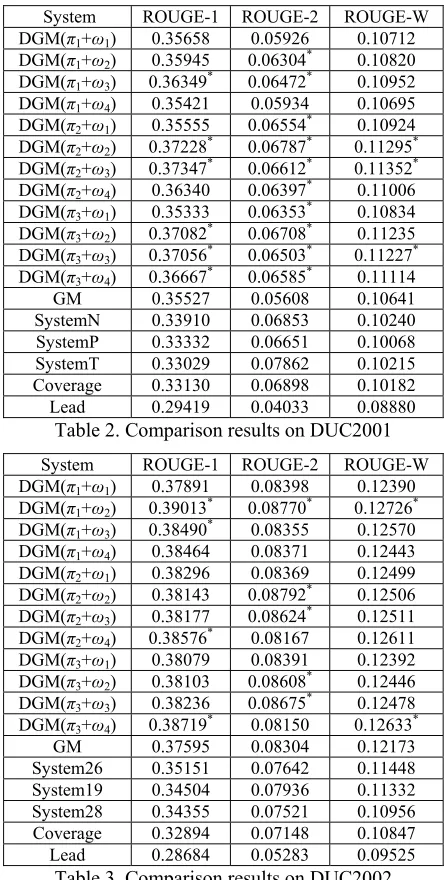
The proposed document-based graph model (de-noted as DGM) with different settings is compared with the basic graph-based Model (denoted as GM), the top three performing systems and two baseline systems on DUC2001 and DUC2002, respectively. The top three systems are the systems with highest ROUGE scores, chosen from the performing sys-tems on each task respectively. The lead baseline and coverage baseline are two baselines employed in the generic multi-document summarization tasks of DUC2001 and DUC2002. The lead baseline takes the first sentences one by one in the last document in the collection, where documents are assumed to be ordered chronologically. And the coverage baseline takes the first sentence one by one from the first document to the last document. Tables 2 and 3 show the comparison results on DUC2001 and DUC2002, respectively. In Table 1, SystemN, SystemP and System T are the top three
performing systems for DUC2001. In Table 2, Sys-tem19, System26, System28 are the top three per-forming systems for DUC2002. The document-based graph model is configured with different settings (i.e. π1-π3, ω1-ω4). For example,
DGM(π1+ω1) refers to the DGM model with π1 to
evaluate the document importance and ω1 to
evalu-ate the correlation between a sentence and its docu-ment.
System ROUGE-1 ROUGE-2 ROUGE-W
DGM(π1+ω1) 0.35658 0.05926 0.10712 DGM(π1+ω2) 0.35945 0.06304* 0.10820 DGM(π1+ω3) 0.36349* 0.06472* 0.10952 DGM(π1+ω4) 0.35421 0.05934 0.10695 DGM(π2+ω1) 0.35555 0.06554* 0.10924 DGM(π2+ω2) 0.37228* 0.06787* 0.11295* DGM(π2+ω3) 0.37347* 0.06612* 0.11352* DGM(π2+ω4) 0.36340 0.06397* 0.11006 DGM(π3+ω1) 0.35333 0.06353* 0.10834 DGM(π3+ω2) 0.37082* 0.06708* 0.11235 DGM(π3+ω3) 0.37056* 0.06503* 0.11227* DGM(π3+ω4) 0.36667* 0.06585* 0.11114
GM 0.35527 0.05608 0.10641
SystemN 0.33910 0.06853 0.10240
SystemP 0.33332 0.06651 0.10068
SystemT 0.33029 0.07862 0.10215
Coverage 0.33130 0.06898 0.10182
[image:6.612.315.538.175.615.2]Lead 0.29419 0.04033 0.08880
Table 2. Comparison results on DUC2001
System ROUGE-1 ROUGE-2 ROUGE-W
DGM(π1+ω1) 0.37891 0.08398 0.12390 DGM(π1+ω2) 0.39013* 0.08770* 0.12726* DGM(π1+ω3) 0.38490* 0.08355 0.12570 DGM(π1+ω4) 0.38464 0.08371 0.12443 DGM(π2+ω1) 0.38296 0.08369 0.12499 DGM(π2+ω2) 0.38143 0.08792* 0.12506 DGM(π2+ω3) 0.38177 0.08624* 0.12511 DGM(π2+ω4) 0.38576* 0.08167 0.12611 DGM(π3+ω1) 0.38079 0.08391 0.12392 DGM(π3+ω2) 0.38103 0.08608* 0.12446 DGM(π3+ω3) 0.38236 0.08675* 0.12478 DGM(π3+ω4) 0.38719* 0.08150 0.12633*
GM 0.37595 0.08304 0.12173
System26 0.35151 0.07642 0.11448 System19 0.34504 0.07936 0.11332 System28 0.34355 0.07521 0.10956 Coverage 0.32894 0.07148 0.10847
Lead 0.28684 0.05283 0.09525
Table 3. Comparison results on DUC2002
(* indicates that the improvement over the baseline GM
model is statistically significant at 95% confidence level)
DUC2001 and DUC2002 datasets. The results demonstrate the good effectiveness of the proposed model, i.e. the incorporation of document impact does benefit the graph-based summarization model. It is interesting that the three methods for comput-ing document importance and the four methods for computing the sentence-document correlation are almost as effective as each other on the DUC2002 dataset. However, π1 does not perform as well as π2
and π3, and ω1 and ω4 does not perform as well as
ω2 and ω3 on the DUC2001 dataset.
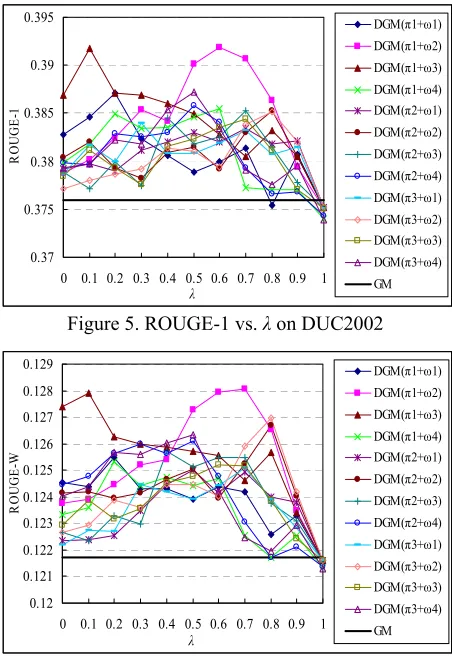
In order to investigate the relative contributions from the two documents for two sentences to the summarization performance, we varies the combi-nation weight λ from 0 to 1 and Figures 3-6 show the ROUGE-1 and ROUGE-W curves on DUC2001 and DUC2002 respectively. The similar ROUGE-2 curves are omitted here.
0.35 0.355 0.36 0.365 0.37 0.375
0 0.1 0.2 0.3 0.4 0.5 0.6 0.7 0.8 0.9 1
λ
R
OUGE
-1
[image:7.612.314.540.58.388.2]DGM(π1+ω1) DGM(π1+ω2) DGM(π1+ω3) DGM(π1+ω4) DGM(π2+ω1) DGM(π2+ω2) DGM(π2+ω3) DGM(π2+ω4) DGM(π3+ω1) DGM(π3+ω2) DGM(π3+ω3) DGM(π3+ω4) GM
Figure 3. ROUGE-1 vs. λon DUC2001
0.104 0.106 0.108 0.11 0.112 0.114
0 0.1 0.2 0.3 0.4 0.5 0.6 0.7 0.8 0.9 1
λ
R
OUG
E
-W
DGM(π1+ω1) DGM(π1+ω2) DGM(π1+ω3) DGM(π1+ω4) DGM(π2+ω1) DGM(π2+ω2) DGM(π2+ω3) DGM(π2+ω4) DGM(π3+ω1) DGM(π3+ω2) DGM(π3+ω3) DGM(π3+ω4) GM
Figure 4. ROUGE-W vs. λon DUC2001
0.37 0.375 0.38 0.385 0.39 0.395
0 0.1 0.2 0.3 0.4 0.5 0.6 0.7 0.8 0.9 1
λ
RO
U
G
E
-1
DGM(π1+ω1) DGM(π1+ω2) DGM(π1+ω3) DGM(π1+ω4) DGM(π2+ω1) DGM(π2+ω2) DGM(π2+ω3) DGM(π2+ω4) DGM(π3+ω1) DGM(π3+ω2) DGM(π3+ω3) DGM(π3+ω4) GM
Figure 5. ROUGE-1 vs. λon DUC2002
0.12 0.121 0.122 0.123 0.124 0.125 0.126 0.127 0.128 0.129
0 0.1 0.2 0.3 0.4 0.5 0.6 0.7 0.8 0.9 1
λ
R
OUG
E
-W
DGM(π1+ω1) DGM(π1+ω2) DGM(π1+ω3) DGM(π1+ω4) DGM(π2+ω1) DGM(π2+ω2) DGM(π2+ω3) DGM(π2+ω4) DGM(π3+ω1) DGM(π3+ω2) DGM(π3+ω3) DGM(π3+ω4) GM
Figure 6. ROUGE-W vs. λon DUC2002
We can see from the figures that the proposed document-based graph model with different set-tings can almost always outperform the basic graph-based model, with respect to different values of λ. The results show the robustness of the pro-posed model. We can also see that for most set-tings of the propose model, very large values or very small values of λ can deteriorate the summari-zation performance, i.e. both the first document and the second document in the computation of the conditional affinity weight between sentences have great impact on the summarization performance.
6
Conclusion and Future Work
[image:7.612.74.300.300.625.2]In this study, we directly make use of the coarse-grained document-level information. Actually, a document can be segmented into a few subtopic passages by using the TextTiling algorithm (Hearst, 1997), and we believe the subtopic passage is more fine-grained than the original document. In future work, we will exploit this kind of subtopic-level information to further improve the summarization performance.
Acknowledgments
This work was supported by the National Science Foundation of China (No.60703064), the Research Fund for the Doctoral Program of Higher Educa-tion of China (No.20070001059) and the NaEduca-tional High Technology Research and Development Pro-gram of China (No.2008AA01Z421). We also thank the anonymous reviewers for their useful comments.
References
R. Barzilay, K. R. McKeown and M. Elhadad. 1999. Information fusion in the context of multi-document summarization. In Proceedings of ACL1999.
H. Daumé and D. Marcu. 2006. Bayesian query-focused summarization. 2006. In Proceedings of COLING-ACL2006.
G. Erkan and D. Radev. 2004. LexPageRank: prestige in multi-document text summarization. In Proceedings of EMNLP’04.
J. Goldstein, M. Kantrowitz, V. Mittal and J. Carbonell. 1999. Summarizing text documents: sentence selec-tion and evaluaselec-tion metrics. In Proceedings of SIGIR-99.
S. Gupta, A. Nenkova and D. Jurafsky. 2007. Measuring importance and query relevance in topic-focused multi-document summarization. In Proceedings of ACL-07.
S. Harabagiu and F. Lacatusu. 2005. Topic themes for multi-document summarization. In Proceedings of SIGIR’05.
H. Hardy, N. Shimizu, T. Strzalkowski, L. Ting, G. B. Wise. and X. Zhang. 2002. Cross-document summa-rization by concept classification. In Proceedings of SIGIR’02.
M. Hearst. 1997. TextTiling: segmenting text into multi-paragraph subtopic passages. Computational Linguis-tics, 23(1): 33-64.
K. Knight. and D. Marcu. 2002. Summarization beyond sentence extraction: a probabilistic approach to sen-tence compression, Artificial Intelligence, 139(1).
W. Kraaij, M. Spitters and M. van der Heijden. 2001. Combining a mixture language model and Naïve Bayes for multi-document summarization. In SIGIR 2001 Workshop on Text Summarization.
A. Leuski, C.-Y. Lin and E. Hovy. 2003. iNeATS: in-teractive multi-document summarization. In Proceed-ings of ACL2003.
C.-Y. Lin and E. H. Hovy. 2002. From single to multi-document summarization: a prototype system and its evaluation. In Proceedings of ACL-2002.
C.-Y. Lin and E. H. Hovy. 2003. Automatic evaluation of summaries using n-gram co-occurrence statistics. In Proceedings of HLT-NAACL2003.
T.-Y. Liu and W.-Y. Ma. 2005. Webpage importance analysis using Conditional Markov Random Walk. In Proceedings of WI2005.
I. Mani and E. Bloedorn. 2000. Summarizing similari-ties and differences among related documents. Infor-mation Retrieval, 1(1).
D. Marcu. Discourse-based summarization in DUC– 2001. 2001. In SIGIR 2001 Workshop on Text Sum-marization.
K. McKeown, J. Klavans, V. Hatzivassiloglou, R.
Barzi-lay and E. Eskin. 1999. Towards multidocument
summarization by reformulation: progress and pros-pects, in Proceedings of AAAI1999.
R. Mihalcea and P. Tarau. 2005. A language independ-ent algorithm for single and multiple documindepend-ent sum-marization. In Proceedings of IJCNLP’2005.
A. Nenkova and A. Louis. 2008. Can you summarize this? Identifying correlates of input difficulty for ge-neric multi-document summarization. In Proceedings of ACL-08: HLT.
L. Page, S. Brin, R. Motwani and T. Winograd. 1998. The pagerank citation ranking: Bringing order to the web. Technical report, Stanford Digital Libraries. D. R. Radev, H. Y. Jing, M. Stys and D. Tam. 2004.
Centroid-based summarization of multiple documents. Information Processing and Management, 40: 919-938.
X. Wan and J. Yang. 2006. Improved affinity graph based multi-document summarization. In Proceedings of HLT-NAACL2006.