Discriminative Word Alignment with a Function Word Reordering Model
Hendra Setiawan UMIACS University of Maryland
Chris Dyer
Language Technologies Institute Carnegie Mellon University
Philip Resnik Linguistics and UMIACS
University of Maryland
Abstract
We address the modeling, parameter estima-tion and search challenges that arise from the introduction of reordering models that capture non-local reordering in alignment modeling. In particular, we introduce several reordering models that utilize (pairs of) function words as contexts for alignment reordering. To ad-dress the parameter estimation challenge, we propose to estimate these reordering models from a relatively small amount of manually-aligned corpora. To address the search chlenge, we devise an iterative local search al-gorithm that stochastically explores reorder-ing possibilities. By capturreorder-ing non-local re-ordering phenomena, our proposed alignment model bears a closer resemblance to state-of-the-art translation model. Empirical re-sults show significant improvements in align-ment quality as well as in translation perfor-mance over baselines in a large-scale Chinese-English translation task.
1 Introduction
In many Statistical Machine Translation (SMT) sys-tems, alignment represents an important piece of in-formation, from which translation rules are learnt. However, while translation models have evolved from word-based to syntax-based modeling, the de facto alignment model remains word-based (Brown et al., 1993; Vogel et al., 1996). This gap be-tween alignment modeling and translation modeling is clearly undesirable as it often generates tensions that would prevent the extraction of many useful translation rules (DeNero and Klein, 2007). Recent work, e.g. by Blunsom et al. (2009) and Haghihi et
al. (2009) just to name a few, show that alignment models that bear closer resemblance to state-of-the-art translation model consistently yields not only a better alignment quality but also an improved trans-lation quality.
In this paper, we follow this recent effort to nar-row the gap between alignment model and trans-lation model to improve transtrans-lation quality. More concretely, we focus on the reordering component since we observe that the treatment of reordering re-mains significantly different when comparing align-ment versus translation: the reordering component in state-of-the-art translation models has focused on long-distance reordering, but its counterpart in alignment models has remained focused on local reordering, typically modeling distortion based en-tirely on positional information. This leaves most alignment decisions to association-based scores.
Why is employing stronger reordering models more challenging in alignment than in translation? One answer can be attributed to the fact that align-ment points are unobserved in parallel text, thus so are their reorderings. As such, introducing stronger reordering often further exacerbates the computa-tional complexity to do inference over the model. Some recent alignment models appeal to external linguistic knowledge, mostly by using monolingual syntactic parses (Cherry and Lin, 2006; Pauls et al., 2010), which at the same time, provides an approx-imation of the bilingual syntactic divergences that drive the reordering. To our knowledge, however, this approach has been used mainly to constrain re-ordering possibilities, or to add to the generalization ability of association-based scores, not to directly model reordering in the context of alignment.
In this paper, we introduce a new approach to im-proving the modeling of reordering in alignment. In-stead of relying on monolingual parses, we condi-tion our reordering model on the behavior of func-tion words and the phrases that surround them. Function words are the “syntactic glue” of sen-tences, and in fact many syntacticians believe that functional categories, as opposed to substantive cat-egories like noun and verb, are primarily responsi-ble for cross-language syntactic variation (Ouhalla, 1991). Our reordering model can be seen as offering a reasonable approximation to more fully elaborated bilingual syntactic modeling, and this approxima-tion is also highly practical, as it demands no exter-nal knowledge (other than a list of function words) and avoids the practical issues associated with the use of monolingual parses, e.g. whether the mono-lingual parser is robust enough to produce reliable output for every sentence in training data.
At a glance, our reordering model enumerates the function words on both source and target sides, modeling their reordering relative to their neighbor-ing phrases, their neighborneighbor-ing function words, and the sentence boundaries. Because the frequency of function words is high, we find that by predicting the reordering of function words accurately, the reorder-ing of the remainreorder-ing words improves in accuracy as well. In total, we introduce six sub-models involving function words, and these serve as features in a log linear model. We train model weights discrimina-tively using Minimum Error Rate Training (MERT) (Och, 2003), optimizing F-measure.
The parameters of our sub-models are estimated from manually-aligned corpora, leading the reorder-ing model more directly toward reproducreorder-ing human alignments, rather than maximizing the likelihood of unaligned training data. This use of manual data for parameter estimation is a reasonable choice be-cause these models depend on a small, fixed number of lexical items that occur frequently in language, hence only small training corpora are required. In addition, the availability of manually-aligned cor-pora has been growing steadily.
The remainder of the paper proceeds as follows. In Section 2, we provide empirical motivation for our approach. In Section 3, we discuss six sub-models based on function word relationships and how their parameters are estimated; these are
com-Ϣ࣫䶽᳝䙺Ѹ ⱘᇥ᭄ ᆊП ϔ
one of
few
that have dipl. rels. with countries Australia is
▇ ⌆ᰃ
North Korea the
1
1 2 3 4 5 6 7 8 9 10 11 2
[image:2.612.343.512.56.219.2]3 4 5 6 7 8 9 10 11 12
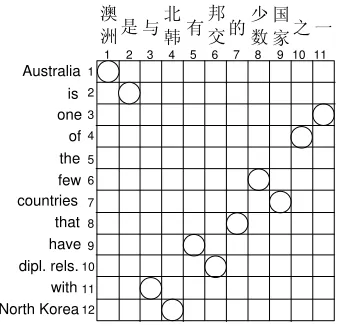
Figure 1: An aligned Chinese-English sentence pair.
bined with additional features in Section 4 to pro-duce a single discriminative alignment model. Sec-tion 5 describes a simple decoding algorithm to find the most probable alignment under the combined model, Section 6 describes the training of our dis-criminative model and Section 7 presents experi-mental results for the model using this algorithm. We wrap up in Sections 8 and 9 with a discussion of related work and a summary of our conclusions.
2 Empirical Motivation
Fig. 1 shows an example of a Chinese-English sen-tence pair together with correct alignment points. Predicting the alignment for this particular Chinese-English sentence pair is challenging, since the sig-nificantly different syntactic structures of these two languages lead to non-monotone reordering. For ex-ample, an accurate alignment model should account for the fact that prepositional phrases in Chinese ap-pear in a different order than in English, as illus-trated by the movement of the phrase “与北韩/with
North Korea” from the beginning of the Chinese noun phrase to the end of the corresponding English. The central question that concerns us here is how to define and infer regularities that can be useful to predict alignment reorderings. The approach we take here is supported by empirical results from a pilot study, conducted as an inquiry into the idea of focusing on function words to model alignment re-ordering, which we briefly describe.
࣫ 䶽᳝
䙺 Ѹ
ᇥ ᭄
ᆊ ϔ
one
of
few
that have
dipl. rels.
with
countries Australia
is
▇ ⌆
North Korea
the
1
1 2 3 4 5 6 7 8 9 10 11 2
[image:3.612.104.270.57.219.2]3 4 5 6 7 8 9 10 11 12
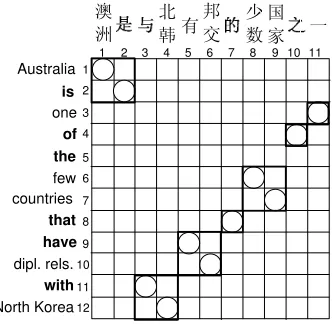
Figure 2: The all-monotone phrase pairs, indicated as rectangular areas in bold, that can be extracted from the Fig. 1 example.
and divided each sentence pair into all-monotone phrase pairs. Visually, an all-monotone phrase pair corresponds to a maximal block in the alignment matrix for which internal alignment points appear in monotone order from the top-left corner to the bottom-right corner. Fig. 2 illustrates seven such pairs that can be extracted from the example in Fig. 1. In total, there are 154,517 such phrase pairs in our manually-aligned corpus.
The alignment configuration internal to all-monotone phrase pair blocks is, obviously, mono-tonic, which is a configuration that is effectively modeled by traditional alignments models. On the other hand, the reordering between two adjacent blocks is the focus of our efforts since existing mod-els are less effective at modeling non-monotonic alignment configurations. To measure the function words’ potential to predict non-monotone reorder-ings, we examined the border words where two ad-jacent blocks meet. In particular, we are interested in how many adjacent blocks whose border words are function words.
The results of this pilot study were quite encour-aging. If we consider only the Chinese side of the phrase pairs, 88.35% adjacent blocks have function words as their boundary words. If we consider only the English side, function words appear at the bor-ders of 93.91% adjacent blocks. If we consider both the Chinese and English sides, the percentage increases to 95.53%. Notice that in Fig. 2,
func-tion words appear at the borders of all adjacent all-monotone phrase pairs, if both Chinese and English sides are considered. Clearly with such high cov-erage, function words are central in predicting non-monotone reordering in alignment.
3 Reordering with Function Words
The reordering models we describe follow our previ-ous work using function word models for translation (Setiawan et al., 2007; Setiawan et al., 2009). The core hypothesis in this work is that function words provide robust clues to the reordering patterns of the phrases surrounding them. To make this insight use-ful for alignment, we develop features that score the alignment configuration of the neighboring phrases of a function word (which functions as an anchor) using two kinds of information: 1) the relative order-ing of the phrases with respect to the function word anchor; and 2) the span of the phrases. This sec-tion provides a high level overview of our reordering model, which attempts to leverage this information.
To facilitate subsequent discussions, we introduce the notion of monolingual function word phrase F Wi, which consists of the tuple(Yi, Li, Ri), where Yiis thei-th function word andLi,Riare its left and right neighboring phrases, respectively. Note that this notion of “phrase” is defined only for reorder-ing purposes in our model, and does not necessar-ily correspond to a linguistic phrase. We define such phrases on both sides to cover as many non-monotone reorderings as possible, as suggested by the pilot study. To denote the side, we append a sub-script: F Wi,S = (Yi,S, Li,S, Ri,S) refers to a func-tion word phrase on the source side, andF Wi,T =
(Yi,T, Li,T, Ri,T) to one on the target side. In our subsequent discussion, we will mainly use F Wi,S, and we will omit subscriptsS orT if they are clear from context.
The primary objective of our reordering model is to predict the projection of monolingual func-tion word phrases from one language to the other, inferring bilingual function word phrase pairs F Wi,S→T = (Yi,S→T, Li,S→T, Ri,S→T), which en-code the two aforementioned pieces of informa-tion.1 To infer these phrases, we take a
probabilis-1
tic approach. For instance, to estimate the spans of Li,S→T, Ri,S→T, our reordering model assumes that any span to the left of Yi,S is a possible Li,S and any span to the right of Yi,S is a possibleRi,S, de-ciding which is most probable via features, rather than committing to particular spans (e.g. as defined by a monolingual text chunker or parser). We only enforce one criterion onLi,S→T andRi,S→T: they have to be the maximal alignment blocks satisfying the consistent heuristic (Och and Ney, 2004) that end or start with Yi,S→T on the source S side respec-tively.2
To infer these phrases, we decompose Li,S→T into (o(Li,S→T), d(F Wi−1,S→T), b(hsi)); sim-ilarly, Ri,S→T into (o(Ri,S→T),d(F Wi+1,S→T), b(h/si) )). Taking the decomposition ofLi,S→T as a case in point, here o(Li,S→T) describes the re-ordering of the left neighbor Li,S→T with respect to the function wordYi,S→T, whiled(F Wi−1,S→T) andb(hsi))probe the span ofLi,S→T, i.e. whether it goes beyond the preceding function word phrase pairs F Wi−1,S→T and up to the beginning-of-sentence markerhsirespectively. The same defini-tion applies to the decomposidefini-tion ofRi,S→T, where F Wi+1,S→T is the succeeding function word phrase pair andh/siis the end-of-sentence marker.
3.1 Six (Sub-)Models
To model o(Li,S→T), o(Ri,S→T), i.e. the re-ordering of the neighboring phrases of a func-tion word, we employ the orientafunc-tion model in-troduced by Setiawan et al. (2007). Formally, this model takes the form of probability distribution Pori(o(Li,S→T), o(Ri,S→T)|Yi,S→T), which condi-tions the reordering on the lexical identity of the function word alignment (but independent of the lex-ical identity of its neighboring phrases). In particu-lar,omaps the reordering into one of the following four orientation values (borrowed from Nagata et al. (2006)) with respect to the function word: Mono-tone Adjacent (MA), MonoMono-tone Gap (MG), Reverse Adjacent (RA) and Reverse Gap (RG). The Mono-tone/Reverse distinction indicates whether the pro-jected order follows the original order, while the Adjacent/Gap distinction indicates whether the
pro-2This heuristic is commonly used in learning phrase pairs
from parallel text. The maximality ensures the uniqueness ofL
andR.
jections of the function word and the neighboring phrase are adjacent or separated by an intervening phrase.
To model d(F Wi−1,S→T), d(F Wi+1,S→T), i.e. whether Li,S→T and Ri,S→T extend beyond the neighboring function word phrase pairs, we uti-lize the pairwise dominance model of Setiawan et al. (2009). Taking d(F Wi−1,S→T) as a case in point, this model takes the form Pdom(d(F Wi−1,S→T)|Yi−1,S→T, Yi,S→T), whered takes one of the following four dominance val-ues: leftFirst, rightFirst, dontCare, or neither. We will detail the exact formulation of these val-ues in the next subsection. However, to provide intuition, the value of either leftFirst or neither
ford(F Wi−1,S→T)would suggest that the span of Li,S→T doesn’t extend toYi−1,S→T; the further dis-tinction betweenleftFirstandneitherconcerns with whether the span ofRi−1,S→T extends toF Wi,S→T.
To modelb(hsi),b(h/si), i.e. whether the span of Li,S→T andRi,S→T extends up to sentence mark-ers, we introduce the borderwise dominance model. Formally, this model is similar to the pairwise domi-nance model, except that we use the sentence bound-aries as the anchors instead of the neighboring phrase pairs. This model captures longer distance dependencies compared to the previous two mod-els; in the Chinese-English case, in particular, it is useful to discourage word alignments from crossing clause or sentence boundaries. The sentence bound-ary issue is especially important in machine trans-lation (MT) experimentation, since the Chinese side of English-Chinese parallel text often includes long sentences that are composed of several independent clauses joined together; in such cases, words from one clause should be discouraged from aligning to words from other clauses. In Fig. 1, this model is potentially useful to discourage words from cross-ing the copula “是/is”.
(T) sentence pair, as follows:
fori= N
Y
i=1
Pori(o(Li), o(Ri)|Yi) (1)
fdom= N
Y
i=2
Pdom(d(F Wi−1)|Yi−1, Yi) (2)
fbdom= N
Y
i=1
Pbdom(b(hsi)|hsi, Yi)·
Pbdom(b(h/si)|Yi,h/si) (3)
where N is the number of function words (of the source side, in the S → T case). As the bilingual function word phrase pairs are uni-directional, we employ these three models in both directions, i.e. T → S as well as S → T. As a result, there are six reordering models based on function words.
3.2 Prediction and Parameter Estimation
Given F Wi−1,S→T (and all other F W∀i′/i,S→T), our reordering model has to decomposeLi,S→T into
(o(Li,S→T), d(F Wi−1,S→T), b(hsi)); and Ri,S→T into (o(Ri,S→T),d(F Wi+1,S→T),b(h/si) )) during prediction and parameter estimation. In prediction mode (described in Section 5), it has to make the de-composition on the current state of alignment, while during parameter estimation, it has to make the same decomposition on the manually-aligned cor-pora. Since the process is identical, we proceed with the discussion in the context of parameter estima-tion, where the decomposition is performed to col-lect counts to estimate the parameters of our models.
Orientation model. Using Li,S→T as a case in point and given (Yi,S→T=sll/tmm, Li,S→T=sl2l1/tm2m1, Ri,S→T=sl4l3/tm4m3)3, the value ofo(Li,S→T)in terms of Monotone/Reverse is:
Monotone/Reverse= (
M, m2< m,
R, m < m1.
(4)
while its value in terms of Adjacent/Gap values is:
Adjacent/Gap= (
A, |m−m1| ∨ |m−m2|= 1,
G, otherwise.
(5)
3
We use subscripts to indicate the starting index, and super-scripts the ending index.
By adjusting the indices, the computation of o(Ri,S→T)follows similarly to the procedure above. Suppose we want to estimate the probability of Li,S→T=M Afor a particularYi. Note that here, we are interested in the lexical identity ofYi, thus the indexiis irrelevant. We first gather the counts of the orientation value for allLi,S→T ofYiin the corpus: c(o(Li,S→T) ∈ {M A, RA, M G, RG}, Yi). Then Pori(M A|Yi)is estimated as follows:
Pori(M A|Yi) = c(M A, Yi) c(Yi)
(6)
wherec(Yi)is the frequency ofYiin the corpus. The estimation of other orientation values as well as the T →Sversion of the model, follows the same pro-cedure.
Pairwise and Borderwise dominance models. Given Ri,S→T = sl2l1/tm2m1 and Li+1,S→T = sl4l3/tm4
m3, i.e. the spans of the neighbors of a pair of neighboring function word phrase pairs (Yi = sl5l5/tm5m5, Yi+1 = sl6l6/tm6m6), the value of d(F Wi+1,S→T)is:
=
leftFirst, l2 ≥l6Vl3 > l5 rightFirst, l2 < l6Vl3 ≤l5
dontCare, l2 ≥l6Vl3 ≤l5 neither, l2 < l6Vl3 > l5
(7)
Note that the neighbors of the sentence markers for the borderwise models span the whole sentence, thus value ofneitheris impossible for these models.
Suppose we want to estimate the probability ofYi andYi+1having adontCaredominance value. Note
that here we are interested in the lexical identity of YiandYi+1, thus the models are insensitive to the
in-dices. We first gather the counts of theYi andYi+1
having thedontCare valuec(dontCare, Yi, Yi+1);
then Pdom(dontCare|Yi, Yi+1) is estimated as
fol-lows:
Pdom(dontCare|Yi, Yi+1) =
c(dontCare, Yi, Yi+1)
c(Yi, Yi+1)
(8) where c(Yi, Yi+1) is the count of Yi appears after Yi+1 in the training corpus without any other
4 Alignment Model
To use the function word alignment features de-scribed in the previous section to predict alignments, we use a linear model of the following form:
ˆ
A= arg max
A∈A(S,T)
θ·f(A, S, T) (9)
whereA(S, T)is the set of all possible alignments of a source sentence S and target sentenceT, and
f(A, S, T)is a vector of feature functions onA,S, andT, andθis a parameter vector.
In addition to the six reordering models, our model employs several association-based scores that look at alignments in isolation. These features in-clude:
1. Normalized log-likelihood ratio (LLR). This feature represents an association score, derived from statistical testing statistics. LLR (Dunning, 1993) has been widely used especially to measure lexical association. Since the values of LLR are unnormal-ized, we normalize them on a per-sentence basis, so that the normalized LLRs of, say, a particular source word to the target words in a particular sentence sum up to one.
2. Translation table from IBM model 4. This feature represents another association score, derived from a generative model, in particular the word-based IBM model 4. The use of this feature is widespread in recent alignment models, since it pro-vides a relatively accurate initial prediction.
3. Translation table from manually-aligned corpora. This feature represents a gold-standard as-sociation score, based on human annotation. While attractive, this feature suffers from data sparse-ness issues since the lexical coverage of manually-aligned corpora, especially over content words, is very low. To overcome this issue, we design this feature to have two levels of granularity; as such, a fine-grained one is applied for function words and the coarse-grained one for content words.
4. Grow-diag-final alignments bonus. This fea-ture encourages our alignment model to reuse align-ment points that are part of the alignalign-ments created by the grow-diag-final heuristic, which we used as the baseline of our machine translation experiments. 5. Fertility model from IBM model 4. This fea-ture, which is another by-product of IBM model 4,
measures the probability of a certain word aligning to zero, one, or two or more words.
6. Null-alignment probability. This bino-mial feature models preference towards not aligning words, i.e. aligning to the NULL token. The intu-ition is to penalize NULL alignments depending on word class, by assigning lower probability mass to unaligned content words than to unaligned function words. In our experiment, we assign feature value
10−3 for a function word aligning to NULL, and
10−5for a content word aligning to NULL.
Note that with the exception of the alignment bonus feature (4), all features are uni-directional, and therefore we employ these features in both di-rections just as was done for the reordering models.
5 Search
To find Aˆ using the model in Eq. 9, it is neces-sary to search 2|S|×|T| different alignment config-urations, and, because of the non-local dependen-cies in some of our features, it is not possible to use dynamic programming to perform this search effi-ciently. We therefore employ an approximate search for the best alignment. We use a local search pro-cedure which starts from some alignment (in our case, a symmetrized Model 4 alignment) and make local changes to it. Rather than taking a pure hill-climbing approach which greedily moves to locally better configurations (Brown et al., 1993), we use a stochastic search procedure which can move into lower-scoring states with some probability, similar to the Monte Carlo techniques used to draw sam-ples from analytically intractable probability distri-butions.
5.1 Algorithm
To findA, our search algorithm starts with an initialˆ alignment A(1) and iteratively draws a new set by making a few small changes to the current set. For each step i = [1, n], with alignmentA(i), a set of
is sampled from the following distribution:
p(A(i+1)|S, T, A(i)) = expθ·f(A
(i+1), S, T)
Z(A(i), S, T)
whereZ(A(i), S, T) = X
A′∈N(A(i))
expθ·f(A′, S, T)
In addition to the current ‘active’ alignment configu-rationA(i), the algorithm keeps track of the highest scoring alignment observed so far, Amax. After n steps, the algorithm returnsAmaxas its
approxima-tion of A. In the experiments reported below, weˆ initialized A(1) with the Model 4 alignments sym-metrized by using the grow-diag-final-and heuristic (Koehn et al., 2003).
5.2 Alignment Neighborhoods
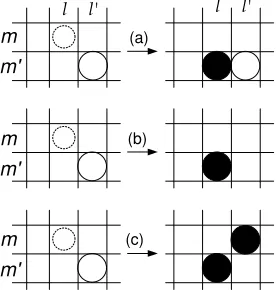
We now turn to a discussion of how the alignment neighborhoods used by our stochastic search algo-rithm are generated. We define three local transfor-mation operations that apply to single columns of the alignment grid (which represent all of the align-ments to thelthsource word), rows, or existing align-ment points(l, m). Our three neighborhood gener-ating operators are ALIGN, ALIGNEXCLUSIVE, and SWAP. The ALIGN operator applies to thelth col-umn of A and can either add an alignment point
(l, m′) or move an existing one (including to null, thus deleting it). ALIGNEXCLUSIVE adds an align-ment point(l, m) and deletes all other points from rowm. Finally, the SWAPoperator swaps(l, m)and
(l′, m′), resulting in new alignment points (l, m′)
and (l′, m). We increase the decoder’s mobility by traversing the target side and applying the same steps above for each target word. Fig. 3 illustrates the three operators. By iterating over all columnsl and rowsm, the full alignment space A(S, T)can be explored.4
To further reduce the search space, an alignment point(l, m)is only admitted into a neighborhood if it is found in the high-recall alignment setR(S, T), which we define to be the model 4 union alignments (bidirectional model 4 symmetrized via union) plus the 5 best alignments according to the log-likelihood ratio.
4Using only the ALIGNoperator, it is possible to explore
the full alignment space; however, using all three operators in-creases mobility.
(a)
(b)
(c)
l l' l l'
m m'
m m'
[image:7.612.358.496.58.203.2]m m'
Figure 3: Illustrations for (a) ALIGN, (b) ALIGNEXCLU-SIVE, and (c) SWAPoperators, as applied to align the dot-ted, smaller circle (l, m) to (l, m′). The left hand side rep-resentsA(i), while the right hand side represents a can-didate for A(i+1). The solid circles represent the new alignment points added toA(i+1).
6 Discriminative Training
To set the model parameters θ, we used the
min-imum error rate training (MERT) algorithm (Och, 2003) to maximize the F-measure of the 1-best alignment of the model on a development set con-sisting of sentence pairs with manually generated alignments. The candidate set used by MERT to ap-proximate the model is simply the set of alignments
{A(1), A(2), . . . , A(n)}encountered in the stochastic
search.
sub-sequent evaluations of the same sentence pair (even with the same weights) may result in a different can-didate set.
Although MERT is a non-probabilistic optimizer, we explore the alignment space stochastically. This is necessary to make sure that the weights we use correspond to a probability distribution that is not overly peaked (which would result in a greedy hill-climbing search) or flat (which would explore the model space without information from the model). We found that normalizing the weights by the Eu-clidean norm resulted in a distribution that was well-balanced between the two extremes.
7 Experiments
We evaluated our proposed alignment model intrin-sically on an alignment task and extrinintrin-sically on a large-scale translation task, focusing on Chinese-English as the language pair. Our training data consists of manually aligned corpora available from LDC (LDC2006E93 and LDC2008E57) and un-aligned corpora, which include FBIS, ISI, HKNews and Xinhua. In total, the manually aligned corpora consist of more than 21 thousand sentence pairs, while the unaligned corpora consist of more than 710 thousand sentence pairs. The manually-aligned corpora are primarily used for training the reorder-ing models and for discriminative trainreorder-ing purposes. For translation experiments, we used cdec (Dyer et al., 2010), a fast implementation of hierarchi-cal phrase-based translation models (Chiang, 2005), which represents a state-of-the-art translation sys-tem.
We constructed the list of function words in En-glish manually and in Chinese from (Howard, 2002). Punctuation marks were added to the list, result-ing in 883 and 359 tokens in the Chinese and En-glish lists, respectively. For the alignment experi-ments, we took the first 500 sentence pairs from the newswire genre of the manually-aligned corpora and used the first 250 sentences as the development set, with the remaining 250 as the test set. To ensure blind experimentation, we excluded these sentence pairs from the training of the features, including the reordering models.
7.1 Alignment Quality
We used GIZA++, the implementation of the de-facto standard IBM alignment model, as our base-line alignment model. In particular, we used GIZA++ to align the concatenation of the develop-ment set, the test set, and the unaligned corpora, with 5, 5, 3 and 3 iterations of model 1, HMM, model 3, and model 4 respectively. Since the IBM model is asymmetric, we followed the standard practice of running GIZA++ twice, once in each direction, and combining the resulting outputs heuristically. We chose to use the grow-diag-final-and heuristic as it worked well for hierarchical phrase-based transla-tion in our early experiments. We recorded the align-ment quality of the test set as our baseline perfor-mance.
For our alignment model, we used the same set of training data. To align the test set, we first tuned the weights of the features in our discriminative alignment model using minimum error rate training (MERT) (Och, 2003) with Fα=0.1 as the
optimiza-tion criterion. At each iteraoptimiza-tion, our aligner outputs k-best alignments under current set of weights, from which MERT proceeds to compute the next set of weights. MERT terminates once the improvement over the previous iteration is lower than a predefined value. Once tuned, we ran our aligner on the test set and measured the quality of the resulting alignment as the performance of our model.
Model P R F0.5 F0.1
[image:8.612.321.530.467.555.2]gdfa 70.97 63.83 67.21 64.48 association 73.70 76.85 75.24 76.52 +ori 74.09 78.29 76.13 77.85 +dom 75.06 78.98 76.97 78.57 +bdom 75.41 80.53 77.89 79.99
Table 1: Alignment quality results (F0.1) for our discrim-inative reordering models with various features (lines 2-5) versus the baseline IBM word-based Model 4 sym-metrized using the grow-diag-final-and heuristic. The balancedF0.5measure is reported for reference. The best scores are bolded.
perfor-mance. In the first experiment (association), we em-ployed only the association-based features described in Section 4. As shown, we obtain a significant im-provement over baseline. This result is consistent with recent literature (Fraser and Marcu, 2007a) that shows that a discriminatively trained model outper-forms baseline unsupervised models like GIZA++. In the second set of experiments, we added the re-ordering models into our discriminative model one by one, starting with the orientation models, then the pairwise dominance model and finally the bor-derwise dominance model, reported in lines +ori, +dom and +bdom respectively. As shown, each ditional reordering model provides a significant ad-ditional improvement. The best result is obtained by employing all reordering models. These results em-pirically confirm our hypothesis that we can improve alignment quality by employing reordering models that capture non-local reordering phenomena.
7.2 Translation Quality
For translation experiments, we used the products from our intrinsic experiments to learn translation rules for the hierarchical phrase-based decoder, i.e. the features weights of the +bdom experiment to align the MT training data using our discriminative model. For our translation model, we used the stan-dard features based on the relative frequency counts, including a 5-gram language model feature trained on the English portion of the whole training data plus portions of the Gigaword v2 corpus. Specif-ically, we tuned the weights of these features via MERT on the NIST MT06 set and we report the re-sult on the NIST MT02, MT03, MT04 and MT05 sets.
MT02 MT03 MT04 MT05 gdfa 25.61 32.05 31.80 29.34 this work 26.56 33.79 32.61 30.47
Table 2: The translation performance (BLEU) of hierar-chical phrase-based translation trained on training data aligned by IBM model 4 symmetrized with the grow-diag-final-and heuristic, versus being trained on align-ments by our discriminative alignment model. Bolded scores indicate that the improvement is statistically sig-nificant.
Table 2 shows the result of our translation
exper-iments. In our alignment model, we employed the whole set of reordering models, i.e. the one reported in the +bdom line in Table 1. As shown, our dis-criminative alignment model produces a consistent and significant improvement over the baseline IBM model 4 (p <0.01), ranging between 0.81 and 1.71 BLEU points.
8 Related Work
The focus of our work is to strengthen the reordering component of alignment modeling. Although the de facto standard, the IBM models do not generalize well in practice: the IBM approach employs a series of reordering models based on the word’s position, but reordering depends on syntactic context rather than absolute position in the sentence. Over the years, there have been many proposals to improve these reordering models, most notably Vogel et al. (1996), which adds a first-order dependency. Never-theless, the use of these distortion-based models re-mains widespread (Marcu and Wong, 2002; Moore, 2004).
Alignment modeling is challenging because it often has to consider a prohibitively large align-ment space. Efforts to constrain the space gen-erally comes from the use of Inversion Transduc-tion Grammar (ITG) (Wu, 1997). Recent propos-als that use ITG constraints include (Haghighi et al., 2009; Blunsom et al., 2009) just to name a few. More recent models have begun to use linguistically-motivated constraints, often in combination with ITG, primarily exploiting monolingual syntactic in-formation (Burkett et al., 2010; Pauls et al., 2010).
9 Conclusions
Languages exhibit regularities of word order that are preserved when projected to another language. We use the notion of function words to infer such regularities, resulting in several reordering models that are employed as features in a discriminative alignment model. In particular, our models pre-dict the reordering of function words by looking at their dependencies with respect to their neigh-boring phrases, their neighneigh-boring function words, and the sentence boundaries. By capturing such long-distance dependencies, our proposed ment model contributes to the effort to unify align-ment and translation. Our experialign-ments demonstrate that our alignment approach achieves both its intrin-sic and extrinintrin-sic goals.
Acknowledgements
This research was supported in part by the GALE program of the Defense Advanced Research Projects Agency, Contract No. HR0011-06-2-001. Any opinions, findings, conclusions or recommendations expressed in this paper are those of the authors and do not necessarily reflect the view of the sponsors.
References
Phil Blunsom, Trevor Cohn, Chris Dyer, and Miles Os-borne. 2009. A gibbs sampler for phrasal synchronous grammar induction. In ACL, pages 782–790, Sun-tec, Singapore, August. Association for Computational Linguistics.
Peter F. Brown, Stephen A. Della Pietra, Vincent J. Della Pietra, and Robert L. Mercer. 1993. The mathemat-ics of statistical machine translation: Parameter esti-mation. Computational Linguistics, 19(2):263–311, June.
David Burkett, John Blitzer, and Dan Klein. 2010. Joint parsing and alignment with weakly synchronized grammars. In HLT-NAACL, pages 127–135, Los An-geles, California, June. Association for Computational Linguistics.
Colin Cherry and Dekang Lin. 2006. Soft syntactic constraints for word alignment through discriminative training. In COLING/ACL, pages 105–112, Sydney, Australia, July. Association for Computational Lin-guistics.
David Chiang. 2005. A hierarchical phrase-based model for statistical machine translation. In ACL, pages 263–270, Ann Arbor, Michigan, June. Association for Computational Linguistics.
John DeNero and Dan Klein. 2007. Tailoring word alignments to syntactic machine translation. In ACL, pages 17–24, Prague, Czech Republic, June. Associa-tion for ComputaAssocia-tional Linguistics.
Ted Dunning. 1993. Accurate methods for the statistics of surprise and coincidence. Computational Linguis-tics, 19(1):61–74, March.
Chris Dyer, Adam Lopez, Juri Ganitkevitch, Johnathan Weese, Ferhan Ture, Phil Blunsom, Hendra Setiawan, Vladimir Eidelman, and Philip Resnik. 2010. cdec: A decoder, alignment, and learning framework for finite-state and context-free translation models. In ACL, Up-psala, Sweden.
Alexander Fraser and Daniel Marcu. 2007a. Getting the structure right for word alignment: LEAF. In EMNLP-CoNLL, pages 51–60, Prague, Czech Repub-lic, June. Association for Computational Linguistics. Alexander Fraser and Daniel Marcu. 2007b. Measuring
word alignment quality for statistical machine transla-tion. Computational Linguistics, 33(3):293–303. Aria Haghighi, John Blitzer, John DeNero, and Dan
Klein. 2009. Better word alignments with supervised itg models. In ACL, pages 923–931, Suntec, Singa-pore, August. Association for Computational Linguis-tics.
Ulf Hermjakob. 2009. Improved word alignment with statistics and linguistic heuristics. In EMNLP, pages 229–237, Singapore, August. Association for Compu-tational Linguistics.
Jiaying Howard. 2002. A Student Handbook for Chinese Function Words. The Chinese University Press. Philipp Koehn, Franz J. Och, and Daniel Marcu. 2003.
Statistical phrase-based translation. In HTL-NAACL, pages 127–133, Edmonton, Alberta, Canada, May. As-sociation for Computational Linguistics.
Daniel Marcu and William Wong. 2002. A phrase-based, joint probability model for statistical machine transla-tion. In EMNLP, July 23.
Robert C. Moore. 2004. Improving ibm word alignment model 1. In ACL, pages 518–525, Barcelona, Spain, July.
Masaaki Nagata, Kuniko Saito, Kazuhide Yamamoto, and Kazuteru Ohashi. 2006. A clustered global phrase reordering model for statistical machine translation. In ACL, pages 713–720, Sydney, Australia, July. Associ-ation for ComputAssoci-ational Linguistics.
Franz Josef Och and Hermann Ney. 2004. The align-ment template approach to statistical machine transla-tion. Computational Linguistics, 30(4):417–449. Franz Josef Och. 2003. Minimum error rate training
in statistical machine translation. In ACL, pages 160– 167.
Adam Pauls, Dan Klein, David Chiang, and Kevin Knight. 2010. Unsupervised syntactic alignment with inversion transduction grammars. In HLT-NAACL, pages 118–126, Los Angeles, California, June. Asso-ciation for Computational Linguistics.
Hendra Setiawan, Min-Yen Kan, and Haizhou Li. 2007. Ordering phrases with function words. In ACL, pages 712–719, Prague, Czech Republic, June. Association for Computational Linguistics.
Hendra Setiawan, Min Yen Kan, Haizhou Li, and Philip Resnik. 2009. Topological ordering of function words in hierarchical phrase-based translation. In ACL, pages 324–332, Suntec, Singapore, August. As-sociation for Computational Linguistics.
Stephan Vogel, Hermann Ney, and Christoph Tillmann. 1996. HMM-based word alignment in statistical trans-lation. In COLING, pages 836–841, Copenhagen. Dekai Wu. 1997. Stochastic inversion transduction
grammars and bilingual parsing of parallel corpora. Computational Linguistics, 23(3):377–404, Sep. Hao Zhang and Daniel Gildea. 2005. Stochastic
lexical-ized inversion transduction grammar for alignment. In ACL. The Association for Computer Linguistics. Hao Zhang and Daniel Gildea. 2006. Inducing word