Proceedings of the 2011 Conference on Empirical Methods in Natural Language Processing, pages 949–958,
A Non-negative Matrix Factorization Based Approach for Active Dual
Supervision from Document and Word Labels
Chao Shen and Tao Li
School of Computing and Information Sciences Florida International University
Miami, FL 33199 USA
{cshen001,taoli}@cs.fiu.edu
Abstract
In active dual supervision, not only informa-tive examples but also features are selected for labeling to build a high quality classifier with low cost. However, how to measure the infor-mativeness for both examples and feature on the same scale has not been well solved. In this paper, we propose a non-negative matrix factorization based approach to address this is-sue. We first extend the matrix factorization framework to explicitly model the correspond-ing relationships between feature classes and examples classes. Then by making use of the reconstruction error, we propose a unified scheme to determine which feature or exam-ple a classifier is most likely to benefit from having labeled. Empirical results demonstrate the effectiveness of our proposed methods.
1 Introduction
Active learning, as an effective paradigm to optimize the learning benefit from domain experts’ feedback and to reduce the cost of acquiring labeled examples for supervised learning, has been intensively stud-ied in recent years (McCallum and Nigam, 1998; Tong and Koller, 2002; Settles, 2009). Traditional approaches for active learning query the human ex-perts to obtain the labels for intelligently chosen data samples. However, in text classification where the input data is generally represented as document-word matrices, human supervision can be obtained on both documents and words. For example, in sen-timent analysis of product reviews, human labelers can label reviews as positive or negative, they can
also label the words that elicit positive sentiment (such as “sensational” and “electrifying”) as posi-tive and words that evoke negaposi-tive sentiment (such as “depressed” and “unfulfilling”) as negative. Re-cent work has demonstrated that labeled words (or feature supervision) can greatly reduce the number of labeled samples for building high-quality classi-fiers (Druck et al., 2008; Zaidan and Eisner, 2008). In fact, different kinds of supervision generally have different acquisition costs, different degrees of util-ity and are not mutually redundant (Sindhwani et al., 2009). Ideally, effective active learning schemes should be able to utilize different forms of supervi-sion.
In Sindhwani et al.’s initial work on active dual supervision (Sindhwani et al., 2009), a transductive bipartite graph regularization approach is used for learning from both labeled examples and features. In addition, uncertainty sampling and experimental design are used for selecting informative examples and features for labeling. To trade-off between dif-ferent types of supervision, a simple probabilistic interleaving scheme where the active learner prob-abilistically queries the example oracle and the fea-ture oracle is used. One problem in their method is that the values of acquiring the feature labels and the example labels are not on the same scale.
Recently, Li et al. (Li et al., 2009) proposed a dual supervision method based on constrained non-negative tri-factorization of the document-term ma-trix where the labeled features and examples are naturally incorporated as sets of constraints. Hav-ing a framework for incorporatHav-ing dual-supervision based on matrix factorization, gives rise to the nat-ural question of how to perform active dual super-vision in this setting. Since rows and columns are treated equally in estimating the errors of matrix fac-torization, another question is can we address the scaling issue in comparing the value of feature la-bels and example lala-bels.
In this paper, we study the problem of ac-tive dual supervision using non-negaac-tive matrix tri-factorization. Our work is based on the dual supervi-sion framework using constrained non-negative tri-factorization proposed in (Li et al., 2009). We first extend the framework to explicitly model the corre-sponding relationships between feature classes and example classes. Then by making use of the recon-struction error criterion in matrix factorization, we propose a unified scheme to evaluate the value of feature and example labels. Instead of comparing the estimated performance increase of new feature labels or example labels, our proposed scheme as-sumes that a better supervision (a feature label or a example label) should lead to a more accurate re-construction of the original data matrix. In our pro-posed scheme, the value of feature labels and ex-ample labels is computed on the same scale. The experiments show that our proposed unified scheme to query selection (i.e., feature/example selection for labeling) outperforms the interleaving schemes and the scheme based on expected log gain.
The rest of this paper is organized as follows: the related work is discussed in Section 2, and the dual supervision framework based on non-negative ma-trix tri-factorization is introduced in Section 3. We extend non-negative matrix tri-factorization to active learning settings in Section 4, and propose a unified scheme for query selection in Section 5. Experi-ments are presented in Section 6, and finally Section 7 concludes the paper.
2 Related Work
We point the reader to a recent report (Settles, 2009) for an in-depth survey on active learning. In this section, we briefly cover related work to position our contributions appropriately.
model may not be reliable as small model changes resulted from a single additional example label or feature label may not be reflected in the classifica-tion performance (Attenberg et al., 2010). The em-pirical comparisons show that our proposed unified scheme based on reconstruction error outperforms the expected log gain.
Dual Supervision Note that a learning method that is capable of performing dual supervision (i.e., learning from both labeled examples and features) is the basis for active dual supervision. Dual su-pervision is a relatively new area of research and few methods have been developed for dual super-vision. In (Sindhwani and Melville, 2008; Sind-hwani et al., 2008), a bipartite graph regularization model (GRADS) is used to diffuse label informa-tion along both sides of the document-term matrix and to perform dual supervision for semi-supervised sentiment analysis. Conceptually, their model im-plements a co-clustering assumption closely related to Singular Value Decomposition (see also (Dhillon, 2001; Zha et al., 2001) for more on this perspec-tive). In (Sandler et al., 2008), standard regulariza-tion models are constrained using graphs of word co-occurrences. In (Melville et al., 2009), Naive Bayes classifier is extended, where the parameters, the con-ditional word distributions given the classes, are es-timated by combining multiple sources, e.g. docu-ment labels and word labels. Our work is based on the dual supervision framework using constrained non-negative tri-factorization.
3 Learning with Dual Supervision via Tri-NMF
Our dual supervision model is based on non-negative matrix tri-factorization (Tri-NMF), where the non-negative input document-word matrix is ap-proximated by 3 factor matrices asX ≈GSFT, in
which,Xis ann×mdocument-term matrix,Gis an n×k non-negative orthogonal matrix representing
the probability of generating a document from a doc-ument cluster,F is anm×knon-negative
orthogo-nal matrix representing the probability of generating a word from a word cluster, and S is ak×k non-negative matrix providing the relationship between document cluster space and word cluster space.
While Tri-NMF is first applied in co-clustering, Li
et al. (Li et al., 2009) extended it to incorporate la-beled words and documents as dual supervision via two loss terms in the objective function of Tri-NMF as following:
minF,G,S kX−GSFTk2
+αtrace[(F −F0)TC1(F −F0)] +βtrace[(G−G0)TC2(G−G0)].
(1) Here, α > 0 is a parameter which determines the extent to which we enforceF ≈ F0 to its labeled rows. C1 is a m×m diagonal matrix whose en-try (C1)ii = 1 if the row ofF0 is labeled, that is, the class of thei-th word is known and(C1)ii = 0
otherwise. β > 0is a parameter which determines the extent to which we enforce G ≈ G0 to its la-beled rows. C2 is an×n diagonal matrix whose entry(C2)ii = 1 if the row of G0 is labeled, that is, the category of the i-th document is known and
(C2)ii= 0otherwise. The squared loss terms ensure
that the solution forG, F in the otherwise unsuper-vised learning problem be close to the prior knowl-edgeG0, F0. So the partial labels on documents and words can be described using G0 and F0, respec-tively.
4 Dual Supervision with Explicit Class Alignment
4.1 Modeling the Relationships between Word Classes and Document Classes
In the solution to Equation 1, we haveS=GTXF,
or
Slk=glTXfk =
1
|Rl|1/2|Ck|1/2
X
i∈Rl
X
j∈Ck Xij,
(2) where|Rl|is the size of thel-th document class, and
|Ck|is the size of thek-th word class (Ding et al.,
2006). Note thatSlkrepresents properly normalized
within-class sum of weights (l = k) and between-class sum of weights (l 6= k). So,S represents the
relationship between the classes over documents and the classes over words. Under the assumption that thei-th document class should correspond to thei
-th word class, S should be an approximate
thatSis not an exact diagonal matrix, since a
doc-ument of one class apparently can use words from other classes (especiallyGandF are required to be
approximately orthogonal, which means the classi-fication is rigorous). However, in Equation 1, there are no explicit constraints on the relationship be-tween word classes and document classes. Instead, the relationship is established and enforced implic-itly using existing labeled documents and words.
In active learning, the set of starting labeled doc-uments or words is small, and this may generate an ill-formed S, leading to an incorrect alignment of word classes and document classes. To explicitly model the relationships between word classes and document classes, we constrain the shape of S via an extra loss term in the objective function as fol-lows:
minF,G,S kX−GSFTk2
+αtrace[(F−F0)TC1(F−F0)] +βtrace[(G−G0)TC2(G−G0)] +γtrace[(S−S0)T(S−S0)]
(3) whereS0is a diagonal matrix.
How to ChooseS0 If there is no orthogonal con-straint onF, G and I-divergence is used as the
ob-jective function, it can been shown that the factors of Tri-NMF have probabilistic interpretation (Ding et al., 2008; Shen et al., 2011):
Fil=P(w=wi|zw=l),
Gjk =P(d=dj|zd=k),
Skl=P(zd=k, zw =l),
(4)
where w is word variable, d is document variable,
and zw, zd are random variables indicating word
class and document class respectively. F and G
represent posterior distributions for words and docu-ments, andSrepresents the joint distribution of
doc-ument class and word class. With such an interpre-tation,S0 can be easily decided in balanced classifi-cation problems with each diagonal entry equals to one over the number of classes.
However, in our setting of Tri-NMF, orthogonal constraints are enforced onF, Gand Euclidean
dis-tance is used as the objective function. To pre-computeS0, one way is to first solve the optimiza-tion problem Equaoptimiza-tion 1 with another constraint that
Sshould be diagonal. Alternatively, to keep it
sim-ple, we ignore the known label information and just assume there exists a diagonal matrix S0 and two orthogonal matricesG, F, that
GS0FT ≈X.
Then
trace[XXT] ≈ trace[GS0FTF S0TGT], = trace[S0S0TFTF GTG], = trace[S0S0T],
= Pk(S0)2kk.
(5)
So if a classification problem is balanced with K
classes,S0 can be estimated as following:
(S0)kl =
( q
trace[XXT]
K l=k,
0 otherwise. (6)
4.2 Computing Algorithm
This optimization problem can be solved using the following update rules
Gjk ←Gjk(GGTXF SXF S++βGGβC2GT0C
2G)jk,
Sjk ←Sjk F
TXTG+γS
0
(FTF SGTG+γS)jk,
Fjk ←Fjk X
TGST+αC1F0
(F FTXTGST+αC1F)jk.
(7)
The algorithm consists of an iterative procedure us-ing the above three rules until convergence.
Theorem 4.1 The above iterative algorithm con-verges.
Theorem 4.2 At convergence, the solution satisfies the Karuch-Kuhn-Tucker (KKT) optimality condi-tion, i.e., the algorithm converges correctly to a lo-cal optima.
Theorem 4.1 can be proved using the standard aux-iliary function approach (Lee and Seung, 2001). Proof of Theorem 4.2: Proof for the update rules ofG, F is the same as in (Li et al., 2009). Here we focus on the update rule ofS. We want to minimize
L(S) = kX−GSFTk2
+αtrace[(F−F0)TC1(F−F0)] +βtrace[(G−G0)TC2(G−G0)] +γtrace[(S−S0)T(S−S0)].
The gradient ofLis
∂L
∂S = 2F
TF SGTG−2FTXTG+ 2γ(S−S
0)
The KKT complementarity condition for the non-negativity ofSjkgives
[2FTF SGTG−2FTXTG+2γ(S−S0)]jkSjk = 0.
This is the fixed point relation that local minima for
S must satisfy, which is equivalent with the update
rule ofSin Equation 7.
5 A Unified Scheme for Query Selection Using the Reconstruction Error 5.1 Introduction
An ideal active dual supervision scheme should be able to evaluate the value of acquiring labels for doc-uments and words on the same scale. In the initial study of dual active supervision, different scores are used for documents and words (e.g. uncertainty for documents and certainty for words), and thus they are not on the same scale (Sindhwani et al., 2009). Recently, the framework of Expected Utility (Esti-mated Risk Minimization) is proposed in (Attenberg et al., 2010). At each step of the framework, the next word or document selected for labeling is the one that will result in the highest estimated improvement in classifier performance as defined as:
EU(qj) =
K
X
k=1
P(qj =ck)U(qj =ck), (9)
whereKis the class number,P(qj =ck)indicates
the probability that qj, j-th query (a word or
docu-ment), belongs to thek-th class, and theU(qj =ck)
indicates the utility thatqj belongs to thek-th class.
However, the choice of the utility measure is still a challenge.
5.2 Reconstruction Error
In our matrix factorization framework, rows and columns are treated equally in estimating the errors of matrix factorization, and the reconstruction error is thus a natural measure of utility. Let the current supervision knowledge beG0, F0. To select a new unlabeled document/word for labeling, we assume
that a good supervision should lead to a good con-strained factorization for the document-term matrix,
X ≈GSFT. If the new queryqj is a word and its
label isk, then the new factorization is
G∗j=k, Sj∗=k, Fj∗=k
= arg minG,S,FkX−GSFTk2
+αtrace[(G−G0)TC2(G−G0)] +βtrace[(F−F0,j=k)TC1(F−F0,j=k)]
+γtrace[(S−S0)T(S−S0)],
(10) where F0,j=k is same as F0 except that
F0,j=k(j, k) = 1. In other words, we obtained
a new factorization using the labeled words. Sim-ilarly, if the new queryqj is a document, then the
new factorization is
G∗j=k, Sj∗=k, Fj∗=k
= arg minG,S,FkX−GSFTk2
+αtrace[(G−G0,j=k)TC2(G−G0,j=k)]
+βtrace[(F−F0)TC1(F−F0)] +γtrace[(S−S0)T(S−S0)],
(11) where G0,j=k is same as G0 except that
G0,j=k(j, k) = 1. In other words, we obtained
a new factorization using the labeled documents. Then the new reconstruction error is
RE(qj =k) =kX−G∗j=kSj∗=kFj∗=kk2. (12)
So the expected utility of a document or word label query,qj, can be computed as
EU(qj) =
K
X
k=1
P(qj =k)∗(−RE(qj =k)). (13)
To calculate theP(qj = k), which is the posterior
distribution for words or documents, probabilistic interpretation of Tri-NMF is abused. When a query
qj is a word,P(qj =k)is
P(zw=k|w=wi)
∝ P(w=wi|zw =k)PKj=1P(zw=k, zd=j)
= Fik∗PKj=1Skj,
(14) otherwise,
P(zd=k|d=di)
∝ P(d=di|zd=k)PKj=1P(zw=j, zd=k)
= Gik∗PKj=1Sjk.
5.3 Algorithm Description
Computational Improvement: It can be computa-tionally intensive if the reconstruction error is com-puted for all unknown documents and words. In-spired by (Attenberg et al., 2010), we first select the top 100 unknown words that the current model is most certain about, and the top 100 unknown docu-ments that the current model is most uncertain about. Then we identify the words or documents in this pool with the highest expected utility (reconstruc-tion error). Equa(reconstruc-tions 14 and 15 are used to perform the initial selection of top 100 unknown words and top 100 unknown documents.
Algorithm 1 Active Dual Supervision Algorithm Based on Matrix Factorization
INPUT:X, document-word matrix; F0, current
la-beled words;G0, current labeled documents;O, the
oracle
OUTPUT:G, classification result for all documents
inX
1. Get base factorization ofX:G, S, F.
2. Active dual supervision repeat
D is the set of top 100 unlabeled documents
with most uncertainty;
W is the set of top 100 unlabeled words with most certainty;
Q=D∪W;
for allq∈Qdo
fork= 1toKdo
GetG∗q=k, Fq∗=k, Sq∗=k by Equation 10 or
Equation 11 according to whether the queryqis a document or a word;
CalculateEU(q)by Equation 13;
q∗= arg maxqEU(q);
Acquire new label ofq∗,lfromO; G, F, S =G∗q∗=l, Fq∗∗=l, Sq∗∗=l;
untilstop criterion is met.
The overall algorithm procedure is described in Algorithm 1. First we iteratively use the updat-ing rules of Equation 7 to obtain the
factoriza-tionG, F, S based on initial labeled documents and
words. Then to select a new query, for each unla-beled document or word in the pool and for each possible class, we compute the reconstruction error
with new supervision (using the current factoriza-tion results as initializafactoriza-tion values). It is efficient to compute a new factorization due to the sparsity of the matrices. The document-term matrix is typically very sparse withznmnon-zero entries whilekis typically also much smaller than document number
n, and word numberm. By using sparse matrix
mul-tiplications and avoiding dense intermediate matri-ces, updatingF, S, Geach takesO(k2(m+n) +kz) time per iteration which scales linearly with the di-mensions and density of the data matrix (Li et al., 2009). Empirically, the number of iterations that is needed to compute the new factorization is usually very small (less than 10).
6 Experiments
6.1 Experiments Settings
Three popular binary text classification datasets are used in the experiments: ibm-mac (1937 examples), baseball-hockey (1988 examples) and med-space (1972 examples) datasets. All of them are drawn from the 20-newsgroups text collection1 where the
task is to assign messages into the newsgroup in which they appeared. Top 1500 frequent words in each dataset are used as features in the binary vec-tor representation. These datasets have labels for all the documents. For a document query, the oracle re-turns its label. We construct the word oracle in the same manner as in (Sindhwani et al., 2009): first compute the information gain of words with respect to the known true class labels in the training splits of a dataset, and then the top 100 words as ranked by information gain are assigned the label which is the class in which the word appears more frequently. To those words with labels, the word oracle returns its label; otherwise, the oracle returns a “don’t know” response (no word label is obtained for learning, but the word is excluded from the following query se-lection).
Results are averaged over 10 random training-test splits. For each split, 30% examples are used for testing. All methods are initialized by a ran-dom choice of 10 document labels and 10 word la-bels. For simplicity, we follow the widely used cost model (Raghavan and Allan, 2007; Druck et al.,
1http://www.ai.mit.edu/people/jrennie/
2008; Sindhwani et al., 2009) where features are roughly 5 times cheaper to label than examples, so we assume the cost is 1 for a word query and is 5 for a document query. We setα =β = 5,γ = 1for all the following experiments2.
0.45 0.5 0.55 0.6 0.65 0.7 0.75 0.8
10-10 20-15 30-20 40-25 50-30 400-50500-60600-70700-80800-90
Accuracy
#labeled documents-#labeled words w/o. constraint on S
w/. constraint on S
(a) baseball-hockey
0.5 0.55 0.6 0.65 0.7 0.75 0.8 0.85
10-10 20-15 30-20 40-25 50-30 400-50500-60600-70700-80800-90
Accuracy
#labeled documents-#labeled words w/o. constraint on S
w/. constraint on S
(b) ibm-mac
0.5 0.55 0.6 0.65 0.7 0.75
10-10 20-15 30-20 40-25 50-30 400-50500-60600-70700-80800-90
Accuracy
#labeled documents-#labeled words w/o. constraint on S
w/. constraint on S
(c) med-space
Figure 1: Comparing the performance of dual supervision via Tri-NMF w/ and w/o the constraint onS.
2We do not perform fine tuning on the parameters since the
main objective of the paper is to demonstrate the effectiveness of matrix factorization based methods for dual active supervi-sion. A vigorous investigation on the parameter choices is our further work.
6.2 Experimental Results
Effect of Constraints on S in Constrained
Tri-NMF Figure 1 demonstrates the effectiveness of dual supervision with explicit class alignment via Tri-NMF as described in Section 4. When there are enough labeled documents and words, the con-straints onShave a relative small impact on the
per-formance of dual supervision. However, in the be-ginning phase of active learning, the labeled dataset can be small (such as 10 labeled documents and 10 labeled words). In this case, without the constraint ofS, the matrix factorization may generate incorrect
class alignment, thus lead to almost random classi-fication results (around 50% accuracy), as shown in Figure 1, and further make unreasonable the follow-ing evaluation of queries.
Comparing Query Selection Approaches Figure 2 compares our proposed unified scheme (denoted as
Expected-reconstruction-error) with the following baselines using Tri-NMF as the classifier for dual supervision: (1). Interleaved-uncertainty which first selects feature query by certainty and sample query by uncertainty and then combines the two types of queries using an interleaving scheme. The interleaving probability (probability to select the query as a document) is set as 0.2, 0.4, 0.6 and 0.8. (2). Expected-log-gain which selects feature and sample query by maximizing the expected log gain. Expected-reconstruction-error outperforms interleaving schemes with all the different interleav-ing probability values with which we experimented. It also has a better performance than Expected-log-gain. Although log gain is a finer-grained utility measure of classifier performance than accuracy and has a good performance in the setting with a large set of starting labeled documents (e.g., 100 documents), it is not reliable especially in the setting with a small set of labeled data. Different from the Expected-log-gain, Expected-reconstruction-error estimates the utility using the matrix reconstruction error, making use of information of all documents and words, in-cluding those unlabeled.
0.7 0.72 0.74 0.76 0.78 0.8 0.82 0.84
0 100 200 300 400 500 600 700 800
Accuracy Labeling Cost Expected-log-gain Interleaved-uncertainty-0.2 Interleaved-uncertainty-0.4 Interleaved-uncertainty-0.6 Interleaved-uncertainty-0.8 Expected-reconstruction-error (a) baseball-hockey 0.7 0.72 0.74 0.76 0.78 0.8 0.82
0 100 200 300 400 500 600 700 800
Accuracy Labeling Cost Expected-log-gain Interleaved-uncertainty-0.2 Interleaved-uncertainty-0.4 Interleaved-uncertainty-0.6 Interleaved-uncertainty-0.8 Expected-reconstruction-error (b) ibm-mac 0.56 0.58 0.6 0.62 0.64 0.66 0.68 0.7
0 100 200 300 400 500 600 700 800
[image:8.612.87.534.73.186.2]Accuracy Labeling Cost Expected-log-gain Interleaved-uncertainty-0.2 Interleaved-uncertainty-0.4 Interleaved-uncertainty-0.6 Interleaved-uncertainty-0.8 Expected-reconstruction-error (c) med-space
Figure 2: Comparing the different query selection approaches in active learning via Tri-NMF with dual supervision.
0.7 0.72 0.74 0.76 0.78 0.8 0.82 0.84
0 100 200 300 400 500 600 700 800
Accuracy Labeling Cost Interleaved-expected-reconstruction-error-0.2 Interleaved-expected-reconstruction-error-0.4 Interleaved-expected-reconstruction-error-0.6 Interleaved-expected-reconstruction-error-0.8 Expected-reconstruction-error (a) baseball-hockey 0.68 0.7 0.72 0.74 0.76 0.78 0.8 0.82
0 100 200 300 400 500 600 700 800
Accuracy Labeling Cost Interleaved-expected-reconstruction-error-0.2 Interleaved-expected-reconstruction-error-0.4 Interleaved-expected-reconstruction-error-0.6 Interleaved-expected-reconstruction-error-0.8 Expected-reconstruction-error (b) ibm-mac 0.56 0.58 0.6 0.62 0.64 0.66 0.68 0.7
0 100 200 300 400 500 600 700 800
[image:8.612.88.533.223.337.2]Accuracy Labeling Cost Interleaved-expected-reconstruction-error-0.2 Interleaved-expected-reconstruction-error-0.4 Interleaved-expected-reconstruction-error-0.6 Interleaved-expected-reconstruction-error-0.8 Expected-reconstruction-error (c) med-space
Figure 3: Comparing the unified and interleaving scheme based on reconstruction error.
construction-error which computes the utility of a query using the reconstruction error, but uses inter-leaving scheme to decide which type of query to select. We experiment with different interleaving probability values ranging from 0.2 to 0.8, which lead to quite different performance results. From Figure 3, the optimal interleaving probability value varies on different datasets. For example, the proba-bility value of 0.8 is among the optimal interleaving probability values on baseball-hockey dataset but performs poorly on ibm-mac dataset. This obser-vation also illustrates the need for a unified scheme, because of the difficulty in choosing the optimal in-terleaving probability value. Although the proposed unified scheme is not significantly better than its in-terleaving counterparts for all inin-terleaving probabil-ity values on all datasets, it avoids the bad choices.
Figure 5 presents the sequence of different query types selected by our unified scheme and it clearly demonstrates the distribution patterns of different query types. At the beginning phase of active learn-ing, word queries have much higher probabilities to be selected, which is consistent with the result of previous work: feature labels can be more effec-tive than examples in text classification (Druck et
50 100 150 200 250 300
Query Type Query Sequence Word Document Word Document (a) baseball-hockey
50 100 150 200 250 300
Query Type
Query Sequence Word
Document
(b) ibm-mac
Figure 5: Example of query sequence.
al., 2008). And in the later learning phase, docu-ments are more likely to be selected, since the num-ber of words that can benefit the classification is much smaller than the effective documents.
Reconstruction Error vs. Interleaving uncer-tainty using GRADS It should be pointed out that
[image:8.612.324.534.385.537.2]0.86 0.87 0.88 0.89 0.9 0.91 0.92 0.93 0.94
0 100 200 300 400 500 600 700 800
Accuracy
Labeling Cost GRADS-Interleaving-0.5 GRADS-Reconstruction-Error
(a) baseball-hockey
0.62 0.64 0.66 0.68 0.7 0.72 0.74 0.76 0.78 0.8 0.82 0.84
0 100 200 300 400 500 600 700 800
Accuracy
Labeling Cost GRADS-Interleaving-0.5 GRADS-Reconstruction-Error
(b) ibm-mac
0.86 0.87 0.88 0.89 0.9 0.91 0.92 0.93
0 100 200 300 400 500 600 700 800
Accuracy
Labeling Cost GRADS-Interleaving-0.5 GRADS-Reconstruction-Error
[image:9.612.88.534.73.188.2](c) med-space
Figure 4: GRADS with reconstruction error and interleaving uncertainty.
els such as GRADS (Sindhwani et al., 2008). Fig-ure 4 shows the comparison of GRADS using the interleaved scheme with an interleaving probability of 0.5, and using our unified scheme based on recon-struction error. Among the 3 datasets we used, the reconstruction error based approach outperforms the interleaving scheme on baseball-hockey and ibm-mac, and has similar performance with the interleav-ing scheme on med-space.
0.5 0.55 0.6 0.65 0.7 0.75
0 100 200 300 400 500 600 700 800
Accuracy
Labeling Cost
GRADS-Interleaving-0.2 GRADS-Interleaving-0.4 GRADS-Interleaving-0.6 GRADS-Interleaving-0.8 Tri-NMF-Reconstruction-Error
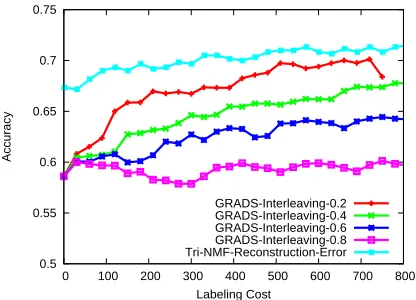
Figure 6: Comparing active dual supervision using ma-trix factorization with GRADS on sentiment analysis.
Comparing Active Dual Supervision Using Ma-trix Factorization with GRADS on Sentiment Analysis The sentiment analysis experiment is conducted on the movies review dataset (Pang et al., 2002), containing 1000 positive and 1000 negative movie reviews. The results are shown in Figure 6. The experimental results clearly demonstrate the ef-fectiveness of our approach, denoted as Tri-NMF-Reconstruction-Error.
7 Conclusions
In this paper, we study the problem of active dual supervision, and propose a matrix tri-factorization based approach to address the issue, how to evaluate labeling benifit of different types of queries (exam-ples or features) in the same scale. Following ex-tending the nonnegative matrix tri-factorization to the active dual supervision setting, we use the recon-struction error to evaluate the value of feature and example labels. Experimental results show that our proposed approach outperforms existing methods.
Acknowledgement
The work is partially supported by NSF grants DMS-0915110, CCF-0830659, and HRD-0833093. We would like to thank Dr. Vikas Sindhwani for his insightful discussions and for sharing us with his GRADS code.
References
J. Attenberg, P. Melville, and F. Provost. 2010. A Uni-fied Approach to Active Dual Supervision for Label-ing Features and Examples. Machine Learning and Knowledge Discovery in Databases, pages 40–55. D. Cohn, L. Atlas, and R. Ladner. 1994. Improving
gen-eralization with active learning. Machine Learning, 15(2):201–221.
I.S. Dhillon. 2001. Co-clustering documents and words using bipartite spectral graph partitioning. In Pro-ceedings of the seventh ACM SIGKDD international conference on Knowledge discovery and data mining, pages 269–274. ACM.
C. Ding, T. Li, W. Peng, and H. Park. 2006. Orthogonal nonnegative matrix t-factorizations for clustering. In
[image:9.612.81.289.377.527.2]conference on Knowledge discovery and data mining, pages 126–135. ACM.
C. Ding, T. Li, and W. Peng. 2008. On the equiva-lence between non-negative matrix factorization and probabilistic latent semantic indexing. Computational Statistics & Data Analysis, 52(8):3913–3927.
G. Druck, G. Mann, and A. McCallum. 2008. Learn-ing from labeled features usLearn-ing generalized expecta-tion criteria. In Proceedings of the 31st annual in-ternational ACM SIGIR conference on Research and development in information retrieval, pages 595–602. ACM.
G. Druck, B. Settles, and A. McCallum. 2009. Active learning by labeling features. In Proceedings of the 2009 conference on Empirical methods in natural lan-guage processing, pages 81–90. Association for Com-putational Linguistics.
S. Godbole, A. Harpale, S. Sarawagi, and S. Chakrabarti. 2004. Document classification through interactive su-pervision of document and term labels. Knowledge Discovery in Databases: PKDD 2004, pages 185–196. D.D. Lee and H.S. Seung. 2001. Algorithms for non-negative matrix factorization. Advances in neural in-formation processing systems, 13.
T. Li, Y. Zhang, and V. Sindhwani. 2009. A non-negative matrix tri-factorization approach to sentiment classifi-cation with lexical prior knowledge. InProceedings of the Joint Conference of the 47th Annual Meeting of the ACL, pages 244–252. Association for Computational Linguistics.
A.K. McCallum and K. Nigam. 1998. Employing EM and pool-based active learning for text classification. In Proceedings of the Fifteenth International Confer-ence on Machine Learning. Citeseer.
P. Melville and V. Sindhwani. 2009. Active dual su-pervision: Reducing the cost of annotating examples and features. InProceedings of the NAACL HLT 2009 Workshop on Active Learning for Natural Language Processing, pages 49–57. Association for Computa-tional Linguistics.
P. Melville, M. Saar-Tsechansky, F. Provost, and R. Mooney. 2005. An expected utility approach to active feature-value acquisition. In Proceedings of Fifth IEEE International Conference on Data Mining. IEEE.
P. Melville, W. Gryc, and R.D. Lawrence. 2009. Senti-ment analysis of blogs by combining lexical knowl-edge with text classification. In Proceedings of the 15th ACM SIGKDD international conference on Knowledge discovery and data mining, pages 1275– 1284. ACM.
B. Pang, L. Lee, and S. Vaithyanathan. 2002. Thumbs up?: sentiment classification using machine learning
techniques. In Proceedings of the 2002 conference on Empirical methods in natural language processing, pages 79–86. Association for Computational Linguis-tics.
H. Raghavan and J. Allan. 2007. An interactive algo-rithm for asking and incorporating feature feedback into support vector machines. In Proceedings of the 30th annual international ACM SIGIR conference on Research and development in information retrieval, pages 79–86. ACM.
H. Raghavan, O. Madani, and R. Jones. 2006. Active learning with feedback on features and instances. The Journal of Machine Learning Research, 7:1655–1686. T. Sandler, P.P. Talukdar, L.H. Ungar, and J. Blitzer. 2008. Regularized learning with networks of features.
Advances in Neural Information Processing Systems, pages 1401–1408.
B. Settles. 2009. Active Learning Literature Survey.
Technical Report 1648.
C. Shen, T. Li, and C. Ding. 2011. Integrating Clustering and Multi-Document Summarization by Bi-mixture Probabilistic Latent Semantic Analysis (PLSA) with Sentence Bases. InProceedings of the national con-ference on Artificial intelligence. AAAI Press. V. Sindhwani and P. Melville. 2008. Document-word
co-regularization for semi-supervised sentiment anal-ysis. InData Mining, Eighth IEEE International Con-ference on, pages 1025–1030. IEEE.
V. Sindhwani, J. Hu, and A. Mojsilovic. 2008. Regular-ized co-clustering with dual supervision. Advances in Neural Information Processing Systems, 21.
V. Sindhwani, P. Melville, and R.D. Lawrence. 2009. Uncertainty sampling and transductive experimental design for active dual supervision. InProceedings of the 26th Annual International Conference on Machine Learning, pages 953–960. ACM.
S. Tong and D. Koller. 2002. Support vector machine active learning with applications to text classification.
The Journal of Machine Learning Research, 2:45–66. Omar F. Zaidan and Jason Eisner. 2008. Modeling
anno-tators: A generative approach to learning from annota-tor rationales. InProceedings of the 2008 conference on Empirical methods in natural language processing, pages 31–40. Association for Computational Linguis-tics, October.