Adapting a Polarity Lexicon using Integer Linear Programming
for Domain-Specific Sentiment Classification
Yejin Choi and Claire Cardie
Department of Computer Science Cornell University
Ithaca, NY 14853
{ychoi,cardie}@cs.cornell.edu
Abstract
Polarity lexicons have been a valuable re-source for sentiment analysis and opinion mining. There are a number of such lexi-cal resources available, but it is often sub-optimal to use them as is, because general purpose lexical resources do not reflect domain-specific lexical usage. In this pa-per, we propose a novel method based on integer linear programming that can adapt an existing lexicon into a new one to re-flect the characteristics of the data more directly. In particular, our method collec-tively considers the relations among words and opinion expressions to derive the most likely polarity of each lexical item (posi-tive, neutral, nega(posi-tive, ornegator) for the given domain. Experimental results show that our lexicon adaptation technique im-proves the performance of fine-grained po-larity classification.
1 Introduction
Polarity lexicons have been a valuable resource for sentiment analysis and opinion mining. In particu-lar, they have been an essential ingredient for fine-grained sentiment analysis (e.g., Kim and Hovy (2004), Kennedy and Inkpen (2005), Wilson et al. (2005)). Even though the polarity lexicon plays an important role (Section 3.1), it has received rela-tively less attention in previous research. In most cases, polarity lexicon construction is discussed only briefly as a preprocessing step for a sentiment analysis task (e.g., Hu and Liu (2004), Moilanen and Pulman (2007)), but the effect of different al-ternative polarity lexicons is not explicitly inves-tigated. Conversely, research efforts that focus on constructing a general purpose polarity lexicon (e.g., Takamura et al. (2005), Andreevskaia and Bergler (2006), Esuli and Sebastiani (2006), Rao
and Ravichandran (2009)) generally evaluate the lexicon in isolation from any potentially relevant NLP task, and it is unclear how the new lexicon might affect end-to-end performance of a concrete NLP application.
It might even be unrealistic to expect that there can be a general-purpose lexical resource that can be effective across allrelevant NLP applica-tions, as general-purpose lexicons will not reflect domain-specific lexical usage. Indeed, Blitzer et al. (2007) note that the polarity of a particu-lar word can carry opposite sentiment depending on the domain (e.g., Andreevskaia and Bergler (2008)).
In this paper, we propose a novel method based on integer linear programming to adapt an existing polarity lexicon into a new one to reflect the char-acteristics of the data more directly. In particular, our method considers the relations among words and opinion expressions collectively to derive the most likely polarity of each word for the given do-main.
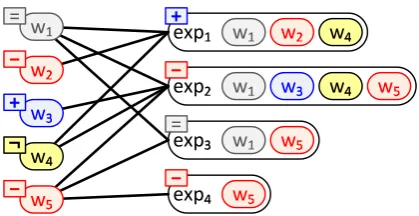
Figure 1 depicts the key insight of our approach using a bipartite graph. On the left hand side, each node represents a word, and on the right hand side, each node represents an opinion expression. There is an edge between a wordwiand an opinion ex-pressionej, if the wordwiappears in the expres-sionej. We assume the possible polarity of each expression is one of the following three values:
{positive, neutral, negative}, while the possible polarity of each word is one of:{positive,neutral, negativeornegator}. Strictly speaking,negatoris not a value for polarity, but we include them in our lexicon, becausevalence shiftersornegatorshave been shown to play an important role for sentiment analysis (e.g., Polanyi and Zaenen (2004), Moila-nen and Pulman (2007), Choi and Cardie (2008)). Typically, the ultimate goal of the sentiment analysis task is to determine the expression-level (or sentiment/ document-level) polarities, rather
than the correct word-level polarities with respect to the domain. Therefore, word-level polarities can be considered as latent information. In this pa-per, we show how we can improve the word-level polarities of a general-purpose polarity lexicon by utilizing the expression-level polarities, and in re-turn, how the adapted word-level polarities can improve the expression-level polarities.
In Figure 1, there are two types of relations we could exploit when adapting a general-purpose polarity lexicon into a domain-specific one. The first are word-to-word relations within each ex-pression. That is, if we are not sure about the polarity of a certain word, we can still make a guess based on the polarities of other words within the same expression and knowledge of the polar-ity of the expression. The second type of relations are word-to-expression relations: e.g., some words appear in expressions that take on a variety of po-larities, while other words are associated with ex-pressions of one polarity class or another.
In relation to previous research, analyz-ing word-to-word (intra-expression) relations is most related to techniques that determine expression-level polarityin context (e.g., Wilson et al. (2005)), while exploring word-to-expression (inter-expression) relations has connections to techniques that employ more of a global-view of corpus statistics (e.g., Kanayama and Nasukawa (2006)).1
While most previous research exploits only one or the other type of relation, we propose a unified method that can exploit both types of semantic re-lation, while adapting a general purpose polarity lexicon into a domain specific one. We formulate our lexicon adaptation task using integer linear programming (ILP), which has been shown to be very effective when solving problems with com-plex constraints (e.g., Roth and Yih (2004), Denis and Baldridge (2007)). And the word-to-word and word-to-expression relations discussed above can be encoded as soft and hard constraints in ILP. Un-fortunately, one class of constraint that we would like to encode (see Section 2) will require an exponentially many number of constraints when grounded into an actual ILP problem. We there-fore propose an approximation scheme to make the problem more practically solvable.
We evaluate the effect of the adapted
lex-1In case of document-level polarity classification,
word-to-expression relations correspond to word-to-document re-lations.
exp
exp
exp
expw w
w
w w w w
w w
w +
−
w
w
w
w
w
=
+
−
−
=
[image:2.595.311.521.60.168.2]−
Figure 1: The relations among words and expres-sions. + indicates positive, - indicates negative, = indicates neutral, and¬indicates a negator.
icon in the context of a concrete NLP task: expression-level polarity classification. Experi-mental results show that our lexicon adaptation technique improves the accuracy of two com-petitive expression-level polarity classifiers from 64.2% - 70.4% to 67.0% - 71.2%..
2 An Integer Linear Programming
Approach
In this section, we describe how we formulate the lexicon adaptation task using integer linear pro-gramming. Before we begin, we assume that we have a general-purpose polarity lexiconL, and a polarity classification algorithmf(el,L), that can determine the polarity of the opinion expressionel based on the words ineland the initial lexiconL. The polarity classification algorithmf(·) can be either a heuristic-based one, or a machine-learning based one – we consider it as a black box for now.
Constraints for word-level polarities: For each word xi, we define four binary variables: x+i , x=i , x−i , x¬i to represent positive, neutral, neg-ative polarity, and negators respectively. Ifxδi = 1
for someδ ∈ {+,=,−,¬}, then the wordxihas the polarityδ. The following inequality constraint states that at least one polarity value must be cho-sen for each word.
x+i +x=i +x−i +x¬i >= 1 (1)
constraint states that at most two polarities can be chosen for each word.
x+i +x=i +xi−+x¬i <= 1 +αi (2)
Next we introduce the initial part of our objec-tive function.
maximize X i
wi+x+i + wi=x=i
+ wi−x−i + wi¬x¬i
− wααi
+ · · · (3)
For the auxiliary variable αi, we apply a con-stant weightwαto discourage ILP from choosing more than one polarity for each word. We can al-low more than two polarities for each word, by adding extra auxiliary variables and weights. For each variablexδi, we define its weightwδi, which indicates how likely it is that wordxi carries the polarity δ. We define the value of wiδ using two different types of information as follows:
wδi := Lwδi + Cwiδ
whereLwδi is the degree of polarityδfor wordxi determined by the general-purpose polarity lexi-conL, andCwδ
i is the degree of polarity δ deter-mined by the corpus statistics as follows:2
Cwδ i :=
#ofxiin expressions with polarityδ
#ofxiin the corpusC
Note that the occurrence of word xi in an ex-pression ej with a polarity δ does not necessar-ily mean that the polarity of xi should also be δ, as the interpretation of the polarity of an ex-pression is more than just a linear sum of the word-level polarities (e.g., Moilanen and Pulman (2007)). Nonetheless, not all expressions require a complicated inference procedure to determine their polarity. Therefore,Cwδi still provides useful information about the likely polarity of each word based on the corpus statistics.
From the perspective of Chomskyan linguistics, the weightsLwδ
i based on the prior polarity from the lexicon can be considered as having a ”com-petence” component , while Cwδi derived from the corpus counts can be considered as a ”perfor-mance” component (Noam Chomsky (1965)).
2
If a wordxi is in an expression that is not an opinion, then we count it as an occurrence with neutral polarity.
Constraints for content-word negators: Next we describe a constraint that exploits knowledge of the typical distribution of content-word nega-torsin natural language. Content-word negators are words that are not function words, but act se-mantically as negators (Choi and Cardie, 2008).3 Although it is possible to artificially construct a very convoluted sentence with lots of negations, it is unlikely for multiple layers of negations to ap-pear very often in natural language (Pickett et al. (1996)). Therefore, we allow at most one content-word negator for each expressionel. Because we do not restrict the number of function-word nega-tors, our constraint still gives room for multiple layers of negations.
X
i∈µ(el)
x¬i <= 1 (4)
In the above constraint,µ(el) indicates the set of indices of content words appearing inel. For instance, ifi∈ µ(el), thenxi appears inel. This constraint can be polished further to accommodate longer expressions where multiple content-word negators are more likely to appear, by adding a separate constraint with a sliding window.
Constraints for expression-level polarities: Before we begin, we introduceπ(el) that will be used often in the remaining section. For each ex-pressionel, we defineπ(el) to be the set of con-tent words appearing inel, together with the most likely polarity proposed by a general-purpose po-larity lexiconL. For instance, ifx+i ∈π(el), then the polarity of wordxiis+according toL.
Next we encode constraints that consider expression-level polarities. If the polarity classifi-cation algorithmf(el,L)makes an incorrect pre-diction forelusing the original lexiconL, then we need to encourage ILP to fix the error by suggest-ing different word-level polarities. We capture this idea by the following constraint:
X
xδ i∈π(el)
xδi <= |π(el)| −1 +βl (5)
The auxiliary binary variable βl is introduced for each el so that the assignmentπ(el) does not have to be changed if paying for the costwβin the objective function. (See equation (10).) That is, suppose the ILP solver assigns ‘1’ to all variables
3
Examples of content-word negators are destroy,
inφ(el), (which corresponds to keeping the orig-inal lexicon as it is for all words in the given ex-pressionel), then the auxiliary variableβlmust be also set as ‘1’ in order to satisfy the constraint (5). Because βl is associated with a negative weight in the objective function, doing so will act against maximizing the objective function. This way, we discourage the ILP solver to preserve the original lexicon as it is.
To verify the constraint (5) further, suppose that the ILP solver assigns ‘1’ for all variables inφ(el) except for one variable. (Notice that doing so cor-responds to proposing a new polarity for one of the words in the given expression el.) Then the constraint (5) will hold regardless of whether the ILP solver assigns ‘0’ or ‘1’ toβl. Becauseβl is associated with a negative weight in the objective function, the ILP solver will then assign ‘0’ toβlto maximize the objective function. In other words, we encourage the ILP solver to modify the original lexicon for the given expressionel.
We use this type of soft constraint in order to cope with the following two noise factors: first, it is possible that some annotations are noisy. Sec-ond,f(el,L)is not perfect, and might not be able to make a correct prediction even with the correct word-level polarities.
Next we encode a constraint that is the oppo-site of the previous one. That is, if the polarity classification algorithmf(el,L) makes a correct prediction onelusing the original lexiconL, then we encourage ILP to keep the original word-level polarities for words inel.
X
xδ i∈π(el)
xδi >= |π(el)| − |π(el)|βl (6)
Interpretation of constraint (6) with the auxil-iary binary variable βl is similar to that of con-straint (5) elaborated above.
Notice that in equation (5), we encouraged ILP to fix the current lexicon L for words in el, but we have not specified the consequence of a mod-ified lexicon (L0) in terms of expression-level po-larity classificationf(el,L0). Certain changes to
L might not fix the prediction error for el, and those might even cause extra incorrect predictions for other expressions. Then it would seem that we need to replicate constraints (5) & (6) for all per-mutations of word-level polarities. However, do-ing so would incur exponentially many number of
constraints (4|el|) for each expression.4
To make the problem more practically solv-able, we only consider changes to the lexicon that are within edit-one distance with respect toπ(el). More formally, let us defineπ0(el)to be the set of content words appearing in el, together with the most likely polarity proposed by a modified polar-ity lexiconL0. Then we need to consider allπ0(el) such that|π0(el)∩π(el)|=|π(el)| −1. There are
(4−1)|el|number of differentπ0(el), and we index them asπk0(el). We then add following constraints similarly as equation (5) & (6):
X
xδ i∈π0k(el)
xδi <= |πk0(el)| −1 +β(l,k) (7)
if the polarity classification algorithmf(·)makes an incorrect prediction based onπk0(el). And,
X
xδ i∈πk(el)0
xδi >= |πk0(el)| − |πk0(el)|β(l,k) (8)
if the polarity classification algorithmf(·)makes a correct prediction based onπk0(el). Remember that none of the constraints (5) - (8) enforces as-signmentπ(el)orπk0(el)as a hard constraint. In order to enforce at least one of them to be chosen, we add the following constraint:
X
xδ i∈π(el)
xδi >= |π(el)| −1 (9)
This constraint ensures that the modified lexi-conL0is not drastically different fromL. Assum-ing that the initial lexiconLis a reasonably good one, constraining the search space forL0 will reg-ulate thatL0 does not turn into a degenerative one that overfits to the current corpusC.
Objective function: Finally, we introduce our full objective function.
4
For certain simple polarity classification algorithm
f(el,L), it is possible to write polynomially many number of constraints. However our approach intends to be more gen-eral by treatingf(el,L)as a black box, so that algorithms
maximize X i
wi+x+i + wi=x=i
+ wi−x−i + wi¬x¬i
− wααi
−X
l
wβρlβl
−X
l,k
wβρ(l,k)β(l,k) (10)
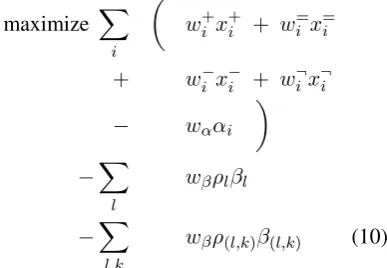
We have already described the first part of the objective function (equation (3)), thus we only de-scribe the last two terms here. wβis defined simi-larly aswα; it is a constant weight that applies for any auxiliary binary variableβlandβ(l,k).
We further define ρl and ρ(l,k) as secondary weights, oramplifiersto adjust the constant weight wβ. To enlighten the motivation behind the am-plifiers ρl and ρ(l,k), we bring out the following observations:
1. Among the incorrect predictions for expression-level polarity classification, some are more incorrect than the other. For instance, classifying positive class to negative class is more wrong than classifying positive class to neutral class. Therefore, the cost of not fixing very incorrect predictions should be higher than the cost of not fixing less incorrect predictions. (See [R2] and [R3] in Table 1.)
2. If the current assignmentπ(el)for expression elyields a correct prediction using the classi-fiery(el,L), then there is not much point in changingLtoL0, even ify(e
l,L0)also yields a correct prediction. In this case, we would like to assign slightly higher confidence in the original lexiconLthen the new oneL0. (See [R1] in Table 1.)
3. Likewise, if the current assignmentπ(el)for expression el yields an incorrect prediction using the classifiery(el,L), then there is not much point in changingL toL0, ify(el,L0) also yields an equally incorrect prediction. Again we assign slightly higher confidence in the original lexiconLthan the new oneL0 in such cases. (Compare each row in [R2] with a corresponding row in [R3] in Table 1.)
[image:5.595.96.290.87.221.2][R1] Ifπ(el)correct ρl ←1.5 Ifπk0(el)correct ρ(l,k) ←1.0 [R2] Ifπ(el)very incorrect ρl ←1.0 Ifπ(el)less incorrect ρl ←0.5 [R3] Ifπk0(el)very incorrect ρ(l,k) ←1.5 Ifπk0(el)less incorrect ρ(l,k) ←1.0
Table 1: The value of amplifiersρlandρ(l,k).
To summarize, for correct predictions, the de-gree ofρdetermines the degree of cost of (unde-sirably) altering the current lexicon forel. For in-correct predictions, the degree ofρdetermines the degree of cost of not fixing the current lexicon for el.
3 Experiments
In the experiment section, we seek for answers for the following questions:
Q1 What is the effect of a polarity lexicon on the expression-level polarity classification task? In particular, is it useful when using a ma-chine learning technique that might be able to learn the necessary polarity information just based on the words in the training data, with-out consulting a dictionary? (Section 3.1)
Q2 What is the effect of an adapted polarity lex-icon on the expression-level polarity classifi-cation task? (Section 3.2)
Notice that we include theneutral polarity in the polarity classification. It makes our task much harder (e.g., Wilson et al. (2009)) than those that assume inputs are guaranteed to be either strongly positive or negative (e.g., Pang et al. (2002), Choi and Cardie (2008)). But in practice, one can-not expect that a given input is strongly polar, as automatically extracted opinions are bound to be noisy. Furthermore, Wiebe et al. (2005) discuss that some opinion expressions do carry a neutral polarity.
higher, and exclude those with annotation confi-dence marked as ‘uncertain’. To focus our study on the direct influence of the polarity lexicon upon the sentiment classification task, we assume the boundaries of the expressions are given. How-ever, our approach can be readily used in tan-dem with a system that extracts opinion expres-sions (e.g., Kim and Hovy (2005), Breck et al. (2007)). Performance is reported using 10-fold cross-validation on 400 documents, and a separate 135 documents were used as a development set. For the general-purpose polarity lexicon, we ex-pand the polarity lexicon of Wilson et al. (2005) with General Inquirer dictionary as suggested by Choi and Cardie (2008).
We report the performance in two measures: ac-curacyfor 3-way classification, andaverage error distance. The reason why we consideraverage er-ror distanceis because classifying a positive class into a negative class is worse than classifying a positive class into a neutral one. We define the er-ror distance between ‘neutral’ class and any other class as1, while the error distance between ‘posi-tive’ class and ‘nega‘posi-tive’ class as2. If a predicted polarity is correct, then the error distance is0. We compute the error distance of each prediction and take the average over all predictions in the test data.
3.1 Experiment-I: Effect of a Polarity Lexicon
To verify the effect of a polarity lexicon on the expression-level polarity classification task, we experiment with simple classification-based ma-chine learning technique. We use the Mallet (McCallum, 2002) implementation of Conditional Random Fields (CRFs) (Lafferty et al., 2001).5 To
highlight the influence of a polarity lexicon, we compare the performance of CRFs with and with-out features derived from polarity lexicons.
Features: We encode basic features as words and lemmas for all content words in the given ex-pression. The performance of CRFs using only the basic features are given in the first row of the Ta-ble 2. Next we encode features derived from po-larity lexicons as follows.
• The output of Vote & Flip algorithm. (Sec-tion 3.2 & Figure 2.)
5We use the CRF implementation of Mallet (McCallum,
2002) with Markov-order 0, which is equivalent to Maximum Entropy models (Berger et al. (1996)).
Accuracy Avg. Error Distance
Without Lexicon 63.9 0.440
[image:6.595.313.519.63.105.2]With Lexicon 70.4 0.334
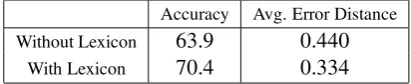
Table 2: Effect of a polarity lexicon on expression-level classification using CRFs
• Number of positive, neutral, negative, and negators in the given expression.
• Number of positive (or negative) words in conjunction with number of negators.
• (boolean) Whether the number of positive words dominates negative ones.
• (boolean) Whether the number of negative words dominates positive ones.
• (boolean) None of the above two cases
• Each of the above three boolean values in conjunction with the number of negators.
Results: Table 2 shows the performance of CRFs with and without features that consult the general-purpose lexicon. As expected, CRFs can perform reasonably well (accuracy =63.9%) even without consulting the dictionary, by learning di-rectly from the data. However, having the polarity lexicon boosts the performance significantly (ac-curacy = 70.4%), demonstrating that lexical re-sources are very helpful for fine-grained sentiment analysis. The difference in performance is statisti-cally significant by paired t-test for both accuracy (p <0.01) and average error distance (p <0.01).
3.2 Experiment-II: Adapting a Polarity Lexicon
For each expressionei,
nP ositive←# of positive words inei nN eutral←# of neutral words inei
nN egative←# of negative words inei nN egator←# of negating words inei
if (nN egator% 2 = 0)
thenf F lipP olarity←f alse
else
thenf F lipP olarity←true
if(nP ositive > nN egative) &¬f F lipP olarity
then Polarity(ei)←positive
else if(nP ositive > nN egative) & f F lipP olarity
then Polarity(ei)←negative
else if(nP ositive < nN egative) &¬f F lipP olarity
then Polarity(ei)←negative
else if(nP ositive < nN egative) & f F lipP olarity
then Polarity(ei)←neutral
else ifnN eutral >0
then Polarity(ei)←neutral
else
then Polarity(ei)←def ault polarity(the most
prominent polarity in the corpus)
Figure 2: Vote & Flip Algorithm
It might look a bit complex at first glance, but the intuition is simple. The variable f F lipP olarity determines whether we need to flip the overall majority polarity based on the num-ber of negators in the given expression. If the positive (or negative) polarity words dominate the given expression, and if there is no need to flip the majority polarity, then we take the positive (or negative) polarity as the overall polarity. If the positive (or negative) polarity words dominate the given expression, and if we need to flip the major-ity polarmajor-ity, then we take the negative (or neutral) polarity as the overall polarity.
Notice that the result of flipping the negative po-larity isneutral, notpositive. In our pilot study, we found that this strategy works better than flipping the negative polarity to positive.6 Finally, if the number of positive words and the negative words tie, and there is any neutral word, then we assign the neutral polarity. In this case, we don’t worry if
6This finding is not surprising. For instance, if we
con-sider the polarity of”She did not get hurt much from the
ac-cident.”, it can be viewed as neutral; although it is good that
one did not hurt much, it is still bad that there was an acci-dent. Hence it gives a mixed feeling, which corresponds to the neutral polarity.
there is a negator, because flipping a neutral polar-ity would still result in a neutral polarpolar-ity. If none of above condition is met, than we default to the most prominent polarity of the data, which is the nega-tive polarity in the MPQA corpus. We name this simple algorithm as Vote & Flip algorithm. The performance is shown in the first row in Table 2.
Next we describe the implementation part of the ILP. For 10 fold-cross validation, we formulate the ILP problem using the training data (360 docu-ments), and then test the effect of the adapted lex-icon on the remaining 40 documents. We include only those content words that appeared more than 3 times in the training data. From the pilot test us-ing the development set, we picked the value of wβ as 0.1. We found that having the auxiliary variables αl which allow more than one polarity per word does not necessarily help with the per-formance, so we omitted them. We suspect it is because the polarity classifiers we experimented with is not highly capable of disambiguating dif-ferent lexical usages and select the right polarity for a given context. We use CPLEX integer pro-gramming solver to solve our ILP problems. On a machine with 4GHz CPU, it took several minutes to solve each ILP problem.
In order to assess the effect of the adapted lex-icon using CRFs, we need to first train the CRFs model. Using the same training set used for the lexicon adaptation would be suboptimal, because the features generated from the adapted lexicon will be unrealistically good in that particular data. Therefore, we prepared a separate training data for CRFs using 135 documents from the development set.
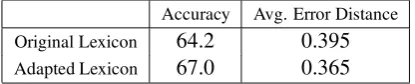
Results: Table 3 shows the comparison of the original lexicon and the adapted lexicon in terms of polarity classification performance using the Vote & Flip algorithm. The adapted lexicon im-proves the accuracy as well as reducing the aver-age error distance. The difference in performance is statistically significant by paired t-test for both accuracy (p < 0.01) and average error distance (p <0.01).
Accuracy Avg. Error Distance
Original Lexicon 64.2 0.395
Adapted Lexicon 67.0 0.365
Table 3: Effect of an adapted polarity lexicon on expression-level classification using the Vote & Flip Algorithm
Accuracy Avg. Error Distance
Original Lexicon 70.4 0.334
[image:8.595.78.286.63.105.2]Adapted Lexicon 71.2 0.327
Table 4: Effect of an adapted polarity lexicon on expression-level classification using CRFs
4 Related Work
There are a number of previous work that focus on building polarity lexicons (e.g., Takamura et al. (2005), Kaji and Kitsuregawa (2007), Rao and Ravichandran (2009)). But most of them evalu-ated their lexicon in isolation from any potentially relevant NLP task, and it is unclear how the new lexicon might affect end-to-end performance of a concrete NLP application. Our work differs in that we try to draw a bridge between general purpose lexical resources and a domain-specific NLP ap-plication.
Kim and Hovy (2005) and Banea et al. (2008) present bootstrapping methods to construct a sub-jectivity lexicon and measure the effect of the new lexicon for sentence-level subjectivity classifica-tion. However, their lexicons only tell whether a word is a subjective one, but not the polarity of the sentiment. Furthermore, the construction of lexi-con is still an isolated step from the classification task. Our work on the other hand allows the classi-fication task to directly influence the construction of lexicon, enabling the lexicon to be adapted for a concrete NLP application and for a specific do-main.
Wilson et al. (2005) pioneered the expression-level polarity classification task using the MPQA corpus. The experimental results are not directly comparable to ours, because Wilson et al. (2005) limit the evaluation only for the words that ap-peared in their polarity lexicon. Choi and Cardie (2008) also focus on the expression-level polarity classification, but their evaluation setting is not as practical as ours in that they assume the inputs are guaranteed to be either strongly positive or nega-tive.
5 Conclusion
In this paper, we present a novel lexicon adapta-tion technique based on integer linear program-ming to reflect the characteristics of the domain more directly. In particular, our method collec-tively considers the relations among words and opinion expressions to derive the most likely po-larity of each lexical item for the given domain. We evaluate the effect of our lexicon adaptation technique in the context of a concrete NLP ap-plication: expression-level polarity classification. The positive results from our experiments encour-age further research for lexical resource adaptation techniques.
Acknowledgments
This work was supported in part by National Sci-ence Foundation Grant BCS-0624277 and by the Department of Homeland Security under ONR Grant N0014-07-1-0152. We also thank the EMNLP reviewers for insightful comments.
References
Alina Andreevskaia and Sabine Bergler. 2008. When Specialists and Generalists Work Together: Over-coming Domain Dependence in Sentiment Tagging.
ACL
Alina Andreevskaia and Sabine Bergler. 2006. Min-ing WordNet For a Fuzzy Sentiment: Sentiment Tag Extraction From WordNet Glosses. EACL
Carmen Banea, Rada Mihalcea, and JanyceWiebe. 2008. A Bootstrapping Method for Building Sub-jectivity Lexicons for Languages with Scarce Re-sources. LREC
Adam Berger, Stephen Della Pietra, and Vincent Della Pietra. 1996. A maximum entropy approach to nat-ural language processing. InComputational Lin-guistics, 22(1)
John Blitzer, Mark Dredze, and Fernando Pereira. 2007. Biographies, Bollywood, Boom-boxes, and Blenders: Domain Adaptation for Sentiment Classi-fication. Association for Computational Linguistics - ACL 2007
Eric Breck, Yejin Choi and Claire Cardie. 2007. Iden-tifying Expressions of Opinion in Context. InIJCAI.
Yejin Choi and Claire Cardie. 2008. Learning with Compositional Semantics as Structural Inference for Subsentential Sentiment Analysis.EMNLP
Pascal Denis and Jason Baldridge. 2007. Joint deter-mination of anaphoricity and coreference resolution using integer programming.NAACL
Andrea Esuli and Fabrizio Sebastiani. 2006. Senti-WordNet: A Publicly Available Lexical Resource for Opinion Mining. In Proceedings of 5th Con-ference on Language Resources and Evaluation (LREC),.
Minqing Hu and Bing Liu. 2004. Mining and sum-marizing customer reviews. In Proceedings of the ACM SIGKDD International Conference on Knowl-edge Discovery & Data Mining (KDD-2004).
Nobuhiro Kaji and Masaru Kitsuregawa. 2007. Build-ing Lexicon for Sentiment Analysis from Massive
Collection of HTML Documents. In
EMNLP-CoNLL.
Hiroshi Kanayama Tetsuya Nasukawa. 2006. Fully Automatic Lexicon Expansion for Domain-oriented Sentiment Analysis. In ACL.
Alistair Kennedy and Diana Inkpen. 2005. Sentiment Classification of Movie and Product Reviews Us-ing Contextual Valence Shifters. InProceedings of FINEXIN 2005, Workshop on the Analysis of Infor-mal and ForInfor-mal Information Exchange during Ne-gotiations.
Soo-Min Kim and Eduard Hovy. 2004. Determining the sentiment of opinions. InProceedings of COL-ING.
Soo-Min Kim and Eduard Hovy. 2005. Automatic De-tection of Opinion Bearing Words and Sentences. In Companion Volume to the Proceedings of the Sec-ond International Joint Conference on Natural Lan-guage Processing (IJCNLP-05)
John Lafferty, Andrew Kachites McCallum and Fer-nando Pereira. 2001. Conditional Random Fields: Probabilistic Models for Segmenting and Labeling Sequence Data. InICML.
Andrew Kachites McCallum. 2002.
MAL-LET: A Machine Learning for Language Toolkit. http://mallet.cs.umass.edu.
Karo Moilanen and Stephen Pulman. 2007. Sentiment Composition. InProceedings of Recent Advances in Natural Language Processing (RANLP 2007).
Bo Pang, Lillian Lee and Shivakumar Vaithyanathan. 2002. Thumbs up? Sentiment Classification using Machine Learning Techniques. InEMNLP.
Joseph Pickett et al. 1996. The American heritage book of English usage: A practical and authoritative guide to contemporary English. Houghton Mifflin Company.
Livia Polanyi and Annie Zaenen. 2004. Contextual lexical valence shifters. In Exploring Attitude and Affect in Text: Theories and Applications: Papers from the 2004 Spring Symposium, AAAI.
Delip Rao and Deepak Ravichandran. 2009. Semi-Supervised Polarity Lexicon Induction. InEACL.
Dan Roth and Wen-tau Yih. 2004. A Linear Program-ming Formulation for Global Inference in Natural Language Tasks. InCoNLL.
Hiroya Takamura, Takashi Inui, and Manabu Okumura. 2005. Extracting semantic orientations of words us-ing spin model. InACL.
Janyce Wiebe, Theresa Wilson and Claire Cardie. 2005. Annotating expressions of opinions and emo-tions in language. InLanguage Resources and Eval-uation (formerly Computers and the Humanities), 39(2-3):165210.
Theresa Wilson, Janyce Wiebe and Paul Hoffmann. 2005. Recognizing contextual polarity in phrase-level sentiment analysis. In Proceedings of HLT/EMNLP.