An Empirical Analysis of Optimization for Max-Margin NLP
Jonathan K. Kummerfeld, Taylor Berg-Kirkpatrick and Dan Klein
Computer Science Division University of California, Berkeley
Berkeley, CA 94720, USA
{jkk,tberg,klein}@cs.berkeley.edu
Abstract
Despite the convexity of structured max-margin objectives (Taskar et al., 2004; Tsochantaridis et al., 2004), the many ways to optimize them are not equally ef-fective in practice. We compare a range of online optimization methods over a vari-ety of structured NLP tasks (coreference, summarization, parsing, etc) and find sev-eral broad trends. First, margin methods do tend to outperform both likelihood and the perceptron. Second, for max-margin objectives, primal optimization methods are often more robust and progress faster than dual methods. This advantage is most pronounced for tasks with dense or continuous-valued features. Overall, we argue for a particularly simple online pri-mal subgradient descent method that, de-spite being rarely mentioned in the litera-ture, is surprisingly effective in relation to its alternatives.
1 Introduction
Structured discriminative models have proven ef-fective across a range of tasks in NLP includ-ing tagginclud-ing (Lafferty et al., 2001; Collins, 2002), reranking parses (Charniak and Johnson, 2005), and many more (Taskar, 2004; Smith, 2011). Common approaches to training such models in-clude margin methods, likelihood methods, and mistake-driven procedures like the averaged per-ceptron algorithm. In this paper, we primarily csider the relative empirical behavior of several on-line optimization methods for margin-based objec-tives, with secondary attention to other approaches for calibration.
It is increasingly common to train structured models using a max-margin objective that incor-porates a loss function that decomposes in the
same way as the dynamic program used for in-ference (Taskar, 2004). Fortunately, most struc-tured margin objectives are convex, so a range of optimization methods with similar theoretical properties are available – in short, any of these methods will work in the end. However, in prac-tice, how fast each method converges varies across tasks. Moreover, some of the most popular meth-ods more loosely associated with the margin ob-jective, such as the MIRA algorithm (Crammer and Singer, 2003) or even the averaged perceptron (Freund and Schapire, 1999) are not global opti-mizations and can have different properties.
We analyze a range of methods empirically, to understand on which tasks and with which fea-ture types, they are most effective. We modified six existing, high-performance, systems to enable loss-augmented decoding, and trained these mod-els with six different methods. We have released our learning code as a Java library.1 Our results
provide support for the conventional wisdom that margin-based optimization is broadly effective, frequently outperforming likelihood optimization and the perceptron algorithm. We also found that directly optimizing the primal structured margin objective based on subgradients calculated from single training instances is surprisingly effective, performing consistently well across all tasks.
2 Learning Algorithms
We implemented a range of optimization methods that are widely used in NLP; below we categorize them into margin, likelihood, and perceptron-like methods. In each case, we used a structured loss function, modified to suit each task. In general, we focus on online methods because of their sub-stantial speed advantages, rather than algorithms such as LBFGS (Liu and Nocedal, 1989) or batch Exponentiated Gradient (Collins et al., 2008).
1http://nlp.cs.berkeley.edu/software.shtml
Algorithm 1The Online Primal Subgradient Algorithm with`1 or`2regularization, and sparse updates
Parameters:g
iters Number of iterations
C Regularization constant (10−1to10−8) η Learning rate (100 to10−4)
δ Initializer forq(10−6)
w=0 Weight vector
q=δ Cumulative squared gradient
u=0 Time of last update for each weight n= 0 Number of updates so far
foriter∈[1,iters]do forbatch∈datado
Sum gradients from loss-aug. decodes
g=0
for(xi, yi)∈batchdo
fory = argmax
y0∈Y(xi)[SCORE(y
0) +L(y0, y
i)] forg += (f(y)−f(yi))
Update the active features
q+=g2...Element-wise square
n+= 1
forf ∈nonzero features ingdo
wf =UPDATE-ACTIVE(wf,gf,qf) uf =n
The AdaGrad update
functionUPDATE-ACTIVE(w,g,q)
return wη√C+q−√ηgq [`2]
d =|w−√ηqg| −√ηqC [`1] returnsign(w−√ηqg)·max(0,d) [`1]
Functions only needed for sparse updates A single update equivalent to a series of AdaGrad updates where the weight’s subgradient was zero
functionUPDATE-CATCHUP(w,q,t)
returnwηC+√q√qt [`2] returnsign(w)·max(0,|w| −η√Cqt) [`1]
Computew>f(y0), but for each weight, apply an
update to catch up on the steps in which the gra-dient for that weight was zero
functionSCORE(y0) s= 0
forf ∈f(y0)do
forwf =UPDATE-CATCHUP(wf, qf, n−uf) foruf =n
fors+=wf
returns
Note: To implement without the sparse update, useSCORE=w>f(y0), and run the update loop on the left over all features.
Also, for comparison, to implement perceptron, remove the sparse update and useUPDATE-ACTIVE=returnw+g.
2.1 Margin
Cutting Plane (Tsochantaridis et al., 2004)
Solves a sequence of quadratic programs (QP), each of which is an approximation to the dual formulation of the margin-based learning prob-lem. At each iteration, the current QP is refined by adding additional active constraints. We solve each approximate QP using Sequential Minimal Optimization (Platt, 1999; Taskar et al., 2004).
Online Cutting Plane (Chang and Yih, 2013)
A modified form of cutting plane that only par-tially solves the QP on each iteration, operating in the dual space and optimizing a single dual vari-able on each iteration. We use a variant of Chang and Yih (2013) for theL1loss margin objective.
Online Primal Subgradient (Ratliff et al., 2007)
Computes the subgradient of the margin objective on each instance by performing a loss-augmented decode, then uses these instance-wise subgradi-ents to optimize the global objective using Ada-Grad (Duchi et al., 2011) with eitherL1orL2 reg-ularization. The simplest implementation of Ada-Grad touches every weight when doing the update
for a batch. To save time, we distinguish between two different types of update. When the subgradi-ent is nonzero, we apply the usual update. When the subgradient is zero, we apply a numerically equivalent update later, at the next time the weight is queried. This saves time, as we only touch the weights corresponding to the (usually sparse) nonzero directions in the current batch’s subgradi-ent. Algorithm 1 gives pseudocode for our imple-mentation, which was based on Dyer (2013).
2.2 Likelihood
Stochastic Gradient Descent The built-in train-ing method for many of the systems was softmax-margin likelihood optimization (Gimpel and Smith, 2010) via subgradient descent with ei-ther AdaGrad or AdaDelta (Duchi et al., 2011; Zeiler, 2012). We include results with each sys-tem’s default settings as a point of comparison.
2.3 Mistake Driven
incre-mented. Weights are averaged over the course of training, and decoding is not loss-augmented.
Margin Infused Relaxed Algorithm (Crammer and Singer, 2003) A modified form of the per-ceptron that uses loss-augmented decoding and makes the smallest update necessary to give a mar-gin at least as large as the loss of each solution. MIRA is generally presented as being related to the perceptron because it does not explicitly op-timize a global objective, but it also has connec-tions to margin methods, as explored by Chiang (2012). We consider one-best decoding, where the quadratic program for determining the magnitude of the update has a closed form.
3 Tasks and Systems
We considered tasks covering a range of structured output spaces, from sequences to non-projective trees. Most of the corresponding systems use models designed for likelihood-based structured prediction. Some use sparse indicator features, while others use dense continuous-valued features.
Named Entity Recognition This task provides a case of sequence prediction. We used the NER component of Durrett and Klein (2014)’s entity stack, training it independently of the other com-ponents. We define the loss as the number of in-correctly labelled words, and train on the CoNLL 2012 division of OntoNotes (Pradhan et al., 2007).
Coreference Resolution This gives an example of training when there are multiple gold outputs for each instance. The system we consider uses latent links between mentions in the same cluster, marginalizing over the possibilities during learn-ing (Durrett and Klein, 2013). Since the model decomposes across mentions, we train by treat-ing them as independent predictions with multiple gold outputs, comparing the inferred link with the gold link that is scored highest under the current model. We use the system’s weighted loss func-tion, and the same data as for NER.
Constituency Parsing We considered two dif-ferent systems. The first uses only sparse indicator features (Hall et al., 2014), while the second is pa-rameterized via a neural network and adds dense features derived from word vectors (Durrett and Klein, 2015).2 We define the loss as the number 2Our results are slightly lower as we save time by only using the dense features and a reduced n-gram context.
of incorrect rule productions, and use the standard Penn Treebank division (Marcus et al., 1993).
Dependency Parsing We used the first-order MST parser in two modes, Eisner’s algorithm for projective trees (Eisner, 1996; McDonald et al., 2005b), and the Chu-Liu-Edmonds algorithm for non-projective trees (Chu and Liu, 1965; Ed-monds, 1967; McDonald et al., 2005a). The loss function was the number of arcs with an incorrect parent or label, and we used the standard division of the English Universal Dependencies (Agi´c et al., 2015). The built-in training method for MST parser is averaged, 1-best MIRA, which we in-clude for comparison purposes.
Summarization With this task, we explore a case in which there is relatively little training data and the model uses a small number of dense tures. The system uses a linear model with fea-tures considering counts of bigrams in the input document collection. The system forms the out-put summary by selecting a subset of the sen-tences in the input collection that does not exceed a fixed word-length limit (Berg-Kirkpatrick et al., 2011). Inference involves solving an integer linear program, the loss function is bigram recall, and the data is from the TAC shared tasks (Dang and Owczarzak, 2008; Dang and Owczarzak, 2009).
3.1 Tuning
For each method we tuned hyperparameters by considering a grid of values and measuring dev set performance over five training iterations, ex-cept for constituency parsing, where we took five measurements, 4k instances apart. For the cutting plane methods we cached constraints in memory to save time, but the memory cost was too great to run batch cutting plane on constituency parsing (over 60 Gb), and so is not included in the results. 4 Observations
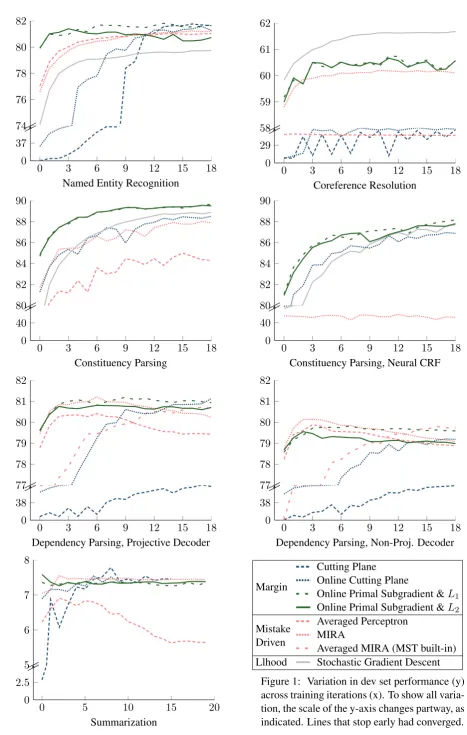
From the results in Figure 1 and during tuning, we can make several observations about these op-timization methods’ performance on these tasks.
0 3 6 9 12 15 18 0
37
Named Entity Recognition
74 76 78 80 82
0 3 6 9 12 15 18
0 29
Coreference Resolution
58 59 60 61 62
0 3 6 9 12 15 18
0 40
Constituency Parsing
80 82 84 86 88 90
0 3 6 9 12 15 18
0 40
Constituency Parsing, Neural CRF
80 82 84 86 88 90
0 3 6 9 12 15 18
0 38
Dependency Parsing, Projective Decoder
77 78 79 80 81 82
0 3 6 9 12 15 18
0 38
Dependency Parsing, Non-Proj. Decoder
77 78 79 80 81 82
0 5 10 15 20
0 2.5
Summarization
5 6 7 8
Margin
Cutting Plane Online Cutting Plane
Online Primal Subgradient &L1 Online Primal Subgradient &L2 Mistake
Driven
Averaged Perceptron MIRA
[image:4.595.60.528.49.785.2]Averaged MIRA (MST built-in) Llhood Stochastic Gradient Descent
Time per iteration relative to averaged perceptron
Method NER Coref Span Parser Neural Parser MST Proj. MST Non-Proj. Summ.
AP 1.0 1.0 1.0 - 1.0 1.0 1.0
MIRA 1.9 1.0 1.0 1.0 1.0 1.0 1.0
CP 60.8 2.7 - - 6.8 8.4 0.6
OCP 2.7 1.7 0.9 0.9 1.5 1.6 1.1
OPS 3.9 1.3 1.1 1.0 1.8 2.0 0.9
Decoding 0.6 0.2 0.9 0.7 0.7 0.6 0.7
Table 1: Comparison of time per iteration relative to the perceptron (or MIRA for the Neural Parser). Decoding shows the time spent on inference. Times were averaged across the entire run. OPS uses batch size 10 for NER to save time, but performs just as well as with batch size 1 in Figure 1.
and has a weighted loss function tuned for like-lihood (softmax-margin).
Observation 2: Dual cutting plane methods ap-pear to learn more slowly Both cutting plane methods took more iterations to reach peak per-formance than the other methods. In addition, for batch cutting plane, accuracy varied so drastically that we extended tuning to ten iterations, and even then choosing the best parameters was sometimes difficult. Table 1 shows that the online cutting plane method did take slightly less time per iter-ation than OPS, but not enough to compensate for the slower learning rate.
Observation 3: Learning with real-valued features is difficult for perceptron methods
Learning models for tasks such as NER, which are driven by sparse indicator features, often roughly amounts to tallying the features that are con-trastively present in correct hypotheses. In such cases, most learning methods work fairly well. However, when models use real-valued features, learning may involve determining a more delicate balance between features. In the models we con-sider that have real-valued features, summariza-tion and parsing with a neural model, we can see that perceptron methods indeed have difficulty.3
Observation 4: Online Primal Subgradient is robust and effective All of the margin based methods, and gradient descent on likelihood, re-quire tuning of a regularization constant and a step size (or convergence requirements for SMO). The dual methods were particularly sensitive to these hyperparameters, performing poorly if they were not chosen carefully. In contrast, performance for the primal methods remained high over a broad
3For the neural parser, the perceptron took a gradient step for each mistake, but this had dismal performance.
range of values.
Our implementation of sparse updates for Ada-Grad was crucial for high-speed performance, de-creasing time by an order of magnitude on tasks with many sparse features, such as NER and de-pendency parsing.
Observation 5: Other minor properties We found that varying the batch size did not substan-tially impact performance after a given number of decodes, but did enable a speed improvement as decoding of multiple instances can occur in paral-lel. Increasing batch sizes leads to a further im-provement to OPS, as overall there are fewer up-dates per iteration. For some tasks, re-tuning the step size was necessary when changing batch size.
5 Conclusion
The effectiveness of max-margin optimization methods is widely known, but the default choice of learning algorithm in NLP is often a form of the perceptron (or likelihood) instead. Our results il-lustrate some of the pitfalls of perceptron methods and suggest that online optimization of the max-margin objective via primal subgradients is a sim-ple, well-behaved alternative.
6 Acknowledgments
References
ˇZeljko Agi´c, Maria Jesus Aranzabe, Aitziber Atutxa, Cristina Bosco, Jinho Choi, Marie-Catherine de Marneffe, Timothy Dozat, Rich´ard Farkas, Jennifer Foster, Filip Ginter, Iakes Goenaga, Koldo Gojenola, Yoav Goldberg, Jan Hajiˇc, An-ders Trærup Johannsen, Jenna Kanerva, Juha Kuokkala, Veronika Laippala, Alessandro Lenci, Krister Lind´en, Nikola Ljubeˇsi´c, Teresa Lynn, Christopher Manning, H´ector Alonso Mart´ınez, Ryan McDonald, Anna Missil¨a, Simonetta Monte-magni, Joakim Nivre, Hanna Nurmi, Petya Osen-ova, Slav Petrov, Jussi Piitulainen, Barbara Plank, Prokopis Prokopidis, Sampo Pyysalo, Wolfgang Seeker, Mojgan Seraji, Natalia Silveira, Maria Simi, Kiril Simov, Aaron Smith, Reut Tsarfaty, Veronika Vincze, and Daniel Zeman. 2015. Universal depen-dencies 1.1.
Taylor Berg-Kirkpatrick, Dan Gillick, and Dan Klein. 2011. Jointly learning to extract and compress. In
Proceedings of the 49th Annual Meeting of the Asso-ciation for Computational Linguistics: Human Lan-guage Technologies, pages 481–490, Portland, Ore-gon, USA, June.
Ming-Wei Chang and Wen-Tau Yih. 2013. Dual coor-dinate descent algorithms for efficient large margin structured prediction. Transactions of the Associa-tion for ComputaAssocia-tional Linguistics, 1:207–218.
Eugene Charniak and Mark Johnson. 2005. Coarse-to-fine N-best parsing and MaxEnt discriminative reranking. InProceedings of the 43rd Annual Meet-ing of the Association for Computational LMeet-inguistics (ACL’05), pages 173–180, June.
David Chiang. 2012. Hope and fear for discriminative training of statistical translation models. Journal of Machine Learning Research, 13(1):1159–1187, April.
Yoeng-jin Chu and Tseng-hong Liu. 1965. On the shortest arborescence of a directed graph. Science Sinica, pages 1396–1400.
Michael Collins, Amir Globerson, Terry Koo, Xavier Carreras, and Peter L. Bartlett. 2008. Exponen-tiated gradient algorithms for conditional random fields and max-margin markov networks. Journal of Machine Learning Research, 9:1775–1822, June.
Michael Collins. 2002. Discriminative training meth-ods for hidden markov models: Theory and exper-iments with perceptron algorithms. InProceedings of the ACL-02 Conference on Empirical Methods in Natural Language Processing - Volume 10, pages 1– 8.
Koby Crammer and Yoram Singer. 2003. Ultracon-servative online algorithms for multiclass problems.
Journal of Machine Learning Research, 3:951–991, March.
Hoa Trang Dang and Karolina Owczarzak. 2008. Overview of the TAC 2008 update summarization task. InText Analysis Conference.
Hoa Trang Dang and Karolina Owczarzak. 2009. Overview of the TAC 2009 summarization track. In
Text Analysis Conference.
John Duchi, Elad Hazan, and Yoram Singer. 2011. Adaptive subgradient methods for online learning and stochastic optimization. Journal of Machine Learning Research, 12:2121–2159, July.
Greg Durrett and Dan Klein. 2013. Easy victories and uphill battles in coreference resolution. In Proceed-ings of the 2013 Conference on Empirical Methods in Natural Language Processing, pages 1971–1982, Seattle, Washington, USA, October.
Greg Durrett and Dan Klein. 2014. A joint model for entity analysis: Coreference, typing, and linking. volume 2, pages 477–490.
Greg Durrett and Dan Klein. 2015. Neural CRF parsing. In Proceedings of the 53rd Annual Meet-ing of the Association for Computational LMeet-inguistics and the 7th International Joint Conference on Natu-ral Language Processing (Volume 1: Long Papers), pages 302–312, Beijing, China, July.
Chris Dyer. 2013. Notes on AdaGrad. Technical re-port, Carnegie Mellon University, June.
Jack Edmonds. 1967. Optimum branchings. Jour-nal of Research of the NatioJour-nal Bureau of Standards, 71B:233–240.
Jason Eisner. 1996. Three new probabilistic models for dependency parsing: An exploration. In Pro-ceedings of the 16th Conference on Computational Linguistics - Volume 1, pages 340–345.
Yoav Freund and Robert E. Schapire. 1999. Large margin classification using the perceptron algorithm.
Machine Learning, 37(3):277–296, December. Kevin Gimpel and Noah A. Smith. 2010.
Softmax-margin CRFs: Training log-linear models with cost functions. InHuman Language Technologies: The 2010 Annual Conference of the North American Chapter of the Association for Computational Lin-guistics, pages 733–736.
David Hall, Greg Durrett, and Dan Klein. 2014. Less grammar, more features. InProceedings of the 52nd Annual Meeting of the Association for Computa-tional Linguistics (Volume 1: Long Papers), pages 228–237, Baltimore, Maryland, USA, June. John D. Lafferty, Andrew McCallum, and Fernando
D. C. Liu and J. Nocedal. 1989. On the limited memory BFGS method for large scale optimiza-tion. Mathematical Programming, 45(3):503–528, December.
Mitchell P. Marcus, Mary Ann Marcinkiewicz, and Beatrice Santorini. 1993. Building a large anno-tated corpus of english: the penn treebank. Compu-tational Linguistics, 19(2):313–330.
Ryan McDonald, Koby Crammer, and Fernando Pereira. 2005a. Online large-margin training of dependency parsers. In Proceedings of the 43rd Annual Meeting of the Association for Computa-tional Linguistics (ACL’05), pages 91–98, Ann Ar-bor, Michigan, USA, June.
Ryan McDonald, Fernando Pereira, Kiril Ribarov, and Jan Hajic. 2005b. Non-projective dependency pars-ing uspars-ing spannpars-ing tree algorithms. In Proceed-ings of Human Language Technology Conference and Conference on Empirical Methods in Natural Language Processing, pages 523–530, Vancouver, British Columbia, Canada, October.
John C. Platt. 1999. Fast training of support vec-tor machines using sequential minimal optimization. In Bernhard Sch¨olkopf, Christopher J. C. Burges, and Alexander J. Smola, editors, Advances in Ker-nel Methods, pages 185–208. MIT Press.
Sameer Pradhan, Lance Ramshaw, Ralph Weischedel, Jessica MacBride, and Linnea Micciulla. 2007. Unrestricted coreference: Identifying entities and events in OntoNotes. In Proceedings of the Inter-national Conference on Semantic Computing, pages 446–453, September.
Nathan Ratliff, J. Andrew (Drew) Bagnell, and Mar-tin Zinkevich. 2007. (Online) subgradient methods for structured prediction. InEleventh International Conference on Artificial Intelligence and Statistics (AIStats), March.
Noah A. Smith. 2011. Linguistic Structure Prediction. Synthesis Lectures on Human Language Technolo-gies. Morgan and Claypool.
Ben Taskar, Dan Klein, Michael Collins, Daphne Koller, and Chris Manning. 2004. Max-margin parsing. InProceedings of EMNLP 2004, pages 1– 8, Barcelona, Spain, July.
Ben Taskar. 2004. Learning Structured Prediction Models: A Large Margin Approach. Ph.D. thesis, Stanford University.
Ioannis Tsochantaridis, Thomas Hofmann, Thorsten Joachims, and Yasemin Altun. 2004. Support vector machine learning for interdependent and structured output spaces. InProceedings of the Twenty-first In-ternational Conference on Machine Learning, pages 104–112, July.