Syntax-Aware Multi-Sense Word Embeddings
for Deep Compositional Models of Meaning
Jianpeng Cheng University of Oxford
Department of Computer Science
Dimitri Kartsaklis
Queen Mary University of London School of Electronic Engineering
and Computer Science [email protected]
Abstract
Deep compositional models of meaning acting on distributional representations of words in order to produce vectors of larger text constituents are evolving to a pop-ular area of NLP research. We detail a compositional distributional framework based on a rich form of word embeddings that aims at facilitating the interactions between words in the context of a sen-tence. Embeddings and composition lay-ers are jointly learned against a generic objective that enhances the vectors with syntactic information from the surround-ing context. Furthermore, each word is associated with a number of senses, the most plausible of which is selected dy-namically during the composition process. We evaluate the produced vectors qualita-tively and quantitaqualita-tively with positive re-sults. At the sentence level, the effective-ness of the framework is demonstrated on the MSRPar task, for which we report re-sults within the state-of-the-art range.
1 Introduction
Representing the meaning of words by using their distributional behaviour in a large text corpus is a well-established technique in NLP research that has been proved useful in numerous tasks. In a distributional model of meaning, the semantic representation of a word is given as a vector in some high dimensional vector space, obtained ei-ther by explicitly collecting co-occurrence statis-tics of the target word with words belonging to a representative subset of the vocabulary, or by di-rectly optimizing the word vectors against an ob-jective function in some neural-network based ar-chitecture (Collobert and Weston, 2008; Mikolov et al., 2013).
Regardless their method of construction, distri-butional models of meaning do not scale up to
larger text constituents such as phrases or sen-tences, since the uniqueness of multi-word expres-sions would inevitably lead to data sparsity prob-lems, thus to unreliable vectorial representations. The problem is usually addressed by the provision of a compositional function, the purpose of which is to prepare a vectorial representation for a phrase or sentence by combining the vectors of the words therein. While the nature and complexity of these compositional models may vary, approaches based on deep-learning architectures have been shown to be especially successful in modelling the meaning of sentences for a variety of tasks (Socher et al., 2012; Kalchbrenner et al., 2014).
The mutual interaction of distributional word vectors by a means of a compositional model pro-vides many opportunities for interesting research, the majority of which still remains to be explored. One such direction is to investigate in what way lexical ambiguity affects the compositional pro-cess. In fact, recent work has shown that shal-low multi-linear compositional models that explic-itly handle extreme cases of lexical ambiguity in a step prior to composition present consistently bet-ter performance than their “ambiguous” counbet-ter- counter-parts (Kartsaklis and Sadrzadeh, 2013; Kartsaklis et al., 2014). A first attempt to test these obser-vations in a deep compositional setting has been presented by Cheng et al. (2014) with promising results.
Furthermore, a second important question re-lates to the very nature of the word embeddings used in the context of a compositional model. In a setting of this form, word vectors are not any more just a means for discriminating words based on their underlying semantic relationships; the main goal of a word vector is to contribute to a bigger whole—a task in which syntax, along with seman-tics, also plays a very important role. It is a central point of this paper, therefore, that in a composi-tional distribucomposi-tional model of meaning word vec-tors should be injected with information that re-flects their syntactical roles in the training corpus.
The purpose of this work is to improve the current practice in deep compositional models of meaning in relation to both the compositional pro-cess itself and the quality of the word embed-dings used therein. We propose an architecture for jointly training a compositional model and a set of word embeddings, in a way that imposes dynamic word sense induction for each word dur-ing the learndur-ing process. Note that this is in con-trast with recent work in multi-sense neural word embeddings (Neelakantan et al., 2014), in which the word senses are learned without any composi-tional considerations in mind.
Furthermore, we make the word embeddings syntax-aware by introducing a variation of the hinge loss objective function of Collobert and We-ston (2008), in which the goal is not only to predict the occurrence of a target word in a context, but to also predict the position of the word within that context. A qualitative analysis shows that our vec-tors reflect both semantic and syntactic features in a concise way.
In all current deep compositional distributional settings, the word embeddings are internal param-eters of the model with no use for any other pur-pose than the task for which they were specifically trained. In this work, one of our main consid-erations is that the joint training step should be generic enough to not be tied in any particular task. In this way the word embeddings and the de-rived compositional model can be learned on data much more diverse than any task-specific dataset, reflecting a wider range of linguistic features. In-deed, experimental evaluation shows that the pro-duced word embeddings can serve as a high qual-ity general-purpose semantic word space, present-ing performance on the Stanford Contextual Word Similarity (SCWS) dataset of Huang et al. (2012) competitive to and even better of the performance of well-established neural word embeddings sets.
Finally, we propose a dynamic disambiguation framework for a number of existing deep compo-sitional models of meaning, in which the multi-sense word embeddings and the compositional model of the original training step are further re-fined according to the purposes of a specific task at hand. In the context of paraphrase detection, we achieve a result very close to the current state-of-the-art on the Microsoft Research Paraphrase Cor-pus (Dolan and Brockett, 2005). An interesting aspect at the sideline of the paraphrase detection experiment is that, in contrast to mainstream ap-proaches that mainly rely on simple forms of
clas-sifiers, we approach the problem by following a siamese architecture (Bromley et al., 1993).
2 Background and related work 2.1 Distributional models of meaning
Distributional models of meaning follow the dis-tributional hypothesis(Harris, 1954), which states that two words that occur in similar contexts have similar meanings. Traditional approaches for con-structing a word space rely on simple counting: a word is represented by a vector of numbers (usu-ally smoothed by the application of some func-tion such as point-wise mutual informafunc-tion) which show how frequently this word co-occurs with other possible context words in a corpus of text.
In contrast to these methods, a recent class of distributional models treat word representations as parameters directly optimized on a word predic-tion task (Bengio et al., 2003; Collobert and We-ston, 2008; Mikolov et al., 2013; Pennington et al., 2014). Instead of relying on observed co-occurrence counts, these models aim to maximize the objective function of a neural net-based ar-chitecture; Mikolov et al. (2013), for example, compute the conditional probability of observ-ing words in a context around a target word (an approach known as the skip-gram model). Re-cent studies have shown that, compared to their co-occurrence counterparts, neural word vectors reflect better the semantic relationships between words (Baroni et al., 2014) and are more effective in compositional settings (Milajevs et al., 2014).
2.2 Syntactic awareness
Since the main purpose of distributional models until now was to measure the semantic relatedness of words, relatively little effort has been put into making word vectors aware of information regard-ing the syntactic role under which a word occurs in a sentence. In some cases the vectors are POS-tag specific, so that ‘book’ as noun and ‘book’ as verb are represented by different vectors (Kart-saklis and Sadrzadeh, 2013). Furthermore, word spaces in which the context of a target word is de-termined by means of grammatical dependencies (Pad´o and Lapata, 2007) are more effective in cap-turing syntactic relations than approaches based on simple word proximity.
based on grammatical dependencies. Following a different approach, Mnih and Kavukcuoglu (2013) weight the vector of each context word depending on its distance from the target word. With regard to compositional settings (discussed in the next section), Hashimoto et al. (2014) use dependency-based word embeddings by employing a hinge loss objective, while Hermann and Blunsom (2013) condition their objectives on the CCG types of the involved words.
As we will see in Section 3, the current paper offers an appealing alternative to those approaches that does not depend on grammatical relations or types of any form.
2.3 Compositionality in distributional models
The methods that aim to equip distributional mod-els of meaning with compositional abilities come in many different levels of sophistication, from simple element-wise vector operators such as ad-dition and multiplication (Mitchell and Lapata, 2008) to category theory (Coecke et al., 2010). In this latter work relational words (such as verbs or adjectives) are represented as multi-linear maps acting on vectors representing their arguments (nouns and noun phrases). In general, the above models are shallow in the sense that they do not have functional parameters and the output is pro-duced by the direct interaction of the inputs; yet they have been shown to capture the compositional meaning of sentences to an adequate degree.
The idea of using neural networks for compo-sitionality in language appeared 25 years ago in a seminal paper by Pollack (1990), and has been recently re-popularized by Socher and colleagues (Socher et al., 2011a; Socher et al., 2012). The compositional architecture used in these works is that of a recursive neural network (RecNN) (Socher et al., 2011b), where the words get com-posed by following a parse tree. A particular variant of the RecNN is therecurrent neural net-work (RNN), in which a sentence is assumed to be generated by aggregating words in sequence (Mikolov et al., 2010). Furthermore, some re-cent work (Kalchbrenner et al., 2014) models the meaning of sentences by utilizing the concept of a convolutional neural network (LeCun et al., 1998), the main characteristic of which is that it acts on small overlapping parts of the input vectors. In all the above models, the word embeddings and the weights of the compositional layers are optimized against a task-specific objective function.
In Section 3 we will show how to remove the restriction of a supervised setting,
introduc-ing a generic objective that can be trained on any general-purpose text corpus. While we focus on recursive and recurrent neural network architec-tures, the general ideas we will discuss are in prin-ciple model-independent.
2.4 Disambiguation in composition
Regardless of the way they address composition, all the models of Section 2.3 rely on ambiguous word spaces, in which every meaning of a poly-semous word is merged into a single vector. Es-pecially for cases of homonymy (such as ‘bank’, ‘organ’ and so on), where the same word is used to describe two or more completely unrelated con-cepts, this approach is problematic: the semantic representation of the word becomes the average of all senses, inadequate to express any of them in a reliable way.
To address this problem, a prior disambiguation step on the word vectors is often introduced, the purpose of which is to find the word representa-tions that best fit to the given context, before com-position takes place (Reddy et al., 2011; Kartsak-lis et al., 2013; KartsakKartsak-lis and Sadrzadeh, 2013; Kartsaklis et al., 2014). This idea has been tested on algebraic and tensor-based compositional func-tions with very positive results. Furthermore, it has been also found to provide minimal benefits for a RecNN compositional architecture in a num-ber of phrase and sentence similarity tasks (Cheng et al., 2014). This latter work clearly suggests that explicitly dealing with lexical ambiguity in a deep compositional setting is an idea that is worth to be further explored. While treating disambiguation as only a preprocessing step is a strategy less than optimal for a neural setting, one would expect that the benefits should be greater for an architecture in which the disambiguation takes place in a dy-namic fashion during training.
We are now ready to start detailing a compo-sitional model that takes into account the above considerations. The issue of lexical ambiguity is covered in Section 4; Section 3 below deals with generic training and syntactic awareness.
3 Syntax-based generic training
input
output
input
output
(a) RecNN
[image:4.595.96.271.58.254.2](b) RNN
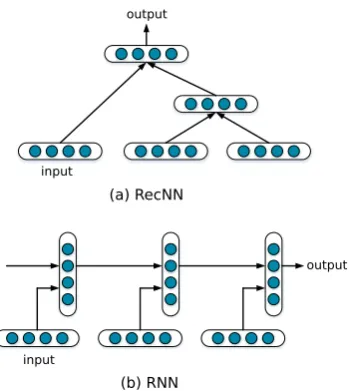
Figure 1: Recursive (a) and recurrent (b) neural networks.
Figure 1 shows the general form of recursive and recurrent neural networks. In architectures of this form, a compositional layer is applied on each pair of inputsx1andx2in the following way:
p=g(Wx[1:2]+b) (1) wherex[1:2]denotes the concatenation of the two
vectors, gis a non-linear function, and W,bare the parameters of the model. In the RecNN case, the compositional process continues recursively by following a parse tree until a vector for the whole sentence or phrase is produced; on the other hand, an RNN assumes that a sentence is gener-ated in a left-to-right fashion, taking into consider-ation no dependencies other than word adjacency. We amend the above setting by introducing a novel layer on the top of the compositional one, which scores the linguistic plausibility of the com-posed sentence or phrase vector with regard to
both syntax and semantics. Following Collobert and Weston (2008), we convert the unsupervised learning problem to a supervised one by corrupt-ing traincorrupt-ing sentences. Specifically, for each sen-tenceswe create two sets of negative examples. In the first set,S0, the target word within a given context is replaced by a random word; as in the original C&W paper, this set is used to enforce semantic coherence in the word vectors. Syntac-tic coherence is enforced by a second set of nega-tive examples,S00, in which the words of the con-text have been randomly shuffled. The objective function is defined in terms of the following hinge losses:
X
s∈S X
s0∈S0
max(0, m−f(s) +f(s0)) (2)
X
s∈S X
s00∈S00
max(0, m−f(s) +f(s00)) (3)
where S is the set of sentences, f the composi-tional layer, and m a margin we wish to retain between the scores of the positive training ex-amples and the negative ones. During training, all parameters in the scoring layer, the composi-tional layers and word representations are jointly updated by error back-propagation. As output, we get both general-purpose syntax-aware word representations and weights for the corresponding compositional model.
4 From words to senses
We now extend our model to address lexical ambi-guity. We achieve that by applying a gated archi-tecture, similar to the one used in the multi-sense model of Neelakantan et al. (2014), but advancing the main idea to the compositional setting detailed in Section 3.
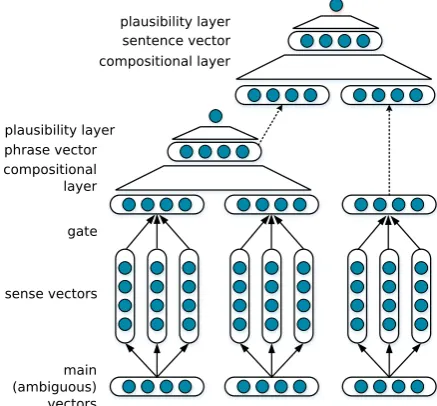
We assume a fixed number of n senses per word.1 Each word is associated with a main vector
(obtained for example by using an existing vector set, or by simply applying the process of Section 3 in a separate step), as well as withnvectors de-noting cluster centroids and an equal number of sense vectors. Both cluster centroids and sense vectors are randomly initialized in the beginning of the process. For each wordwtin a training sen-tence, we prepare a context vector by averaging the main vectors of all other words in the same context. This context vector is compared with the cluster centroids of wt by cosine similarity, and the sense corresponding to the closest cluster is se-lected as the most representative ofwtin the cur-rent context. The selected cluster centroid is up-dated by the addition of the context vector, and the associated sense vector is passed as input to the compositional layer. The selected sense vectors for each word in the sentence are updated by back-propagation, based on the objectives of Equations 2 and 3. The overall architecture of our model, as described in this and the previous section, is illus-trated in Figure 2.
5 Task-specific dynamic disambiguation
The model of Figure 2 decouples the training of word vectors and compositional parameters from 1Note that in principle the fixed number of senses
main (ambiguous)
vectors sense vectors gate compositional layer phrase vector plausibility layer
[image:5.595.70.289.65.268.2]compositional layer sentence vector plausibility layer
Figure 2: Training of syntax-aware multi-sense embeddings in the context of a RecNN.
a specific task, and as a consequence from any task-specific training dataset. However, note that by replacing the plausibility layer with a classi-fier trained for some task at hand, you get a task-specific network that transparently trains multi-sense word embeddings and applies dynamic dis-ambiguation on the fly. While this idea of a single-step direct training seems appealing, one consid-eration is that the task-specific dataset used for the training will not probably reflect the linguistic va-riety that is required to exploit the expressiveness of the setting in its full. Additionally, in many cases the size of datasets tied to specific tasks is prohibiting for training a deep architecture.
It is a merit of this proposal that, in cases like these, it is possible for one to train the generic model of Figure 2 on any large corpus of text, and then use the produced word vectors and compo-sitional weights to initialize the parameters of a more specific version of the architecture. As a result, the trained parameters will be further re-fined according to the task-specific objective. Fig-ure 3 illustrates the generic case of a composi-tional framework applying dynamic disambigua-tion. Note that here sense selection takes place by a soft-max layer, which can be directly optimized on the task objective.
6 A siamese network for paraphrase detection
We will test the dynamic disambiguation frame-work of Section 5 in a paraphrase detection task. Aparaphraseis a restatement of the meaning of a
sentence using different words and/or syntax. The goal of a paraphrase detection model, thus, is to examine two sentences and decide if they express the same meaning.
While the usual way to approach this problem is to utilize a classifier that acts (for example) on the concatenation of the two sentence vectors, in this work we follow a novel perspective: specifically, we apply a siamese architecture (Bromley et al., 1993), a concept that has been extensively used in computer vision (Hadsell et al., 2006; Sun et al., 2014). While siamese networks have been also used in the past for NLP purposes (for example, by Yih et al. (2011)), to the best of our knowledge this is the first time that such a setting is applied for paraphrase detection.
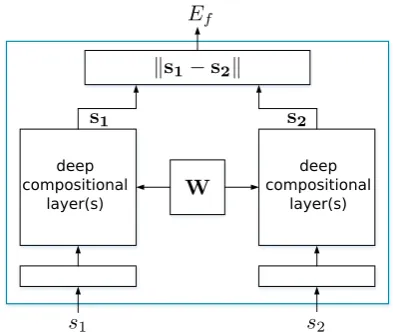
In our model, two networks sharing the same parameters are used to compute the vectorial rep-resentations of two sentences, the paraphrase rela-tion of which we wish to detect; this is achieved by employing a cost function that compares the two vectors. There are two commonly used cost func-tions: the first is based on the L2 norm (Hadsell
et al., 2006; Sun et al., 2014), while the second on the cosine similarity (Nair and Hinton, 2010; Sun et al., 2014). TheL2norm variation is capable of
handling differences in the magnitude of the vec-tors. Formally, the cost function is defined as:
Ef =
1
2kf(s1)−f(s2)k22, ify= 1 1
2max(0, m− kf(s1)−f(s2)k2)2, o.w.
where s1, s2 are the input sentences, f the
com-positional layer (sof(s1) andf(s2)refer to
sen-tence vectors), andy= 1denotes a paraphrase re-lationship between the sentences;mstands for the margin, a hyper-parameter chosen in advance. On
classifier
main (ambiguous) vectors
sense vectors soft-max layer selected sense vectors
compositional layer(s) sentence vector
[image:5.595.309.520.549.726.2]deep compositional
layer(s)
deep compositional
[image:6.595.82.279.60.226.2]layer(s)
Figure 4: A siamese network for paraphrase detec-tion.
the other hand, the cost function based on cosine similarity handles only directional differences, as follows:
Ef = 12(y−σ(wd+b))2 (4)
where d = kf(fs(1)sk1)·f(s2)
2kf(s2)k2 is the cosine
similar-ity of the two sentence vectors, w and b are the scaling and shifting parameters to be optimized,σ is the sigmoid function andy is the label. In the experiments that will follow in Section 7.4, both of these cost functions are evaluated. The overall architecture is shown in Figure 4.
In Section 7.4 we will use the pre-trained vec-tors and compositional weights for deriving sen-tence representations that will be subsequently fed to the siamese network. When the dynamic disam-biguation framework is used, the sense vectors of the words are updated during training so that the sense selection process is gradually refined.
7 Experiments
We evaluate the quality of the compositional word vectors and the proposed deep compositional framework in the tasks of word similarity and paraphrase detection, respectively.
7.1 Model pre-training
In all experiments the word representations and compositional models are pre-trained on the British National Corpus (BNC), a general-purpose text corpus that contains 6 million sentences of written and spoken English. For comparison we train two sets of word vectors and compositional models, one ambiguous and one multi-sense
(fix-ing 3 senses per word). The dimension of the em-beddings is set to 300.
As our compositional architectures we use a RecNN and an RNN. In the RecNN case, the words are composed by following the result of an external parser, while for the RNN the composi-tion takes place in sequence from left to right. To avoid the exploding or vanishing gradient problem (Bengio et al., 1994) for long sentences, we em-ploy along short-term memory(LSTM) network (Hochreiter and Schmidhuber, 1997). During the training of each model, we minimize the hinge loss in Equations 2 and 3. The plausibility layer is im-plemented as a 2-layer network, with 150 units at the hidden layer, and is applied at each individ-ual node (as opposed to a single application at the sentence level). All parameters are updated with mini-batches by AdaDelta (Zeiler, 2012) gradient descent method (λ= 0.03, initialα= 0.05).
7.2 Qualitative evaluation of the word vectors
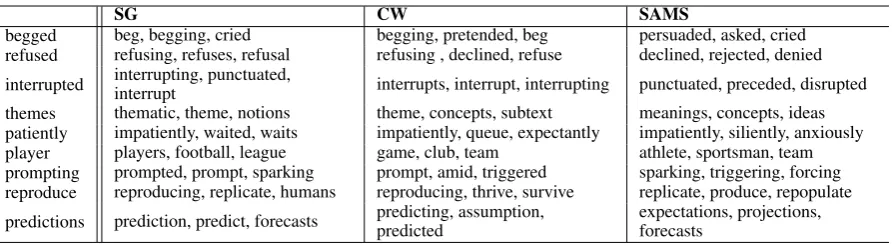
As a first step, we qualitatively evaluate the trained word embeddings by examining the nearest neigh-bours lists of a few selected words. We com-pare the results with those produced by the skip-gram model (SG) of Mikolov et al. (2013) and the language model (CW) of Collobert and Weston (2008). We refer to our model as SAMS (Syntax-Aware Multi-Sense). The results in Table 1 show clearly that our model tends to group words that are both semantically and syntactically related; for example, and in contrast with the compared mod-els which group words only at the semantic level, our model is able to retain tenses, numbers (singu-lars and plurals), and gerunds.
SG CW SAMS
[image:7.595.78.525.60.183.2]begged beg, begging, cried begging, pretended, beg persuaded, asked, cried refused refusing, refuses, refusal refusing , declined, refuse declined, rejected, denied interrupted interrupting, punctuated,interrupt interrupts, interrupt, interrupting punctuated, preceded, disrupted themes thematic, theme, notions theme, concepts, subtext meanings, concepts, ideas patiently impatiently, waited, waits impatiently, queue, expectantly impatiently, siliently, anxiously player players, football, league game, club, team athlete, sportsman, team prompting prompted, prompt, sparking prompt, amid, triggered sparking, triggering, forcing reproduce reproducing, replicate, humans reproducing, thrive, survive replicate, produce, repopulate predictions prediction, predict, forecasts predicting, assumption,predicted expectations, projections,forecasts
Table 1: Nearest neighbours for a number of words with various embedding models.
7.3 Word similarity
We now proceed to a quantitative evaluation of our embeddings on the Stanford Contextual Word Similarity (SCWS) dataset of Huang et al. (2012). The dataset contains 2,003 pairs of words and the contexts they occur in. We can therefore make use of the contextual information in order to select the most appropriate sense for each ambiguous word. Similarly to Neelakantan et al. (2014), we use three different metrics: globalSim measures the similarity between two ambiguous word vec-tors;localSimselects a single sense for each word based on the context and computes the similarity between the two sense vectors;avgSimrepresents each word as a weighted average of all senses in the given context and computes the similarity be-tween the two weighted sense vectors.
We compute and report the Spearman’s corre-lation between the embedding similarities and hu-man judgments (Table 2). In addition to the skip-gram and Collobert and Weston models, we also compare against the CBOW model (Mikolov et al., 2013) and the multi-sense skip-gram (MSSG) model of Neelakantan et al. (2014).
Model globalSim localSim avgSim
CBOW 59.5 – –
SG 61.8 – –
CW 55.3 – –
MSSG 61.3 56.7 62.1
SAMS 59.9 58.5 62.5
Table 2: Results for the word similarity task (Spearman’sρ×100).
Among all methods, only the MSSG model and ours are capable of learning multi-prototype word representations. Our embeddings show top per-formance forlocalSimandavgSimmeasures, and performance competitive to that of MSSG and SG for globalSim, both of which use a hierarchical
soft-max as their objective function. Compared to the original C&W model, our version presents an improvement of 4.6%—a clear indication for the effectiveness of the proposed learning method and the enhanced objective.
7.4 Paraphrase detection
In the last set of experiments, the proposed com-positional distributional framework is evaluated on the Microsoft Research Paraphrase Corpus (MSRPC) (Dolan and Brockett, 2005), which con-tains 5,800 pairs of sentences. This is a binary classification task, with labels provided by human annotators. We apply the siamese network detailed in Section 6.
While MSRPC is one of the most used datasets for evaluating paraphrase detection models, its size is prohibitory for any attempt of training a deep architecture. Therefore, for our training we rely on a much larger external dataset, the Paraphrase Database (PPDB) (Ganitkevitch et al., 2013). The PPDB contains more than 220 million paraphrase pairs, of which 73 million are phrasal paraphrases and 140 million are paraphrase pat-terns that capture syntactic transformations of sen-tences. We use these phrase- and sentence-level paraphrase pairs as additional training contexts to fine-tune the generic compositional model pa-rameters and word embeddings and to train the baseline models. The original training set of the MSRPC is used as validation set for deciding hy-perparameters, such as the margin of the error function and the number of training epochs.
The evaluations were conducted on various as-pects, and the models are gradually refined to demonstrate performance within the state-of-the-art range.
ambigu-ous vectors. As we can see in Table 3, the co-sine error function consistently outperforms the L2 norm-based one for both compositional
mod-els, providing a yet another confirmation of the already well-established fact that similarity in se-mantic vector spaces is better reflected by length-invariant measures.
Model L2 Cosine
RecNN 73.8 74.9
RNN 73.0 74.3
Table 3: Results with different error functions for the paraphrase detection task (accuracy×100).
Effectiveness of disambiguation We now pro-ceed to compare the effectiveness of the two com-positional models when using ambiguous vectors and multi-sense vectors, respectively. Our error function is set to cosine similarity, following the results of the previous evaluation. When dynamic disambiguation is applied, we test two methods of selecting sense vectors: in the hard case the vector of the most plausible sense is selected, while in the soft case a new vector is prepared as the weighted average of all sense vectors according to proba-bilities returned by the soft-max layer (see Figure 3). As a baseline we use a simple compositional model based on vector addition.
The dynamic disambiguation models and the additive baseline are compared with variations that use a simple prior disambiguation step applied on the word vectors. This is achieved by first se-lecting for each word the sense vector that is the closest to the average of all other word vectors in the same sentence, and then composing the se-lected sense vectors without further considerations regarding ambiguity. The baseline model and the prior disambiguation variants are trained as sepa-rate logistic regression classifiers. The results are shown in Table 4.
Model Ambig. Prior Hard DD Soft DD
Addition 69.9 71.3 – –
RecNN 74.9 75.3 75.7 76.0
RNN 74.3 74.6 75.1 75.2
Table 4: Different disambiguation choices for the paraphrase detection task (accuracy×100).
Overall, disambiguated vectors work better than the ambiguous ones, with the improvement to be more significant for the additive model; there, a simple prior disambiguation step produces 1.4% gains. For the deep compositional models, simple
prior disambiguation is still helpful with small im-provements, a result which is consistent with the findings of Cheng et al. (2014). The small gains of the prior disambiguation models over the am-biguous models clearly show that deep architec-tures are quite capable of performing this elemen-tary form of sense selection intrinsically, as part of the learning process itself. However, the situ-ation changes when the dynamic disambigusitu-ation framework is used, where the gains over the am-biguous version become more significant. Com-paring the two ways of dynamic disambiguation (hard method and soft method), the numbers that the soft method gives are slightly higher, produc-ing a total gain of 1.1% over the ambiguous ver-sion for the RecNN case.2
Note that, at this stage, the advantage of us-ing the dynamic disambiguation framework over simple prior disambiguation is still small (0.7% for the case of RecNN). We seek the reason be-hind this in the recursive nature of our architecture, which tends to progressively “hide” local features of word vectors, thus diminishing the effect of the fine-tuned sense vectors produced by the dynamic disambiguation mechanism. The next section dis-cusses the problem and provides a solution.
The role of pooling One of the problems of the recursive and recurrent compositional architec-tures, especially in grammars with strict branching structure such as in English, is that any given com-position is usually the product of a terminal and a non-terminal; i.e. a single word can contribute to the meaning of a sentence to the same extent as the rest of a sentence on its whole, as below:
[[kids]NP[play ball games in the park]VP]S
In the above case, the contribution of the words within the verb phrase to the final sentence rep-resentation will be faded out due to the recursive composition mechanism. Inspired by related work in computer vision (Sun et al., 2014), we attempt to alleviate this problem by introducing an aver-age pooling layer at the sense vector level and adding the resulting vector to the sentence repre-sentation. By doing this we expect that the new sentence vector will reflect local features from all words in the sentence that can help in the clas-sification in a more direct way. The results for the new deep architectures are shown in Table 5, where we see substantial improvements for both deep nets. More importantly, the effect of dynamic 2For all subsequent experiments, the reported results are
disambiguation now becomes more significant, as expected by our analysis.
Table 5 also includes results for two models trained in a single step, with word and sense vec-tors randomly initialized at the beginning of the process. We see that, despite the large size of the training set, the results are much lower than the ones obtained when using the pre-training step. This demonstrates the importance of the initial training on a general-purpose corpus: the result-ing vectors reflect lresult-inguistic information that, al-though not obtainable from the task-specific train-ing, can make great difference in the result of the classification.
Model Ambig. Prior Dynamic
RecNN+pooling 75.5 76.3 77.6
RNN+pooling 74.8 75.9 76.6
1-step RecNN+pooling 74.4 – 72.9 1-step RNN+pooling 73.6 – 73.1
Table 5: Results with average pooling for the para-phrase detection task (accuracy×100).
Cross-model comparison In this section we propose a method to further improve the perfor-mance of our models, and we present an evaluation against some of the previously reported results.
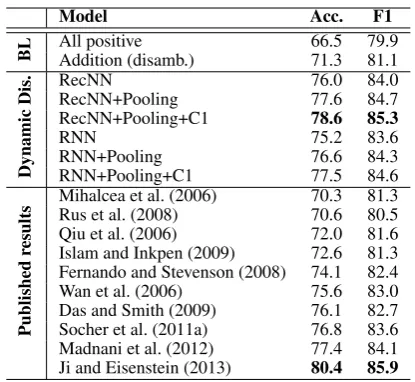
We notice that using distributional properties alone cannot capture efficiently subtle aspects of a sentence, for example numbers or human names. However, even small differences on those aspects between two sentences can lead to a different clas-sification result. Therefore, we train (using the MSPRC training data) an additional logistic re-gression classifier which is based not only on the embeddings similarity, but also on a few hand-engineered features. We then ensemble the new classifier (C1) with the original one. In terms of feature selection, we follow Socher et al. (2011a) and Blacoe and Lapata (2012) and add the fol-lowing features: the difference in sentence length, the unigram overlap among the two sentences, fea-tures related to numbers (including the presence or absence of numbers from a sentence and whether or not the numbers in the two sentences are the same). In Table 6 we report results of the original model and the ensembled model, and we compare with the performance of other existing models.
In all of the implemented models (including the additive baseline), disambiguation is performed to guarantee the best performance. We see that by ensembling the original classifier with C1, we im-prove the result of the previous section by another 1%. This is the second best result reported so far
Model Acc. F1
BL All positiveAddition (disamb.) 66.571.3 79.981.1
Dynamic
Dis. RecNNRecNN+Pooling 76.077.6 84.084.7 RecNN+Pooling+C1 78.6 85.3
RNN 75.2 83.6
RNN+Pooling 76.6 84.3
RNN+Pooling+C1 77.5 84.6
Published
results
[image:9.595.312.520.59.250.2]Mihalcea et al. (2006) 70.3 81.3 Rus et al. (2008) 70.6 80.5 Qiu et al. (2006) 72.0 81.6 Islam and Inkpen (2009) 72.6 81.3 Fernando and Stevenson (2008) 74.1 82.4 Wan et al. (2006) 75.6 83.0 Das and Smith (2009) 76.1 82.7 Socher et al. (2011a) 76.8 83.6 Madnani et al. (2012) 77.4 84.1 Ji and Eisenstein (2013) 80.4 85.9
Table 6: Cross-model comparison in the para-phrase detection task.
for the specific task, with a 0.6 difference in F-score from the first (Ji and Eisenstein, 2013).3
8 Conclusion and future work
The main contribution of this paper is a deep com-positional distributional model acting on linguis-tically motivated word embeddings.4 The
effec-tiveness of the syntax-aware, multi-sense word vectors and the dynamic compositional disam-biguation framework in which they are used was demonstrated by appropriate tasks at the lexical and sentence level, respectively, with very posi-tive results. As an aside, we also demonstrated the benefits of a siamese architecture in the context of a paraphrase detection task. While the architec-tures tested in this work were limited to a RecNN and an RNN, the ideas we presented are in prin-ciple directly applicable to any kind of deep net-work. As a future step, we aim to test the proposed models on a convolutional compositional architec-ture, similar to that of Kalchbrenner et al. (2014).
Acknowledgments
The authors would like to thank the three anony-mous reviewers for their useful comments, as well as Nal Kalchbrenner and Ed Grefenstette for early discussions and suggestions on the paper, and Si-mon ˇSuster for comments on the final draft. Dim-itri Kartsaklis gratefully acknowledges financial support by AFOSR.
3Source: ACL Wiki ( http://www.aclweb.org/acl-wiki), August 2015.
4Code in Python/Theano and the word embeddings can be
References
Marco Baroni, Georgiana Dinu, and Germ´an Kruszewski. 2014. Don’t count, predict! a systematic comparison of context-counting vs. context-predicting semantic vectors. InProceedings of the 52nd Annual Meeting of the Association for Computational Linguistics, volume 1.
Yoshua Bengio, Patrice Simard, and Paolo Frasconi. 1994. Learning long-term dependencies with gra-dient descent is difficult. Neural Networks, IEEE Transactions on, 5(2):157–166.
Yoshua Bengio, R´ejean Ducharme, Pascal Vincent, and Christian Janvin. 2003. A neural probabilistic lan-guage model. The Journal of Machine Learning Re-search, 3:1137–1155.
William Blacoe and Mirella Lapata. 2012. A com-parison of vector-based representations for semantic composition. InProceedings of the 2012 Joint Con-ference on Empirical Methods in Natural Language Processing and Computational Natural Language Learning, pages 546–556. Association for Compu-tational Linguistics.
Jane Bromley, James W Bentz, L´eon Bottou, Is-abelle Guyon, Yann LeCun, Cliff Moore, Eduard S¨ackinger, and Roopak Shah. 1993. Signature verification using a siamese time delay neural net-work. International Journal of Pattern Recognition and Artificial Intelligence, 7(04):669–688.
Jianpeng Cheng, Dimitri Kartsaklis, and Edward Grefenstette. 2014. Investigating the role of prior disambiguation in deep-learning composi-tional models of meaning. In 2nd Workshop of Learning Semantics, NIPS 2014, Montreal, Canada, December.
B Coecke, M Sadrzadeh, and S Clark. 2010. Math-ematical foundations for a distributional composi-tional model of meaning. lambek festschrift. Lin-guistic Analysis, 36:345–384.
Ronan Collobert and Jason Weston. 2008. A unified architecture for natural language processing: Deep neural networks with multitask learning. In Pro-ceedings of the 25th international conference on Machine learning, pages 160–167. ACM.
Dipanjan Das and Noah A Smith. 2009. Paraphrase identification as probabilistic quasi-synchronous recognition. In Proceedings of the Joint Confer-ence of the 47th Annual Meeting of the ACL and the 4th International Joint Conference on Natural Lan-guage Processing of the AFNLP: Volume 1-Volume 1, pages 468–476. Association for Computational Linguistics.
W.B. Dolan and C. Brockett. 2005. Automati-cally constructing a corpus of sentential paraphrases. In Third International Workshop on Paraphrasing (IWP2005).
Samuel Fernando and Mark Stevenson. 2008. A se-mantic similarity approach to paraphrase detection. InProceedings of the 11th Annual Research Collo-quium of the UK Special Interest Group for Compu-tational Linguistics, pages 45–52. Citeseer.
Juri Ganitkevitch, Benjamin Van Durme, and Chris Callison-Burch. 2013. Ppdb: The paraphrase database. InHLT-NAACL, pages 758–764.
Raia Hadsell, Sumit Chopra, and Yann LeCun. 2006. Dimensionality reduction by learning an invariant mapping. In Computer vision and pattern recog-nition, 2006 IEEE computer society conference on, volume 2, pages 1735–1742. IEEE.
Zellig S Harris. 1954. Distributional structure. Word.
Kazuma Hashimoto, Pontus Stenetorp, Makoto Miwa, and Yoshimasa Tsuruoka. 2014. Jointly learn-ing word representations and composition functions using predicate-argument structures. In Proceed-ings of the 2014 Conference on Empirical Methods in Natural Language Processing (EMNLP), pages 1544–1555, Doha, Qatar, October. Association for Computational Linguistics.
Karl Moritz Hermann and Phil Blunsom. 2013. The role of syntax in vector space models of composi-tional semantics. InProceedings of the 51st Annual Meeting of the Association for Computational Lin-guistics (Volume 1: Long Papers), pages 894–904, Sofia, Bulgaria, August. Association for Computa-tional Linguistics.
Sepp Hochreiter and J¨urgen Schmidhuber. 1997. Long short-term memory. Neural computation, 9(8):1735–1780.
Eric H Huang, Richard Socher, Christopher D Man-ning, and Andrew Y Ng. 2012. Improving word representations via global context and multiple word prototypes. InProceedings of the 50th Annual Meet-ing of the Association for Computational LMeet-inguis- Linguis-tics: Long Papers-Volume 1, pages 873–882. Asso-ciation for Computational Linguistics.
Aminul Islam and Diana Inkpen. 2009. Semantic sim-ilarity of short texts. Recent Advances in Natural Language Processing V, 309:227–236.
Yangfeng Ji and Jacob Eisenstein. 2013. Discrimi-native improvements to distributional sentence sim-ilarity. InProceedings of the 2013 Conference on Empirical Methods in Natural Language Process-ing, pages 891–896, Seattle, Washington, USA, Oc-tober. Association for Computational Linguistics.
Dimitri Kartsaklis and Mehrnoosh Sadrzadeh. 2013. Prior disambiguation of word tensors for construct-ing sentence vectors. In Proceedings of the 2013 Conference on Empirical Methods in Natural Lan-guage Processing, pages 1590–1601, Seattle, Wash-ington, USA, October. Association for Computa-tional Linguistics.
Dimitri Kartsaklis, Mehrnoosh Sadrzadeh, and Stephen Pulman. 2013. Separating disambiguation from composition in distributional semantics. In Pro-ceedings of 17th Conference on Natural Language Learning (CoNLL), pages 114–123, Sofia, Bulgaria, August.
Dimitri Kartsaklis, Nal Kalchbrenner, and Mehrnoosh Sadrzadeh. 2014. Resolving lexical ambiguity in tensor regression models of meaning. In Proceed-ings of the 52nd Annual Meeting of the Associa-tion for ComputaAssocia-tional Linguistics (Vol. 2: Short Pa-pers), pages 212–217, Baltimore, USA, June. Asso-ciation for Computational Linguistics.
Yann LeCun, L´eon Bottou, Yoshua Bengio, and Patrick Haffner. 1998. Gradient-based learning applied to document recognition. Proceedings of the IEEE, 86(11):2278–2324.
Omer Levy and Yoav Goldberg. 2014. Dependency-based word embeddings. InProceedings of the 52nd Annual Meeting of the Association for Computa-tional Linguistics (Volume 2: Short Papers), pages 302–308, Baltimore, Maryland, June. Association for Computational Linguistics.
Nitin Madnani, Joel Tetreault, and Martin Chodorow. 2012. Re-examining machine translation metrics for paraphrase identification. InProceedings of the 2012 Conference of the North American Chapter of the Association for Computational Linguistics: Hu-man Language Technologies, pages 182–190. Asso-ciation for Computational Linguistics.
Rada Mihalcea, Courtney Corley, and Carlo Strappa-rava. 2006. Corpus-based and knowledge-based measures of text semantic similarity. InAAAI, vol-ume 6, pages 775–780.
Tomas Mikolov, Martin Karafi´at, Lukas Burget, Jan Cernock`y, and Sanjeev Khudanpur. 2010. Recur-rent neural network based language model. In IN-TERSPEECH 2010, 11th Annual Conference of the International Speech Communication Association, Makuhari, Chiba, Japan, September 26-30, 2010, pages 1045–1048.
Tomas Mikolov, Ilya Sutskever, Kai Chen, Greg S Cor-rado, and Jeff Dean. 2013. Distributed representa-tions of words and phrases and their compositional-ity. InAdvances in Neural Information Processing Systems, pages 3111–3119.
Dmitrijs Milajevs, Dimitri Kartsaklis, Mehrnoosh Sadrzadeh, and Matthew Purver. 2014. Evaluating
neural word representations in tensor-based compo-sitional settings. In Proceedings of the 2014 Con-ference on Empirical Methods in Natural Language Processing (EMNLP), pages 708–719, Doha, Qatar, October. Association for Computational Linguistics. Jeff Mitchell and Mirella Lapata. 2008. Vector-based models of semantic composition. In Proceedings of ACL-08: HLT, pages 236–244, Columbus, Ohio, June. Association for Computational Linguistics. Andriy Mnih and Koray Kavukcuoglu. 2013. Learning
word embeddings efficiently with noise-contrastive estimation. InAdvances in Neural Information Pro-cessing Systems, pages 2265–2273.
Vinod Nair and Geoffrey E Hinton. 2010. Rectified linear units improve restricted boltzmann machines. InProceedings of the 27th International Conference on Machine Learning (ICML-10), pages 807–814. Arvind Neelakantan, Jeevan Shankar, Alexandre
Pas-sos, and Andrew McCallum. 2014. Efficient non-parametric estimation of multiple embeddings per word in vector space. InProceedings of EMNLP. S. Pad´o and M. Lapata. 2007. Dependency-based
Construction of Semantic Space Models. Compu-tational Linguistics, 33(2):161–199.
Jeffrey Pennington, Richard Socher, and Christopher D Manning. 2014. Glove: Global vectors for word representation. Proceedings of the Empiricial Methods in Natural Language Processing (EMNLP 2014), 12.
Jordan B Pollack. 1990. Recursive distributed repre-sentations.Artificial Intelligence, 46(1):77–105. Long Qiu, Min-Yen Kan, and Tat-Seng Chua. 2006.
Paraphrase recognition via dissimilarity significance classification. InProceedings of the 2006 Confer-ence on Empirical Methods in Natural Language Processing, pages 18–26. Association for Compu-tational Linguistics.
Siva Reddy, Ioannis P Klapaftis, Diana McCarthy, and Suresh Manandhar. 2011. Dynamic and static pro-totype vectors for semantic composition. In IJC-NLP, pages 705–713.
Vasile Rus, Philip M McCarthy, Mihai C Lintean, Danielle S McNamara, and Arthur C Graesser. 2008. Paraphrase identification with lexico-syntactic graph subsumption. In FLAIRS confer-ence, pages 201–206.
Richard Socher, Eric H Huang, Jeffrey Pennin, Christo-pher D Manning, and Andrew Y Ng. 2011a. Dy-namic pooling and unfolding recursive autoencoders for paraphrase detection. InAdvances in Neural In-formation Processing Systems, pages 801–809. Richard Socher, Cliff C Lin, Chris Manning, and
R. Socher, B. Huval, C. Manning, and Ng. A. 2012. Semantic compositionality through recursive matrix-vector spaces. In Conference on Empirical Methods in Natural Language Processing 2012. Yi Sun, Yuheng Chen, Xiaogang Wang, and Xiaoou
Tang. 2014. Deep learning face representation by joint identification-verification. InAdvances in Neu-ral Information Processing Systems, pages 1988– 1996.
Stephen Wan, Mark Dras, Robert Dale, and C´ecile Paris. 2006. Using dependency-based features to take the para-farce out of paraphrase. In Pro-ceedings of the Australasian Language Technology Workshop, volume 2006.
Wen-tau Yih, Kristina Toutanova, John C. Platt, and Christopher Meek. 2011. Learning discriminative projections for text similarity measures. In Proceed-ings of the Fifteenth Conference on Computational Natural Language Learning, pages 247–256, Port-land, Oregon, USA, June. Association for Computa-tional Linguistics.