Original Article
Association of
ALDH2
rs671 polymorphism
with essential hypertension: a case-control
study in non-drinking Han Chinese
Lili Zhang, Limei Dong, Qian Ma, Guocai Yang
Department of Cardiology, The People’ Hospital of Rizhao, Rizhao 276800, Shandong, China
Received November 27, 2015; Accepted August 14, 2016; Epub June 15, 2018; Published June 30, 2018
Abstract: Objective: This study was aimed to investigate the association of acetaldehyde dehydrogenase 2 (ALDH2) rs671 polymorphism with the risk of essential hypertension (EH). Methods: 137 EH patients and 102 healthy in-dividuals in Chinese Han population were selected as the study subjects. Polymerase chain reaction-restriction fragment length polymorphism (PCR-RFLP) was applied to detect ALDH2 rs671 polymorphism. Association between
ALDH2 rs671 polymorphism and EH risk was calculated by Chi-square test. Risk intensity of EH was represented by odds ratios (ORs) and 95% confidence intervals (CIs). Results: Systolic blood pressure (SBP), diastolic blood pres -sure (DBP) and total cholesterol (TC) had high levels in cases than that in controls (P<0.05), while other character-istics had no significant difference between the two groups. AA genotype and A allele of rs671 might increase the risk of EH (P=0.023, OR=3.195, 95% CI=1.128-9.049; P=0.013, OR=1.759, 95% CI=1.124-2.751). After adjusted by age, SBP, DBP, body mass index (BMI), triglyceride (TG) and TC, the association had no obvious change (P=0.040, OR=3.402, 95% CI=1.037-1.824; P=0.028, OR=1.853, 95% CI=1.142-3.045). Conclusions: ALDH2 rs671 polymor-phism might act as a risk factor for the onset of EH in non-drinking Han Chinese.
Keywords: Essential hypertension (EH), acetaldehyde dehydrogenase 2 (ALDH2), polymorphism
Introduction
Essential hypertension (EH) and secondary hypertension are the main types of hyperten-sion, and the former accounts the most part of the hypertension cases. EH is a quite com-mon cardiovascular disease (CVD) at present. By definition, EH has no recognizable cause. However, several risk factors have been identi-fied. It is reported that EH is greatly affected by genetic and environmental factors [1-6], and the genetic factor play a critical role in the onset of EH [7, 8]. The high morbidity and mor-tality of stroke, coronary artery disease (CAD) and diabetes caused by EH immensely increase the economic burden of society and govern-ment. Blood pressure control is an important measure to prevent the high incidence of CVD at the moment [9]. However, EH is a lifelong dis-ease, the blood pressure can be controlled, but the EH cannot be cured. In order to improve the therapy method of EH, the exploration of the EH mechanism is necessary. Up to now, many
genes are found to be associated with the risk of EH.
Acetaldehyde dehydrogenase (ALDH) is a big family composed of various isozymes. ALDH2, the most important member of ALDH family, is one of the key enzymes of ethanol meta-bolism in the human body [10]. ALDH2 main- ly expressed in mitochondria. Human ALDH2
gene locates at 12q24.2, and contains 13 exons and 12 introns [11]. Single nucleotide polymorphism (SNP) which is in the 12th exon
focused on rs671, and several studies detect the association between rs671 and the risk of EH [15-17]. Distinctly genetic polymorph- ism exists in ALDH2 gene. Meanwhile, the reports are not consistent about the correla- tion between ALDH2 polymorphism and the incidence of EH up to now.
So, in present study, we select ALDH2 rs671 polymorphism to analyze the association of
ALDH2 polymorphism with EH. This study will contribute to the prevention, treatment and prognosis of clinical CVD.
Materials and methods
Research objects
This study was approved by the ethnics com-mittee of The People’ Hospital of Rizhao, Informed consents were signed by every par-ticipant. 239 unrelated Han Chinese popula-tion were recruited from out-patient clinics, in-patient department and physical examination center of The People’ Hospital of Rizhao from April, 2013 to April, 2015. Among them were 137 EH patients with the age range of 36-80 years old as the case group and the rest were 102 healthy people from 33 to 76 years old as the control group, respectively. The controls should be frequency-matched in age and gen-der. EH patients were diagnosed based on 2011 China guidelines for the diagnosis and treatment of hypertension: systolic blood pres-sure (SBP) ≥140 mmHg and (or) diastolic blood pressure (DBP) ≥90 mmHg, continuously or more than 3 times at sitting position, in three different days. Drinkers, patients with second-ary hypertension, serious cardiac insufficiency and clear kidney lesion were excluded from this study.
Sample collection
5 ml peripheral venous blood was extracted from every fasting participator, anticoagulated by EDTA-Na2, and then stored in -70°C for back-up. Genomic DNA was extracted by a Gen- Elute™ Blood Genomic DNA Kit (Sigma, USA).
DNA products amplified by polymerase chain reaction (PCR)
PCR primers of ALDH2 rs671 SNP were de- signed by Primer Premier 5.0 software and
synthesized by Boya biological technology co., LTD (Shanghai, China). Forward primer was 5’-GTC AAC TGC TAT GAT GTG TTT GG-3’, reverse primer was 5’-CCA CCA GCA GAC CCT CAA G-3’, and PCR amplified fragments were 91 bp. PCR amplification system was 25 μL, including 1 μL template DNA, 2.5 pmol primers, 0.25 mM 4× dNTP, 2.5 mM MgCl2, 1 uL Taq enzyme and 2.5 μL 10× Buffer. Amplification conditions were as follows: 95°C pre-degeneration for 10 min; then followed by 35 cycles of 95°C degen-eration for 1 min, 58°C annealing for 2 min, 72°C extension for 1 min; finally 72°C exten -sion for 5 min. After the amplification, 3 µL PCR products were added into 5νMbo II restriction enzyme and 10× L Buffer which with the total volume was 10 μL, and the mixture was digest -ed at 37°C for 2.5 h. 8 μL digest-ed products were analyzed by 15% polyacrylamide gel elec -trophoresis and ethidium bromide staining. Three genotypes were presented under ultravi-olet radiation: wild homozygote GG with a 55 bp stripe, heterozygote GA with 65 bp and 55 bp stripes and mutant homozygote AA with a 65 bp stripe.
Determination of blood lipid level
The levels of total cholesterol (TC) and triglycer-ides (TG) were examined by automatic bio-chemical analyzer (Olympus 1000 type, USA) in accordance with the kit instructions.
Statistical analysis
SPSS18.0 was applied to analyze all of the experimental data. Differences of clinical char-acteristics between groups were compared by χ2 test or t test. Hardy-Weinberg equilibrium
(HWE) was used to evaluate the genotype distri-butions. When P>0.05, genotype distribution conformed to HWE. Genotypes and alleles dif-ferences between cases and controls were cal-culated by χ2 test, and then adjusted by logistic
regression. The relative risk was expressed by odds ratios (ORs) as well as 95% confidence intervals (CIs). P<0.05 stood for statistically sig-nificant difference.
Results
General clinical features of study objects
controls consisted of 67 males and 35 females with an average age of 66.18±10.32. There was no significant difference in age and gender distributions between the two groups (P>0.05). Body mass index (BMI) in the two groups was 26.1±3.4 and 25.2±3.2 respectively and the difference was not obvious (P>0.05). SBP (161.5±15.3, 120.2±11.4), DBP (95.4±12.6, 81.5±10.6) and TC (4.9±1.2, 4.6±1.1) levels in the case group were all significantly higher than that in the control group (P<0.05), but TG level was not significant difference between the two (1.7±1.1, 1.5±0.9; P>0.05). The detailed data were list in Table 1.
Correlation analysis between ALDH2 rs671 polymorphism and EH risk
The genotype and allele frequencies of ALDH2
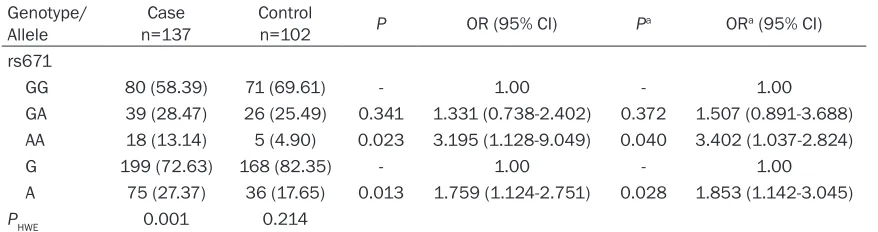
rs671 polymorphism in the case and control groups were compared and showed in Table 2. Firstly, genotype distribution of ALDH2 rs671 polymorphism in control group conformed to HWE test (P>0.05), indicating the representa-tiveness of the study population.
AA genotype of rs671 had higher frequency in case group than that in control group (13.14% vs. 4.90%), this difference was statistically sig-nificant (P=0.023). The result indicated that the AA genotype increase the risk of EH (OR=3.195,
95% CI=1.128-9.049). After the adjustments of confounding factors like age, SBP, DBP, BMI, TG and TC, AA genotype still associated with the risk of EH (OR=3.402, 95% CI=1.037-1.824). Meanwhile, the frequency of A allele was signifi -cantly different between cases and controls (P=0.013). The A allele significantly increased the risk of EH before (OR=1.759, 95% CI=1.124-2.751) and after (OR=1.853, 95% CI=1.142-3.045) the adjustment of confounding factors. However, although GA genotype had high fre-quency in cases, but the association with EH risk had no significance (P>0.05).
Discussion
Hypertension means the increase of SBP and/ or DBP of arteries in the quiescent condition. Hypertension is a systemic disease accompa-nied with functional or organic changes of many organ, and lead to many complications. With the unidentifiable cause, EH has a high morbid -ity, and the pathogenesis of it is not yet clear. Most part of the EH is a chronic CVD, the fea-tures of it are hidden onset, slow progress, and long duration. Complications of EH might lead to sudden death. Besides, the control of EH could affect the development of many cardio-vascular and cerebrocardio-vascular diseases [18, 19]. Multiple researches revealed that alcohol-ism is a risk factor for CVD, including EH
[10-Table 1. General clinical characteristics of case and control groups
Group (male/female)Gender Age (mmHg)SBP (mmHg)DBP (kg/mBMI 2) (mmol/L)TC (mmol/L)TG
Case 90/47 65.12±11.24 161.5±15.3 95.4±12.6 26.1±3.5 4.9±1.2 1.7±1.1
Control 67/35 66.18±10.32 120.2±11.4 81.5±10.6 25.2±3.2 4.6±1.1 1.5±0.9
P >0.05 >0.05 <0.05 <0.05 >0.05 <0.05 >0.05
[image:3.612.91.523.85.150.2]SBP: Systolic blood pressure; DBP: Diastolic blood pressure; BMI: Body mass index; TC: Cholesterol; TG: Triglycerides.
Table 2. Distributions of ALDH2 rs671 polymorphism in case and control groups
Genotype/
Allele n=137Case Control n=102 P OR (95% CI) Pa ORa (95% CI)
rs671
GG 80 (58.39) 71 (69.61) - 1.00 - 1.00
GA 39 (28.47) 26 (25.49) 0.341 1.331 (0.738-2.402) 0.372 1.507 (0.891-3.688)
AA 18 (13.14) 5 (4.90) 0.023 3.195 (1.128-9.049) 0.040 3.402 (1.037-2.824)
G 199 (72.63) 168 (82.35) - 1.00 - 1.00
A 75 (27.37) 36 (17.65) 0.013 1.759 (1.124-2.751) 0.028 1.853 (1.142-3.045)
PHWE 0.001 0.214
[image:3.612.89.528.197.313.2]22]. EH related genome-wide association stud-ies manifested that ALDH2 may affect the changes of SBP and DBP through changing the alcohol consumption and blood lipid metabo-lism [17, 23, 24]. ALDH2 is the key enzyme in oxidative stress and alcohol metabolism [13, 25]. Besides, ALDH2 also influences the levels of TG and high-density-lipoprotein cholesterol (HDLC) [26]. Amamoto et al. have found that GG genotype of rs671 is a risk factor of EH, and the blood pressure increases in the sequence of GG>GA>AA [27]. Moreover, Lai et al. showed that ALDH2 mutant genotype is an indepen-dent risk factor for EH, and it is able to increase the risk of concurrent acute CVD events in EH patients through elevating the blood pressure [28].
ALDH2 widely distributes in human organs such as liver, kidney, heart, lungs and brain.
ALDH2 rs671 polymorphism, which has racial difference, is the site that has been studied most. Additionally, human genome project (HGP) illustrated that rs671 polymorphism is common in Asians, but rare and even not dis-tributes in white and black races. ALDH2 poly-morphism of people in the same race from dif-ferent regions also has significant differences [20].
Present study discovered that the frequency of rs671 A allele is 27.37% in cases and 17.65% in controls, respectively. Meanwhile, AA and GA genotypes of rs671 were higher in cases than in controls. Our results demonstrated that AA genotype and A allele might increase the risk of EH about 3.195 and 1.759 times. Logistic regression indicated that, after adjusted by confounding factors (including age, SBP, DBP, BMI, TG and TC), AA genotype and A allele were still able to increase the risk of EH. The association of AA genotype and A allele of rs671 with EH risk were significantly, revealing that ALDH2 rs671 polymorphism was a risk factor of EH. This result accorded with the previous study performed by Wang et al. [29]. However, another study showed that A allele decrease the EH risk in Chinese Han drinkers [15]. In Chinese Mongolia population, AA geno-type was not found, and A allele might nega-tively associated with the EH risk [16]. It was reported that AA genotype of rs671 together with ADH1B rs1229984 could affect the drink -ing behavior, and rs671 significantly correlated
with blood pressure in drinkers in Japanese [30]. These discrepant results might caused by the different ethnicity, study subjects and other reasons.
To sum up, ALDH2 rs671 polymorphism might be one of the genetic risk factors for the inci-dence of EH. But, the etiology and pathogene -sis of EH remain unclear by far. Although the representativeness of our study is good, there still many limitations influence the accuracy of our result, such as the small sample size. In addition, the ethnicity number, stratified analy -sis and interaction with other factors are not considered in current study. Therefore, the spe-cific mechanism of ALDH2 mutations inducing EH still needs to be studied. The further studies should expand the race number and sample size, and include stratified and interaction analysis.
Disclosure of conflict of interest
None.
Address correspondence to: Lili Zhang, Department of Cardiology, The People’ Hospital of Rizhao, Rizhao 276800, Shandong, China. E-mail: xhggsb55@126. com
References
[1] Li Q, Sun L, Du J, Ran P, Gao T, Yuan Y and Xiao C. Risk given by AGT polymorphisms in in-ducing susceptibility to essential hypertension among isolated populations from a remote region of China: A case-control study among the isolated populations. J Renin Angiotensin Aldosterone Syst 2015; 16: 1202-17.
[2] Tchelougou D, Kologo JK, Karou SD, Yameogo VN, Bisseye C, Djigma FW, Ouermi D, Compaore TR, Assih M, Pietra V, Zabsonre P and Sim- pore J. Renin-Angiotensin System Genes Poly- morphisms and Essential Hypertension in Burkina Faso, West Africa. Int J Hypertens 2015; 2015: 979631.
[3] Gurnani M, Birken C and Hamilton J. Childhood obesity: causes, consequences, and manage-ment. Pediatr Clin North Am 2015; 62: 821-840.
[4] Farquhar WB, Edwards DG, Jurkovitz CT and Weintraub WS. Dietary sodium and health: more than just blood pressure. J Am Coll Cardiol 2015; 65: 1042-1050.
[6] Joseph PG, Pare G and Anand SS. Exploring gene-environment relationships in cardiovas-cular disease. Can J Cardiol 2013; 29: 37-45. [7] Gu D, Gupta A, Muntner P, Hu S, Duan X, Chen
J, Reynolds RF, Whelton PK and He J. Pre-valence of cardiovascular disease risk factor clustering among the adult population of China: results from the International Collabo- rative Study of Cardiovascular Disease in Asia (InterAsia). Circulation 2005; 112: 658-665. [8] Doaei S and Gholamalizadeh M. The associa
-tion of genetic varia-tions with sensitivity of blood pressure to dietary salt: A narrative lit-erature review. ARYA Atheroscler 2014; 10: 169-174.
[9] Cosselman KE, Navas-Acien A and Kaufman JD. Environmental factors in cardiovascular disease. Nat Rev Cardiol 2015; 12: 627-42. [10] Chang YC, Chiu YF, Lee IT, Ho LT, Hung YJ,
Hsiung CA, Quertermous T, Donlon T, Lee WJ, Lee PC, Chen CH, Mochly-Rosen D and Chuang LM. Common ALDH2 genetic variants predict development of hypertension in the SAPPHIRe prospective cohort: gene-environmental inter-action with alcohol consumption. BMC Cardio-vasc Disord 2012; 12: 58.
[11] Hsu LC, Bendel RE and Yoshida A. Genomic structure of the human mitochondrial alde-hyde dehydrogenase gene. Genomics 1988; 2: 57-65.
[12] Larson HN, Zhou J, Chen Z, Stamler JS, Weiner H and Hurley TD. Structural and functional consequences of coenzyme binding to the in -active asian variant of mitochondrial aldehyde dehydrogenase: roles of residues 475 and 487. J Biol Chem 2007; 282: 12940-12950. [13] Ohta S, Ohsawa I, Kamino K, Ando F and
Shimokata H. Mitochondrial ALDH2 deficiency as an oxidative stress. Ann N Y Acad Sci 2004; 1011: 36-44.
[14] Gao Y, Xu Y, Hua S, Zhou S and Wang K. ALDH2 attenuates Dox-induced cardiotoxicity by inhib-iting cardiac apoptosis and oxidative stress. Int J Clin Exp Med 2015; 8: 6794-6803. [15] Wang Y, Zhang Y, Zhang J, Tang X, Qian Y, Gao
P and Zhu D. Association of a functional sin-gle-nucleotide polymorphism in the ALDH2 gene with essential hypertension depends on drinking behavior in a Chinese Han popula-tion. J Hum Hypertens 2013; 27: 181-186. [16] Hasi T, Hao L, Yang L and Su XL. Acetaldehyde
dehydrogenase 2 SNP rs671 and susceptibili-ty to essential hypertension in Mongolians: a case control study. Genet Mol Res 2011; 10: 537-543.
[17] Hui P, Nakayama T, Morita A, Sato N, Hishiki M, Saito K, Yoshikawa Y, Tamura M, Sato I, Takahashi T, Soma M, Izumi Y, Ozawa Y and Cheng Z. Common single nucleotide
polymor-phisms in Japanese patients with essential hypertension: aldehyde dehydrogenase 2 gene as a risk factor independent of alcohol con-sumption. Hypertens Res 2007; 30: 585-592. [18] Pistoia F, Sacco S, Degan D, Tiseo C, Ornello R
and Carolei A. Hypertension and Stroke: Epi- demiological Aspects and Clinical Evaluation. High Blood Press Cardiovasc Prev 2016; 23: 9-18.
[19] Kintscher U. The burden of hypertension. EuroIntervention 2013; 9 Suppl R: R12-15. [20] Au Yeung SL, Jiang C, Cheng KK, Liu B, Zhang
W, Lam TH, Leung GM and Schooling CM. Is aldehyde dehydrogenase 2 a credible genetic instrument for alcohol use in Mendelian ran-domization analysis in Southern Chinese men? Int J Epidemiol 2013; 42: 318-328.
[21] Zavala-Hernandez C, Hernandez-Zamora E, Martinez-Murillo C, Majluf-Cruz A, Vela-Ojeda J, Garcia-Chavez J and Reyes-Maldonado E. Risk factors for thrombosis development in mexi-can patients. Ann Vasc Surg 2015; 29: 1625-32.
[22] Jiang S, Pan M, Wu S, Venners SA, Zhong G, Hsu YH, Weinstock J, Wang B, Tang G, Liu D and Xu X. Elevation in Total Homocysteine Levels in Chinese Patients With Essential Hypertension Treated With Antihypertensive Benazepril. Clin Appl Thromb Hemost 2016; 22: 191-8.
[23] Hiura Y, Tabara Y, Kokubo Y, Okamura T, Miki T, Tomoike H and Iwai N. A genome-wide associa-tion study of hypertension-related phenotypes in a Japanese population. Circ J 2010; 74: 2353-2359.
[24] Nakagawa T, Kajiwara A, Saruwatari J, Hamamoto A, Kaku W, Oniki K, Mihara S, Ogata Y and Nakagawa K. The combination of mitochondrial low enzyme-activity aldehyde dehydrogenase 2 allele and superoxide dis-mutase 2 genotypes increases the risk of hy-pertension in relation to alcohol consumption. Pharmacogenet Genomics 2013; 23: 34-37. [25] Yao CT, Lai CL and Yin SJ. Steady-state
metab-olism of ethanol in perfused rat livers treated with cyanamide: quantitative analysis of acet-aldehyde effects on the metabolic flux rates. Alcohol Clin Exp Res 2015; 39: 798-807. [26] Yokoyama A, Yokoyama T, Matsui T, Mizukami
T, Kimura M, Matsushita S, Higuchi S and Maruyama K. Alcohol dehydrogenase-1B (rs-1229984) and aldehyde dehydrogenase-2 (rs- 671) genotypes are strong determinants of the serum triglyceride and cholesterol levels of Japanese alcoholic men. PLoS One 2015; 10: e0133460.
associ-ation of low-Km mitochondrial acetaldehyde dehydrogenase genotypes with blood pressure level and the prevalence of hypertension in a general population. Hypertens Res 2002; 25: 857-864.
[28] Lai CL, Liu MT, Yin SJ, Lee JT, Lu CC and Peng GS. Heavy binge drinking may increase risk of stroke in nonalcoholic hypertensives carrying variant ALDH2*2 gene allele. Acta Neurol Taiwan 2012; 21: 39-43.
[29] Wang Y, Du F, Zhao H, Yu X, Liu J, Xiao Y, Lu C, Li X, Wang B and Niu W. Synergistic as-sociation between two alcohol metabolism relevant genes and coronary artery disease among Chinese hypertensive patients. PLoS One 2014; 9: e103161.