Joint Named Entity Recognition and Disambiguation
Gang Luo1, Xiaojiang Huang2, Chin-Yew Lin2, Zaiqing Nie2 1Microsoft, California, USA
2Microsoft Research, Beijing, China
{gluo, xiaojih, cyl, znie}@microsoft.com
Abstract
Extracting named entities in text and link-ing extracted names to a given knowledge base are fundamental tasks in applications for text understanding. Existing systems typically run a named entity recognition (NER) model to extract entity names first, then run an entity linking model to link ex-tracted names to a knowledge base. NER and linking models are usually trained sep-arately, and the mutual dependency be-tween the two tasks is ignored. We pro-pose JERL, Joint Entity Recognition and Linking, to jointly model NER and link-ing tasks and capture the mutual depen-dency between them. It allows the in-formation from each task to improve the performance of the other. To the best of our knowledge, JERL is the first model to jointly optimize NER and linking tasks to-gether completely. In experiments on the CoNLL’03/AIDA data set, JERL outper-forms state-of-art NER and linking sys-tems, and we find improvements of 0.4% absoluteF1 for NER on CoNLL’03, and
0.36% absolute precision@1 for linking on AIDA.
1 Introduction
In applications of complex Natural Language Pro-cessing tasks, such as automatic knowledge base construction, entity summarization, and question answering systems, it is essential to first have high quality systems for lower level tasks, such as part-of-speech (POS) tagging, chunking, named en-tity recognition (NER), enen-tity linking, and parsing among others. These lower level tasks are usually decoupled and optimized separately to keep the system tractable. The disadvantage of the decou-pled approach is that each lower level task is not
aware of other tasks and thus not able to leverage information provided by others to improve perfor-mance. What is more, there is no guarantee that their outputs will be consistent.
This paper addresses the problem by building a joint model for Entity Recognition and Disam-biguation (ERD). The goal of ERD is to extract named entities in text and link extracted names to a knowledge base, usually Wikipedia or Freebase. ERD is closely related to NER and linking tasks. NER aims to identify named entities in text and classify mentions into predefined categories such as persons, organizations, locations, etc. Given a mention and context as input, entity linking con-nects the mention to a referent entity in a knowl-edge base.
Existing ERD systems typically run a NER to extract entity mentions first, then run an entity linking model to link mentions to a knowledge base. Such a decoupled approach makes the sys-tem tractable, and both NER and linking models can be optimized separately. The disadvantages are also obvious: 1) errors caused by NER will be propagated to linking and are not recoverable 2) NER can not benefit from information available used in entity linking; 3) NER and linking may create inconsistent outputs.
We argue that there is strong mutual depen-dency between NER and linking tasks. Consider the following two examples:
1. The New York Times (NYT) is an American daily newspaper.
2. Clinton plans to have more news conferences in 2nd term. WASHINGTON 1996-12-06
Example 1 is the first sentence from the Wikipedia article about “The New York Times”. It is reasonable but incorrect for NER to identify “New York Times” without “The” as a named en-tity, while entity linking has no trouble connect-ing “The New York Times” to the correct entity.
Example 2 is a news title where our NER classi-fies “WASHINGTON” as a location, since a lo-cation followed by a date is a frequent pattern in news articles it learned, while the entity link-ing prefers linklink-ing this mention to the U.S. pres-ident “George Washington” since another presi-dent’s name “Clinton” is mentioned in the con-text. Both the entity boundaries and entity types predicted by NER are correlated to the knowledge of entities linked by entity linking. Modeling such mutual dependency is helpful in resolving incon-sistency and improving performance for both NER and linking.
We propose JERL, Joint Entity Recognition and Linking, to jointly model NER and linking tasks and capture the mutual dependency between them. It allows the information from each task to im-prove the performance of the other. If NER is highly confident on its outputs of entity boundaries and types, it will encourage entity linking to link an entity which is consistent with NER’s outputs, and vice versa. In other words, JERL is able to model how consistent NER and linking’s outputs are, and predict coherent outputs. According to our experiments, this approach does improve the end to end performance. To the best of our knowl-edge, JERL is the first model to jointly optimize NER and linking tasks together completely .
Sil (2013) also proposes jointly conducting NER and linking tasks. They leverage existing NER/chunking systems and Freebase to over gen-erate mention candidates and leave the linking al-gorithm to make final decisions, which is a re-ranking model. Their model captures the depen-dency between entity linking decisions and men-tion boundary decisions with impressive results. The difference between our model and theirs is that our model jointly models NER and linking tasks from the training phrase, while their model is a combined one which depends on an existing state-of-art NER system. Our model is more pow-erful in capturing mutual dependency by consider-ing entity type and confidences information, while in their model the confidence of outputs is lost in the linking phrase. Furthermore, in our model NER can naturally benefit from entity linking’s decision since both decisions are made together, while in their model, it is not clear how the linking decision can help the NER decision in return.
Joint optimization is costly. It increases the problem complexity, is usually inefficient, and
requires the careful consideration of features of multiple tasks and mutual dependency, making proper assumptions and approximations to enable tractable training and inference. However, we believe that joint optimization is a promising di-rection for improving performance for NLP tasks since it is closer to how human beings process text information. Experiment result indicates that our joint model does a better job at both NER and linking tasks than separate models with the same features, and outperforms state-of-art systems on a widely used data set. We found improvements of 0.4% absolute F1 for NER on CoNLL’03 and
0.36% absolute precision@1 for linking on AIDA. NER is a widely studied problem, and we believe our improvement is significant.
The contributions of this paper are as follows: 1. We identify the mutual dependency between NER and linking tasks, and argue that NER and linking should be conducted together to improve the end to end performance.
2. We propose the first completely joint NER and linking model, JERL, to train and inference the two tasks together. Efficient training and inference algorithms are also presented.
3. The JERL outperforms the best NER record on the CoNLL’03 data set, which demonstrates how NER could be improved further by leverag-ing knowledge base and linkleverag-ing techniques.
The remainder of this paper is organized as fol-lows: the next section discusses related works on NER, entity linking, and joint optimization; sec-tion 3 presents our Joint Entity Recognisec-tion and Linking model in detail; section 4 describes ex-periments, results, and analysis; and section 5 con-cludes.
2 Related Work
NER (Ratinov and Roth, 2009). Liang (2005) compares the performance of the 2nd order lin-ear chain CRF and Semi-CRF (Sarawagi and Co-hen, 2004) in his thesis. Lin and Wu (2009) clus-ter tens of millions of phrases and use the result-ing clusters as features in NER reportresult-ing the best performance on the CoNLL’03 English NER data set. Recent works on NER have started to focus on multi-lingual named entity recognition or NER on short text, e.g. Twitter.
Entity linking was initiated with Wikipedia-based works on entity disambiguation (Bunescu and Pasca, 2006; Cucerzan, 2007). This task is encouraged by the TAC 2009 KB population task1 first and receives more and more attention from the research community (Hoffart et al., 2011; Ratinov et al., 2011; Han and Sun, 2011). Linking usu-ally takes mentions detected by NER as its input. Stern et al. (2012) and Wang et al. (2012) present joint NER and linking systems and evaluate their systems on French and Chinese data sets. Sil and Yates (2013) take a re-ranking based approach and achieve the best result on the AIDA data set. In 2014, Microsoft and Google jointly hosted “En-tity Recognition and Disambiguation Challenge” which focused on the end to end performance of linking system2.
Joint optimization models have been studied at great length. E.g. Dynamic CRF (McCallum et al., 2003) has been proposed to conduct Part-of-Speech Tagging and Chunking tasks together. Finkel and Manning (2009) show how to model parsing and named entity recognition together. Yu et al. (2011) work on jointly entity identifica-tion and relaidentifica-tion extracidentifica-tion from Wikipedia. Sil’s (2013) work on jointly NER and linking is de-scribed in the introduction section of this paper. It is worth noting that joint optimization does not always work. The CoNLL 2008 shared task (Sur-deanu et al., 2008) was intended to encourage jointly optimize parsing and semantic role label-ing, but the top performing systems decoupled the two tasks.
3 Joint Entity Recognition and Linking Named entity recognition is usually formalized as a sequence labeling task, in which each word is classified to not-an-entity or entity labels. Condi-tional Random Fields (CRFs) is one of the
popu-1http://www.nist.gov/tac/2014/KBP/
[image:3.595.305.539.62.211.2]2http://web-ngram.research.microsoft.com/ERD2014/
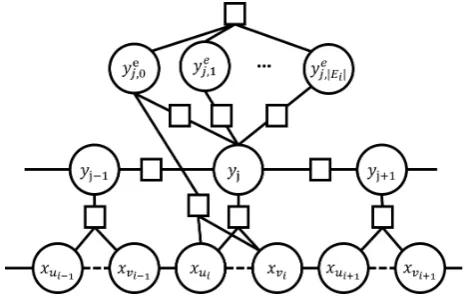
Figure 1: The factor graph of JERL model
lar models used. Most features used in NER are word-level (e.g. a word sequence appears at po-sition i or whether a word contains exactly four digits). It is hard, if not impossible, to encode entity-level features (such as ”entity length” and ”correlation to known entities”) in traditional CRF. Entity linking is typically formalized as a ranking task. Features used for entity linking are at entity-level inherently (such as entity prior probability; whether there are any related entity names or dis-criminative keywords occurring in the context).
The main challenges of joint optimization be-tween NER and linking are: how to combine a se-quence labeling model and a ranking model; and how to incorporate word-level and entity-level fea-tures. In a linear chain CRF model, each word’s label is assumed to depend on the observations and the label of its previous word. Semi-CRF carefully relaxes the Markov assumption between words in CRF, and models the distribution of seg-mentation boundaries directly. We further extend Semi-CRF to model entity distribution and mu-tual dependency over segmentations, and name it Joint Entity Recognition and Linking (JERL). The model is described below.
3.1 JERL
Letx= {xi}be a word sequence containing|x|
words. Lets = {sj} be a segmentation
assign-ment over x, where segment sj = (uj, vj)
con-sist of a start positionuj and an end positionvj.
All segments have a positive length and are adja-cent to each other, so every(uj, vj) always
satis-fies1 ≤uj ≤ vj ≤ |x|anduj+1 =vj + 1. Let
y = {yj} be labels in a fixed label alphabet Y
is the corresponding word sequence to sj, and Esj = {ej,k} is a set of entities in the
knowl-edge base (KB), which may be referred by word sequencexsj in the entity linking task. Each
en-tity ej,k is associated with a label yej,k ∈ {0,1}.
Label ye
j,k takes 1 iff xsj referring to entityej,k,
and 0 otherwise. Ifxsj does not refer to any entity
in the KB,ye
j,0 takes 1, which is analogous to the
NIL3identifier in entity linking.
Based on the preliminaries and notations, Fig-ure 1 shows the factor graph (Kschischang et al., 2001) of JERL. There are similar factor nodes for every (uj, vj, yej,k), we only show the first one (uj, vj, yj,e0)for clarity.
Given x, let a = (s,y,ye) be a joint
assign-ment, and g(x, j,a) be local functions for xsj,
namely features, each of which maps an assign-menta to a measurementgk(x, j, a) ∈ <. Then
G(x,a) = P|js=1| g(x, j,a) is the factor graph defining a probability distribution of assignment
aconditioned on word sequencex.
Then JERL, conditional probability ofaoverx, is defined as:
P(a|x,w) = Z(1x)ew·G(x,a) (1)
wherewis the weight vector corresponding toG
will be learned later, andZ(x) is the normaliza-tion factorZ(x) =Pa∈Aew·G(x,a), in which A
is the union of all possible assignments overx. JERL is a probabilistic graphical model. More specificly, as shown in Figure 1, there are three groups of local functions and one constrain intro-duced. Each of them take a different role in JERL, as described below:
Features defined on x,sj, yj, yj−1 are written
as gner(x, s
j, yj, yj−1). These functions model
segmentation and entity types’ distribution overx. Actually, every local features used in NER can be formulated in this way, and thus can be included in JERL. We thus refer to them as “NER features”.
Features defined on x, sj, yj,ke are written as
gel(x, sj, ye
j,k) and are called “linking features”.
These features model joint probabilities of word sequencexsj and linking decisionsyj,kk = 1(0 ≤
k≤ |Esj|)given contextx. JERL incorporates all
linking features in this way.
Features defined on yj, yej,k are written as
gcr(yj, ye
j,k). These features model “mutual
de-3In the entity linking task, if a given mention refers to
an entity which is not in the knowledge base, linking system should return a special identifier “NIL”.
pendency” between NER and linking’s outputs. For each entity ej,k, there is additional
informa-tion available in the knowledge base, e.g. cate-gories information, popularity and relationship to other entities. These features encourage predicting coherent outputs for NER and linking.
There is one constrain for eachye
j that the
cor-respondingxsj can refer to only one entityej,k ∈
Esj or NIL. This is equivalent toP|Ek=0sj|yj,ke = 1.
Based on the above description, G(x,a)
in equation 1 is the sum of conjunction
(gner,gel,gcr)overs, and can be rewritten as,
G(x,a) =P|s|
j=1( gner(x, sj, yj, yj−1)
,P|Ej|
k=0gel(x, sj, yj,ke )
,P|Ej|
k=0gcr(x, yj, yj,ke ) )
In summary, JERL jointly models the NER and linking, and leverages mutual dependency be-tween them to predict coherent outputs. Previ-ous works (Cucerzan, 2007; Ratinov et al., 2011; Sil and Yates, 2013) on linking argued that en-tity linking systems often suffer because of errors involved in mention detection phrase, especially false negative errors, and try to mitigate it via over-generating mention candidates. From the mention generation perspective, JERL actually considers every possible assignment and is able to find the optimala.
3.2 Parameter Estimation
We describe how to conduct parameter estima-tion for JERL in this secestima-tion. Given independent and identically distributed (i.i.d.) training data
T ={(xt,at)}Nt=1, the goal of parameter
estima-tion is to find optimal w∗ to maximize the joint
probability of the assignments{at}over{xt}.
w∗=argmaxw∈<|G|
N
Y
t=1
P(at|xt,w)
We use conditional log likelihood with`2norm as
the objective function in training,
L(T,w) = PtlogP(at|xt,w)−2σ12||w||22
The gradient ofL(T,w)is derived as,
∂L
∂w =
X
t
(G(xt,at)
−X
a0
G(xt,a0)P(a0|xt,w))− w
σ2
(2)
As shown in Figure 1, our model’s factor graph is a tree, which means the calculation of the gradient is tractable.
Inspired by the forward backward algorithm (Sha and Pereira, 2003) and Semi-CRF (Sarawagi and Cohen, 2004), we leverage dynamic program-ming techniques to compute the normalization factorZw and marginal probabilityP(a0j|xt, w)
when w is given.(Sutton and McCallum, 2006) The parameter estimation algorithm is abstracted in Algorithm 1.
Algorithm 1:JERL parameter estimation
input : training dataT ={(xt,at)}Nt=1 output: the optimalw
w←0;
whileweightwis not convergeddo
Z←0;
w0←0;
fort←1toN do
calculateαt,βtaccording to eq.3;
calculateZtaccording to eq.4
calculatew0
taccording to eq.2, 5;
Z ←Z+Zt;
w0←w0+w0
t; end
updatewto maximize log likelihood
L(T,w)under(Z,w0)via L-BFGS;
end
Letαi,y (i ∈[0,|x|], y ∈ Y)be the sum of
po-tential functions of all possible assignments over
(x1. . . xi)whose last segmentation’s labels arey.
Thenαi,ycan be calculated recursively fromi= 0
toi=|x|as below.
We first define base cases as α0,y= 1|{y∈Y}.
Wheni∈(0,|x|]:
αi,y = L
X
d=1
X
y0∈Y
αi−d,y0ψiner−d+1,i,y,y0
( X
ye j∈Yje∗
ψel.cr i−d+1,i,y,ye
j)
(3)
whereLis the max segmentation length in Semi-CRF, and Ye∗
j is all valid assignments for yje
which satisfiesP|Ek=0sj|ye
j,k = 1. Theψunerj,vj,yj,yj−1
andψel.cr uj,vj,yj,ye
j are precomputed ahead as below,
ψneruj,vj,yj,yj−1 =ewner·gner(x,sj,yj,yj−1)
ψel.cr
uj,vj,yj,yje = |Ej|
Y
k=0
ewelgel(x,sj,yj,ke )+wcrgcr(yj,yej,k)
wherewner,welandwcrare weights forgner,gel
andgcr inwaccordingly.
The value ofZwcan then be written as
Zw(x) =
X
y
α|x|,y (4)
Define βi,y (i ∈ [0,|x|], y ∈ Y) as the sum
of potential functions of all possible assignments over(xi+1. . . x|x|)whose first segmentation’s
la-bels arey. βi,y is calculated in a similar way,
ex-cept they are calculated fromi=|x|to lefti= 0. Once we get {αi,j} and {βi,j}, the
marginal probability of arbitrary assignment aj = (sj, yj,yej), where sj = (uj, vj), can be
calculated as below:
P(sj, yj|x,w) =
(Py0∈Yαuj−1,y0ψuner
j,vj,yj,y0)βvj,yj
Zw(x)
and
P(aj|xt,w) =
P(sj, yj|x,w)
ψel.cr uj,vj,yj,ye
j
P
ye
0∈Yje∗ψ
el.cr uj,vj,yj,ye
0 (5)
3.3 Inference
Given a new word sequencexand model weights
w trained on a training set, the goal of in-ference is to find the best assignment, a∗ =
argmaxaP(a|x,w)forx. We extend the Viterbi
algorithm to exactly infer the best assignment. The inference algorithm is shown in Algorithm 2.
Letφ(uj, vj, yj, yj−1)be the product of
poten-tials depending on(sj, yj, yj−1)as,
φ(uj, vj, yj, yj−1) =
ψner
uj,vj,yj,yj−1(
X
yje∈Yje∗
ψel.cr
Algorithm 2:JERL inference
input : one word sequencexand weightsw
output: the best assignmentaoverx
// shrink JERL graph to a Semi-CRF graph;
foru←1to|x|do
forv←u+ 1to|x|do for(y, y0)∈ Y × Ydo
calculateφu,v,y,y0 // see eq.6;
end end end
// infer the best assignment of (s∗,y∗);
fori←1to|x|do fory∈ Y do
calculateVi,y // see eq.7; end
end
(s∗,y∗)←argmax(V
i,y);
// infer the best assignment of{ye j}; forj←1to|s∗|do
ye
j ←argmax(P(|x,w,s∗j,yj∗)) end
a∗←(s∗,y∗,ye∗);
and let V(i, y) denotes the largest value of (w·
G(x,a0)) where a0 could be any possible
par-tial assignment starting from x1 toxi. The best (s∗,y∗) are derived during the following
recur-sive calculation,
Vi,y =
maxy0∈Y,d∈[1,L]
(Vi−d,y0 +φ(i−d+1, i, y, y0)) i >0
0 i= 0
−∞ i <0
(7)
whereLis the maximum segmentation length for Semi-CRF.
Once (s∗,y∗) are found, the corresponding ye∗
j = argmax{ye
0∈Yje∗}(ψ
el.cr u∗
j,vj∗,yj∗,y0e)is also the optimal one. Thena∗ = (s∗,y∗,ye∗)is the best
assignment for the givenxandw. 4 Experiments
In our experiments, we first construct two base-line models JERLnerand JERLel, which use exact
NER and EL feature sets used in JERL. Then eval-uate JERL and the two baseline models against several state-of-art NER and linking systems. Af-ter that, we evaluate JERL under different feature
CoNLL’03 Training Dev set Test
Articles 946 216 231
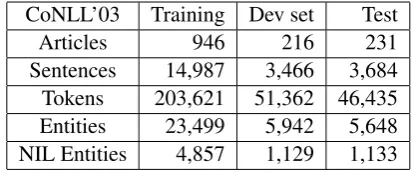
[image:6.595.312.519.62.148.2]Sentences 14,987 3,466 3,684 Tokens 203,621 51,362 46,435 Entities 23,499 5,942 5,648 NIL Entities 4,857 1,129 1,133 Table 1: Overview of CoNLL’03/AIDA data set
settings to analysis the contributions of each fea-tures set, and show some examples we find. We also compare the training speed under different settings.
4.1 Data set
We take the CoNLL’03/AIDA English data set to evaluate the performance of NER and linking systems. CoNLL’03 is extensively used in prior work on NER evaluation (Tjong Kim Sang and De Meulder, 2003). The English data is taken from Reuters news articles published between Au-gust 1966 and AuAu-gust 1997. Four types of en-tities persons (PER), organizations (ORG), loca-tions (LOC), and miscellaneous names (MISC) are annotated. Hoffart et al. (2011) hand-annotated all proper nouns with corresponding entities wiht YAGO2, Freebase and Wikipedia IDs. This data is referenced as AIDA here. To the best of our knowledge, this data set is the biggest data set which has been labeled for both NER and linking tasks. It becomes a really good starting point for our work. Table 1 contains of an overview of the CoNLL’03/AIDA data set.
For entity linking, we take Wikipedia as the ref-erent knowledge base. We use a Wikipedia snap-shot dumped in May 2013, which contains around 4.8 million articles. We also align our Wikipedia dump with additional knowledge bases, Freebase and Satori (a Microsoft internal knowledge base), to enrich the information of these entities.
4.2 Evaluation Metrics
We follow the CoNLL’03 metrics to evaluate NER performance by precision, recall, and F1 scores,
Category Features
Word unigram / bigram Lower cased unigram / bigram Word shape unigram / bigram Stemmed unigram / bigram POS unigram / bigram NER Chunk unigram / bigram
Words in the 4 left/right window Character n-grams,n≤4
Brown clusters WordNet clusters Dictionaries Alternative names Entity priors Entity name priors Linking Entity priors over names
Context scores Geo distance Related entities
[image:7.595.78.287.58.337.2]Mutual Type-category correlation
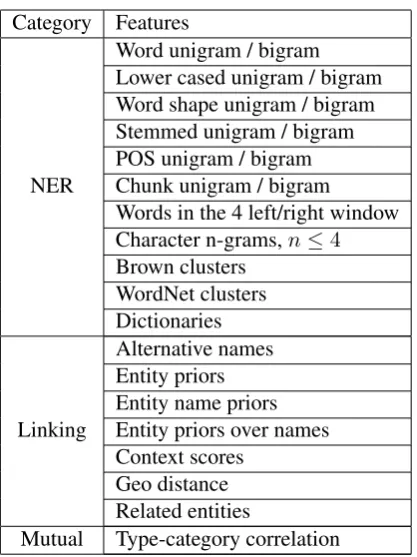
Table 2: JERL feature list
4.3 JERL Implementation
Table 2 shows features used in our models. JERL uses all features in the three categories, while JERLner and JERLeluse only one corresponding
category. All three models are trained on the train and development set, and evaluated on the test set of CoNLL’03/AIDA.
4.3.1 NER
Features in the NER category are relevant to NER. We considered the most commonly used features in literatures (Finkel et al., 2005; Liang, 2005; Ratinov and Roth, 2009). We collect several known name lists, like popular English first/last names for people, organization lists and so on from Wikipedia and Freebase. UIUC NER’s lists are also included. In addition, we extract entity name lists from the knowledge base we used for entity linking, and construct 655 more lists. Al-though those lists are noisy, we find that statisti-cally they do improve the performance of our NER baseline by a significant amount.
4.3.2 Linking
Features in linking category are relevant to entity linking. An entity can be referred by its canoni-cal name, nick names, alias, and first/last names. Those names are defined as alternative names for this entity. We collect all alternative names for all
known entities and build a name to entity index. This index is used to select entity candidates for any word sequence, also known as surface form. Following previous work by Han and Sun (2011), we calculate entity priors and entity name priors from Wikipedia. Context scores are calculated based on discriminative keywords. Geo distance and related entities capture the relatedness among entities in the given context.
4.3.3 Mutual
Features in this category capture the mutual de-pendency between NER and linking’s outputs. For each entity in a knowledge base, there is category information available. We aggregate around 1000 distinct categories from multiple sources. One en-tity can have multiple categories. For example, London is connected to 29 categories. We use all combinations between NER types and categories as features in JERL, and let the model learn the correlation of each combination. This encourages coherent NER and EL decisions, which is one of the key contributions of our work.
4.3.4 Non-local features
Features capturing long distance dependency be-tween hidden labels are classified as non-local features. Those features are very helpful in im-proving NER system performance but are costly. Since this is not the focus of this paper, we take a simple approach to incorporate non-local fea-tures. We cache history results of previous sen-tences in a 1000 words window, and adopt sev-eral heuristic rules for personal names. This ap-proach contributes 0.2 points to the final NERF1
score. Non-local features are also considered in linking (Ratinov et al., 2011; Han et al., 2011). We try several features, which has been proved to be helpful in TAC data set. However, the gain on CoNLL’03/AIDA data set is not obvious, we do not optimize linking globally.
Lastly, based on preliminary studies and exper-iments, we set the maximum segmentation length to 6 and max candidate count per segmentation to 5 for efficient training and inference.
4.4 State-of-Art systems
compo-Dataset System Prec. Recall F1
Stanford 95.1 78.3 85.9
UIUC 91.2 90.5 90.8
CoNLL’03 NereL 86.8 89.5 88.2
JERLner 90.0 89.9 89.9
[image:8.595.325.505.61.146.2]JERL 91.5 91.4 91.2
Table 3: NER evaluation results
nents, then trains a maximum-entropy model to re-rank different assignments. UIUC NER uses a regularized averaged perceptron model and ex-ternal gazetteers to achieve strong performance. In Addition, NereL also uses UIUC NER to gen-erate mentions. Stanford NER uses Conditional Random Fields and Gibbs sampling to incorporate non-local features into its model.
For entity linking systems, NereL, Kul09 (Kulkarni et al., 2009) and Hof11 (Hoffart et al., 2011) are compared with our models. NereL achieves the best precision@1. Kul09 formulates the local compatibility and global coherence in en-tity linking, and optimizes the overall enen-tity as-signment for all entities in a document via a lo-cal hill-climbing approach. Hof11 unifies the prior probability of an entity being mentioned, the simi-larity between context and entity, and the coher-ence between entity candidates among all men-tions in a dense graph.
4.5 Results
Table 3 shows the performance of different NER systems on the CoNLL’03 testb data set. We re-fer the numbers of state-of-art systems reported by Sil and Yates (2013). Stanford NER achieves the best precision, but its recall is low. UIUC reports the (almost) best recordedF1.JERLnerconsiders
features only in the NER category, which could be treated as a pure NER system implemented in Semi-CRF. Actually CRF-based implementation with a similar feature set has comparable perfor-mance. Our baselineJERLner is strong enough. We argue that that it is mainly because of the ad-ditional dictionaries derived from the knowledge base. JERL further pushes the F1 to 91.2, which
outperforms UIUC by 0.4 points inF1 score. To
the best of our knowledge, it is the best F1 on
CoNLL’03 since 2009. The reason our model can outperform state-of-art systems is that, it has more knowledge about entities via incorporate en-tity linking techniques. If an enen-tity can be linked to a well known entity via entity linking in high
Dataset System Precision@1
Kul09 76.74
Hof11 81.91
CoNLL’03 Nerel 84.22
JERLel 81.49
JERL 84.58
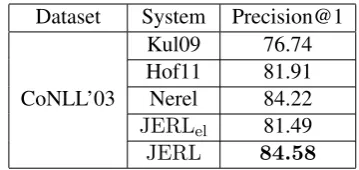
Table 4: Linking evaluation results
# Feature set description NERF1
0 JERLner(baseline) 89.9
1 + candidate 88.7
2 + candidate + linking 89.9
3 + candidate + mutual 90.6
[image:8.595.72.300.61.148.2]4 + candidate + mutual + linking 91.2 Table 5: JERL features analysis
confidence, its mention boundary and entity type are confirmed implicitly.
Table 4 shows the performance of different en-tity linking systems on the AIDA test set. Kul09 and Hof11 use only the correct mentions detected by the Stanford NER as input, and thus their re-call is bound by the rere-call of NER. NereL uses its overgeneration techniques to generate mention candidates, and outperforms Hoff11 in both preci-sion and recall. Our baseline model JERLelis also
evaluated on Stanford NER generated mentions, which has comparable performance with Kul09 and Hof11. JERL achieves precision@1 84.58 which is better than NereL.
We run 15 trials for both NER and linking’s ex-periments and report the average numbers above. The standard deviations are 0.11% and 0.08% for NER and linking separately, which pass the stan-dard t-test with confidence level 5%, demonstrat-ing the significance of our results.
In order to investigate how different features contribute to the overall gain. We compare
JERLner with four different feature sets. Table
5 summaries the results. In the trial “+candidate”, JERL expands every possible segmentation with corresponding entity list and builds its factor graph without any linking and mutual features. This ver-sion’sF1drops to 88.7 which indicates the created
structure is quite noisy. In the “+candidate +link-ing” trial, only linking features are enabled and theF1is comparable to the baseline. On the other
side, in the “+candidate +mutual” trial when mu-tual features are enabled theF1 increases to 90.6.
[image:8.595.309.526.176.265.2]Category PER LOC ORG Other people.person 3.65 0.817 1.260 -1.782
[image:9.595.76.289.151.252.2]location.city -0.187 0.712 0.491 -0.188 sports.team -0.180 2.382 3.595 -2.019
Table 6: Learned mutual dependency
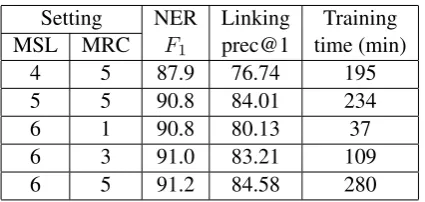
Setting NER Linking Training MSL MRC F1 prec@1 time (min)
4 5 87.9 76.74 195
5 5 90.8 84.01 234
6 1 90.8 80.13 37
6 3 91.0 83.21 109
6 5 91.2 84.58 280
Table 7: Training time under different settings
JERL achieves the reported performance. The re-sult indicates that mutual features are the deter-mining factor to the performance gain.
Table 6 shows weights of learned mutual depen-dency of three categories ”people.person”, ”loca-tion.city”, and ”sports.team”. The bigger a weight is, the more consistent this combination would be. From the weights, we find several interest-ing thinterest-ings. If an entity belongs to any of the three categories, it is less likely to be predicted as non-an-entity by NER. If an entity belongs to the category of ”people.person”, it more likely to be predicted as PER. When an entity belongs to the category ”location.city” or ”sports.team”, NER may predict it as ORG or LOC. This is be-cause in the CoNLL’03/AIDA data set, there are many sports teams mentioned by their city/country names. JERL successfully models such unex-pected mutual dependency.
Table 7 compares the performance and training time under different settings of max segmentation length (MSL) and max referent count (MRC). We use machines with Intel Xeon E5620 @ 2.4GHz CPU (8 cores / 16 logical processors) and 48GB memory. We run every setting 10 times and report the averages. As MSL and MRC increasing, the performance is slightly better, but the training time increased a lot. MSL has linear impact on training time, while MRC affects training time more.
5 Conclusion and Future Work
In this paper, we address the problem of joint opti-mization of named entity recognition and linking. We propose a novel model, JERL, to jointly train
and infer for NER and linking tasks. To the best of our knowledge, this is the first model which trains two tasks at the same time. The joint model is able to leverage mutual dependency of the two tasks, and predict coherent outputs. JERL outperforms the state-of-art systems on both NER and linking tasks on the CoNLL’03/AIDA data set.
For future works, we would like to study how to leverage existing partial labeled data, either for NER or for linking only, in joint optimization, and incorporate more NLP tasks together for multi-tasks joint optimization.
Acknowledgments
This work was performed when the first author was working at Microsoft Research. The first au-thor is sponsored by Microsoft Bing Core Rele-vance team. Thanks Shuming Shi, Bin Gao, and Yohn Cao for their helpful guidance and valuable discussions. Additionally, we would like to thank the three anonymous reviewers for their insightful suggestions and detailed comments.
References
Razvan C Bunescu and Marius Pasca. 2006. Using en-cyclopedic knowledge for named entity disambigua-tion. InEACL, volume 6, pages 9–16.
Nancy Chinchor and Elaine Marsh. 1998. Muc-7 in-formation extraction task definition. InProceeding of the seventh message understanding conference (MUC-7), Appendices, pages 359–367.
Silviu Cucerzan. 2007. Large-scale named entity dis-ambiguation based on wikipedia data. In EMNLP-CoNLL, volume 7, pages 708–716.
George R Doddington, Alexis Mitchell, Mark A Przy-bocki, Lance A Ramshaw, Stephanie Strassel, and Ralph M Weischedel. 2004. The automatic content extraction (ace) program-tasks, data, and evaluation. InLREC.
Jenny Rose Finkel and Christopher D Manning. 2009. Joint parsing and named entity recognition. In Pro-ceedings of Human Language Technologies: The 2009 Annual Conference of the North American Chapter of the Association for Computational Lin-guistics, pages 326–334. Association for Computa-tional Linguistics.
Xianpei Han and Le Sun. 2011. A generative entity-mention model for linking entities with knowledge base. InProceedings of the 49th Annual Meeting of the Association for Computational Linguistics: Hu-man Language Technologies-Volume 1, pages 945– 954. Association for Computational Linguistics. Xianpei Han, Le Sun, and Jun Zhao. 2011. Collective
entity linking in web text: a graph-based method. In
Proceedings of the 34th international ACM SIGIR conference on Research and development in Infor-mation Retrieval, pages 765–774. ACM.
Johannes Hoffart, Mohamed Amir Yosef, Ilaria Bor-dino, Hagen F¨urstenau, Manfred Pinkal, Marc Span-iol, Bilyana Taneva, Stefan Thater, and Gerhard Weikum. 2011. Robust disambiguation of named entities in text. InProceedings of the Conference on Empirical Methods in Natural Language Process-ing, pages 782–792. Association for Computational Linguistics.
Frank R Kschischang, Brendan J Frey, and H-A Loeliger. 2001. Factor graphs and the sum-product algorithm. Information Theory, IEEE Transactions on, 47(2):498–519.
Sayali Kulkarni, Amit Singh, Ganesh Ramakrishnan, and Soumen Chakrabarti. 2009. Collective annota-tion of wikipedia entities in web text. In Proceed-ings of the 15th ACM SIGKDD international con-ference on Knowledge discovery and data mining, pages 457–466. ACM.
John Lafferty, Andrew McCallum, and Fernando CN Pereira. 2001. Conditional random fields: Prob-abilistic models for segmenting and labeling se-quence data.
Percy Liang. 2005. Semi-supervised learning for nat-ural language. Ph.D. thesis, Massachusetts Institute of Technology.
Dekang Lin and Xiaoyun Wu. 2009. Phrase clustering for discriminative learning. In Proceedings of the Joint Conference of the 47th Annual Meeting of the ACL and the 4th International Joint Conference on Natural Language Processing of the AFNLP: Vol-ume 2-VolVol-ume 2, pages 1030–1038. Association for Computational Linguistics.
Dong C Liu and Jorge Nocedal. 1989. On the limited memory bfgs method for large scale optimization.
Mathematical programming, 45(1-3):503–528. Andrew McCallum, Khashayar Rohanimanesh, and
Charles Sutton. 2003. Dynamic conditional ran-dom fields for jointly labeling multiple sequences. Innips workshop on syntax, semantics and statistics. Lev Ratinov and Dan Roth. 2009. Design challenges and misconceptions in named entity recognition. In
Proceedings of the Thirteenth Conference on Com-putational Natural Language Learning, pages 147– 155. Association for Computational Linguistics.
Lev Ratinov, Dan Roth, Doug Downey, and Mike Anderson. 2011. Local and global algorithms for disambiguation to wikipedia. In Proceedings of the 49th Annual Meeting of the Association for Computational Linguistics: Human Language Technologies-Volume 1, pages 1375–1384. Associ-ation for ComputAssoci-ational Linguistics.
Sunita Sarawagi and William W Cohen. 2004. Semi-markov conditional random fields for information extraction. InAdvances in Neural Information Pro-cessing Systems, pages 1185–1192.
Fei Sha and Fernando Pereira. 2003. Shallow parsing with conditional random fields. InProceedings of the 2003 Conference of the North American Chapter of the Association for Computational Linguistics on Human Language Technology-Volume 1, pages 134– 141. Association for Computational Linguistics. Avirup Sil and Alexander Yates. 2013. Re-ranking for
joint named-entity recognition and linking. In Pro-ceedings of the 22nd ACM international conference on Conference on information & knowledge man-agement, pages 2369–2374. ACM.
Rosa Stern, Benoˆıt Sagot, and Fr´ed´eric B´echet. 2012. A joint named entity recognition and entity linking system. InProceedings of the Workshop on Innova-tive Hybrid Approaches to the Processing of Textual Data, pages 52–60. Association for Computational Linguistics.
Mihai Surdeanu, Richard Johansson, Adam Meyers, Llu´ıs M`arquez, and Joakim Nivre. 2008. The conll-2008 shared task on joint parsing of syntac-tic and semansyntac-tic dependencies. In Proceedings of the Twelfth Conference on Computational Natural Language Learning, pages 159–177. Association for Computational Linguistics.
Charles Sutton and Andrew McCallum. 2006. An in-troduction to conditional random fields for relational learning.Introduction to statistical relational learn-ing, pages 93–128.
Erik F Tjong Kim Sang and Fien De Meulder. 2003. Introduction to the conll-2003 shared task: Language-independent named entity recognition. In
Proceedings of the seventh conference on Natural language learning at HLT-NAACL 2003-Volume 4, pages 142–147. Association for Computational Lin-guistics.
Longyue Wang, Shuo Li, Derek F Wong, and Lidia S Chao. 2012. A joint chinese named entity recog-nition and disambiguation system. CLP 2012, page 146.