Combining Sample Selection and Error-Driven Pruning for
Machine Learning of Coreference Rules
Vincent Ng and Claire Cardie Department of Computer Science
Cornell University Ithaca, NY 14853-7501
yung,cardie @cs.cornell.edu
Abstract
Most machine learning solutions to noun phrase coreference resolution recast the problem as a classification task. We ex-amine three potential problems with this reformulation, namely, skewed class dis-tributions, the inclusion of “hard” training instances, and the loss of transitivity in-herent in the original coreference relation. We show how these problems can be han-dled via intelligent sample selection and error-driven pruning of classification rule-sets. The resulting system achieves an F-measure of 69.5 and 63.4 on the MUC-6 and MUC-7 coreference resolution data sets, respectively, surpassing the perfor-mance of the best MUC-6 and MUC-7 coreference systems. In particular, the system outperforms the best-performing learning-based coreference system to date.
1 Introduction
Noun phrase coreference resolution refers to the problem of determining which noun phrases (NPs) refer to each real-world entity mentioned in a doc-ument. Machine learning approaches to this prob-lem have been reasonably successful, operating pri-marily by recasting the problem as a classification
task (e.g. Aone and Bennett (1995), McCarthy and
Lehnert (1995), Soon et al. (2001)). Specifically, an inductive learning algorithm is used to train a classi-fier that decides whether or not two NPs in a
docu-ment are coreferent. Training data are typically cre-ated by relying on coreference chains from the train-ing documents: traintrain-ing instances are generated by pairing each NP with each of its preceding NPs; in-stances are labeled as positive if the two NPs are in the same coreference chain, and labeled as negative otherwise.1
A separate clustering mechanism then coordinates the possibly contradictory pairwise coreference clas-sification decisions and constructs a partition on the set of NPs with one cluster for each set of corefer-ent NPs. Although, in principle, any clustering algo-rithm can be used, most previous work uses a single-link clustering algorithm to impose coreference par-titions.2An implicit assumption in the choice of the single-link clustering algorithm is that coreference resolution is viewed as anaphora resolution, i.e. the goal during clustering is to find an antecedent for each anaphoric NP in a document.3
Three intrinsic properties of coreference4, how-ever, make the formulation of the problem as a classification-based single-link clustering task po-tentially undesirable:
Coreference is a rare relation. That is, most NP pairs in a document are not coreferent.
Con-1Two NPs are in the same coreference chain if and only if
they are coreferent.
2One exception is Kehler’s work on probabilistic
corefer-ence (Kehler, 1997), in which he applies Dempster’s Rule of
Combination (Dempster, 1968) to combine all pairwise
proba-bilities of coreference to form a partition.
3
In this paper, we consider an NP anaphoric if it is part of a coreference chain but is not the head of the chain.
4
Here, we use the term coreference loosely to refer to either the problem or the binary relation defined on a set of NPs. The particular choice should be clear from the context.
sequently, generating training instances by pairing each NP with each of its preceding NPs creates highly skewed class distributions, in which the num-ber of positive instances is overwhelmed by the number of negative instances. For example, the stan-dard MUC-6 and MUC-7 (1995; 1998) coreference data sets contain only 2% positive instances. Un-fortunately, learning in the presence of such skewed class distributions remains an open area of research in the machine learning community (e.g. Pazzani et al. (1994), Fawcett (1996), Cardie and Howe (1997), Kubat and Matwin (1997)).
Coreference is a discourse-level problem with dif-ferent solutions for difdif-ferent types of NPs. The interpretation of a pronoun, for example, may be de-pendent only on its closest antecedent and not on the rest of the members of the same coreference chain. Proper name resolution, on the other hand, may be better served by ignoring locality constraints alto-gether and relying on string-matching or more so-phisticated aliasing techniques. Consequently, gen-erating positive instances from all pairs of NPs from the same coreference chain can potentially make the learning task harder: all but a few coreference links derived from any chain might be hard to identify based on the available contextual cues.
Coreference is an equivalence relation. Recast-ing the problem as a classification task precludes en-forcement of the transitivity constraint. After train-ing, for example, the classifier might determine that A is coreferent with B, and B with C, but that A and C are not coreferent. Hence, the clustering mecha-nism is needed to coordinate these possibly contra-dictory pairwise classifications. In addition, because the coreference classifiers are trained independent of the clustering algorithm to be used, improvements in classification accuracy do not guarantee correspond-ing improvements in clustercorrespond-ing-level accuracy, i.e. overall performance on the coreference resolution task might not improve.
This paper examines each of the above issues. First, to address the problem of skewed class dis-tributions, we apply a technique for negative in-stance selection similar to that proposed in Soon et al. (2001). In contrast to results reported there, how-ever, we show empirically that system performance increases noticeably in response to negative example
selection, with increases in F-measure of 3-5%. Second, in an attempt to avoid the inclusion of “hard” training instances, we present a corpus-based method for implicit selection of positive instances. The approach is a fully automated variant of the ex-ample selection algorithm introduced in Harabagiu et al. (2001). With positive example selection, sys-tem performance (F-measure) again increases, by 12-14%.
Finally, to more tightly tie the classification- and clustering-level coreference decisions, we propose an error-driven rule pruning algorithm that opti-mizes the coreference classifier ruleset with respect to the clustering-level coreference scoring function. Overall, the use of pruning boosts system perfor-mance from an F-measure of 69.3 to 69.5, and from 57.2 to 63.4 for the MUC-6 and MUC-7 data sets, respectively, enabling the system to achieve perfor-mance that surpasses that of the best MUC corefer-ence systems by 4.6% and 1.6%. In particular, the system outperforms the best-performing learning-based coreference system (Soon et al., 2001) by 6.9% and 3.0%.
The remainder of the paper is organized as fol-lows. In sections 2 and 3, we present the machine learning framework underlying the baseline corefer-ence system and examine the effect of negative sam-ple selection. Section 4 presents our corpus-based algorithm for selection of positive instances. Section 5 describes and evaluates the error-driven pruning algorithm. We conclude with future work in section 6.
2 The Machine Learning Framework for
Coreference Resolution
Our machine learning framework for coreference resolution is a standard combination of classification and clustering, as described above.
Creating an instance. An instance in our machine learning framework is a description of two NPs in a document. More formally, letNP be the th NP in
document . An instance formed fromNP andNP
is denoted by . A valid instance is an
instance
such thatNP
precedes NP
. 5
Following previous work (Aone and Bennett (1995),
5
By definition, exactly valid instances can be created
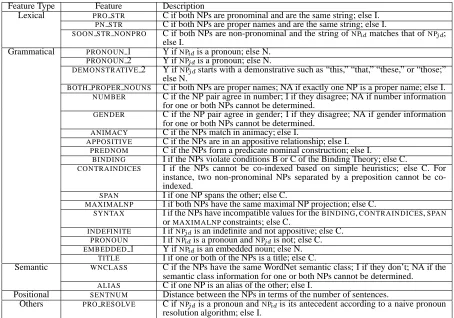
Soon et al. (2001)), we assume throughout the paper that only valid instances will be generated and used for training and testing. Each instance consists of 25 features, which are described in Table 1.6 The clas-sification associated with a training instance is one of COREFERENT or NOT COREFERENT depending on whether the NPs co-refer in the associated train-ing text.7
Building an NP coreference classifier. We use RIPPER (Cohen, 1995), an information gain-based propositional rule learning system, to train a classi-fier that, given a test instance , decides
whether or notNP
andNP
are coreferent.
Specifi-cally, RIPPER sequentially covers the positive train-ing instances and induces a ruleset that determines when two NPs are coreferent. When none of the rules in the ruleset is applicable to a given NP pair, a default rule that classifies the pair as not coreferent is automatically invoked. The output of the classifier is eitherCOREFERENT orNOT COREFERENT along with a number between 0 and 1 that indicates the confidence of the classification.
Applying the classifier to create coreference chains. After training, the resulting ruleset is used by a best-first clustering algorithm to impose a par-titioning on all NPs in the test texts, creating one cluster for each set of coreferent NPs. Texts are processed from left to right. Each NP encountered,
NP , is compared in turn to each preceding NP,NP ,
from right to left. For each pair, a test instance is created as during training and is presented to the coreference classifier. The NP with the highest con-fidence value among the preceding NPs that are clas-sified as being coreferent withNP is selected as the
antecedent of NP ; otherwise, no antecedent is
se-lected forNP .
3 Negative Sample Selection
As noted above, skewed class distributions arise when generating all valid instances from the train-ing texts. A number of methods for handltrain-ing skewed distributions have been proposed in the machine learning literature, most of which modify the
learn-6
See Ng and Cardie (2002) for a detailed description of the features.
7
In all of the work presented here, NPs are identified, and feature values computed entirely automatically.
Algorithm NEG-SELECT(NEG: set of all possible
negative instances)
for !"#$%'& NEG do
ifNP is anaphoric then
ifNP precedes( (NP ) then
NEG := NEG)#* !"%%,+
else
NEG := NEG)#*! $%+
return NEG
Figure 1: The NEG-SELECT algorithm
ing algorithm to incorporate a loss function with a much larger penalty for minority class errors than for instances from the majority classes (e.g. Gordon and Perlis (1989), Pazzani et al. (1994)). We investigate here a different approach to handling skewed class distributions — negative sample selection, i.e. the selection of a smaller subset of negative instances from the set of available negative instances. In the case of NP coreference, we hypothesize that reduc-ing the number of negative instances will improve recall but potentially reduce precision: intuitively, the existence of fewer negative instances should al-low RIPPER to more liberally induce positive rules. We propose a method for negative sample selection that, for each anaphoric NP,NP
, retains only those
negative instances for non-coreferent NPs that lie betweenNP and its farthest preceding antecedent,
( (NP ). The algorithm for negative sample
selec-tion, SELECT, is shown in Figure 1. NEG-SELECT takes as input the set of all possible neg-ative instances in the training texts, i.e. the set of valid instances !"#$% such thatNP andNP
are not in the same coreference chain.
The intuition behind this approach is very simple. Let - (NP ) be the set of preceding antecedents of
NP , and. (NP ,NP ) be the set consisting of NPs
NP , NP 0/21
,
3%343, NP . Recall that the goal
dur-ing clusterdur-ing is to compute, for each NPNP , the
set - (NP ) from which the element with the
high-est confidence is selected as the antecedent ofNP .
Since (1)- (NP ) is a subset of. (( (NP ),NP ) 8and
8
We define5 (6 (NP
),NP
) to be the empty set if6 (NP
) does not exist (i.e.NP
Feature Type Feature Description
Lexical PRO STR C if both NPs are pronominal and are the same string; else I.
PN STR C if both NPs are proper names and are the same string; else I.
SOON STR NONPRO C if both NPs are non-pronominal and the string ofNP
matches that ofNP
; else I.
Grammatical PRONOUN1 Y ifNP
is a pronoun; else N.
PRONOUN2 Y ifNP
is a pronoun; else N.
DEMONSTRATIVE2 Y ifNP
starts with a demonstrative such as “this,” “that,” “these,” or “those;” else N.
BOTH PROPER NOUNS C if both NPs are proper names; NA if exactly one NP is a proper name; else I.
NUMBER C if the NP pair agree in number; I if they disagree; NA if number information for one or both NPs cannot be determined.
GENDER C if the NP pair agree in gender; I if they disagree; NA if gender information for one or both NPs cannot be determined.
ANIMACY C if the NPs match in animacy; else I.
APPOSITIVE C if the NPs are in an appositive relationship; else I.
PREDNOM C if the NPs form a predicate nominal construction; else I.
BINDING I if the NPs violate conditions B or C of the Binding Theory; else C.
CONTRAINDICES I if the NPs cannot be co-indexed based on simple heuristics; else C. For instance, two non-pronominal NPs separated by a preposition cannot be co-indexed.
SPAN I if one NP spans the other; else C.
MAXIMALNP I if both NPs have the same maximal NP projection; else C.
SYNTAX I if the NPs have incompatible values for theBINDING,CONTRAINDICES,SPAN
orMAXIMALNPconstraints; else C.
INDEFINITE I ifNP
is an indefinite and not appositive; else C.
PRONOUN I ifNP
is a pronoun andNP
is not; else C.
EMBEDDED1 Y ifNP
is an embedded noun; else N.
TITLE I if one or both of the NPs is a title; else C.
Semantic WNCLASS C if the NPs have the same WordNet semantic class; I if they don’t; NA if the semantic class information for one or both NPs cannot be determined.
ALIAS C if one NP is an alias of the other; else I.
Positional SENTNUM Distance between the NPs in terms of the number of sentences. Others PRO RESOLVE C ifNP
is a pronoun andNP$
[image:4.612.79.533.70.388.2]is its antecedent according to a naive pronoun resolution algorithm; else I.
Table 1: Feature Set for the Coreference System. The feature set contains relational and non-relational features. Non-relational features test some property P of one of the NPs under consideration and take on a value of YESor NOdepending on whether P holds. Relational features test whether some property P holds for the NP pair under consideration and indicate whether the NPs are COMPATIBLEor INCOMPATIBLEw.r.t. P; a value of NOTAPPLICABLEis used when property P does not apply.
(2) NP is compared to each preceding NP from right to left by the clustering algorithm, it follows
that the set of negative instances whose classifica-tions the classifier needs to determine in order to compute- (NP
) is a superset of the set of instances
7
(NP ) formed by pairingNP with each of its
non-coreferent preceding NPs in . (( (NP ),NP ).
Con-sequently,
7
(NP ) is the minimal set of
(nega-tive) instances whose classifications will be required during clustering. In principle, to perform the classi-fications accurately, the classifier needs to be trained on the corresponding set of negative instances from the training set, which is
7
(NP ), where NP
is now the 8 th NP in training document .
NEG-SELECT is designed essentially to compute this set. Next, we examine the effects of this minimalist ap-proach to negative sample selection.
significant, but much larger drops in precision.9 The resulting F-measure scores, however, increase non-trivially from 52.4 to 55.2 (for MUC-6), and from 41.3 to 46.0 (for MUC-7).10
4 Positive Sample Selection
Since not all of the coreference relationships de-rived from coreference chains are equally easy to identify, training a classifier using all possible coref-erence relationships can potentially lead to the in-duction of inaccurate rules. Given the observa-tion that one antecedent is sufficient to resolve an anaphor, it may be desirable to learn only from easy positive instances. Similar observations are made by Harabagiu et al. (2001), who point out that in-telligent selection of positive instances can poten-tially minimize the amount of knowledge required to perform coreference resolution accurately. They assume that the easiest types of coreference rela-tionships to resolve are those that occur with high frequencies in the data. Consequently, they mine by hand three sets of coreference rules for cov-ering positive instances from the training data by finding the coreference knowledge satisfied by the largest number of anaphor-antecedent pairs. While the Harabagiu et al. algorithm attempts to mine easy coreference rules from the data by hand, nei-ther the rule creation process nor stopping condi-tions are precisely defined. In addition, a lot of human intervention is required to derive the rules. In this section, we describe an automatic positive sample selection algorithm that coarsely mimics the Harabagiu et al. algorithm by finding a confident an-tecedent for each anaphor. Overall, our goal is to avoid the inclusion of hard training instances by au-tomating the process of deriving easy coreference rules from the data.
The Algorithm. The positive sample selection al-gorithm, POS-SELECT, is shown in Figure 2. It as-sumes the existence of a rule learner, L, that pro-duces an ordered set of positive rules. POS-SELECT
9
Chi-square statistical significance tests are applied to changes in recall and precision throughout the paper. Unless otherwise noted, reported differences are at the 0.05 level or higher. The chi-square test is not applicable to F-measure.
10
The F-measure score computed by the MUC scoring pro-gram is the harmonic mean of recall and precision.
Algorithm POS-SELECT(L: positive rule learner,
T: set of training instances) FinalRuleSet :=9 ;
AnaphorSet :=9 ;
BestRule := NIL;
repeat
BestRule := best rule among the ranked set of positive rules induced on T using L FinalRuleSet := FinalRuleSet: BestRule // collect anaphors from instances that // are correctly covered by BestRule
for %;& T do
if !" < is covered by BestRule and
class( !"#$ )= COREFERENT then
AnaphorSet := AnaphorSet:>* NP
+
// remove instances associated with the // anaphors covered by BestRule
for
& T do
ifNP?& AnaphorSet then
T@A= T)B*C "%<+
until L cannot induce any rule for the positives. return FinalRuleSet
Figure 2: The POS-SELECT algorithm
first uses L to induce a ruleset on the training in-stances and picks the first rule from the ruleset. For any training instance "
$
correctly covered
by this rule, an antecedent NP has been
identi-fied for the anaphor NP . As a result, all (positive
and negative) training instances formed with NP
as the anaphor are no longer needed and are sub-sequently removed from the training data.11 The process is repeated until L cannot induce a rule to cover the remaining positive instances. The output of POS-SELECT is a set of positive rules selected during each iteration of the algorithm. Hence, posi-tive sample selection in POS-SELECT is implicit in the sense that it is embedded within the rule induc-tion process.
Evaluation. Results are shown in rows 3 and 4 of Table 2. As in the previous experiments, the rule learner is RIPPER. We run the system twice, first
11
Experiments Algorithms used MUC-6 MUC-7
R P F R P F
[image:6.612.96.519.71.146.2]Baseline — 40.7 73.5 52.4 27.2 86.3 41.3 Neg-Only NEG-SELECT 46.5 67.8 55.2 37.4 59.7 46.0 Pos-Only POS-SELECT 53.1 80.8 64.1 41.1 78.0 53.8 Combined NEG-SELECT+POS-SELECT 63.4 76.3 69.3 59.5 55.1 57.2 Pruning NEG-SELECT+POS-SELECT+RULE-SELECT 63.3 76.9 69.5 54.2 76.3 63.4 More Training NEG-SELECT+POS-SELECT 64.8 70.6 67.6 60.0 55.7 57.8
Table 2: Effects of sample selection and error-driven pruning.
with SELECT only and then with both POS-SELECT and NEG-POS-SELECT. With POS-POS-SELECT only, the system achieves an F-measure of 64.1 (for MUC-6) and 53.8 (for MUC-7). When POS-SELECT and NEG-POS-SELECT are used in combina-tion, however, the system achieves an F-measure of 69.3 (for MUC-6) and 57.2 (for MUC-7).
Discussion. The experimental results are largely consistent with our hypothesis. System performance improves dramatically with positive sample selec-tion using POS-SELECT both in the absence and presence of negative sample selection. Without neg-ative sample selection, F-measure increases from 52.4 to 64.1 (for MUC-6), and from 41.3 to 53.8 (for MUC-7). Similarly, with negative sample selection, F-measure increases from 55.2 to 69.3 (for MUC-6), and from 46.0 to 57.2 (for MUC-7). In addition, our results indicate that applying both negative and pos-itive sample selection leads to better performance than applying positive sample selection alone: F-measure increases from 64.1 to 69.3, and from 53.8 to 57.2 for the MUC-6 and MUC-7 data sets, respec-tively. Nevertheless, reducing the number of neg-ative instances (via negneg-ative sample selection) im-proves recall but damages precision: we see sta-tistically significant gains in recall and stasta-tistically significant drops in precision for both data sets. In particular, precision drops precipitously from 78.0 to 55.1 for the MUC-7 data set. We hypothesize that POS-SELECT does not guarantee that hard pos-itive instances will be avoided and that the inclu-sion of these hard instances is responsible for the poorer precision of the system. Anaphors that do not have easy antecedents can never be removed auto-matically via the induction of new rules using POS-SELECT. In fact, RIPPER will possibly induce rules to handle these hard instances as long as such kind of anaphors occur sufficiently frequently in the data set
relative to the number of negative instances.12 Al-though it might be beneficial to acquire these rules at the classification level (according to the learning algorithm), they can be detrimental to system per-formance at the clustering level, especially if the rules cover a large number of examples with a lot of exceptions. Consequently, it is necessary to know which rules are worthy of keeping at the clustering level and not the classification level. We will address this issue in the next section.
5 Pruning the Coreference Ruleset
As noted in the introduction, machine learning ap-proaches to coreference resolution that rely only on pairwise NP coreference classifiers will not neces-sarily enforce the transitivity constraint inherent in the coreference relation. Although approaches to coreference resolution that rely only on clustering could easily enforce transitivity (as in Cardie and Wagstaff (1999)), they have not performed as well as state-of-the-art approaches to coreference. In this section, we propose a method for resolving this con-flict: we introduce an error-driven rule pruning al-gorithm that considers rules induced by the coref-erence classifier and discards those that cause the ruleset to perform poorly with respect to the global, clustering-level coreference scoring function.
The Algorithm. The error-driven pruning algo-rithm is inspired by the backward elimination al-gorithm commonly used for feature selection (see Blum and Langley (1997)) and is shown in Figure 3. The algorithm, RULE-SELECT, takes as input a ruleset learned from a training corpus for perform-ing coreference resolution, a prunperform-ing corpus (dis-joint from the training corpus), and a clustering-level
12
Algorithm RULE-SELECT(R: ruleset,
P: pruning corpus, S: scoring function) BestScore@D= score of the coreference system
using R on P w.r.t. S; r@D= NIL;
repeat
r := the rule in R whose removal yields a ruleset with which the coreference system achieves the best score b on P w.r.t. S.
if bE BestScore then
BestScore@A= b;
R@A= R)B* r+
[image:7.612.68.299.76.306.2]else break while true return R
Figure 3: The RULE-SELECT algorithm
coreference scoring function that is the same as the one being used for evaluating the final output of the system.13 At each iteration, RULE-SELECT greed-ily discards the rule whose removal yields a rule-set with which the coreference system performs the best (with respect to the coreference scoring func-tion) on the pruning corpus. As a hill-climbing pro-cedure, the algorithm terminates when removal of any of the rules in the ruleset fails to improve per-formance. In contrast to most existing algorithms for coreference resolution, RULE-SELECT establishes a tighter connection between the classification- and clustering-level decisions for coreference resolution and ensures that system performance is optimized with respect to the coreference scoring function. We hypothesize that this optimization of the coreference classifier will improve performance of the resulting coreference system, in particular by increasing its precision.
Evaluation and Discussion. Results are shown in row 5 of Table 2. In the Pruning experiment, the MUC-7 formal evaluation corpus is the pruning cor-pus for the MUC-6 run; the MUC-6 formal evalu-ation corpus is the pruning corpus for the MUC-7
13
Importantly, RULE-SELECT assumes no knowledge of the inner workings of the scoring function.
run. In addition, the quantity that RULE-SELECT optimizes for a given ruleset is the F-measure re-turned by the MUC scoring function.14 In compar-ison to the Combined results, we see an improve-ment of 0.2% (for MUC-6) and 6.2% (for MUC-7) in F-measure. In particular, we see statistically sig-nificant gains in precision (from 55.1 to 73.6) and statistically significant, but much smaller, drops in recall (from 59.5 to 54.2) for the MUC-7 data set. In general, our results support the hypothesis that rule pruning can be used to improve system perfor-mance; moreover, the technique is especially effec-tive at enhancing the precision of the system. How-ever, performance gains may be negligible when pruning is used in systems with high precision, as can be seen from the results for the MUC-6 data set. To determine whether performance improvements are instead attributable to the availability of addi-tional “training” data provided by the pruning cor-pus, we train a classifier (using the same setting as the Combined experiments) on both the training and the pruning corpora. The performance of the system using this unpruned ruleset is shown in the last row of Table 2. In comparison to the Combined results, F-measure drops from 69.3 to 67.6 (for MUC-6), and rises from 57.2 and 57.8 (for MUC-7). These re-sults indicate that the RULE-SELECT algorithm has made a more effective use of the additional data than the learning algorithm without rule pruning by ex-ploiting the feedback provided by the scoring func-tion.
6 Conclusions
We have examined three problems with recasting noun phrase coreference resolution as a classifica-tion task. To handle these problems, we presented a minimalist negative sample selection algorithm to reduce the skewness of the class distributions, and an automatic positive sample selection algorithm to select easy positive instances. In addition, our ex-periments indicate that the positive sample selection algorithm does not guarantee that hard instances can be entirely excluded. As a result, we proposed an error-driven rule pruning algorithm that can effec-tively enhance the precision of the system by
dis-14
carding rules that cause the ruleset to perform poorly with respect to the coreference scoring function. The resulting system outperformed the best MUC-6 and MUC-7 coreference systems as well as the best-performing learning-based system on the cor-responding MUC data sets. Nevertheless, there is substantial room for improvement. For example, it is important to know how sensitive system perfor-mance is with respect to the size of the pruning cor-pus. In addition, although we use RIPPER as the un-derlying learning algorithm in our coreference sys-tem, we expect that the techniques described in this paper can be used in conjunction with other learn-ing algorithms. We plan to explore this possibility in future work.
Acknowledgments
We thank two anonymous reviewers for their help-ful comments and Hwee Tou Ng for explaining the method of training instance selection employed by his coreference system. This work was supported in part by DARPA TIDES contract N66001-00-C-8009, and NSF Grants 0081334 and 0074896.
References
C. Aone and S. W. Bennett. 1995. Evaluating Auto-mated and Manual Acquisition of Anaphora Resolu-tion Strategies. In Proceedings of the 33rd Annual
Meeting of the Association for Computational Linguis-tics, pages 122–129.
A. Blum and P. Langley. 1997. Selection of relevant features and examples in machine learning. Artificial
Intelligence, pages 245–271.
C. Cardie and N. Howe. 1997. Improving minority class prediction using case-specific feature weights. In
Pro-ceedings of the Fourteenth International Conference on Machine Learning, pages 57–65.
C. Cardie and K. Wagstaff. 1999. Noun Phrase Coref-erence as Clustering. In Joint SIGDAT ConfCoref-erence on
Empirical Methods in Natural Language Processing and Very Large Corpora (EMNLP/VLC-99), pages 82–
89.
W. Cohen. 1995. Fast Effective Rule Induction. In
Pro-ceedings of the Twelfth International Conference on Machine Learning, San Francisco, CA.
A. Dempster. 1968. A generalization of Bayesian infer-ence. Journal of the Royal Statistical Society, 30:205– 247.
T. Fawcett. 1996. Learning with skewed class
distri-butions — summary of responses. Machine Learning
List: Vol. 8, No. 20.
D. F. Gordon and D. Perlis. 1989. Explicitly biased gen-eralization. Computational Intelligence, 5:67–81.
S. Harabagiu, R. Bunescu, and S. Maiorano. 2001. Text and Knowledge Mining for Coreference Resolution. In Proceedings of the Second Meeting of the North
America Chapter of the Association for Computational Linguistics (NAACL-2001), pages 55–62.
A. Kehler. 1997. Probabilistic Coreference in Informa-tion ExtracInforma-tion. In Proceedings of the Second
Confer-ence on Empirical Methods in Natural Language Pro-cessing, pages 163–173.
M. Kubat and S. Matwin. 1997. Addressing the Curse of Imbalanced Training Sets: One-Sided Selection. In
Proceedings of the 14th International Conference on Machine Learning (ICML-97), pages 179–186.
J. McCarthy and W. Lehnert. 1995. Using Decision
Trees for Coreference Resolution. In Proceedings of
the Fourteenth International Conference on Artificial Intelligence, pages 1050–1055.
MUC-6. 1995. Proceedings of the Sixth Message
Under-standing Conference (MUC-6). Morgan Kaufmann,
San Francisco, CA.
MUC-7. 1998. Proceedings of the Seventh Message
Understanding Conference (MUC-7). Morgan
Kauf-mann, San Francisco, CA.
V. Ng and C. Cardie. 2002. Improving machine learn-ing approaches to coreference resolution. In
Proceed-ings of the 40th Annual Meeting of the Association for Computational Linguistics. Association for
Computa-tional Linguistics.
M. Pazzani, C. Merz, P. Murphy, K. Ali, T. Hume, and C. Brunk. 1994. Reducing Misclassification Costs. In
Proceedings of the Eleventh International Conference on Machine Learning, pages 217–225.
W. M. Soon, H. T. Ng, and D. C. Y. Lim. 2001. A Machine Learning Approach to Coreference
Resolu-tion of Noun Phrases. Computational Linguistics,
27(4):521–544.
M. Vilain, J. Burger, J. Aberdeen, D. Connolly, and L. Hirschman. 1995. A model-theoretic coreference
scoring scheme. In Proceedings of the Sixth
Mes-sage Understanding Conference (MUC-6), pages 45–