management
Shane Valentine Howley
Declaration
This thesis has not been submitted as an exercise
for a degree at this or any other university. It
is entirely the candidate’s own work. The
can-didate agrees that the Library may lend or copy
the thesis upon request. This permission
cov-ers only single copies made for study purposes,
subject to normal conditions of acknowledgement.
Shane Valentine Howley
Abstract
The current design trend in microprocessor systems is to add more CPU cores thus
in-creasing parallel execution resources. Although this allows many sequential programs
to be run in parallel, it can be challenging to use multiple cores to speed up a single
program. Concurrent algorithms have traditionally used mutual exclusion to
synchro-nise access to data structures shared between executing threads. This limits access to
the data structure to a single thread at any one time. The pitfalls of using mutual
exclusion are well known, deadlock, livelock, convoying and priority inversion to name
a few. Mutual exclusion inherently limits parallelism. Non-blocking algorithms are
optimistic and can enable much greater levels of parallelism by allowing all threads
access to shared data concurrently, resolving contention when detected.
This thesis presents a new non-blocking internal binary search tree algorithm.
Previous binary search tree algorithms either rely on mutual exclusion or require
modi-fications to the tree structure that result in suboptimal memory use. The new algorithm
does not suffer from these limitations and closely mirrors the standard implementation
of a sequential binary tree. Furthermore, the new algorithm is based on standard
atomic instructions which comprise single-word reads, writes and compare-and-swap.
The new algorithm is also informally proven to be lock-free and linearisable.
Extensive experimental measurement and analysis demonstrates that the new
internal binary search tree algorithm has a higher throughput than previously published
concurrent dynamic search structure algorithms for a range of workload patterns and
data structure sizes. Tests were initially performed without memory management and
then the effect of applying hazard pointer memory management was analysed and
shown to impose minimal overhead. The memory footprint, per key, is shown to be
significantly smaller than that of the other algorithms. Finally, a new technique for
avoiding the ABA problem in descriptor-based concurrent algorithms is described and
used to ensure all retired objects can be reclaimed.
Acknowledgements
I would first like to thank my supervisor, Dr. Jeremy Jones, without whose
encourage-ment this thesis would not have come together at the end. Your advice and guidance
has kept me on track over the last few years and you have always acted as a great
sounding board for new ideas.
I would like to thank my parents, Patricia and Cyril, for their unrelenting support
and for instilling me with the determination (and at times, stubbornness!) to see this
through.
Thanks to Warren for sharing in the Ph.D. experience with many technical (and
not so technical) conversations over coffee, these were an essential part of the day in
the final few weeks.
Last, but not least, I would like to thank Di for bearing with me through the
postgraduate work (which I believe I had initially estimated taking 3 years). Living
with a Ph.D. student can’t have been easy at times, but your love and support helped
me push through to the end.
Shane Howley
Dublin, October 2012.
Publications Related to this
Thesis
• Shane V. Howley and Jeremy Jones. A non-blocking internal binary search tree.
In Proceedings of the 24th ACM Symposium on Parallelism in Algorithms and Architecture, SPAA ’12, pages 161–171, Pittsburgh, PA, USA, June 2012. ACM.
Contents
1 Introduction 3
1.1 Current design trends . . . 3
1.2 Mutual exclusion . . . 4
1.3 Non-blocking synchronisation . . . 5
1.4 Binary search trees . . . 6
1.5 Contribution . . . 7
1.6 Outline of the thesis . . . 7
2 Background 9 2.1 Architecture . . . 9
2.1.1 CPU cache subsystem . . . 9
2.1.2 Read-modify-write . . . 11
2.1.3 Memory ordering . . . 14
2.1.4 The ABA problem . . . 14
2.2 Desirable properties . . . 16
2.2.1 Non-blocking property . . . 16
2.2.2 Linearisability . . . 17
2.2.3 Disjoint-access parallelism . . . 18
2.3 Related work . . . 18
2.3.1 Universal techniques . . . 18
2.3.2 Data structures . . . 24
2.3.3 Memory management . . . 34
2.4 Summary . . . 39
3 Design and Implementation 41 3.1 Binary search tree . . . 41
3.1.1 Description . . . 41
2 CONTENTS
3.1.2 Concurrency issues . . . 42
3.2 Split-node binary search tree . . . 46
3.2.1 High-level overview . . . 46
3.2.2 Detailed implementation . . . 49
3.2.3 Memory management . . . 61
3.2.4 Correctness . . . 62
3.3 Single-node binary search tree . . . 65
3.3.1 High-level overview . . . 65
3.3.2 Detailed implementation . . . 68
3.3.3 Memory management . . . 79
3.3.4 Correctness . . . 80
3.4 Unique null pointers for descriptor based designs . . . 82
3.4.1 Motivation . . . 82
3.4.2 Description . . . 83
3.4.3 Application to single-node BST . . . 84
4 Results and Evaluation 87 4.1 Raw performance benchmarks . . . 87
4.1.1 Experimental setup . . . 87
4.1.2 Throughput . . . 90
4.2 Hazard pointer memory management . . . 96
4.2.1 Experimental setup . . . 96
4.2.2 Throughput . . . 98
4.3 Memory efficiency . . . 101
4.4 Summary . . . 104
5 Conclusion 105 5.1 Contribution . . . 105
5.2 Future work . . . 106
A SPIN Model Checking Code for Split-Node BST 109
B SPIN Model Checking Code for Single-Node BST 121
C Optimised Traversal Code for Single-Node BST 133
Introduction
This thesis is concerned with concurrent algorithms for shared memory multiprocessors.
Such systems have multiple CPUs which communicate indirectly by reading and writing
to shared memory locations in a unified address space. A sequence of instructions (or
computer program) executed on a CPU is known as athread of execution or a process. A typical system will have many more threads running than CPUs available so an
operating system requires a scheduler component that decides which threads are run,
for how long and on which CPU. These decisions are usually made based on fairness
(all waiting threads should get a chance to run) and priority (some more important
threads should run before others). A scheduling decision to stop a thread running in
order to allow another thread use of the CPU is knownpreemption. This makes threads naturally asynchronous because they could be scheduled to run at any time as well as
preempted at any time when running.
1.1
Current design trends
While CPU designers have been able to fit ever more transistors on a single chip with
every new generation of manufacturing processes, increases in single-threaded
through-put of CPUs has slowed significantly. The performance gained by raising clock speed
alone can no longer be justified because of the associated increase in power
consump-tion. CPU designers have also created more complex chips in order to extract more
performance per clock by adding and enhancing features such as pipelining, branch
prediction, caches and out of order instruction execution. Performance gains in these
4 CHAPTER 1. INTRODUCTION
areas have slowed in recent years due to diminishing returns from further optimisations.
Hardware architects have instead focussed on raising the number of processing
cores per CPU package and the number of thread contexts per core while
consider-ing power efficiency. This has not had a huge impact on general purpose computconsider-ing
performance outside of some niche applications as traditional software is sequential.
By adding more CPUs, the effect is that more sequential programs can be run in
par-allel. Concurrent algorithms that can effectively use these extra processing resources
are required, therefore, in order to achieve higher performance from computer
appli-cations. Concurrent algorithms are an active research area, but their composition is
not well understood by programmers who have learned to program writing sequential
code. Herlihy and Shavit have attempted to bring concurrent programming principles
into the mainstream with their well-received bookThe Art of Multiprocessor Program-ming [Herlihy and Shavit 2008].
1.2
Mutual exclusion
Traditionally, synchronising access to a shared resource is performed via mutual
exclu-sion where a single thread has exclusive access to the resource. This type of
synchroni-sation clearly limits parallelism, however, as concurrent threads requiring access to the
resource must wait until it becomes available. Mutual exclusion is a type of blocking synchronisation – other threads are blocked from progressing if the resource is
unavail-able. Programs that are sharing data between threads will often contain blocks of code
where access must be serialised so that updates cannot be processed concurrently and
other threads do not read data that is undergoing updates. Access to these critical sections can be controlled via mutual exclusion.
Mutual exclusion is commonly enforced using a lock variable in shared memory.
For instance, if the lock is free, a thread can acquire the lock by writing 1 to the memory
location and can later release the lock by writing 0. If the lock is not free, it is possible
that another thread is blocked from doing any useful work and will repeatedly check
the status of the lock until it becomes free which is known asspinning. The assumption is that under normal circumstances the lock will not be held for very long.
Optimisations can be added to mutex locks in order to extract better parallelism
by having information about the environment in which they will be used. A
to any writer thread. The writer thread must wait until all readers have released the
RW lock before it can acquire it and process its updates to the shared data. A common
problem with RW locks is writer starvation, which can happen if at least one reader
thread continuously holds the lock which can be the case if there are many overlapping
readers. A solution to this would be to not allow any new readers to acquire the lock
while a writer is waiting, but this will cause reader threads to block until the current
readers finish and then the writer releases the lock.
There are many well-known problems that can occur when dealing with mutual
exclusion. Deadlock can occur when two or more threads must acquire more than one lock before they can proceed. One lock is acquired by one thread and another lock is
acquired by a different thread but both then attempt to wait for the other lock they
require. Both threads are waiting for the other to finish and release their lock and so
neither progresses. One possible solution to deadlock is to have a waiting thread take
some action in order to recover from the deadlock by perhaps releasing their held lock
and retrying after some period of time. Unfortunately, this can give rise to another
negative property calledlivelock. If the two or more threads involved require resources locked by another thread and attempt take some action to recover, it is possible that
these threads become caught in a sequence of deadlocking and then backing off from
one another. In this case, any livelocked threads never make progress. Lock convoying is another possible problem when using mutual exclusion and is caused by thread
scheduling. If a thread holding a lock is preempted by the scheduler and other threads
of equal priority require the lock, a queue of threads forms all waiting on the same lock
to become free before the thread holding the lock is scheduled again. This is closely
related to priority inversion which is caused when a lower priority thread acquires a lock and is preempted by a higher priority thread that requires the lock before it can
proceed. The high priority thread yields in order to allow the low priority thread to
complete its critical section and release the lock but the operating system schedules
some medium priority thread instead. In this case, the waiting thread has had its
priority inverted because it cannot progress until the low priority thread runs again.
1.3
Non-blocking synchronisation
Non-blocking synchronisation seeks to eliminate these concurrency problems. As the name suggests, the actions of any one thread do not block the entire system from
6 CHAPTER 1. INTRODUCTION
progress which has the effect of reducing latency, and most parts of the algorithm
are designed to be executed concurrently. Allowing many threads concurrent access
to a data structure also means that algorithms can achieve large speedups relative to
versions protecting the data structure via mutual exclusion.
Unfortunately, non-blocking algorithms have their own set of associated
prob-lems. The complexity of their design means that even minor improvements to existing
algorithms warrant publication as an academic paper accompanied with a detailed
correctness proof. This makes it difficult for programmers to implement or modify
these algorithms as subtle changes can affect their correctness. Adding complexity to a
sequential algorithm in order to make it concurrent will usually mean adding a
perfor-mance overhead for single threaded or lightly contended executions limiting the cases
where the non-blocking algorithm is useful. This means that some lock-based
algo-rithms that simplify access via mutual exclusion will perform better than non-blocking
algorithms employing complex synchronisation in order to allow concurrent access.
Some universal techniques exist that allow almost mechanical creation of non-blocking
implementations of data structures but these tend to perform relatively poorly
com-pared with concurrent algorithms tailored to the specific data structure. Non-trivial
memory management issues also arise when access to shared memory is not exclusive.
Memory use cannot follow the usual allocation and deallocation pattern of sequential
programs because it is often difficult to determine a safe time for memory to be
deal-located. Shared memory which is concurrently accessible can be removed from the
visibility of any new thread accessing the shared data, but threads executing while the
shared data was still visible could still attempt to access it.
1.4
Binary search trees
Trees are one of the fundamental types of data structure in computer science,
par-ticularly suited to storing hierarchical data and allowing efficient searching, and have
applications in many areas. Binary search trees represent the simplest form of the tree
type of data structure by allowing a maximum of two children per node and they have
a straightforward ordering layout. Binary search trees are the basis for many more
specialised types of tree suited to particular tasks, and while they are not commonly
used directly, any augmentations to the basic structure can yield improvements in the
1.5
Contribution
This thesis makes the following contributions to the existing body of knowledge:
• Two non-blocking algorithms for internal binary search trees. The first uses a
simplified construction in order to demonstrate the correctness condition. The
second algorithm is a refinement of the first in terms of performance and resource
use. Updates to nodes in the trees are serialised via a single field per node and this
also enables a technique for detecting concurrent changes upstream in the tree
structure that could affect the validity of searches. Empirical analysis of the
re-fined design shows it outperforms previously published concurrent dynamic search
structure algorithms while maintaining a significantly smaller memory footprint.
• A technique is described for avoiding the ABA problem in descriptor-based
con-current algorithms by generating unique null pointer values to reside in descriptor
pointers when they are between periods of use. This improves on previous
tech-niques which can block the most recently used descriptor from being reclaimed,
thus consuming memory.
• A detailed measurement and analysis of the performance and memory use of the
best known concurrent algorithms for dynamic sets. Each algorithm is tested
us-ing a range of common workload patterns and structure sizes. The performance
of the algorithms that support hazard pointer memory reclamation is also
inves-tigated in order to show the effect an active memory reclamation technique has
on the concurrent throughput.
1.6
Outline of the thesis
The rest of the thesis is outlined as follows:
• Chapter 2 describes the background, theory and related work in the field of
non-blocking data structures. The architectural features of microprocessor systems
that are leveraged in order to provide synchronisation between multiple threads
are outlined along with some of the problems that must be dealt with. The
follow-ing section then looks at properties that have been defined in order to make the
8 CHAPTER 1. INTRODUCTION
by examining the previously published works on concurrent data structures,
al-gorithmic techniques and memory management.
• Chapter 3 starts by describing the implementation issues that arise when enabling
concurrent access to a binary search tree. Two algorithms for concurrent internal
binary search trees are described, one building on and optimising the design of
the other. A solution is then proposed for solving the ABA problem in
descriptor-based concurrent algorithms, which is then used to ensure all retired objects in
the new algorithms can be reclaimed.
• In chapter 4, a detailed analysis is performed on a number of concurrent dynamic
data structures with a focus on throughput and memory use. The effect of
inte-grating a memory management system to algorithms that can support it is also
investigated.
Background
This chapter discusses the hardware and software mechanisms that are used to
synchro-nise threads in a multiprocessor system – and their associated problems. Some desirable
properties for concurrent algorithms are then defined and outlined. Finally, a thorough
review is performed covering: universal constructions for converting sequential data
structures to non-blocking forms, the techniques that have been used previously to
implement specific non-blocking data structures, and memory reclamation schemes for
shared data.
2.1
Architecture
2.1.1 CPU cache subsystem
A modern CPU design will include two or more levels of cache to reduce average memory
access times by providing an order of magnitude faster access to recently loaded memory
locations. Taking a CPU using the Intel Nehalem architecture as an example, each CPU
core has its own 64KB L1 and 256KB L2 cache and all cores on a single chip share
an 8MB L3 cache. These cache levels form a hierarchy from fastest to slowest, with
the most recently accessed memory locations in the L1 cache. When main memory is
accessed, a fixed size contiguous block of memory (known as a cache line) must be read
into the cache. This is the unit with which cache states are associated.
A cache coherency protocol ensures that the data stored in any of the caches is
coherent with the data stored in the corresponding locations in main memory. When
10 CHAPTER 2. BACKGROUND
considering memory locations that are unshared between CPU cores, the basic
opera-tions of the cache coherency protocol will be similar to, or a variation of, the following:
When a memory location is read, each cache level in succession is checked to see if it
contains that memory location, otherwise it is read into the cache from main memory
and the L1 cache entry will be set in an exclusive or unshared state. Successive reads
by the same CPU core can be serviced directly from its cache. If this memory location
is written to by the same CPU core, the write will only update the cache line and it
will be set in a modified or dirty state. When the cache line is evicted from the cache,
its updated data must be written back to main memory.
When a CPU core attempts to access a memory location contained in the cache
of another core, the coherency protocol must ensure that the most up to date version of
the data is read. The core with exclusive access to the cache line will share it with the
requesting core and both cache entries will be in the shared state. Both cores would
now have low latency access to that memory location if it is read again. If either core
was to write to that memory location while the cache line was a shared state, it would
need to invalidate the other’s cache line and set its own to be in a modified state. If the
other CPU core were to then read the memory location again, the dirty cache line must
be shared via the lowest common cache level between the cores (and possibly written
back to main memory).
The cache coherency protocol is enforced even across physical CPU sockets in a
multi-socket system. In these types of system, messages are passed across the system
bus in order to ensure that all caches in the system remain coherent.
These cache interactions can have a significant impact on the performance of
algorithms that involve sharing memory locations between multiple CPU cores.
Pro-grams in which multiple cores are writing to memory locations which cause invalidation
of each other’s cache lines suffer a penalty when rereading those memory locations
com-pared to if it were just a single core performing the accesses. This inherently limits the
ability for the program to scale as more execution resources are added, compared to
running on a single core.
It is even possible for this cycle of cache line invalidations to occur when only
private variables are being accessed. False sharing will happen when distinct memory locations which share the same cache line are being updated by different CPUs. The
example in Figure 2.1 illustrates this if, for example, a reader thread executes
1 s t r u c t t h r e a d L o c a l S t o r a g e 2 {
3 v o l a t i l e int l o c a l s [ N U M _ T H R E A D S ]; 4 };
6 t h r e a d L o c a l S t o r a g e tls ;
8 int r e a d e r T h r e a d F u n c t i o n (int t h r e a d I D ) 9 {
10 int x = 0;
11 for (int i = 0; i < 1 0 0 0 ; i ++) 12 {
13 x = x + tls . l o c a l s [ t h r e a d I D ]; 14 }
15 r e t u r n x ; 16 }
18 v o i d w r i t e r T h r e a d F u n c t i o n (int t h r e a d I D ) 19 {
20 for (int i = 0; i < 1 0 0 0 ; i ++) 21 {
22 tls . l o c a l s [ t h r e a d I D ] = i ; 23 }
[image:21.595.102.357.112.369.2]24 }
Figure 2.1: Demonstration of false sharing. tls.locals[0...k−1]is assumed to be stored in the same cache line where k is the number of ints in a single cache line. A concurrent reader and writer thread with thread IDs in the range 0 tok−1 will falsely share data even though they both operate on private memory locations.
local storage variables be in the same cache line. The reader will need to read its thread
local storage variable at each iteration of theforloop, but the cache line containing it
will be repeatedly invalided by the writer thread writing to its own thread local storage
variable. This example is quite contrived in order to demonstrate a point, but a more
realistic case where this is encountered would be with naturally disjointed objects such
as dynamically allocated nodes in a linked list.
2.1.2 Read-modify-write
When a memory location is to be updated by multiple writers, it is often useful for a
writer thread to know if no other writers have updated the location since it had last
been read by that thread. Consider the pseudocode example of a naive attempt at
implementing mutual exclusion in Figure 2.2: in the case that more than one CPU
reaches line 29 while the lock is free, each CPU will write to the lock variable and think
12 CHAPTER 2. BACKGROUND
25 w h i l e ( l o c k != 0) 26 {
27 // w a i t ... 28 }
29 l o c k = 1;
31 // p r o c e s s c r i t i a l s e c t i o n
33 l o c k = 0;
Figure 2.2: Critial section protected by a naive (and incorrect) mutual exclusion lock
34 b o o l CAS (V a l u e* address , V a l u e e x p e c t e d , V a l u e s w a p ) 35 {
36 a t o m i c 37 {
38 if (* a d d r e s s == e x p e c t e d ) 39 {
40 * a d d r e s s = s w a p ; 41 r e t u r n t r u e; 42 }
43 e l s e 44 {
45 r e t u r n f a l s e; 46 }
47 } 48 }
Figure 2.3: Pseudocode operation of Compare-and-Swap
used to alleviate this issue by enabling a CPU to both check the state of the lock and,
if available, obtain the lock in a single atomic step.
Modern microprocessor support for atomic RMW operations are divided into two
types of implementations for historical reasons. Complex Instruction Set Computer
(CISC) architectures such as Intel x86 or Motorola 68000 are generally able to perform
both a load and store as part of a single instruction1. The most powerful instruction
for solving synchronisation problems (as defined in terms of Herlihy’s consensus
num-bers [Herlihy 1991]) is Compare-And-Swap (CAS)2. A CAS operation (Figure 2.3) does
the following in a single atomic step: loads a value from a memory location, compares
it to an expected value and conditionally stores a new value back to the same memory
location. The operation then returns a boolean to indicate whether the values were
successfully swapped or not.
1
Although, the operations are also supported by the non-CISC SPARC architecture.
2
49 V a l u e L o a d L i n k e d (V a l u e* a d d r e s s ) 50 {
51 r e t u r n * a d d r e s s ; 52 }
54 b o o l S t o r e C o n d i t i o n a l (V a l u e* address , V a l u e s t o r e ) 55 {
56 if (address has not been written to since matching LoadLinked) 57 {
58 * a d d r e s s = s t o r e ; 59 r e t u r n t r u e; 60 }
61 e l s e 62 {
63 r e t u r n f a l s e; 64 }
65 }
Figure 2.4: Pseudocode operation of Load-Linked and Store-Conditional
The Reduced Instruction Set Computer (RISC) design philosophy normally
re-stricts memory access to a single load or store per instruction meaning an ideal atomic
RMW is not possible. The same effect can be achieved, however, using the
instruc-tion pair Load-Link and Store-Condiinstruc-tional (LL/SC) which is supported, for example
by the Alpha, ARM, MIPS and PowerPC architectures. For ideal LL/SC semantics
(Figure 2.4), Load-Link is used to read the value from a memory location after which
arbitrary transformations may be applied to the value and a Store-Conditional can then
be executed which will store the modified value in the same memory location if, and
only if, no other writes were performed on that memory location since the Load-Link.
Unfortunately, none of the architectures mentioned support the ideal semantics and
are restricted usually by Store-Conditional failing in the case of the following: other
loads to the same cache line containing the Load-Linked address (because the cache
line state would be updated), nested LL/SC pairs (because only a single location can
be Load-Linked at a time), context switches (because the thread which executed the
Load-Link is descheduled). This restriction limits the usefulness of LL/SC so is used
generally to simulate CAS (Figure 2.5).
Most 32-bit architectures have the ability to atomically load and store 64-bit
val-ues which means they can also support a double-width compare-and-swap (DWCAS).
The advantage of DWCAS is that it allows the updating of two adjacent pointer-sized
values atomically. Unfortunately, this is less common in 64-bit architectures, where it
is currently only supported by Intel x86-64 via itsCMPXCHG16Binstruction. This means
14 CHAPTER 2. BACKGROUND
66 b o o l CAS (V a l u e* address , V a l u e e x p e c t e d , V a l u e s w a p ) 67 {
68 do 69 {
70 V a l u e s e e n = L o a d L i n k e d ( a d d r e s s ) ; 71 if ( s e e n != e x p e c t e d )
72 {
73 r e t u r n f a l s e; 74 }
75 } w h i l e (! S t o r e C o n d i t i o n a l ( address , s w a p ) ) ; 77 r e t u r n t r u e;
78 }
Figure 2.5: Pseudocode implementation of Compare-and-Swap using Load-Linked and Store-Conditional
although it is possible to emulate in software with a performance cost.
2.1.3 Memory ordering
In order to optimise memory accesses, most CPU architectures will not process loads
and stores in the order they are received so as to decrease stalls in the pipeline and
better utilise the cache and memory subsystems. This has no logical effect on
single-threaded programs because all memory accesses will have the same result/effect as they
would have had if executed in their absolute order but the implications for concurrent
executions are greater. For example, a store used to release a lock could be reordered
before a store inside a critical section leaving an inconsistency inside the data structure
protected by the lock if another CPU concurrently acquired the lock and read from
the data structure. Architectures that perform reordering have explicit instructions,
called memory barriers, that can be used to enforce ordering before proceeding, along
with certain instructions that contain implicit memory barriers, such as the x86 CAS
instruction. For simplicity and clarity, the source code examples in this thesis assume a
sequentially-consistent memory order as different architectures might require different
numbers of memory barriers.
2.1.4 The ABA problem
The ABA problem is a commonly encountered problem in concurrent programs. It
79 N o d e * top ;
81 v o i d p u s h ( N o d e * n ) 82 {
83 do 84 {
85 N o d e * o l d T o p = top ; 86 n - > n e x t = o l d T o p ;
87 } w h i l e (! CAS (& top , oldTop , n ) ) ; 88 }
90 N o d e * pop () 91 {
92 do 93 {
94 N o d e * o l d T o p = top ;
95 if ( o l d T o p == N U L L ) r e t u r n N U L L ; 96 N o d e * n e w T o p = oldTop - > n e x t ;
97 } w h i l e (! CAS (& top , oldTop , n e w T o p ) ) ; 99 r e t u r n o l d T o p ;
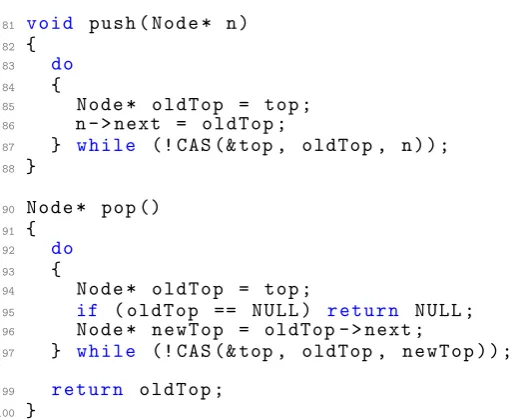
[image:25.595.101.361.132.342.2]100 }
Figure 2.6: ABA prone implementation of a lock-free stack using CAS.
to back to A again. If the first thread then reads the memory location again and observes the value A, it could incorrectly infer that the memory location had not changed between the two reads. This is what gives rise to the name ABA. CAS is particularly susceptible to the ABA problem when it compares its expected value with
the memory location.
The problematic side to this is that assumptions based on this value having not
changed may no longer be true. The ABA problem was first reported in reference
to the CAS instruction on the IBM System/370 [IBM 1983]. When CAS is used to
implement a naive list-based stack, the pop()function suffers from the ABA problem
(Figure 2.6). Take the example that the initial stack contains at least two objects: A at the top andB the next object in the stack. A thread performing a pop()operation is preempted before the CAS at line 97 occurs. Before it is resumed, another thread
pops both A and B off the stack, and then pushes A back on. When the first thread continues executing, the CAS expecting to see A on top of the stack will succeed and
incorrectly make B the new top of the stack. This is incorrect and can cause further
problems ifB’s memory has been reclaimed and/or reused for some other purpose.
The report that first identified the ABA problem also proposed a simple solution.
Each ABA prone field which is to be modified with CAS must also have an adjacent
16 CHAPTER 2. BACKGROUND
prone field using DWCAS. If the ABA sequence occurs and a DWCAS is attempted
which depends on the memory location having not changed, the modified tag value will
cause it to fail and the program can proceed to handle that. In theory, LL/SC should
avoid the ABA problem in these situations because SC will fail if any change is made
to the memory location read by LL but because LL/SC is mostly used to implement
CAS (again, due to the restricted implementations of LL/SC), it will encounter the
same instances of the ABA problem.
2.2
Desirable properties
This section discusses some desirable properties of concurrent algorithms which make
it easier to reason about the performance characteristics, correctness and behaviour of
concurrent operations.
2.2.1 Non-blocking property
A non-blocking property defines a level of progress guarantee for algorithms in the face
of thread stalls and concurrency conflicts. It is at odds with mutual exclusion which
generally means that no progress is made or useful work is done by threads waiting for
a lock to become free.
2.2.1.1 Obstruction-freedom
Obstruction freedom is the weakest of the three levels of non-blocking properties and
the most recently defined [Herlihy et al. 2003a]. It guarantees that in the case there are
n threads operating on a shared object, if anyn-1 threads are suspended the remaining thread will complete its operation in a bounded number of steps. Obstruction freedom
is considered the simpler non-blocking property to adhere to and it can be reasoned
that the overhead would be minimal when the chance of conflicts is low. It is often
implemented by allowing threads to abort and roll back operations which were started
by other threads in an attempt to complete their own operations. While this level of
non-blocking behaviour eliminates deadlock, it is still susceptible to livelock because it
allows for the situation where concurrently executing threads make no progress toward
2.2.1.2 Lock-freedom
Lock-freedom3 is a superset of obstruction-freedom, offering the stronger guarantee
that for any finite number of threads concurrently operating on a shared object, at
least one thread will make overall system progress. In order to achieve this, the usual
approach is to ensure information is made available to all threads so that they may
cooperate in the completion of each others operations. Even in the event that all
threads have conflicted and are all cooperating in the processing of the same operation,
the guaranteed completion of this operation means system throughput will be achieved.
Careful consideration must be made to the design of these ‘helping’ algorithms because
help can potentially be given at any time after the attempted operation has been made
visible, even after it has run its course. The design must ensure that this can have no
unintended effect on the concurrent object, such as successful CAS operations on ABA
prone fields. While progress is guaranteed for at least one thread (meaning livelock is
eliminated), individual threads can still suffer from starvation if, for example, they are
endlessly helping other operations.
2.2.1.3 Wait-freedom
Wait-freedom is the strongest non-blocking property, guaranteeing that every thread
concurrently executing on a shared object will complete its operation in a finite number
of steps. Wait-free algorithms are generally considered more difficult to write than other
non-blocking equivalents and often carry a significant overhead in space requirements
and/or sequential execution throughput. Because of this, wait-free algorithms tend to
find more use in real-time systems where their guaranteed response times are required.
The time guarantees of this type of non-blocking property mean that it is immune to
thread starvation.
2.2.2 Linearisability
Linearisability is a correctness condition for concurrent objects, proposed by Herlihy
and Wing [1990]. An operation is defined as being linearisable if it appears to take effect
instantaneously at a point between its invocation and response. This can be viewed
3
18 CHAPTER 2. BACKGROUND
as similar to performing updates on a data structure which is protected by mutual
exclusion lock – other threads attempting to access the data structure must wait for
the lock to become free and can never observe it in a mid-update state. By ensuring
linearisation points exist for the concurrent operations which can affect a shared object,
it is possible to mirror the behaviour of the sequential definition of the object which
makes it easier to reason about. For any possible concurrent execution, the absolute
ordering of the linearisation points can be viewed as a sequential history which matches
the expected outcome of serially executing the operations. This vastly simplifies the
interactions that can occur between concurrent threads and makes algorithms more
intuitive from a practical point of view.
2.2.3 Disjoint-access parallelism
Disjoint-access parallelism means that two threads can operate on separate sections of
the same data structure without interfering with each other and do not have
dependen-cies on any common set of objects. This means that disjoint-access parallel algorithms
allow for greater levels of parallelism through reduced contention on shared memory
locations. A simple example of disjoint-access parallelism is two threads operating
at either end of a concurrent linked list – each can operate in isolation of the other
provided the list is not empty.
2.3
Related work
2.3.1 Universal techniques
Initially, a series of universal techniques are introduced which are designed to make it
easier to design non-blocking data structures. These techniques are designed such that
they can be applied in a wide variety of circumstances, generally to convert existing
sequential data structures to a concurrent non-blocking form.
2.3.1.1 Root swapping
Herlihy [1990, 1993] was the first to propose a universal method to convert a sequential
data structure to a concurrent lock-free or wait-free version. For small structures, a
– to which the updates are then applied. The single root pointer to the data structure
is then atomically modified to point to the private updated version using CAS, which
will succeed if the structure had not been updated since the copy was made. This
algorithm serialises all updates at a single point, the root pointer, so disjoint access
parallelism is precluded. For larger objects, however, the cost of creating a local copy
of the data structure could become substantial, making this method impractical. For
larger structures (which are defined as being a collection of linked objects) Herlihy
suggests only copying the parts of the structure which are being updated in order to
reduce the memory and copy overhead. This may not have a substantial impact of the
number of objects to be copied, however, as replacing a linked object requires updates
to all the objects that link to it, so they must also be copied and replaced, and then
the objects linking to those must be replaced also, and so on.
2.3.1.2 Cooperation descriptors
Turek et al. [1992] described a technique for replacing locks in a deadlock free
lock-based algorithm, in order to make it lock-free. To perform a concurrent update, first, the
sequence of instructions that would have been performed – had a lock been acquired –
is converted to a sequence of virtual instructions. These are stored in a descriptor along
with a virtual program counter and a version counter. A pointer to the descriptor is then
stored in the same object that would be locked in the original lock-based algorithm – a
null value here representing an unlocked state and a pointer value representing a locked
state. The thread then begins processing the virtual instructions, but, if another thread
encounters a descriptor stored in one of these locations, it must assist in processing the
list of virtual instructions before it can continue and acquire the object with its own
update operation. After each virtual instruction is decoded and executed, a DWCAS is
used to update the virtual program counter and version counter. This technique doesn
not disallow disjoint access parallelism, but it is likely that the emulation required to
fetch, decode and execute the sequence of virtual instructions is expensive in comparison
to updating the structure with atomic instuctions.
Barnes [1993] independently defined a very similar technique to that of Turek,
Shasha and Parkash, where locks are replaced with pointers to descriptors containing
sequences of virtual instructions that must be interpreted and executed. But he goes on
to refine the design into a simpler form. Updates to individual objects are serialised via
20 CHAPTER 2. BACKGROUND
a sequence of updates being applied to the data structure, during which time the object
must not be concurrently updated. When a thread is attempting to update the shared
data structure, it makes private copies of the objects affected and performs its operation
on these. The copies are then validated by rereading and verifying that no updates have
happened to the affected objects since the copies were made, otherwise it must restart.
The thread attempts to acquire exclusive access to each of the objects to be updated by
copying a pointer to a descriptor describing the sequence of updates into them, ordering
the acquisitions in such a manner as to avoid livelock. If successful, it will go ahead
to perform the updates on the shared data structure and then remove the descriptor
pointers. If another ongoing operation is encountered on a required object, the thread
must first cooperate by processing the updates listed in its descriptor and release the
object before it can continue. Because threads will assist in each others’ operations
before reattempting their own, throughput of updates is guaranteed but the algorithm
as described requires nested LL/SC (in order to acquire access to each of the objects
and ensure no concurrent updates occurred) which has not been implemented on any
hardware.
2.3.1.3 Multiple CAS
Multiple CAS (MCAS) (sometimes called CASn) is an operation that executes CAS
on n memory locations atomically for some bounded value of n. The MCAS interface
takes in an array of CAS tuples comprising a memory location, an expected value,
and the new value to write. It is not available in hardware on any known CPU but a
software emulated MCAS typically allows for simpler implementations of lock-free data
structures [Fraser 2003] at the cost of poorer performance compared with lock-free
implementations of specific data structures.
Israeli and Rappoport [1994] presented a design for MCAS built using nestable
LL/SC. Because nestable LL/SC is typically not available, a software implementation
is provided based on DWCAS. Each location that is accessed using MCAS is required to
have an adjacent bitmask field, comprising a bit for each thread accessing the structure.
When attempting an MCAS, a thread copies all the CAS tuples into a globally readable
structure also containing an operation state defining whether the MCAS is in progress,
successful, or failed. Once all of the locations have been acquired in order and verified
to contain the expected values, the operation can be considered successful and can
atomically setting a bit in the bitmask and verifying the expected value at the memory
location. Acquisition can fail if either the location does not contain the expected
value, in which case the operation must be rolled back and restarted, or it contains
a set bit from another thread, in which case it must assist in completing the other
thread’s MCAS before continuing with its own. This can be considered an extension
of cooperation descriptors and is required to make the design lock-free. This MCAS
design limits the amount of concurrent MCAS operations that can occur to the number
of bits that can be contained in the bitmask and its reliance on the emulated nestable
LL/SC typically makes it inefficient. Anderson and Moir [1995] extend the basic design
of Israeli and Rappoport to create a wait-free implementation that instead requires
O(log(n)) bits per MCAS-able location wherenis the maximum number of concurrent
MCAS operations.
Harris, Fraser and Pratt [Harris et al. 2002; Fraser 2003; Fraser and Harris 2007]
presented the first practical implementation of MCAS, requiring single-word CAS and
up to two bits per memory location. First, a conditional CAS (CCAS) operation
type is described. The specification of this operation is that a compare-and-swap will
occur if another memory location is atomically verified to contain some value, or it
could also be considered a double compare and single swap. This is implemented by
creating a descriptor to contain the variables necessary to perform the CCAS: the two
addresses, the two expected values and the single value to swap. A pointer to the
descriptor is CASed into the memory location to be updated if the expected value is
seen. Then the compare-only address is compared to the other expected value and if
they match, another CAS is used to remove the pointer to the descriptor and swap
it with the updated value. The MCAS operation is then constructed as follows: the
list of locations and values to be CASed is copied into a descriptor, also containing a
status value indicating whether the operation is ongoing, successful or failed. CCAS
is used to copy a pointer to the MCAS descriptor into each memory location to be
MCASed, conditional on the MCAS operation being in the ongoing state. This stops
cooperating threads from performing incorrect work by acquiring memory locations
on behalf of a completed MCAS. Some operations are described to distinguish between
pointers to descriptors and the data stored in MCASable memory locations. A run time
type identification (RTTI) system could identify the object type, but not all languages
support this. Alternatively, two bits could be reserved in each memory location as
flags to describe the object type – or a single bit for both types – storing additional
type information inside the descriptors (this technique is described in more detail in
22 CHAPTER 2. BACKGROUND
2.3.1.4 Transactional memory
In order to simplify the software design of non-blocking concurrent data structures,
Herlihy and Moss [1993] introduced the concept of a Transactional Memory (TM).
A TM allows more complex concurrent operations to be composed without worrying
about the synchronisation of the underlying objects being accessed. The high level
operation of a transaction is that it comprises a series of instructions executed by a single
thread. Transactions appear to execute serially, as if successive transactions began after
the previous transaction committed, and they are never affected by interleaving with
other transactions. As a transaction executes, it makes tentative changes to shared
memory locations it needs to update. These are not visible to other threads unless
the transaction commits at which point all the updates become visible instantaneously.
Envisioned as existing in hardware (HTM), it could be implemented as a per-CPU
cache along with some new transactional instructions. Normal reads and writes are
replaced with transaction versions which load the memory locations exclusively in the
transactional cache or make changes directly in the cache. Successfully committing the
transaction makes the data in the transactional cache available to other CPUs and the
transactional cache lines are then considered the most up to date version of the data.
Aborting the transaction causes the contents of the cache to be invalidated. Competing
transactions requesting any of the same memory locations must have their conflict
resolved by some other mechanism in order to avoid livelock and deadlock. HTM can
be considered an extension of strong LL/SC working on multiple memory locations.
The first availability of HTM in a commodity CPU is expected in the upcoming Intel
Haswell microarchitecture [Intel].
Shavit and Touitou [1995, 1997] presented Software Transactional Memory (STM)
as a means to emulate the functionality of HTM. Their implementation is somewhat
restrictive, however, as the memory locations to be operated on during a transaction
must be known in advance. It relies on using nestable LL/SC to acquire the
transac-tional memory locations but suggests implementing this with DWCAS given its lack
of support in hardware. They diverge from the cooperative methodology of Barnes –
which can cause redundant recursive helping – and suggest aborting contending
trans-actions rather than helping. An aborted transaction would then help the transaction
that caused it to abort before retrying, maintaining the lock-free property. Less
restric-tive implementations have been developed by Fraser and Harris [Fraser 2003; Fraser
and Harris 2007] (building on their MCAS design) and Herlihy et al. [2003b]. These
101 v o i d a d d H e a d ( N o d e * n e w N o d e ) 102 {
103 newNode - > p r e v = N U L L ;
105 a t o m i c 106 {
107 if ( h e a d != N U L L ) 108 {
109 newNode - > n e x t = h e a d ; 110 head - > p r e v = n e w N o d e ; 111 }
112 e l s e 113 {
114 newNode - > n e x t = N U L L ; 115 t a i l = n e w N o d e ;
116 }
118 h e a d = n e w N o d e ; 119 }
[image:33.595.98.286.114.321.2]120 }
Figure 2.7: Function to add a node to the head of a doubly-linked list. An atomic block is used so that threads which concurrently execute the function do not see the list in an intermediate state.
number of memory locations. They are also implemented directly using CAS.
Transactional memory enables significantly more straightforward atomic
modifi-cation of data structures. Existing sequential algorithms can be adapted to make use
of the ‘atomic block’ syntax to create lock-free concurrent algorithms without needing
to make use of low-level atomic primitives directly. Figure 2.7 shows a function which
adds a node to the head of a doubly-linked list and has been adapted to a concurrent
form using an atomic block. The sequential implementation has its reads and writes
to shared memory wrapped in the atomic block to enable concurrent execution via the
transactional memory, avoiding a complicated and involved lock-free implementation
built from CAS.
2.3.1.5 Performance
Fraser and Harris [Fraser 2003; Fraser and Harris 2007] performed detailed analyses
of the performance characteristics of their MCAS and STM systems compared with
lock-based and non-blocking algorithms. For large concurrent skip lists, their results
show that CAS and MCAS based designs outperform those using STM due to the high
overhead of STM operations versus the simpler accesses of CAS and MCAS. A
24 CHAPTER 2. BACKGROUND
implementations. When a smaller skip list structure was used, MCAS performance fell
below that of the lock-based algorithms, while CAS still performed the best.
A binary search tree algorithm built using MCAS was compared to lock-based
al-gorithms and was shown to outperform them when the set size is large. But, again,
con-tention at smaller structure sizes caused it to suffer. STM performance when applied to
a red-black tree was compared with lock-based designs which required either extensive
locking or whole-structure locking due to the complexity of the red-black specification.
STM was found to perform significantly better with higher levels of concurrency. The
conclusion gathered from these experiments was that, from a programming perspective,
it is simpler to design algorithms using STM than it is with MCAS and, similarly, it
is simpler to design algorithms using MCAS than it is with CAS. In terms of run time
performance, however, the algorithms built using CAS performed the best at both low
and high contention levels. MCAS performed similarly to CAS at low contention but
suffered at higher contention and STM tended to only perform better than RW locks.
2.3.2 Data structures
The following section reviews concurrent implementations of a number of common
dy-namic data structures including the current state of the art. These algorithms are
implemented directly using hardware synchronisation primitives rather than the
uni-versal constructions mentioned in the previous section.
2.3.2.1 Stacks
Treiber [1986] described a very straightforward algorithm for a lock-free LIFO stack
based on a singly linked list. Because stacks are only effected at one single point, a
stack can be simply controlled by ensuring modifications to its top are made using
CAS. Pushing a node onto the stack is done by first linking the node to the current
top node, then using CAS to update the stack head pointer to point to the new node.
Similarly, popping a node is done by using CAS to update the head pointer to point
to the next node after the node it is currently pointing to. Treiber also identified that
this approach is susceptible to the ABA problem during popping and suggested adding
2.3.2.2 Queues
Treiber [1986] presented a lock-free queue algorithm for the IBM System/370 based on
a linked list and using tagged pointers. Enqueuing elements is done with a single-word
CAS at the front of the list, but in order to dequeue an element, the entire queue must
be traversed and the last element removed with a DWCAS. Treiber acknowledged the
performance penalty of doing this when the queue is large and suggests an approximate
FIFO algorithm as an alternative. In this design, the queue is essentially treated as two
LIFO stacks. Enqueuing elements happens by adding them to the top of the enqueue
stack. A dequeuing thread removes the entire list of added elements from the enque
stack, reverses the order and adds them to the front of a dequeue stack. Any other
dequeuing threads can then remove the first element from the dequeue stack if it is not
empty, otherwise they must transfer another portion of the enqueue stack. A thread
reordering a chain of queued items could be considered blocking here since other threads
cannot access the elements in the chain until they are placed on the dequeue stack.
Another list-based queue described by Prakash et al. [1994] maintains pointers to
both the head and tail of the queue in order to allow more efficient queue operations.
A consistent snapshot of the head and tail must be acquired before any updates can be
applied in order to determine the state of any concurrent operations. These must be
helped to complete before the thread can progress. Head, tail and next pointers are all
tagged in order to deal with the ABA problem. Enqueuing nodes happens at the tail
and requires one DWCAS to add the new node to the back of the queue and a second
DWCAS to swing the global tail pointer. Dequeuing is a much simpler operation and
is performed at the head as per a LIFO stack with a single DWCAS.
Valois [1994] presented a simplification to Prakash, Lee and Johnson’s queue by
keeping the most recently dequeued item at the head of the list-structure making the
next node in the list the logical queue head. This greatly simplifies the number of special
cases that must be dealt with (when the queue is empty or contains one element) and
eliminates the need for obtaining a snapshot of the head and tail before an operation
can progress. Because of the ordering of adding a new node into the queue and then
updating the tail pointer, it becomes possible for the tail pointer to lag behind the
head pointer. This could break the queue if the node pointed to by the tail pointer was
then reclaimed. This issue, and avoidance of the ABA problem occurring at the head
and tail (which are updated with a single-width CAS), are dealt with by implementing
26 CHAPTER 2. BACKGROUND
condition, this was corrected later by Michael and Scott [1995]. In testing of their own
queue algorithm [Michael and Scott 1996], they also identified a case where the memory
requirements of Valois’ queue could become unbounded. If a thread dequeues a node
and stalls while still holding a pointer to the node, that node and every node linked
after it (which is every node enqueued since the thread stalled) cannot decrease their
reference counts and cannot be reclaimed.
The queue presented by Michael and Scott [1996] represents a safer version than
that presented by Valois. The tail pointer can lag, at most, one step behind the end
of the queue which ensures that the tail node cannot be dequeued. This avoids the
issue by which the node currently pointed to by the tail pointer can be reclaimed. In
order to remove the issue where memory use could be unbounded, they make the head,
tail and the queue links tagged pointers (which get updated with DWCAS) and store
removed nodes on a freelist. Michael [2002b] later did away with the need for tagged
pointers using his SMR memory management system.
Ladan-Mozes and Shavit [2004] focussed on reducing the cost associated with
using at least two CAS operations to enqueue a node. As a CAS requires memory
barriers, requires exclusive cache line access, and flushes the processor’s write-buffer;
they state that a simple store can be done an order of magnitude faster. At a structural
level, they reverse the order of the linked list so that nodes can be enqueued with a
single CAS at the head of the list. This means that when dequeuing a node, it would
not be able to see the previous node in the list, therefore the list is made
doubly-linked. The normal next pointers are guaranteed to maintain a correct structure and
the previous pointers are optimistically set with a store when a node is enqueued. If
a thread is delayed or stalled before writing the previous pointer and the tail of the
list catches up, the dequeuing operation must walk the length of the queue, fixing any
inconsistent previous pointers along the way. In order to simplify the cases where the
queue is empty or has a single element, if the last element is removed, a dummy node is
enqueued to retain the list structure. This dummy node is skipped over if encountered
by any dequeuing operation. Tagged pointers are used in order to avoid the ABA
problem and to test for consistency in the optimistically set previous pointers.
2.3.2.3 Linked lists
Concurrently adding new nodes into to an ordered linked list is a simpler operation
another thread attempts to perform a concurrent insertion at the same point in the
list, its CAS will fail when it finds the node’s next pointer has changed. Considering
a sequential implementation of a linked list for a moment, removing a node is usually
completed with a single write – updating the next pointer of the predecessor node to
point to the successor node. This technique cannot be directly applied to a concurrent
implementation due to a race condition between one thread updating the next pointer
of the predecessor and another thread updating the next pointer of the node to be
removed. If the second thread concurrently inserts a node positioned directly after
the removed node, it will assume the operation succeeded but the inserted node will be
inaccessible. Alternatively, if a concurrent operation succeeds in removing the successor
to the removed node from the list, the successor node will be incorrectly reintroduced
to the list structure. Along with violating the specification of the linked list, this second
case can cause further problems if the successor node was then reclaimed.
The first effective design of a lock-free linked list is credited to Valois [1995]. His
design places intermediate ‘auxiliary node’ objects in between the logical nodes in the
list. The auxiliary nodes act as a layer of indirection between successive nodes and
simplify concurrent interactions between competing operations. Removals from the list
can then be safely performed by joining two auxiliary nodes together, but this can then
allow chains of auxiliary nodes to form. Each node also contains a backlink pointer to
the previous valid node when it is removed to aid in the removal of its chained auxiliary.
Harris [2001] presented a solution to implementing a lock-free linked list by
per-forming the node removal operation in two stages. The first stage is to ‘mark’ the next
pointer of the node to be removed. This process leaves the pointer data intact but
it signals that this node’s key is now logically removed from the list. It also prevents
concurrent updates to the node because by changing the data contained in the next
pointer, any CAS expecting the unmodified pointer data will fail. The second stage is
the same as for the sequential list, where the node is physically excised from the list.
Concurrent operations can safely traverse over these marked nodes by decoding the
pointer data and moving on. But, if there is a conflict, that thread must first assist in
the removal of the marked node before it can attempt its own operation.
The manner in which the pointers are marked makes use of the fact that when
memory is allocated, the memory address returned will be aligned on a boundary
matching at least the size of a register4. This means that the least significant bits of
4
The POSIX standard guarantees pointer alignment will be a power of two multiple of
28 CHAPTER 2. BACKGROUND
a pointer are guaranteed to be zero and so can be used to store auxiliary data (in this
case a bit to signify a marked state) – provided they are properly masked away when
the value needs to be treated as a pointer.
Michael [2002a] refined the design of Harris’ linked list algorithm in order to make
it better compatible with general memory management methods. He also provided
specific implementations supporting IBM freelists [IBM 1983; Treiber 1986] as memory
management (using tagged pointers) and his own Safe Memory Reclamation (SMR)
method. These changes require forcing traversals to remove marked nodes encountered
on the search path as they progress.
Another extension to the Harris and Michael algorithms was presented by Fomitchev
and Ruppert [Fomitchev 2003; Fomitchev and Ruppert 2004]. Their modification
in-volves converting Harris’ two-step removal to a three-step process. The predecessor
node first has its next pointer flagged using another low-order bit to avoid concurrent
updates, then the node to be removed has a backlink pointer set to the predecessor and
it is marked. The final stage is to physically excise the node from the list. The
non-blocking property is maintained because threads observing flagged or marked nodes
can help the operation to complete. The motivation behind this modification is to
reduce the penalty of failing to successfully help an observed operation. In the Harris
and Michael algorithms this would cause the operation to restart its traversal from
the head node, but this algorithm allows the backlink pointers to be followed until an
unmarked node is reached.
Heller et al. [2005] argue that most accesses of concurrent sets would be
mem-bership tests and therefore having a wait-free and read-only version of this method is
preferable, at the cost of not having non-blocking updates. Traversals progress without
acquiring any locks, but a physical insertion or removal requires blocking updates to a
node and its predecessor.
2.3.2.4 Deques
Most of the early lock-free deque (double-ended queue) implementations [Greenwald
1999; Agesen et al. 2000; Detlefs et al. 2000] rely on double compare-and-swap (DCAS
or also called CAS2). Double and-swap differs from double-width
compare-and-swap because it can operate on two non-contiguous memory locations as opposed
to being restricted to two adjacent memory locations. DCAS is supported by certain
members of the Motorola 68000 family of processors but is currently not available on any
modern processor. In the literature, its implementation was considered slow [Greenwald
and Cheriton 1996] therefore designs that could work around a DCAS requirement were
preferred. Doherty et al. [2004] argued that supporting DCAS in hardware could not
be justified as it does not provide enough additional flexibility over CAS.
Michael [2003] provided the first list-based lock-free deque algorithm that can
be implemented efficiently on modern hardware. The nodes are stored internally as
a consistent doubly-linked list. The anchor point of the deque stores both the front
and back pointers in a single block so they are always updated together along with
some state information. This allows the algorithm to have a clear linearisation point
for all operations, but means that it is not disjoint access parallel when operations are
acting on different ends of the deque. Modifying both pointers in a single operation
requires DWCAS, but Michael also describes a statically sized deque that is allocated
from a single block of memory. This would allow more redundant bits of a pointer to be
repurposed, enabling the anchor to be packed into a single word and to be updated with
CAS. Dequeuing nodes from either end of the deque can be done with a single atomic
operation, by moving the front or back pointer along one node, however, enqueuing
must be done in two stages. The first stage is that the new node is linked into the
list structure and the anchor pointer is updated to point to it. When the anchor is
updated, a state bit is also set to signify to other threads that the list structure must be
made consistent before the operation can be cleared and the next operation can occur.
This is because the list structure could be broken if a concurrent enqueuing operation
also linked its node into the list, in which case CAS is used to repair the link. Once
this has been verified, the anchor is atomically updated again to remove the state flag
and allow the next operation to proceed.
Sundell and Tsigas [2004b, 2008] proposed a deque algorithm that is similarly
based around a doubly-linked list but with physically separate sentinel head and tail
nodes in order to allow disjoint access parallelism when operations access opposing ends
of the deque. The consistency of the list is maintained in a single direction only, using
the linked list design of Harris [2001]. The previous pointer in a node is only updated
once the change has succeeded on the next pointer. To enqueue a node, its links are
initialised and CAS is used to link it into the next chain of the list. Then a further CAS
is used to link it into the previous chain. Dequeuing nodes is similar, the next pointer of
30 CHAPTER 2. BACKGROUND
K
R
K
K
R
R
K
K
K
K
K
K
K
K
K
H
E
A
D
K
K
K
K
K
K
K
R
R
R
R
R
R
R
R
R
R
R
K
K
K
K
K
K
K
K
[image:40.595.91.464.117.282.2]T
A
I
L
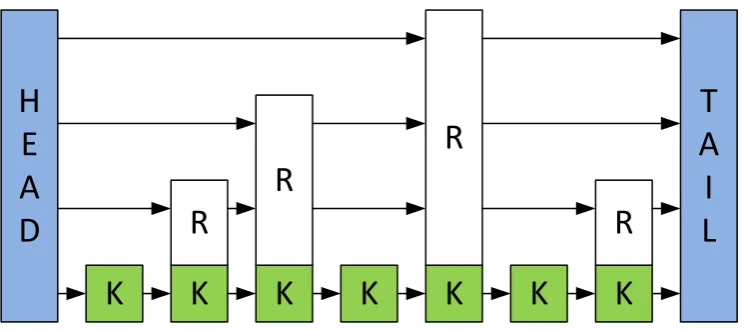
Figure 2.8: Structure of a skip list. Every key K in the skip list is present in the base level. The upper routing levels R allow for more efficient searches by skipping large portions of the list.
from the list structure then follows a similar pattern of using CAS to remove the node
from the next chain, and another CAS to remove it from the previous chain. Sometimes,
the previous links will not resemble the same structure as the next links if threads are
delayed or stalled while inserting or removing a node. If this state is encountered by
another thread, it must follow the links down the list until an unmarked node is found
and then repair the previous chain so that it mirrors the structure of the next chain.
This list structure was also extended [Sundell 2004] to allow adding and removing at
arbitrary points making it a complete lock-free doubly-linked list algorithm.
2.3.2.5 Skip lists
Skip lists were first presented by Pugh [1990b] as an alternative to balanced trees. The
structure of a skip list is that of multiple levels of linked lists where every element in
the data structure is present in the base level and for every level that a node is present
in, it is probabilistically present in the next higher level up to some maximum level
(Figure 2.8). This allows searches to use these higher levels of links to ‘skip’ over large
chunks of the base level list during a traversal. The randomised nature of the skip
levels makes the structure probabilistically balanced giving it an averageO(log n)time complexity for locating a node so they are often used in place of binary search trees.
![Figure 2.1: Demonstration of false sharing. tls.locals[concurrent reader and writer thread with thread IDs in the range 0 tostored in the same cache line where0...k − 1] is assumed to be k is the number of ints in a single cache line](https://thumb-us.123doks.com/thumbv2/123dok_us/1378960.671739/21.595.102.357.112.369/figure-demonstration-sharing-locals-concurrent-tostored-assumed-single.webp)