Analyzing models for semantic role assignment using confusability
Katrin Erk and Sebastian Padó Computational Linguistics
Saarland University Saarbrücken, Germany
{erk,pado}@coli.uni-sb.de
Abstract
We analyze models for semantic role assignment by defining a meta-model
that abstracts over features and learning paradigms. This meta-model is based on the concept of role confusability, is de-fined in information-theoretic terms, and predicts that roles realized by less specific grammatical functions are more difficult to assign. We find that confusability is strongly correlated with the performance of classifiers based on syntactic features, but not for classifiers including semantic features. This indicates that syntactic fea-tures approximate a description of gram-matical functions, and that semantic fea-tures provide an independent second view on the data.
1 Introduction
Semantic roles have become a focus of research in computational linguistics during the recent years. The driving force behind this interest is the prospect that semantic roles, as a shallow meaning represen-tation, can improve many NLP applications, while still being amenable to automatic analysis. The benefit of semantic roles has already been demon-strated for a number of tasks, among others for ma-chine translation (Boas, 2002), information extrac-tion (Surdeanu et al., 2003), and quesextrac-tion answer-ing (Narayanan and Harabagiu, 2004).
Robust and accurate automatic semantic role as-signment, a prerequisite for the wide-range use of semantic roles in NLP, has been investigated in a
number of studies and shared tasks. Typically, role assignment has been modeled as a classification task, with models being estimated from large cor-pora (Gildea and Jurafsky, 2002; Moschitti, 2004; Xue and Palmer, 2004; Surdeanu et al., 2003; Prad-han et al., 2004; Litkowski, 2004; Carreras and Màrquez, 2005).
Within this framework, there is a number of archi-tectural parameters which lend themselves to opti-mization: the machine learning framework, the fea-ture set, pre- and postprocessing, each of which has been investigated in the context of semantic role as-signment. The current paper concentrates on feature engineering, since the feature set is a pivotal com-ponent of any kind of machine learning system, and allows us to incorporate and test linguistic intuitions on the role assignment task.
We approach feature engineering not by directly optimizing system performance. Instead, we pro-ceed byerror analysis, like Pado and Boleda (2004). Our aim is to form aglobal hypothesisthat explains the distribution of errors across classes. Insofar as the model does not contain model-specific infor-mation, following this methodology can provide a
meta-modelof a model family which abstracts over concrete features and over the learning paradigm.
The concrete global hypothesis we test is: (1) All features of current models approximate a descrip-tion of grammatical funcdescrip-tions, and the complete sys-tems approximate an assignment based on grammat-ical functions. (2) System performance for a given role depends on how easily it is confused with other roles. We will give this concept ofrole confusability
a formal, information-theoretic definition.
The present study specifically analyzes mod-els for semantic role assignment in the FrameNet
paradigm (Fillmore et al., 2003). We are going to show that our hypothesis indeed holds for a variety of models – but only models that comprise exclu-sively syntactic features. We conclude that syntactic features approximate a description of grammatical functions, but that semantic features model a dif-ferent aspect of the role assignment mapping. To-gether with the reasonable performance of a solely semantics-based system, this leads us to suggest a closer investigation of semantic features – and in particular, a co-training approach with syntactic and semantic features as different views on the role as-signment data.
Plan of the paper. In Section 2, we give a brief introduction to FrameNet, the semantic role paradigm and corpus we are using in this study. Our first experiment, described in Section 3, establishes that there is a high variance in performance across roles, and that this variance is itself stable across models and learners. In Section 4, we state our hy-pothesis, namely that this variance can be explained through role confusability, and formalize the con-cept . In Section 5, we perform detailed correlation tests to verify our hypothesis and discuss our find-ings. Section 6 concludes the paper.
2 FrameNet
This section presents the semantic role paradigm and the role-annotated corpus on which the present study is based. FrameNet1 is a lexical resource based on Fillmore’s Frame Semantics (Fillmore, 1985). It de-scribesframes, representations of prototypical situa-tions. Each frame provides its set of semantic roles, the entities or concepts pertaining to the prototypi-cal situation. Each frame is further associated with a set oftarget predicates (nouns, verbs or adjectives), occurrences of which can introduce the frame.
FrameNet provides manually annotated examples for each predicate, sampled from the British Na-tional Corpus (Burnard, 1995). The size of this cor-pus exceeds 135,000 sentences. The following sen-tences are examples for verbs in the IMPACTframe, which describes a situation in which typically “an IMPACTORmakes sudden, forcible contact with the IMPACTEE, or two IMPACTORS both ... [make] forcible contact”:
1http://www.icsi.berkeley.edu/~framenet/
(1) [Impactee His car] was struck [Impactor by a
third vehicle].
(2) [ImpactorThe door]slammed[Resultshut].
(3) [Impactors Their vehicles] collided [Place at
Pond Hill].
FrameNet manual annotation also comprises a layer of grammatical functions: For example, the subject of finite verbs is labeled Ext, and Mod is a label used for modifiers of heads, e.g. an adjective mod-ifying a noun. The grammatical functions used in FrameNet are listed in Fillmore and Petruck (2003). Note that the frame-specificity of semantic roles in FrameNet has important consequences for seman-tic role assignment, since there is no direct way to generalize role assignments across frames, and learning has to proceed frame-wise. This com-pounds the data sparseness problem, and automatic assignment for frames with no training data is very difficult (Gildea and Jurafsky, 2002).
3 Experiment 1: Variance in role assignment
Several studies have established that there is con-siderable variance in semantic role assignment per-formance across different semantic roles within sys-tems (Carreras and Màrquez, 2004; Carreras and Màrquez, 2005; Pado and Boleda Torrent, 2004). However, these studies used either the PropBank semantic role paradigm (Carreras and Màrquez) or a limited of experimental conditions (Pado and Boleda). For this reason, we perform a first experi-ment to replicate this phenomenon in our setting.
Note that the vast majority of participant sys-tems in recent shared tasks divides semantic role as-signment into multiple sequential steps. The max-imal decomposition is as follows: preprocessing, e.g. removal of unlikely argument candidates; ar-gument recognition, the distinction between role-bearing and non-role-role-bearing instances; argument labeling, the actual classification of role-bearing in-stances; andpostprocessing, e.g. by inference over probable role sequences.
from non-roles. This is justified by earlier empiri-cal results, namely that the argument labeling step requires more training data than argument recogni-tion (Fleischmann and Hovy, 2003), and that it calls for more sophisticated feature construction (Xue and Palmer, 2004). We take this as evidence that the quality of the argument labeling step is central to a good semantic role assignment system.
In order to isolate the effects of argument label-ing, we assume perfect argument recognition by us-ing gold standard role boundaries; however, we do not use gold standard parse trees, but rather automat-ically computed ones, which realistautomat-ically introduces some noise (see the following paragraph).
Data and preprocessing. As experimental mate-rial, we used the same data that was used in the Senseval-3 semantic role assignment task: 40 frames from FrameNet version 1.1, comprising 66,777 in-stances. The number of roles per frame ranged from 2 to 22, and the number of role instances ranged from 593 to 8,378. The data was randomly split into training (90%) and test instances (10%).
The data was parsed with the Collins model 3 (1996) parser; in addition, all tokens were lemmatized with TreeTagger (Schmid, 1994).
Modeling. We model role assignment as a clas-sification task, with parse tree constituents as in-stances to be classified. We repeated the classifica-tion with two different learners: The first learner, TiMBL (Daelemans et al., 2003) is an implementa-tion of nearest-neighbor classificaimplementa-tion algorithms in the memory-based learning paradigm2. The second learner, Malouf’s probabilistic maximum entropy (Maxent) system (Malouf, 2002), uses the LMVM algorithm to estimate log-linear models. We did not perform smoothing.
Table 5 shows the features we use. Here as in the system setup, we keep close to current existing mod-els for semantic role assignment in order to make our results as representative as possible. We investigate different feature sets in order to verify our results. In Exp. 1, we limit ourselves to two feature sets, Syn
(syntactic features) andSem (lexical features) from the bottom of Table 5. The feature sets were exactly the same for both learners.
2TiMBL was set tok-NN classification, using the MVDM distance metric and 5 neighbors.
[image:3.612.351.500.55.88.2]Syn/Sem Syn MBL 87.1±12.7 82.2±17.8 Maxent 87.5±13.4 82.4±18. 2
Table 1: Exp. 1: Overall results (F-scores and stan-dard deviation across roles).
Syn/Sem Syn
Role FMBL FMaxent FMBL FMaxent
Frame: CHANGE_POSITION_ON_A_SCALE
ATTR 79.0 80.7 57.6 66.1
CO_VAR 55.6 64.0 22.2 31.6
DIFF 87.1 84.9 75.0 66.7
ITEM 68.6 70.3 48.0 61.3
VALUE_1 88.0 91.7 78.3 72.7 VALUE_2 93.3 90.9 89.3 85.2 Frame: KINSHIP
ALTER 87.0 89.2 87.8 87.4
EGO 96.7 98.8 96.7 95.5
Frame: PART_ORIENTATIONAL
PART 98.2 96.4 97.6 97.0
WHOLE 100 100 98.2 100
Frame: TRAVEL
AREA 31.6 52.6 25.0 45.5
GOAL 74.4 71.4 68.3 62.2
MODE 46.2 72.7 12.5 15.4
PATH 66.7 53.3 50.0 40.0
SOURCE 66.7 72.7 66.7 66.7
TIME 77.8 66.7 15.4 40.0
TRAVELER 90.9 90.6 90.9 90.6
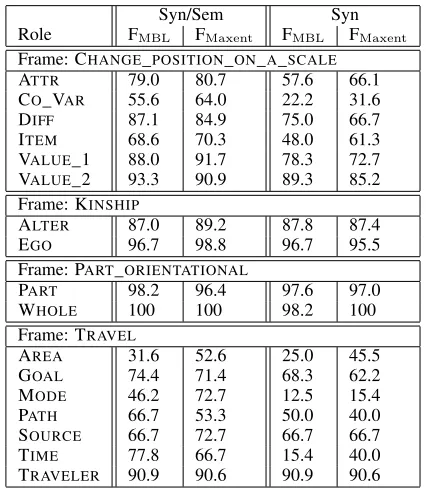
Table 2: Exp. 1: Role-specific figures of system per-formance for four example frames.
Results. Table 1 shows the systems’ overall F-scores and standard deviation across roles. Table 2 illustrates the differences in performance across roles on four frames: It lists all roles with≥ 5 oc-currences for each frame. PART_ORIENTATIONAL shows very little variance, while the roles of CHANGE_POSITION_ON_A_SCALEand especially TRAVEL differ widely. For KINSHIP, the system shows good performance for both roles, but the F-scores still differ by around 9 points.
[image:3.612.319.532.138.382.2]fr frame
fe role (frame element)
fes(fr) roles of a frame
gfs(fr) gramm. functions of a frame
gfsfr(fe) gramm. functions realizing a role in a frame
Table 3: Notation summary
4 A meta-model for role assignment: Confusability
The experiment of the previous section has shown a considerable variance in system performance across roles. The aim of this section is to develop a meta-model which can explain this variance.
The models we have explored in Exp. 1 rely mainly on syntactic features: Even in the combined syntax-semantics model, 24 of the 31 features de-scribe syntactic structure. This predominance of syntactic features can be observed in many current models for semantic role assignment. Accordingly, our meta-model focuses on the uniformity of the mapping from syntactic structure to semantic roles. We formalize the variance in this mapping by the
confusabilityof a semantic role. It implements the following hypothesis:
(1) The semantic role assignment systems we study approximate role assignment through gram-matical functions.
(2) System performance for a given role depends on the role’s confusability: A role is highly con-fusable if the grammatical functions that in-stantiate it often also inin-stantiate other roles.
By using the ideal, manually assigned grammat-ical functions that are available from the FrameNet data – and which are not passed on to the learner – our meta-model abstracts over concrete feature sets. Our definition of confusability proceeds in two steps. First we model the informativity of a gram-matical function by the entropy of semantic roles that it maps to. Then we compute the confusabil-ity of a role as a weighted average of the entropies of the grammatical functions that realize it.
Grammatical function entropy. Viewing a gram-matical function as a random variable with semantic
Grammatical function entropy
GF DEG THM DEP LOC H
Mod 69 43 24 0 1.46
Comp 18 491 12 41 0.72
Ext 0 17 0 561 0.16
Head 0 0 0 273 0.0
Obj 0 0 0 3 0.0
Role Confusability
Role Mod Comp Ext Head Obj Conf
DEG 69 18 0 0 0 1.31
THM 43 491 17 0 0 0.76
DEP 24 12 0 0 0 1.22
[image:4.612.317.539.52.207.2]LOC 0 41 561 273 3 0.16
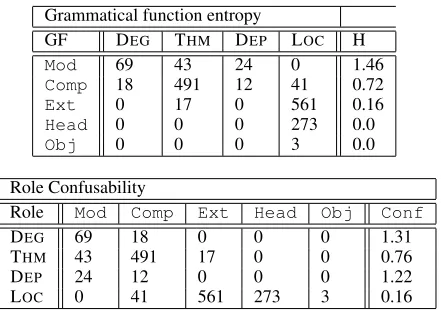
Table 4: Grammatical function entropy and role con-fusability for the frame ABUNDANCE
roles as values, we define the entropy of a grammat-ical functiongfwithin the framefras
Hfr(gf) = X
fe∈fes(fr)
−p(fe|gf) logp(fe|gf)
wherep(fe|gf) = f(gff(gf,fe)) is the conditional proba-bility of rolesfegivengf(cf. the notation in Table 3).
Role confusability. The confusability of a role is the sum of its grammatical function entropies, weighted by the conditional probabilitiesp(gf|fe) =
f(gf,fe)
f(fe) of grammatical functionsgfgivenfe.
cfr(fe) = X
gf∈gfs(fr)
p(gf|fe)Hfr(gf)
An example. Table 4 shows the grammatical func-tion entropies and role confusabilities for the frame ABUNDANCE, both computed on the training data. The upper part of Table 4 lists the entropies of the grammatical functions Mod, Comp, Ext, HeadandObj3 and the countsf(gf, fe) of occur-rences of the grammatical functions together with the roles DEGREE (DEG), THEME(THM), DEPIC -TIVE (DEP) and LOCATION(LOC). The entropy of
Mod, with similar numbers of occurrences for three different roles, is relatively high, whileExtoccurs almost exclusively for one role and has a much lower entropy. The lower part of Table 4 shows the confus-ability for the same set of roles. The confusconfus-ability of
DEGREE is relatively high even though it is mostly realized byModbecauseModhas a high entropy, i.e. it indicates multiple roles; LOCATION on the other hand is not very confusable even though it occurs frequently as bothExtandHead, since both gram-matical functions indicate this role.
Related work. Our approach is similar to Pado and Boleda (2004) in that they also use the unifor-mity of linking as an explanation for performance variations in semantic role assignment. However, their analysis is located at the frame level. We ex-amine individual roles, which allows us to derive a simpler and more intuitive formalization of linking uniformity. Also, our model will ultimately lead us to a different conclusion: the uniformity of linking is a good predictor of the performance of role as-signment systems, but only for exclusively syntactic models (see Section 5).
5 Experiment 2: Relating confusability and system performance
In this section, we test the validity of our meta-model. We assess whether confusability, defined in Section 4, can explain the variance in role assign-ment that we have found in Section 3, by testing the correlation between the two variables.
Experimental setup. We use the same data set (Senseval-3) and the same two classifiers (memory-based and maximum entropy classification) as in Exp. 1. To cover a wider range of models and thus increase the validity of our analysis, we split up the
Syn feature set from Exp. 1 into the four smaller sets described in the upper part of Table 5. We use these sets individually, combined, and together with the lexical features in theSemset. This results in a total of 20 different models (10 for each classifier), for which we computed role-specific F-scores.
In parallel, we estimated the confusability as de-scribed in Section 4, with FrameNet’s manually as-signed grammatical functions as a basis, using only the training portion of our data. We did not smooth, but omitted roles occurring less than 5 times to avoid sparse and thus unreliable data points. Re-call that confusability does not vary with the feature set, since its central asset is to abstract over concrete model parameters and feature sets.
Feature set FM BL FM axent
Path0 70.9 71.3
Path 73.3 72.6
Pt 78.8 79.0
Path/Pt 80.8 79.8
Path/Sibling 76.7 76.6 Pt/Sibling 78.8 79.1
Syn 82.2 82.4
Sem 80.3 80.7
[image:5.612.347.506.52.192.2]Syn/Sem 87.1 87.5
Table 6: Exp. 2: Results for different feature sets
Results. The F-scores for the subdividedSyn fea-ture set are shown in the upper part of Table 6, with the completeSyn andSem sets and their combina-tion below. There is a clear relacombina-tionship between features and F-score: additional features are consis-tently rewarded with higher performance. Interest-ingly, phrase type information appears to be a better role predictor than path (compare modelsPath and
Pt). Also, the semantic feature set alone (Sem) per-forms at over 80% F-Score, slightly better any of the individual syntactic feature groups.
The high F-score variance between individual roles which we have shown for the feature setsSyn
andSyn/Sem in Exp. 1 generalizes to the other fea-ture sets; all individual syntactic feafea-ture sets exhibit a higher variance thanSyn, andSem shows a higher variance than theSyn/Sem combination. This does not come as a surprise, since the two models of Exp. 1 use the two richest feature sets, and we would expect less robust behavior for weaker models. An-other point to note is that the performance of the two learners is remarkably similar.
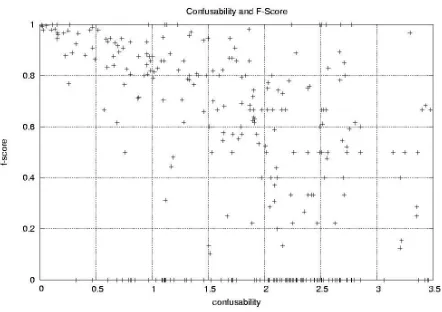
The high variance in the F-scores is mirrored in the confusability figures; we obtain an average con-fusability for our semantic roles of 1.79 with a high standard deviation of 0.84. A scatter plot of F-scores against confusability figures (Fig.1) suggests a linear correlation analysis.
confus-Path0 These are features centered around the path from the target lemma to the constituent: the path itself, its length, partial path up to the lowest common ancestor, the grammatical rule that expands the target predicate’s parent, relative position of constituent to target
Path Feature set Path, plus target lemma
Pt These are features related to phrase type and part of speech: the phrase type of the constituent and its parent, the POS of the constituent first word, last word and head as well as the POS of an informative content word of the constituent (for PP and SBar constituents only: the head of the head’s complement), as well as the target lemma
Sibling Phrase type and POS of the head of the left and right sibling constituent, and the Collins parser’s judgment on the argumenthood of the constituent
Syn This set combines Path, Sibling and Pt. Additional features are: target voice; the constituent’s preposition; a feature combining path with target voice and target POS; and two rule-based features judging argumenthood and grammatical function of the constituent
[image:6.612.71.537.51.286.2]Sem These are lexical features: Head words of the constituent and of its left and right siblings; leftmost and rightmost word of the constituent; informative content word lemma (see set Pt for details); and the governing verb of the target predicate
[image:6.612.294.539.317.472.2]Table 5: Feature groups used in the experiments
Figure 1: Scatter plot: F-score against confusability (Feature setSyn).
ability appears to be related to lower F-score. However, note that the correlation is extremely significant even for the model which only uses se-mantic features. This is unexpected at best and makes a strong interpretation of this correlation doubtful: it is rather likely that there is a third vari-able with which both F-score and confusability are correlated. The most obvious candidate for such a
confounding variableis the size of the training set – clearly, we expect our models to perform better with larger training sets. In order to get a more realistic
MBL MaxEnt
Feature set z p z p
Path0 -11.72 10−15 -11.76 10−15 Path -12.29 10−15 -11.23 10−15 Pt -10.64 10−15 -11.12 10−15 Path/Pt -11.19 10−15 -10.45 10−15 Path/Sibling -12.65 10−15 -11.76 10−15 Pt/Sibling -10.58 10−15 -9.90 10−15 Syn -9.47 10−15 -9.38 10−15 Sem -6.90 10−11 -8.23 10−15 Syn/Sem -8.30 10−15 -8.29 10−15
Table 7: Exp. 2, Analysis 1: Correlation between F-Score and confusability. z: Kendall’s tau coefficient, p: significance level
assessment of the relationship between confusabil-ity and F-score, we perform an additional analysis to disconfound confusability and frequency.
[image:6.612.77.298.324.480.2]MBL MaxEnt
Features rc rf rc rf
[image:7.612.73.301.53.209.2]Path0 -.29∗∗∗ -.03 -.29∗∗∗ -.03 Path -.30∗∗∗ -.02 -.27∗∗∗ -.07∗∗ Pt -.19∗∗∗ -.11∗∗ -.21∗∗∗ -.12∗∗ Path/Pt -.22∗∗∗ -.07∗ -.19∗∗∗ -.16∗∗∗ Path/Sibl -.31∗∗∗ +.01 -.28∗∗∗ -.06∗ Pt/Sibl -.20∗∗∗ -.10∗∗ -.18∗∗∗ -.16∗∗∗ Syn -.10∗ -.17∗∗∗ -.12∗ -.19∗∗∗ Sem +.01 -.27∗∗∗ -.02 -.24∗∗∗ Syn/Sem +.02 -.25∗∗∗ -.01 -.25∗∗∗
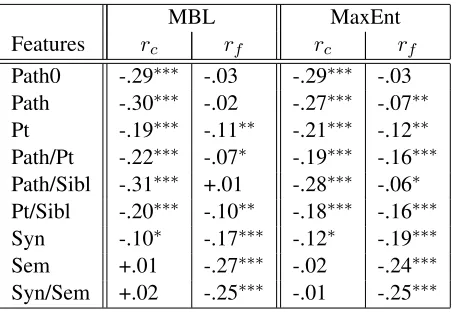
Table 8: Exp. 2, Analysis 2: Partial correlation coefficients. rc: correlation between F-score and
confusability, controlling for training set size. rf:
correlation between F-score and training set size, controlling for confusability. Significance levels:
∗∗∗: p<0.001;∗∗: p<0.01;∗: p<0.05.
We first compute partial correlation coefficients between F-score and confusability, controlling for training set size. The results, which indicate the “true” relationship between performance and con-fusability, are shown in therc columns of Table 8.
For both learners, confusability is significantly cor-related with F-score for all syntactic feature sets, but not for the semantic feature set and for the combined setSyn/Sem.
We also compute the partial correlation coeffi-cients between F-score and training set size, control-ling for confusability. These figures are reported in therf columns of Table 8 and show the “true”
rela-tionship between performance and training set size. There is no significant correlation between training set size and performance for simple syntax based-models, but the correlation is highly significant for complex syntactic models and all semantic models.
Discussion. The partial correlation analysis con-firms that confusability is a meta-model that can ex-plain the performance of a range of different models for semantic role assignment, namely those models which rely exclusively on syntactic features. Since we used the gold standard features provided by FrameNet and did not introduce implementation- or feature-specific knowledge, this points to a general limitation of syntax-based models. In contrast, se-mantic features behave completely differently; their
contribution is not limited by a role’s confusabil-ity. At the very least, it cannot be captured by our current meta-model, but the absolute increase in performance indicates that integrating semantics is the way forward, which is surprising given that the purely lexical features we use the present study are usually extremely sparse.
The analysis of the partial correlation between F-score and training set size also allows interesting conclusions. The correlation is not significant for small syntactic feature sets likePath, indicating that models for such features can be learned satisfacto-rily from relatively small training sets (but which are also limited in expressivity). This is markedly dif-ferent for richer feature sets. Arguably, these feature sets are sparser and can therefore profit more from an increased amount of training data. Again, the ef-fect is most pronounced for the semantic feature set.
6 Conclusion
In this paper, we have formulated ameta-modelfor semantic role assignment. We have used the confus-abilityof roles to predict classification performance independently of the classification framework and feature sets used. We have defined role confusability in two steps: First, we have formalized the certainty with which we can predict a semantic role from a given grammatical function withgrammatical func-tion entropy. Then, we have defined the confusabil-ity of a roleas a weighted sum of grammatical func-tion entropies.
We have found that role confusability is highly significantly correlated with system performance for models based solely on syntactic features. We con-clude that syntactic features approximate a descrip-tion of grammatical funcdescrip-tions, but that semantic fea-tures model a different aspect of the world.
Fol-lowing up on this idea, a natural continuation of the present study would be to create a meta-model that subsumes semantic features. Such a model could use optimal selectional restrictions as a predictor. The next step would then be to construct a combined meta-model that describes the behavior of systems with both syntactic and semantic features.
Another interesting research direction that our study suggests is the combination of syntactic and semantic models in co-training. Co-training can be sensibly applied only when conditional indepen-dence holds for the two target functions and the dis-tribution (Blum and Mitchell, 1998), i.e. when it uses two independent views on the instance set. By pointing out a highly significant distinction between syntactic and semantic features with respect to role confusability, our study provides empirical evidence that syntactic and semantic features model different aspects of the role assignment mapping, and that co-training may be feasible by using syntactic and se-mantic features as views.
Acknowledgments. We are grateful to the Deutsche Forschungsgemeinschaft (DFG) for funding the SALSA-II project (grant PI-154/9-2).
References
U. Baldewein, K. Erk, S. Pado, D. Prescher. 2004. Se-mantic role labelling with similarity-based
generali-sation using em-based clustering. In Proceedings of
SENSEVAL-3.
A. Blum, T. Mitchell. 1998. Combining labeled and
un-labeled data with co-training. InCOLT: Proceedings
of the Workshop on Computational Learning Theory, Morgan Kaufmann Publishers.
H. C. Boas. 2002. Bilingual framenet dictionaries for
machine translation. In Proceedings of LREC 2002,
1364–1371, Las Palmas, Canary Islands.
L. Burnard, 1995. User’s guide for the British National
Corpus. British National Corpus Consortium, Oxford University Computing Services, 1995.
X. Carreras, L. Màrquez. 2004. Introduction to the
CoNLL-2004 shared task: semantic role labeling. In
Proceedings of CoNLL 2004, Boston, MA.
X. Carreras, L. Màrquez. 2005. Introduction to the
CoNLL-2005 shared task: semantic role labeling. In
Proceedings of CoNLL 2005, Ann Arbor, MI.
M. J. Collins. 1996. A new statistical parser based on bigram lexical dependencies. In A. Joshi, M. Palmer,
eds.,Proceedings of the Thirty-Fourth Annual Meeting of the Association for Computational Linguistics, 184– 191, San Francisco. Morgan Kaufmann Publishers.
W. Daelemans, J. Zavrel, K. van der Sloot, A. van den
Bosch. 2003. Timbl: Tilburg memory based
learner, version 5.0, reference guide. Technical Re-port ILK 03-10, Tilburg University, 2003. Available from http://ilk.uvt.nl/downloads/pub/ papers/ilk0310.ps.gz.
C. J. Fillmore, M. R. Petruck. 2003. FrameNet glossary.
International Journal of Lexicography, 16:359–361.
C. J. Fillmore, C. R. Johnson, M. R. Petruck. 2003.
Background to FrameNet. International Journal of
Lexicography, 16:235–250.
C. J. Fillmore. 1985. Frames and the semantics of under-standing. Quaderni di Semantica, IV(2).
M. Fleischmann, E. Hovy. 2003. A maximum
en-tropy approach to framenet tagging. In Proceedings
of HLT/NAACL 2003, Edmonton, Canada.
D. Gildea, D. Jurafsky. 2002. Automatic labeling of se-mantic roles. Computational Linguistics, 28(3):245– 288.
K. Litkowski. 2004. Senseval-3 task: Automatic label-ing of semantic roles. In R. Mihalcea, P. Edmonds,
eds., Proceedings of Senseval-3: The Third
Interna-tional Workshop on the Evaluation of Systems for the Semantic Analysis of Text, Barcelona, Spain.
R. Malouf. 2002. A comparison of algorithms for
maxi-mum entropy parameter estimation. InProceedings of
CoNLL 2002, Taipei, Taiwan.
A. Moschitti. 2004. A study on convolution kernel for
shallow semantic parsing. InProceedings of the ACL
2004, Barcelona, Spain.
S. Narayanan, S. Harabagiu. 2004. Question answering
based on semantic structures. InProceedings of
COL-ING 2004, Geneva, Switzerland.
S. Pado, G. Boleda Torrent. 2004. The influence of ar-gument structure on semantic role assignment. In Pro-ceedings of EMNLP 2004, Barcelona, Spain.
S. Pradhan, W. Ward, K. Hacioglu, J. H. Martin, D. Ju-rafsky. 2004. Shallow semantic parsing using
sup-port vector machines. InProceedings of HLT/NAACL
2004, Boston, MA.
H. Schmid. 1994. Probabilistic part-of-speech tagging using decision trees. InProceedings of NeMLaP 1994.
M. Surdeanu, S. Harabagiu, J. Williams, P. Aarseth. 2003. Using predicate-argument structures for
infor-mation extraction. InProceedings of ACL 2003,
Sap-poro, Japan.
N. Xue, M. Palmer. 2004. Calibrating features for
se-mantic role labeling. InProceedings of EMNLP 2004,