Neural Graphical Models over Strings for Principal Parts
Morphological Paradigm Completion
Ryan Cotterell1,2 John Sylak-Glassman2
1Department of Computer Science 2Center for Language and Speech Processing
Johns Hopkins University
[email protected] [email protected] [email protected]
Christo Kirov2
Abstract
Many of the world’s languages contain an abundance of inflected forms for each lex-eme. A major task in processing such lan-guages is predicting these inflected forms. We develop a novel statistical model for the problem, drawing on graphical model-ing techniques and recent advances in deep learning. We derive a Metropolis-Hastings algorithm to jointly decode the model. Our Bayesian network draws inspiration from principal parts morphological analysis. We demonstrate improvements on 5 languages.
1 Introduction
Inflectional morphology modifies the form of words to convey grammatical distinctions (e.g. tense, case, and number), and is an extremely common and productive phenomenon throughout the world’s languages (Dryer and Haspelmath, 2013). For instance, the Spanish verbponermay transform into one of over fifty unique inflectional forms depending on context, e.g. the 1st person present form ispongo, but the2ndperson present form ispones. These variants cause data sparsity, which is problematic for machine learning since many word forms will not occur in training corpora. Thus, a necessity for improving NLP on morphologically rich languages is the ability to analyze all inflected forms for any lexical entry. One way to do this is through paradigm completion, which generates all the inflected forms associated with a given lemma.
Until recently, paradigm completion has been narrowly construed as the task of generating a full paradigm (e.g. noun declension, verb conjuga-tion) based on a single privileged form—the lemma (i.e. the citation form, such asponer). While recent work (Durrett and DeNero, 2013; Hulden, 2014;
Nicolai et al., 2015; Ahlberg et al., 2015; Faruqui et al., 2016) has made tremendous progress on this narrower task, paradigm completion is not only broader in scope, but is better solved without priv-ileging the lemma over other forms. By forcing string-to-string transformations from one inflected form to another to go through the lemma, the trans-formation problem is often made more complex than by allowing transformations to happen directly or through a different intermediary form. This inter-pretation is inspired by ideas from linguistics and language pedagogy, namely principal parts mor-phology, which argues that forms in a paradigm are best derived using asetof citation forms rather than a single form (Finkel and Stump, 2007a; Finkel and Stump, 2007b).
Directed graphical models provide a natural for-malism for principal parts morphology since a graph topology can represent relations between inflected forms and principal parts. Specifically, we apply string-valued graphical models (Dreyer and Eisner, 2009; Cotterell et al., 2015) to the prob-lem. We develop a novel, neural parameterization of string-valued graphical models where the con-ditional probabilities in the Bayesian network are given by a sequence-to-sequence model (Sutskever et al., 2014). However, under such a parameteriza-tion, exact inference and decoding are intractable. Thus, we derive a sampling-based decoding algo-rithm. We experiment on 5 languages: Arabic, German, Latin, Russian, and Spanish, showing that our model outperforms a baseline approach that privileges the lemma form.
2 A Generative Model of Principal Parts
We first formally define the task of paradigm com-pletion and relate it to research in principal parts morphology. LetΣbe a discrete alphabet of char-acters in a language. Formally, for a given lemma
` ∈ Σ∗, we define the complete paradigm of that lemma π(`) = hm1, . . . , mNi, where each
mi ∈ Σ∗is an inflected form.1 For example, the paradigm for the English lemmato runis defined asπ(RUN) =hrun,runs,ran,runningi. While the size of a typical English verbal paradigm is compar-atively small (|π| =N = 4), in many languages the size of the paradigms can be very large (Kib-rik, 1998). The task of paradigm completion is to predict all elements of the tuple π given one or more forms (mi). Paradigm completion solely from the lemma (m`), however, largely ignores the linguistic structure of the paradigm. Given certain inflected word forms, termed principal parts, the construction of a set of other word forms in the same paradigm is fully deterministic. Latin verbs are famous for having four such principal parts (Finkel and Stump, 2009).
Inspired by the concept of principal parts, we present a solution to the paradigm completion task in which target inflected forms are predicted from other forms in the paradigm, rather than only from the lemma. We implement this solution in the form of a generative probabilistic model of the paradigm. We define a joint probability distribution over the entire paradigm:
p(π) =Y
i
p(mi|mpaT(i)) (1)
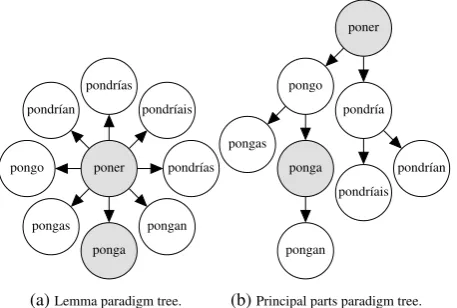
where paT(·)is a function that returns the parent of the node i with respect to the tree T, which encodes the source form from which each target form is predicted. In terms of graphical modeling, thisp(π)is a Bayesian network over string-valued variables (Cotterell et al., 2015). Trees provide a natural formalism for encoding the intuition behind principal parts theory, and provide a fixed paradigm structure prior to inference. We construct a graph with nodes for each cell in the paradigm, as in Figure 1. The parent of each node is another form in the paradigm that best predicts that node.
2.1 Paradigm Trees
Baseline Network. Predicting inflected forms only from the lemma involves a particular graphi-cal model in which all the forms are leaves attached to the lemma. This network is treated as a baseline, and is depicted in Figure 1a.
1We constrain the task such that the number of forms in a paradigm (|π|=N) is fixed, and each possible form of a paradigm is assumed to have consistent semantics.
poner pongo
pongas ponga
pongan pondr´ıas pondr´ıais pondr´ıan
pondr´ıas
(a)Lemma paradigm tree.
poner
pongo pondr´ıa
pongas ponga
pongan pondr´ıais
pondr´ıan
[image:2.595.308.537.63.217.2](b)Principal parts paradigm tree.
Figure 1: Two potential graphical models for the paradigm completion task. The topology in (a) encodes the the network where all forms are predicted from the lemma. The topology in (b) is a principle-parts-inspired topology introduced here.
Heuristic Network. We heuristically induce a paradigm tree with the following procedure. For each ordered pair of forms in a paradigm π, we compute the number of distinct edit scripts that convert one form into the other. The edit script procedure is similar to that described in Chrupała et al. (2008). For each ordered pair(i, j)of inflected forms inπ, we count the number of distinct edit paths mapping from mi to mj, which serves as a weight on the edge wi→j. Empirically, wi→j is a good proxy for how deterministic a mapping is. We use Edmonds’ algorithm (Edmonds, 1967) to find the minimal directed spanning tree. The intuition behind this procedure is that the number of deterministic arcs should be maximized.
Gold Network. Finally, for Latin verbs we con-sider a graph that matches the classic pedagogical derivation of Latin verbs from four principal parts.
3 Inflection Generation with RNNs
RNNs have recently achieved state-of-the-art re-sults for many sequence-to-sequence mapping problems and paradigm completion is no excep-tion. Given the success of LSTM-based (Hochre-iter and Schmidhuber, 1997) and GRU-based (Cho et al., 2014) morphological inflectors (Faruqui et al., 2016; Cotterell et al., 2016), we choose a neural parameterization for our Bayesian network, i.e. the conditional probability p(mi | mpaT(i)) is
com-puted using a RNN. Our graphical modeling ap-proach as well as the inference algorithms subse-quently discussed in§4.2 are agnostic to the minu-tiae of any one parameterization, i.e. the encoding
Algorithm 1Decoding by Simulated Annealing 1: procedureSIMULATED-ANNEALING(T,d,)
2: τ ←10.0;m←[ε, . . . , ε]
3: repeat
4: i∼uniform({1,2, . . . ,|m|}) .sample latent node inT
5: m0
i∼qi .sample string from proposal distribution
6: a←min
"
1,p(m0i|mpaT(i))
p(mi|mpaT(i)) 1/τ
qi(mi) qi(m0i)
#
7: ifuniform(0,1)≤athen
8: mi←m0i .update string to new value if accepted 9: τ ←τ·d .decay temperature whered∈(0,1)
10: untilτ ≤ .repeat until convergence; see Spall (2003, Ch. 8)
11: returnm
3.1 LSTMs with Hard Monotonic Attention
We define the conditional distributions in our Bayesian networkp(mi|mpaT(i))as LSTMs with
hard monotonic attention (Aharoni et al., 2016; Aharoni and Goldberg, 2016), which we briefly overview. These networks map one inflection to another, e.g. mapping the English gerundrunning to the past tense ran, using an encoder-decoder architecture (Sutskever et al., 2014) run over an augmented alignment alphabet, consisting of copy, substitution, deletion and insertion, as in Dreyer et al. (2008). For stringsx, y∈Σ∗, the alignment is extracted from the minimal weight edit path using the BioPython toolkit (Cock et al., 2009). Crucially, as the model is locally normalized we may sam-ple strings from the conditionalp(mi | mpaT(i))
efficientlyusing forward sampling. This network stands in contrast to attention models (Bahdanau et al., 2015) in which the alignments are soft and not necessarily monotonic. We refer the reader to Aha-roni et al. (2016) for exact implementation details as we use their code out-of-the-box.2
4 Neural Graphical Models over Strings
Our Bayesian network defined in Equation (1) is a graphical model defined over multiple string-valued random variables, a framework formalized in Dreyer and Eisner (2009). In contrast to previ-ous work, e.g. Cotterell and Eisner (2015; Peng et al. (2015), which considered conditional distribu-tions encodable by finite-state machines, we offer the first neural parameterization for such graphi-cal models. With the increased expressivity comes computational challenges—inference becomes in-tractable. Thus, we fashion an efficient sampling algorithm.
2https://github.com/roeeaharoni/
morphological-reinflection
4.1 Parameter Estimation
Following previous work (Faruqui et al., 2016), we train our model in the fully observed setting withcomplete paradigmsas training data. As our model is directed, this makes parameter estimation relatively straightforward. We may estimate the parameters of each LSTM independently without performing joint inference during training. We fol-low the training procedure of Aharoni et al. (2016), using a maximum of 300 epochs of SGD.
4.2 Approximate Joint Decoding
In a Bayesian network, themaximum-a-posteriori (MAP) inference problem refers to finding the most probable configuration of the variables given some evidence. In our case, this requires finding the best set of inflections to complete the paradigm given an observed set of inflected forms. Returning to the English verbal paradigm, given the past tense formranand the3rdperson present singularruns, the goal of MAP inference is to return the most probable assignment to the past tense and gerund form (the correct assignment isranandrunning). In many Bayesian networks, e.g. models with finite support, exact MAP inference can be performed efficiently with the sum-product belief propagation algorithm (Pearl, 1988) when the model has a tree structure. Despite the tree structure, the LSTM makes exact inference intractable. Thus, we resort to an approximate scheme.
4.3 Simulated Annealing
The Metropolis-Hastings algorithm (Metropolis et al., 1953; Hastings, 1970) is a popular Markov-Chain Monte Carlo (MCMC) (Robert and Casella, 2013) algorithm for approximate sampling from intractable distributions. As with all MCMC al-gorithms, the goal is to construct a Markov chain whose stationary distribution is the target distribu-tion. Thus, after having mixed, taking a random walk on the Markov chain is equivalent to sampling from the intractable distribution. Here, we are in-terested in sampling fromp(π), where part ofπ
may be observed.
Simulated annealing (Kirkpatrick et al., 1983; Andrieu et al., 2003) is a slight modification of the Metropolis-Hastings algorithm suitable for MAP inference. We add the temperature hyperparameter
sam-Language Baseline Heuristic Tree Gold Tree
Arabic 70.3% 92.7% N/A
German 93.3% 98.8% N/A
Latin 92.8% 98.3% 98.9%
Russian 84.2% 84.4% N/A
Spanish 99.2% 99.2% N/A
Table 1: Accuracy on the paradigm completion task comparing Bayesian network topologies over 5 languages.
ple a latent nodeiin the tree uniformly at random. We then sample a new stringm0
ifrom the proposal distributionqi(see§4.4), which we accept (replac-ingmi) with probability
a=min
1, p(m0i|mpaT(i))
p(mi|mpaT(i)) !1/τ
qi(mi)
qi(m0i)
. (2)
We iterate until convergence and accept the final configuration of values as our approximate MAP estimate. We give pseudocode in Algorithm 1 for clarity.
4.4 Proposal Distribution
We define a tractable proposal distribution for our neural graphical model over strings using a pro-cedure similar to the stochastic inverse method of Stuhlm¨uller et al. (2013) for probabilistic program-ming. In addition to estimating the parameters of an LSTM defining the distributionp(mi |mpaT(i)),
we also estimate parameters of an LSTM to define theinverse distributionp(mpaT(i) |mi). As we ob-serve only complete paradigms at training time, we train networks as in§4.1. First, we define the neigh-borhood of a nodeias all those nodes adjacent to
i(connected by an ingoingoroutgoing edge). We define the proposal distribution as a mixture model of all conditional distributions in the neighborhood N(i), i.e.
qi(mi) =|N(i)|−1
X
j∈N(i)
p(mi|mj). (3)
Crucially, some of the distributions are stochastic inverses. Sampling fromqiis tractable: We sample a mixture component uniformly and then sample a string.
5 Related Work
Our effort is closest to Faruqui et al. (2016), who proposed the first neural paradigm completer. Many neural solutions were also proposed in the
Language (POS) Train Dev Test
Arabic (N) 632 79 79
German (N) 1723 200 200
Latin (V) 2660 333 333
Russian (N) 8266 1032 1033
[image:4.595.331.504.62.138.2]Spanish (V) 2973 372 372
Table 2: Lemmata per dataset.
SIGMORPHON shared task on morphological re-inflection (Cotterell et al., 2016). Notably, the winning system used an encoder-decoder archi-tecture (Kann and Sch¨utze, 2016). Neural net-works have been used in other areas of compu-tational morphology, e.g. morpheme segmentation (Wang et al., 2016; Kann et al., 2016; Cotterell and Sch¨utze, 2017), morphological tagging (Heigold et al., 2016), and language modeling (Botha and Blunsom, 2014).
6 Experiments and Results
Our proposed modelgeneralizesprevious efforts in paradigm completion since all previously pro-posed models take the form of Figure 1a, i.e. a graphical model where all leaves connect to the lemma. Unfortunately, in that configuration, ob-serving additional formscannothelp at test time since information must flow through the lemma, which is always observed. We conjecture that prin-cipal parts-based topologies will outperform the baseline topology for that reason. We propose a controlled experiment in which we consider iden-tical training and testing conditions and vary only the topology.
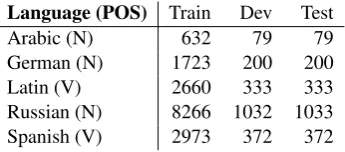
[image:4.595.74.287.62.135.2]Data. Data for training, development, and testing is randomly sampled from the UniMorph dataset (Sylak-Glassman et al., 2015).3 We run experi-ments on Arabic, German, and Russian nominal paradigms and Latin and Spanish verbal paradigms. The sizes of the resulting data splits are given in Table 2. For the development and test splits we always include the lemma (as is standard) while sampling additional observed forms. On average one third of all forms are observed.
Evaluation. Evaluation of the held-out sets pro-ceeds as follows: Given the observed forms in the paradigm, we jointly decode the remaining forms as discussed in§4.2; joint decoding is performed without Algorithm 1 for the baseline—instead, we
decode as in Aharoni et al. (2016). We measure accuracy (macro-averaged) on the held-out forms.
Results. In general, we find that our princi-pal parts-inspired networks outperform lemma-centered baseline networks. In Arabic, German, and Latin, we find the largest gains (for Latin, our heuristic topology closely matches that of the gold tree, validating the heuristics we use). We attribute the gains to the ability to use knowledge from attested forms that are otherwise difficult to pre-dict, e.g. forms based on the Arabic broken plural, the German plural, and any of the Latin present perfect forms. In the case of paradigms with por-tions which are difficult to predict without knowl-edge of a representative form, knowing multiple principle parts will be a boon given a proper tree improvement—we attribute this to the fact that al-most all of the test examples were regular-arverbs and, thus, fully predictable. Finally, in the case of Russian we see only minor improvements—this stems from need to maintain a different optimal topology for each declension. Because our model assumes a fixed paradigmatic structure in the form of a tree, using multiple topologies is not possible.
7 Conclusion
We have presented a directed graphical model over strings with a RNN parameterization for principle-parts-inspired morphological paradigm completion. This paradigm gives us the best of two worlds. We can exploit state-of-the-art neural morphological inflectors while injecting linguistic insight into the structure of the graphical model itself. Due to the expressivity of our parameterization, exact decod-ing becomes intractable. To solve this, we derive an efficient MCMC approach to approximately decode the model. We validate our model experimentally and show gains over a baseline which represents the topology used in nearly all previous research.
Acknowledgements
The first author was supported by a DAAD Long-Term Research Grant and an NDSEG fellowship.
References
Roee Aharoni and Yoav Goldberg. 2016. Sequence to sequence transduction with hard monotonic atten-tion. arXiv preprint arXiv:1611.01487.
Roee Aharoni, Yoav Goldberg, and Yonatan Belinkov. 2016. Improving sequence to sequence learning for
morphological inflection generation: The biu-mit systems for the sigmorphon 2016 shared task for morphological reinflection. In Proceedings of the 14th SIGMORPHON Workshop on Computational Research in Phonetics, Phonology, and Morphology, pages 41–48, Berlin, Germany, August. Association for Computational Linguistics.
Malin Ahlberg, Markus Forsberg, and Mans Hulden. 2015. Paradigm classification in supervised learn-ing of morphology. InProceedings of the 2015 Con-ference of the North American Chapter of the Asso-ciation for Computational Linguistics: Human Lan-guage Technologies, pages 1024–1029, Denver, Col-orado, May–June. Association for Computational Linguistics.
Christophe Andrieu, Nando De Freitas, Arnaud Doucet, and Michael I. Jordan. 2003. An introduction to MCMC for machine learning. Machine Learning, 50(1-2):5–43.
Dzmitry Bahdanau, Kyunghyun Cho, and Yoshua Ben-gio. 2015. Neural machine translation by jointly learning to align and translate. InICLR.
Jan A. Botha and Phil Blunsom. 2014. Compositional morphology for word representations and language modelling. InICML, pages 1899–1907.
Kyunghyun Cho, Bart van Merrienboer, C¸aglar G¨ulc¸ehre, Dzmitry Bahdanau, Fethi Bougares, Hol-ger Schwenk, and Yoshua Bengio. 2014. Learning phrase representations using RNN encoder-decoder for statistical machine translation. InEMNLP, pages 1724–1734.
Grzegorz Chrupała, Georgiana Dinu, and Josef van Genabith. 2008. Learning morphology with Mor-fette. InLREC, volume 8.
Peter Cock, Tiago Antao, Jeffrey Chang, Brad Chap-man, Cymon Cox, Andrew Dalke, Iddo Friedberg, Thomas Hamelryck, Frank Kauff, Bartek Wilczyn-ski, et al. 2009. Biopython: Freely available Python tools for computational molecular biology and bioin-formatics. Bioinformatics, 25(11):1422–1423.
Ryan Cotterell and Jason Eisner. 2015. Penalized expectation propagation for graphical models over strings. In Proceedings of the 2015 Conference of the North American Chapter of the Association for Computational Linguistics: Human Language Tech-nologies, pages 932–942, Denver, Colorado, May– June. Association for Computational Linguistics.
Ryan Cotterell and Hinrich Sch¨utze. 2017. Joint se-mantic synthesis and morphological analysis of the derived word. CoRR, abs/1701.00946.
Ryan Cotterell, Christo Kirov, John Sylak-Glassman, David Yarowsky, Jason Eisner, and Mans Hulden. 2016. The sigmorphon 2016 shared taskmorpholog-ical reinflection. In Proceedings of the 14th SIG-MORPHON Workshop on Computational Research in Phonetics, Phonology, and Morphology, pages 10–22, Berlin, Germany, August. Association for Computational Linguistics.
Markus Dreyer and Jason Eisner. 2009. Graphical models over multiple strings. InProceedings of the 2009 Conference on Empirical Methods in Natural Language Processing, pages 101–110, Singapore, August. Association for Computational Linguistics. Markus Dreyer, Jason Smith, and Jason Eisner. 2008.
Latent-variable modeling of string transductions with finite-state methods. In Proceedings of the 2008 Conference on Empirical Methods in Natu-ral Language Processing, pages 1080–1089, Hon-olulu, Hawaii, October. Association for Computa-tional Linguistics.
Matthew S. Dryer and Martin Haspelmath, editors. 2013. WALS Online. Max Planck Institute for Evo-lutionary Anthropology, Leipzig.
Greg Durrett and John DeNero. 2013. Supervised learning of complete morphological paradigms. In Proceedings of the 2013 Conference of the North American Chapter of the Association for Computa-tional Linguistics: Human Language Technologies, pages 1185–1195, Atlanta, Georgia, June. Associa-tion for ComputaAssocia-tional Linguistics.
Jack Edmonds. 1967. Optimum branchings. Journal of Research of the National Bureau of Standards B, 71(4):233–240.
Manaal Faruqui, Yulia Tsvetkov, Graham Neubig, and Chris Dyer. 2016. Morphological inflection gener-ation using character sequence to sequence learning. InProceedings of the 2016 Conference of the North American Chapter of the Association for Computa-tional Linguistics: Human Language Technologies, pages 634–643, San Diego, California, June. Asso-ciation for Computational Linguistics.
Raphael Finkel and Gregory Stump. 2007a. Principal parts and degrees of paradigmatic transparency (no. tr 470-07). Technical report, Department of Com-puter Science, University of Kentucky, Lexington, KY.
Raphael Finkel and Gregory Stump. 2007b. Princi-pal parts and morphological typology. Morphology, 17:39–75, November.
Raphael Finkel and Gregory Stump. 2009. What your teacher told you is true: Latin verbs have four prin-cipal parts. Digital Humanities Quarterly (DHQ), 3(1).
Wilfred Keith Hastings. 1970. Monte Carlo sampling methods using Markov chains and their applications. Biometrika, 57(1):97–109.
Georg Heigold, Guenter Neumann, and Josef van Genabith. 2016. Neural morphological tagging from characters for morphologically rich languages. CoRR, abs/1606.06640.
Sepp Hochreiter and J¨urgen Schmidhuber. 1997. Long short-term memory. Neural computation, 9(8):1735–1780.
Mans Hulden. 2014. Generalizing inflection tables into paradigms with finite-state operations. In Pro-ceedings of the 14th SIGMORPHON Workshop on Computational Research in Phonetics, Phonology, and Morphology, pages 29–36, Baltimore, Mary-land. Association for Computational Linguistics. Katharina Kann and Hinrich Sch¨utze. 2016. MED:
The LMU system for the SIGMORPHON 2016 shared task on morphological reinflection. In Pro-ceedings of the 14th SIGMORPHON Workshop on Computational Research in Phonetics, Phonology, and Morphology, pages 62–70, Berlin, Germany, August. Association for Computational Linguistics. Katharina Kann, Ryan Cotterell, and Hinrich Sch¨utze.
2016. Neural morphological analysis: Encoding-decoding canonical segments. In Proceedings of the 2016 Conference on Empirical Methods in Nat-ural Language Processing, pages 961–967, Austin, Texas, November. Association for Computational Linguistics.
Aleksandr E. Kibrik. 1998. Archi. In Andrew Spencer and Arnold M. Zwicky, editors, The Handbook of Morphology, pages 455–476. Blackwell, Oxford. Scott Kirkpatrick, C. Daniel Gelatt, Mario P. Vecchi,
et al. 1983. Optimization by simmulated annealing. Science, 220(4598):671–680.
Nicholas Metropolis, Arianna W. Rosenbluth, Mar-shall N. Rosenbluth, Augusta H. Teller, and Edward Teller. 1953. Equations of state calculations by fast computing machines. Journal of Chemical Physics, 21(6):1087–1092.
Garrett Nicolai, Colin Cherry, and Grzegorz Kondrak. 2015. Inflection generation as discriminative string transduction. In Proceedings of the 2015 Confer-ence of the North American Chapter of the Associ-ation for ComputAssoci-ational Linguistics: Human Lan-guage Technologies, pages 922–931, Denver, Col-orado, May–June. Association for Computational Linguistics.
Judea Pearl. 1988. Probabilistic Reasoning in Intelli-gent Systems: Networks of Plausible Inference. Mor-gan Kaufmann.
Christian Robert and George Casella. 2013. Monte Carlo statistical methods. Springer Science & Busi-ness Media.
James C. Spall. 2003. Introduction to stochastic search and optimization: estimation, simulation, and control, volume 65. John Wiley & Sons. Andreas Stuhlm¨uller, Jacob Taylor, and Noah
Good-man. 2013. Learning stochastic inverses. InNIPS, pages 3048–3056.
Ilya Sutskever, Oriol Vinyals, and Quoc V. Le. 2014. Sequence to sequence learning with neural networks. CoRR, abs/1409.3215.
John Sylak-Glassman, Christo Kirov, David Yarowsky, and Roger Que. 2015. A language-independent feature schema for inflectional morphology. In Pro-ceedings of the 53rd Annual Meeting of the Associa-tion for ComputaAssocia-tional Linguistics and the 7th Inter-national Joint Conference on Natural Language Pro-cessing (Volume 2: Short Papers), pages 674–680, Beijing, China, July. Association for Computational Linguistics.