A Dataset for Multi-Target Stance Detection
Parinaz Sobhani1, Diana Inkpen1and Xiaodan Zhu2 1EECS, University of Ottawa
2National Research Council Canada
{psobh090,diana.inkpen}@uottawa.ca
{xiaodan.zhu}@nrc-cnrc.gc.ca
Abstract
Current models for stance classification often treat each target independently, but in many applications, there exist natural dependencies among targets, e.g., stance towards two or more politicians in an elec-tion or towards several brands of the same product. In this paper, we focus on the problem of multi-target stance detection. We present a new dataset that we built for this task. Furthermore, We experiment with several neural models on the dataset and show that they are more effective in jointly modeling the overall position to-wards two related targets compared to in-dependent predictions and other models of joint learning, such as cascading classifi-cation. We make the new dataset publicly available, in order to facilitate further re-search in multi-target stance classification.
1 Introduction
The subjectivity, for example, sentiments or stances, expressed towards different targets is of-ten considered independently. In a wide range of contexts, however, they are closely related. For ex-ample, in an electoral document, the stance toward one candidate may be relevant or even inferrable from tweets about other candidates. This could be true in many other domains, such as product re-views.
Stance detection is the task of automatically de-termining from the text whether the author of the text is in favor of, against, or neutral towards a proposition or target. The target may be a per-son, organization, government policy, movement or product.
In this paper, our first goal is to provide a bench-mark dataset to jointly learn subjectivities
corre-sponding to related targets. Then, we investigate the problem of jointly predicting the stance ex-pressed towards multiple targets (two at a time), in order to demonstrate the utility of the dataset.
The closest work related to our work is Deng and Wiebe (2015a), where sentiment toward dif-ferent entities and events is jointly modeled us-ing a rule-based probabilistic soft logic approach. The authors also made their dataset MPQA 3.0 (Deng and Wiebe, 2015b) available, However, this dataset is relatively small (it contains 70 docu-ments) and has a potentially infinite number of targets (the target sets depend on the context), which makes it hard to train a system. Instead, we provide a reasonably large dataset for training and evaluation. Our dataset contains 4,455 tweets manually annotated for stance towards more than one target simultaneously. We will refer to this data as the Multi-Target Stance Dataset. More-over, we make available a much larger unlabeled dataset providing more choices for users to further investigate the multi-target stance detection prob-lem by learning more knowledge about the rela-tionship between target entities.
We propose a framework that leverages deep neural models to jointly learn the subjectivity to-ward two target entities, given the text of a tweet. We treat the task as sequence-to-sequence learn-ing, where the entire text of the tweet is mapped to a vector at the encoder side using a bidirectional recurrent neural network (RNN). On the decoder side, another RNN conditioned on the input vec-tors generates stance labels toward the related en-tities. By using an attention-based network, the model can focus on different parts of the tweet text to generate each stance label. Because stance la-bels are generated conditionally dependent on the previously-generated labels toward other entities, the model removes the independence assumption between different targets and specifically focuses
on the dependencies.
2 Dataset
We collected tweets related to the 2016 US elec-tion. We selected four presidential candidates: ‘Donald Trump’, ‘Hillary Clinton’, ‘Ted Cruz’, and ‘Bernie Sanders’ as our targets of interest and identified a small set of hashtags (which are not stance-indicative) related to these targets 1. We used the Twitter API to collect more than eleven millions of tweets containing any of these hash-tags. For approximately 25% of the tweets, the hashtag of interest appeared at the end. Hashtags at the end of the tweets may not have any contri-bution to the meaning of the tweets; this means that the targets of opinions may not be the same as the targets of interest and, therefore, an inference is required. This is one of the main differences be-tween our task and aspect-based sentiment analy-sis. Here is an example from our dataset. None of the targets of interest, ‘Hillary Clinton’ or ‘Bernie Sanders’, are mentioned explicitly, except by the hashtags at the end of the tweet, but humans can infer that the tweeter is likely against both of them:
Tweet: Given a choice to kill 100 ISIS or 100 white American men, leftist scum would choose the latter. #UniteBlue #nomorerefugees #Bernie #Hillary
2.1 Data Annotation
We selected three target pairs for our Multi-Target Stance Dataset: Donald Trump and Hillary Clin-ton, Donald Trump and Ted Cruz, Hillary Clinton and Bernie Sanders. Further, we filtered the col-lected tweets by removing short tweets, retweets and those having a URL. We also discarded tweets that do not include at least two hashtags, one for each of the targets of interest. For each of the three selected target pairs, we randomly sam-pled 2,000 tweets. These tweets were annotated through CrowdFlower2. We asked the annotators two questions, one for the stance towards each of the presidential candidates in the target pair of in-terest. For stance annotation, the same annotation instructions were used as in (Mohammad et al., 2016c).
We used CrowdFlower’s gold annotations scheme for quality control, wherein about 10% 1Our hashtags list includes: #DonaldTrump, #Trumpt, #Trump2016, #TedCruz, #Cruz, #Cruz2016, #TedCruz2016, #HillaryClinton, #Hillary, #Hillary2016, #BernieSanders, #Bernie, #Bernie2016
2http://www.crowdflower.com
Target Pair # total # train # dev # test
Clinton-Sanders 1366 957 137 272 Clinton-Trump 1722 1240 177 355
Cruz-Trump 1317 922 132 263
[image:2.595.311.521.62.115.2]Total 4455 3119 446 890
Table 1: Distribution of instances in the Train, De-velopment and Test sets for different target pairs in the Multi-Target Stance Dataset
of the data was annotated internally (by the au-thors). During crowd annotation, these gold ques-tions were interspersed with other quesques-tions, and the annotator was not aware which is which. How-ever, if she got a gold question wrong, she was im-mediately notified of it. If the accuracy of the an-notations on the gold questions falls below 70%, the annotator was refused further annotation. This served as a mechanism to avoid malicious annota-tions and as a guide to the annotators.
Each tweet was annotated by at least eight anno-tators. To aggregate stance annotation information from multiple annotators for an instance rather than opting for a simple majority, the instances with less than 50% agreement on any of the candi-dates in the target pairs were discarded. We refer to this dataset as the Multi-Target Stance Dataset and we make it available online 3. The inter-annotator agreement on this dataset is 79.74%. We kept the rest of the tweets that were not used in the annotation process as unlabeled data, which can be used to obtain additional information about stance and relations between relevant entities.
2.2 The Multi-Target Stance Dataset
We partitioned the Multi-Target Stance Dataset into training, development, and test sets, based on the timestamps of the tweets. All annotated tweets were ordered by their timestamps; the first 70% of the tweets formed the training set, the next 10% the development set, and the last 20% formed the test set. Table 1 shows the number of instances in the training, development, and test sets over differ-ent target pairs in our Multi-Target Stance Dataset. Having different US presidential candidates as the targets of interest does not necessarily im-ply that the tweeters have opposing positions to-ward them. There are several cases where au-thors have favorable stances towards both, or sim-ilarly, opposing positions towards both of them. In our dataset, approximately 20% of the
Opinion Clinton Toward favor against neither
Sanders
favor 7.5 33.9 3.7
[image:3.595.318.510.62.113.2]against 12.6 12.0 3.8 neither 2.3 5.6 18.6
Table 2: Distribution across the 9 stance classes for the Hillary Clinton-Bernie Sanders target pair
Opinion Clinton Toward favor against neither
Trump
favor 0.5 52.3 1.2
[image:3.595.85.274.62.114.2]against 14.0 9.0 3.5 neither 0.3 3.9 15.2
Table 3: Distribution across the 9 stance classes for the Donald Trump-Hillary Clinton target pair
ers have the same position towards both entities, 50% of tweeters have opposing positions towards the given targets, and for 17% of the data, the posi-tions towards none of the targets is inferable. The example below shows a tweet that have the same position towards two candidates:
Targets: Donald Trump & Hillary Clinton Tweet: Looking at the List of PC’s for 2016 is like looking at the McDonalds Menu. You just know that shit is bad for you. #Trump2016 #Hillary2016
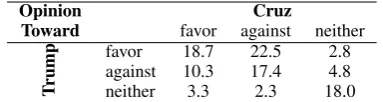
To illustrate more details about the correlation between subjectivities towards targets of interest, the stance distribution across the 9 classes for different target pairs in the Multi-Target Stance Dataset are depicted in tables 2, 3 and 4. We note that the numbers vary between target pairs.
3 Multi-Target Stance Classification
In this section, we propose a framework that lever-ages recurrent neural models to capture the poten-tially complicated interaction between subjectivi-ties expressed towards multiple targets. We exper-imentally show that the attention-based encoder-decoder framework is more effective in jointly modeling the overall position towards two related targets, compared to independent predictions of positions and other popular frameworks for joint learning, such as cascading classification.
3.1 Window-Based Classification
One popular approach to detect subjectivity to-wards different targets, as is used in aspect-based sentiment classification (Brychc´ın et al., 2014), is to consider a context window of sizenin both di-rections around the target terms and to extract fea-tures for that target’s classifier based on its con-text. This approach is based on the assumption
Opinion Cruz
Toward favor against neither
Trump
favor 18.7 22.5 2.8 against 10.3 17.4 4.8 neither 3.3 2.3 18.0
Table 4: Distribution across the 9 stance classes for the Ted Cruz-Donald Trump target pair that the words outside the context window do not have an influence on the target. We will first in-clude such a baseline for our task.
3.2 Cascading Classifiers
To capture dependencies between stance labels of related targets, one possibility is to use the pre-dicted class toward one target as an extra fea-ture in other targets’ models. This framework is based on cascade classification, where several classifiers of related tasks are combined to im-prove the overall system performance (Heitz et al., 2009). we adopted this framework for multi-target stance classification by starting from an indepen-dent classifier to predict stance toward the first tar-get based on the text representation and exploit its prediction as an extra feature for other classifiers.
The major restriction of this framework is that the classification algorithm should have a mecha-nism to add new features based on other learners’ outputs. Most of the machine learning algorithms for text classification that rely on hand-crafted fea-tures extracted from text to represent it, provide such mechanism, but, for the state-of-the-art deep neural models, where the feature vectors for the text representation are learned with the classifica-tion model during training, adding new features to the model is not trivial.
3.3 Sequence-to-Sequence Model to Capture Dependencies in Output Space
[image:3.595.84.274.150.204.2]We propose to use the attention-based encoder-decoder for multi-target stance classification. Specifically, we regard the given tweet as the in-put, and the model is trained to generate the stance labels for targets. This model can naturally capture the dependencies among the target stance labels when searching the best label sequence, based on automatically-learned input features. The atten-tion mechanism has the potential of dynamically focusing on different words of the input text to generate stance labels for each target of interest. As such, the attention-based encoder-decoder is expected to have the strengths of both the window-based classification, by dynamically customizing the feature vector to predict each target stance la-bel, and the cascading classification, by condition-ing each label generation on the other labels with-out inheriting the limitations of these models. The model automatically learns the features and re-gions of the input that should be paid attention to.
4 Experiments
We evaluate the effectiveness of our models on the multi-target stance dataset described earlier, where two stance labels are predicted for each tweet. Note that all the models can be easily extended to predict more than two labels as well. For all methods, the tweets were tokenized with the CMU Twitter NLP tool (Gimpel et al., 2011). All the models we proposed were implemented in Python. As the evaluation measure for each target, we use the average of the F1-scores (the harmonic mean of precision and recall) for the two main classes, Favor and Against. A similar metric was used for stance detection—SemEval 2016 Task 4 (Mohammad et al., 2016a). For multiple targets (in our dataset, target pairs) the average over all the targets is calculated. To report a single num-ber for all three target pairs, we take the average of three values returned for each target pair and we refer to it as macro-averaged F-score. All the models are evaluated on the test sets.
As mentioned before, we used encoder-decoder attention-based deep models for multi-target stance detection. We followed (Bahdanau et al., 2014; Luong et al., 2015) to train our models using the minibatch stochastic gradient descent (SGD) algorithm with adaptive learning rate (Adadelta (Zeiler, 2012)). As RNN unit, we used a Gated Recurrent Unit (Cho et al., 2014a) with 128 cells. The word vectors at the embedding layer have 100
dimensions. All the parameters are initialized ran-domly, but the word vectors are pretrained using related unlabeled tweets (11,873,771 tweets) that we collected in the same time period. As training algorithm, we employed the Word2Vec Skip-gram model (Mikolov et al., 2013).
4.1 Results and Discussion
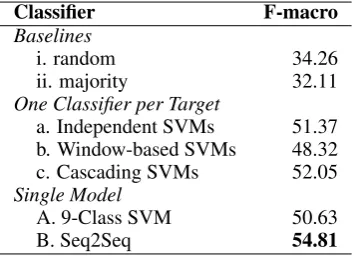
Table 5 presents the macro-averaged F-scores of different models on the Multi-Target Stance dataset. Row i. shows the result obtained by a random classifier and row ii. shows the result ob-tained by the majority classifier. When we have multiple targets to predict overall positions to-wards them, one possibility is to have a single learners per target that are independently trained. Row a. shows the result of having two indepen-dent linear Support Vector Machine (SVM) clas-sifiers whose parameters are tuned using the de-velopment datasets. We used the implementation provided in the Scikit-learn Machine Learning li-brary (Pedregosa et al., 2011). Row b. is the re-sult of applying Window-based SVM on our Muti-Target Stance Dataset. Because we collected our data based on hashtags related to the targets, those hashtags can be considered as target terms and we place a context window around them. We used the development set to find the best value for the win-dow size. The main limitation of this approach on this dataset is that for the majority of the tweets, the contexts windows have significant overlaps, as the two hashtags appeared in the close vicinity of each other. Row c. presents the results of the Cascading SVMs; this model shows improvement over the baseline of independent SVMs.
encoder-Classifier F-macro
Baselines
i. random 34.26
ii. majority 32.11
One Classifier per Target
a. Independent SVMs 51.37
b. Window-based SVMs 48.32
c. Cascading SVMs 52.05
Single Model
A. 9-Class SVM 50.63
B. Seq2Seq 54.81
Table 5: Macro-averaged F-scores of different models on the Multi-Target Stance dataset
decoder deep neural model on our dataset. This model has both the advantages of windows-based and cascading classification, and it has the best performance compared to all other models and baselines. By applying paired t-test on these re-sults, we concluded that the differences between sequence-to-sequence model and all other models are statistically significant.
5 Related Work
Stance DetectionOver the last decade, there has been active research in modeling stance (Thomas et al., 2006; Somasundaran and Wiebe, 2009; Anand et al., 2011; Sobhani et al., 2015; Walker et al., 2012a; Hasan and Ng, 2013; Sobhani et al., 2016). However, all of these previous works treat each target independently, ignoring the potential dependencies that could exist among related tar-gets. Stance detection was one of the tasks in the SemEval-2016 shared task competition (Mo-hammad et al., 2016a). Out of 19 participant teams, most used standard text classification fea-tures such asn-grams and word embedding vec-tors, as well as standard sentiment analysis fea-tures, while others used deep neural models such as RNNs and convolutional neural nets.
Most of the existing datasets for stance de-tection were created from online debate forums like 4forums.com and createdebates.com (Soma-sundaran and Wiebe, 2010; Walker et al., 2012b; Hasan and Ng, 2013). The majority of these de-bates are two-sided, and the data labels are of-ten provided by the authors of the posts. Re-cently, Mohammad et al. (2016b) created a dataset of tweets labeled for both stance and sentiment. None of the prior work has created a dataset an-notated for more than one target simultaneously, neither has explored the dependencies and rela-tionships between targets when predicting overall
positions towards them.
Deep Recurrent Neural Models Different structures of deep RNNs have recently shown to be very effective in a wide range of sequence modeling problems, particularly for opinion min-ing and sentiment analysis (Zhu et al., 2015a; Socher et al., 2013; Zhu et al., 2015b; Irsoy and Cardie, 2014; Zhu et al., 2016). These neural models were extended for tasks with variable in-put and outin-put sequence length including: end-to-end neural machine translation (Sutskever et al., 2014; Cho et al., 2014b), image-to-text conver-sion (Vinyals et al., 2015b), syntactic constituency parsing (Vinyals et al., 2015a) and question an-swering (Hermann et al., 2015). Subsequently, the attention mechanism allowed the models to learn alignments between different parts of the source and the target such as between speech frames and the text in speech recognition (Chorowski et al., 2014) or between image frames and the agent’s actions in dynamic control problems (Mnih et al., 2014). We are the first to adopt these techniques for the task of multi-target stance classification.
6 Conclusions and Future Work
We presented the first multi-target stance dataset of a reasonable size from social media, to help further exploration of this task. Each tweet is an-notated for position toward more than one target. By making this dataset available, more work on joint learning of subjectivities corresponding to re-lated targets is encouraged. In addition, we pre-sented a framework that relieves the independence assumption by jointly modeling the subjectivity expressed towards multiple targets. We experi-mentally showed that the attention-based encoder-decoder model is more effective in jointly model-ing the overall position toward two related targets, compared to independent predictions of positions and other popular frameworks for joint learning, such as cascading classification.
Directions of future work include annotating a similar dataset for other domains, for example, several brands of the same product, and exploring transfer learning where a model trained for a target pair can be transferred to other related target pairs.
Acknowledgments
[image:5.595.93.273.62.192.2]References
Pranav Anand, Marilyn Walker, Rob Abbott, Jean E. Fox Tree, Robeson Bowmani, and Michael Minor. 2011. Cats rule and dogs drool!: Classifying stance in online debate. InProceedings of the 2nd Work-shop on Computational Approaches to Subjectivity and Sentiment Analysis (WASSA 2.011), pages 1–9, Portland, Oregon, June. Association for Computa-tional Linguistics.
Dzmitry Bahdanau, Kyunghyun Cho, and Yoshua Ben-gio. 2014. Neural machine translation by jointly learning to align and translate. arXiv preprint arXiv:1409.0473.
Tom´aˇs Brychc´ın, Michal Konkol, and Josef Stein-berger. 2014. Uwb: Machine learning approach to aspect-based sentiment analysis. InProceedings of the 8th International Workshop on Semantic Evalu-ation (SemEval 2014), pages 817–822, Dublin, Ire-land, August. Association for Computational Lin-guistics and Dublin City University.
Kyunghyun Cho, Bart Van Merri¨enboer, Dzmitry Bah-danau, and Yoshua Bengio. 2014a. On the proper-ties of neural machine translation: Encoder-decoder approaches. arXiv preprint arXiv:1409.1259. Kyunghyun Cho, Bart Van Merri¨enboer, Caglar
Gul-cehre, Dzmitry Bahdanau, Fethi Bougares, Holger Schwenk, and Yoshua Bengio. 2014b. Learning phrase representations using rnn encoder-decoder for statistical machine translation. arXiv preprint arXiv:1406.1078.
Jan Chorowski, Dzmitry Bahdanau, Kyunghyun Cho, and Yoshua Bengio. 2014. End-to-end continuous speech recognition using attention-based recurrent nn: first results. arXiv preprint arXiv:1412.1602. Lingjia Deng and Janyce Wiebe. 2015a. Joint
predic-tion for entity/event-level sentiment analysis using probabilistic soft logic models. In Proceedings of the 2015 Conference on Empirical Methods in Nat-ural Language Processing, pages 179–189, Lisbon, Portugal, September. Association for Computational Linguistics.
Lingjia Deng and Janyce Wiebe. 2015b. Mpqa 3.0: An entity/event-level sentiment corpus. In Proceed-ings of the 2015 Conference of the North Ameri-can Chapter of the Association for Computational Linguistics: Human Language Technologies, pages 1323–1328, Denver, Colorado, May–June. Associa-tion for ComputaAssocia-tional Linguistics.
Kevin Gimpel, Nathan Schneider, Brendan O’Connor, Dipanjan Das, Daniel Mills, Jacob Eisenstein, Michael Heilman, Dani Yogatama, Jeffrey Flanigan, and Noah A. Smith. 2011. Part-of-speech tag-ging for twitter: Annotation, features, and experi-ments. In Proceedings of the 49th Annual Meet-ing of the Association for Computational LMeet-inguis- Linguis-tics: Human Language Technologies, pages 42–47,
Portland, Oregon, USA, June. Association for Com-putational Linguistics.
Awni Hannun, Carl Case, Jared Casper, Bryan Catan-zaro, Greg Diamos, Erich Elsen, Ryan Prenger, Sanjeev Satheesh, Shubho Sengupta, Adam Coates, et al. 2014. Deep speech: Scaling up end-to-end speech recognition. arXiv preprint arXiv:1412.5567.
Kazi Saidul Hasan and Vincent Ng. 2013. Stance classification of ideological debates: Data, mod-els, features, and constraints. In Proceedings of the Sixth International Joint Conference on Natural Language Processing, pages 1348–1356, Nagoya, Japan, October. Asian Federation of Natural Lan-guage Processing.
Geremy Heitz, Stephen Gould, Ashutosh Saxena, and Daphne Koller. 2009. Cascaded classification mod-els: Combining models for holistic scene under-standing. InAdvances in Neural Information Pro-cessing Systems, pages 641–648.
Karl Moritz Hermann, Tomas Kocisky, Edward Grefenstette, Lasse Espeholt, Will Kay, Mustafa Su-leyman, and Phil Blunsom. 2015. Teaching ma-chines to read and comprehend. InAdvances in Neu-ral Information Processing Systems, pages 1693– 1701.
Ozan Irsoy and Claire Cardie. 2014. Opinion mining with deep recurrent neural networks. In Proceed-ings of the 2014 Conference on Empirical Methods in Natural Language Processing (EMNLP), pages 720–728, Doha, Qatar, October. Association for Computational Linguistics.
Minh-Thang Luong, Hieu Pham, and Christopher D. Manning. 2015. Effective approaches to attention-based neural machine translation. arXiv preprint arXiv:1508.04025.
Tomas Mikolov, Ilya Sutskever, Kai Chen, Greg S. Cor-rado, and Jeff Dean. 2013. Distributed representa-tions of words and phrases and their compositional-ity. InAdvances in Neural Information Processing Systems, pages 3111–3119.
Volodymyr Mnih, Nicolas Heess, Alex Graves, et al. 2014. Recurrent models of visual attention. In Ad-vances in Neural Information Processing Systems, pages 2204–2212.
Saif Mohammad, Svetlana Kiritchenko, Parinaz Sob-hani, Xiaodan Zhu, and Colin Cherry. 2016a. Semeval-2016 task 6: Detecting stance in tweets. In
Proceedings of the 10th International Workshop on Semantic Evaluation (SemEval-2016), pages 31–41, San Diego, California, June. Association for Com-putational Linguistics.
Saif M. Mohammad, Parinaz Sobhani, and Svetlana Kiritchenko. 2016c. Stance and sentiment in tweets.
Special Section of the ACM Transactions on Inter-net Technology on Argumentation in Social Media, In Press.
Fabian Pedregosa, Ga¨el Varoquaux, et al. 2011. Scikit-learn: Machine learning in Python. Journal of Ma-chine Learning Research, 12:2825–2830.
Parinaz Sobhani, Diana Inkpen, and Stan Matwin. 2015. From argumentation mining to stance clas-sification. InProceedings of the Workshop on Argu-mentation Mining, pages 67–77, Denver, Colorado, USA.
Parinaz Sobhani, Saif M. Mohammad, and Svetlana Kiritchenko. 2016. Detecting stance in tweets and analyzing its interaction with sentiment. In Proceed-ings of the Fifth Joint Conference on Lexical and Computational Semantics (*Sem), Edinburgh, Scot-land.
Richard Socher, Alex Perelygin, Jean Wu, Jason Chuang, Christopher D. Manning, Andrew Ng, and Christopher Potts. 2013. Recursive deep models for semantic compositionality over a sentiment tree-bank. In Proceedings of the 2013 Conference on Empirical Methods in Natural Language Process-ing, pages 1631–1642, Seattle, Washington, USA, October. Association for Computational Linguistics.
Swapna Somasundaran and Janyce Wiebe. 2009. Rec-ognizing stances in online debates. InProceedings of the Annual Meeting of the Association for Com-putational Linguistics, pages 226–234, Suntec, Sin-gapore.
Swapna Somasundaran and Janyce Wiebe. 2010. Rec-ognizing stances in ideological on-line debates. In
Proceedings of the NAACL HLT 2010 Workshop on Computational Approaches to Analysis and Gener-ation of Emotion in Text, pages 116–124, Los Ange-les, CA, June. Association for Computational Lin-guistics.
Ilya Sutskever, Oriol Vinyals, and Quoc V. Le. 2014. Sequence to sequence learning with neural net-works. InAdvances in neural information process-ing systems, pages 3104–3112.
Matt Thomas, Bo Pang, and Lillian Lee. 2006. Get out the vote: Determining support or opposition from congressional floor-debate transcripts. In Proceed-ings of the 2006 Conference on Empirical Methods in Natural Language Processing, pages 327–335, Sydney, Australia, July. Association for Computa-tional Linguistics.
Oriol Vinyals, Łukasz Kaiser, Terry Koo, Slav Petrov, Ilya Sutskever, and Geoffrey Hinton. 2015a. Gram-mar as a foreign language. InAdvances in Neural Information Processing Systems, pages 2773–2781.
Oriol Vinyals, Alexander Toshev, Samy Bengio, and Dumitru Erhan. 2015b. Show and tell: A neural im-age caption generator. InProceedings of the IEEE Conference on Computer Vision and Pattern Recog-nition, pages 3156–3164.
Marilyn Walker, Pranav Anand, Rob Abbott, and Ricky Grant. 2012a. Stance classification using dialogic properties of persuasion. InProceedings of the 2012 Conference of the North American Chapter of the Association for Computational Linguistics: Human Language Technologies, pages 592–596, Montr´eal, Canada, June. Association for Computational Lin-guistics.
Marilyn Walker, Grace Lin, and Jennifer Sawyer. 2012b. An annotated corpus of film dialogue for learning and characterizing character style. In Nico-letta Calzolari, Khalid Choukri, Thierry Declerck, Mehmet U˘gur Do˘gan, Bente Maegaard, Joseph Mar-iani, Jan Odijk, and Stelios Piperidis, editors, Pro-ceedings of the Eighth International Conference on Language Resources and Evaluation (LREC-2012), pages 1373–1378, Istanbul, Turkey, May. European Language Resources Association (ELRA). ACL Anthology Identifier: L12-1657.
Matthew D. Zeiler. 2012. Adadelta: an adaptive learn-ing rate method.arXiv preprint arXiv:1212.5701. Xiaodan Zhu, Hongyu Guo, and Parinaz Sobhani.
2015a. Neural networks for integrating composi-tional and non-composicomposi-tional sentiment in sentiment composition. In Proceedings of the Fourth Joint Conference on Lexical and Computational Seman-tics, pages 1–9, Denver, Colorado, June. Association for Computational Linguistics.
Xiaodan Zhu, Parinaz Sobhani, and Hongyu Guo. 2015b. Long short-term memory over recursive structures. In Proceedings of the 32nd Interna-tional Conference on Machine Learning, ICML 2015, Lille, France, 6-11 July 2015, pages 1604– 1612.