Word Mover’s Embedding:
From Word2Vec to Document Embedding
Lingfei WuIBM Research [email protected]
Ian En-Hsu Yen Carnegie Mellon University
Kun Xu IBM Research [email protected] Fangli Xu
College of William and Mary [email protected]
Avinash Balakrishnan IBM Research
Pin-Yu Chen IBM Research [email protected] Pradeep Ravikumar
Carnegie Mellon University [email protected]
Michael J. Witbrock IBM Research [email protected]
Abstract
While the celebrated Word2Vec technique yields semantically rich representations for in-dividual words, there has been relatively less success in extending to generate unsupervised sentences or documents embeddings. Recent work has demonstrated that a distance mea-sure between documents calledWord Mover’s Distance(WMD) that aligns semantically sim-ilar words, yields unprecedented KNN clas-sification accuracy. However, WMD is ex-pensive to compute, and it is hard to extend its use beyond a KNN classifier. In this pa-per, we propose the Word Mover’s Embed-ding (WME), a novel approach to building an unsupervised document (sentence) embedding from pre-trained word embeddings. In our ex-periments on 9 benchmark text classification datasets and 22 textual similarity tasks, the proposed technique consistently matches or outperforms state-of-the-art techniques, with significantly higher accuracy on problems of short length.
1 Introduction
Text representation plays an important role in many NLP-based tasks such as document classification and clustering (Zhang et al., 2018; Gui et al.,
2016, 2014), sense disambiguation (Gong et al.,
2017,2018a), machine translation (Mikolov et al.,
2013b), document matching (Pham et al.,2015), and sequential alignment (Peng et al.,2016,2015). Since there are no explicit features in text, much work has aimed to develop effective text represen-tations. Among them, the simplest bag of words (BOW) approach (Salton and Buckley,1988) and
its term frequency variants (e.g. TF-IDF) ( Robert-son and Walker,1994) are most widely used due to simplicity, efficiency and often surprisingly high ac-curacy (Wang and Manning,2012). However, sim-ply treating words and phrases as discrete symbols fails to take into account word order and the seman-tics of the words, and suffers from frequent near-orthogonality due to its high dimensional sparse representation. To overcome these limitations, La-tent Semantic Indexing (Deerwester et al.,1990) and Latent Dirichlet Allocation (Blei et al.,2003) were developed to extract more meaningful repre-sentations through singular value decomposition (Wu and Stathopoulos,2015) and learning a proba-bilistic BOW representation.
A recent empirically successful body of research makes use of distributional or contextual informa-tion together with simple neural-network models to obtain vector-space representations of words and phrases (Bengio et al.,2003;Mikolov et al.,
2013a,c;Pennington et al.,2014). A number of researchers have proposed extensions of these to-wards learning semantic vector-space representa-tions of sentences or documents. A simple but often effective approach is to use a weighted average over some or all of the embeddings of words in the doc-ument. While this is simple, important information could easily be lost in such a document representa-tion, in part since it does not consider word order. A more sophisticated approach (Le and Mikolov,
in such a model may be limited by the size of the training corpus, which cannot scale to the large sizes used in the simpler word embedding models, and which may consequently weaken the quality of the document embeddings.
Recently, Kusner et al. (Kusner et al., 2015) presented a novel document distance metric, Word Mover’s Distance (WMD), that measures the dis-similarity between two text documents in the Word2Vec embedding space. Despite its state-of-the-art KNN-based classification accuracy over other methods, combining KNN and WMD incurs very high computational cost. More importantly, WMD is simply a distance that can be only com-bined with KNN or K-means, whereas many ma-chine learning algorithms require a fixed-length feature representation as input.
A recent work in building kernels from distance measures, D2KE (distances to kernels and em-beddings) (Wu et al., 2018a) proposes a general methodology of the derivation of a positive-definite kernel from a given distance function, which enjoys better theoretical guarantees than other distance-based methods, such ask-nearest neighbor and
dis-tance substitution kernel (Haasdonk and Bahlmann,
2004), and has also been demonstrated to have
strong empirical performance in the time-series domain (Wu et al.,2018b).
In this paper, we build on this recent innova-tion D2KE (Wu et al., 2018a), and present the
Word Mover’s Embedding(WME), an unsupervised generic framework that learns continuous vector representations for text of variable lengths such as a sentence, paragraph, or document. In par-ticular, we propose a new approach to first con-struct a positive-definiteWord Mover’s Kernelvia an infinite-dimensional feature map given by the Word Mover’s distance (WMD) to random docu-ments from a given distribution. Due to its use of the WMD, the feature map takes into account align-ments of individual words between the docualign-ments in the semantic space given by the pre-trained word embeddings. Based on this kernel, we can then de-rive a document embedding via a Random Features approximation of the kernel, whose inner products approximate exact kernel computations. Our
tech-nique extends the theory ofRandom Featuresto
show convergence of the inner product between WMEs to a positive-definite kernel that can be in-terpreted as a soft version of (inverse) WMD.
The proposed embedding is more efficient and
flexible than WMD in many situations. As an example, WME with a simple linear classifier reduces the computational cost of WMD-based KNNfrom cubic to linearin document length and
from quadratic to linear in number of samples, while simultaneously improving accuracy. WME is extremely easy to implement, fully paralleliz-able, and highly extensible, since its two build-ing blocks, Word2Vec and WMD, can be replaced
by other techniques such as GloVe (Pennington
et al., 2014; Wieting et al., 2015b) or S-WMD (Huang et al., 2016). We evaluate WME on 9 real-world text classification tasks and 22 textual similarity tasks, and demonstrate that it consis-tently matches or outperforms other state-of-the-art techniques. Moreover, WME often achieves orders of magnitude speed-up compared to KNN-WMD while obtaining the same testing accuracy. Our code and data is available athttps://github. com/IBM/WordMoversEmbeddings.
2 Word2Vec and Word Mover’s Distance
We briefly introduce Word2Vec and WMD, which are the key building blocks of our proposed method. Here are some notations we will use throughout the paper. Given a total number of documentsN with
a vocabularyW of size|W| = n, the Word2vec
embedding gives us ad-dimensional vector space
V ✓Rdsuch that any word in the vocabulary set
w2W is associated with a semantically rich vec-tor representationvw 2Rd. Then in this work, we consider each document as a collection of word vectorsx:= (vj)Lj=1and denoteX :=
SLmax
L=1 VL
as the space of documents.
Word2Vec.In the celebrated Word2Vec approach
(a) WMD (b) WME
Figure 1: An illustration of the WMD and WME. All non-stop words are marked as bold face. WMD measures the distance between two documents. WME approximates a kernel derived from WMD with a set of random documents.
embeddings (Pennington et al.,2014;Wieting et al.,
2015b) could also be utilized.
Word Mover’s Distance.Word Mover’s Distance
was introduced by (Kusner et al.,2015) as a special case of the Earth Mover’s Distance (Rubner et al.,
2000), which can be computed as a solution of
the well-known transportation problem (Hitchcock,
1941;Altschuler et al.,2017). WMD is a distance between two text documentsx,y 2 X that takes into account the alignments between words. Let |x|, |y|be the number of distinct words inxand y. Letfx 2R|x|,f
y 2R|y|denote the normalized frequency vectors of each word in the documents
x andy respectively (so that fTx1 = fTy1 = 1).
Then the WMD distance between documentsxand
yis defined as:
WMD(x, y) := min
F2R|+x|⇥|y|
hC, Fi,
s.t., F1=fx, FT1=fy.
(1)
where F is the transportation flow matrix with
Fij denoting the amount of flow traveling from
i-th wordxi inx toj-th word yj iny, andC is the transportation cost withCij := dist(vxi,vyj)
being the distance between two words measured in the Word2Vec embedding space. A popular choice is the Euclidean distance dist(vxi,vyj) =
kvxi vyjk2. When dist(vxi,vyj) is a metric,
the WMD distance in Eq. (1) also qualifies as a metric, and in particular, satisfies the triangle in-equality (Rubner et al., 2000). Building on top of Word2Vec, WMD is a particularly useful and accurate for measure of the distance between doc-uments with semantically close but syntactically different words as illustrated in Figure 1(a).
The WMD distance when coupled with KNN
has been observed to have strong performance in classification tasks (Kusner et al.,2015). However, WMD is expensive to compute with computational complexity ofO(L3log(L)), especially for long
documents whereLis large. Additionally, since
WMD is just a document distance, rather than a doc-ument representation, using it within KNN incurs even higher computational costsO(N2L3log(L)).
3 Document Embedding via Word Mover’s Kernel
In this section, we extend the framework in (Wu et al.,2018a), to derive a positive-definite kernel from an alignment-aware document distance met-ric, which then gives us an unsupervised semantic embeddings of texts of variable length as a by-product through the theory ofRandom Feature Ap-proximation(Rahimi and Recht,2007).
3.1 Word Mover’s Kernel
We start by defining theWord Mover’s Kernel:
k(x, y) := Z
p(!) !(x) !(y)d!,
where !(x) := exp( WMD(x,!)).
(2)
where ! can be interpreted as a random
docu-ment {vj}Dj=1 that contains a collection of
ran-dom word vectors inV, andp(!)is a distribution
over the space of all possible random documents
⌦ := SDmax
D=1 VD. !(x) is an possibly
infinite-dimensional feature map derived from the WMD betweenxand all possible documents!2⌦.
An insightful interpretation of this kernel (2):
where
softminp(!)f(!) := 1log
Z
p(!)e f(!)d!,
and f(!) = {WMD(x,!) + WMD(!, y)}, is a version of soft minimum function
parameter-ized by p(!) and . Comparing this with the
usual definition of soft minimumsoftminifi :=
softmax( fi) = logPie fi,it can be seen
that the soft-min-variant in the above Equations uses a weighting of the objects!via the
probabil-ity densprobabil-ityp(!), and moreover has the additional
parameter to control the degree of smoothness. When is large andf(!)is Lipschitz-continuous,
the value of the soft-min-variant is mostly deter-mined by the minimum off(!).
Note that since WMD is a metric, by the triangu-lar inequality we have
WMD(x, y) min
!2⌦ (WMD(x,!) +WMD(!, y))
and the equality holds if we allow the length of random documentDmaxto be not smaller thanL.
Therefore, the kernel (2) serves as a good approx-imation to the WMD between any pair of docu-mentsx,yas illustrated in Figure 1(b), while it is
positive-definiteby the definition.
3.2 Word Mover’s Embedding
Given the Word-Mover’s Kernel in Eq. (2), we can then use the Monte-Carlo approximation:
k(x, y)⇡ hZ(x), Z(y)i= 1
R
R
X
i=1
!i(x) !i(y)
(3) where{!i}Ri=1are i.i.d. random documents drawn
from p(!) and Z(x) := (p1
R !i(x))Ri=1 gives a
vector representation of documentx. We call this
random approximationWord Mover’s Embedding.
Later, we show that this Random Features approxi-mation in Eq. (3) converges to the exact kernel (2) uniformly over all pairs of documents(x, y).
Distributionp(!). A key ingredient in the Word
Mover’s Kernel and Embedding is the distribution
p(!) over random documents. Note that! 2 X
consists of sets of words, each of which lies in the Word2Vec embedding space; the characteris-tics of which need to be captured byp(!)in order
to generate (sets of) “meaningful” random words. Several studies have found that the word vectors
vare roughly uniformly dispersed in the word
em-bedding space (Arora et al.,2016,2017). This is
also consistent with our empirical findings, that the uniform distribution centered by the mean of all word vectors in the documents is generally appli-cable for various text corpora. Thus, if dis the dimensionality of the pre-trained word embedding
space, we can draw a random word u 2 Rd as
uj ⇠Uniform[vmin, vmax], forj = 1, . . . , d, and
wherevminandvmaxare some constants.
Given a distribution over random words, the re-maining ingredient is the lengthDof random
doc-uments. It is desirable to set these to a small num-ber, in part because this length is indicative of the number of hidden global topics, and we expect the number of such global topics to be small. In par-ticular, these global topics will allow short random documents to align with the documents to obtain “topic-based” discriminatory features. Since there is no prior information for global topics, we choose to uniformly sample the length of random docu-ments as D ⇠ Uniform[1, Dmax], for some
con-stantDmax. Stitching the distributions over words,
and over the number of words, we then get a distri-bution over random documents. We note that our WME embedding allows potentially other random distributions, and other types of word embeddings, making it a flexible and powerful feature learning framework to utilize state-of-the-art techniques.
Algorithm 1Word Mover’s Embedding: An
Unsu-pervised Feature Representation for Documents
Input:Texts{xi}Ni=1,Dmax,R.
Output:MatrixZN⇥R, with rows
correspond-ing to text embeddcorrespond-ings.
1: Computevmaxandvminas the maximum and
minimum values, over all coordinates of the word vectors v of {xi}Ni=1, from any
pre-trained word embeddings (e.g. Word2Vec, GloVe or PSL999).
2: forj = 1, . . . , Rdo
3: DrawDj ⇠Uniform[1, Dmax].
4: Generate a random document !j
consist-ing ofDjnumber of random words drawn as
!j`⇠Uniform[vmin, vmax]d,`= 1, . . . , Dj.
5: Compute fxi and f!j using a popular
weighting scheme (e.g. NBOW or TF-IDF).
6: Compute the WME feature vector Zj =
!j({xi}
N
i=1)using WMD in Equation (2).
7: end for
8: ReturnZ({xi}Ni=1) = p1R[Z1Z2 . . . ZR]
to generate feature vectors for text of any length such as sentences, paragraphs, and documents.
KNN-WMD, which uses the WMD distance together with KNN based classification, requires
O(N2)evaluations of the WMD distance, which in
turn hasO(L3log(L))complexity, assuming that
documents have lengths bounded by L, leading
to an overall complexity ofO(N2L3 log(L). In
contrast, our WME approximation only requires super-linear complexity ofO(N RLlog(L))when
D is constant. This is because in our case each
evaluation of WMD only requiresO(D2Llog(L))
(Bourgeois and Lassalle,1971), due to the short lengthDof our random documents. This dramatic
reduction in computation significantly accelerates training and testing when combined with empiri-cal risk minimization classifiers such as SVMs. A simple yet useful trick is to pre-compute the word distances to avoid redundant computations since a pair of words may appear multiple times in differ-ent pairs of documdiffer-ents. Note that the computation of the ground distance between each pair of word vectors in documents has a O(L2d) complexity,
which could be close to one WMD evaluation if
document length L is short and word vector
di-mensiondis large. This simple scheme leads to
additional improvement in runtime performance of our WME method that we show in our experiments.
3.3 Convergence of WME
In this section, we study the convergence of our embedding (3) to the exact kernel (2) under the framework of Random Features (RF) approxima-tion (Rahimi and Recht, 2007). Note that the standard RF convergence theory applies only to the shift-invariant kernel operated on two vectors, while our kernel (2) operates on two documents
x, y 2 X that are sets of word vectors. In (Wu et al.,2018a), a general RF convergence theory is provided for anydistance-based kernelas long as a finite covering number is given w.r.t. the given distance. In the following lemma, we provide the covering number for all documents of bounded length under theWord Mover’s Distance. Without loss of generality, we will assume that the word embeddings{v}are normalized s.t.kvk 1.
Lemma 1. There exists an✏-coveringEofXunder
the WMD metric with Euclidean ground distance, so that:
8x2X,9xi 2E, WMD(x, xi)✏,
that has size bounded as|E|(2✏)d L, whereLis
a bound on the length of documentx2X.
Equipped with Lemma1, we can derive the fol-lowing convergence result as a simple corollary of the theoretical results in (Wu et al.,2018a). We defer the proof to the appendixA.
Theorem 1. Let R(x, y) be the difference
be-tween the exact kernel(2)and the random approxi-mation(3)withRsamples, we have uniform
con-vergence
P
⇢ max
x,y2X| R(x, y)|>2t 2
✓ 12
t
◆2dL
e Rt2/2.
wheredis the dimension of word embedding andL
is a bound on the document length. In other words, to guarantee| R(x, y)| ✏with probability at
least1 , it suffices to have
R=⌦
✓
dL
✏2 log(✏) +
1
✏2 log(
1 )
◆
.
4 Experiments
We conduct an extensive set of experiments to demonstrate the effectiveness and efficiency of the proposed method. We first compare its perfor-mance against 7 unsupervised document embed-ding approaches over a wide range of text classi-fication tasks, including sentiment analysis, news categorization, amazon review, and recipe identifi-cation. We use 9 different document corpora, with 8 of these drawn from (Kusner et al.,2015;Huang et al.,2016); Table1provides statistics of the dif-ferent datasets. We further compare our method against 10 unsupervised, semi-supervised, and su-pervised document embedding approaches on the 22 datasets from SemEval semantic textual similar-ity tasks. Our code is implemented in Matlab, and we use C Mex for the computationally intensive components of WMD (Rubner et al.,2000).
4.1 Effects ofRandDon WME
Setup.We first perform experiments to investigate
the behavior of the WME method by varying the number of Random FeaturesRand the lengthDof
random documents. The hyper-parameter is set via cross validation on training set over the range
[0.01, 10]. We simply fix theDmin= 1, and vary
Table 1: Properties of the datasets
Dataset C:Classes N:Train M:Test BOW Dim L:Length Application
BBCSPORT 5 517 220 13243 117 BBC sports article labeled by sport
TWITTER 3 2176 932 6344 9.9 tweets categorized by sentiment
RECIPE 15 3059 1311 5708 48.5 recipe procedures labeled by origin OHSUMED 10 3999 5153 31789 59.2 medical abstracts (class subsampled) CLASSIC 4 4965 2128 24277 38.6 academic papers labeled by publisher
REUTERS 8 5485 2189 22425 37.1 news dataset (train/test split)
AMAZON 4 5600 2400 42063 45.0 amazon reviews labeled by product
20NEWS 20 11293 7528 29671 72 canonical user-written posts dataset RECIPE_L 20 27841 11933 3590 18.5 recipe procedures labeled by origin
100 101 102 103 104 Varying R
65 70 75 80 85
Accuracy %
Train and Test Accuracy
Train D=21 gamma=1.12 Test D=21 gamma=1.12
(a) TWITTER
100 101 102 103 104 Varying R
50 60 70 80 90 100
Accuracy %
Train and Test Accuracy
Train D=3 gamma=1.12 Test D=3 gamma=1.12
(b) CLASSIC
Figure 2: Train (Blue) and Test (Red) accuracy when varyingRwith fixedD.
0 5 10 15 20 25
Varying DMax 72
74 76 78 80 82 84
Accuracy %
Train and Test Accuracy
Train R=1024 Test R=1024
(a) TWITTER
0 5 10 15 20 25 Varying DMax 94
95 96 97 98 99
Accuracy %
Train and Test Accuracy Train R=1024 Test R=1024
(b) CLASSIC
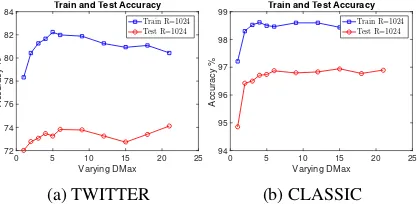
Figure 3: Train (Blue) and Test (Red) accuracy when varyingDwith fixedR.
Effects ofR.We investigate how the performance
changes when varying the number of Random Fea-turesRfrom 4 to 4096 with fixedD. Fig.2shows
that both training and testing accuracies
gener-ally converge very fast when increasing R from
a small number (R= 4) to a relatively large
num-ber (R = 1024), and then gradually reach to the
optimal performance. This confirms our analysis in Theory1that the proposed WME can guarantee the fast convergence to the exact kernel.
Effects ofD.We further evaluate the training and
testing accuracies when varying the length of ran-dom documentDwith fixedR. As shown in Fig.3,
we can see that near-peak performance can usually be achieved whenDis small (typicallyD 6).
This behavior illustrates two important aspects: (1)
using very few random words (e.g. D = 1) is
not enough to generate useful Random Features
whenRbecomes large; (2) using too many random
words (e.g.D 10) tends to generate similar and
redundant Random Features when increasingR.
Conceptually, the number of random words in a random document can be thought of as the number of the global topics in documents, which is gen-erally small. This is an important desired feature that confers both a performance boost as well as computational efficiency to the WME method.
4.2 Comparison with KNN-WMD
Baselines. We now compare two WMD-based
methods in terms of testing accuracy and total train-ing and testtrain-ing runtime. We consider two variants
of WME with different sizes of R. WME(LR)
stands for WME with large rank that achieves the best accuracy (usingRup to 4096) with more com-putational time, while WME(SR) stands for WME with small rank that obtains comparable accuracy in less time. We also consider two variants of both methods where +P denotes that we precompute the ground distance between each pair of words to avoid redundant computations.
Setup.Following (Kusner et al.,2015;Huang et al.,
2016), for datasets that do not have a predefined train/test split, we report average and standard devi-ation of the testing accuracy and average run-time of the methods over five 70/30 train/test splits. For WMD, we provide the results (with respect to ac-curacy) from (Kusner et al.,2015); we also reran the experiments of KNN-WMD and found them to be consistent with the reported results. For all methods, we perform 10-fold cross validation to search for the best parameters on the training docu-ments. We employ a linear SVM implemented us-ing LIBLINEAR (Fan et al.,2008) on WME since it can isolate the effectiveness of the feature repre-sentation from the power of the nonlinear learning solvers. For additional results on all KNN-based methods, please refer to AppendixB.3.
[image:6.595.77.287.351.453.2]advan-Table 2: Test accuracy, and total training and testing time (in seconds) of WME against KNN-WMD. Speedups are computed between the best numbers of KNN-WMD+P and these of WME(SR)+P when achieving similar testing accuracy. Bold face highlights the best number for each dataset.
Classifier KNN-WMD KNN-WMD+P WME(SR) WME(SR)+P WME(LR) WME(LR)+P
Dataset Accu Time Time Accu Time Time Accu Time Time Speedup
BBCSPORT 95.4±1.2 147 122 95.5±0.7 3 1 98.2±0.6 92 34 122
TWITTER 71.3±0.6 25 4 72.5±0.5 10 2 74.5±0.5 162 34 2
RECIPE 57.4±0.3 448 326 57.4±0.5 18 4 61.8±0.8 277 61 82
OHSUMED 55.5 3530 2807 55.8 24 7 64.5 757 240 401
CLASSIC 97.2±0.1 777 520 96.6±0.2 49 10 97.1±0.4 388 70 52
REUTERS 96.5 814 557 96.0 50 24 97.2 823 396 23
AMAZON 92.6±0.3 2190 1319 92.7±0.3 31 8 94.3±0.4 495 123 165
20NEWS 73.2 37988 32610 72.9 205 69 78.3 1620 547 472
RECIPE_L 71.4±0.5 5942 2060 72.5±0.4 113 20 79.2±0.3 1838 330 103
Table 3: Testing accuracy of WME against Word2Vec and Doc2Vec-based methods.
Dataset SIF(GloVe) Word2Vec+nbow Word2Vec+tf-idf PV-DBOW PV-DM Doc2VecC WME BBCSPORT 97.3±1.2 97.3±0.9 96.9±1.1 97.2±0.7 97.9±1.3 90.5±1.7 98.2±0.6
TWITTER 57.8±2.5 72.0±1.5 71.9±0.7 67.8±0.4 67.3±0.3 71.0±0.4 74.5±0.5
OHSUMED 67.1 63.0 60.6 55.9 59.8 63.4 64.5
CLASSIC 92.7±0.9 95.2±0.4 93.9±0.4 97.0±0.3 96.5±0.7 96.6±0.4 97.1±0.4
REUTERS 87.6 96.9 95.9 96.3 94.9 96.5 97.2
AMAZON 94.1±0.2 94.0±0.5 92.2±0.4 89.2±0.3 88.6±0.4 91.2±0.5 94.3±0.4
20NEWS 72.3 71.7 70.2 71.0 74.0 78.2 78.3
RECIPE_L 71.1±0.5 74.9±0.5 73.1±0.6 73.1±0.5 71.1±0.4 76.1±0.4 79.2±0.3
tages of WME compared to KNN-WMD in terms of both accuracy and runtime. First, WME(SR) can consistently achieve better or similar accuracy compared to KNN-WMD while requiring order-of-magnitude less computational time on all datasets. Second, both methods can benefit from precom-putation of the ground distance between a pair of words but WME gains much more from prefetch (typically 3-5x speedup). This is because the typ-ical lengthDof random documents is very short where computing ground distance between word vectors may be even more expensive than the corre-sponding WMD distance. Finally, WME(LR) can achieve much higher accuracy compared to KNN-WMD while still often requiring less computational time, especially on large datasets like 20NEWS and relatively long documents like OHSUMED.
4.3 Comparisons with Word2Vec & Doc2Vec
Baselines.We compare against 6 document
repre-sentations methods: 1)Smooth Inverse Frequency
(SIF) (Arora et al.,2017): a recently proposed sim-ple but tough to beat baseline for sentence embed-dings, combining a new weighted scheme of word embeddings with dominant component removal; 2)Word2Vec+nbow: a weighted average of word
vectors using NBOW weights; 3)
Word2Vec+tf-idf: a weighted average of word vectors using
TF-IDF weights; 4)PV-DBOW(Le and Mikolov,
2014): distributed bag of words model of
Para-graph Vectors; 5)PV-DM(Le and Mikolov,2014): distributed memory model of Paragraph Vectors; 6)Doc2VecC (Chen, 2017): a recently proposed document-embedding via corruptions, achieving state-of-the-art performance in text classification.
Setup. Word2Vec+nbow, Word2Vec+tf-idf and
WME use pre-trained Word2Vec embeddings while SIF uses its default pre-trained GloVe embeddings. Following (Chen, 2017), to enhance the
perfor-mance ofPV-DBOW,PV-DM, andDoc2VecCthese
methods are trained transductively on both train and test, which is indeed beneficial for generating a better document representation (see Appendix
B.4). In contrast, the hyperparameters of WME are obtained through a 10-fold cross validation only on training set. For a fair comparison, we run a linear SVM using LIBLINEAR on all methods.
Results.Table3shows that WME consistently
out-performs or matches existing state-of-the-art doc-ument representation methods in terms of testing accuracy on all datasets except one (OHSUMED). The first highlight is that simple average of word embeddings often achieves better performance than
SIF(Glove), indicating that removing the first prin-ciple component could hurt the expressive power of the resulting representation for some of clas-sification tasks. Surprisingly, these two methods often achieve similar or better performance than
[image:7.595.106.491.252.327.2]Table 4: Pearson’s scores of WME against other unsupervised, semi-supervised, and supervised methods on 22 textual similarity tasks. Results are collected from (Arora et al.,2017) except our approach.
Approaches Supervised Unsupervised Semi-supervised
WordEmbeddings PSL GloVe PSL
Tasks PP Dan RNN iRNN LSTM(no) LSTM(o.g.) ST nbow tf-idf SIF WME SIF WME
STS’12 58.7 56.0 48.1 58.4 51.0 46.4 30.8 52.5 58.7 56.2 60.6 59.5 62.8
STS’13 55.8 54.2 44.7 56.7 45.2 41.5 24.8 42.3 52.1 56.6 54.5 61.8 56.3
STS’14 70.9 69.5 57.7 70.9 59.8 51.5 31.4 54.2 63.8 68.5 65.5 73.5 68.0
STS’15 75.8 72.7 57.2 75.6 63.9 56.0 31.0 52.7 60.6 71.7 61.8 76.3 64.2
SICK’14 71.6 70.7 61.2 71.2 63.9 59.0 49.8 65.9 69.4 72.2 68.0 72.9 68.1
Twitter’15 52.9 53.7 45.1 52.9 47.6 36.1 24.7 30.3 33.8 48.0 41.6 49.0 47.4
the other hand, Doc2VecC achieves much better
testing accuracy than these previous methods on two datasets (20NEWS, and RECIPE_L). This is mainly because that it benefits significantly from transductive training (See AppendixB.4). Finally, the better performance of WME over these strong baselines stems from fact that WME is empow-ered by two important building blocks, WMD and Word2Vec, to yield a more informative representa-tion of the documents by considering both the word alignments and the semantics of words.
We refer the readers to additional results on the Imdb dataset in AppendixB.4, which also demon-strate the clear advantage of WME even compared to the supervised RNN method as well as the afore-mentioned baselines.
4.4 Comparisons on textual similarity tasks
Baselines. We compare WME against 10
super-vised, simi-sepersuper-vised, and unsupervised methods for performing textual similarity tasks. Six su-pervised methods are initialized with Paragram-SL999(PSL) word vectors (Wieting et al.,2015b) and then trained on the PPDB dataset, includ-ing: 1)PARAGRAM-PHRASE(PP) (Wieting et al.,
2015a): simple average of refined PSL word
vec-tors; 2) Deep Averaging Network (DAN) (Iyyer
et al., 2015); 3) RNN: classical recurrent neural network; 4)iRNN: a variant of RNN with the acti-vation being the identify; 5)LSTM(no)(Gers et al.,
2002): LSTM with no output gates; 6)LSTM(o.g.)
(Gers et al.,2002): LSTM with output gates. Four unsupervised methods are: 1)Skip-Thought Vectors
(ST) (Kiros et al.,2015): an encoder-decoder RNN model for generalizing Skip-gram to the sentence level; 2) nbow: simple averaging of pre-trained GloVe word vectors; 3)tf-idf: a weighted average of GloVe word vecors using TF-IDF weights; 4)
SIF(Arora et al.,2017): a simple yet strong method on textual similarity tasks using GloVe word vecors. Two semi-supervised methods use PSL word
vec-tors, which are trained using labeled data (Wieting et al.,2015b).
Setup.There are total 22 textual similarity datasets
from STS tasks (2012-2015) (Agirre et al.,2012,
2013,2014,2015), SemEval 2014 Semantic Relat-edness task (Xu et al.,2015), and SemEval 2015 Twitter task (Marelli et al.,2014). The goal of these tasks is to predict the similarity between two input sentences. Each year STS usually has 4 to 6 differ-ent tasks and we only report the averaged Pearson’s scores for clarity. Detailed results on each dataset are listed in AppendixB.5.
Results. Table 4 shows that WME consistently
matches or outperforms other unsupervised and su-pervised methods except theSIFmethod. Indeed,
compared withSTandnbow, WME improves
Pear-son’s scores substantially by 10% to 33% as a re-sult of the consideration of word alignments and the use of TF-IDF weighting scheme. tf-idf also improves over these two methods but is slightly worse than our method, indicating the importance of taking into account the alignments between the words. SIF method is a strong baseline for tex-tual similarity tasks but WME still can beat it on STS’12 and achieve close performance in other cases. Interestingly, WME is on a par with three su-pervised methodsRNN,LSTM(no), andLSTM(o.g.)
in most cases. The final remarks stem from the fact that, WME can gain significantly benefit from the supervised word embeddings similar toSIF, both showing strong performance on PSL.
5 Related Work
Two broad classes ofunsupervisedandsupervised
methods have been proposed to generate sentence and document representations. The former primar-ily generate general purpose and domain indepen-dent embeddings of word sequences (Socher et al.,
on either training an auto-encoder to learn the la-tent structure of a sentence (Socher et al.,2013), a paragraph, or document (Li et al.,2015); or gen-eralizing Word2Vec models to predict words in a paragraph (Le and Mikolov,2014;Chen,2017) or in neighboring sentences (Kiros et al.,2015). How-ever, some important information could be lost in the resulting document representation without con-sidering the word order. Our proposed WME over-comes this difficulty by considering the alignments between each pair of words.
The other line of work has focused on developing compositional supervised models to create a vector representation of sentences (Kim et al.,2016;Gong et al., 2018b). Most of this work proposed com-position using recursive neural networks based on parse structure (Socher et al.,2012,2013), deep av-eraging networks over bag-of-words models (Iyyer et al.,2015;Wieting et al.,2015a), convolutional neural networks (Kim,2014;Kalchbrenner et al.,
2014;Xu et al., 2018), and recurrent neural net-works using long short-term memory (Tai et al.,
2015;Liu et al.,2015). However, these methods are less well suited for domain adaptation settings.
6 Conclusion
In this paper, we have proposed an alignment-aware text kernel using WMD for texts of variable lengths, which takes into account both word alignments and pre-trained high quality word embeddings in learning an effective semantics-preserving feature representation. The proposed WME is simple, ef-ficient, flexible, and unsupervised. Extensive ex-periments show that WME consistently matches or outperforms state-of-the-art models on various text classification and textual similarity tasks. WME embeddings can be easily used for a wide range of downstream supervised and unsupervised tasks.
References
Eneko Agirre, Carmen Banea, Claire Cardie, Daniel M Cer, Mona T Diab, Aitor Gonzalez-Agirre, Weiwei Guo, Inigo Lopez-Gazpio, Montse Maritxalar, Rada Mihalcea, et al. 2015. Semeval-2015 task 2: Seman-tic textual similarity, english, spanish and pilot on interpretability. In SemEval@ NAACL-HLT, pages 252–263.
Eneko Agirre, Carmen Banea, Claire Cardie, Daniel M Cer, Mona T Diab, Aitor Gonzalez-Agirre, Weiwei Guo, Rada Mihalcea, German Rigau, and Janyce Wiebe. 2014. Semeval-2014 task 10: Multilingual
semantic textual similarity. InSemEval@ COLING, pages 81–91.
Eneko Agirre, Daniel Cer, Mona Diab, Aitor Gonzalez-Agirre, and Weiwei Guo. 2013. sem 2013 shared task: Semantic textual similarity, including a pilot on typed-similarity. InIn* SEM 2013: The Second Joint Conference on Lexical and Computational Se-mantics. Association for Computational Linguistics. Citeseer.
Eneko Agirre, Mona Diab, Daniel Cer, and Aitor Gonzalez-Agirre. 2012. Semeval-2012 task 6: A pi-lot on semantic textual similarity. InProceedings of the First Joint Conference on Lexical and Computa-tional Semantics-Volume 1: Proceedings of the main conference and the shared task, and Volume 2: Pro-ceedings of the Sixth International Workshop on Se-mantic Evaluation, pages 385–393. Association for Computational Linguistics.
Jason Altschuler, Jonathan Weed, and Philippe Rigollet. 2017. Near-linear time approximation algorithms for optimal transport via sinkhorn iteration. In Ad-vances in Neural Information Processing Systems, pages 1964–1974.
Sanjeev Arora, Yuanzhi Li, Yingyu Liang, Tengyu Ma, and Andrej Risteski. 2016. A latent variable model approach to pmi-based word embeddings. Transac-tions of the Association for Computational Linguis-tics, 4:385–399.
Sanjeev Arora, Yingyu Liang, and Tengyu Ma. 2017. A simple but tough-to-beat baseline for sentence em-beddings. InICLR.
Yoshua Bengio, Réjean Ducharme, Pascal Vincent, and Christian Jauvin. 2003. A neural probabilistic lan-guage model. Journal of machine learning research, 3(Feb):1137–1155.
David M Blei, Andrew Y Ng, and Michael I Jordan. 2003. Latent dirichlet allocation. Journal of ma-chine Learning research, 3(Jan):993–1022.
François Bourgeois and Jean-Claude Lassalle. 1971. An extension of the munkres algorithm for the as-signment problem to rectangular matrices. Commu-nications of the ACM, 14(12):802–804.
Chris Buckley, Gerard Salton, James Allan, and Amit Singhal. 1995. Automatic query expansion using smart: Trec 3. NIST special publication sp, pages 69–69.
Minmin Chen. 2017. Efficient vector representation for documents through corruption. InICLR.
Scott Deerwester, Susan T Dumais, George W Fur-nas, Thomas K Landauer, and Richard Harshman. 1990. Indexing by latent semantic analysis. Jour-nal of the American society for information science, 41(6):391.
Rong-En Fan, Kai-Wei Chang, Cho-Jui Hsieh, Xiang-Rui Wang, and Chih-Jen Lin. 2008. Liblinear: A library for large linear classification. Journal of ma-chine learning research, 9(Aug):1871–1874.
Felix A Gers, Nicol N Schraudolph, and Jürgen Schmidhuber. 2002. Learning precise timing with lstm recurrent networks. Journal of machine learn-ing research, 3(Aug):115–143.
Xavier Glorot, Antoine Bordes, and Yoshua Bengio. 2011. Domain adaptation for large-scale sentiment classification: A deep learning approach. In Pro-ceedings of the 28th international conference on ma-chine learning (ICML-11), pages 513–520.
Hongyu Gong, Suma Bhat, and Pramod Viswanath. 2018a. Embedding syntax and semantics of prepo-sitions via tensor decomposition. InProceedings of the 2018 Conference of the North American Chap-ter of the Association for Computational Linguistics: Human Language Technologies, Volume 1 (Long Pa-pers), volume 1, pages 896–906.
Hongyu Gong, Jiaqi Mu, Suma Bhat, and Pramod Viswanath. 2017. Prepositions in context. arXiv preprint arXiv:1702.01466.
Hongyu Gong, Tarek Sakakini, Suma Bhat, and JinJun Xiong. 2018b. Document similarity for texts of vary-ing lengths via hidden topics. In ACL, volume 1, pages 2341–2351.
Tom Griffiths and Mark Steyvers. 2007. Probabilistic topic models. Latent Semantic Analysis: A Road to Meaning.
Jie Gui, Tongliang Liu, Dacheng Tao, Zhenan Sun, and Tieniu Tan. 2016. Representative vector machines: a unified framework for classical classifiers. IEEE transactions on cybernetics, 46(8):1877–1888.
Jie Gui, Zhenan Sun, Jun Cheng, Shuiwang Ji, and Xindong Wu. 2014. How to estimate the regulariza-tion parameter for spectral regression discriminant analysis and its kernel version? IEEE Transac-tions on Circuits and Systems for Video Technology, 24(2):211–223.
Bernard Haasdonk and Claus Bahlmann. 2004. Learn-ing with distance substitution kernels. In Joint Pattern Recognition Symposium, pages 220–227. Springer.
Frank L Hitchcock. 1941. The distribution of a product from several sources to numerous localities. Studies in Applied Mathematics, 20(1-4):224–230.
Gao Huang, Chuan Guo, Matt J Kusner, Yu Sun, Fei Sha, and Kilian Q Weinberger. 2016. Supervised word mover’s distance. InAdvances in Neural In-formation Processing Systems, pages 4862–4870.
Mohit Iyyer, Varun Manjunatha, Jordan Boyd-Graber, and Hal Daumé III. 2015. Deep unordered com-position rivals syntactic methods for text classifica-tion. InProceedings of the 53rd Annual Meeting of the Association for Computational Linguistics and the 7th International Joint Conference on Natural Language Processing (Volume 1: Long Papers), vol-ume 1, pages 1681–1691.
Nal Kalchbrenner, Edward Grefenstette, and Phil Blun-som. 2014. A convolutional neural network for mod-elling sentences.arXiv preprint arXiv:1404.2188.
Yoon Kim. 2014. Convolutional neural net-works for sentence classification. arXiv preprint arXiv:1408.5882.
Yoon Kim, Yacine Jernite, David Sontag, and Alexan-der M Rush. 2016. Character-aware neural language models. InThirtieth AAAI Conference on Artificial Intelligence.
Ryan Kiros, Yukun Zhu, Ruslan R Salakhutdinov, Richard Zemel, Raquel Urtasun, Antonio Torralba, and Sanja Fidler. 2015. Skip-thought vectors. In Advances in neural information processing systems, pages 3294–3302.
Matt Kusner, Yu Sun, Nicholas Kolkin, and Kilian Weinberger. 2015. From word embeddings to docu-ment distances. InInternational Conference on Ma-chine Learning, pages 957–966.
Quoc V Le and Tomas Mikolov. 2014. Distributed rep-resentations of sentences and documents. InICML, volume 14, pages 1188–1196.
Jiwei Li, Minh-Thang Luong, and Dan Jurafsky. 2015. A hierarchical neural autoencoder for paragraphs and documents.arXiv preprint arXiv:1506.01057.
Pengfei Liu, Xipeng Qiu, Xinchi Chen, Shiyu Wu, and Xuanjing Huang. 2015. Multi-timescale long short-term memory neural network for modelling sentences and documents. In Proceedings of the 2015 conference on empirical methods in natural language processing, pages 2326–2335.
Marco Marelli, Luisa Bentivogli, Marco Baroni, Raf-faella Bernardi, Stefano Menini, and Roberto Zam-parelli. 2014. Semeval-2014 task 1: Evaluation of compositional distributional semantic models on full sentences through semantic relatedness and textual entailment. InSemEval@ COLING, pages 1–8.
Tomas Mikolov, Quoc V Le, and Ilya Sutskever. 2013b. Exploiting similarities among languages for ma-chine translation. arXiv preprint arXiv:1309.4168.
Tomas Mikolov, Ilya Sutskever, Kai Chen, Greg S Cor-rado, and Jeff Dean. 2013c. Distributed representa-tions of words and phrases and their compositional-ity. InAdvances in neural information processing systems, pages 3111–3119.
Xi Peng, Rogerio S Feris, Xiaoyu Wang, and Dim-itris N Metaxas. 2016. A recurrent encoder-decoder network for sequential face alignment. In Euro-pean conference on computer vision, pages 38–56. Springer, Cham.
Xi Peng, Shaoting Zhang, Yu Yang, and Dimitris N Metaxas. 2015. Piefa: Personalized incremental and ensemble face alignment. In Proceedings of the IEEE international conference on computer vision, pages 3880–3888.
Jeffrey Pennington, Richard Socher, and Christopher D Manning. 2014. Glove: Global vectors for word representation. InEMNLP, volume 14, pages 1532– 1543.
Hieu Pham, Minh-Thang Luong, and Christopher D Manning. 2015. Learning distributed representa-tions for multilingual text sequences. In Proceed-ings of NAACL-HLT, pages 88–94.
Ali Rahimi and Benjamin Recht. 2007. Random fea-tures for large-scale kernel machines. InAdvances in Neural Information Processing Systems, page 5.
Stephen E Robertson and Steve Walker. 1994. Some simple effective approximations to the 2-poisson model for probabilistic weighted retrieval. InACM SIGIR conference on Research and development in information retrieval.
Stephen E Robertson, Steve Walker, Susan Jones, Micheline M Hancock-Beaulieu, Mike Gatford, et al. 1995. Okapi at trec-3. Nist Special Publication Sp, 109:109.
Yossi Rubner, Carlo Tomasi, and Leonidas J Guibas. 2000. The earth mover’s distance as a metric for image retrieval. International journal of computer vision, 40(2):99–121.
Gerard Salton and Christopher Buckley. 1988. Term-weighting approaches in automatic text retrieval. In-formation processing & management, 24(5):513– 523.
Richard Socher, Eric H Huang, Jeffrey Pennin, Christo-pher D Manning, and Andrew Y Ng. 2011. Dy-namic pooling and unfolding recursive autoencoders for paraphrase detection. InAdvances in neural in-formation processing systems, pages 801–809.
Richard Socher, Brody Huval, Christopher D Man-ning, and Andrew Y Ng. 2012. Semantic composi-tionality through recursive matrix-vector spaces. In
EMNLP, pages 1201–1211. Association for Compu-tational Linguistics.
Richard Socher, Alex Perelygin, Jean Y Wu, Jason Chuang, Christopher D Manning, Andrew Y Ng, Christopher Potts, et al. 2013. Recursive deep mod-els for semantic compositionality over a sentiment treebank. InEMNLP.
Kai Sheng Tai, Richard Socher, and Christopher D Manning. 2015. Improved semantic representations from tree-structured long short-term memory net-works.arXiv preprint arXiv:1503.00075.
Sida Wang and Christopher D Manning. 2012. Base-lines and bigrams: Simple, good sentiment and topic classification. In Proceedings of the 50th Annual Meeting of the Association for Computational Lin-guistics: Short Papers-Volume 2, pages 90–94. As-sociation for Computational Linguistics.
John Wieting, Mohit Bansal, Kevin Gimpel, and Karen Livescu. 2015a. Towards universal para-phrastic sentence embeddings. arXiv preprint arXiv:1511.08198.
John Wieting, Mohit Bansal, Kevin Gimpel, Karen Livescu, and Dan Roth. 2015b. From paraphrase database to compositional paraphrase model and back. Transactions of the ACL (TACL).
Lingfei Wu, Eloy Romero, and Andreas Stathopou-los. 2017. Primme_svds: A high-performance pre-conditioned svd solver for accurate large-scale com-putations. SIAM Journal on Scientific Computing, 39(5):S248–S271.
Lingfei Wu and Andreas Stathopoulos. 2015. A pre-conditioned hybrid svd method for accurately com-puting singular triplets of large matrices. SIAM Jour-nal on Scientific Computing, 37(5):S365–S388. Lingfei Wu, Ian En-Hsu Yen, Fnagli Xu, Pradeep
Ravikumar, and Witbrock Michael. 2018a. D2ke: From distance to kernel and embedding. https://arxiv.org/abs/1802.04956.
Lingfei Wu, Ian En-Hsu Yen, Jinfeng Yi, Fangli Xu, Qi Lei, and Michael Witbrock. 2018b. Random warping series: A random features method for time-series embedding. InInternational Conference on Artificial Intelligence and Statistics, pages 793–802. Kun Xu, Lingfei Wu, Zhiguo Wang, and Vadim Sheinin. 2018. Graph2seq: Graph to sequence learn-ing with attention-based neural networks. arXiv preprint arXiv:1804.00823.
Wei Xu, Chris Callison-Burch, and Bill Dolan. 2015. Semeval-2015 task 1: Paraphrase and semantic sim-ilarity in twitter (pit). InSemEval@ NAACL-HLT, pages 1–11.