3981
Better Conversations by Modeling, Filtering, and Optimizing for
Coherence and Diversity
Xinnuo Xu, Ondˇrej Duˇsek, Ioannis Konstas and Verena Rieser
The Interaction Lab, School of Mathematical and Computer Sciences Heriot-Watt University, Edinburgh
xx6, o.dusek, i.konstas, [email protected]
Abstract
We present three enhancements to exist-ing encoder-decoder models for open-domain conversational agents, aimed at effectively modeling coherence and promoting output di-versity: (1) We introduce a measure of co-herence as the GloVe embedding similarity between the dialogue context and the gener-ated response, (2) we filter our training cor-pora based on the measure of coherence to obtain topically coherent and lexically diverse context-response pairs, (3) we then train a re-sponse generator using a conditional varia-tional autoencoder model that incorporates the measure of coherence as a latent variable and uses a context gate to guarantee topical con-sistency with the context and promote lexical diversity. Experiments on the OpenSubtitles corpus show a substantial improvement over competitive neural models in terms of BLEU score as well as metrics of coherence and di-versity.
1 Introduction
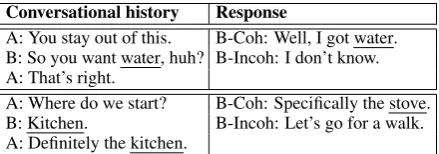
End-to-end neural response generation methods are promising for developing open domain dia-logue systems as they allow to learn from very large unlabeled datasets (Shang et al.,2015; Sor-doni et al., 2015; Vinyals and Le, 2015). How-ever, these models have also been shown to gen-erate generic, uninformative, and non-coherent replies (e.g.,“I don’t know.” in Figure1), mainly due to the fact that neural systems tend to set-tle for the most frequent options, thus penaliz-ing length and favorpenaliz-ing high-frequency word se-quences (Sountsov and Sarawagi,2016;Wei et al., 2017).
To address these problems,Li et al.(2016a) and Li et al. (2017a) attempt to promote diversity by improving the objective function, but do not model diversity explicitly. Serban et al.(2017) focus on
Conversational history Response
A: You stay out of this. B-Coh: Well, I got water. B: So you want water, huh? B-Incoh: I don’t know. A: That’s right.
[image:1.595.308.528.221.298.2]A: Where do we start? B-Coh: Specifically the stove. B: Kitchen. B-Incoh: Let’s go for a walk. A: Definitely the kitchen.
Figure 1: Examples of conversational history (left) with two alternative responses to follow it (right): (B-Coh) a more coherent, topical utterance, and (B-Incoh) a generic, inconsistent response.
model structure without any upgrades to the ob-jective function. Other works control the style of the output by leveraging external resources (Hu et al.(2017): sentiment classifier, time annotation; Zhao et al.(2017): dialogue acts) or focus on well-structured input such as paragraphs (Li and Juraf-sky,2017).
This paper extends previous attempts to model diversity and coherence by enhancing all three as-pects of the learning process: the data, the model, and the objective function. While previous re-search has addressed these aspects individually, this paper is the first to address all three in a uni-fied framework. Instead of using existing linguis-tic knowledge or labeled datasets, we aim to con-trol for coherence by learning directly from data, using a fully unsupervised approach. This is also the first work encoding and evaluating coherence explicitly in the dialogue generation task, as op-posed to using diversity, style, or other properties of responses as a proxy.
the previous two utterances and containing rich thematic words, whereas the response “Let’s go for a walk.”is unrelated and uninteresting.
In order to obtain coherent responses, we present three generic enhancements to existing encoder-decoder (E-D) models:
1. We define ameasure of coherencesimply as the averaged word embedding similarity between the words of the context and the response com-puted using GloVe vectors (Pennington et al., 2014).
2. We filter a corpus of conversations based on our measure of coherence, which leaves us with context-response pairs that are both topically coherent and lexically diverse.
3. We train an E-D generator recast as a con-ditional Variational Autoencoder (cVAE;Zhao et al.,2017) model that incorporates two latent variables, one for encoding the context and an-other for conditioning on the measure of co-herence, trained jointly as inHu et al. (2017). We then decode using a context gate (Tu et al., 2017) to control the generation of words that directly relate to the most topical words of the context and promote coherence.
Experiments on the OpenSubtitles (Lison and Meena, 2016) corpus demonstrate the effective-ness of the overall approach. Our models achieve a substantial improvement over competitive neural models. We provide an ablation analysis, quanti-fying the contributions that come from effective modeling of coherence into our models. All our experimental code is freely available on GitHub.1
2 Coherence-based Dialogue Generation
Our model aims to generate responses given a dialogue context, incorporating measures of co-herence estimated purely from the training data. We propose the following enhancements to the attention-based E-D architecture (Bahdanau et al., 2015;Luong et al.,2015):
• We introduce a stochastic latent variablez con-ditioned on previous dialogue context to store the global information about the conversation (Bowman et al., 2016; Chung et al., 2015; Li and Jurafsky,2017;Hu et al.,2017).
1https://github.com/XinnuoXu/CVAE_Dial
• We force the model to condition on the mea-sure of coherence explicitly by encoding a la-tent variable (code)clearned from data.
• We incorporate a context gate (Tu et al.,2017) that dynamically controls the ratio at which the generated words in the response derive di-rectly from the coherence-enhanced dialogue context or the previously generated parts of the response.
In the rest of this section, we introduce the mea-sure of coherence (Section 2.1), we present an overview of our model (Section 2.2), and finally describe the model in detail (Sections2.3–2.4).
2.1 Measure of Dialogue Coherence
Semantic vector space models of language repre-sent each word with a real-valued word embed-ding vector (Pennington et al., 2014). By simply taking a weighted average of all its word embed-dings, a whole sentence can be mapped into the semantic vector space. We define the coherence of a dialogue as the average distance between se-mantic vectors of preceding dialogue context and its response.
Let x = {x1, . . . xj, . . . xJ} represent a
dia-logue context and y = {y1, . . . yi, . . . yI} a
re-sponse. J and I are the numbers of words in the dialogue context and its response, respectively. Semantic vector space models map each wordxj
into embeddingsxembj , andyi intoyembi . The
se-mantic representation of a dialogue context x is thenxemb = PJ
j=1wjxembj ; for a responsey, it
isyemb=PI
i=1viyembi . Here,wj andvi are
im-portance weights for each word in the sentence.2 The measure of coherence is then defined as the cosine distance of the two semantic vectors of the dialogue context and its response:
C(x,y) = cos
xemb,yemb
(1)
2.2 Model Overview
End-to-end response generation for dialogue can be formalized as follows: Given a dialogue con-textx, a dialogue generator generates the next ut-terancey. During the training process, the aim for a dialogue generator is to maximize the probabil-ity p(y|x) over the training dataset. To encode
2We set the importance weights to 0 for a list of stop
dialogue contexts that adequately incorporate co-herence information, we build our generator based on the cVAE model ofHu et al.(2017), which has been used to control text generation with respect to linguistic properties, such as tense or sentiment. In our model, the responseyis generated condi-tioned on the previous conversationx, a diversity-promoting latent variablez, and a latent variable c indicating dialogue coherence; z and c are in-dependent. The generation probability p(y|x)is defined as:
p(y|x) =
Z
z,c
p(y|x,z, c)p(z, c|x) dzdc
=
Z
z,c
p(y|x,z, c)p(z|x)p(c|x) dzdc
(2)
Unfortunately, optimizing Eq (2) during train-ing is intractable; therefore, we apply variational inference and optimize instead the variational lower bound:
logp(y|x) = log
Z
z,c
p(y|x,z, c)p(z, c|x) dzdc
≥Eq(z|x,y)p(c|x,y)[logp(y|x,z, c)]
−DKL(q(z|x,y)kp(z|x))
(3)
where p(y|x,z, c) is the probability of gener-ating utterance y given x, z and c; q(z|x,y)
stands for the approximate posterior distribution of the latent variable z conditioned on dialogue context x and the gold response y; p(c|x,y)
is the measure of coherence between context x
and responsey; p(z|x)is the true prior distribu-tion ofzconditioned only on dialogue contextx; DKL(·|·)denotes the KL-divergence. We assume
that bothq(z|x,y)andp(z|x)are Gaussian with mean vectorsµappr,µtrueand covariance matrices Σappr,Σtrue.
2.2.1 Model Details
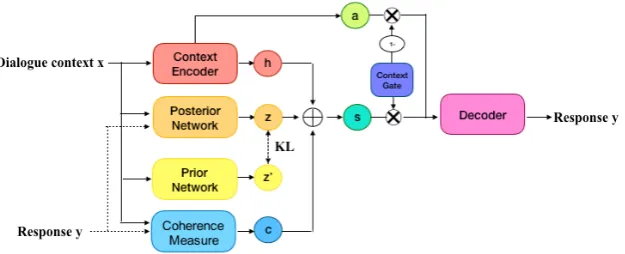
Optimizing Eq (3) consists of two parts: (1) min-imizing the KL-divergence between the approxi-mate posterior distribution and the true prior dis-tribution of z, (2) maximizing the probability of generating the gold responseyconditioned on di-alogue context x and coherence factors z andc. Figure2shows the pipeline of the training proce-dure.
Encoder: First, we encode a dialogue contextx
into a hidden state h using the context encoder, which is based on Recurrent Neural Networks (RNNs). Then theposterior networkencodes both dialogue contextxand gold responseyinto a hid-den state happr followed by two linear
transfor-mationsfappr(·) andgappr(·) to maphappr into
mean vector µappr and covariance matrix Σappr.
The latent variablezcan be sampled from the dis-tributionN(µappr,Σappr):
µappr =fappr(happr)
Σappr =gappr(happr)
q(z|x,y) =N(µappr,Σappr)
(4)
Theprior networkin Figure2takes a form similar to the posterior network:
µtrue =ftrue(htrue)
Σtrue =gtrue(htrue)
p(z|x) =N(µtrue,Σtrue)
(5)
wherehtrueis the final hidden state of an RNN
en-coding only the dialogue contextx, andftrue(·),
gtrue(·) are linear transformations. Code c is
given by thecoherence measurefrom Eq (1).
Decoder: We build an attention-based decoder (Bahdanau et al.,2015;Luong et al.,2015) using RNNs to generate responses conditioned on en-coded dialogue contexth, diversity signalz, and coherence signalc. We concatenate the latent vari-ableszandcto the context encoder hidden stateh
and feed them into the decoder as the initial hidden states0, similar toHu et al.(2017).
During the decoding process, tokens are gener-ated sequentially under the following probability distribution:
p(y|x,z, c) = I
Y
i=1
p yi|y<i,x,z, c
= I
Y
i=1
g(yi−1,si,ai)
(6)
where I is the length of the produced response; g(·) is an RNN;si is the hidden state of the
de-coder at time step i which is conditioned on the previously generated tokenyi−1, the previous
Figure 2: The training process of the generative model. First, the dialogue context is encoded:his the final hidden state of the context encoder. Then we derive the diversity-promoting latent variablez. Next, we compute the latent variablecthat corresponds to the measure of coherence between the dialogue contextxand the generated response
y. We concatenate all three vectors intosto feed the decoder. ais the attention matrix calculated for every time step of the decoding process.
ai:
si=f(yi−1,si−1,ai) (7)
ai= J
X
j=1
wijhi (8)
whereJ is the number of tokens of the dialogue context; hi is theith hidden state of the encoder;
the attention weight wij of each context hidden
statehiis computed followingLuong et al.(2015).
Context Gate: To increase the influence of code c, we introduce the context gatek. UnlikeTu et al. (2017), whose context gate assigns an element-wise weight to the input signal deriving from the encoder RNN, we build the context gate condi-tioned only on the coherence signal:
ki =λσ c−c0i
(9)
whereσis the sigmoid function;λis a bias term;3 cis the target value of the measure of coherence, calculated byC(x,y)(see Section 2.1);c0i is the measure of coherence between the dialogue con-text and the generated prefix sentence at time step i, calculated byC x,y<i
. Now Eq (7) with the context gate applied tosican be rewritten as:
si =f yi−1,(1−ki)◦si−1, ki◦ai
(10)
where◦denotes element-wise multiplication. The coherence-informed context gate aims to dynamically control the ratio at which preceding dialogue context and previously generated tokens of the current response contribute to the generation of the next token in the response.
3We setλempirically against the development set.
2.3 Training
Our generator is trained similarly to Hu et al. (2017). The objective function is a weighted com-bination of three losses (generation, coherence, and diversity):
L=LG+λcLc+λzLz (11)
To teach the generator to produce responses close to the training data, we maximize the generation probability of the training response logp(y|x)
given the dialogue context according to Eq (2). During training, we setLG = −logp(y|x) and minimize the following:
LG=DKL(q(z|x,y)kp(z|x))
−Eq(z|x,y)p(c|x,y)[logp(y|x,z, c)] (12)
Apart from the generation loss, the coherence measure provides an extra learning signal Lc
which pushes the generator to produce responses that match the coherence signal given by the latent variablec.
Lc=−Ep(z|x)p(c)
h
logp
c|x,Ge(x,z, c) i
(13)
In Eq (13),p(c) = N(0,1)is the prior distribu-tion of the coherence variable c. To ensure that the loss is differentiable, we cannot sample words from the response vocabulary. Instead we define
e
G(x,z, c) = ys ={ys1, . . .ysi, . . .ysI}as the se-quence of output word probability distributions. p
c|x,Ge(x,z, c)
is predicted by the coherence
measure defined in Eq (1) withyembset as:
yemb= I
X
i=1
whereMglvis the word embedding matrix trained
using GloVe (Section2.1).
The last component in Eq (11) is the indepen-dent constraintLzthat forces the soft distribution over the generated response Ge to be diverse, so that it is able to faithfully reproduce the latent vari-ablez:
Lz=−Ep(z|x)p(c)
h
logq
z|x,Ge(x,z, c) i
(15) whereqz|x,Ge(x,z, c)
is predicted by the pos-terior network withysjas the soft input to the RNN encoder at each time stepj.
2.4 Inference
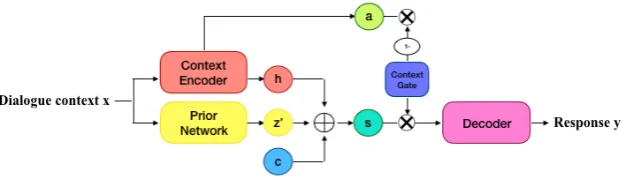
Figure3 shows the inference process of the gen-erative model. Given a dialogue contextxand an expected coherence value c, the context encoder first encodes the dialogue context into a hidden stateh. The prior network then generates a sam-ple z0 conditioned on the dialogue context. The decoder is initialized with s, i.e., the concatena-tion of h, z and c. During decoding, the next word is generated via the context gate modulating between the attention-reweighted context and the previously generated words of the response.
3 Dataset and Filtering
Dataset for Generator
We train and evaluate our models on the OpenSub-titles corpus (Lison and Tiedemann, 2016) with automatic dialogue turn segmentation (Lison and Meena,2016).4 A training pair consists of a dia-logue context and a corresponding response. We consider three consecutive turns as the dialogue context and the following turn as the response. From a total of 65M instances, we select those that have context and response lengths of less than 120 and 30 words, respectively. We create two datasets:
1. OST (plain OpenSubtitles) consists of 2M/4K/4K instances as our train-ing/development/test sets, selected randomly from the whole corpus;
2. fOST (filtered OpenSubtitles) contains the same amount of instances, but randomly se-lected only among those that have a measure of
4http://www.opensubtitles.org
Dataset Coh D-1% D-2% D-Sent%
OST 0.390 14.3 57.9 83.8
fOST 0.801 15.5 62.9 89.3
Table 1: Coherence and diversity metrics7for the OST and fOST datasets (see Section3for the datasets and Section4.2for metrics definition).
coherence scoreC(x,y)≥0.68.5
Filtering of the OpenSubtitles corpus is moti-vated by the fact that by removing the video and audio modalities which the subtitles originally ac-companied, we are very often left with incomplete and incoherent dialogues. Therefore, by keep-ing dialogues with high coherence scores, we aim at building a high quality corpus with (1) more semantically coherent and topically related con-texts and responses, and (2) fewer general and dull responses. Table3shows the coherence and diversity metrics (cf. Section 4.2) between OST and fOST. Unsurprisingly, coherence for fOST is much higher than OST, with a slightly higher di-versity. We list dialogue examples for different co-herence scores in Supplemental MaterialB.
Dataset for Coherence Measure
In order to accurately measure coherence on our domain using the semantic distance as defined in Section 2.1, we train GloVe embeddings on the full OpenSubtitles corpus (i.e. 100K movies).
4 Experiments
Our generator model, ablative variants, and base-lines are implemented using the publicly avail-able OpenNMT-py framework (Klein et al.,2017) based onBahdanau et al.(2015) andLuong et al. (2015). We used the publicly available glove-python package8 to implement our coherence measure.
We experiment on two versions of our model: (1) cVAE with the coherence context gate as de-scribed in Section 2.3 (cVAE-XGate), (2) cVAE with the original context gate implementation of
5The coherence score is calculated as shown in Eq (1).
We observed that the scores on the training set follow a nor-mal distribution with a slight tail on the negatively correlated side, so we fit a normal distribution to the data with parame-tersN(0.25,0.22)and set the cut-off to+2σ. A histogram of coherence scores is shown in Figure 5in Supplemental MaterialA.
7
Note that Distinct-1 and Distinct-2 are computed on a randomly selected subsets of 4k responses.
8https://github.com/maciejkula/
[image:5.595.319.513.63.93.2]Figure 3: The inference process of the generative model, where the latent variablecis given as an input.
(Tu et al.,2017) (cVAE-CGate). For each of these, we consider the main variant where the input co-herence measurecis preset to a fixed ideal value as estimated on development data (1.0 for OST and 0.95 for fOST), as well as an oracle variant where we use the true coherence measure between the context and the gold-standard response in the test set (indicated with “(C)” in Tables2and3).
We compare against two baseline models: (1) a vanilla E-D with attention (Attention) (Luong et al., 2015); (2) an enhancement where output beams are rescored using the maximum mutual in-formation anti-language model (MMI-antiLM) of Li et al.(2016a) (MMI).
4.1 Parameter Settings
We set our model parameters based on preliminary experiments on the development data.
We use 2-layer RNNs with LSTM cells (Hochreiter and Schmidhuber, 1997) with in-put/hidden dimension of 128 for both the context encoder and the decoder. The dropout rate is set to 0.2 and the Adam optimizer (Kingma and Ba, 2015) is used to update the parameters. A vocab-ulary of 25,000 words is shared between the en-coder and the deen-coder.
Both the posterior network and prior network for the latent variable learning are built with 2-layer LSTM RNNs with input/hidden dimension of 64. The dimension of the latent variablezis set to 20. Same as for the encoder and decoder, the dropout rate is 0.2 and the Adam optimizer is used to update the parameters.
The window size for GloVe computation in our coherence measure is set to 10.
4.2 Evaluation metrics
We use a number of metrics to evaluate the outputs of our models:
• BLEU, B1, B2, B3 – the word-overlap score against gold-standard responses (Papineni et al.,2002) used by the vast majority of recent
dialogue generation works (Zhao et al., 2017; Yao et al., 2017; Li et al., 2017a, 2016c; Sor-doni et al.,2015;Li et al.,2016a; Ghazvinine-jad et al.,2017). BLEU in this paper refers to the default BLEU-4, but we also report on lower n-gram scores (B1, B2, B3).9
• Coh– our novel GloVe-based coherence score calculated using Eq (1) showing the semantic distance of dialogue contexts and generated re-sponses.
• D-1, D-2, D-Sent – common metrics used to evaluate the diversity of generated responses (e.g.Li et al.,2016a;Xu et al.,2017;Xing et al., 2017;Dhingra et al., 2017): the proportion of distinct unigrams, bigrams, and sentences in the outputs.
5 Results
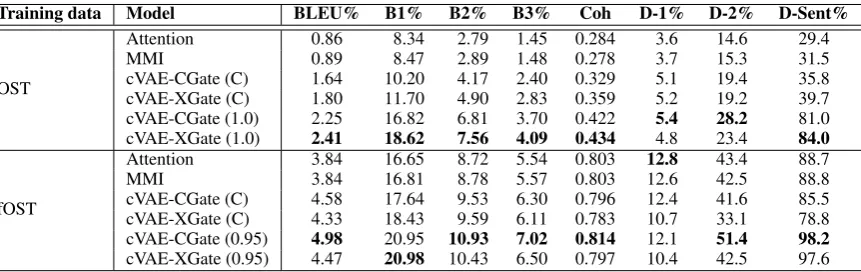
All model variants described in Section 4 are trained on both OST and fOST datasets. Tables2 and 3 present the scores of all models tested on the OST and fOST test sets, respectively. Note that in addition to testing the models on the respec-tive test sections of their training datasets, we also test them on the other dataset (OST-trained mod-els on fOST and vice-versa). This way, we can ob-serve the performance of the fOST-trained models in more noisy contexts and see how good the OST-trained models are when evaluated against coher-ent responses only.
Given all the evaluated model variants, we can observe the effects and contributions of the indi-vidual components of our setup:
• Data filtering: The models trained on fOST consistently outperform the same models trained on OST – for all evaluation metrics and on both test sets. This shows that coherence-based training data filtering is generally benefi-cial.
9We use the Multi-BLEU script from OpenNMT to
Training data Model BLEU% B1% B2% B3% Coh D-1% D-2% D-Sent%
OST
Attention 1.32 10.92 3.85 2.10 0.293 3.4 14.2 25.6
MMI 1.31 11.06 3.88 2.09 0.284 3.3 14.6 28.2
cVAE-CGate (C) 1.58 11.86 4.45 2.48 0.311 4.1 15.0 28.2
cVAE-XGate (C) 1.51 13.38 4.97 2.58 0.324 3.9 14.5 29.8
cVAE-CGate (1.0) 1.60 17.08 5.78 2.86 0.404 5.0 27.1 79.7
cVAE-XGate (1.0) 1.44 15.83 5.34 2.62 0.413 4.5 22.6 80.2
fOST
Attention 1.79 15.43 5.65 2.94 0.758 11.9 41.8 92.7
MMI 1.99 16.24 6.06 3.22 0.764 11.9 44.5 95.8
cVAE-CGate (C) 2.10 15.98 6.05 3.35 0.728 11.9 37.6 88.4
cVAE-XGate (C) 1.85 16.44 5.94 3.07 0.706 10.3 31.2 80.4
cVAE-CGate (0.95) 2.02 15.52 5.78 3.16 0.767 10.6 44.8 98.7
[image:7.595.87.518.262.398.2]cVAE-XGate (0.95) 1.64 14.43 5.20 2.70 0.745 9.0 36.9 98.7
Table 2: Evaluation results on the OST test set (see Section4for model description and Section4.2for metrics definition). Note that the cVAE-CGate(C) / cVAE-XGate(C) models use the truecvalue between the context and the gold response as input. Other cVAE-CGate / cVAE-XGate models use fixed values forcselected on dev sets shown in brackets. BLEU score reported here is BLEU-4; B1, B2 and B3 denote lowern-gram BLEU scores.
Training data Model BLEU% B1% B2% B3% Coh D-1% D-2% D-Sent%
OST
Attention 0.86 8.34 2.79 1.45 0.284 3.6 14.6 29.4
MMI 0.89 8.47 2.89 1.48 0.278 3.7 15.3 31.5
cVAE-CGate (C) 1.64 10.20 4.17 2.40 0.329 5.1 19.4 35.8
cVAE-XGate (C) 1.80 11.70 4.90 2.83 0.359 5.2 19.2 39.7
cVAE-CGate (1.0) 2.25 16.82 6.81 3.70 0.422 5.4 28.2 81.0
cVAE-XGate (1.0) 2.41 18.62 7.56 4.09 0.434 4.8 23.4 84.0
fOST
Attention 3.84 16.65 8.72 5.54 0.803 12.8 43.4 88.7
MMI 3.84 16.81 8.78 5.57 0.803 12.6 42.5 88.8
cVAE-CGate (C) 4.58 17.64 9.53 6.30 0.796 12.4 41.6 85.5
cVAE-XGate (C) 4.33 18.43 9.59 6.11 0.783 10.7 33.1 78.8
cVAE-CGate (0.95) 4.98 20.95 10.93 7.02 0.814 12.1 51.4 98.2
cVAE-XGate (0.95) 4.47 20.98 10.43 6.50 0.797 10.4 42.5 97.6
Table 3: Evaluation results on the fOST test set (see Section4and Table2for model description; see Section4.2 for metrics definition). BLEU score reported here is BLEU-4; B1, B2 and B3 denote lowern-gram BLEU scores.
• cVAE-Context Gate models: Nearly all cVAE-based models perform markedly better than the baselines w.r.t. BLEU, coherence, and diver-sity.10
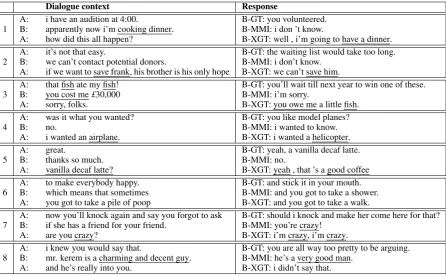
If we look at models trained on OST and tested on fOST (the top half of Table 3), we can see that all cVAE-based models, espe-cially cVAE-XGate, are able to learn to pro-duce coherent and diverse response even when trained on a noisy, incoherent corpus. Ex-amples of responses generated by the baseline MMI model and by cVAE-XGate in Figure 4 show that cVAE-XGate mostly produces more diverse and coherent responses than MMI.
• Preset c vs. oracle models with gold-standard c:Table2shows that on the noisy OST test set, cVAE-based models using the gold-standard
10
We performed paired bootstrap re-sampling for the best cVAE model and the best baseline model in each experiments set (Table2and Table3) as is done for MT (Koehn,2004), which confirmed statistical significance at 99% confidence level for all cases except for models trained on fOST and tested on OST (bottom half of Table2).
value of c achieve higher BLEU scores than models using preset c. This is expected since many gold-standard responses in the unfiltered set have a low coherence score; – the model can generate a more generic response if the gold-standard c is low. The models with pre-set c always attempt to generate coherent re-sponses, which is apparent from the other met-rics: Coh and D-Sent are consistently higher than for models using gold-standardc.
On the fOST test set where only high-coherence responses are expected, models using fixed c consistently reach higher scores in all metrics including BLEU (see Table3). This shows that in general, using a preset constant value of c works well, even better than using the gold-standardc.
Dialogue context Response
A: i have an audition at 4:00. B-GT: you volunteered. 1 B: apparently now i’m cooking dinner. B-MMI: i don ’t know.
A: how did this all happen? B-XGT: well , i’m going to have a dinner. A: it’s not that easy. B-GT: the waiting list would take too long. 2 B: we can’t contact potential donors. B-MMI: i don’t know.
A: if we want to save frank, his brother is his only hope B-XGT: we can’t save him.
A: that fish ate my fish! B-GT: you’ll wait till next year to win one of these.
3 B: you cost me£30,000 B-MMI: i’m sorry.
A: sorry, folks. B-XGT: you owe me a little fish.
A: was it what you wanted? B-GT: you like model planes?
4 B: no. B-MMI: i wanted to know.
A: i wanted an airplane. B-XGT: i wanted a helicopter.
A: great. B-GT: yeah, a vanilla decaf latte.
5 B: thanks so much. B-MMI: no.
A: vanilla decaf latte? B-XGT: yeah , that ’s a good coffee
A: to make everybody happy. B-GT: and stick it in your mouth. 6 B: which means that sometimes B-MMI: and you got to take a shower.
A: you got to take a pile of poop B-XGT: and you got to take a walk.
A: now you’ll knock again and say you forgot to ask B-GT: should i knock and make her come here for that? 7 B: if she has a friend for your friend. B-MMI: you’re crazy!
A: are you crazy? B-XGT: i’m crazy, i’m crazy.
A: i knew you would say that. B-GT: you are all way too pretty to be arguing. 8 B: mr. kerem is a charming and decent guy. B-MMI: he’s a very good man.
[image:8.595.77.524.61.337.2]A: and he’s really into you. B-XGT: i didn’t say that.
Figure 4: Generation output examples comparing two models trained on the OST dataset and tested on the fOST test set: the MMI baseline (B-MMI) and our cVAE-XGate (1.0) model (B-XGT). B-GT is the ground-truth response from the test set. The three sequential dialog turns on the left are the preceding dialogue context used to generate the responses. Corresponding topical phrases are underlined. We can see that cVAE-XGate (1.0) mostly produces markedly more coherent and specific outputs than MMI (1-5). In some cases, it is comparable with MMI (6-7) and occasionally, it is less coherent (8).
6 Related Work
Our work fits into the context of the very active area of end-to-end generative conversation mod-els, where neural E-D approaches have been first applied byVinyals and Le(2015) and extended by many others since.
Many works address the lack of diversity and coherence in E-D outputs (Sountsov and Sarawagi, 2016; Wei et al., 2017) but do not at-tempt to model coherence directly, unlike our work: Li et al.(2016a) use anti-LM reranking;Li et al.(2016c) modify the beam search decoding al-gorithm, similar toShao et al. (2017) in addition to using a self-attention model. Mou et al.(2016) predict keywords for the output in a preprocessing step whileWu et al.(2018) preselect a vocabulary subset to be used for decoding. Li et al. (2016b) focus specifically on personality generation (using personality embeddings) and Wang et al. (2017) promote topic-specific outputs by language-model rescoring and sampling.
A lot of recent works explore the use of addi-tional training signals and VAE setups in dialogue
generation. In contrast to this paper, they do not focus explicitly on coherence:Asghar et al.(2017) use reinforcement learning with human-provided feedback,Li et al.(2017a) use a RL scenario with length as reward signal. Li et al. (2017b) add an adversarial discriminator to provide RL rewards (discriminating between human and machine out-puts),Xu et al.(2017) use a full adversarial train-ing setup. The most recent works explore the us-age of VAEs: Cao and Clark (2017) explore a vanilla VAE setup conditioned on dual encoder (for contexts and responses) during training, the model ofSerban et al.(2017) uses a VAE in a hier-archical E-D model.Shen et al.(2017) use a cVAE conditioned on sentiment and response genericity (based on a handwritten list of phrases).Shen et al. (2018) combine a cVAE with a plain VAE in an adversarial fashion.
7 Conclusions and Future Work
We showed that explicitly modeling coherence and optimizing towards coherence and diversity leads to better-quality outputs in dialogue response generation. We introduced three extensions to cur-rent encoder-decoder response generation models: (1) we defined a measure of coherence based on GloVe embeddings (Pennington et al.,2014), (2) we filtered the OpenSubtitles training corpus ( Li-son and Meena, 2016) based on this measure to obtain coherent and diverse training instances, (3) we trained a cVAE model based on (Hu et al., 2017) and (Tu et al.,2017) that uses our coherence measure as one of the training signals. Our ex-perimental results showed a considerable improve-ment in the output quality over competitive mod-els, which demonstrates the effectiveness of our approach.
In future work, we plan to replace the GloVe-based measure of coherence with a trained dis-criminator that distinguishes between coherent and incoherent responses (Li and Jurafsky,2017). This will allow us to use extend the notion of co-herence to account for phenomena such as topic shifts. We also plan to verify the results with a human evaluation study.
Acknowledgements
This research received funding from the EPSRC project MaDrIgAL (EP/N017536/1). The Titan Xp used for this research was donated by the NVIDIA Corporation.
References
Nabiha Asghar, Pascal Poupart, Xin Jiang, and Hang Li. 2017. Deep Active Learning for Dialogue Gen-eration. In 6th Joint Conference on Lexical and Computational Semantics (*SEM) 2017. ArXiv: 1612.03929.
Dzmitry Bahdanau, Kyunghyun Cho, and Yoshua Bengio. 2015. Neural Machine Translation by Jointly Learning to Align and Translate. In 3rd International Conference on Learning Representa-tions (ICLR2015), San Diego, CA, USA. ArXiv: 1409.0473.
Samuel R. Bowman, Luke Vilnis, Oriol Vinyals, An-drew Dai, Rafal Jozefowicz, and Samy Bengio. 2016. Generating Sentences from a Continuous Space. In Proceedings of The 20th SIGNLL Con-ference on Computational Natural Language Learn-ing, pages 10–21, Berlin, Germany. Association for Computational Linguistics.
Kris Cao and Stephen Clark. 2017. Latent Variable Dialogue Models and their Diversity. In Proceed-ings of the 15th Conference of the European Chap-ter of the Association for Computational Linguistics: Volume 2, Short Papers, pages 182–187, Valencia, Spain. Association for Computational Linguistics.
Junyoung Chung, Kyle Kastner, Laurent Dinh, Kratarth Goel, Aaron C Courville, and Yoshua Bengio. 2015. A recurrent latent variable model for sequential data. In Advances in neural information processing sys-tems, pages 2980–2988.
Bhuwan Dhingra, Lihong Li, Xiujun Li, Jianfeng Gao, Yun-Nung Chen, Faisal Ahmed, and Li Deng. 2017. Towards end-to-end reinforcement learning of dia-logue agents for information access. In Proceed-ings of the 55th Annual Meeting of the Association for Computational Linguistics (Volume 1: Long Pa-pers), volume 1, pages 484–495.
Marjan Ghazvininejad, Chris Brockett, Ming-Wei Chang, Bill Dolan, Jianfeng Gao, Wen tau Yih, and Michel Galley. 2017. A knowledge-grounded neural conversation model.arXiv preprint arXiv:1702.01932.
Sepp Hochreiter and J¨urgen Schmidhuber. 1997. Long short-term memory. Neural computation, 9(8):1735–1780.
Zhiting Hu, Zichao Yang, Xiaodan Liang, Ruslan Salakhutdinov, and Eric P Xing. 2017. Toward con-trolled generation of text. InInternational Confer-ence on Machine Learning, pages 1587–1596.
Diederik Kingma and Jimmy Ba. 2015. Adam: A Method for Stochastic Optimization. In Proceed-ings of the 3rd International Conference on Learn-ing Representations, San Diego, CA, USA. ArXiv: 1412.6980.
Guillaume Klein, Yoon Kim, Yuntian Deng, Jean Senellart, and Alexander M. Rush. 2017. Open-NMT: Open-source toolkit for neural machine trans-lation. InProceedings of the 55th Annual Meeting of the Association for Computational Linguistics, Van-couver, Canada.
Philipp Koehn. 2004. Statistical significance tests for machine translation evaluation. In Proceedings of the 2004 conference on empirical methods in natural language processing.
Jiwei Li, Michel Galley, Chris Brockett, Jianfeng Gao, and Bill Dolan. 2016a. A diversity-promoting ob-jective function for neural conversation models. In
Proceedings of the 2016 Conference of the North American Chapter of the Association for Computa-tional Linguistics: Human Language Technologies, pages 110–119. Association for Computational Lin-guistics.
Conversation Model. InProceedings of the 54th An-nual Meeting of the Association for Computational Linguistics, Berlin, Germany. ArXiv: 1603.06155.
Jiwei Li and Dan Jurafsky. 2017. Neural Net Mod-els for Open-Domain Discourse Coherence. In Em-pirical Methods in Natural Language Processing, Copenhagen, Denmark. ArXiv: 1606.01545.
Jiwei Li, Will Monroe, and Dan Jurafsky. 2016c. A simple, fast diverse decoding algorithm for neural generation. arXiv preprint arXiv:1611.08562.
Jiwei Li, Will Monroe, and Dan Jurafsky. 2017a. Learning to decode for future success. arXiv preprint arXiv:1701.06549.
Jiwei Li, Will Monroe, Tianlin Shi, Alan Ritter, and Dan Jurafsky. 2017b. Adversarial Learning for Neu-ral Dialogue Generation. arXiv:1701.06547 [cs]. ArXiv: 1701.06547.
Pierre Lison and Raveesh Meena. 2016. Automatic Turn Segmentation for Movie & TV Subtitles. In
2016 IEEE Workshop on Spoken Language Technol-ogy. IEEE conference proceedings.
Pierre Lison and J¨org Tiedemann. 2016. OpenSub-titles2016: Extracting Large Parallel Corpora from Movie and TV Subtitles. InProceedings of the 10th International Conference on Language Resources and Evaluation (LREC 2016), Portoroˇz, Slovenia.
Minh-Thang Luong, Hieu Pham, and Christopher D. Manning. 2015. Effective Approaches to Attention-based Neural Machine Translation. In Proceed-ings of the 2015 Conference on Empirical Methods in Natural Language Processing, pages 1412–1421, Lisbon, Portugal. ArXiv: 1508.04025.
Lili Mou, Yiping Song, Rui Yan, Ge Li, Lu Zhang, and Zhi Jin. 2016. Sequence to Backward and For-ward Sequences: A Content-Introducing Approach to Generative Short-Text Conversation. In Pro-ceedings of COLING 2016, the 26th International Conference on Computational Linguistics: Techni-cal Papers, pages 3349–3358, Osaka, Japan. The COLING 2016 Organizing Committee. ArXiv: 1607.00970.
Kishore Papineni, Salim Roukos, Todd Ward, and Wei-Jing Zhu. 2002. Bleu: a method for automatic eval-uation of machine translation. In Proceedings of the 40th annual meeting on association for compu-tational linguistics, pages 311–318. Association for Computational Linguistics.
Jeffrey Pennington, Richard Socher, and Christopher Manning. 2014. GloVe: Global Vectors for Word Representation. In Proceedings of the 2014 Con-ference on Empirical Methods in Natural Language Processing (EMNLP), pages 1532–1543, Doha, Qatar. Association for Computational Linguistics.
Iulian Serban, Alessandro Sordoni, Ryan Joseph Lowe, Laurent Charlin, Joelle Pineau, Aaron C. Courville, and Yoshua Bengio. 2017. A hierarchical latent variable encoder-decoder model for generating di-alogues. InAAAI.
Lifeng Shang, Zhengdong Lu, and Hang Li. 2015. Neural responding machine for short-text conversa-tion. InProceedings of Annual Meeting of the Asso-ciation for Computational Linguistics (ACL).
Louis Shao, Stephan Gouws, Denny Britz, Anna Goldie, Brian Strope, and Ray Kurzweil. 2017. Generating Long and Diverse Responses with Neu-ral Conversation Models. In Empirical Methods in Natural Language Processing, pages 2200–2009, Copenhagen, Denmark. ArXiv: 1701.03185.
Xiaoyu Shen, Hui Su, Yanran Li, Wenjie Li, Shuzi Niu, Yang Zhao, Akiko Aizawa, and Guoping Long. 2017. A Conditional Variational Framework for Di-alog Generation. InProceedings of the 55th Annual Meeting of the Association for Computational Lin-guistics (ACL 2017), Vancouver, Canada. ArXiv: 1705.00316.
Xiaoyu Shen, Hui Su, Shuzi Niu, and Vera Demberg. 2018. Improving Variational Encoder-Decoders in Dialogue Generation. In AAAI 2018. ArXiv: 1802.02032.
Alessandro Sordoni, Michel Galley, Michael Auli, Chris Brockett, Yangfeng Ji, Margaret Mitchell, Jian-Yun Nie, Jianfeng Gao, and Bill Dolan. 2015. A neural network approach to context-sensitive gen-eration of conversational responses. InNAACL.
Pavel Sountsov and Sunita Sarawagi. 2016. Length bias in Encoder Decoder Models and a Case for Global Conditioning. In Proceedings of the 2016 Conference on Empirical Methods in Natural Lan-guage Processing, pages 1516–1525, Austin, TX, USA. Association for Computational Linguistics.
Zhaopeng Tu, Yang Liu, Zhengdong Lu, Xiaohua Liu, and Hang Li. 2017. Context Gates for Neural Ma-chine Translation. Transactions of the Association for Computational Linguistics, 5:87–99.
Oriol Vinyals and Quoc V. Le. 2015. A neural conver-sational model. InICML Deep Learning Workshop.
Di Wang, Nebojsa Jojic, Chris Brockett, and Eric Ny-berg. 2017. Steering output style and topic in neu-ral response generation. InProceedings of the 2017 Conference on Empirical Methods in Natural Lan-guage Processing, pages 2140–2150, Copenhagen, Denmark.
Yu Wu, Wei Wu, Dejian Yang, Can Xu, Zhoujun Li, and Ming Zhou. 2018. Neural Response Generation with Dynamic Vocabularies. In AAAI 2018, New Orleans, LA, USA. ArXiv: 1711.11191.
Chen Xing, Wei Wu, Yu Wu, Jie Liu, Yalou Huang, Ming Zhou, and Wei-Ying Ma. 2017. Topic aware neural response generation. In AAAI, pages 3351– 3357.
Zhen Xu, Bingquan Liu, Baoxun Wang, SUN Chengjie, Xiaolong Wang, Zhuoran Wang, and Chao Qi. 2017. Neural response generation via gan with an approximate embedding layer. In Proceed-ings of the 2017 Conference on Empirical Methods in Natural Language Processing, pages 628–637.
Lili Yao, Yaoyuan Zhang, Yansong Feng, Dongyan Zhao, and Rui Yan. 2017. Towards implicit content-introducing for generative short-text conversation systems. InProceedings of the 2017 Conference on Empirical Methods in Natural Language Process-ing, pages 2180–2189.