Game-Theoretic Modeling for System-wide Performance Optimization
at the MAC Layer in Ad-hoc Wireless Networks
Debarshi Kumar Sanyal
Matangini Chattopadhyay Samiran
Chattopadhyay
Abstract—This paper presents a game theoretic model aimed
at optimizing the performance of medium access control in ad-hoc wireless networks. IEEE 802.11 is the commonly used protocol in such networks, so our model is specifically tailored for it. The network of wireless nodes is abstracted into a community of selfish users playing a non-cooperative game. The resource they vie for is the common random-access wireless channel. We define new utility functions for the nodes and show that these utility functions have insightful and elegant mathematical properties to steer the game to a unique non-trivial Nash equilibrium. This defines a stable operating point from which no player has an incentive to deviate unilaterally. At this stable point each node has an equal non-trivial share of the common wireless transmission channel. Thus selfish behavior of the nodes is used as a mechanism to enforce desirable properties of the network as a whole. Simulations show that this design scores over the traditional Distributed Coordination Function (DCF) in IEEE 802.11 MAC in terms of throughput and collision overhead, thus greatly improving the system-wide MAC layer performance of the network. Since the utility functions produce high performance objectives over a wide range of network sizes in a completely distributed fashion with the nodes behaving selfishly, a self-enforcing mechanism for efficient working of ad-hoc and large unattended networks of constrained wireless devices is achieved.
Index Terms—Ad-hoc Wireless Networks, Game Theory, Nash Equilibrium, IEEE 802.11, Throughput
I. INTRODUCTION
In most wireless networks, including ad-hoc and sensor networks, access to the shared wireless medium is random-access based. In absence of a central regulating authority, it is only natural that multiple wireless nodes will attempt to access the medium simultaneously, resulting in packet collisions. IEEE 802.11 (hereafter briefly called 802.11) is the most commonly followed standard in wireless networks. It defines a distributed mechanism called the
distributed coordination function (DCF) to resolve
Manuscript received March 7, 2008.
Debarshi Kumar Sanyal (corresponding author) is with Interra Systems (India) Pvt. Ltd., Kolkata, India (phone: +919830803194, e-mail: [email protected]).
Dr. Matangini Chattopadhyay is an assistant Professor in the School of Education Technology, Jadavpur University, India.
Dr. Samiran Chattopadhyay is a Professor in the Department of Information Technology, Jadavpur University, India (e-mail:
contention among the contending nodes. It involves channel sensing to assess the state of the network and adjusting the channel access probability accordingly to minimize chances of collision.
In 802.11, the channel access probability is determined by a contention window (CW) maintained by a node. DCF uses a binary feedback signal (collision or no collision) and sharply updates CW using binary exponential backoff to adapt to the contention.
However, various studies [3], [7], [8], [10] report that this contention control scheme results in drastic reduction in throughput with increasing number of contending nodes. Every new transmission begins with the same channel access probability and thus the history of contention level in the network is not used. Moreover, doubling the contention window for every failed transmission only reduces the chances of transmission by the nodes that were already unsuccessful.
These inferences indicate that instead of using drastic update strategies, it is better to steadily guide the system to a state that is optimal with respect to the current contention level in the network. Since this state is optimal, it is sustainable and has high throughput, greater fairness and sparing collisions.
This requires an analytical framework where these desirable features can be mathematically characterized.
Towards this end, we model the nodes as selfish players in a non-cooperative game [4]. Unlike common studies [2], [11], we do not reverse-engineer DCF as a game but use game theory as a tool for optimization. We define utility functions reflecting the gain from channel access and the loss from collision. The strategy set of each node is the set of
allowable channel access probabilities of the node. We next propose gentle update strategies that drive the network to its Nash equilibrium from which no player has an incentive to unilaterally deviate. This characterizes the desired stable operating point or the optimal state of the network. A continuous feedback signal is used to assess the contention level.
overhead and time slots wasted in collisions are drastically reduced in the new design. The nodes do not need to know the total number of nodes in the network nor is any message passing necessary. A completely distributed mechanism that allows each node to behave selfishly to maximize its own payoff is used to ensure a socially beneficial state.
The remaining part of the paper is as follows: Section II provides a background of this study, journeying through the recent past of game-theoretic models in communication systems, especially medium access control in networks. We also point out the differentiation and novelty of our work as regards related studies in the literature. Section III presents the proposed game model and its many properties. Section IV investigates distributed mechanisms to achieve the equilibrium of the game in real networks. The model is evaluated via simulations in section V. After a brief discussion in section VI conclusions follow in section VII.
II. THE BACKGROUND
Game theory [4] provides a tool to study situations in which there is a set of rational decision makers who take specific actions that have mutual, possibly conflicting, consequences. A game models an interaction among parties (called the
players) who are rational decision makers and have possibly conflicting objectives. Each player has a set of actions called its strategies and with each strategy is associated a payoff function. Rationality demands each player maximize its own payoff function. Non-cooperative games are commonly used to model problems in medium access control in telecommunication networks. In such a game, the solution concept is a notion called a stable set or Nash Equilibrium
that identifies a set of strategies for all the participating players, from which no player has an incentive to unilaterally deviate as any unilateral deviation will not result in an increase in payoff of the deviating player.
In [1] the authors model the nodes in an Aloha network as selfish players in a non-cooperative Aloha game. They assume that the number of backlogged users is always globally known. This limitation is addressed in [6] where only the total number of users is known. More recent research includes modeling the DCF in 802.11 in a game-theoretic framework [11], and reverse engineering exponential backoff as a strategy [2].
In contradistinction to these works, we do not explicitly reverse-engineer 802.11 or DCF into a game model but use ideas from non-cooperative game theory to optimize the performance of 802.11. We consider each node in a wireless network as having a set of strategies which are its channel access probabilities. Unlike common practices in optimization of 802.11 like [3], we do not assume that each node knows the number of users in the network. This is more reflective of practical situations where such knowledge is difficult to acquire. Non game-theoretic approaches that do not depend on the nodes' knowing the network size include the ones presented in [7] and [10]. We use selfishness to achieve optimized system-wide performance. Related work also includes [9] where the authors use game theory to study and optimize 802.11. But their illustrative utility functions are different from ours. Their utility functions are well-behaved in a much more restricted domain than ours.
Moreover, as we show, our utility functions give far better results for large network sizes.
III. THE GAME-THEORETIC MODEL OF MEDIUM ACCESS
CONTROL
The system we consider is a network of N nodes that are all able to hear one another. To facilitate analysis we will adopt a description of our access mechanism in terms of channel access probabilities. It has been shown in [8] that in a saturated regime the constant channel access probability p
relates to the corresponding contention window cw according to:
1 2
+ =
cw p
…(1) Now we turn to the game model. We define the game G as a 3-tuple G = <N, {Si}i ∊ N, {ui}i ∊ N>, where N is a set of players (wireless nodes), player i∊ N, each player having a strategy set Si = {pi|pi∊ [vi, wi]} with 0 < vi < wi < 1 and payoff function ui. The strategy set of each player is the set of its channel access probabilities. Note that it is a generalization to a continuous space of the simpler strategy set {wait, transmit} denoting the two deterministic actions that a node can perform. The payoff is naturally of the form:
ui = Ui(pi) – piqi(p). Here Ui(pi) is the utility function denoting the gain from channel access and qi(p) is the conditional collision probability given by
∏
− ∈
−
−
=
} {
)
1
(
1
)
(
i N j
j
i
p
q
p
…(2) Thus piqi(p) is the cost of channel access.We propose a novel utility function:
i i i i i
i
r
p
w
p
p
U
ln
)
1
ln
(ln
)
(
=
−
+
…(3) where pi = channel access probability (0 < vi ≤ pi ≤ wi < 1), ri = wi / vi > 1.
In non-cooperative games, the final outcome is described by investigating its Nash Equilibrium. Denote the strategy profile of all nodes by p = (p1, p2, ..., pi, ..., pn) and the strategy profile of all nodes but i by p-i = (p1, p2, ..., pi-1, pi+1, ..., pn). Then the Nash Equilibrium (NE) is defined as the strategy profile p* =(p1*, p2*, ..., pi*, ... pn*) with the property that for every player i and every strategy pi of player
i, ui(pi*, p-i*) ≥ ui(pi, p-i*). So no player gains by unilaterally changing its strategy.
Note in passing that our utility function does not correspond to a physical quantity like throughput, delay, or the like but is a mathematical expression formulated to satisfy the desirable property of unique non-trivial NE of the game. The rest of the paper proves these characteristics and shows that it leads to performance far superior to DCF in contention control.
Theorem 1: The game G has a NE.
0
ln
1
2 2<
−
=
∂
∂
i i i ir
p
p
u
and pi Si, ui is quasi-concave in pi. Hence the game has an NE [4].
An NE is non-trivial if the following condition holds
*)
(
)
(
* 'p
i ii
p
q
U
=
...(4) and trivial otherwise.Theorem 2: The gameG has non-trivial NE.
Proof: From (2), qi(p) maps any p S1 x S2 x ... x Sn into a point in [0,1]. Now from the definition of non-trivial NE as given in (4) above, *
(
*)
p
i
i
f
p
=
=(
')
1(
(
*))
p
i
i
q
U
− .Since i i i i i
r
p
w
p
U
ln
)
ln(
)
(
'=
...(5) 1-1 in Si ,the inverse functioni
q i i i
i
q
w
r
U
)
−(
)
=
−(
' 1 exists, which is continuous and decreasing in qi. Also, Ui =wi− (0)
) ( ' 1
and (Ui')−1(1)=vi
. Thus, qi(p) maps any qi [0, 1] into a point in [vi, wi]. Hence the vector function f(p) = (f1(p), f2(p), ... , f|N|(p)) maps the set Xi NSi into itself. Hence, by Brouwer's fixed point theorem, there is a fixed point of f in Xi NSi. At this fixed point, the condition (4) holds. In other words, G has a non-trivial NE.
The existence of non-trivial NE signifies that the channel access probability of any node in NE is not at the boundary of strategy space. This reduces unfair sharing of the wireless channel among the contending nodes, thus preventing the highly undesirable 'tragedy of commons'.
Theorem 3: The NE is unique for all pi in [vi, wi] for all i∊ N if 1 1−
>
i w i ie
w
v
.Proof: First consider the function
))
(
1
)(
1
(
)
(
' i i i ii
p
=
−
p
−
U
p
ϕ
. Substituting (5) anddifferentiating with respect to pi,
)]
ln(
1
1
[
ln
1
)
(
' i i i i i iv
p
p
r
p
=
−
−
ϕ
. If 1 1 −>
i p i ie
p
v
, ii
i
p
p
v
(
1
1
)
ln
ln
+
−
>
which means0
)
(
'>
i ip
ϕ
. Sincep
i∈
[
v
i,
w
i]
and 1 1− i p ie
p
is strictlyincreasing in
p
i, if1 1 −
>
i w i ie
w
v
, we haveϕ
i'(
p
i)
>
0
. Forthe rest of the proof, assume the above relation between vi and wi holds. Also by (4) at non-trivial NE, for node i,
∏
− ∈−
−
=
=
] { * *'
(
)
1
(
1
)
i N j j i i
i
p
q
p
U
making φi(pi) identical for all nodes i.
Now assume for the sake of contradiction that there exist at least two distinct non-trivial NE x* and y* of the game G. Let
φi(xi*) = σ1 and φi(yi*) = σ2 for some node i. Since φi is strictly increasing, σ1 ≠ σ2. Assume without loss in generality, σ1 > σ2. Then, xi* > yi*for all i N. By (4) and since qi(p) is increasing in p, Ui'(xi*) = qi(x*) > qi(y*) = Ui'(yi*). But Ui’’(pi) = -1/(pi ln
ri) showing that Ui’(pi) is decreasing, thus a contradiction. Hence x* = y* proving the uniqueness of the NE.
Theorem 4: Suppose all the players in G have identical strategy sets. Then at the unique non-trivial NE of G, all the players choose the same strategies.
Proof: Since all players have the same strategy sets, for any two players i and j, wi = wj and vi = vj. Now suppose that the unique non-trivial NE is p*. Let there exist pi* and pj* in p* corresponding to nodes i and j such that pi* ≠ pj*. Denote the set of strategies in some order of all nodes except i and j at NE as p-ij* so that the NE can be described as an ordered set (p-ij*, pi*, pj*). Then interchanging the strategies of nodes i and j at NE results in a new NE given by the ordered set (p-ij*,
pj*, pi*). Since by theorem 2, none of the elements of p* is zero, it contradicts the uniqueness of the NE, violating theorem 3. Hence, pi* = pj*. i and j being arbitrary, it follows that pi* = pj* for all i, j N.
This has a very important and useful consequence: the wireless channel is accessed by the nodes with identical access probabilities at the equilibrium point thus resulting in fair sharing of the resource among the contenders, and consequently short-term fairness.
IV. DISTRIBUTED MECHANISMS TO ACHIEVE NASH
EQUILIBRIUM
In our design the non-cooperative game G is played repeatedly by the nodes, that is, it is a multi-stage game. A stage may be a single transmission or a sequence of K
transmissions for a fixed K > 1.
Suppose that each node after playing a round observes the cumulative effect (in the sense of conditional collision probability) of the actions of all players in the previous round. This knowledge may now be used by the node to select its strategy for the next round. Based on how this knowledge is used, there are many common techniques to push the system to its Nash equilibrium. Two more popular ones are:
Best Response: This is the most obvious mechanism where at each stage every player chooses the strategy that maximizes its payoff given the actions of all the other players in the previous round:
))) ( ( ) ( ) ( ( ( max arg ) 1 ( ] , [ )
( U p t p tq t
t
p i i i i
w v t p i i i i p − = + ∈
Gradient Play: In this case, each player adjusts its persistence probability gradually in a gradient direction suggested by the observations of the effect of other players’ actions. Mathematically,
))) ( ( ) ( ( ))( ( ( ) ( ) 1
(t p t f p t U' p t q t
pi + = i + i i i i − i p
for each node i∈N where step size fi(.)>0can be a
function of the strategy of player i. It has a intuitively appealing interpretation: if at any stage of the game, the marginal utility Ui’(pi(t)) exceeds the “price of contention”
qi(p(t)), the persistence probability is increased, but if the price is greater, the persistence probability is reduced. For convergence of these mechanisms in a more generic setting, see [5], [9].
To eliminate the need to know the current strategies of all other players, a node needs to estimate qi(p) in an indirect way. A simple method is to track the number of packet transmissions (nt) and the number of packet losses (nl) over a period of time and calculate qi = nl/nt. A more sophisticated approach [10] involves observing the number of idle slots which follows a geometric distribution with mean I = pidle/ (1-pidle) where pidle = probability of a slot being idle =
)
1
(
∏
∈
−
N ii
p
. Thus by observing I, qi can be estimated as:i
i
p
I
I
q
−
+
−
=
1
)
1
(
1
, allowing a completely distributed update mechanism.
V. PERFORMANCE EVALUATION
In this section, we perform extensive numerical simulations to analyze our model. The simulation results are obtained in a saturation regime. The performance is compared with the standard DCF in basic access 802.11b. We choose to measure the channel access probabilities, aggregate throughput of all nodes, collision overhead incurred and the average number of time slots wasted in collisions per successful transmission
The saturation throughout Si of a node i in an 802.11 network is given by the following expression in Bianchi’s model [8]:
col col suc suc i trans idle
trans suc i i
p
p
p
p
p
p
S
τ
τ
σ
+
+
℘
=
where
℘
= packet payload (assumed constant),p
trans= probability of a transmission by any node =)
1
(
1
∏
∈
−
−
N i
i
p
,p
isuc = conditional success probability of node i = probability of a successful transmission by the nodegiven that there is a transmission =
tr i i N i i
p
p
p
(
1
)
} {
−
∏
− ∈
, idle
p
= probability of a slot being idle =∏
(
1
)
∈−
N ii
p
,∑
∈
−
−
=
N i
suc i idle
col
p
p
p
1
, σ is the slot time, τsuc is the average duration of a slot in which a successful transmission occurs and τcol is the average duration of a slot in which a collision occurs.
In our experiments, the slot time is 20 us, SIFS = 10 μs, DIFS = 20 μs, basic rate = 1 Mbps, data rate = 11 Mbps, propagation delay = 1 μs, PHY header = 24 bytes, MAC header = 34 bytes, ACK = 14 bytes and the packet payload is fixed at 1500 bytes. We assume all nodes use the same parameters for the utility function. To compare with DCF, we set bounds of the contention window to powers of 2 (specifically 32 and 1024) and derive the bounds of the strategy sets using (1). This gives wi = 2/33 = 0.06061 and vi = 2/1025 = 0.00195. Note that in this range the condition of theorem 3 is satisfied since
1 1
−
>
i
w i i
e
w
v
≈ 1 x 10⁻⁸. In thefollowing subsections, we call our game-theoretic distributed
coordination function GDCF.
A. Channel Access Probabilities
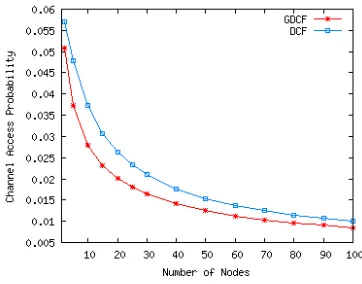
Figure 1 shows the variation of the probability with which a node accesses the wireless channel in the saturation regime in GDCF and DCF as the network size increases. In both protocols, the domain of the probability is the set [0.06061, 0.00195] since contention window varies from 32 to 1024. Recollect from section III that the probability with which any given node in GDCF accesses the channel at the NE is identical for all nodes. We observe that the channel access probabilities are always observed to be higher in DCF than in GDCF. This has an important consequence as will be evident in the ensuing discussion.
B. Aggregate Throughput
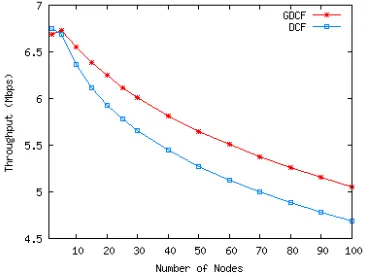
[image:4.612.321.502.465.607.2]The aggregate throughput (see figure 2) which measures the total throughput of all nodes under saturation conditions is higher in DCF when the network size is small but it gets far lower than GDCF as the network size grows. This is because the channel access probabilities are higher in DCF. In a small
network, collisions are few and so higher channel access probabilities translate to higher throughput. But as network size grows, collisions increase if all nodes aggressively access the channel, triggering a drastic reduction in throughput. Since channel access probabilities are lower in GDCF, it supersedes DCF as network size grows. Consequently, large beds of wireless nodes achieve much greater throughput if they run GDCF instead of DCF.
C. Collision Overhead
We observe from figure 3 that the conditional collision probability is higher in case of DCF than in GDCF. This is expected as the channel access probabilities are lower in case of GDCF resulting in reduced medium contention even when the number of nodes increases. Indeed GDCF is designed with the aim of keeping the “price of contention” low.
D. Slots Wasted in Collisions
In 802.11, a large number of slots are wasted due to collisions. This seriously affects the performance and lifetime of the power-constrained devices in ad-hoc and sensor networks. Figure 4 makes clear that the number of
slots wasted in collisions for every successful transmission is much higher in DCF than in GDCF, making the later attractive in these networks.
VI. DISCUSSION
The motivation for this work is [9]. So we make a brief comparison with it in this section.
Our utility function produces unique non-trivial NE for a wide range of vi and wi while the one in [9] has strict constraints on vionce wi is specified. This makes our utility functions admit a much larger game space and hence is superior for widely varying network sizes since the channel access probability should be very small for very large network sizes and high for small network sizes. In our experiments, we vary contention windows from 32 to 1024 as is the default for DSSS PHY in 802.11 standard while in [9] (call it U_9) the window ceiling is limited to 256 if the base is 32 and only powers of 2 are chosen. Our utility function exhibit particularly good performance for large network sizes. A brief performance comparison as regards throughput and collision for large networks is provided in table 1.
No. of Nodes
Throughput Conditional Collision Probability
GDCF U_9 GDCF U_9
80 5.26 5.13 0.48 0.56
90 5.15 4.93 0.55 0.59
100 5.06 4.73 0.57 0.63
VII. CONCLUSION
[image:5.612.72.255.257.396.2]The paper proposed a novel and elegant game-theoretic model aimed at optimizing the aggregate throughput and distributing it fairly among the contending nodes in an 802.11 network, thus inducing a desirable state of the entire network. It also drastically brings down the collision overhead, reducing energy loss due to failed transmissions. We believe it contends as a serious and superior alternative to the traditional distributed coordination function in 802.11 MAC. Our game-theoretic model uses selfish behavior of the
[image:5.612.69.256.257.629.2]Fig. 4: Number of slots wasted in collisions per successful packet transmission
[image:5.612.321.503.307.446.2]Fig. 3: Variation of conditional collision probabilities with network size Fig. 2: Variation of aggregate throughput with
network size
[image:5.612.315.553.526.608.2]participating players to steer the network to desirable system-wide characteristics. The presence of Nash equilibrium signifies a stable operating point from which no player has an incentive to unilaterally deviate while the unique, non-trivial nature of the equilibrium together with identical access probabilities for all nodes at the stable operating point assure fairly distributed throughput with low collision overhead. Rigorous analysis and simulations are used to prove the ideas. In future we intend to simulate the algorithm in settings with bit errors to gather more performance measures. Further, we intend to investigate other utility functions with similar characteristics and explore if this design can be used in cross layer optimization.
ACKNOWLEDGMENT
We dedicate the work to our parents and teachers. We are grateful to Interra Systems (India) Pvt. Ltd., India and Jadavpur University, India for providing a congenial atmosphere for research. We thank Debarshi Ray of Interra Systems (India) Pvt. Ltd. for introducing us to Maxima used for numerical simulations reported in the paper. We also express our thanks to the anonymous reviewers for suggesting improvements to the presentation of the paper.
REFERENCES
[1] A. B. MacKenzie and S. B. Wicker, Selfish users in Aloha: A game-theoretic approach, IEEE Vehicular Technology Conference, October 2001
[2] A. Tang, J. W. Lee, J. Huang, M. Chiang and A. R. Calderbank, Reverse Engineering MAC, Proceedings of WiOpt, 2006
[3] Alberto Lopez Toledo, Tom Vercauteren, Xiaodang Wang, Adaptive optimization of IEEE 802.11 DCF based on Bayesian estimation of the
number of competing terminals, IEEE Transactions on Mobile
Computing, 5(9), September 2006
[4] D. Fudenburg and J. Tirole, Game Theory. MIT Press, 1991
[5] D. P. Bertsekas and J. N. Tsitsiklis, Parallel and Distributed Computation, Prentice Hall, 1989
[6] E. Altman, R. El Azouzi and T. Jimenez, Slotted Aloha as a stochastic game with partial information, Proceedings of WiOpt, 2002
[7] F. Cali, M. Conti, E. Gregori, Dynamic IEEE 802.11: design, modeling and performance evaluation, IEEE Journal on Selected Areas in Communication, 18(9): 1774-1786, September 2000
[8] G. Bianchi, Performance Analysis of the IEEE 802.11 distributed
coordination function, IEEE Journal on Selected Areas in
Communications, 18(3):535-547, March 2000
[9] L. Chen, S.H. Low and J. C. Doyle, Random Access Game and Medium Access Control Design, Caltech CDS, Technical Report, March 2006
[10] M. Heusse, F. Rousseau, R. Guillier and A. Dula, Idle Sense: An optimal access method for high throughput and fairness in rate-diverse wireless LANs, Proceedings of ACM SIGCOMM, August 2005 [11] Yomgkang Xiao, Xiuming Shan and Yong Ren, Game theory models
for IEEE 802.11 DCF in wireless ad hoc networks, IEEE