Proceedings of the 2019 Conference on Empirical Methods in Natural Language Processing
4894
Event Representation Learning Enhanced with External Commonsense
Knowledge
Xiao Ding, Kuo Liao, Ting Liu∗, Zhongyang Li, Junwen Duan Research Center for Social Computing and Information Retrieval
Harbin Institute of Technology, China
{xding, kliao, tliu, zyli, jwduan}@ir.hit.edu.cn
Abstract
Prior work has proposed effective methods to learn event representations that can capture syntactic and semantic information over text corpus, demonstrating their effectiveness for downstream tasks such as script event predic-tion. On the other hand, events extracted from raw texts lacks of commonsense knowledge, such as the intents and emotions of the event participants, which are useful for distinguish-ing event pairs when there are only subtle dif-ferences in their surface realizations. To ad-dress this issue, this paper proposes to leverage external commonsense knowledge about the intent and sentiment of the event. Experiments on three event-related tasks, i.e., event simi-larity, script event prediction and stock mar-ket prediction, show that our model obtains much better event embeddings for the tasks, achieving 78% improvements on hard similar-ity task, yielding more precise inferences on subsequent events under given contexts, and better accuracies in predicting the volatilities of the stock market1.
1 Introduction
Events are a kind of importantobjective informa-tion of the world. Structuralizing and represent-ing such information as machine-readable knowl-edge are crucial to artificial intelligence (Li et al.,
2018b,2019). The main idea is to learn distributed representations for structured events (i.e. event embeddings) from text, and use them as the basis to induce textual features for downstream appli-cations, such as script event prediction and stock market prediction.
Parameterized additive models are among the most widely used for learning distributed event representations in prior work (Granroth-Wilding
∗
Corresponding author
1The code and data are available on
https://github.com/MagiaSN/CommonsenseERL EMNLP 2019.
PersonX threw basketball
PersonZ attacked embassy
Intent
PersonY threw bomb PersonZ attacked embassy
PersonX broke record
PersonY broke vase Sentiment
PersonX broke record
PersonY broke vase (a)
(b)
PersonY threw bomb
PersonX threw basketball
[image:1.595.308.524.219.324.2]PersonZ achieved goal PersonZ achieved goal
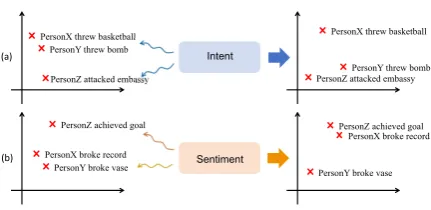
Figure 1: Intent and sentiment enhanced event embed-dings can distinguish distinct events even with high ical overlap, and find similar events even with low lex-ical overlap.
and Clark, 2016;Modi, 2016), which passes the concatenation or addition of event arguments’ word embeddings to a parameterized function. The function maps the summed vectors into an event embedding space. Furthermore,Ding et al.
(2015) andWeber et al. (2018) propose using neu-ral tensor networks to perform semantic composi-tion of event arguments, which can better capture the interactions between event arguments.
This line of work only captures shallow event semantics, which is not capable of distinguishing events with subtle differences. On the one hand, the obtained event embeddings cannot capture the relationship between events that are syntactically or semantically similar, if they do not share sim-ilar word vectors. For example, as shown in Fig-ure1(a), “PersonX threw bomb” and “PersonZ at-tacked embassy”. On the other hand, two events with similar word embeddings may have similar embeddings despite that they are quite unrelated, for example, as shown in Figure 1(b), “PersonX broke record” and “PersonY broke vase”. Note that in this paper, similar events generally refer to events with strong semantic relationships rather than just the same events.
Share weights Share weights
BiLSTM BiLSTM Share weights
𝑦 𝑓 𝑊𝑥 𝑏
actor predicate object objectneg intent intentneg event eventneg intent intentneg sentipred sentigold
score scoreneg lossevent
lossintent
sim simneg
losssenti
𝑦 𝑓 𝑊𝑥 𝑏 𝑦 𝑓 𝑊𝑥 𝑏 cosine cosine
loss
+
NTN Tensor
Tensor Tensor
NTN Tensor
[image:2.595.121.478.60.301.2]Tensor Tensor
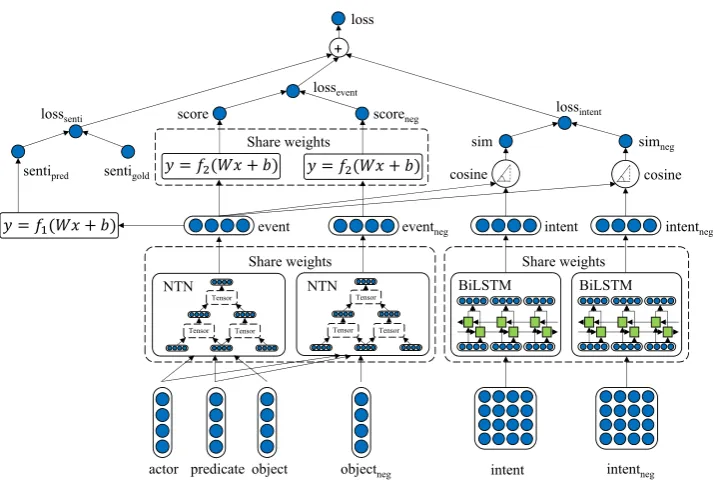
Figure 2: Architecture of the joint embedding model.eventnegrefers to the corrupted event tuple, which is derived
by replacing each word of the event object with a random word in our dictionary.intentnegis the incorrect intent
for the given event, which is randomly selected from the annotated dataset.
of the external commonsense knowledge about the mental state of event participants when learning theobjectiveevent representations. In Figure1(a), two event participants “PersonY” and “PersonZ” may carry out a terrorist attack, and hence, they have the same intent: “to bloodshed”, which can help representation learning model maps two events into the neighbor vector space. In Fig-ure1 (b), a change to a single argument leads to a large semantic shift in the event representations, as the change of an argument can result in different emotions of event participants. Who “broke the record” is likely to be happy, while, who “broke a vase” may be sad. Hence, intent and sentiment can be used to learn more fine-grained semantic features for event embeddings.
Such commonsense knowledge is not explic-itly expressed but can be found in a knowledge base such as Event2Mind (Rashkin et al., 2018) and ATOMIC (Sap et al., 2019). Thus, we aim to incorporate the external commonsense knowl-edge, i.e., intent and sentiment, into the learn-ing process to generate better event representa-tions. Specifically, we propose a simple and ef-fective model to jointly embed events, intents and emotions into the same vector space. A neural ten-sor network is used to learn baseline event embed-dings, and we define a corresponding loss function to incorporate intent and sentiment information.
Extensive experiments show that incorporating external commonsense knowledge brings promis-ing improvements to event embeddpromis-ings, achiev-ing 78% and 200% improvements on hard similar-ity small and big dataset, respectively. With bet-ter embeddings, we can achieve superior perfor-mances on script event prediction and stock mar-ket prediction compared to state-of-the-art base-line methods.
2 Commonsense Knowledge Enhanced Event Representations
The joint embedding framework is shown in Fig-ure 2. We begin by introducing the baseline event embedding learning model, which serves as the basis of the proposed framework. Then, we show how to model intent and sentiment infor-mation. Subsequently, we describe the proposed joint model by integrating intent and sentiment into the original objective function to help learn high-quality event representations, and introduce the training details.
2.1 Low-Rank Tensors for Event Embedding
+ +
Tensor Composition
AT
P P
A
T
b W
S1=f
A P O
C
S1 S2
Tensor Composition
[image:3.595.307.527.59.134.2]Tensor Composition Tensor Composition
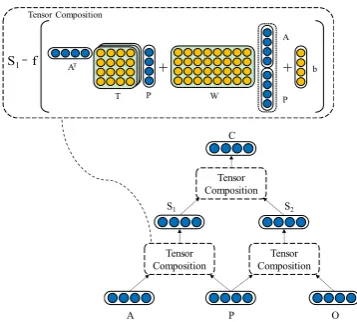
Figure 3: Baseline event-embedding model.
embedding models compound vector tions over its predicate and arguments representa-tions. The challenge is that the composition mod-els should be effective for learning the interactions between the predicate and the argument. Simple additive transformations are incompetent.
We follow Ding et al. (2015) modelling such informative interactions through tensor composi-tion. The architecture of neural tensor network (NTN) for learning event embeddings is shown in Figure3, where the bilinear tensors are used to ex-plicitly model the relationship between the actor and the action, and that between the object and the action.
The inputs of NTN are the word embeddings ofA,P andO, and the outputs are event embed-dings. We initialized our word representations us-ing publicly available d-dimensional (d = 100) GloVe vectors (Pennington et al.,2014). As most event arguments consist of several words, we rep-resent the actor, action and object as the average of their word embeddings, respectively.
From Figure3,S1 ∈Rdis computed by:
S1=f
ATT1[1:k]P+W
A P
+b
g(S1) =g(A, P) =UTS1
(1)
where T1[1:k] ∈ Rd×d×k is a tensor, which is a set of k matrices, each with d×d dimensions. The bilinear tensor product ATT1[1:k]P is a vec-torr ∈Rk, where each entry is computed by one slice of the tensor (ri =ATT1[i]P, i = 1,· · · , k).
The other parameters are a standard feed-forward neural network, whereW ∈ Rk×2d is the weight
matrix, b ∈ Rk is the bias vector, U ∈
Rk is a
≈ +
slice=1
… … …
≈ +
slice=k
Figure 4: An illustration of low-rank neural tensor net-work for learning event embeddings.
hyper-parameter andf =tanh is a standard non-linearity applied element-wise. S2 andC in
Fig-ure3are computed in the same way asS1.
One problem with tensors is curse of dimen-sionality, which limits the wide application of ten-sors in many areas. It is therefore essential to ap-proximate tensors of higher order in a compressed scheme, for example, a low-rank tensor decom-position. To decrease the number of parameters in standard neural tensor network, we make low-rank approximation that represents each matrix by two low-rank matrices plus diagonal, as illustrated in Figure 4. Formally, the parameter of thei-th slice isTappr[i] = T[i1]×T[i2]+diag(t[i]), where T[i1] ∈
Rd×n, T[i2] ∈ Rn×d, t[i] ∈ Rd, n is a hyper-parameter, which is used for adjusting the degree of tensor decomposition. The output of neural tensor layer is formalized as follows.
S1=f
AT[Tappr][1:1 k]P+W
A P
+b
, (2)
where [Tappr][1:1 k] is the low-rank tensor that
de-fines multiple low-rank bilinear layers. k is the slice number of neural tensor network which is also equal to the output length ofS1.
We assume that event tuples in the training data should be scored higher than corrupted tuples, in which one of the event arguments is replaced with a random argument. Formally, the corrupted event tuple isEr = (Ar, P, O), which is derived by re-placing each word inAwith a random wordwrin our dictionaryD(which contains all the words in the training data) to obtain a corrupted counterpart
Ar. We calculate themargin lossof the two event tuples as:
LE =loss(E, Er) = max(0,1−g(E) +g(Er)) +λkΦk2
2,
(3)
whereΦ = (T1, T2, T3, W, b) is the set of model
parameters. The standard L2 regularization is
[image:3.595.90.269.60.221.2]algorithm goes over the training set for multiple iterations. For each training instance, if the loss
loss(E, Er) = max(0,1−g(E)+g(Er))is equal to zero, the online training algorithm continues to process the next event tuple. Otherwise, the pa-rameters are updated to minimize the loss using back-propagation (Rumelhart et al.,1985).
2.2 Intent Embedding
Intent embedding refers to encoding the event participants’ intents into event vectors, which is mainly used to explain why the actor per-formed the action. For example, given two events “PersonX threw basketball” and “PersonX threw bomb”, there are only subtle differences in their surface realizations, however, the intents are to-tally different. “PersonX threw basketball” is just for fun, while “PersonX threw bomb” could be a terrorist attack. With the intents, we can easily dis-tinguish these superficial similar events.
One challenge for incorporating intents into event embeddings is that we should have a large-scale labeled dataset, which annotated the event and its actor’s intents. Recently, Rashkin et al.
(2018) andSap et al. (2019) released such valu-able commonsense knowledge dataset (ATOMIC), which consists of 25,000 event phrases covering a diverse range of daily-life events and situations. For example, given an event “PersonX drinks cof-fee in the morning”, the dataset labelsPersonX’s likely intent is “PersonX wants to stay awake”.
We notice that the intents labeled in ATOMIC is a sentence. Hence, intent embedding is ac-tually a sentence representation learning task. Among various neural networks for encoding sen-tences, bi-directional LSTMs (BiLSTM) ( Hochre-iter and Schmidhuber,1997) have been a dominant method, giving state-of-the-art results in language modelling (Peters et al.,2018) and syntactic pars-ing (Dozat and Manning,2016).
We use BiLSTM model to learn intent represen-tations. BiLSTM consists of two LSTM compo-nents, which process the input in the forward left-to-right and the backward right-to-left directions, respectively. In each direction, the reading of in-put words is modelled as a recurrent process with a single hidden state. Given an initial value, the state changes its value recurrently, each time con-suming an incoming word.
Take the forward LSTM component for exam-ple. Denoting the initial state as−→h0, which is a
model parameter, it reads the input word repre-sentations x0,x1, . . . ,xn, and the recurrent state
transition step for calculating −→h1, . . . ,−→hn+1 is defined asGraves and Schmidhuber(2005).
The backward LSTM component follows the same recurrent state transition process as the for-ward LSTM component. Starting from an initial state←h−n+1, which is a model parameter, it reads the inputxn,xn−1, . . . ,x0, changing its value to
←−
hn,←h−n−1, . . . ,←h−0, respectively.
The BiLSTM model uses the concatenated value of−→htand←h−tas the hidden vector forwt:
ht= [−→ht;←h−t] (4)
A single hidden vector representationviof the
in-put intent can be obtained by concatenating the last hidden states of the two LSTMs:
vi= [
− →
hn+1;←h−0] (5)
In the training process, we calculate the similar-ity between a given event vectorveand its related
intent vectorvi. For effectively training the model,
we devise a ranking type loss function as follows:
LI=max(0,1−cosine(ve,vi) +cosine(ve,v0i)) (6)
where vi0 is the incorrect intent for ve, which is
randomly selected from the annotated dataset.
2.3 Sentiment Embedding
Sentiment embedding refers to encoding the event participants’ emotions into event vectors, which is mainly used to explain how does the actor feel af-ter the event. For example, given two events “ Per-sonX broke record” and “PersonX broke vase”, there are only subtle differences in their surface re-alizations, however, the emotions ofPersonX are totally different. After “PersonX broke record”, PersonXmay be feel happy, while after “PersonX broke vase”,PersonX could be feel sad. With the emotions, we can also effectively distinguish these superficial similar events.
We also use ATOMIC (Sap et al.,2019) as the event sentiment labeled dataset. In this dataset, the sentiment of the event is labeled as words. For example, the sentiment of “PersonX broke vase” is labeled as “(sad, be regretful, feel sorry, afraid)”. We use SenticNet (Cambria et al.,
2018) to normalize these emotion words (W =
the negative (labeled as -1) sentiment. The senti-ment polarity of the eventPeis dependent on the
polarity of the labeled emotion wordsPW: Pe = 1, if P
iPwi > 0, orPe = −1, if P
iPwi < 0.
We use the softmax binary classifier to learn sen-timent enhanced event embeddings. The input of the classifier is event embeddings, and the output is its sentiment polarity (positive or negative). The model is trained in a supervised manner by min-imizing the cross entropy error of the sentiment classification, whose loss function is given below.
LS=− X
xe∈C X
l∈L
pgl(xe)·log(pl(xe)) (7)
whereCmeans all training instances,Lis the col-lection of sentiment categories,xemeans an event
vector, pl(xe) is the probability of predicting xe
as classl, pgl(xe) indicates whether classl is the
correct sentiment category, whose value is 1 or -1.
2.4 Joint Event, Intent and Sentiment Embedding
Given a training event corpus with annotated in-tents and emotions, our model jointly minimizes a linear combination of the loss functions on events, intents and sentiment:
L=αLE+βLI+γLS (8)
where α, β, γ ∈ [0,1] are model parameters to weight the three loss functions.
We use the New York Times Gigaword Cor-pus (LDC2007T07) for pre-training event embed-dings. Event triples are extracted based on the Open Information Extraction technology (Schmitz et al., 2012). We initialize the word embedding layer with 100 dimensional pre-trained GloVe vec-tors (Pennington et al.,2014), and fine-tune initial-ized word vectors during our model training. We use Adagrad (Duchi et al., 2011) for optimizing the parameters with initial learning rate 0.001 and batch size 128.
3 Experiments
We compare the performance of intent and senti-ment powered event embedding model with state-of-the-art baselines on three tasks: event similar-ity, script event prediction and stock prediction.
3.1 Baselines
We compare the performance of our approach against a variety of event embedding models
de-veloped in recent years. These models can be cat-egorized into three groups:
• Averaging Baseline (Avg) This represents each event as the average of the constituent word vectors using pre-trained GloVe embed-dings (Pennington et al.,2014).
• Compositional Neural Network (Comp.
NN) The event representation in this model is computed by feeding the concatenation of the subject, predicate, and object embedding into a two layer neural network (Modi and Titov, 2013; Modi, 2016; Granroth-Wilding and Clark,2016).
• Element-wise Multiplicative Composition (EM Comp.) This method simply concate-nates the element-wise multiplications be-tween the verb and its subject/object.
• Neural Tensor Network This line of work use tensors to learn the interactions between the predicate and its subject/object (Ding et al., 2015; Weber et al., 2018). Accord-ing to the different usage of tensors, we have three baseline methods: Role Factor Ten-sor (Weber et al., 2018) which represents the predicate as a tensor, Predicate Tensor
(Weber et al.,2018) which uses two tensors learning the interactions between the predi-cate and its subject, and the predipredi-cate and its object, respectively,NTN(Ding et al.,2015), which we used as the baseline event embed-ding model in this paper, andKGEB (Ding et al., 2016), which incorporates knowledge graph information in NTN.
3.2 Event Similarity Evaluation
3.2.1 Hard Similarity Task
Method Hard Similarity (Accuracy %) Transitive Sentence Similarity (ρ) Small Dataset Big Dataset
Avg 5.2 13.7 0.67
Comp. NN 33.0 18.9 0.63
EM Comp. 33.9 18.7 0.57
Role Factor Tensor 43.5 20.7 0.64
Predicate Tensor 41.0 25.6 0.63
KGEB 52.6 49.8 0.61
NTN 40.0 37.0 0.60
NTN+Int 65.2 58.1 0.67
NTN+Senti 54.8 52.2 0.61
[image:6.595.131.466.61.184.2]NTN+Int+Senti 77.4 62.8 0.74
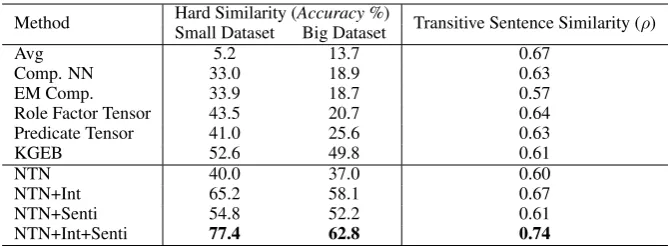
Table 1: Experimental results on hard similarity dataset and transitive sentence similarity dataset. The small dataset (230 event pairs) of hard similarity task fromWeber et al.(2018), and the big dataset (2,000 event pairs) is annotated by us. The best results are in bold.
The labeled dataset contains 230 event pairs (115 pairs each of similar and dissimilar types). Three different annotators were asked to give the similarity/dissimilarity rankings, of which only those the annotators agreed upon completely were kept. For each event representation learning method, we obtain the cosine similarity score of the pairs, and report the fraction of cases where the similar pair receives a higher cosine value than the dissimilar pair (we useAccuracy∈[0,1]denoting it). To evaluate the robustness of our approach, we extend this dataset to 1,000 event pairs (similar and dissimilar events each account for 50%), and we will release this dataset to the public.
3.2.2 Transitive Sentence Similarity
Except for the hard similarity task, we also evalu-ate our approach on the transitive sentence sim-ilarity dataset (Kartsaklis and Sadrzadeh, 2014), which contains 108 pairs of transitive sentences: short phrases containing a single subject, object and verb (e.g., agent sell property). It also has an-other dataset which consists of 200 sentence pairs. In this dataset, the sentences to be compared are constructed using the same subject and object and semantically correlated verbs, such as ‘spell’ and ‘write’; for example, ‘pupils write letters’ is com-pared with ‘pupils spell letters’. As this dataset is not suitable for our task, we only evaluate our approach and baselines on 108 sentence pairs.
Every pair is annotated by a human with a simi-larity score from 1 to 7. For example, pairs such as (design, reduce, amount) and (company, cut, cost) are annotated with a high similarity score, while pairs such as (wife, pour, tea) and (worker, join, party) are given low similarity scores. Since each pair has several annotations, we use the average
annotator score as the gold score2. To evaluate the cosine similarity given by each model and the annotated similarity score, we use the Spearman’s correlation (ρ∈[−1,1]).
3.2.3 Results
Experimental results of hard similarity and transi-tive sentence similarity are shown in Table1. We find that:
(1) Simple averaging achieved competitive per-formance in the task of transitive sentence similar-ity, while performed very badly in the task of hard similarity. This is mainly because hard similarity dataset is specially created for evaluating the event pairs that should be close to each other but have lit-tle lexical overlap and that should be farther apart but have high lexical overlap. Obviously, on such dataset, simply averaging word vectors which is incapable of capturing the semantic interactions between event arguments, cannot achieve a sound performance.
(2) Tensor-based compositional methods (NTN, KGEB, Role Factor Tensor and Predicate Ten-sor) outperformed parameterized additive models (Comp. NN and EM Comp.), which shows that tensor is capable of learning the semantic compo-sition of event arguments.
(3) Our commonsense knowledge enhanced event representation learning approach outper-formed all baseline methods across all datasets (achieving 78% and 200% improvements on hard similarity small and big dataset, respectively, com-pared to previous SOTA method), which indicates that commonsense knowledge is useful for distin-guishing distinct events.
2To directly compare with baseline methods (Weber et al.,
Event1 Event 2 oScore mScore Event1 Event 2 oScore mScore
man clears test he passed exam -0.08 0.40 man passed car man passed exam 0.81 0.12
he grind corn cook chops beans 0.31 0.81 he grind corn he grind teeth 0.89 0.36
he made meal chef cooked pasta 0.51 0.85 chef cooked pasta chef cooked books 0.89 0.45
farmer load truck person packs car 0.58 0.83 farmer load truck farmer load gun 0.93 0.55
[image:7.595.74.528.61.124.2]player scored goal she carried team 0.19 0.44 she carried bread she carried team 0.59 0.09
Table 2: Case study of the cosine similarity score changes with incorporating the intent and sentiment. oScore is the original cosine similarity score without intent and sentiment, and mScore is the modified cosine similarity score with intent and sentiment.
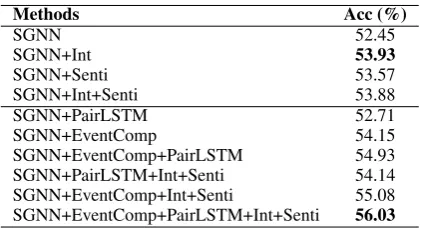
Methods Acc (%)
SGNN 52.45
SGNN+Int 53.93
SGNN+Senti 53.57
SGNN+Int+Senti 53.88
SGNN+PairLSTM 52.71
SGNN+EventComp 54.15
SGNN+EventComp+PairLSTM 54.93
SGNN+PairLSTM+Int+Senti 54.14
SGNN+EventComp+Int+Senti 55.08
SGNN+EventComp+PairLSTM+Int+Senti 56.03
Table 3: Results of script event prediction on the test set. The improvement is significant atp <0.05. Acc is short for Accuracy.
3.2.4 Case Study
To further analyse the effects of intents and emo-tions on the event representation learning, we present case studies in Table 2, which directly shows the changes of similarity scores before and after incorporating intent and sentiment. For ex-ample, the original similarity score of two events “chef cooked pasta” and “chef cooked books” is very high (0.89) as they have high lexical overlap. However, their intents differ greatly. The intent of “chef cooked pasta” is “to hope his customer enjoying the delicious food”, while the intent of “chef cooked books” is “to falsify their financial statements”. Enhanced with the intents, the sim-ilarity score of the above two events dramatically drops to 0.45. For another example, as the event pair “man clears test” and “he passed exam” share the same sentiment polarity, their similarity score is boosted from -0.08 to 0.40.
3.3 Script Event Prediction
Event is a kind of important real-world knowl-edge. Learning effective event representations can be benefit for numerous applications. Script event prediction (Chambers and Jurafsky, 2008) is a challenging event-based commonsense reasoning task, which is defined as giving an existing event context, one needs to choose the most reasonable subsequent event from a candidate list.
50.00% 52.00% 54.00% 56.00% 58.00% 60.00% 62.00% 64.00% 66.00% 68.00% 70.00%
Word Event NTN KGEB +Int +Senti +Int+Senti
Accuracy
[image:7.595.76.287.187.301.2]Methods
Figure 5: Experimental results on S&P 500 index pre-diction. “+Int” means that we encode the intent infor-mation into the original event embeddings.
FollowingLi et al. (2018a), we evaluate on the standard multiple choice narrative cloze (MCNC) dataset (Granroth-Wilding and Clark, 2016). As SGNN proposed by Li et al. (2018a) achieved state-of-the-art performances for this task, we use the framework of SGNN, and only replace their input event embeddings with our intent and sentiment-enhanced event embeddings.
[image:7.595.312.524.190.304.2]3.4 Stock Market Prediction
It has been shown that news events influence the trends of stock price movements (Luss and d’Aspremont, 2012). As news events affect hu-man decisions and the volatility of stock prices is influenced by human trading, it is reasonable to say that events can influence the stock market.
In this section, we compare with several event-driven stock market prediction baseline methods: (1)Word,Luss and d’Aspremont(2012) use bag-of-words represent news events for stock predic-tion; (2)Event,Ding et al.(2014) represent events by subject-predicate-object triples for stock pre-diction; (3)NTN,Ding et al. (2015) learn contin-ues event vectors for stock prediction; (4)KGEB,
Ding et al. (2016) incorporate knowledge graph into event vectors for stock prediction.
Experimental results are shown in Figure5. We find that knowledge-driven event embedding is a competitive baseline method, which incorporates world knowledge to improve the performances of event embeddings on the stock prediction. Sen-timent is often discussed in predicting stock mar-ket, as positive or negative news can affect peo-ple’s trading decision, which in turn influences the movement of stock market. In this study, we em-pirically show that event emotions are effective for improving the performance of stock prediction (+2.4%).
4 Related Work
Recent advances in computing power and NLP technology enables more accurate models of events with structures. Using open information extraction to obtain structured events representa-tions, we find that the actor and object of events can be better captured (Ding et al., 2014). For example, a structured representation of the event above can be (Actor = Microsoft, Action =sues, Object =Barnes & Noble). They report improve-ments on stock market prediction using their struc-tured representation instead of words as features.
One disadvantage of structured representations of events is that they lead to increased spar-sity, which potentially limits the predictive power.
Ding et al. (2015) propose to address this issue by representing structured events usingevent em-beddings, which are dense vectors. The goal of event representation learning is that similar events should be embedded close to each other in the same vector space, and distinct events should be
farther from each other.
Previous work investigated compositional mod-els for event embeddings. Granroth-Wilding and Clark(2016) concatenate predicate and argument embeddings and feed them to a neural network to generate an event embedding. Event embeddings are further concatenated and fed through another neural network to predict the coherence between the events. Modi (2016) encodes a set of events in a similar way and use that to incrementally predict the next event – first the argument, then the predi-cate and then next argument.Pichotta and Mooney
(2016) treat event prediction as a sequence to se-quence problem and use RNN based models con-ditioned on event sequences in order to predict the next event. These three works all model narrative chains, that is, event sequences in which a single entity (the protagonist) participates in every event.
Hu et al.(2017) also apply an RNN approach, ap-plying a new hierarchical LSTM model in order to predict events by generating descriptive word se-quences. This line of work combines the words in these phrases by the passing the concatenation or addition of their word embeddings to a parameter-ized function that maps the summed vector into event embedding space. The additive nature of these models makes it difficult to model subtle dif-ferences in an event’s surface form.
To address this issue, Ding et al. (2015), and
Weber et al. (2018) propose tensor-based compo-sition models, which combine the subject, predi-cate and object to produce the final event repre-sentation. The models capture multiplicative inter-actions between these elements and are thus able to make large shifts in event semantics with only small changes to the arguments.
However, previous work mainly focuses on the nature of the event and lose sight of external com-monsense knowledge, such as the intent and sen-timent of event participants. This paper proposes to encode intent and sentiment into event embed-dings, such that we can obtain a kind of more pow-erful event representations.
5 Conclusion
learn-ing process of event embeddlearn-ings. Experimental results on event similarity, script event prediction and stock prediction showed that commonsense knowledge enhanced event embeddings can im-prove the quality of event representations and ben-efit the downstream applications.
Acknowledgments
We thank the anonymous reviewers for their constructive comments, and gratefully acknowl-edge the support of the National Key Re-search and Development Program of China (SQ2018AAA010010), the National Key Re-search and Development Program of China (2018YFB1005103), the National Natural Science Foundation of China (NSFC) via Grant 61702137.
References
Erik Cambria, Soujanya Poria, Devamanyu Hazarika, and Kenneth Kwok. 2018. Senticnet 5: discover-ing conceptual primitives for sentiment analysis by means of context embeddings. InProceedings of the Thirty-Second AAAI Conference on Artificial Intelli-gence, (AAAI-18), the 30th innovative Applications of Artificial Intelligence (IAAI-18), and the 8th AAAI Symposium on Educational Advances in Artificial Intelligence (EAAI-18), New Orleans, Louisiana, USA, February 2-7, 2018.
Nathanael Chambers and Dan Jurafsky. 2008. Unsu-pervised learning of narrative event chains. In Pro-ceedings of ACL-08: HLT, pages 789–797. Associa-tion for ComputaAssocia-tional Linguistics.
Xiao Ding, Yue Zhang, Ting Liu, and Junwen Duan. 2014. Using structured events to predict stock price movement: An empirical investigation. In Proceed-ings of the 2014 Conference on Empirical Methods in Natural Language Processing, EMNLP 2014, Oc-tober 25-29, 2014, Doha, Qatar, A meeting of SIG-DAT, a Special Interest Group of the ACL, pages 1415–1425, Doha, Qatar. Association for Computa-tional Linguistics.
Xiao Ding, Yue Zhang, Ting Liu, and Junwen Duan. 2015. Deep learning for event-driven stock predic-tion. In Proceedings of the Twenty-Fourth Inter-national Joint Conference on Artificial Intelligence, IJCAI 2015, Buenos Aires, Argentina, July 25-31, 2015, pages 2327–2333.
Xiao Ding, Yue Zhang, Ting Liu, and Junwen Duan. 2016. Knowledge-driven event embedding for stock prediction. In Proceedings of COLING 2016, the 26th International Conference on Computational Linguistics: Technical Papers, pages 2133–2142.
Timothy Dozat and Christopher D Manning. 2016. Deep biaffine attention for neural dependency pars-ing. arXiv preprint arXiv:1611.01734.
John C Duchi, Elad Hazan, and Yoram Singer. 2011. Adaptive subgradient methods for online learning and stochastic optimization. Journal of Machine Learning Research, 12:2121–2159.
Mark Granroth-Wilding and Stephen Christopher Clark. 2016. What happens next? event predic-tion using a composipredic-tional neural network model. In Proceedings of the Thirtieth AAAI Conference on Artificial Intelligence, February 12-17, 2016, Phoenix, Arizona, USA., pages 2727–2733.
Alex Graves and J¨urgen Schmidhuber. 2005. Frame-wise phoneme classification with bidirectional lstm and other neural network architectures. Neural Net-works, 18(5-6):602–610.
Sepp Hochreiter and J¨urgen Schmidhuber. 1997. Long short-term memory. Neural computation, 9(8):1735–1780.
Linmei Hu, Juanzi Li, Liqiang Nie, Xiao-Li Li, and Chao Shao. 2017. What happens next? future subevent prediction using contextual hierarchical lstm. In Proceedings of the Thirty-First AAAI Conference on Artificial Intelligence, February 4-9, 2017, San Francisco, California, USA., pages 3450– 3456.
Dimitri Kartsaklis and Mehrnoosh Sadrzadeh. 2014. A study of entanglement in a categorical framework of natural language. Electronic Proceedings in Theo-retical Computer Science, 172.
Zhongyang Li, Xiao Ding, and Ting Liu. 2018a. Constructing narrative event evolutionary graph for script event prediction. In Proceedings of the Twenty-Seventh International Joint Conference on Artificial Intelligence, IJCAI 2018, July 13-19, 2018, Stockholm, Sweden., pages 4201–4207.
Zhongyang Li, Xiao Ding, and Ting Liu. 2018b. Gen-erating reasonable and diversified story ending using sequence to sequence model with adversarial train-ing. InProceedings of the 27th International Con-ference on Computational Linguistics, pages 1033– 1043, Santa Fe, New Mexico, USA. Association for Computational Linguistics.
Zhongyang Li, Xiao Ding, and Ting Liu. 2019. Story ending prediction by transferable bert. In Pro-ceedings of the Twenty-Eighth International Joint Conference on Artificial Intelligence, IJCAI 2019, Macao, China, August 10-16, 2019, pages 1800– 1806.
Ronny Luss and Alexandre d’Aspremont. 2012. Predicting abnormal returns from news us-ing text classification. Quantitative Finance, (doi:10.1080/14697688.2012.672762):1–14.
Ashutosh Modi and Ivan Titov. 2013. Learning seman-tic script knowledge with event embeddings. In2nd International Conference on Learning Representa-tions, ICLR 2014, Banff, AB, Canada, April 14-16, 2014, Workshop Track Proceedings.
Jeffrey Pennington, Richard Socher, and Christopher Manning. 2014. Glove: Global vectors for word representation. InProceedings of the 2014 confer-ence on empirical methods in natural language pro-cessing (EMNLP), pages 1532–1543.
Matthew Peters, Mark Neumann, Mohit Iyyer, Matt Gardner, Christopher Clark, Kenton Lee, and Luke Zettlemoyer. 2018. Deep contextualized word repre-sentations. InProceedings of the 2018 Conference of the North American Chapter of the Association for Computational Linguistics: Human Language Technologies, Volume 1 (Long Papers), volume 1, pages 2227–2237.
Karl Pichotta and Raymond J Mooney. 2016. Learn-ing statistical scripts with lstm recurrent neural net-works. In Proceedings of the Thirtieth AAAI Con-ference on Artificial Intelligence, February 12-17, 2016, Phoenix, Arizona, USA., pages 2800–2806.
Hannah Rashkin, Maarten Sap, Emily Allaway, Noah A. Smith, and Yejin Choi. 2018.Event2mind: Commonsense inference on events, intents, and re-actions. InProceedings of the 56th Annual Meet-ing of the Association for Computational LMeet-inguistics (Volume 1: Long Papers), pages 463–473. Associa-tion for ComputaAssocia-tional Linguistics.
David E Rumelhart, Geoffrey E Hinton, and Ronald J Williams. 1985. Learning internal representations by error propagation. Technical report, DTIC Doc-ument.
Maarten Sap, Ronan LeBras, Emily Allaway, Chan-dra Bhagavatula, Nicholas Lourie, Hannah Rashkin, Brendan Roof, Noah A Smith, and Yejin Choi. 2019. Atomic: An atlas of machine commonsense for if-then reasoning. pages 3027–3035.
Michael Schmitz, Robert Bart, Stephen Soderland, Oren Etzioni, et al. 2012. Open language learn-ing for information extraction. In Proceedings of the 2012 Joint Conference on Empirical Methods in Natural Language Processing and Computational Natural Language Learning, pages 523–534. Asso-ciation for Computational Linguistics.
Zhongqing Wang, Yue Zhang, and Ching-Yun Chang. 2017. Integrating order information and event re-lation for script event prediction. InProceedings of the 2017 Conference on Empirical Methods in Natu-ral Language Processing, pages 57–67. Association for Computational Linguistics.
Noah Weber, Niranjan Balasubramanian, and Nathanael Chambers. 2018. Event representations with tensor-based compositions. InProceedings of the Thirty-Second AAAI Conference on Artificial