Proceedings of the 2019 Conference on Empirical Methods in Natural Language Processing 1866
Retrieval-guided Dialogue Response Generation via a
Matching-to-Generation Framework
Deng Cai1∗ Yan Wang2∗ Wei Bi2 Zhaopeng Tu2 Xiaojiang Liu2 Shuming Shi2 1The Chinese University of Hong Kong,2Tencent AI Lab
{brandenwang,victoriabi,zptu,kieranliu,shumingshi}@tencent.com
Abstract
End-to-end sequence generation is a popular technique for developing open domain dia-logue systems, though they suffer from the safe response problem. Researchers have at-tempted to tackle this problem by incorpo-rating generative models with the returns of retrieval systems. Recently, a skeleton-then-response framework has been shown promis-ing results for this task. Nevertheless, how to precisely extract a skeleton and how to effec-tively train a retrieval-guided response gener-ator are still challenging. This paper presents a novel framework in which the skeleton ex-traction is made by an interpretable matching model and the following skeleton-guided re-sponse generation is accomplished by a sep-arately trained generator. Extensive exper-iments demonstrate the effectiveness of our model designs.
1 Introduction
Sequence-to-sequence (seq2seq) neural models (Shang et al., 2015; Vinyals and Le, 2015; Sor-doni et al., 2015; Serban et al., 2016; Li et al.,
2016a) have been popular for single-turn dialogue response generation. However, many of the gen-erated responses (e.g., “I don’t know” and “I think so”) appear to be generic and dull (safe response problem) (Li et al., 2016a). This problem is avoided in traditional retrieval systems (Ji et al.,
2014;Hu et al., 2014) by preceding the selection of informative and engaging responses.
It is of interest to benefit from both the gener-alization capacity of the seq2seq models and the information richness of the retrieved responses. Following the standard encoder-decoder frame-work, early attempts have either used an extra en-coder for the retrieved response (Song et al.,2016;
∗This work was mainly done when Deng Cai was an
intern at Tencent AI Lab. Yan Wang is the corresponding author.
Query: How is your day today?
Response: Great, I get promotion today. Retrieval
guided seq2seqVanilla
Bad, I hate the weather.
collapse
mismatch
retrieve
generate
[image:1.595.315.516.221.334.2]generate
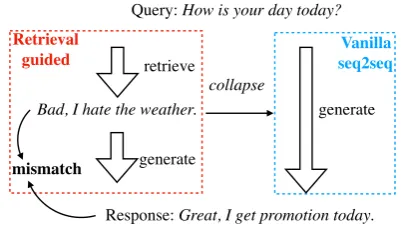
Figure 1: The common problem for training a retrieval-guided generation model in previous work. The model is forced to neglect the retrieved response even though it is a proper response, due to the mismatch between the retrieved response and the target response.
Pandey et al., 2018; Wu et al., 2019) or a uni-fied encoder for the concatenation of the query and the retrieved response (Weston et al., 2018). To prevent the inflow of erroneous information,
Cai et al. (2019) proposed a general framework that first extracts a skeleton from the retrieved re-sponse and then generates the rere-sponse based on the extracted skeleton. Despite their differences, a common issue is that the generation model easily learns to ignore the retrieved response entirely and collapses to a vanilla seq2seq model. As shown in Figure 1, this happens with improper training instances. Given the large space of possible sponses, it happens frequently that a retrieved re-sponse (extracted skeleton) is suitable for respond-ing to the query, but inconsistent with the current target response.1The generation model is thus mis-takenly led to be inclined to neglect the retrieval.
To address the above problem, we present the matching-to-generation method, a more flexible
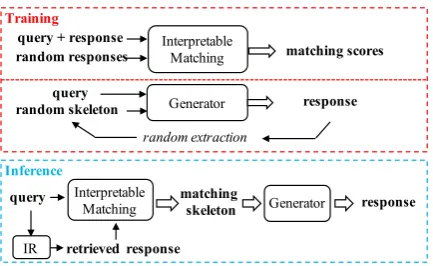
framework for retrieval-guided response genera-tion. This framework consists of an interpretable matching model for skeleton extraction and a skeleton-guided response generator for response generation. One novel characteristic of our pro-posed framework is that the training of the skele-ton extractor (i.e., the matching model) and the re-sponse generator is decoupled, yet they work co-operatively under the help of a retrieval system. Figure 2 depicts the training and inference pro-cedures of our framework. During training, the skeleton-guided response generator is trained in a similar manner as the denoising autoencoder ( Vin-cent et al., 2008), where the model learns to re-cover an input pattern that is partially corrupted. Specifically, we employ a random mechanism for generating the skeletons used for training. The generated skeletons are extracted from their cor-responding responses with some deliberate distur-bance. In this way, we circumvent the aforemen-tioned problem of improper training instances in previous work. Meanwhile, the random mecha-nism also simulates the actual inference environ-ment where the quality of the input skeleton varies among different queries due to the instability of the retrieval system and the skeleton extractor. The diversity of the training skeletons helps produce a robust response generator that is capable of han-dling different situations.
Note the separation of the training of skeleton extraction and response generation requires an ad-ditional training objective for the skeleton extrac-tor. Given there is no explicit response skeleton in general query-response pairs for training, we pro-pose to use an interpretable matching model for
matching skeletonextraction. We consider that the matching skeleton for a given query-response pair should be the sub-sequence of the response that is particularly useful in matching the query. The designed interpretable matching model is able to reveal the fine-grained matching scores at token-level whereas it is trained by ordinary query-response pairs.
Experiments show that our method significantly improves the informativeness of the generated re-sponses as well as their relevance to the corre-sponding queries. In addition, we conduct exten-sive ablation studies to quantify the improvement from different model designs.
To summarize, our contributions are as follows:
• We propose a flexible framework for
Training
Inference query + response
random responses Interpretable Matching matching scores
query
Generator
random skeleton response
random extraction
query Interpretable Matching
IR retrieved response matching
skeleton Generator response
Figure 2: Flow charts during training and inference.
retrieval-guided dialogue response gen-eration. The training of our approach is independent of the underlying retrieval system.
• We propose an interpretable matching model
for matching skeleton extraction.
• We propose to train a skeleton-guided
re-sponse generator that can handle skeletons with different qualities.
2 Models
The whole framework consists of two compo-nents: an interpretable matching model and a skeleton-guided response generator. During in-ference, the matching model is used to derive a matching skeleton by explicitly selecting a sub-sequence of a retrieved response. The response generator then takes the generated skeleton as an additional input and makes necessary editions to obtain a complete and appropriate response.
2.1 Interpretable Matching Model
The goal of the interpretable matching model is to reveal token-level matching information between a query-response pair thus a matching skeleton can be derived from the response. However, the train-ing of the matchtrain-ing model does not rely on such fine-grained annotations. Instead, it is trained to estimate the sequence-level quality of a response for a given query, as an ordinary query-response matching model. The key is that the sequence-level matching score can be decomposed into a set of token-level scores, which will be illustrated later.
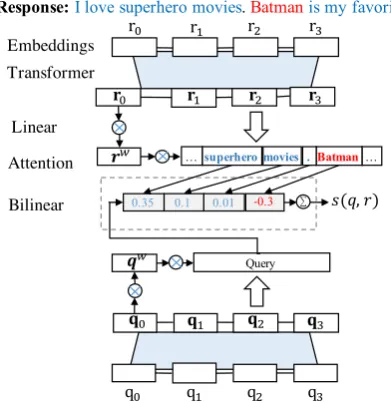
[image:2.595.310.527.61.194.2]re-sponse. Both encoders are based on the Trans-former architecture (Vaswani et al.,2017). For a query q = (q1, q2, . . . , qn) and a response r = (r1, r2, . . . , rm), where n and m are the query
length and the response length respectively, we first insert a special token at the beginning of each input sequence. The transformer encoders results in two sequences of hidden state vectors
q0,q1, . . . ,qn andr0,r1, . . . ,rm, where q0 and
r0 are considered as the aggregate summary for the query and the response respectively.
We then use self-attention mechanism for ac-quiring the final query representationxq and the
final response representation xr. For instance, to
compute the response representation xr, we use
the sequence-level summaryr0 for weighting the different parts of the input response. First, the sequence-level summaryr0is projected to another vector space by a linear transformation:
rw=Wwr0+bw
where rw is the weight vector, and Ww and bw are learnable parameters. The attention score ωi
of thei-th token in the response is then computed as a dot-product between the weight vectorrwand
the token representationri:
ωi =
exp(rw·ri)
Pm
k=1exp(rw·rk)
The response representationxris calculated as the
weighted sum of the Transformer encoder outputs as well as their initial vector representations (i.e., the sum of tokens and position embeddings)2:
xr= m X
k=1
ωi(ri+eri)
The self-attention mechanism for the query has the identical architecture but uses a different set of parameters. Finally, the pair-wise score is calcu-lated by a bilinear function ofxqandxr:
s(q, r) =xqTWsxr
where Ws is a trainable parameter. The above equation can be rewritten by a decomposition of
2We found that adding the initial vector representations
erito be critical in keeping the weighted elements reflect the corresponding local information. Without this operation, the Transformer encoder outputsritends to be constant regard-less of the positioni, which indicates that the point informa-tion about a specific input part is overwhelmed by the global information.
Embeddings Transformer
Linear
Attention
Bilinear
Query
!(#, %) 0.35 0.01 -0.3 '
q* q+ q, q -r* r+ r, r
-/* /+ /, / -0* 0+ 0, 0
-12
32
Response: I love superhero movies. Batman is my favorite.
Query: Would you like to watch Captain America?
…superheromovies . Batman…
[image:3.595.315.511.63.265.2]0.1
Figure 3: Architecture of the interpretable matching model. The query and response are encoded separately. We compute all attention values for each token simulta-neously. The final score is computed by a bilinear func-tion between query representafunc-tion and response repre-sentation. Different colors indicate the different values of the local scores.
the ingredients ofxr:
s(q, r) =xqTWsxr
=xqTWs m X
k=1
ωk(rk+erk)
= m X
k=1
ωkxqTWs(rk+erk)
Letsk =xqTWs(rk+erk), we arrive at:
s(q, r) = m X
k=1 ωksk
Note that for a given query, ωk andsk are
func-tions of the response r and the position index k only. According to the formulation, we see thatsk
andωkare largely impacted by the local
informa-tion atrk. Therefore,sk,ωkcan be interpreted as
thelocal matching scoreand thelocal importance, respectively, followed by thats(q, r)is a weighted
sum of all local scores.
Once the matching model has been well-trained, we can useωkandskto identify the most
2.2 Skeleton-guided Response Generator
The skeleton-guided response generator is devised for generating a fluent and adequate response based on the current query and an input skeleton. To ensure the skeleton-guided response generator does make use of the input skeleton, we extract the training skeleton from the ground-truth response by some randomized strategies. To prevent the response generator from mindlessly copying, we deliberately vary the length and the quality of the training skeletons to create a diverse set of training instances. We note the response generator behaves like a denoising autoencoder (Vincent et al.,2008) with an extra input, i.e. the query. In this way, we learn a robust response generator that is compati-ble with different types of skeletons.
Specifically, for any golden query-response pair
(q, r), we randomly generate a training skeleton
through the following procedures.3
• All stop words in r are masked in advance. The rest tokens are masked at a mask rateγ. 90% of the time,γ is set to 0.7. 10% of the time,γ is uniformly sampled in the range of
[0,1].
• Instead of always replacing the masked
to-ken with a special placeholder toto-ken, 20%
of time, we replace the token with a random word uniformly sampled from the total vo-cabulary.
• At a chance of10%, we randomly shuffle the
word order in the training skeleton.
The response generator consists of one encoder for the query q, one encoder for the skeleton s and one decoder for the response r, all implemented by LSTM networks (Hochreiter and Schmidhu-ber,1997). The decoder interacts with the two en-coders through two separate attention mechanisms accordingly.
2.3 Training
The matching model and the response generator are trained separately. Previous studies (Shang et al., 2018; Tao et al., 2018; Mou et al., 2016) formulated the training of matching models as bi-nary classification learning, where negative sam-pling is used to free human annotation. Specifi-cally, for queryqand golden responser+, a nega-tive response r− can be randomly sampled from
3We did not tune much the hyper-parameters in the ran-dom strategies as the given setting just works fine.
other responses in the training set. We extend the binary classification setting into a learning-to-rank fashion for improved performance. Con-cretely, at each training mini-batch, we randomly sample M query-response pairs. Then we com-pute the matching scores between all combina-tions of queries and responses in the mini-batch. As a result, all these scores form a scoring matrix
S ∈ RM×M, whereS
ij is the score between the
i-th query and thej-th response.
Inspired by Henderson et al.(2017); Lin et al.
(2017), we use softmax to compute the ranking scores for candidate responses. Intuitively, for each query, the matching model should give the highest score to the golden response over other M−1responses (i.e., always rank the golden
re-sponse at the first place). Thus, we define the train-ing loss as
L(θ) =− M X
k=1
logsoftmax(Sk:)k (1)
where Sk: is k-th row of S. Label smoothing (Szegedy et al.,2016) of valuels= 0.1is used to
improve the performance. Note although there are M ×M scores to compute, each query and each response only needs to be modeled once thanks to the independent encoding of xq and xr.
Ex-periments show that the ranking scheme outper-forms the binary classification scheme by a large margin when evaluated by hits@1 metric with127
randomly sampled responses.
The response generator is trained by the stan-dard maximum likelihood estimate.
2.4 Discussion
We note that the most related work is Cai et al.
generator to severely ignore the skeleton. Differ-ently, our response generator is trained with target-specific skeletons.
3 Experiments
3.1 Dataset and Evaluation Metrics
We use a single-turn conversation dataset col-lected from popular Chinese social websites such as Douban and Weibo.4The dataset contains about six millions query-response pairs. Throughout all experiments, the retrieval system we adopted is a publicly available chatbot API.5 The related resources can be found at https://github. com/jcyk/seqgen.
It has been argued that existing automatic met-rics such as BLEU and METEOR cannot authen-tically reflect the quality of dialog response. Thus, the main evaluation is done by human annotators. Specifically, we evaluate the quality of a response on three criteria: informativeness, relevance, and fluency. Each aspect is rated on a five-point scale, where1,3and5indicate unacceptable, moderate
and excellent performance respectively. 2 and4
are used by annotators in unsure cases. A set of 300 different query samples are used for evalua-tion. We recruit five experienced annotators and take the average score among them. Besides, we also use dist-1/dist-2 (Li et al., 2016a) to exam-ine a model’s ability for generating diverse re-sponses. which is the number of distinct uni-grams/bi-grams divided by the total number.
3.2 Compared Methods
To show the effectiveness of our proposed meth-ods, we compare it with the following methods.
• Retrieval The underlying retrieval system
used in our experiments.
• Seq2Seq The basic Seq2Seq model ( Bah-danau et al., 2014; Luong et al., 2015) that only takes the query as input.
• Seq2Seq-MMIA variant of the basic Seq2Seq
model that uses Maximum Mutual Informa-tion (MMI) for filtering out generic responses (Li et al.,2016a). Concretely, a response-to-query Seq2Seq model is trained and used to
4Douban https://www.douban.com/ and Weibo
https://www.weibo.com/
5https://ai.qq.com/product/nlpchat.
shtml
rerank the outputs of the top-100 responses
ofSeq2Seq.
• RetrieveNRefine++ The best performing model used inWeston et al.(2018), which ap-pends the retrieved response to the query in a basic Seq2Seq model.6 The model’s output will be overwritten by the retrieved response once they have a large word overlap (Jaccard distance>0.6).
• EditVec The model proposed in Wu et al.
(2019). In addition to the retrieved response, the lexical difference (insert words and delete words) between the query and the retrieved query is also encoded (in a so-called edit vec-tor) to feed the decoder.
• Skeleton-Lex The best method presented in Cai et al.(2019). We refer to it as Skeleton-Lex because its skeleton extractor is ptrained by the lexical overlap between the re-trieved response and the golden response.
3.3 Implementation Details
For encoders and decoders in all above baselines, they are implemented by LSTM networks (bidi-rectional for encoders and unidi(bidi-rectional for de-coders) (Hochreiter and Schmidhuber,1997) with the number of layers and hidden size equal to 2 and 500. The word embeddings are randomly initial-ized, of which the dimension is 300. Our response generator follows the same settings. The skeleton extractor is implemented by 2-layer Transformer encoder (Vaswani et al.,2017), of which the num-ber of heads and hidden size is 8 and 512. In periments, we use a simple heuristic rule for ex-tracting skeletons. First, we remove all words with a negative local scoresk. Then we compute the
av-erage score of the rest part. Lastly, words with a score below the average are also removed.
As the retrieval system can potentially return a large set of results, we allow retrieval-guided gen-eration models (both baselines and ours) make use of the top-10 retrieved results both in training and testing. Therefore, during testing, 10 responses are generated for each query. They are then ranked by the matching model proposed in Section 2.1
and the highest-scored one is used for evaluation.7
6We take a slightly different approach by treating the two inputs as independent sources to do attention over, as it is also suggested by the original authors.
Models Informativeness Relevance Fluency Dist-1(%) Dist-2(%)
Retrieval 2.65 (0.90)† 2.58 (0.86) 2.96 (0.72) 49.10 84.19
Seq2Seq 2.01 (0.65) 2.58 (0.53) 2.71 (0.43) 30.38 54.52
Seq2Seq-MMI 2.47 (0.70) 2.79 (0.67) 2.99 (0.61) 30.98 62.85
RetrieveNRefine++ 2.30 (0.79) 2.62 (0.63) 2.82 (0.51) 29.83 61.07
EditVec 2.29 (0.61) 2.62 (0.60) 2.83 (0.47) 35.30 67.57
Skeleton-Lex 2.45 (0.61) 2.80 (0.56) 2.99 (0.46) 25.70 56.61
[image:6.595.95.505.61.173.2]Ours 2.69(0.87) 3.11(0.55) 3.20(0.55) 49.01 80.36
Table 1: Human scores on response quality, depicted in three aspects: informativeness, relevance, and fluency, with standard deviation in parentheses. Sign tests on human scores show that our method is significantly better than all other methods with p-value<0.01 with the only exception marked by†. We also present dist-1 and dist-2 for diversity assessment.
3.4 Main Results
The evaluation results are given in Table1. They show that our method outperforms all baseline methods in all three human evaluation aspects. Surprisingly, the informativeness score is even slightly better than the underlying retrieval system, which indicates the retrieved information has been effectively utilized. It can also be verified by the automatic metrics (dist-1 and dist-2), our genera-tion model is the only one that achieves close per-formance to that of the retrieval system.
For the relevance score, the retrieval-independent Seq2Seq-MMI establishes a strong baseline. As for retrieval-guided generation, skeleton-guided methods are better than those who use completely retrieved responses, which confirms that the introduction of the intermediate skeleton prevents the inflow of irrelevant infor-mation. Furthermore, our method advances the performance of Skeleton-Lex by a large margin, which partly demonstrates that the skeletons extracted by our deep semantic matching model are more precise.
For fluency, our method also achieves much bet-ter performance than all baseline methods. We at-tribute the remarkable improvement to the unique training fashion for our response generator. Dur-ing trainDur-ing, our response generator receives a di-verse set of probably noisy skeletons, which im-pels it to learn the error correction and better lan-guage organization.
3.5 More Analysis
To further quantify the contributions made by dif-ferent components in our model, we turn to ab-lation tests. Generally, we try to substitute each component of our model with other possible
coun-Skeletons Info. Relevance Fluency Ours 2.69 3.11 3.20
Lexical 2.62 2.92 3.05
keywords 2.56 2.90 3.03
PMI 2.53 2.88 3.02
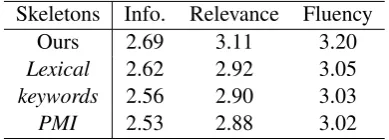
Table 2: Ablation study on the skeleton extractor. Info. is short for informativeness in this and following tables.
terparts. The detailed analysis is given below. First, we would like to see if the matching skele-ton extracted by our interpretable architecture is beneficial. In order to examine this, we replace our skeleton extractor by several different approaches.
• LexicalWe use the skeletons extracted by the
skeleton extractor inSkeleton-Lex.
• PMI Point mutual information (PMI) is a
popular measure used for finding collocations and associations between words. We com-pute the PMI between query word and re-sponse word through statistics on the training corpus. For a word in the retrieved response, we score it by the sum of the PMIs between it and all words in the target query. Words with the highest scores form the skeleton.
• KeywordsWe generate a skeleton by
preserv-ing the most informative words in the re-trieved response. Specifically, the words with the highest TF-IDF values are preserved and the others are removed.
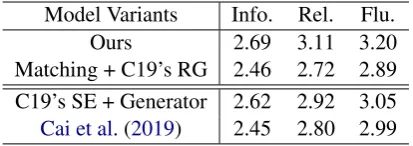
[image:6.595.319.514.250.320.2]Model Variants Info. Rel. Flu. Ours 2.69 3.11 3.20 Matching + C19’s RG 2.46 2.72 2.89 C19’s SE + Generator 2.62 2.92 3.05
[image:7.595.78.285.62.135.2]Cai et al.(2019) 2.45 2.80 2.99
Table 3: A systematic comparison of different compo-nent combinations, where C19’s SE and C19’s RG are short forCai et al.(2019)’s skeleton extractor and re-sponse generator respectively.
is in selecting the most useful words, compared to statistical values such as TF-IDF and PMI.
The result is in shown Table 2. As seen, both two learnable skeleton extractors give better re-sults than non-parametric methods, indicating the task of skeleton extraction is non-trivial and re-quires deep reasoning. Our semantic-inspired model is far ahead of others in all aspects, while
Lexicalonly has a notable improvement in infor-mativeness compared to statistical methods. This suggests that the skeleton extracted byLexicalhas a relatively low precision, leading to moderate rel-evance. In addition, it might be a little bit sur-prising to see thatPMI andkeywordsgive almost the same performance on all three metrics, telling a given query is not that necessary. However, we found lots of skeletons proposed byPMIare iden-tical to those ofkeywords. We attribute it to that the keywords in r are often also the keywords in differentiating its context.
To test the ability of the skeleton-based re-sponse generator, we use the existing alternative trained inSkeleton-Lex, which also takes a skele-ton and input query as input. The result displays on how good our response generator is at trans-forming a skeleton to a proper response.
The results are shown in the first block of Ta-ble3. We see a clear decline in performance after switching to the response generator of Skeleton-Lex. We conjecture that the big gap is caused by that their response generator is trained with the output of their skeleton extractor, thus it is highly biased to their specific skeleton extractor and can-not work well with others. This result motivates us to present a systematic examination of differ-ent compondiffer-ent combinations, as shown by the full content of Table3. As seen, our response gener-ator is less sensitive to the underlying skeletons. The result of combining our response generator and their skeleton extractor is slightly below our
Variants Info. Relevance Fluency
ours 2.69 3.11 3.20
Seq2Seq-MMI 2.64 3.02 3.14
Table 4: Ablation study on the ranker.
full mode, but even higher than their full model. Lastly, we investigate the improvement brought by our ranker. To this end, we replace our ranker with theseq2seq-MMImodel (use the sum of the forward and backward generation probability of re-ranking). The results are shown in Table 4. As we can see, our matching model shows supe-rior capability in selecting the best response, espe-cially in terms of relevance.
3.6 Case Study
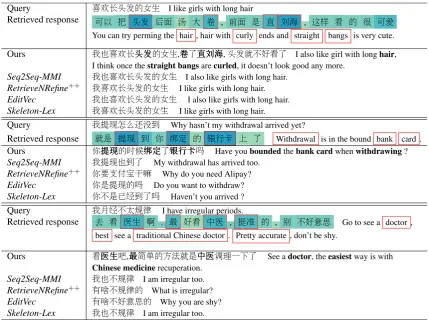
We also present some examples generated by dif-ferent methods in Table 5. In the first case, the retrieved utterance is very specific with elaborated details. However, it is not a reasonable response due to the sudden topic drift. While other methods directly ignore the retrieved response, our method makes an informative and fluent response by using some useful details. In the second case, our skele-ton extractor again successfully locates the most informative and relevant parts of the retrieved re-sponse, the response generator then chains them together and generate a meaningful response. In the third case, the retrieved response is also good but not fluent. The skeleton extracted by our skele-ton extractor contains a useless word, yet our re-sponse generator can ignore the mistake and gen-erate a fluent and comforting response. We can also see another retrieval-guided method (EditVec) also attempt to use the retrieved response but cap-ture the wrong parts.
4 Related Work
[image:7.595.310.523.62.106.2]rea-Query 喜欢长头发的女生 I like girls with long hair
Retrieved response 可以 把 头发 后面 汤 大 卷 , 前面 是 直 刘海 , 这样 看 的 很 可爱
You can try perming the hair , hair with curly ends and straight bangs is very cute.
Ours 我也喜欢长头头头发发发的女生,卷了直卷卷 直直刘刘刘海海海,头发就不好看了 I also like girl with longhair, I think once thestraight bangsarecurled, it doesn’t look good any more.
Seq2Seq-MMI 我也喜欢长头发的女生 I also like girls with long hair. RetrieveNRefine++ 我喜欢长头发的女生 I like girls with long hair. EditVec 我也喜欢长头发的女生 I also like girls with long hair. Skeleton-Lex 我喜欢长头发的女生 I like girls with long hair.
Query 我提现怎么还没到 Why hasn’t my withdrawal arrived yet?
Retrieved response 就是 提现 到 你 绑定 的 银行卡 上 了 Withdrawal is in the bound bank card . Ours 你提提提现现现的时候绑绑绑定定定了银银银行行行卡卡卡吗 Have youboundedthebank cardwhenwithdrawing? Seq2Seq-MMI 我提现也到了 My withdrawal has arrived too.
RetrieveNRefine++ 你要支付宝干嘛 Why do you need Alipay? EditVec 你是提现的吗 Do you want to withdraw? Skeleton-Lex 你不是已经到了吗 Haven’t you arrived ? Query 我月经不太规律 I have irregular periods.
Retrieved response 去 看 医生 啊 . 最 好看 中医 , 挺准 的 , 别 不好意思 Go to see a doctor , best see a traditional Chinese doctor . Pretty accurate , don’t be shy.
Ours 看医医医生生生吧,最最最简单的方法就是中中中医医医调理一下了 See adoctor, theeasiestway is with Chinese medicinerecuperation.
[image:8.595.84.514.60.381.2]Seq2Seq-MMI 我也不规律 I am irregular too. RetrieveNRefine++ 有啥不规律的 What is irregular? EditVec 有啥不好意思的 Why you are shy? Skeleton-Lex 我也不规律 I am irregular too.
Table 5: Example responses from different models, as well as a visualization of the skeleton extraction in our model. Darker color indicates bigger matching scores and the words being selected for skeleton are in red boxes.
sons is that for most queries, the set of possible re-sponses is considerably large and the query alone cannot specify an informative response. Various approaches (Li et al., 2016b; Xing et al., 2017;
Ghazvininejad et al.,2018;Zhou et al.,2018;Liu et al.,2018;Bi et al.,2019;Tian et al.,2019;Gao et al.,2019) have been proposed for this problem. Some previous studies have been about using the results of traditional retrieval systems for in-formative response generation. Song et al.(2016) introduced an extra encoder for the retrieved re-sponse. The encoder’s output, together with that of the query encoder, is utilized to feed the de-coder. Weston et al. (2018) simply concatenated the original query and the retrieved response as the input to the encoder. Instead of solely using the retrieved response, Wu et al. (2019) further introduced to encodes the lexical differences be-tween the current query and the retrieved query. Besides,Pandey et al.(2018) proposed to weight different training instances by context similarity, yet their work is done in close domain conversa-tion. The idea of editing some prototype materials rather than generating from scratch has also been
explored in other text generation tasks. For ex-amples, Guu et al.(2018) proposed a prototype-then-edit model for unconditional text generation.
Wiseman et al.(2017,2018) used either fixed tem-plate or learned temtem-plates for data-to-text genera-tion. Xu et al. (2018) conditioned the next sen-tence generation on a skeleton that is extracted from the source input and the already generated text in storytelling. Also for storytelling, Clark et al.(2018) proposed to extract the entities in sen-tences and use them as additional input. Gu et al.
(2018) uses retrieved translation as a reference to the generative translation model.
5 Conclusion
References
Dzmitry Bahdanau, Kyunghyun Cho, and Yoshua Ben-gio. 2014. Neural machine translation by jointly learning to align and translate. InICLR.
Wei Bi, Jun Gao, Xiaojiang Liu, and Shuming Shi. 2019. Fine-grained sentence functions for short-text conversation. InACL, pages 3984–3993.
Deng Cai, Yan Wang, Wei Bi, Zhaopeng Tu, Xiaojiang Liu, Wai Lam, and Shuming Shi. 2019. Skeleton-to-response: Dialogue generation guided by retrieval memory. InNAACL.
Elizabeth Clark, Yangfeng Ji, and Noah A. Smith. 2018. Neural text generation in stories using entity representations as context. InNAACL, pages 2250– 2260.
Jun Gao, Wei Bi, Xiaojiang Liu, Junhui Li, and Shum-ing Shi. 2019. Generating multiple diverse re-sponses for short-text conversation. In AAAI, vol-ume 33, pages 6383–6390.
Marjan Ghazvininejad, Chris Brockett, Ming-Wei Chang, Bill Dolan, Jianfeng Gao, Wen-tau Yih, and Michel Galley. 2018. A knowledge-grounded neural conversation model. InAAAI, pages 5110–5117.
Jiatao Gu, Yong Wang, Kyunghyun Cho, and Vic-tor OK Li. 2018. Search engine guided neural ma-chine translation. InAAAI.
Kelvin Guu, Tatsunori B Hashimoto, Yonatan Oren, and Percy Liang. 2018. Generating sentences by editing prototypes. Transactions of the Association for Computational Linguistics, 6:437–450.
Matthew Henderson, Rami Al-Rfou, Brian Strope, Yun-hsuan Sung, L´aszl´o Luk´acs, Ruiqi Guo, San-jiv Kumar, Balint Miklos, and Ray Kurzweil. 2017. Efficient natural language response suggestion for smart reply. arXiv preprint arXiv:1705.00652. Sepp Hochreiter and J¨urgen Schmidhuber. 1997.
Long short-term memory. Neural computation, 9(8):1735–1780.
Baotian Hu, Zhengdong Lu, Hang Li, and Qingcai Chen. 2014. Convolutional neural network architec-tures for matching natural language sentences. In NIPS, pages 2042–2050.
Zongcheng Ji, Zhengdong Lu, and Hang Li. 2014. An information retrieval approach to short text conver-sation. arXiv preprint arXiv:1408.6988.
Jiwei Li, Michel Galley, Chris Brockett, Jianfeng Gao, and Bill Dolan. 2016a. A diversity-promoting ob-jective function for neural conversation models. In NAACL, pages 110–119.
Jiwei Li, Michel Galley, Chris Brockett, Georgios P Spithourakis, Jianfeng Gao, and Bill Dolan. 2016b. A persona-based neural conversation model. In ACL, pages 994–1003.
Kevin Lin, Dianqi Li, Xiaodong He, Zhengyou Zhang, and Ming-Ting Sun. 2017. Adversarial ranking for language generation. InNIPS, pages 3155–3165. Yahui Liu, Wei Bi, Jun Gao, Xiaojiang Liu, Jian Yao,
and Shuming Shi. 2018. Towards less generic re-sponses in neural conversation models: A statisti-cal re-weighting method. InEMNLP, pages 2769– 2774.
Thang Luong, Hieu Pham, and Christopher D. Man-ning. 2015. Effective approaches to attention-based neural machine translation. In EMNLP, pages 1412–1421.
Lili Mou, Yiping Song, Rui Yan, Ge Li, Lu Zhang, and Zhi Jin. 2016. Sequence to backward and forward sequences: A content-introducing approach to gen-erative short-text conversation. In COLING, pages 3349–3358.
Gaurav Pandey, Danish Contractor, Vineet Kumar, and Sachindra Joshi. 2018. Exemplar encoder-decoder for neural conversation generation. InACL, pages 1329–1338.
Lisong Qiu, Juntao Li, Wei Bi, Dongyan Zhao, and Rui Yan. 2019. Are training samples correlated? learn-ing to generate dialogue responses with multiple ref-erences. InACL, pages 3826–3835.
Iulian Vlad Serban, Alessandro Sordoni, Yoshua Ben-gio, Aaron C Courville, and Joelle Pineau. 2016. Building end-to-end dialogue systems using gener-ative hierarchical neural network models. InAAAI, volume 16, pages 3776–3784.
Lifeng Shang, Zhengdong Lu, and Hang Li. 2015. Neural responding machine for short-text conversa-tion. InACL, pages 1577–1586.
Mingyue Shang, Zhenxin Fu, Nanyun Peng, Yansong Feng, Dongyan Zhao, and Rui Yan. 2018. Learning to converse with noisy data: Generation with cali-bration. InIJCAI, pages 4338–4344.
Yiping Song, Rui Yan, Xiang Li, Dongyan Zhao, and Ming Zhang. 2016. Two are better than one: An en-semble of retrieval-and generation-based dialog sys-tems. arXiv preprint arXiv:1610.07149.
Alessandro Sordoni, Michel Galley, Michael Auli, Chris Brockett, Yangfeng Ji, Margaret Mitchell, Jian-Yun Nie, Jianfeng Gao, and Bill Dolan. 2015. A neural network approach to context-sensitive gen-eration of conversational responses. In NAACL, pages 196–205.
Christian Szegedy, Vincent Vanhoucke, Sergey Ioffe, Jon Shlens, and Zbigniew Wojna. 2016. Rethinking the inception architecture for computer vision. In CVPR, pages 2818–2826.
Zhiliang Tian, Wei Bi, Xiaopeng Li, and Nevin L. Zhang. 2019. Learning to abstract for memory-augmented conversational response generation. In ACL, pages 3816–3825.
Ashish Vaswani, Noam Shazeer, Niki Parmar, Jakob Uszkoreit, Llion Jones, Aidan N Gomez, Łukasz Kaiser, and Illia Polosukhin. 2017. Attention is all you need. InNIPS, pages 5998–6008.
Pascal Vincent, Hugo Larochelle, Yoshua Bengio, and Pierre-Antoine Manzagol. 2008. Extracting and composing robust features with denoising autoen-coders. InICML, pages 1096–1103.
Oriol Vinyals and Quoc Le. 2015. A neural conversa-tional model. InICML (Deep Learning Workshop).
Joseph Weizenbaum. 1966. Eliza—a computer pro-gram for the study of natural language communica-tion between man and machine. Communications of the ACM, 9(1):36–45.
Jason Weston, Emily Dinan, and Alexander H Miller. 2018. Retrieve and refine: Improved sequence generation models for dialogue. arXiv preprint arXiv:1808.04776.
Sam Wiseman, Stuart Shieber, and Alexander Rush. 2017. Challenges in data-to-document generation. InEMNLP, pages 2253–2263.
Sam Wiseman, Stuart Shieber, and Alexander Rush. 2018. Learning neural templates for text generation. InEMNLP, pages 3174–3187.
Yu Wu, Furu Wei, Shaohan Huang, Zhoujun Li, and Ming Zhou. 2019. Response generation by context-aware prototype editing. InAAAI.
Chen Xing, Wei Wu, Yu Wu, Jie Liu, Yalou Huang, Ming Zhou, and Wei-Ying Ma. 2017. Topic aware neural response generation. In AAAI, pages 3351– 3357.
Jingjing Xu, Xuancheng Ren, Yi Zhang, Qi Zeng, Xi-aoyan Cai, and Xu Sun. 2018. A skeleton-based model for promoting coherence among sentences in narrative story generation. InEMNLP, pages 4306– 4315.
Tiancheng Zhao, Kyusong Lee, and Maxine Eskenazi. 2018. Unsupervised discrete sentence representa-tion learning for interpretable neural dialog gener-ation. InACL, pages 1098–1107.