Cross-Sentence Inference for Process Knowledge
Samuel Louvan+, Chetan Naik+, Sadhana Kumaravel+, Heeyoung Kwon+, Niranjan Balasubramanian+, Peter Clark∗
+Stony Brook University,∗Allen Institute for AI,
{slouvan, cnaik, skumaravel, heekwon,niranjan}@cs.stonybrook.edu,
Abstract
For AI systems to reason about real world situ-ations, they need to recognize which processes are at play and which entities play key roles in them. Our goal is to extract this kind of role-based knowledge about processes, from mul-tiple sentence-level descriptions. This knowl-edge is hard to acquire; while semantic role labeling (SRL) systems can extract sentence level role information about individual men-tions of a process, their results are often noisy and they do not attempt create a globally con-sistent characterization of a process.
To overcome this, we extend standardwithin sentence joint inference to inference across multiple sentences. This cross sentence in-ference promotes role assignments that are compatible across different descriptions of the same process. When formulated as an Integer Linear Program, this leads to improvements over within-sentence inference by nearly 3% in F1. The resulting role-based knowledge is of high quality (with a F1 of nearly 82).
1 Introduction
Knowledge about processes is essential for AI sys-tems in order to understand and reason about the world. At the simplest level, even knowing which class of entities play key roles can be useful for tasks involving recognition and reasoning about pro-cesses. For instance, given a description “a pud-dle drying in the sun”, one can recognize this as an instance of the processevaporationusing a macro-level role knowledge: Among others, the typical un-dergoerof evaporation is a kind of liquid (the
pud-1) Evaporation is the process by which liquids are converted to their gaseous forms.
2) Evaporation is the process by which water is converted into water vapor.
3) Water vapor rises from water due to evaporation. 4) Clouds arise as water evaporates in the sun.
Table 1:Example sentences for the processevaporation.
Un-derlined spans correspond to fillers for theundergoerrole. dle), and the enabler is usually a heat source (the sun).
Our goal is to acquire this kind of role-based knowledge about processes from sentence-level de-scriptions in grade level texts. Semantic role label-ing (SRL) systems can be trained to identify these process specific roles. However, these were de-veloped for sentence-level interpretation and only ensure within sentence consistency of labels (Pun-yakanok et al., 2004; Toutanova et al., 2005; Lewis et al., 2015), limiting their ability to generate co-herent characterizations of the process overall. In particular, the same process participant may appear in text at different syntactic positions, with different wording, and with different verbs, which makes it hard to extract globally consistent descriptions. In this work, we propose a cross sentence inference method to address this problem.
To illustrate the challenge consider some exam-ple sentences onevaporationshown in Table 1.The underlined spans correspond to fillers for an un-dergoer role i.e., the main entity that is undergo-ing evaporation. However, the filler water occurs as different syntactic arguments with different main actions. Without large amounts of process-specific training data, a supervised classifier will not able to
learn these variations reliably. Nevertheless, since all these sentences are describingevaporation, it is highly likely thatwaterplays a single role. This ex-pectation can be encoded as a factor during inference to promote consistency and improve accuracy, and is the basis of our approach.
We formalize this cross sentencejoint inference idea as an Integer Linear Program (ILP). Our cen-tral idea is to collect all sentences for a single pro-cess, generate candidate arguments, and assign roles that are globally consistent for all arguments within the process. This requires a notion of consistency, which we model as pairwise alignment of arguments that should receive the same label. Argument-level entailment alone turns out to be ineffective for this purpose.
Therefore, we develop an alignment classifier that uses the compatibility of contexts in which the can-didate arguments are embedded. We transform the original role-label training data to create alignment pairs from arguments that get assigned the same la-bel, thus avoiding the need for additional labeling. Finally, the ILP combines the output of the SRL classifier and the alignment classifier in an objective function in order to find globally consistent assign-ments.
An empirical evaluation on a process dataset shows that proposedcross sentenceformulation out-performs a strong within sentence joint inference baseline, which uses scores from a custom built role classifier that is better suited for the target domain.
In summary, this work makes the following con-tributions:
1. A cross-sentence, collective role-labeling and alignment method for harvesting process knowledge.
2. A high quality semantic resource that provides knowledge about scientific processes discussed in grade-level texts including physical, biolog-ical, and natural processes.
3. An evaluation which shows that the proposed cross sentence inference yields high quality process knowledge.
2 Related Work
Role-based representations have been shown to be useful for Open-domain factoid question answer-ing (Shen and Lapata, 2007; Pizzato and Moll´a, 2008), grade-level science exams (Jauhar et al., 2016) , and comprehension questions on process descriptions (Berant et al., 2014). Similar to pro-cess comprehension work, we target semantic rep-resentations about processes but we focus only on a high-level summary of the process, rather than detailed sequential representation of sub-events in-volved. Moreover, we seek to aggregate knowledge from multiple descriptions rather than understand a single discourse about each process.
There has been substantial prior work on se-mantic role labeling itself, that we leverage in this work. First, there are several systems trained on the PropBank dataset, e.g., EasySRL (Lewis et al., 2015), Mate (Bj¨orkelund et al., 2009), Generalized-Inference (Punyakanok et al., 2004). Although use-ful, the PropBank roles are verb (predicate) specific, and thus do not produce consistent labels for a pro-cess(that may be expressed using several different verbs). In constrast, frame-semantic parsers, e.g., SEMAFOR (Das et al., 2010), trained on FrameNet-annotated data (Baker et al., 1998) do produce con-cept (frame)-specific labels, but the FrameNet train-ing data has poor (< 50%) coverage of the grade science process terms. Building a resource like FrameNet for a list of scientific processes is expen-sive.
Several unsupervised, and semi-supervised ap-proaches have been proposed to address these issues for PropBank style predicate-specific roles (Swier and Stevenson, 2004; Lang and Lapata, 2011; F¨urstenau and Lapata, 2009; F¨urstenau and Lapata, 2012; Lang and Lapata, 2010; Klementiev, 2012). A key idea here is to cluster syntactic signatures of the arguments and use the discovered clusters as roles. Another line of research has sought to perform joint training for syntactic parsing and semantic role la-beling (Lewis et al., 2015), and in using PropBank role labels to improve FrameNet processing using pivot features (Kshirsagar et al., 2015).
an-Process Undergoer Enabler Action Result
evaporation liquid heat changes gas
water heat energy convert water vapor weathering rock weather disintegration smaller rocks
solid material heating breaking down smaller particles photosynthesis carbon dioxide solar energy convert energy
[image:3.612.112.500.57.156.2]CO2 light energy transforms food
Table 2:Examples of Target Knowledge Roles
notating individual event mentions in a document using discourse-level evidence such as co-reference chains. Our task is to aggregate knowledge about processes from multiple sentences in different doc-uments. Although both tasks require raw SRL-style input, the different nature of the process task means that a different solution framework is needed.
Our goal is to acquire high quality semantic role based knowledge about processes. This al-lows us an unique opportunity to jointly inter-pret sentences that are discussing the same pro-cess. We build on ideas from previous within sen-tence joint inference (Punyakanok et al., 2004), ar-gument similarity notions in semi and unsupervised approaches (F¨urstenau and Lapata, 2012), and com-bining PropBank roles to propose a cross-sentence inference technique (Kshirsagar et al., 2015). The inference can be integrated with existing trained su-pervised learning pipelines, which can provide a score for role assignments for a given span.
3 Approach
Processes are complex events with many partici-pating entities and inter-related sub-events. In this work, we aim for a relatively simple macro-level role-based knowledge about processes. Our task is to find classes of entities that are likely to fill key roles within a process namely, the undergoer, en-abler, result, andaction1 (different verbs denoting
the main action when the process is occurring, e.g., “dry”). We select these roles based on an initial analysis of grade science questions that involve rec-ognizing instances of processes from their descrip-tions. Table 2 shows some examples of the target knowledge roles.
1For simplicity, we abuse the notion of a role to also include the
main action as a role.
We develop a scalable pipeline for gathering such role-based process knowledge. The input to our sys-tem is the name of a process, e.g., “evaporate”. Then we use a set of query patterns to find sentences that describe the process. A semantic role classifier then identifies the target roles in these sentences. The output is a list of typical fillers for the four process roles.
This setting presents a unique opportunity, where the goal is to perform semantic role labeling on a set of closely related sentences, sentences that describe the same process. This allows us to design a joint inference method that can promote expectations of consistency amongst the extracted role fillers.
There is no large scale training data that can be readily used for this task. Because we tar-get process-specific and not verb-specific semantic roles, existing ProbBank (Kingsbury and Palmer, 2003) trained SRL systems cannot be used di-rectly. Frame-semantic parsers trained on FrameNet data (Baker et al., 1998) are also not directly usable because FrameNet lacks coverage for many of the processes discussed in the science domain. There-fore, we create a process dataset that covers a rel-atively small number of processes, but demonstrate that the role extraction generalizes to previously un-seen processes as well.
3.1 Cross-Sentence Inference
φ
roleφ
sentS
11S
12S
21S
22 [image:4.612.313.540.55.355.2]φ
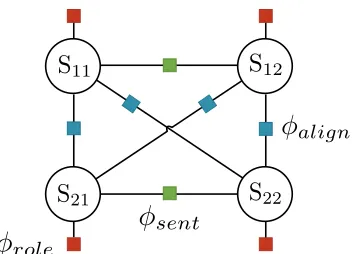
alignFigure 1:A factor graph representation of cross sentence
inference.S11andS12denote role assignments for argu-mentsa11anda12in one sentence, andS21andS22 de-note for argumentsa21anda22in another. Theφrole fac-tors score each role assignment to the arguments, and the
φalignfactors score the compatibility of the connected ar-guments.φsentfactors encode sentence level constraints.
unlikely to fill different roles for the same process. In evaporation, for example, it is highly unlikely that water is an undergoer in one sentence but is a re-sult in another. These role-specific selectional pref-erences vary for each process and can be learned if there are enough example role fillers for each pro-cess during training (Zapirain et al., 2009; Zapirain et al., 2013). Since, we wish to handle processes for which we have no training data, we approximate this by modeling whether two arguments should receive the same role given their similarity and their context similarity.
Figure 1 illustrates the cross sentence inference problem using a factor graph. TheSij random
vari-ables denote the role label assignment for the jth
argument in sentencei. Each assignment to an ar-gument Sij is scored by a combination of the role
classifier’s score (factorφrole), and its pairwise
com-patibility with the assignments to other arguments (factorφalign). The factorsφsent capture two basic
within sentence constraints.
3.2 Inference using ILP
We formulate the cross sentence inference task using an Integer Linear Program shown in Figure 2. The ILP seeks an assignment that maximizes a combina-tion of individual role assignment scores and their global compatibility, which is measured as the simi-larity of fillers for the same role minus simisimi-larity of
arg max z
X
k X
i,j
zijk λ φrole(aij, k) | {z } Role classifier score
+(1−λ)
"
∆(aij, k)− ∇(aij, k) #
| {z }
Global compatibility
!
where compatibility with same roles is:
∆(aij, k) = ˜1
Nk X
l,m
zlmkφalign(aij, alm)
and compatibility with other roles is:
∇(aij) = 2 ˜ Nk0
X
l,m X
n6=k
zlmnφalign(aij, alm)
| {z }
Penalty when role n6=k
subject to:
X
k
zijk ≤1 ∀aij ∈sentencei
X
j
zijk ≤1 ∀aij ∈sentencei, k∈R
˜
Nk:Approximate number of arguments with rolek ˜
Nk0 :Approximate number of arguments with rolen6=k
Figure 2:An Integer Linear Program formulation of the Cross-sentence Inference.
fillers of different roles.
The decision variables zijk denote role
assign-ments to arguassign-ments. Whenzijkis set it denotes that
argumentjin sentencei(aij) has been assigned role
k. The objective function uses three components to assign scores to an assignment.
1. Classifier Scoreφrole(aij, k) – This is the score
of a sentence-level role classifier for assigning rolekto argumentaij.
2. Within Role Compatibility ∆(aij, k) – This is
a measure of argument aij’s compatibility with
other arguments which have also been assigned the same rolek. We measure compatibility us-ing a notion of alignment. An argument is said to align with another if they are similar to each other in some respect (either lexically or se-mantically). As we show later, we develop an alignment cclassifier which predicts an alignment scoreφalignfor each pair of arguments. The
[image:4.612.99.276.56.183.2]other arguments that have also been assigned the role k. Without some normalization roles with many arguments will receive higher compatibil-ity scores.To avoid this, we normalize by (1/N˜k),
whereN˜krefers to the number of arguments that the role classifier originally labeled with rolek, an approximation to the number of arguments that are currently assigned rolekby the ILP. 3. Across Role Incompatibility∇(aij, k) – This is
a measure of how wellaij aligns with the other
arguments that are assigned a different role (n6= k). For good assignments this quantity should be low. Therefore we add this as a penalty to the ob-jective. As with∆, we use an approximation for normalization (1/N˜k0), which is the product of other roles and the number of arguments in other sentences that can receive these roles. Because
˜
Nk0 is typically higher, we boost this score by2 to balance against∆.
Last, we use two sets of hard constraints to en-force the standard within-sentence expectations for roles: 1) A single argument can receive only one role label, and 2) A sentence cannot have more than one argument with the same label, except for the NONE role.
We use an off-the-shelf solver in Gurobi (www.gurobi.com) to find an approximate solution to the resulting optimization problem.
3.3 Role Classifier (Φrole)
The role classifier provides a score for each role la-bel for a given argument. Although existing SRL and frame semantic parsers do not directly produce the role information we need (Section 2), we build on them by using their outputs for building a process role classifier.
Before we can assign role labels, we first need to generate candidate arguments. Using EasySRL (Lewis et al., 2015), a state-of-the-art SRL system, we generate the candidate argument spans for each predicate (verbs) in the sentence. Then, us-ing a linear SVM classifier (Fan et al., 2008), we score the candidate arguments and the predicates for our four roles and a special NONE role to indicate the argument is not one of the four. The classifier is trained with a set of annotated examples (see Sec-tion 4) with the following sets of features.
i) Lexical and Syntactic – We use a small set of
standard SRL features such as lexical and syntactic contexts of arguments (e.g., head word, its POS tag) and predicate-argument path features (e.g, depen-dency paths). We also add features that are specific to the nature of the process sentences. In particular, we encode syntactic relationships of arguments with respect to the process name mention in the sentence. We use Stanford CoreNLP toolkit (Manning et al., 2014) to obtain POS tags, and dependency parses to build these features.
ii) PropBank roles – While they do not have a 1-to-1 correspondence with process roles, we use the EasySRL roles coupled with the specific predicate as a feature to provide useful evidence towards the process role.
iii) Framenet Frames – We use the frames evoked by the words in the sentence to allow better feature sharing among related processes. For instance, the contexts of undergoers in evaporation and conden-sation are likely to be similar as they are both state changes which evoke the sameUndergo Change frame in FrameNet.
iv) Query patterns – We use query patterns to find sentences that are likely to contain the target roles of interest. The query pattern that retrieved a sen-tence can help bias the classifier towards roles that are likely to be expressed in it.
3.4 Alignment Classifier (Φalign)
Our goal with alignment is to identify arguments that should receive similar role labels. One way to do this argument alignment is to use techniques developed for phrase level entailment or similarity which of-ten use resources such as WordNet and distributional embeddings such as word2vec (Mikolov et al., 2013) vectors. It turns out that this simple entailment or argument similarity, by itself, is not enough in many cases for our task2. Moreover, the enabler, and the
result roles are often long phrases whose text-based similarity is not reliable. A more robust approach is necessary. Lexical and syntactic similarity of argu-ments and the context in which they are embedded can provide valuable additional information. Table 3 shows a complete list of features we use to train the alignment classifier.
2We used an approach that combined WordNet-based phrase
Lexical
Entailment score of arguments.
Word2vec similarity of argument vectors. Word2Vec similarity of head nodes of arguments. Word2Vec similarity of parent of the head nodes. Word2Vec similarity of verbs of argument sentences. Jaccard similarity of children of the head node.
Syntactic
Similarities of frames to right and left of arguments. Jaccard similarity of POS tags of argument. POS tag of head nodes match (boolean). POS tag of head node parents match (boolean). Similarity of dep. path from arg to process name. Similarity of POS tags on arg to process name path. Similarity of POS tags of arg’s children.
Similarity of the dependencies of the arg’s head.
Sentence
Query patterns match argument sentences (boolean).
Table 3: Alignment Classifier Features. Similarities of sets
were calculated using Jaccard co-efficient.
Fortunately, learning this classifier does not re-quire any additional training data. The original data with annotated semantic role labels can be easily transformed to generate supervision for this classi-fier. For any given process, we consider all pairs of arguments in different sentences (i.e.,(aij, alm) :
i 6=l) and label them as aligned if they are labeled with the same role, or unaligned otherwise.
4 Evaluation
Our goal is to generate knowledge about processes discussed in grade-level science exams. Since ex-isting semantic resources such as FrameNet do not provide adequate coverage for these, we created a dataset of process sentences annotated with the four process roles: undergoer, enabler, action, and result.
4.1 Dataset
This dataset consists of 1205 role fillers extracted from 537 sentences retrieved from the web. We first compiled the target processes from a list of process-oriented questions found in two collections: (i) New York Regents science exams (Clark, 2015), and (ii) helpteaching.com, a Web-based collection
Query Patterns
hnameiis the process ofhxi hnameiis the process by whichhxi hnamei {occurs when} hxi
hnamei {helps to|causes} hxi
Table 4:Example query patterns used to find process descrip-tion sentences.
of practice questions. Then, we identified 127 pro-cess questions from which we obtained a set of 180 unique target processes. For each target process, we queried the web using Google to find definition-style sentences, which describe the target process. For each process we discarded some noisy sentences through a combination of automatic and manual fil-tering.
Table 4 shows some examples of the 14 query patterns that we used to find process descriptions. Because these patterns are not process-specific, they work for unseen processes as well.
To find role fillers from these sentences, we first processed each sentence using EasySRL (Lewis et al., 2015) to generate candidate arguments. Some of the query patterns can be used to generate additional arguments. For example, in the pattern “hnamei is the process ofhxi” ifhxiis a noun then it is likely to
be an undergoer, and thus can be a good candidate.
3. Then two annotators annotated the candidate
ar-guments with the target roles if one were applicable and marked them as NONE otherwise. Disagree-ments were resolved by a third annotator. The an-notations spanned a random subset of 54 target pro-cesses. The role label distribution is shown below:
Role No. of instance Undergoer 77
Enabler 154
Action 315
Result 194
[image:6.612.362.492.521.598.2]NONE 465
Table 5:Role distribution
We conducted five fold cross validation experi-ments to test role extraction. To ensure that we are testing the generalization of the approach to unseen
3These patterns are ambiguous and are not adequate by
processes, we generated the folds such that the pro-cesses in the test fold were unseen during training. We compared the basic role classifier described in Section 3.3, the within sentenceand the cross sen-tenceinference models. We tune the ILP parame-terλfor cross sentence inference based on a coarse-grained sweep on the training folds.
We also compared with a simple baseline that learned a mapping from PropBank roles produced by EasySRL system to the process roles by using the roles and the verb as features. We also add the FrameNet frames invoked by the lexical unit in the sentence. Note this is essentially a subset of the features we use in our role classifier. As a sec-ond baseline, we compare with a (nearly) out-of-the-box application of SEMAFOR (Das et al., 2010), a FrameNet based frame-semantic parser. We modi-fied SEMAFOR to override the frame identification step since the process frame information is already associated with the test sentences.
[image:7.612.320.530.364.488.2]4.2 Cross-Sentence Inference Results
Table 6 compares performance of the different meth-ods. The learned role mapping of shallow seman-tic roles performs better than SEMAFOR but worse than the simple role classifier. SEMAFOR uses a large set of features which help it scale for a di-verse set of frames in FrameNet. However, many of these many not be well suited for the process sen-tences in our relatively smaller dataset. Therefore, we use our custom role classifier as a strong base-line to demonstrate within and cross sentence gains. Enforcing sentence-level consistency through joint
Method Prec. Rec. F1
Role mapping 56.62 59.60 58.07 SEMAFOR 40.72 50.54 45.10
Role class. (φrole) 78.48 78.62 78.55
+ within sent. 86.25 73.91 79.60 + cross sent. 89.84 75.36 81.97††
Table 6: Process role inference performance. ††indicates
significant improvement over Role + within sentence system.
inference, shown as (+within sent.), improves over the baseline which does not use any consistency. It gains precision (by nearly 8 points), while loosing recall in the trade-off (by about 4.7 points) to yield
an overall gain in F1 by 1.05 points. Enforcing cross sentence consistency, shown as (+cross sent.) pro-vides additional gains beyond within sentence infer-ence by another 2.38 points in F14. Table 7 shows
how the gains are distributed across different roles. Cross sentence inference provides improvements for all roles, with the biggest for undergoers (nearly 4 points).
Method Und. Ena. Act. Res. Role Class. 65.38 73.84 83.58 77.30
+ within 66.01 73.11 86.70 76.11 + cross 70.00 74.31 89.30 78.00
Table 7:Performance (F1) across all roles.
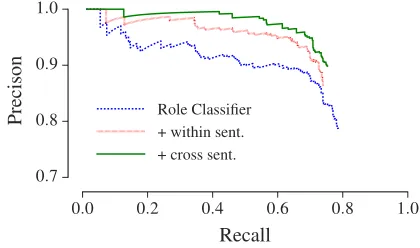
Figure 3 shows the precision/recall plots for the basic role classifier and within and cross sentence in-ference. Both inference models trade recall for gains in precision. Cross sentence yields higher precision at most recall levels, for a smaller overall loss in re-call compared to within sentence (1.6versus4.9).
0.0 0.2 0.4 0.6 0.8 1.0
Recall 0.7
0.8 0.9 1.0
Precison Role Classifier
+ within sent. + cross sent.
Figure 3:Precision/Recall trade-offs for process role inference. y-axis is truncated at0.7to better visualize the differences.
4.3 Ablations
Table 8 shows the utility of various components of cross sentence inference. Using argument entail-ment alone turns out to be ineffective and only pro-duces a minor improvement (0.16 in F1). How-ever, the alignment classifier scores are much more effective and yield about 2.37 points gain in F1. Both within and across role compatibilities,∆and ∇, yield statistically significant improvements5over 4The single parameter in ILP turned out to be stable across the
folds and obtained this best value atλ= 0.8.
0 10 20 30 40 50 # Arguments
−1 0 1 2 3
F1
[image:8.612.79.290.46.148.2]Gains
Figure 4:Cross sentence gains in F1 when varying the number
of most similar arguments used to assess compatibilities.
within sentence inference. Combining these com-plementary compatibilities provides the best gains.
Method Prec. Rec. F1
within sent. 86.25 73.91 79.60
+ Entailment
cross sent. w/∆ 85.13 72.64 78.39 cross sent. w/∇ 85.98 73.36 79.17 cross sent. w/∆ +∇ 86.62 73.91 79.76
+ Alignment Classifier
cross sent. w/∆ 89.07 75.36 81.64††
cross sent. w/∇ 88.72 75.54 81.60††
cross sent. w/∆ +∇ 89.84 75.36 81.97††
Table 8: Performance impact of inference components. ††
indicates significant improvement over within sentence.
We also studied the effect of varying the number of arguments that ILP uses to measure the compat-ibility of role assignments. Specifically, we allow inference to use just the top k alignments from the alignment classifier. Figure 4 shows the main trend. Using just the top similar argument already yields a 1 point gain in F1. Using more arguments tends to increase gains in general but with some fluctuations. Finding an assignment that respects all compatibili-ties across many argument pairs can be difficult. As seen in the figure, at some of the shorter span lengths we see a slightly larger gain (+0.3) compared to us-ing all spans. This hints at benefits of a more flexible formulation that makes joint decisions on alignment and role label assignments.
Table 9 shows an ablation of the alignment clas-sifier features. Entailment of arguments is the most
informative feature for argument alignment. Adding lexical and syntactic context compatibilities adds significant boosts in precision and recall. Know-ing that the arguments are retrieved by the same query pattern (sentence feature) only provides mi-nor improvements. Even though the overall classi-fication performance is far from perfect, cross sen-tence can benefit from alignment as long as it pro-vides a higher score for argument pairs that should align compared to those that should not.
Feature P R F1
Entailment score only 39.55 14.59 21.32 +Lexical 50.75 26.02 34.40 +Syntactic 62.31 31.47 41.82 +Sentence 62.33 31.41 41.53
Table 9:Performance of different feature groups for alignment.
4.3.1 Error Analysis
We conduct an error analysis over a random set of 50 errors observed for cross sentence inference. In addition to issues from noisy web sentences and nested arguments from bad candidate extraction, we find the following main types of errors:
• Dissimilar role fillers (27.5 %) – In some
pro-cesses, the fillers for the result role have high levels of variability that makes alignment error prone. For the process camouflage, for instance, the result roles include ‘disorientation’, ‘protect from predator’, ‘remain undetected’ etc.
• Bad role classifier scores (37.5%) – For some
stances the role classifier assign high scores to in-correct labels, effectively preventing the ILP from flipping to the correct role. For example, the ar-gument that follows “causes” tends to be a re-sult in many cases but not always, leading to high scoring errors. For example, in the sentence with “...when heat from the sun causes water on earth’s ...”, the role classifier incorrectly assigns ‘water’ to a result role with high confidence.
• Improper Weighting (7.5%)– Sometimes the ILP
would have helped the ILP to flip. For example, the argument ‘under autumn conditions’ from the sentence ‘hibernation occurs when the insects are maintained under autumn conditions.’ has a good role score and is similar to other correctly labeled enablers such as ‘cold , winter conditions’ but yet is unable to improve.
The rest (27.5 %) are due to noisy web sentences, incorrect argument extraction and errors outside the scope of cross sentence inference.
5 Conclusions
Simple role-based knowledge is essential for rec-ognizing and reasoning about situations involving processes. In this work we developed a cross sen-tence inference method for automatically acquiring such role-based knowledge for new processes. The main idea is to enforce compatibility among roles extracted from sentences belonging to a single pro-cess. We find that the compatibility can be effec-tively assessed using an alignment classifier built without any additional supervision. Empirical eval-uation on a process dataset shows that cross sentence inference using an Integer Linear Program helps im-prove the accuracy of process knowledge extraction.
6 Acknowledgement
The authors would like to thank the anonymous re-viewers for helpful comments, Meghana Kshirsagar, Sam Thomson, Mike Lewis for answering imple-mentation details of their systems, and the Stony Brook NLP Lab members for their valuable feed-back and suggestions. This work is supported in part by Foreign Fulbright PhD Fellowship and by the grant from Allen Institute for Artificial Intelli-gence.
References
Collin F Baker, Charles J Fillmore, and John B Lowe. 1998. The berkeley framenet project. In Proceed-ings of the 17th international conference on Computa-tional linguistics-Volume 1, pages 86–90. Association for Computational Linguistics.
Jonathan Berant, Vivek Srikumar, Pei-Chun Chen, Abby Vander Linden, Brittany Harding, Brad Huang, Peter Clark, and Christopher D. Manning. 2014. Modeling biological processes for reading comprehen-sion. InProceedings of EMNLP.
Anders Bj¨orkelund, Love Hafdell, and Pierre Nugues. 2009. Multilingual semantic role labeling. In Pro-ceedings of the Thirteenth Conference on Compu-tational Natural Language Learning: Shared Task, pages 43–48. Association for Computational Linguis-tics.
Peter Clark. 2015. Elementary school science and math tests as a driver for ai: Take the aristo challenge. to appear.
Dipanjan Das, Nathan Schneider, Desai Chen, and Noah A. Smith. 2010. Probabilistic frame-semantic parsing. InProc. of NAACL-HLT.
Rong-En Fan, Kai-Wei Chang, Cho-Jui Hsieh, Xiang-Rui Wang, and Chih-Jen Lin. 2008. Liblinear: A library for large linear classification. The Journal of Machine Learning Research, 9:1871–1874.
Hagen F¨urstenau and Mirella Lapata. 2009. Graph alignment for semi-supervised semantic role labeling. In Proceedings of the 2009 Conference on Empirical Methods in Natural Language Processing, pages 11– 20, Singapore.
Hagen F¨urstenau and Mirella Lapata. 2012. Semi-supervised semantic role labeling via structural align-ment.Computational Linguistics, 38(1):135–171. Sujay Kumar Jauhar, Peter D. Turney, and Eduard H.
Hovy. 2016. Tables as semi-structured knowledge for question answering. InACL.
Paul Kingsbury and Martha Palmer. 2003. Propbank: the next level of treebank. In Proceedings of Treebanks and lexical Theories, volume 3. Citeseer.
Ivan Titov Alexandre Klementiev. 2012. Semi-supervised semantic role labeling: Approaching from an unsupervised perspective. In Proceedings of the COLING Conference.
Meghana Kshirsagar, Sam Thomson, Nathan Schneider, Jaime G. Carbonell, Noah A. Smith, and Chris Dyer. 2015. Frame-semantic role labeling with heteroge-neous annotations. InACL.
Joel Lang and Mirella Lapata. 2010. Unsupervised in-duction of semantic roles. InHuman Language Tech-nologies: The 2010 Annual Conference of the North American Chapter of the Association for Computa-tional Linguistics, pages 939–947, Los Angeles, Cal-ifornia, June. Association for Computational Linguis-tics.
Joel Lang and Mirella Lapata. 2011. Unsupervised se-mantic role induction with graph partitioning. In Pro-ceedings of the Conference on Empirical Methods in Natural Language Processing, pages 1320–1331, Ed-inburgh, Scotland, UK., July. Association for Compu-tational Linguistics.
Christopher D Manning, Mihai Surdeanu, John Bauer, Jenny Rose Finkel, Steven Bethard, and David Mc-Closky. 2014. The stanford corenlp natural language processing toolkit.
Tomas Mikolov, Kai Chen, Greg Corrado, and Jeffrey Dean. 2013. Efficient estimation of word representa-tions in vector space. arXiv preprint arXiv:1301.3781. Luiz Augusto Pizzato and Diego Moll´a. 2008. Indexing on semantic roles for question answering. In Coling 2008: Proceedings of the 2nd workshop on Informa-tion Retrieval for QuesInforma-tion Answering, pages 74–81. Association for Computational Linguistics.
Vasin Punyakanok, Dan Roth, Wen-tau Yih, and Dav Zi-mak. 2004. Semantic role labeling via integer linear programming inference. InProceedings of the 20th In-ternational Conference on Computational Linguistics, COLING ’04, Stroudsburg, PA, USA. Association for Computational Linguistics.
Michael Roth and Mirella Lapata. 2015. Context-aware frame-semantic role labeling. Transactions of the Association for Computational Linguistics (TACL), 3:449–460.
Josef Ruppenhofer, Caroline Sporleder, Roser Morante, Collin Baker, and Martha Palmer. 2010. Semeval-2010 task 10: Linking events and their participants in discourse. In Proceedings of the 5th Interna-tional Workshop on Semantic Evaluation, SemEval ’10, pages 45–50, Stroudsburg, PA, USA. Association for Computational Linguistics.
Dan Shen and Mirella Lapata. 2007. Using seman-tic roles to improve question answering. In EMNLP-CoNLL, pages 12–21.
Robert S Swier and Suzanne Stevenson. 2004. Unsuper-vised semantic role labelling. InEMNLP.
Kristina Toutanova, Aria Haghighi, and Christopher D. Manning. 2005. Joint learning improves semantic role labeling. InACL.
Be˜nat Zapirain, Eneko Agirre, and Llu´ıs M`arquez i Villo-dre. 2009. Generalizing over lexical features: Selec-tional preferences for semantic role classification. In ACL.