Intra-Sentential Subject Zero Anaphora Resolution using
Multi-Column Convolutional Neural Network
Ryu Iida Kentaro Torisawa Jong-Hoon Oh Canasai Kruengkrai Julien Kloetzer
National Institute of Information and Communications Technology Kyoto 619-0289, Japan
{ryu.iida,torisawa,rovellia,canasai,julien}@nict.go.jp
Abstract
This paper proposes a method for intra-sentential subject zero anaphora resolution in Japanese. Our proposed method utilizes a Multi-column Convolutional Neural Network (MCNN) for predicting zero anaphoric rela-tions. Motivated by Centering Theory and other previous works, we exploit as clues both the surface word sequence and the dependency tree of a target sentence in our MCNN. Even though the F-score of our method was lower than that of the state-of-the-art method, which achieved relatively high recall and low preci-sion, our method achieved much higher pre-cision (>0.8) in a wide range of recall lev-els. We believe such high precision is cru-cial for real-world NLP applications and thus our method is preferable to the state-of-the-art method.
1 Introduction
In such pro-drop languages as Japanese, Chinese and Italian, pronouns are frequently omitted in text.
For example, the subject ofuketa(suffered) is
unre-alized in the following Japanese example (1): (1) sono-houkokusho-wa seifui-ga
the report-TOP governmenti-SUBJ jouyaku-o teiketsushi (ϕi-ga) keizaitekini
treaty-OBJ make iti-SUBJ economically higai-o uke-ta koto-o shitekishi-ta damage-OBJ suffer-PAST COMP point out-PAST
The report pointed out that the governmenti
agreed to a treaty and (iti) suffered economically.
The omitted argument is called a zero anaphor,
which is represented usingϕ. In example (1), zero
anaphorϕi refers to its antecedent, seifui
(govern-ment). Such a reference phenomenon is calledzero
anaphora. Identifying zero anaphoric relations is an essential task in developing such accurate NLP applications as information extraction and machine translation for pro-drop languages. For example, in Japanese, 60% of subjects in newspaper articles are unrealized as zero anaphors (Iida et al., 2007).
This paper proposes a method forintra-sentential
subject zero anaphora resolution, in which a zero anaphor and its antecedent appear in the same
sen-tence and the zero anaphor must be a subject of
a predicate, for Japanese. We target subject zero
anaphors because they represent 85% of the intra-sentential zero anaphora in our data set (example (1) is such a case). Furthermore, this work focuses on intra-sentential zero anaphora because inter-sentential cases, in which a zero anaphor and its an-tecedent do not appear in the same sentence, are ex-tremely difficult. The accuracy of the state-of-the-art method for resolving inter-sentential anaphora is low (Sasano and Kurohashi, 2011), and we believe the current technologies are not mature enough to deal with inter-sentential cases.
Our method locally predicts the likelihood of a
zero anaphoric relation between every possible com-bination of potential zero anaphor and potential an-tecedent without considering the other (potential) zero anaphoric relations in the same sentence. The final determination of zero anaphoric relations for each zero anaphor in a given sentence is done in a greedy way; only the most likely candidate tecedent for each zero anaphor is selected as its an-tecedent as far as the likelihood score exceeds a
given threshold. This approach contrasts withglobal
optimization methods (Yoshikawa et al., 2011; Iida and Poesio, 2011; Ouchi et al., 2015), which have recently become popular. These methods use the constraints among possible zero anaphoric relations, such as “if a candidate antecedent is identified as the antecedent of a subject zero anaphor of a predi-cate, the candidate cannot be referred to by the ob-ject zero anaphor of the same predicate”, and deter-mine an optimal set of zero anaphoric relations in an entire sentence while satisfying such constraints, using such optimization techniques as sentence-wise global learning (Ouchi et al., 2015) and integer lin-ear programming (Iida and Poesio, 2011).
Although the global optimization methods have outperformed the previous greedy-style methods, our contention is that greedy-style methods can still, in a certain sense, outperform the state-of-the-art global optimization methods. Ouchi et al. (2015)’s global optimization method achieved the state-of-the-art F-score for Japanese intra-sentential subject zero anaphora resolution, but its performance has not yet reached a level of practical use. In our set-ting, for example, it actually obtained a precision of only 0.61, and even after attempting to obtain more reliable zero anaphoric relations by several modi-fications, we could only achieve 0.80 precision at
extremely low recall levels (<0.01). On the other
hand, while our proposed greedy-style method ob-tained a lower F-score than Ouchi et al.’s method, it achieved much higher precision in a wide range of recall levels (e.g., around 0.8 precision at 0.25 in recall and around 0.7 precision at 0.4 in recall). We believe such high precision is crucial to real-world applications, even though the recall remains low, and thus our method is preferable to Ouchi et al.’s method in that sense.
In our proposed method, we use a Multi-column Convolutional Neural Network (MCNN) (Cires¸an et al., 2012), which is a variant of a Convolutional Neu-ral Network (CNN) (LeCun et al., 1998). An MCNN has several independent columns, each of which has its own convolutional and pooling layers. The out-puts of all the columns are combined in the final layer to provide a final prediction. In this work, mo-tivated by Centering Theory (Grosz et al., 1995) and other previous works, we exploit as distinct columns the word sequences obtained from the surface word
sequence and the dependency tree of a target sen-tence in our MCNN. Although the existing works also exploited such word sequences, they used only particular types of information from them as features based on the researchers’ linguistic insights. In con-trast, we minimized such feature engineering due to using an MCNN.
The rest of this paper is organized as follows. In Section 2, we briefly overview previous work
on zero anaphora resolution. In Section 3, we
present the procedure of our zero anaphora resolu-tion method and explain the column sets used in our MCNN architecture. We evaluate how effectively our method recognizes intra-sentential subject zero anaphora in Section 4 and summarize this work and discuss future directions in Section 5.
2 Related work
The typical zero anaphora resolution algorithms pro-posed so far have exploited the information of a predicate that potentially has a zero anaphor and its candidate antecedent in a supervised manner (Seki et al., 2002; Iida et al., 2003; Isozaki and Hirao, 2003; Iida et al., 2006; Taira et al., 2008; Sasano et al., 2008; Imamura et al., 2009; Hayashibe et al., 2011; Iida and Poesio, 2011; Sasano and Kurohashi, 2011; Yoshikawa et al., 2011). In addition, existing works have exploited the dependency path between a predicate and a candidate antecedent either by en-coding such paths to the set of binary features of the words that appear in the path (Iida and Poesio, 2011) or by mining from the paths the sub-trees that effec-tively discriminate zero anaphoric relations (Iida et al., 2006). However, both methods just focus on the dependency paths between a predicate and a candi-date antecedent without exploiting other structural fragments in the dependency tree representing a tar-get sentence, whereas our method uses the text frag-ments that cover the entire dependency tree.
al. (2009) used as features for machine learning the results of rule-based antecedent identification based on a variant of Centering Theory (Nariyama, 2002). However, we observed that actual anaphoric phe-nomena often do not obey Centering Theory. To robustly resolve zero anaphora, we need to explore additional clues that are represented in a target sen-tence (or text).
Recent work by Iida et al. (2015) newly intro-duced a sub-problem of zero anaphora resolution,
subject sharing recognition, which is the task that judges whether two predicates have the same sub-ject. In their method, a network of subject sharing predicates is created by their subject sharing rec-ognizer, and then zero anaphora resolution is per-formed by propagating a subject to the unrealized subject positions through the path in the network. Even though the accuracy of subject sharing recog-nition exceeds that of zero anaphora resolution, the zero anaphoric relations identified using the results of subject sharing recognition are limited to those that can be reached by subject sharing relations. The recall of this method is not high.
Although most zero anaphora resolution methods independently identify a zero anaphoric relation for each predicate, some previous works optimized the global assignment of zero anaphoric relations in an entire sentence (or an entire text) while satisfying several constraints among zero anaphoric relations. For example, Iida and Poesio (2011) found the best assignment of subject zero anaphoric relations using integer linear programming. As mentioned in the In-troduction, Ouchi et al. (2015) estimated the global score of all of the predicate-argument assignments in a sentence, which include the assignments of intra-sentential zero anaphoric relations, to find the best assignment using a hill-climbing technique. Their method has an advantage: it can exploit complicated relations (e.g., the combination of two potential zero anaphoric relations) as features to directly decide more than one predicate-argument relation simulta-neously. We adopted Ouchi et al. (2015)’s method as a baseline in Section 4 because it achieved the state-of-the-art performance for intra-sentential zero anaphora resolution.
Collobert et al. (2011) proposed CNN architec-ture that can be applied to various NLP tasks, such as PoS tagging, chunking, named entity recognition
and semantic role labeling. Following this work, CNNs have been utilized in such NLP tasks as docu-ment classification (Kalchbrenner et al., 2014; Kim, 2014; Johnson and Zhang, 2015), paraphrase (Hu et al., 2014; Yin and Sch¨utze, 2015) and relation extraction (Liu et al., 2013; Zeng et al., 2014; dos Santos et al., 2015; Nguyen and Grishman, 2015). MCNNs were first introduced for image classifica-tion (Cires¸an et al., 2012). In NLP tasks, they have been utilized for question-answering (Dong et al., 2015) and relation extraction (Zeng et al., 2015). Our MCNN architecture was inspired by a Siamese architecture (Chopra et al., 2005), which we extend to a multi-column network and replace its similarity measure with a softmax function at its top.
3 Proposed method
Our proposed method consists of the following four steps:
Step 1 Extract every pair of a predicate and a
can-didate antecedent,⟨predi,candi⟩, that appears
in a target sentence.
Step 2 Predict the probability of each pair using our
MCNN.
Step 3 Rank in descending order all the pairs by
their probabilities obtained in Step 2.
Step 4 Choose the top pair ⟨predi, candi⟩ in the
ranked list and fill the zero anaphor position of
predicatepredibycandiif the position has not
already been filled by another candidate.
Re-move⟨predi, candi⟩ from the list and repeat
this step as long as the score of the chosen pair exceeds a given threshold.
In Step 1, we extract set of pairs⟨predi,candi⟩
in which candidate antecedentcandi is paired with
predicate predi. Note that we extracted predicate
predi, instead of a zero anaphor that is an
unreal-ized subject ofpredi, because the (potential) zero
anaphor of predi is omitted in the text and cannot
be extracted directly.
In Step 2, our MCNN gives a probability that in-dicates the likelihood of a zero anaphoric relation
to judge for each pair whethercandi fills the blank
subject position ofpredithrough zero anaphora and
!"#$%&'
((( (((
SURFSEQ
!"#$#%&'( )*%+*%,*
(((
!"#$%&% !&'($)*" +,$-"#$), .&'#&.!$!/' 01/'*"'),1$#&." #,.,),1!/'.&#'!/'."
)""*+,-.",/"*0$+",
)""*+,-.",/"*0$+", ."*0%,12 ."*0%,13
(((
)""*+,-.",/"*0$+",
)""*+,-.",/"*0$+", ."*0%,14 ."*0%,15
(((
)""*+,-.",/"*0$+", ."*0%,16
PREDCONTEXT
.&,7+7&$81&,$8.878,$ 9.&,7+: );87+.&$819);87+:
DEPTREE
.&,7+
);87+ (((
((( (((
.&,7+ );87+ );87+
.&,7+);87+
)&;!8 8'$;&.$1 <";7
!8=08,.8 8'$;&.$1 <";7!8=08,.8
)""*+,-.",/"*0$+", ."*0%,1>
[image:4.612.382.471.59.160.2]BASE
Figure 1:Our multi-column CNN architecture
Finally, in Step 4 we actually fill candi in the
blank subject positions of predi in a greedy style
in the order of the ranked list in Step 3, i.e., the zero anaphora resolution with a higher probability is done before that with a lower probability. If the sub-ject position is already occupied by another candi-date antecedent, candicandi-date antecedents are no longer filled at that position.
3.1 Design of columns used in MCNN
In Step 2 of our method, we use a Multi-column Convolutional Neural Network (MCNN). Note that zero anaphoric phenomena can be divided into two
different referential phenomena: anaphoric (i.e.,
an antecedent precedes its zero anaphor) and
cat-aphoric(i.e., a zero anaphor precedes its antecedent) cases. To capture this difference, we divided the set of training instances into two subsets by the relative occurrence positions of a predicate and a candidate antecedent and respectively trained two independent MCNNs using each set.
Our MCNN simultaneously uses four column sets, as illustrated in Figure 1. In the following ex-planation for each column set, we assume that
can-didate antecedentcandiprecedes predicateprediin
the surface order (for the opposite case, i.e., the
cat-aphoric case, the positions of candi andpredi are
switched).
BASE The first column set consists of one
col-umn, which stores the word vectors of thebunsetsu
!"#$%
&&& &&&
&&& '()$%
*(+ *,+
[image:4.612.83.297.62.218.2]*'+ *$+
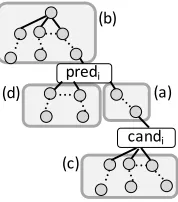
Figure 2:Columns (a, b, c, d) in DEPTREEcolumn set
phrases1 including eithercand
i orpredi. We call
this column set the BASEcolumn set.
SURFSEQ The second column set consists of three
columns, which store the word vectors of (a) the surface word sequence spanning from the beginning
of the sentence tocandi, (b) the sequence between
candi andpredi, and (c) the remainder, i.e., from
predi to the end of the sentence. Note that candi
and predi are not included in any column of this
column set. We call this column set the SURFSEQ
column set.
DEPTREE The third set consists of four columns.
We extracted four partial dependency trees from the entire dependency tree of a target sentence: (a) the
dependency path betweenpredi andcandi, (b) the
sub-trees that depend onpredi, (c) the sub-trees on
which candi depends and (d) the remaining
sub-trees, which are illustrated in Figure 2. Note that
candiandprediare not included in the partial trees.
Each column stores the word vectors of the word se-quence in which the words in (the set of) the partial trees are ordered by their surface order. We call this
set the DEPTREEcolumn set.
PREDCONTEXT The fourth set consists of three columns, which store the word vectors of (a) the
bunsetsu phrase including predi, (b) the surface
word sequence that appears before (a) (from the be-ginning of the sentence) and (c) the sequence that appears after (a) (until the end of the sentence). We
call this column set the PREDCONTEXTcolumn set.
Among the four column sets, the SURFSEQ
col-umn set was designed to introduce the clues based
!"#$%&'( ")%
%*&(+&!"+%
,)--&+
. /0&+"(1$1!*"+2 315& '1314&
4"6&+$3&$% %+&1%7 &8"$"3#81997
1'6: ";< ,);<
,);< ";<
";< ,);<( /%"!#819#0&'2
8"$< &3;&''&'( 891),&
8"3!:
[image:5.612.88.286.62.152.2]!"#$%&'&()$#*+%
Figure 3:Dependency tree of example (1)
on Centering Theory, in which the antecedent for a given zero anaphor can basically be identified by the recency and saliencyproperties of a candidate antecedent. More precisely, in the set of the most salient candidate antecedents, the most recent one is preferred. For example, suppose example (2)
in which the predicate increase has a subject zero
anaphor and its antecedent isFrance:
(2) nihon-wa shoshikataisaku-ni
Japan-TOP countermeasures to falling birth rate-IOBJ shippaishi-taga, furansu-wa sore-ni seikoushi fail-PAST/BUT France-TOP it-IOBJ succeed (ϕi-ga) shusseiritsu-o fuyashiteiru
(iti-SUBJ) birth rate-OBJ increase
Japan failed to develop countermeasures to its falling birth rate, but Franceisucceeded and (ϕi)
increased its birth rate.
In this situation, there are two most salient
candi-date antecedents, Japan and France, because they
are marked with topic marker wa, which basically
indicates the highest degree of candidate saliency.
In this case,Franceis selected as the antecedent
be-cause it appears more recently thanJapan, and such
recency can be estimated by consulting the surface
word sequence between France and increase: no
other salient candidates are included in the word se-quence. Also, the other two types of word sequences (i.e., the sequence that spans from the beginning of
the sentence tocandi and that spans frompredi to
its end) are important for confirming whether a more
salient candidate than candi appears in each word
sequence. If such a more salient candidate is found, it should be a stronger candidate of the antecedent.
The DEPTREEcolumn set is introduced for
cap-turing a different aspect of intra-sentential zero anaphora. In the explanation based on Centering Theory, the most salient candidate (e.g., the
candi-date marked with wa(topic marker)) is selected as
!"#$%&'
((( (((
)"*+,-./$"*!
'0 '1 ((( '2$2
#34&5,5&6.*
#.&$7*.8%&9!, #"*,!8:*&%
"#
"$
"%
/"4/&$.4&$3"4
((( (((
;&'89""534:
/"4-"57$3"4
!8:*&%
"7$97$!,#*"% %&'89""534:, "# "$<.*,/"57%4! "7$97$!,#*"%
%&'89""534:, "# "$<.*,/"57%4!
[image:5.612.322.525.62.219.2]3497$,)"*+ !.=7.4/.
Figure 4:Column of our MCNN
an antecedent, but example (1) in Section 1 cannot be interpreted based on saliency and recency. In
ex-ample (1), thereportis the most salient candidate in
the sentence because it is marked with topic marker
wa, but the less salient candidate government
be-comes the antecedent of zero anaphor ϕ. Such a
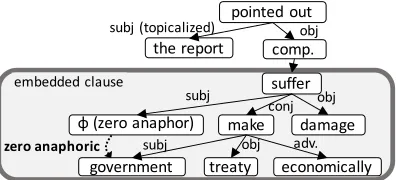
problem is often solved by introducing the depen-dency tree of a sentence. Figure 3 represents the dependency tree of example (1) in which the
an-tecedent ofϕi appears in the embedded clause. In
such a case, an antecedent probably exists among the most salient candidates in the embedded clause. To introduce such structural clues, we used the
par-tial dependency trees as columns in the DEPTREE
column set.
Anaphoricity determination, which is the task of judging whether a candidate anaphor has an an-tecedent, was established as a subtask of coreference resolution. This problem was basically solved by exploring the possible candidate antecedents for a given anaphor candidate in its search space, and the results were used for improving the overall perfor-mance of coreference resolution, especially in En-glish (Ng, 2004; Wiseman et al., 2015). Inspired
by such previous works, we designed the PRED
-CONTEXTset to determine the anaphoricity of zero anaphors, i.e., to judge whether a zero anaphor can-didate has its antecedent in a sentence, by consulting
the surface word sequences before and afterpredi.
3.2 MCNN architecture
In our MCNN (Figure 4), we represent each word
vec-tor xi and t by matrix T = [x1, . . ., x|t|].2 T is
then wired to a set ofM feature maps where each
feature map is a vector. Each element O in the
feature map is computed by a filter denoted by fj
(1 ≤ j ≤ M) from the N-gram word sequences
in t for a fixed integer N, asO = ReLU(Wfj •
xi:i+N−1+bfj), where•denotes element-wise
mul-tiplication followed by the summation of the result-ing elements (i.e., a Frobenious inner product of
Wfj andxi:i+N−1) andReLU(x) = max(0, x). In
other words, we construct a feature map by convolv-ing a text fragment with a filter, which is
parameter-ized by weightWfj ∈R
d×Nand biasb
fj ∈R. Note
that there can be several sets of feature maps where
each set coversN-grams for differentN. Note that
the weight of the feature maps for eachN-gram in
each column set is shared.
As a whole, these feature maps are referred to as aconvolution layer. The next layer is called a pool-ing layer. Here we use max-pooling (Scherer et al., 2010; Collobert et al., 2011), which simply selects the maximum value among the elements in the same feature map. Our assumption is that the maximum value indicates the existence of a strong clue, i.e.,
N-gram, for our final judgment. The selected
maxi-mum values from all theMfeature maps are simply
concatenated, and the resultingM-dimensional
vec-tor is given to our final layer.
The final layer has vectors coming from multiple feature maps in multiple columns. They are again simply concatenated and constitute a high dimen-sional feature vector. The final layer applies a linear softmax function to produce the class probabilities
of the zero anaphoric labels: trueandfalse. We use
a mini-batch stochastic gradient descent (SGD) with the Adadelta update rule (Zeiler, 2012), apply
ran-dom initialization within (-0.01, 0.01) forWfj, and
initialize the remaining parameters at zero.
4 Experiments
4.1 Revising annotation results
In our preliminary investigation of the intra-sentential zero anaphoric relations in the NAIST Text Corpus (Iida et al., 2007), since we found more annotation errors than we expected, we decided to
2We use zero padding for dealing with text fragments of variable length (Kim, 2014).
revise the annotation results. In this revision, we additionally annotated the subject sharing relations, where two predicates have the same subject regard-less whether the subject is realized or omitted, be-tween pairs of predicates in our data set. Note that two predicates can have a subject sharing relation even if neither has a realized subject as far as a sub-ject exists that can naturally fill the subsub-ject position of the two predicates. We used the annotated results of subject sharing relations to efficiently detect the annotation errors of intra-sentential zero anaphoric relations, as shown below.
Twenty-six human annotators directly annotated the subject sharing relations for pairs of predicates in a sentence. For this annotation, we automatically extracted from the NAIST Text Corpus all the pairs of predicates that appear in the same sentence and obtained 227,517 predicate pairs. For making the annotation results more reliable, each subject shar-ing relation was individually judged by three anno-tators, and the final label was decided by a majority vote. After that, further revisions of the subject shar-ing relations and the zero anaphoric relations were performed by focusing on the inconsistent annota-tions between the newly annotated subject sharing relations and the original predicate-argument rela-tions in the NAIST Text Corpus. More precisely, we scrutinized the suspicious annotations such that a subject, which was determined through the anno-tated subject sharing relations, is not the same as a subject that was directly annotated in the NAIST Text Corpus. In this revision phase, both the subject sharing and zero anaphora relations for such suspi-cious instances were independently re-annotated by three annotators, and their final labels of both rela-tions were determined by a majority of the their
de-cisions.3 As a result, 2,120 zero anaphoric instances
were newly added to the corpus and 1,184 instances were removed from it for a total of 19,049 instances
of intra-sentential subject zero anaphoric relations.4
3We are planning to release the annotated results and in-formation on the data separation used in our evaluation from https://alaginrc.nict.go.jp/.
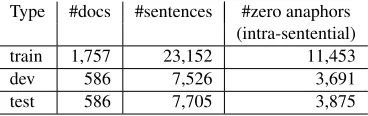
Type #docs #sentences #zero anaphors (intra-sentential)
train 1,757 23,152 11,453
dev 586 7,526 3,691
[image:7.612.94.278.57.115.2]test 586 7,705 3,875
Table 1:Statistics of our data set
4.2 Experimental settings
The documents in the corpus were divided into five subsets, three of which were used as a training data set, one as a development data set, and one as a test-ing data set. The statistics of our data set are sum-marized in Table 1. We evaluated the performance of our intra-sentential subject zero anaphora resolu-tion method and three baseline methods described below using the revised annotated results in our data set.
We implemented our MCNN using Theano
(Bastien et al., 2012). We pre-trained
300-dimensional word embedding vectors for 1,658,487
words5 using Skip-gram with a negative-sampling
algorithm (Mikolov et al., 2013)6 on a set of all
the sentences extracted from Wikipedia articles7
(35,975,219 sentences). We removed from the train-ing data all the words that only appeared once be-fore training. In training, we treated them as un-known words and assigned them a random vector. To avoid overfitting, we applied early-stopping and dropout (Hinton et al., 2012) of 0.5 to the final layer. We used an SGD with mini-batches of 100 and a learning rate decay of 0.95. We ran ten epochs through all of the training data, where each epoch consisted of many mini-batch updates. We utilized 3-, 4- and 5-grams with 100 filters each and used the F-score of positive instances as our evaluation met-ric. The total number of the nodes in the final layers
of our MCNN was 3,300: 11 columns×3N-gram
×100 filters.
Word segmentation, PoS tagging and dependency parsing of the sentences in the NAIST Text Corpus were performed by a Japanese morphological
ana-lyzer, MeCab8 (Kudo et al., 2004), and a
depen-two sets.
5Words occurring less than five times in all the sentences were ignored to train the word embedding vectors.
6We set the skip distance to 5 and the number of negative samples to 10.
7https://archive.org/details/jawiki-20150118 8http://taku910.github.io/mecab/
dency parser, J.DepP9(Yoshinaga and Kitsuregawa,
2009).
4.3 Baselines
We compared our method with three baseline meth-ods. The first baseline is a single-column convolu-tional neural network in which the column includes the entire surface word sequence of a sentence. To
give the positions ofprediandcandito the network,
we concatenated to each word vector an additional 2-dimensional vector, where the first element is set
to one if the corresponding word ispredi, the
sec-ond element is set to 1 if the correspsec-onding word is
candi, and otherwise they are set to 0. This baseline
was adopted for estimating the impact of a multi-column network compared to a single-multi-column one.
The remaining two baselines are Ouchi et al. (2015)’s global optimization method and Iida et al. (2015)’s method based on subject sharing recogni-tion. Note that Ouchi’s method outputs predicate-argument relations for three grammatical roles (subj, obj, iobj), but for this evaluation we used only the outputs related to intra-sentential subject zero anaphora resolution. As done in Ouchi et al. (2015), we averaged their performances across ten indepen-dent runs because the initial random assignment of the predicate-argument relations that was employed in their method changes the performance. Ouchi’s method does not require any development data set, so we used both the development and training data sets for training their joint model. For training the subject sharing recognizer used in Iida’s method, we used the annotated subject sharing relations in the training and development data sets. In these two baselines, we used the same morphological analyzer and dependency analyzer as for our method.
4.4 Results
Table 2 shows the results for each method. Their performances were evaluated by measuring recall, precision, F-score and average precision (Avg.P). To assess the effectiveness of each column set intro-duced in Section 3.1, we evaluated the performance of our method using every possible combination
of column sets that includes at least the BASE
column set. We also gave the precision-recall (PR)
Method #cols. Recall Precision F-score Avg.P
Ouchi et al. (ACL2015) — 0.539 0.612 0.573 0.670
Iida et al. (EMNLP2015) — 0.484 0.357 0.411 —
single column CNN (w/ position vec.) 1 0.365 0.524 0.430 0.540
MCNN BASE 1 0.446 0.394 0.419 0.448
BASE+SURFSEQ 4 0.458 0.597 0.518 0.679
BASE+DEPTREE 5 0.339 0.688 0.454 0.690
BASE+SURFSEQ+DEPTREE 8 0.417 0.695 0.521 0.730
BASE+SURFSEQ+PREDCONTEXT 7 0.459 0.631 0.531 0.702
BASE+DEPTREE+PREDCONTEXT 8 0.298 0.728 0.422 0.702
BASE+SURFSEQ+DEPTREE+PREDCONTEXT(Proposed) 11 0.418 0.704 0.525 0.732
[image:8.612.83.532.56.190.2]#cols. stands for the number of columns used in each MCNN.
Table 2:Results of intra-sentential subject zero anaphora resolution
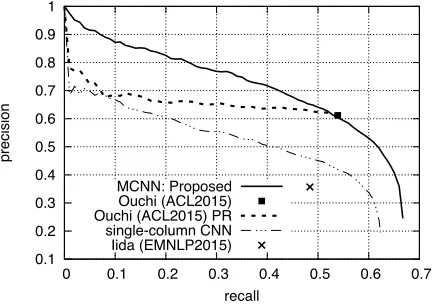
curves of our method using the four column sets (BASE+SURFSEQ+DEPTREE+PREDCONTEXT), the single column baseline, and Ouchi’s method in Figure 5 to investigate the behavior of each
method at a high precision level.10 The PR-curves
of our method and the single-column baseline were plotted just by altering the threshold parameters in Step 4 of our method (See Section 3). In contrast, the PR-curve of Ouchi’s method cannot be easily plotted because it gives a score to each sentence, not to each zero anaphoric relation. For plotting the PR-curve, we used the normalized global score of a sentence as the score of any zero anaphoric
relations in the sentence.11 Note that the recall of
their PR-curve reached just 0.539, shown in Table 2, because we could not estimate the scores of the zero anaphoric relations that were not outputted by their method. The PR-curves of the other methods also fail to reach 1.0 in recall. This is because the zero anaphoric relations are exclusive; a zero anaphor does not refer to more than one antecedent. If a method provides an incorrect zero anaphoric relation, a correct relation for the same zero anaphor will never be provided in its output. Also, note that the average precision of each method was calculated by averaging the precisions at the available recall
10The PR-curve of Iida et al. (2015)’s method was not plotted because it does not provide the score of each zero anaphoric relation.
11The global score provided by Ouchi’s method becomes greater based on the number of predicate-argument pairs in a sentence. To control this, we normalized the original global score by the sum of the frequencies of the single or double predicate-argument pairs because the feature functions were ap-plied to such pairs in their method. This achieved the best per-formance among the normalization schemes we have tried so far.
0.1 0.2 0.3 0.4 0.5 0.6 0.7 0.8 0.9 1
0 0.1 0.2 0.3 0.4 0.5 0.6 0.7
precision
recall MCNN: Proposed Ouchi (ACL2015) Ouchi (ACL2015) PR single-column CNN Iida (EMNLP2015)
Figure 5:PR-curves of each method
levels for each method.
The results in Table 2 show that our method using all the column sets achieved the best average pre-cision among the combination of column sets that
include at least the BASE column set. This
sug-gests that all of the clues introduced by our four column sets are effective for performance improve-ment. Table 2 also demonstrates that our method us-ing all the column sets obtained better average pre-cision than the strongest baseline, Ouchi’s method,
in spite of an unfavorable condition for it.12 The
results also show that our method with all of the column sets achieved a better F-score than Iida’s method and the single-column baseline. However, it achieved a lower F-score than Ouchi’s method. This was caused by the choice of different recall lev-els for computing the F-score. In contrast, the
[image:8.612.317.533.233.385.2]Set Method Recall Precision F-score Avg.P Anaphoric single-column CNN (w/ position vec.) 0.445 0.525 0.481 0.341
MCNN (BASE) 0.591 0.330 0.424 0.367
MCNN (BASE+SURFSEQ) 0.555 0.566 0.560 0.565
MCNN (BASE+DEPTREE) 0.389 0.615 0.476 0.518 MCNN (BASE+SURFSEQ+DEPTREE) 0.503 0.660 0.571 0.599
MCNN (BASE+SURFSEQ+PREDCONTEXT) 0.535 0.611 0.570 0.581 MCNN (BASE+DEPTREE+PREDCONTEXT) 0.330 0.699 0.449 0.528
MCNN (Proposed) 0.492 0.673 0.569 0.602
Cataphoric single-column CNN (w/ position vec.) 0.163 0.293 0.209 0.163
MCNN (BASE) 0.171 0.130 0.148 0.099
MCNN (BASE+SURFSEQ) 0.202 0.417 0.272 0.257
MCNN (BASE+DEPTREE) 0.268 0.438 0.332 0.329 MCNN (BASE+SURFSEQ+DEPTREE) 0.195 0.525 0.285 0.330
MCNN (BASE+SURFSEQ+PREDCONTEXT) 0.258 0.406 0.316 0.276 MCNN (BASE+DEPTREE+PREDCONTEXT) 0.240 0.488 0.322 0.341
[image:9.612.116.497.55.252.2]MCNN (Proposed) 0.251 0.522 0.339 0.337
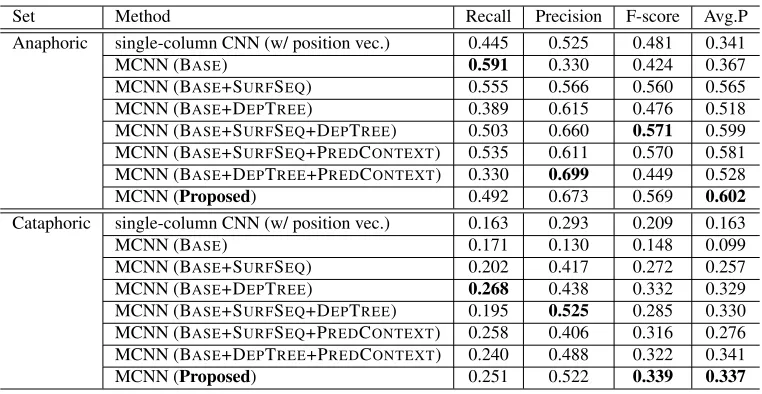
Table 3:Results of instance-wise evaluation for anaphoric and cataphoric sets
curves for these two methods in Figure 5 show that our method obtained higher precision than Ouchi’s method at all recall levels. Particularly, it got high precision in a wide range of recall levels (e.g., around 0.8 in precision at 0.25 in recall and around 0.7 in precision at 0.4 in recall), while the precision obtained by Ouchi’s method at 0.25 in recall was just around 0.65. We believe this difference becomes crucial when using the outputs of each method for developing accurate real-world NLP applications.
In addition to an evaluation that used all of the test instances, we also investigated how our method performed differently for anaphoric and cataphoric cases. In this evaluation, we first divided our data set into anaphoric and cataphoric sets by the relative po-sition of the candidate antecedent and evaluated the performance by measuring the recall, precision, F-score and average precision for each set. This eval-uation was done instance-wise, where we took into account each pair of a predicate and its candidate an-tecedent as a classification target, while in the pre-vious evaluation the performance was measured for the set of zero anaphors in the test set. Thus, the figures in Table 2 and Table 3 are not comparable. Note that we only compared our method with the baseline using a single-column convolutional neural network because the other baselines are not able to output the score of each instance for measuring their average precision.
The results in Table 3 show that our MCNN-based method achieved better average precision than the
single-column CNN baseline except the method that
uses only the BASE column set for the cataphoric
case. The results also demonstrate that each column set consistently contributes to improving the aver-age precision for both the anaphoric and cataphoric cases. However, Table 3 shows that the average pre-cision for the cataphoric set remains low. As one future direction for further improvement, we need to explore clues for identifying cataphoric relations more accurately.
5 Conclusion
This paper proposed an accurate method for intra-sentential subject zero anaphora resolution us-ing a Multi-column Convolutional Neural Network (MCNN). As clues, our MCNN exploits both the surface word sequence and the dependency tree of a target sentence. Our experimental results show that the proposed method achieved better precision than the strong baselines in a wide range of recall levels.
As future work, we plan to use our MCNN archi-tecture for inter-sentential zero anaphora resolution and develop highly accurate NLP applications using our intra-sentential subject zero anaphora resolution method.
Acknowledgement
References
Fr´ed´eric Bastien, Pascal Lamblin, Razvan Pascanu, James Bergstra, Ian J. Goodfellow, Arnaud Berg-eron, Nicolas Bouchard, and Yoshua Bengio. 2012. Theano: new features and speed improvements. In
Proceedings of the NIPS 2012 Workshop: Deep Learn-ing and Unsupervised Feature LearnLearn-ing.
Sumit Chopra, Raia Hadsell, and Yann LeCun. 2005. Learning a similarity metric discriminatively, with application to face verification. In Proceedings of Computer Vision and Pattern Recognition Conference, pages 539–546.
Dan Claudiu Cires¸an, Ueli Meier, and J¨urgen Schmidhu-ber. 2012. Multi-column deep neural networks for image classification. InComputer Vision and Pattern Recognition, pages 3642–3649.
Ronan Collobert, Jason Weston, L´eon Bottou, Michael Karlen, Koray Kavukcuoglu, and Pavel Kuksa. 2011. Natural language processing (almost) from scratch.
Journal of Machine Learning Research, 12:2493– 2537.
Li Dong, Furu Wei, Ming Zhou, and Ke Xu. 2015. Ques-tion answering over freebase with multi-column con-volutional neural networks. InProceedings of the 53rd Annual Meeting of the Association for Computational Linguistics and the 7th International Joint Conference on Natural Language Processing, pages 260–269. Cicero dos Santos, Bing Xiang, and Bowen Zhou. 2015.
Classifying relations by ranking with convolutional neural networks. In Proceedings of the 53rd Annual Meeting of the Association for Computational Linguis-tics and the 7th International Joint Conference on Nat-ural Language Processing, pages 626–634.
Barbara J. Grosz, Scott Weinstein, and Aravind K. Joshi. 1995. Centering: A framework for modeling the lo-cal coherence of discourse. Computational Linguis-tics, 21(2):203–225.
Yuta Hayashibe, Mamoru Komachi, and Yuji Matsumoto. 2011. Japanese predicate argument structure analysis exploiting argument position and type. InProceedings of 5th International Joint Conference on Natural Lan-guage Processing, pages 201–209.
Geoffrey E . Hinton, Nitish Srivastava, Alex Krizhevsky, Ilya Sutskever, and Ruslan Salakhutdinov. 2012. Im-proving neural networks by preventing co-adaptation of feature detectors. CoRR, abs /1207.0580.
Baotian Hu, Zhengdong Lu, Hang Li, and Qingcai Chen. 2014. Convolutional neural network architectures for matching natural language sentences. InProcessings of Advances in Neural Information Processing Systems 27 (NIPS 2014), pages 2042–2050.
Ryu Iida and Massimo Poesio. 2011. A cross-lingual ILP solution to zero anaphora resolution. In Proceed-ings of the 49th Annual Meeting of the Association for
Computational Linguistics: Human Language Tech-nologies, pages 804–813.
Ryu Iida, Kentaro Inui, Hiroya Takamura, and Yuji Mat-sumoto. 2003. Incorporating contextual cues in train-able models for coreference resolution. In Proceed-ings of the 2003 EACL Workshop on The Computa-tional Treatment of Anaphora, pages 23–30.
Ryu Iida, Kentaro Inui, and Yuji Matsumoto. 2006. Ex-ploiting syntactic patterns as clues in zero-anaphora resolution. In Processings of the 21st International Conference on Computational Linguistics and 44th Annual Meeting of the Association for Computational Linguistics, pages 625–632.
Ryu Iida, Mamoru Komachi, Kentaro Inui, and Yuji Mat-sumoto. 2007. Annotating a Japanese text corpus with predicate-argument and coreference relations. In Pro-ceedings of the ACL Workshop: ‘Linguistic Annotation Workshop’, pages 132–139.
Ryu Iida, Kentaro Torisawa, Chikara Hashimoto, Jong-Hoon Oh, and Julien Kloetzer. 2015. Intra-sentential zero anaphora resolution using subject sharing recog-nition. In Proceedings of the 2015 Conference on Empirical Methods in Natural Language Processing, pages 2179–2189.
Kenji Imamura, Kuniko Saito, and Tomoko Izumi. 2009. Discriminative approach to predicate-argument struc-ture analysis with zero-anaphora resolution. In Pro-ceedings of the Joint Conference of the 47th Annual Meeting of the ACL and the 4th International Joint Conference on Natural Language Processing, pages 85–88.
Hideki Isozaki and Tsutomu Hirao. 2003. Japanese zero pronoun resolution based on ranking rules and ma-chine learning. InProceedings of the 2003 Conference on Empirical Methods in Natural Language Process-ing, pages 184–191.
Rie Johnson and Tong Zhang. 2015. Effective use of word order for text categorization with convolutional neural networks. InProceedings of the 2015 Confer-ence of the North American Chapter of the Associa-tion for ComputaAssocia-tional Linguistics: Human Language Technologies, pages 103–112.
Nal Kalchbrenner, Edward Grefenstette, and Phil Blun-som. 2014. A convolutional neural network for mod-elling sentences. InProceedings of the 52nd Annual Meeting of the Association for Computational Linguis-tics, pages 655–665.
Yoon Kim. 2014. Convolutional neural networks for sen-tence classification. InProceedings of the 2014 Con-ference on Empirical Methods in Natural Language Processing, pages 1746–1751.
morphological analysis. In Proceedings of the 2004 Conference on Empirical Methods in Natural Lan-guage Processing, pages 230–237.
Yann LeCun, L´eon Bottou, Yoshua Bengio, and Patrick Haffner. 1998. Gradient-based learning applied to document recognition. In Proceedings of the IEEE, pages 2278–2324.
Chunyang Liu, Wenbo Sun, Wenhan Chao, and Wanxi-ang Che. 2013. Convolution neural network for re-lation extraction. In Proceedings of the 9th Interna-tional Conference of Advanced Data Mining and Ap-plications, pages 231–242.
Tomas Mikolov, Ilya Sutskever, Kai Chen, Greg S Cor-rado, and Jeff Dean. 2013. Distributed representations of words and phrases and their compositionality. In
Proceedings of Advances in Neural Information Pro-cessing Systems 26 (NIPS 2013), pages 3111–3119. Shigeko Nariyama. 2002. Grammar for ellipsis
resolu-tion in Japanese. In Proceedings of the 9th Interna-tional Conference on Theoretical and Methodological Issues in Machine Translation, pages 135–145. Vincent Ng. 2004. Learning noun phrase anaphoricity
to improve conference resolution: Issues in represen-tation and optimization. InProceedings of the 42nd Meeting of the Association for Computational Linguis-tics, pages 151–158.
Thien Huu Nguyen and Ralph Grishman. 2015. Rela-tion extracRela-tion: Perspective from convoluRela-tional neural networks. InProceedings of the 1st Workshop on Vec-tor Space Modeling for Natural Language Processing, pages 39–48.
Manabu Okumura and Kouji Tamura. 1996. Zero pro-noun resolution in Japanese discourse based on center-ing theory. InProceedings of The 16th International Conference on Computational Linguistics, pages 871– 876.
Hiroki Ouchi, Hiroyuki Shindo, Kevin Duh, and Yuji Matsumoto. 2015. Joint case argument identification for Japanese predicate argument structure analysis. In
Proceedings of the 53rd Annual Meeting of the Associ-ation for ComputAssoci-ational Linguistics and the 7th Inter-national Joint Conference on Natural Language Pro-cessing, pages 961–970.
Ryohei Sasano and Sadao Kurohashi. 2011. A discrim-inative approach to Japanese zero anaphora resolution with large-scale lexicalized case frames. In Proceed-ings of 5th International Joint Conference on Natural Language Processing, pages 758–766.
Ryohei Sasano, Daisuke Kawahara, and Sadao Kuro-hashi. 2008. A fully-lexicalized probabilistic model for Japanese zero anaphora resolution. In Proceed-ings of the 22nd International Conference on Compu-tational Linguistics, pages 769–776.
Dominik Scherer, Andreas M¨uller, and Sven Behnke. 2010. Evaluation of pooling operations in convolu-tional architectures for object recognition. In Proceed-ings of the 20th International Conference on Artificial Neural Networks, pages 92–101.
Kazuhiro Seki, Atsushi Fujii, and Tetsuya Ishikawa. 2002. A probabilistic method for analyzing Japanese anaphora integrating zero pronoun detection and reso-lution. InProcessings of the 19th International Con-ference on Computational Linguistics, pages 1–7. Hirotoshi Taira, Sanae Fujita, and Masaaki Nagata. 2008.
A Japanese predicate argument structure analysis us-ing decision lists. InProceedings of the 2008 Confer-ence on Empirical Methods in Natural Language Pro-cessing, pages 523–532.
Sam Wiseman, Alexander M. Rush, Stuart Shieber, and Jason Weston. 2015. Learning anaphoricity and an-tecedent ranking features for coreference resolution. InProceedings of the 53rd Annual Meeting of the As-sociation for Computational Linguistics and the 7th International Joint Conference on Natural Language Processing, pages 1416–1426.
Wenpeng Yin and Hinrich Sch¨utze. 2015. Convolutional neural network for paraphrase identification. In Pro-ceedings of the 2015 Conference of the North Ameri-can Chapter of the Association for Computational Lin-guistics: Human Language Technologies, pages 901– 911.
Katsumasa Yoshikawa, Masayuki Asahara, and Yuji Mat-sumoto. 2011. Jointly extracting Japanese predicate-argument relation with Markov Logic. InProceedings of 5th International Joint Conference on Natural Lan-guage Processing, pages 1125–1133.
Naoki Yoshinaga and Masaru Kitsuregawa. 2009. Poly-nomial to linear: Efficient classification with conjunc-tive features. InProceedings of the 2009 Conference on Empirical Methods in Natural Language Process-ing, pages 1542–1551.
Matthew D. Zeiler. 2012. ADADELTA: An adaptive learning rate method. In arXiv:1212.5701 (Dec 27, 2012).
Daojian Zeng, Kang Liu, Siwei Lai, Guangyou Zhou, and Jun Zhao. 2014. Relation classification via convolu-tional deep neural network. InProceedings of the 25th International Conference on Computational Linguis-tics, pages 2335–2344.