Extracting Aspect-Evaluation and Aspect-of Relations in Opinion Mining
Nozomi Kobayashi∗ Kentaro Inui, and Yuji Matsumoto Graduate School of Information Science,
Nara Institute of Science and Technology 8916-5 Takayama, Ikoma, Nara, 630-0192, Japan
{nozomi-k,inui,matsu}@is.naist.jp
Abstract
The technology of opinion extraction allows users to retrieve and analyze people’s opin-ions scattered over Web documents. We de-fine an opinion unit as a quadruple consist-ing of the opinion holder, the subject beconsist-ing evaluated, the part or the attribute in which the subject is evaluated, and the value of the evaluation that expresses a positive or neg-ative assessment. We use this definition as the basis for our opinion extraction task. We focus on two important subtasks of opinion extraction: (a) extracting aspect-evaluation relations, and (b) extracting aspect-of re-lations, and we approach each task using methods which combine contextual and sta-tistical clues. Our experiments on Japanese weblog posts show that the use of contex-tual clues improve the performance for both tasks.
1 Introduction
The explosive increase in Web communication has attracted increasing interest in technologies for auto-matically mining personal opinions from Web doc-uments such as product reviews and weblogs. Such technologies would benefit users who seek reviews on certain consumer products of interest.
Previous approaches to the task of mining a large-scale document collection of customer opinions (or
∗
Currently, NTT Cyber Space Laboratories,
1-1, Hikarinooka, Yokosuka, Kanagawa, 239-0847 Japan
reviews) can be classified into two approaches: Doc-ument classification and information extraction. The former is the task of classifying documents or pas-sages according to their semantic orientation such as positive vs. negative. This direction has been form-ing the mainstream of research on opinion-sensitive text processing (Pang et al., 2002; Turney, 2002, etc.). The latter, on the other hand, focuses on the task of extracting opinions consisting of information about, for example,hwho feels how about which as-pect of what producti from unstructured text data. In this paper, we refer to this information extraction-oriented task as opinion extraction. In contrast to sentiment classification, opinion extraction aims at producing richer information and requires an in-depth analysis of opinions, which has only recently been attempted by a growing but still relatively small research community (Yi et al., 2003; Hu and Liu, 2004; Popescu and Etzioni, 2005, etc.).
Most previous work on customer opinion ex-traction assumes the source of information to be customer reviews collected from customer review sites (Popescu and Etzioni, 2005; Hu and Liu, 2004; Liu et al., 2005). In contrast, in this paper, we con-sider the task of extracting customer opinions from unstructured weblog posts. Compared with extrac-tion from review articles, extracextrac-tion from weblogs is more challenging because weblog posts tend to exhibit greater diversity in topics, goals, vocabu-lary, style, etc. and are much more likely to in-clude descriptions irrelevant to the subject in ques-tion. In this paper, we first describe our task set-ting of opinion extraction. We conducted a corpus study and investigated the feasibility of the task
inition by showing the statistics and inter-annotator agreement of our corpus annotation. Next, we show that the crucial body of the above opinion extrac-tion task can be decomposed into two kinds of re-lation extraction, i.e. aspect-evaluation rere-lation ex-traction and aspect-of relation exex-traction. For exam-ple, the passage “I went out for lunch at the Deli and ordered a curry with chicken. It was pretty good” has an aspect-evaluation relationhcurry with chicken, was goodi and an aspect-of relation hThe Deli, curry with the chickeni. The former task can be regarded as a special type of predicate-argument structure analysis or semantic role labeling. The latter, on the other hand, can be regarded as bridg-ing reference resolution (Clark, 1977), which is the task of identifying relations between definite noun phrases and discourse-new entities implicitly related to some previously mentioned entities.
Most of the previous work on customer opinion extraction, however, does not adopt the state-of-the-art techniques in those fields, relying only on sim-ple proximity-based or pattern-based methods. In this context, this paper empirically shows that incor-porating machine learning-based techniques devised for predicate-argument structure analysis and bridg-ing reference resolution improve the performance of both aspect-evaluation and aspect-of relation ex-traction. Furthermore, we also show that combin-ing contextual clues with a common co-occurrence statistics-based technique for bridging reference res-olution makes a significant improvement on aspect-of relation extraction.
2 Opinion extraction: Task design
Our present goal is to build a computational model to extract opinions from Web documents in such a form as: Who feels how on which aspects of which subjects. Given the passage presented in Figure 1, for example, the opinion we want to extract is: “the writer feels that the colors of pictures taken with Powershot (product) are beautiful.” As suggested by this example, we consider it reasonable to start with an assumption that most evaluative opinions can be structured as a frame composed of the fol-lowing constituents:
Opinion holder The person who is making an eval-uation. An opinion holder is typically the first
!"#$%'&%( )*+,*-/.01$ *$, *02%3 1"-)*4576* 3 /!8" 90#$ 6"%:2 2,#;6<0, &)=6<"%!(<>"?0. 021@$*/7&!(<"A3"?0.<"2*&6)
*.02702/B6&!*DC;0$*?E $1 C"7"D*$!9E .1 CE :"6 "%0*2>C%(@F@;0.%E
G!H%IJIGJKJILNM *.02*02/76&DC;0;OE *P;1 C"$!;E .1 C.01$ ?Q1"67 E :"6 "072C"% 0# 76E
[image:2.612.315.526.63.150.2]G!H%IJIG%JK!JILSR
Figure 1: Extraction of opinion units
person (the author). We say the opinion holder is unspecified if the opinion is mentioned as a rumor.
Subject A named entity (product or company) of a given particular class of interest (e.g. a car model name in the automobile domain). Aspect A part, member or related object, or an
at-tribute (of a part) of the subject on which the evaluation is made (engine, size, etc.)
Evaluation An evaluative or subjective phrase used to express an evaluation or the opinion holder’s mental/emotional attitude (good, poor, power-ful, stylish, (I) like, (I) am satisfied, etc.)
According to this typology, the example in Figure 1 has six constituents, the writer (opinion holder), Powershot (subject), pictures (aspect), colors (as-pect), beautiful (evaluation), easy to grip (evalua-tion), and constitute two units of opinions as pre-sented in the right half of the figure. We call such a unit an opinion unit. In this paper, we only con-sider explicitly mentioned evaluative opinions as our targets of extraction, excluding opinions indirectly expressed through, for example, style or language choice from our scope.
may affect the feasibility of the task. For tackling these issues, we built a corpus annotated with the above sort of information and investigated the feasi-bility of the task.
2.1 Corpus study
We first collected 116 Japanese weblog posts in the restaurant domain by randomly sampling from a col-lection of posts classified under the “gourmet” cate-gory on a major blog site:http://blog.livedoor.com/.
We asked two annotators to annotate them inde-pendently of each other following the above spec-ification. The annotators first identified evaluative phrases, and then for each evaluative phrase judged whether it was concerning a particular subject (i.e. a restaurant) in the given domain. If judged yes, the annotators filled the opinion holder and subject slots obligatorily. The annotators filled the aspect slot only when its filler appeared in the document and identified the hierarchical relations between as-pects if any (e.g. noodle and its volume). Note that, if a sentence has two or more evaluations, they have to make one opinion unit for each.
2.1.1 Inter-annotator agreement
We investigated the degree of inter-annotator agreement. In the task of identifying evaluations, one annotator A1 identified 450 evaluations while
the otherA2 identified 392, and 329 cases of them
coincided. The two annotators did not identify the same number of evaluations, so instead of using
kappa statistics, we use the following metric for measuring agreement as Wiebe et al. (2005) do:
agr(A1||A2) = # of tags agreed byA1andA2
# of tags annotated byA1
agr(A1||A2) was 0.73 andagr(A2||A1) was 0.83.
The F1 measure of the agreement between the two was therefore 0.79, which indicate that humans can identify evaluation at a reasonable level.
Next, we investigated the inter-annotator agree-ment of the aspect-evaluation and subject-evaluation relations. AnnotatorA1identified 328 relations, and A2identified 346 relations. 295 cases coincided, and agr(A2||A1) was 0.90 and agr(A1||A2) was 0.86
(F1 measure was 0.88). This shows that we obtained high consistency. Finally, for the subject-aspect and aspect-aspect relations, annotatorA1 identified
296 relations, while A2 identified 293, 233 cases
[image:3.612.309.558.94.220.2]of which got agreement. agr(A2||A1) was 0.79
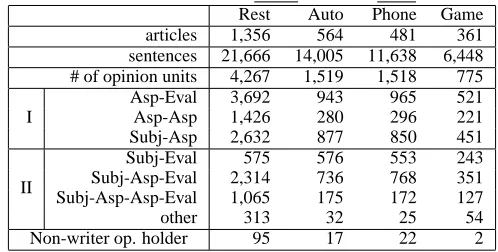
Table 1: Statistics of opinion-annotated corpus (Restaurant, Automobile, cellular phone and video game)
Rest Auto Phone Game articles 1,356 564 481 361 sentences 21,666 14,005 11,638 6,448 # of opinion units 4,267 1,519 1,518 775 Asp-Eval 3,692 943 965 521 I Asp-Asp 1,426 280 296 221 Subj-Asp 2,632 877 850 451
II
Subj-Eval 575 576 553 243 Subj-Asp-Eval 2,314 736 768 351 Subj-Asp-Asp-Eval 1,065 175 172 127 other 313 32 25 54 Non-writer op. holder 95 17 22 2
andagr(A1||A2)was 0.80 (F1 measure was 0.79),
which show that the human annotators can carry out the task at a reasonable accuracy. Based on this cor-pus study, we believe that our definitions of two re-lations are clear enough for constructing annotated corpus.
2.1.2 Opinion-annotated corpus
Based on these results, we collected a larger set of weblog posts in four domains: restaurant, automo-bile, cellular phone and video game. We then asked annotatorA1 to annotate them in the same
annota-tion scheme as above. The results are summarized in Table 1.Iin the table shows the number of the iden-tified opinion units and relations, andII shows the number of hierarchical chains of aspects. For exam-ple, “Nokia 6800 has a nice color screen” is counted as “Subj-Asp-Eval” since this example includes a subject “Nokia 6800”, an aspect “color screen” and an evaluation “nice”. “Other” indicates the number of the case where the length of hierarchical chains of aspects is three or more. One observation is that, for all the domains, 90 % of all the opinion units have a hierarchical chain of aspects whose length is two or less. From this, we can conclude that hierarchical chains longer than two are rare, and the problem is not so complicated, though they can be of any length in theory.
2.2 Related work on task settings of opinion extraction
There are several researches on customer opinion extraction. Hu and Liu (2004) considered the task of extractinghAspect, Sentence, Semantic-orientationi triples in our terminology, where Sentence is the one that includes the Aspect, and Semantic-orientation is either positive or negative.
The notion of Evaluation in our term has also been introduced by previous work (Popescu and Et-zioni, 2005; Tateishi et al., 2004; Suzuki et al., 2006; Kobayashi et al., 2005, etc.). For example, our previous paper (Kobayashi et al., 2005) addresses the task of extracting hSubject,Aspect,Evaluationi. However, none of those papers reports on such an extensive corpus study as what we report in this paper. In addition, in this paper, we consider not only aspect-evaluation relations but also hierarchical chains of subject-aspect and aspect-aspect relations, which has never been addressed in previous work.
Open-domain opinion extraction is another trend of research on opinion extraction, which aims to ex-tract a wider range of opinions from such texts as newspaper articles (Yu and Hatzivassiloglou, 2003; Kim and Hovy, 2004; Wiebe et al., 2005; Choi et al., 2006). To the best of our knowledge, one of the most extensive corpus studies in this field has been conducted in the MPQA project (Wiebe et al., 2005); while their concerns include the types of opinions we consider, they annotate newspaper arti-cles, which presumably exhibit considerably differ-ent characteristics from customer-generated texts.
Though we do not discuss the problem of deter-mining semantic orientation, we assume availabil-ity of state-of-the-art methods that perform this task (Suzuki et al., 2006; Takamura et al., 2006, etc.). The problem of determining semantic orientation will be solved by using these techniques, so we fo-cus on the main issue: Extracting opinion units from given texts.
3 Method for opinion extraction
Before designing a model for our opinion extrac-tion task, it is important to note that aspect phrases are open-class expressions and tend to be heavily domain-dependent. In fact, according to our investi-gation on our opinion-annotated corpus, the number
! !"
# !" $# !"
! !"
# !" $# !" !
!"
[image:4.612.316.540.59.108.2]# !" $# !"
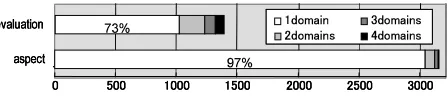
Figure 2: The distributions of evaluation and aspect expressions in the four domains
of aspect types is nearly 3,200, and only 3% of them appear in two or more domains as shown in Figure 2. For evaluation expressions, on the other hand, the number of types is much smaller than that of aspect expressions, and 27% of them appear in multiple do-mains. This indicates that evaluation expressions are more likely to be used commonly across different domains compared with aspects.
To prove this assumption, we created a dictionary of evaluation expressions from customer reviews of automobiles (230,000 sentences in total) using the semi-automatic method proposed by Kobayashi et al. (2004). We expanded the dictionary by hand with external resources including publicly available or-dinal thesauri. As a result, we collected 5,550 en-tries. According to our investigation of the coverage by the dictionary, 0.84 (restaurant), 0.88 (cellular phone), 0.91 (automobile), and 0.93 (video game) of the evaluations annotated in our corpus are covered by the dictionary. From this observation, we con-sider that it is reasonable to start opinion extraction with the identification of evaluation expressions. We therefore design the process of extractinghSubject, Aspect, Evaluationias follows:
1. Aspect-evaluation relation extraction: For each of the candidate evaluations that are se-lected from a given document by dictionary look-up, identify the target of the evaluation. Here the identified target may be a subject (e.g. IXY (is well-designed)) or an aspect of a sub-ject (e.g. the quality (is amazing)). Hereafter, we use the term aspect to refer to both an as-pect and a subject itself, since the subject can be regarded as the top element in the hierarchi-cal chain of aspects.
evaluation expression.
3. Aspect-of relation extraction: If the identified aspect is not a subject, search for its antecedent, i.e. an expression that is a higher aspect or a subject of the current aspect. Repeat step 3 un-til reaching a subject or no parent is found.
3.1 Related work on opinion extraction
A common approach to the customer opinion extrac-tion task mainly uses simple proximity- or pattern-based techniques. For example, Tateishi et al. (2004) implement five syntactic patterns and Popescu et al. (2005) use ten syntactic patterns. Such an ap-proach is limited in two respects. First, it assumes the availability of a list of potential aspect expres-sions as well as evaluation expresexpres-sions; however cre-ating such a list of aspects for a variety of domains can be prohibitively expensive because of the do-main dependency of aspect expressions. In contrast, our method does not require any aspect lexicon.
Second, their approach lacks the perspective of viewing aspect-evaluation extraction as a specific type of predicate-argument structure analysis, i.e. the task of identifying the arguments of a given predicate in a given text, and fails to benefit from the state-of-the-art techniques of this rapidly grow-ing field. The syntactic patterns used in their re-search are analyzed by a dependency parser, how-ever, aspect-evaluation relations appear in diverse syntactic patterns, which cannot be easily captured by a handful of manually devised rules.
An exception is the model reported by Kanayama et al.(2004), which uses a component of an exist-ing MT system to identify the “aspect” argument of a given “evaluation” predicate. However, the MT component they use is not publicly available, and even if it were, it would be difficult to apply it to tasks in hand due of the opaqueness of its mecha-nism. Our approach aims to develop a more gen-erally applicable model of aspect-evaluation extrac-tion.
In open-domain opinion extraction, some ap-proaches use syntactic features obtained from parsed input sentences (Choi et al., 2006; Kim and Hovy, 2006), as is commonly done in semantic role label-ing. Choi et al. (2006) address the task of extract-ing opinion entities and their relations, and incor-porate syntactic features to their relation extraction
model. Kim and Hovy (2006) proposed a method for extracting opinion holders, topics and opinion words, in which they use semantic role labeling as an intermediate step to label opinion holders and topics. However, these approaches do not address the task of extracting aspect-of relations and make use of syntactic features only for labeling opinion holders and topics. In contrast, as we describe be-low, we find the significant overlap between aspect-evaluation relation extraction and aspect-of relation extraction and apply the same approach to both tasks, gaining the generality of the model.
Aspect-of relations can be regarded as a sub-type of bridging reference (Clark, 1977), which is a com-mon linguistic phenomenon where the referent of a definite noun phrase refers to a discourse-new entity implicitly related to some previously mentioned en-tity. For example, we can see a relation of bridg-ing reference between “the door” and “the room” in “She entered the room. The door closed au-tomatically.” A common approach is to use co-occurrence statistics between the referring expres-sion (e.g. “the door” in the above example) and the related entity (“the room”) (Bunescu, 2003; Poesio et al., 2004). Our approach newly incorporates au-tomatically induced syntactic patterns as contextual clues into such a co-occurrence model, producing significant improvements of accuracy.
3.2 Our approach
Now we describe our approach to aspect-evaluation and aspect-of relation extraction. The key idea is to combine the following two kinds of information using a machine learning technique for both tasks.
Contextual clues: Syntactic patterns such as
hAspecti-ga VP-te, hEvaluationi hAspecti-NOM VP-CONJ hEvaluationi
which matches such a sentence as
hsekkyakui-ga kunrens-aretei-tehkimochiyoii hservicei-NOMbe trained-CONJ hfeel comfortablei
(The waiters were well-trained, so I felt
comfort-able.)
are considered to be useful for extracting rela-tions between slot fillers when they appear in a single sentence (Here,hiindicates a slot filler). We employ a supervised learning technique to search for such useful syntactic patterns. Context-independent statistical clues: Statistics
!"#
$%&'(%%
)
*++,.-/
0112
12 ,.34+356"87 9;: <=?>@A>6B=?>6BACDFEHG>8>
IJK0L
LM
)
N;*+3O(,P
/Q4 3,
)
!R*-4;+,.3 3,
)
SAT8UWV8XZY
^6JK0L
LM`_a6_?b
0112
12 $%&'(%% cdfe _.g?h Mi ^ Kj0L
.kl ML10L
Z 22
l
2mLI K2mnop %q!%$(r& st
9Hu<vG>@G>?w(>6BEx:.EHyzB{zA|}yBA@~(E8EHG>?>
SAT8UWV8X 4x SAT?UV?X
[image:6.612.74.300.62.186.2]3,
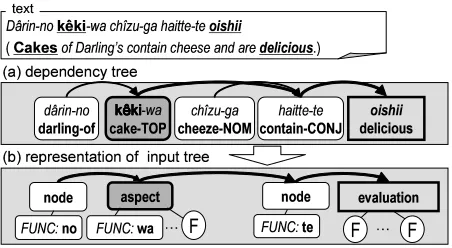
Figure 3: Representation of input data
co-occurrences are expected to be useful. We obtain such statistical clues automatically from a large collection of raw documents.
In what follows, we describe our method for aspect-evaluation. The aspect-of relation extraction is done in an an analogous way.
3.2.1 Supervised learning of contextual clues
Let us consider the problem of searching for the aspect of a given evaluation expressiont. This prob-lem can be decomposed into binary classification problems of deciding whether each pair of candidate aspectcand targettis in an aspect-evaluation rela-tion or not. Our goal is to learn a discriminarela-tion function for this classification problem. If such a function is obtained, we can identify the most likely candidate aspect simply by selecting the best scored
c-tpair and, if its score is negative for all possible candidates, we conclude thatthas no corresponding aspect in the candidate set.
For finding syntactic patterns that extract an as-pect c starting with an evaluationt, we first repre-sent all the repre-sentences in the annotated corpus that has both an aspect and its evaluation, as shown in Figure 3. A sentence is analyzed by a dependency parser, then the dependency tree is converted so as to represent the relation between content words clearly and to attach other information (such as POS labels and other morphological features of content words and the functional words attached to the con-tent words) as shown in the lower part of Figure 3. Among various classifier induction algorithms for tree-structured data, in our experiments, we have so far examined Kudo and Matsumoto (2004)’s algo-rithm, packaged as a free software named BACT.
Given a set of training examples represented as or-dered trees labeled either positive or negative class, this algorithm learns a list of weighted decision stumps as a discrimination function with the Boost-ing algorithm. Each decision stump is associated with tuple hs, l, wi, wheres is a subtree appearing in the training set,la label, and wa weight of this pattern. The strength of this algorithm is that it auto-matically acquires structured features and allows us to analyze the utility of features.
Given ac-tpair in an annotated sentence, tree en-coding of this sentence is done as follows: First, we use a dependency parser to obtain a dependency tree as in Figure 3 (a). We assume “keˆki (cake)” as the candidate aspectcand “oishii (delicious)” as the tar-get evaluation t. We then find the path between t
andctogether with their daughter nodes. For exam-ple, the node “Darling-no (Darling’s)” is kept since it is a daughter ofc. Then, all the content words are abstracted to either of the class types, evaluation, as-pect or node, that is,cis renamed as ”aspect”,tas ”evaluation” and all other content words as ”node”. Other information of a content word and the infor-mation of functional words attaching to the content word are represented as the leaf nodes as shown in Figure 3 (b). The features used in our experiments are summarized in Table 2.
We apply the same method to the aspect-of rela-tion extracrela-tion by replacing the ”evaluarela-tion” label as the second ”aspect” label.
3.3 Context-independent statistical clues
We also introduce the following two kinds of statis-tical clues.
i. Co-occurrences of aspect-evaluation/aspect-aspect: Among various ways to estimate the strength of association (e.g. the number of hits re-turned from a search engine), in our experiments, we extracted aspect-aspect and aspect-evaluation co-occurrences in 1.7 million weblog posts us-ing the patterns “haspecti ga/wa/mo hevaluationi (haspecti is (subject-marker) hevaluationi)” and “haspect Ai no haspect Bi ga/wa (haspect Bi of haspect Ai is)”. To avoid the data sparseness problem, we use Probabilistic Latent Semantic In-dexing (PLSI) (Hofmann, 1999) to estimate con-ditional probabilities P(Aspect|Evaluation) and
information of these probability scores into the learning model described in 3.2 by encoding them as a feature that indicates the relative score rank of each candidate in a given candidate set (see Table 2). ii. Aspect-hood of candidate aspects: Aspect-hood is an index of the degree that measures how plausible a term is used as an aspect within a given domain. We consider that a phrase directly co-occurred with a subject often is likely to be an aspect of the sub-ject, and extract the expressionXwhich appears in the form “Subject no X (X of Subject)” and the ex-pressionY which appears in the form “X no Y”. We calculate the aspect-hood of the expressionsX and
Y by the pointwise mutual information. This score is also used as a features (see Table 2).
3.4 Intra-/inter-sentential relation extraction
Syntactic pattern induction as described in 3.2.1 can apply only when an aspect-evaluation (or aspect-of) relation appears in a single sentence. We therefore build a separate model for inter-sentential relation extraction, which is carried out after intra-sentential relation extraction.
1) Intra-sentential relation identification: Given a target evaluation (or aspect), select the most likely candidate aspect c∗ within the target sentence with the intra-sentential model described in 3.2.1. If the score ofc∗is positive, returnc∗; otherwise, go to the inter-sentential relation extraction phase.
2) Inter-sentential relation identification: Search for the most likely candidate aspect in the sentences preceding the target evaluation (or aspect). This task can be regarded as a zero-anaphora resolution problem. For this purpose, we employ the super-vised learning model for zero-anaphora resolution proposed by (Iida et al., 2003).
3.5 Opinion-hood determination
Evaluation phrases do not always extract correct opinion units in a given domain. Consider an exam-ple from the digital camera domain, “The weather was good. so I went to the park to take some pic-tures”. “good” expresses the evaluation for “the weather”, but “the weather” is not an aspect of digi-tal cameras. Therefore,hthe weather, goodiis not an opinion in the digital camera domain. We can con-sider a binary classification task of judging whether the obtained opinion unit is a real opinion or not in
a given domain. In this paper, we conduct a prelim-inary experiment which uses the opinion-hood de-termination model learned by Support Vector Ma-chines. We conduct the model using our opinion-annotated corpus. The positive examples are aspect-evaluation pairs annotated in the corpus. The neg-ative examples are artificially generated as follows: We first identify the expression in the evaluation dic-tionary that appear in our annotated corpus. We then apply the above aspect-evaluation extraction method and get the most plausible candidate aspect. The re-sult is regarded as a negative example if the extracted aspect is not the true aspect. The features we used in our experiments are summarized in Table 2.
4 Experiments
We conducted experiments with our Japanese opinion-annotated corpus to empirically evaluate the performance of our approach. In these experi-ments, we separately evaluated the models of aspect-evaluation relation extraction, aspect-of relation ex-traction, and opinion-hood determination.
4.1 Common settings
We chose 395 weblog posts in the restaurant do-main from our opinion-annotated corpus described in 2.1, and conducted 5-fold cross validation on that dataset. As preprocessing, we analyzed this corpus using the Japanese morphological analyzer ChaSen1and the Japanese dependency structure an-alyzer CaboCha2.
4.2 Models
The results are summarized in Tables 3 and 4. We evaluated the results by recallRand precisionP de-fined as follows
R = correctly extracted relations
total number of relations ,
P = correctly extracted relations
total number of relations found by the system.
Note that, in aspect-of relations, we permit hA,Ci to be correct when the data includes the chain of aspect-of relations hA,Bi and hB,Ci. Therefore, we merged the intra- and inter-sentential results as shown in Table 4.
1
http://chasen.naist.jp/
2
Table 2: Feature list: tdenotes a given target (eval-uation or aspect) andca candidate
Features for contextual clues
•Position ofc/tin the sentence (beginning, end, other)
•Base phrase distance betweencandt(1, 2, 3, 4, other)
•Whethercandthas a immediate dependency relation
•Whethercprecedest
•Whethercappears in a quoted sentence
•Part-of-speech ofc/t
•Suffix ofc(-sei, -sa (-ty), etc.)
•Character type ofc(English, Chinese, Katakana, etc.)
•Semantic class ofcderived from Nihongo Goi Taikei (Ike-hara et al., 1997).
Features for statistical clues
•Co-occurrence score rank ofc(1st, 2nd, 3rd, 4th, other)
•Aspect-hood score rank ofc(1st, 2nd, 3rd, 4th, other)
The Contextual and Contextual+statistics models are our proposed models where the former uses only contextual clues (3.2.1) and the latter uses both con-textual and statistical clues. We prepared two base-line models, one for each of the above tasks. The Pattern model (in Table 3) simulates the pattern-based method proposed by Tateishi at al. (2004), which uses the following patterns: “hAspecti case-particle hEvaluationi” and “hEvaluationi syntacti-cally depends on hAspecti”. The Co-occurrence model (in Table 4) simulates the co-occurrence statistics-based model used in bridging reference resolution (Bunescu, 2003): For an aspect expres-sion, we select the nearest candidate that has the highest positive score of the pointwise mutual in-formation regardless of its occurrence (i.e. inter-or intra-sentential). Comparing the Pattern (Co-occurrence) model with the Contextual model shows the effects of the supervised learning with contex-tual clues, while comparison of the Contexcontex-tual and Contextual+statistics models shows the joint effect of combining contextual and statistical clues.
4.3 Results and discussions
As for the aspect-evaluation relation extraction, con-cerning the intra-sentential cases, we can see that the models using the contextual clues show nearly 10% improvement in both precision and recall. This indicates that the machine learning-based method has a great advantage over the pattern-based ap-proach. Similar results are seen in aspect-of rela-tion extracrela-tion. The models using the contextual clues achieved more than 10% improvement in
pre-Table 3: The results of aspect-evaluation relation
intra-sent. inter-sent. Patterns P 0.56 (432/774)
-R 0.53 (432/809)
-Contextual P 0.70 (504/723) 0.13 (46/360) R 0.62 (504/809) 0.17 (46/274) Contextual P 0.72 (502/694) 0.14 (53/389) +statistics R 0.62 (502/809) 0.19 (53/274)
Table 4: The results of aspect-of relation
precision recall Co-occurrence 0.27 (175/ 682) 0.17 (175/1048)
Contextual 0.44 (458/1047) 0.44 (458/1048) Contextual+statistics 0.45 (474/1047) 0.45 (474/1048)
cision and 20% improvement in recall over the co-occurrence statistics-based model. We can say that contextual clues are also useful in aspect-of rela-tion extracrela-tion. In comparing the Contextual and Contextual+statistics models, on the other hand, we could get only a slight improvement, which indicates that we need to estimate the statistical clues more precisely. We found that the unsophisticated esti-mation of the statistical clues was a major source of errors in aspect-of relation extraction, however, this estimation is not so easy since the correct expres-sions are appeared only once in large data. We are seeking efficient ways to avoid data sparseness prob-lem (e.g. categorize the aspects).
In the aspect-evaluation relation extraction, we evaluated the results against the human annotated gold-standard in a strict manner. However, accord-ing to our error analysis, some of the errors can be regarded as correct for some real applications. In the following example, a relation annotated by the human is “aji (taste), koi-me (strong)”.
misoshiru-wa hajii-ga hkoi-mei miso soup-TOPhtastei-NOMhstrongi
(The taste of the miso soup is strong.)
However, there is no harm to consider that “mis-oshiru (miso soup), koi-me (strong)” is also correct. If we judge these cases as correct, the Proposed models achieve nearly 0.8 precision and 0.7 recall, and the baseline model also get 7 % improvement (precision 0.63 and recall 0.6). Based on this re-sult, we consider that we achieved reasonable per-formance in intra-sentential aspect-evaluation rela-tion extracrela-tion.
[image:8.612.306.537.74.218.2]inter-sentential relations, our model tends to rely heavily on the statistical clues, because syntactic pattern fea-tures cannot be used. However, our current method for estimating co-occurrence distributions is not so-phisticated as we discussed above. We need to seek for more effective use of large scale domain depen-dent data to obtain better statistics.
We also conducted a preliminary test of the opinion-hood determination model using the fea-tures used in aspect-evaluation relation extraction. As a result, we got 0.5 precision and 0.45 recall. Opinion-hood determination problem includes two decisions: whether the evaluation candidate is an opinion or not, and whether the opinion is related to the given domain if the evaluation candidate is an opinion. We plan to use various features known to be effective in the sentence subjectivity recogni-tion task. This task involves challenging problems. For example, sentence (1) includes the writer’s eval-uation on shrimps served at a particular restaurant. In contrast, very similar sentence (2) does not ex-press evaluation since it is a generic description of the writer’s taste.
(1) watashi-wa konomise-no ebi-ga suki-desu
I the restaurant shrimp like
(I like shrimps of the restaurant.) (2) watashi-wa ebi-ga suki-desu
I shrimps like
(I like shrimps.)
Thus we need to conduct further investigation in or-der to resolve this kind of problems.
4.4 Portability of intra-sentential model
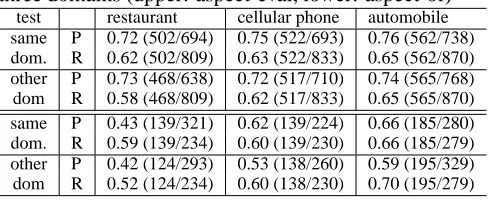
We next evaluated effectiveness of the contextual clues learned in the domains to other domains by testing a model trained on the certain domains to other domain. We selected two new domains, cel-lular phone and automobile, and annotated 290 we-blog posts in each domain. For the restaurant do-main, we randomly selected 290 posts from the pre-viously mentioned our annotated corpus. We then divide each data set to a training set and a test set so that we had the same amount of training data for each domain. Then we trained a model on the data for each domain, and applied it to each of the three set of data. Table 5 shows the results of the experi-ment. Compared with the model trained on the same domain, the models trained on different domains ex-hibited almost comparable performance. This
in-Table 5: Comparing intra-sentential models among three domains (upper: aspect-eval, lower: aspect-of)
test restaurant cellular phone automobile same P 0.72 (502/694) 0.75 (522/693) 0.76 (562/738) dom. R 0.62 (502/809) 0.63 (522/833) 0.65 (562/870) other P 0.73 (468/638) 0.72 (517/710) 0.74 (565/768) dom R 0.58 (468/809) 0.62 (517/833) 0.65 (565/870) same P 0.43 (139/321) 0.62 (139/224) 0.66 (185/280) dom. R 0.59 (139/234) 0.60 (139/230) 0.66 (185/279) other P 0.42 (124/293) 0.53 (138/260) 0.59 (195/329) dom R 0.52 (124/234) 0.60 (138/230) 0.70 (195/279)
dicates that the contextual clues learned in other domains are effective in another domain, showing the cross-domain portability of our intra-sentential model.
5 Conclusion
In this paper, we described our opinion extrac-tion task, which extract opinion units consisting of four constituents. We showed the feasibility of the task definition based on our corpus study. We consider the task as two kinds of relation extrac-tion tasks, aspect-evaluaextrac-tion relaextrac-tion extracextrac-tion and aspect-of relation extraction, and proposed a ma-chine learning-based method which combines con-textual clues and statistical clues. Our experimental results show that the model using contextual clues improved the performance for both tasks. We also showed domain portability of the contextual clues.
References
R. Bunescu. 2003. Associative anaphora resolution: a web-based approach. In Proceedings of the EACL Workshop on
The Computational Treatment of Anaphora, pages 47–52.
Y. Choi, E. Breck, and C. Cardie. 2006. Joint extraction of enti-ties and relations for opinion recognition. In Proceedings of
the Conference on Empirical Methods in Natural Language Processing (EMNLP), pages 431–439.
H. H. Clark. 1977. Bridging. Thinking: readings in cognitive
science. Cambridge : Cambridge University Press.
T. Hofmann. 1999. Probabilistic latent semantic indexing. In
Proceedings of the 22nd Annual ACM Conference on Re-search and Development in Information Retrieval (SIGIR),
pages 50–57.
M. Hu and B. Liu. 2004. Mining and summarizing customer re-views. In Proceedings of the Tenth International Conference
on Knowledge Discovery and Data Mining (KDD), pages
168–177.
R. Iida, K. Inui, H. Takamura, and Y. Matsumoto. 2003. Incor-porating contextual cues in trainable models for coreference resolution. In Proceedings of the EACL Workshop on The
[image:9.612.314.559.91.191.2]S. Ikehara, M. Miyazaki, S. Shirai A. Yokoo, H. Nakaiwa, K. Ogura, Y. Ooyama, and Y. Hayashi. 1997. Nihongo Goi
Taikei (in Japanese). Iwanami Shoten.
H. Kanayama and T. Nasukawa. 2004. Deeper sentiment anal-ysis using machine translation technology. In Proc. of the
20th International Conference on Computational Linguis-tics(COLING), pages 494–500.
S. Kim and E. Hovy. 2004. Determining the sentiment of opin-ions. In Proceedings of the 20th International Conference on
Computational Linguistics (COLING), pages 1367–1373.
S. Kim and E. Hovy. 2006. Extracting opinions, opinion hold-ers, and topics expressed in online news media text. In
Pro-ceedings of the ACL Workshop on Sentiment and Subjectivity in Text.
N. Kobayashi, K. Inui, Y. Matsumoto, K. Tateishi, and T. Fukushima. 2004. Collecting evaluative expressions for opinion extraction. In Proceedings of the 1st
Interna-tional Joint Conference on Natural Language Processing
(IJCNLP) , pages 584–589.
N. Kobayashi, R. Iida, K. Inui, and Y. Matsumoto. 2005. Opinion extraction using a learning-based anaphora reso-lution technique. In The Second International Joint
Con-ference on Natural Language Processing (IJCNLP), Com-panion Volume to the Proceeding of Conference including Posters/Demos and Tutorial Abstracts, pages 175–180.
T. Kudo and Y. Matsumoto. 2004. A boosting algorithm for classification of semi-structured text. In Proceedings of the
Conference on Empirical Methods in Natural Language Pro-cessing (EMNLP).
B. Liu, M. Hu, and J. Cheng. 2005. Opinion observer: Analyz-ing and comparAnalyz-ing opinions on the web. In ProceedAnalyz-ings of
the 14th International World Wide Web Conference (WWW),
pages 342–351.
B. Pang, L. Lee, and S. Vaithyanathan. 2002. Thumbs up? sentiment classification using machine learning techniques. In Proceedings of the Conference on Empirical Methods in
Natural Language Processing (EMNLP), pages 79–86.
M. Poesio, R. Mehta, A. Maroudas, and J. Hitzeman. 2004. Learning to resolve bridging references. In Proceedings of
the 42nd Annual Meeting of the Association for Computa-tional Linguistics (ACL).
A. Popescu and O. Etzioni. 2005. Extracting product features and opinions from reviews. In Proceedings of the
Confer-ence on Empirical Methods in Natural Language Processing
(EMNLP), pages 339–346.
Y. Suzuki, H. Takamura, and M. Okumura. 2006. Application of semi-supervised learning to evaluative expression classi-fication. In Proceedings of the 6th International Conference
on Intelligent Text Processing and Computational Linguis-tics (CICLing).
H. Takamura, T. Inui, and M. Okumura. 2006. Latent variable models for semantic orientations of phrases. In
Proceed-ings of the 11th Conference of the European Chapter of the Association for Computational Linguistics (EACL) , pages
201–208.
K. Tateishi, T. Fukushima, N. Kobayashi, T. Takahashi, A. Fu-jita, K. Inui, and Y. Matsumoto. 2004. Web opinion extrac-tion and summarizaextrac-tion based on viewpoints of products. In
IPSJ SIGNL Note 163, pages 1–8. (in Japanese).
P. D. Turney. 2002. Thumbs up or thumbs down? semantic ori-entation applied to unsupervised classification of reviews. In
Proceedings of the 40th Annual Meeting of the Association for Computational Linguistics (ACL), pages 417–424.
J. Wiebe, T. Wilson, and C. Cardie. 2005. Annotating expres-sions of opinions and emotions in language. Language
Re-sources and Evaluation, 39:165–210.
J. Yi, T. Nasukawa, R. Bunescu, and W. Niblack. 2003. Senti-ment analyzer: Extracting sentiSenti-ments about a given topic us-ing natural language processus-ing techniques. In Proceedus-ings
of the third IEEE International Conference on Data Mining
(ICDM), pages 427–434.
H. Yu and V. Hatzivassiloglou. 2003. Towards answering opin-ion questopin-ions: Separating facts from opinopin-ions and identify-ing the polarity of opinion sentences. In Proceedidentify-ings of the