Abstract— “Swell drying” is a new drying process which is coupled with dehydration itself, a stage of texturing by the instant controlled pressure drop technology, called the Détente Instantanée Contrôlée (DIC), which is inserted between pre and final drying steps. Texturing step permits to modify the material texture, which would then affect the dehydration kinetics, the product physical properties, including water and oil holding capacity, and the microbial decontamination. The results of this work showed that the cassava texturing by DIC implied increasing the effective moisture diffusivity, cassava flour capacities vis-à-vis either the water holding and the oil holding. Texturing by DIC also reduced the bacterial content of cassava flour significantly.
Index Terms—cassava flour, effective diffusivity, microbial decontamination, oil holding capacity, water holding capacity.
I. INTRODUCTION
In Indonesia, cassava is the fourth most importance food crop after rice, maize and soybean. Whereas, most of the cassava product goes to starch extraction or is exported as pellet and chips. The average yield per hectare of cassava is rather low at 12 tons, but the trend has been toward a constant increase in yields. Cassava is grown on about 1.4 million hectares throughout the country, with an average production of 16.3 million tons/year [1]. On an estate of a tapioca plant in Lampung, a yield of 25-30 tons/ha of cassava has been continuously attained [2], as a result of a cassava intensification program started by the Government in 1975. Cassava flour processing began in 1990 to diversify cassava products. In the country most of cassava flour was
This paper was submitted on July 25, 2009, for review.
Puguh Setyopratomo is Head of the Indonesian Research Team of France-Indonesia Agro-industrial Laboratory (FIALab), Chemical Engineering Department, Engineering Faculty, University of Surabaya, Raya Kalirungkut, Surabaya, Indonesia, 60292 (Phone: 62-31-2981158; fax: 62-31-2981178; e-mail: [email protected]).
Akbarningrun Fatmawati is Head of Bioprocess Technology Laboratory, Chemical Engineering Department, Engineering Faculty, University of Surabaya, Raya Kalirungkut, Surabaya, Indonesia, 60292 (email: [email protected]).
Karim Allaf is Scientific Director of France-Indonesia Agro-industrial Laboratory (FIALab); Head of Technologies for Agro-Industry of the University of La Rochelle; Laboratory of Transfer Phenomena and Instantaneity in Agro-industry and Building LEPTIAB. Pole of Science and Technology; Avenue Michel Crepeau, 17042 La Rochelle Cedex 01 France (email : [email protected]).
considered acceptable for household consumption, which was estimated at 4-7 kg/month per household. Since cassava flour can substitute wheat flour by as much as 30 %, the entire local production of cassava flour can be absorbed, especially by the food industries [3].
The Indonesian Government is attempting to develop the potential of cassava flour as a food for domestic consumption and as a raw material for both household consumption and the food industry to complement or substitute wheat flour. The Government has recommended that the agricultural and industrial sectors make special efforts in promoting cassava by diversifying cassava process products, improving their quality, and promoting their use among the different strata of the Indonesian population.
Cassava flour is produced from fresh cassava roots through dehydration (drying) process. Basically, the dehydration process is the removal of water from the cassava roots to a certain level at which microbial spoilage is avoided. Up to now, sun drying is the method mostly used to produce cassava flour in Indonesia. Since very long time exposure is needed for such method, significant deterioration will occur during the drying process, which can result in very low quality of the cassava flour product. In this work, a new process of a texturing by instantaneous control pressure drop, called the Déetente Instantanée Contrôlée (DIC), was introduced between pre and final hot air drying. The purpose of the texturing step is to modify the material texture to improve the product quality including the product physical properties [4].
The DIC (Détente Instantanée Contrôlée) technology was initially developed by ALLAF et al., (since 1988) [5]-[8] in the University of La Rochelle. It apply instant pressure-drop to modify the texture of the material and intensify functional behaviour. DIC treatment usually starts by creating a vacuum condition, followed by injecting steam to the material keeping such a contact for several seconds, proceeds then the sudden pressure drop toward vacuum (about 5 kPa with a rate higher than 0.5 MPa/s). This treatment is also categorized as a HTST (High Temperature Short Time) process. By suddenly dropping pressure, rapid autovaporisation of the moisture from the material will occur, the material will swell, and lead to texture change which results in higher porosity [9]. It increases the material porosity as well as the specific surface area and reduces the diffusion resistance of moisture during the final dehydration step. Such a thermo-mechanical
Texturing by Instant Controlled Pressure Drop
DIC in the Production of Cassava Flour: Impact
on Dehydration Kinetics, Product Physical
Properties and Microbial Decontamination
treatment also induces microbiological decontamination [10].
This research was aimed to apply the DIC technology in the production of cassava flour. The variation of the process variables i.e. steam pressure/temperature and time of treatment in DIC reactor will be studied in accordance with the kinetics of dehydration, the physical properties which include water and oil holding capacity, and the microbial decontamination.
II. MATERIALS AND METHODS A. Raw Material
Freshly harvested cassava roots (Manihot esculenta) were purchased locally and used in all experiments. After washing and peeling, the cassava roots were cut into pieces of 16x16x2 mm3.
B. Dehydration Method
Raw and processed cassava pieces were subjected to a stream of hot air at 50 oC in a hot air dryer (Venticell Dryer).
The cassava pieces were dried until the residual water content of about 20-25 %wb. was reached before DIC treatment. The same hot air dryer and conditions were used for initial as well as for final dehydration.
C. The DIC Reactor
The DIC reactor is shown schematically in Fig. 1. The reactor consisted of four major components, i.e. (a) the processing vessel (1.5x10⁻³ m3 volume), where samples were
placed and treated, (b) the vacuum system, which consisted mainly of a vacuum tank with a volume 60-fold greater than the processing vessel, (c) the adequate vacuum pump, and (d) the pressure-dropping system, which is a pneumatic valve, separated the processing vessel from the vacuum tank and could be operated after a high steam pressure treatment and if required before the injection of steam in order to establish an initial vacuum in the processing vessel.
D. The Experiment Procedure
The general experimental protocol is detailed in Fig. 2. After preparing the raw material, initial partial dehydration was carried out. This is required pre-treatment before the DIC processing.
[image:2.595.315.541.56.284.2]
Figure 1. Schematic diagram of the DIC reactor: (a) treatment vessel with heating jacket; (b) vacuum tank with cooling liquid jacket; (c) vacuum pump; (d) instant pressure-drop valve.
Figure 2. Schematic diagram of global processing
[image:2.595.309.541.332.467.2]
Figure 3. DIC temperature and pressure history: PA and TA are the
steam pressure and temperature respectively in the processing vessel, PV the vacuum tank pressure, TP temperature of product: (a)
sample at atmospheric pressure; (b) initial vacuum; (c) saturated steam injection to reach the selected pressure; (d) constant temperature corresponding to saturated steam pressure; (e) abrupt pressure drop towards vacuum; (f and g) releasing to the atmospheric pressure.
[image:2.595.49.290.606.753.2]The equilibrium after the drop in pressure depended on operating conditions: the higher the steam pressure level, the higher the equilibrium pressure. The steam generated by flash vaporization after the decompression produced micro-texturation, which was closely linked to a complex process of micro-alveolation. This process depended on the difference in temperature between the two thermodynamic equilibrium states, before and after decompression. After treatment the sample was air-dried at 50 °C in convective hot air dryer to around 7% wb (7.5% db) moisture content. Afterward the dried cassava pieces were grounded using a commercial grinder (Philip Grinder) to pass a 200 mesh sieve and stored at 25 °C in sealed plastic containers prior to further analyses.
E. Fundamentals
There are four transfer mechanisms which usually intervene during the drying process [11]; they are: 1). Heat transfer from outside towards the product surface; the energy can be generally brought by contact, convection, or radiation. 2).Heat transfer within the product; the energy is transmitted by conduction. 3). Water transfer within the product; it is carried out either in liquid (by various process including capillarity and molecular diffusivity; the driving force is the gradient of water content) and / or vapour phase (the driving force is the gradient of the partial pressure of vapour). 4). Vapour transport from the surface towards outside.
Energy exchange to the product surface result in constant rate drying period and proceed in very short time. Then, especially for biomaterials, during almost overall drying process the water transfer take place within the product that result in falling rate of drying.
By assuming that external heat and mass transfers do not limit the overall rate operation thanks to adequate air flow temperature and velocity, only internal transfers are considered as controlling the processes [12]. Mounir & Allaf [13] assumed that, when mass transfer is much slower than conduction heat transfer within the product, the drying kinetics is controlled by mass transport of water within the granule; this is the case of numerous biopolymers. The process is then described by a first stage of superficial interaction followed by a diffusion Fick-type’s law within the material; Allaf’s formulation [14] is generally used:
m w eff m w m
w D grad
ρ ρ ν
ν ρ
ρ G G G
)
( − =− (1)
where:
ρw : apparent density of water in the material (kg.m-3), ρm : apparent density of dry material (kg.m-3),
vw : absolute velocity of water flow within the porous medium (m.s-1).
vm : absolute velocity of solid medium (m.s-1).
Deff : effective diffusivity of water within the solid medium (m².s-1).
Mounir & Allaf [11] assumed neglecting effects of possible shrinkage, and with the hypothesis of constant effective diffusivity during drying, Fick’s second law becomes for 1-D:
2 2 ⎥ ⎥ ⎦ ⎤ ⎢ ⎢ ⎣ ⎡ ∂ ∂ = ∂ ∂ r D t w eff w ρ ρ (2)
The effective diffusivity Deff is considered as constant because of the constant temperature and homogeneous structure of the material during drying. Different mathematical solutions have been proposed for this equation, depending on the initial and boundary conditions [15]; in our study, we can adopt the solution given by Crank, according to the geometry of the solid matrix [16]; by expressing the amount X of water in the solid, equation (2) becomes:
∑
∞ = − = − − = 1 2 0 ) exp( q t AX X
X X
MR i i
e
e
(3)
where X is the water content dry basis at t, Xe, the amount of
X at equilibrium (tÎ∞) and X0 the value of X at t = 0. For a
slab geometry form, Eq. (3) becomes:
(
)
(
)
⎟ ⎟ ⎠ ⎞ ⎜ ⎜ ⎝ ⎛ + − + =∑
∞= 20
2 2 0 2 2 4 1 2 exp 1 2 1 8 L t D n n MR eff n π
π (4)
Where Deff is the effective diffusivity (m2/s); L0 is the
thickness of slab (m). For long drying period, Eq. (4) can be further simplified to only the first term of series [17]-[18]. Thus Eq. (4) is written in logarithmic form as follows:
2 0 2 2 4 8 ln ln L t D
MR π eff
π −
= (5)
Diffusivities are typically determined by plotting experimental drying data in term of ln MR versus drying time t in Eq. (5), because the plot gives a straight line with a slope as follows: 2 0 2 4L D
Slope=π eff (6)
F. Water and Oil –Holding Capacity Determination Method proposed by J.A. Larrauri [19] was used with slight modification. Five milliliters of distilled water or commercial
olive oil were added to 0,2 g of dry sample, incubated at 40
oC for 1 h. After centrifugation, the liquid phase was
separated
and the residue was weighed. WHC and OHC were calculated as g water or oil absorbed per g of dry sample, respectively.
G. Determination of Microbial Content
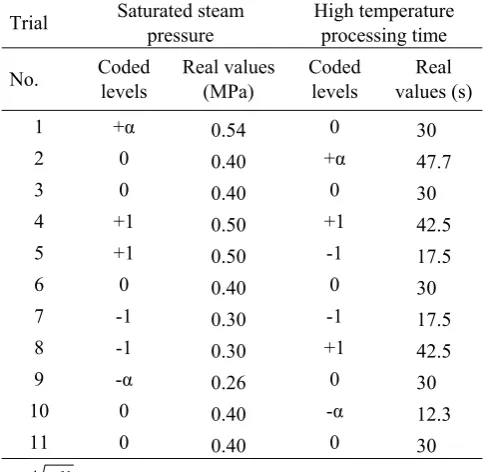
tubes. As much as 1 ml of diluted samples in the test tubes was transferred into plate count agar and incubated for 48 hours at 35oC. The colonies formed were counted afterward. Table 1. Experiment trials with steam pressure P and thermal treatment time t expressed in coded and real values.
Trial Saturated steam pressure High temperature processing time No. Coded levels Real values (MPa) Coded levels values (s) Real
1 +α 0.54 0 30
2 0 0.40 +α 47.7
3 0 0.40 0 30
4 +1 0.50 +1 42.5
5 +1 0.50 -1 17.5
6 0 0.40 0 30
7 -1 0.30 -1 17.5
8 -1 0.30 +1 42.5
9 -α 0.26 0 30
10 0 0.40 -α 12.3
11 0 0.40 0 30
α =4
2
N , N is the number of independent variables. In the present case: N=2 and α = 1.4142H. Experimental Design and Statistical Analysis
A two variable central composite rotatable design was used. Such design needs 13 experiments including 4 repetition runs at the centre point. The experiments were run in random in order to minimize the effects of unexpected variability in the observed responses due to extraneous factors. For each factor, the experimental range and the central point are based on the results of other preliminary trials. Table 1 lists the independent variables, their symbol, and the coded and real factor level. Regression coefficients and analysis of variance (ANOVA) are computed using Minitab-11.12 (Mini Tab Inc., USA) software.
The objective is to observe the influence of the process variables i.e. steam pressure/temperature and time of treatment in DIC reactor on the dependent responses which consisted of kinetic of dehydration (effective moisture diffusivity) and cassava flour physical properties, including water holding capacity (WHC) and oil holding capacity (OHC). Since the processing pressure (ξ1) and the treatment time (ξ2) were set as the design variables, the responses were assumed to be affected by the two independent variables ξi. It was also assumed that the dependent variables (referred to as responses), η, which were experimentally measured, defined the system, and was formulated as:
(
ξ
1,
ξ
2)
f
η
=
(7)The obtained experimental data were analyzed by RSM to fit to the following second-order polynomial
model:
12 12 2 i 2
1 i
ii 2
1 i
i i
0
β
x
β
x
β
x
β
η
=
+
∑
+
∑
+
= =
(8)
where βo, βi, βii and β12 are regression coefficients and xiare the coded variables linearly related to ξi. The coding of ξi into xi is expressed by the following equation:
(
i i)
ii d
x =2
ξ
−ξ
* /(9)
where ξi = actual value in original units; ξi* mean of high and low levels of ξi; and di= difference between the low and high levels of ξi.
III. RESULTS AND DISCUSSION A. Moisture Effective Diffusivity ( Deff )
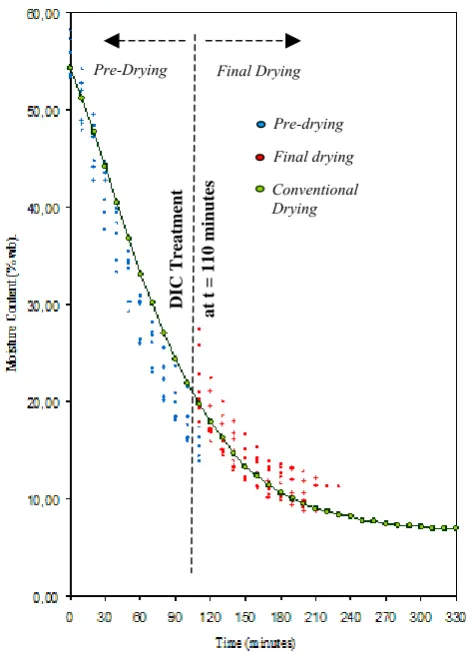
The observed profile of the moisture content change is presented on Fig. 4. It showed that the experimental data lied on curvature profile, which indicated that falling rate drying mechanism had occurred during the whole drying period. In such case, water diffusion mechanism would control the process.
To investigate the impact of DIC texturing on the drying kinetics, the main parameter had been the water diffusivity within material. Taking the prerequisite assumption, then the effective diffusivity (Deff) was calculated using Eq. (5). For the DIC treated cassava, the surface plot of Deff is presented on Fig. 5 and the regression coefficients are showed on Table 2. Even though the obtained regression coefficients were very low, the results showed that the DIC treatment increased the water effective diffusivity. The reference Deff obtained with conventional drying (drying without inserting DIC treatment) had been 1.13 x 10⁻¹⁰ m2/s, whereas the Deff values
in all DIC treated cassava were somewhere higher (1.37 - 3.26) x 10-10 m2/s. It indicated that the change in cassava
physical properties, such as capillary and molecular diffusivity, had occurred during texturing by DIC treatment. The higher Deff value due to the texture change is one among other advantages of DIC treatment application, especially for biomaterial products.
B. The Water and the Oil Holding Capacity
The water holding capacity (WHC) and the oil holding capacity (OHC) are the physical properties that indicate the capacity of a material to hold water and oil, respectively. Both physical properties were very important to be known for flour or powder food material, as some different food powders usually should be blended together to produce a certain final food product. Then appropriate WHC or OHC of food raw material becomes an important property.
increase of the treatment time up to around 30 s resulted in lower WHC, whereas lengthening the treatment time from 30 s resulted in higher WHC. Increasing the steam pressure did not affect the WHC significantly. At low steam pressure, which is less than
4 x 10⁵ Pa, increasing the treatment time up to 30 s resulted in
lower OHC, whereas lengthening the treatment time from 30 s resulted in higher OHC. At high steam pressure, more than 4 x 10⁵ Pa, lengthening the treatment time resulted in higher
[image:5.595.52.286.173.501.2]OHC.
Figure 4. The profile of the moisture content change during pre- and final-drying.
Figure 5. Surface plot of the effective diffusivity
Figure 6. Surface plot of the water holding capacity
Figure 7. Surface plot of the oil holding capacity
It was also found that texturing by DIC resulted in the increase of WHC from 1.2 g water/g dry cassava (drying without DIC treatment) to 2.0-8.0 g water/g dry cassava. Texturing by DIC also resulted in the increase of the OHC from 0.4 g oil/g dry cassava (drying without DIC treatment) to 0.8-2.0 g oil/g dry cassava. The increase of both WHC and OHC indicated that the texturing by DIC might change the micro structure of cassava, such as the total pore volume and the specific surface.
Table 2. The regression coefficients
The Responses The
coefficients Deff WHC OHC
β0 - 1.831 16.067 4.960
β1 1.360 - 2.546 - 1.372
β2 0.097 - 0.473 - 0.076
β11 - 0.173 0.394 0.138
β22 - 0.001 0.008 0.001
β12 - 0.003 0.014 0.007 R2 17.67% 34.53 % 21.81 %
C. The Microbial Decontamination
The observation of the microbial content of treated cassava showed that no fungi growth was detected in the final product, both for process without DIC treatment and for process with DIC treatment. This showed that drying at 50 oC
for 4–5 hours has effectively inhibited the fungi growth on cassava. It would be one advantage compared to producing cassava flour by sun drying, where fungi growth was usually found due to the very low rate of drying.
The result of the bacterial content of treated cassava is Pre-drying
Final drying
Conventional Drying Pre-Drying Final Drying
DIC Treatment
shown in Table 3. In this case DIC treatment was conducted at 4x10⁵ Pa steam pressure for 12.3 seconds. In process
without DIC treatment the bacterial content decreased from 520,000 CFU/ml in the fresh cassava to 204,500 CFU/ml in the treated cassava samples after final drying, which meant that there was 60.7 % reduction of the bacterial content. Whereas in process with DIC treatment, the bacterial content decreased from 605,000 CFU/ml in the fresh cassava to 86,500 CFU/ml in the treated cassava samples after final drying which meant that 85.7 % reduction of the bacteria content had been achieved. The result showed that inserting DIC treatment between the pre- and the final-drying stage had increased the bacterial decontamination significantly. In this work, the investigation of the microbial decontamination was aimed only to observe the initial tendency of the role of DIC treatment in food sterilization process. Further work should be performed to investigate and to optimize the DIC process variables i.e. the applied pressure and treatment time to reach the optimum microbial decontamination by considering the degree of nutritional damage due to exposure on high steam temperature for certain treatment time.
Table 3. The bacterial content
the bacterial content (CFU/ml)
sample without
DIC treatment
with DIC treatment fresh cassava 520,000 605,000 after final drying 204,500 86,500
reduction 315,500
(60.7 %)
518,500 (85.7 %)
IV. CONCLUSION
The impact of the texturing by Instantaneous Control Pressure Drop on the effective moisture diffusivity, the water and the oil holding capacity, and the microbial decontamination of cassava has been investigated. However, further observation should be performed to obtain more comprehensive result. It is highly recommended to conduct more specific measurement related to the product physicochemical characteristics and qualities such as electron microscope image of either product slice or powder to observe the micro texture change, BET analysis to investigate the change in the total micro pore volume, texture measurement, and nutritional content change analysis during the process.
ACKNOWLEDGMENT
The authors wish to thank THE ABCAR-DIC PROCESS SAS, La Rochelle France for providing a set of DIC equipment.
REFERENCES
[1] CBS (Central Bureau of Statistics). “Food balance sheet in Indonesia, 1986-87”. Jakarta, Indonesia. 1988.
[2] I. W. Rusastra, “ Study on aspects of national production, consumption, and marketing of cassava. Indones. Agri. Res. Dev. J., 7, 1988, pp. 57-63.
[3] A. Dimyati & I. Manwan, National coordinated research program : cassava and sweet potato, Central Research Institute for Food Corp (CRIFC), Bogor, Indonesia, 1992.
[4] E. Debs-Louka, N. Louka, G Abraham, & K. Allaf, “Décontamination des produits secs en morceaux ou en poudre par voie thermomécanique contrôlée”, Actes des 12èmes Rencontres Scientifiques et
Technologiques des Industries Alimentaires, AGORAL, Ed. Lavoisier. 225-230, Montpellier , 22-23 Mars; 2000.
[5] K. Allaf & P. Vidal, (1989), "Feasibility study of a new process of drying/swelling by instantaneous decompression toward vacuum of in pieces vegetables in view of a rapid re-hydration" Gradient Activity Plotting University of Technology of Compiegne UTC N° CR/89/103, industrial SILVA-LAON partner, June, 1989.
[6] K. Allaf, N. Louka, J. M. Bouvier, F. Parent, & M. Forget, “Method for processing materials to change their texture, apparatus therefore, and resulting materials”, 01/05/1999, Document Type and Number: United States Patent 5855941. French Patent No. 93 09720. International extension No. PCT/FR94/00975, 1993. [7] M. Al-Haddad, S. Mounir, V. Sobolik, & K. Allaf, “Fruits &
vegetables drying combining hot air, DIC technology and
microwaves”, International Journal of Food Engineering IJFE, Vol 4, iss. 6, art. 9, 2008.
[8] M. Al-Haddad, S. Mounir, V. Sobolik, & K. Allaf, ”Double intensification of operation of hot air drying of fruits and vegetables: impact of swell drying by DIC on the transfer phenomena”, European Drying Conference, Biarritz France, AFSIA 2007, 24-25 May 2007. [9] K. Allaf, “Analysis of instantaneity in thermodynamic processes;
Fundamental laws”, 1st Franco- Lebanese Symposium on technologies and studies on Process Engineering and Biochemistry. Lebanese University, Beirut, July/August, 2002.
[10] K. Allaf, N. Louka, A. Habba, Z. Maache, & S.A. Rezzoug, “Diverse thermal, pressure and vacuum treatment for e.g. moist foods, cosmetics, chemical and pharmaceutical products”, Publication No.: FR2774913; Date of issue: 20/08/1999; original No. FR2774913, 1998.
[11] S. Mounir & K. Allaf, “Study and modeling of dehydration and rehydration kinetics within porous medium”, Proceedings of AFSIA, Lyon (France), 14-15 May, 2009.
[12] S. Mounir, “Etude de nouveaux procédés de fabrication de poudres par insertion de la technologie de détentes instantanée contrôlée DIC, dans les processus d’atomisation, de séchage/ texturation et de pulvérisation contrôlée sous vide de produits laitiers”, PhD (Thèse de doctorat), University of La Rochelle, 2007.
[13] S. Mounir & K. Allaf, “Three-stage spray drying: new process involving instant controlled pressure drop (DIC)”, Journal of Drying Technology, Vol. 26, No. 4, 2008, pp. 452-463.
[14] K. Allaf, “Transfer phenomena and industrial applications”, Teaching book published by the Lebanese University, Faculty of Science, 1982. [15] A.S. Mujundar, “Handbook of Industrial Drying”, Third Edition,
Edited by CRC Taylor & Francis Group Press, 2006.
[16] J. Crank, “The mathematics of diffusion”, Oxford, England. Clarendon Press, 1975.
[17] Z. Pakowski & A.S. Mujumdar, ”Basic process calculations and simulations in drying”, in HANDBOOK OF INDUSTRIAL DRYING, Third Edition, Edited by CRC Taylor & Francis Group Press, 2006. [18] M. A. Tutuncu, and T. P. Labuza, “Effect of geometry on the effective
moisture transfer diffusion coefficient”, Journal of Food Engineering, 30, 1996, pp. 433-447.