Proceedings of NAACL-HLT 2019, pages 345–356 345
UHop: An Unrestricted-Hop Relation Extraction Framework
for Knowledge-Based Question Answering
Zi-Yuan Chen1, Chih-Hung Chang1, Yi-Pei Chen2, Jijnasa Nayak3, Lun-Wei Ku1,4 Institute of Information Science, Academia Sinica1
University of Massachusetts Amherst2 National Institute of Technology, Rourkela3
Most Joint Research Center for AI Technology and All Vista Healthcare4 {zychen,lance5,lwku}@iis.sinica.edu.tw
[email protected], [email protected]
Abstract
In relation extraction for knowledge-based question answering, searching from one en-tity to another enen-tity via a single relation is called “one hop”. In related work, an exhaus-tive search from all one-hop relations, two-hop relations, and so on to the max-hop relations in the knowledge graph is necessary but expen-sive. Therefore, the number of hops is gener-ally restricted to two or three. In this paper, we propose UHop, an unrestricted-hop frame-work which relaxes this restriction by use of a transition-based search framework to replace the relation-chain-based search one. We con-duct experiments on conventional 1- and 2-hop questions as well as lengthy questions, in-cluding datasets such as WebQSP, PathQues-tion, and Grid World. Results show that the proposed framework enables the ability to halt, works well with state-of-the-art models, achieves competitive performance without ex-haustive searches, and opens the performance gap for long relation paths.
1 Introduction
A knowledge graph (KG) is a powerful graph structure that encodes knowledge to save and or-ganize it, and to provide users with direct access to this knowledge via various applications, one of which is question answering, or knowledge-based question answering (KBQA). In the knowl-edge graph, beliefs are commonly represented by triples showing relations between two enti-ties, such as LocatedIn(NewOrleans, Louisiana), where the two entities are nodes and their rela-tion is the edge connecting them in the knowl-edge graph. Given a natural language question, a KBQA system returns its answer if it is included in the knowledge graph; the process of answering a question can be transformed into a traversal that starts from the question (topic) entity and searches for the appropriate path to the answer entity.
In the literature (Yu et al., 2017; Yin et al.,
2016;Yih et al.,2015) KBQA is decomposed into topic entity linking, which determines the start-ing entity correspondstart-ing to the question, and re-lation extraction, which finds the path to the an-swer node(s). Theoretically, relation extraction finds paths of any length, that is, paths that contain any number of relation links, or hops (between two nodes), as long as it reaches the answer node. In previous work, models consider all relation paths starting from the topic entity (Yu et al., 2017;
Yin et al., 2016;Yih et al., 2015); we call these relation-chain-based methods. Two main difficul-ties for these methods are that processing through all relations in a KG is not practical as the com-bination of these relations is nearly infinite, and that the number of candidate paths grows exponen-tially with the path length and quickly becomes in-tractable for large knowledge graphs. As a result, current relation-chain-based methods set the max-imum length of candidate paths to 1, 2 or 3. How-ever, under this framework we cannot find answer entities for indirect or complicated questions.
Most importantly, even given a larger maxi-mum length, it is unrealistic to expect to know in advance the maximum number of hops for real-world applications. Thus even with exhaustive searches, if the answer entity is still too distant or lies outside of the search space, it is not reachable or answerable. In addition, setting a large maxi-mum number of hops necessitates lengthy training instances, which is especially difficult.
three-fold: (1) No predefined maximum hop number is required in UHop, as it enables models within the framework to halt; (2) UHop reduces the search space complexity from exponential to polynomial while maintaining comparable results; (3) UHop facilitates the use of different models, including state-of-the-art models.
2 Related Work
State-of-the-art KBQA methods are in general based on either semantic parsing, or on embed-ding (Zhou et al.,2018). Semantic parsing meth-ods learn semantic parsers which parse natural lan-guage input queries into logical forms, and then use the logical forms to query the KG for an-swers (Berant et al.,2013;Yih et al.,2015,2016;
Krishnamurthy et al., 2017; Iyyer et al., 2017;
Peng et al., 2017;Sorokin and Gurevych, 2018). These systems are effective and provide deep in-terpretation of the question, but require expen-sive data annotation, or require training using re-inforcement learning.
Embedding-based methods first allocate candi-dates from the knowledge graph, represent these candidates as distributed embedding vectors, and choose or rank these vectors. Here the candi-dates can be either entities or relations. Some use embedding-based models to predict answers directly (Dong et al., 2015; Bast and Hauss-mann, 2015;Hao et al.,2017;Zhou et al.,2018;
Lukovnikov et al.,2017), whereas others focus on extracting relation paths and require further pro-cedures to select the answer entity (Bordes et al.,
2015;Xu et al.,2016;Yin et al.,2016;Yu et al.,
2017;Zhang et al.,2018a;Yu et al., 2018;Chen et al., 2018a; Shen et al., 2018). Our work fol-lows the latter methods in focusing on predicting relation paths, but we seek to eliminate the need to assume in advance a maximum number of hops.
For the solution, we turn to the field of multi-hop knowledge based reasoning. Early methods include the Path-Ranking Algorithm and its vari-ants. (Lao et al.,2011;Gardner et al.,2014,2013;
Toutanova et al., 2015) The drawback of these methods is that they use random walks indepen-dent of the type of input. DeepPath (Xiong et al.,
2017) and MINERVA (Das et al.,2017) tackle this issue by framing the multi-hop reasoning problem as a Markov decision process, efficiently search-ing for paths ussearch-ing reinforcement learnsearch-ing; others propose an algorithm (Yang et al.,2017) for
learn-ing logical rules, a variational auto-encoder view of the knowledge graph (Chen et al.,2018b;Zhang et al.,2018b), and reward shaping technique (Lin et al., 2018) for further improvement. The ma-jor difference between UHop and these methods is that they do not utilize annotated relations and hence require REINFORCE training (Williams,
1992) for optimization. As some datasets are al-ready annotated with relations and paths, direct learning using an intermediate reward is more rea-sonable. Hence UHop adopts a novel comparative termination decision module to control the search process of the relation path.
The most related approach is the IRN model (Zhou et al., 2018), composed of an input module, a memory-based reasoning module, and an answer module. At each hop, it predicts a relation path using the reasoning module, and also optimizes it using intermediate results. However, UHop has demonstrated the ability to process large-scale knowledge graphs in experiments conducted on Freebase (Bordes et al., 2015). In contrast, IRN consumes memory linearly to the size of the knowledge graph, resulting in a limited workspace, e.g., they use a subset of Freebase in their experiments. Also, IRN still uses a constraint for the number of maximum hops in the experiments, while UHop needs no such limit. Most importantly, as UHop is a framework which facilitates the use of different models, we can expect the performance of UHop to remain competitive with the state of the art over time.
3 UHop Relation Extraction
With UHop, we aim to handle unrestricted re-lation hops and to be compatible with existing relation extraction models. UHop breaks down unrestricted-hop relation extraction into two major subtasks: single-hop relation extraction and com-parative termination decision.
Algorithm 1: Unrestricted-hop relation ex-traction. edenotes the extracted topic entity, ‘:’ is the concatenation operation, and the ter-mination decision returns True if the frame-work decides to stop.
1 Given KB,Q,e 2 stop ←False;
3 P ←NULL;
4 R←outbound relations ofe; 5 whilestop=False do
6 ˆr←single hop relation extraction; 7 P ←P : ˆr;
8 e0 ←traverse fromethroughrˆ; 9 e←e0;
10 R←outbound relations ofe; 11 stop←termination decision;
12 end Result:P
through another iteration to extract the next rela-tion in the relarela-tion path. If the decision to termi-nate is false, we search the KB again for outbound relations of the newe, after which the search pro-cess starts again. Note that starting from the sec-ond iteration, candidate relations are concatenated with the previously selected relations to remember the history and consider them as a whole. We con-tinue this loop until the process decides to termi-nate. The termination decision thus enables UHop to learn when to stop searching for relations to ex-tract: it determines the number of hops needed to reach the correct target entity. Upon termination, UHop returns the extracted relation(s).
In the UHop framework, the model is trained to favor the correct relation over incorrect relations. That is, to select the correct outbound single-hop relations from current entitye, the model prefers the correctrˆover the other relationsR−rˆofe; to terminate at the current entitye, the model favors the correct relationˆrlinked to the current entitye
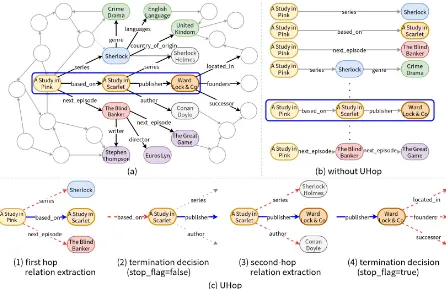
over the outboundRrelations frome. To continue the iteration, it proceeds likewise. In UHop, we successfully utilize this preference over relations to train the same model to perform both single-hop relation extraction and termination decision. Fig-ure 1shows the difference between previous work and our model in the scenario of multi-hop KBQA task with an simplified knowledge graph and the question “Who published the novel adapted into A Study in Pink ?” as example.
3.1 Single Hop Relation Extraction
Single-hop relation extraction can be modeled as pairwise classification of the set of candidate re-lations. Given a question Q, the candidate rela-tion setR, and a pairwise classification modelF, single-hop relation extraction is illustrated as
r= arg max r∈R
F(Q, r). (1)
Hinge loss, used for optimization, is defined as
LRE =
P
r∈R−ˆr
max(0,−(sˆr−sr) +M)
|R−rˆ| , (2)
wheresˆr,srare scores of the true relation and the candidate relations respectively. The margin, M, is an arbitrary value in the range(0,1], where the goal of the loss function is to maximize the margin between the scores of the correct and the incorrect predictions. Note that this relation extraction pro-cess and those proposed in related work are com-patible, which facilitates the installation of state-of-the-art models in the UHop framework.
3.2 Comparative Termination Decision
In the UHop framework, as we hope to easily re-place the used model by state-of-the-art models, we make the termination decision using the same model for single-hop relation extraction so that no additional model is needed. Therefore, we pro-pose a progressive method which treats the ter-mination decision as a comparison. That is, the model stops when it cannot extract any relation better than that from its previous hop.
What is different here isR, the relations to be compared against rˆ, are the concatenation of ex-tracted relation and all the relation starting from the new current entity e; recall that we update
e ← e0 before we step into termination decision. If the scoresˆris higher than all the compared rela-tions, the searching process terminates; otherwise, it continues.
Given a questionQ, an extracted relationrˆfrom the previous entity, the candidate relation set R
from the new current entitye, and the same model
F as in the single hop relation extraction, the pro-cedure can be formulated as
stop =
(
True, F(Q,rˆ)> F(Q, r) ∀r∈R
False, F(Q,rˆ)< F(Q, r) ∃r∈R
Figure 1: (a) A snippet of knowledge graph. (b) without UHop, all the paths less than two hop are considered as candidates; (c) under UHop, the next part of relation is extracted hop by hop (step 1 and 3), then we compare the chosen relation and its outbound relations to decide to terminate or to extract the next relation: if the extracted relation has the highest score than all the outbound relations then the process is terminated (step 4), otherwise, continued (step 2). Here we use solid arrows and dash arrows to respectively represent positive/negative candidates.
Loss is defined depending on the flag stop. If the process should continue, i.e.,stopis false, loss is defined as
LT D= max(0,−(sr0 −sˆr) +margin), (4)
where scoresr0 is the score of the question paired with the gold relationr0 in the next hop andsˆris the score of the question paired with the extracted relationrˆ. In contrast, if the process should termi-nate, we optimize the model by
LT D=
P
r∈R
max(0,−(sˆr−sr) +M)
|R| . (5)
The model thus learns to infersrˆis greater thansr, resulting in the termination of relation extraction.
3.3 Dynamic Question Representation
While UHop inferences hop by hop, it is straight-forward to enforce the focus at different aspects of the question. For this purpose, we update the ques-tion representaques-tion for each hop by defining a dy-namic question representation generation function
G. Given the previously selected relation pathP
and the original questionQ,Ggenerates the new question representation as Q0 = G(Q, P). Our assumption is that since the current relation has been selected, its related information in the ques-tion loses importance when extracting the next re-lation.
Inspired by both supervised attention (Mi et al.,
2016; Liu et al., 2016; Kamigaito et al., 2017), which is lacking in our datasets, and the coverage loss design for summarization (See et al., 2017), we de-focus the selected relation by manipulat-ing weights in the question representation. We propose two ways of updating the question rep-resentation, taking into account the existence of the attention layer in the model’s architecture. For attentive models, we directly utilize the attention weight as part of our dynamic question represen-tation generation function by
G(Q, P) =W(Q−attention(Q, P)) +B. (6)
[image:4.595.75.521.61.350.2]representation to yield the new representation:
G(Q, P) =W[Q:P] +B, (7)
where W andB are weight matrices to be opti-mized during training.
3.4 Jointly Trained Subtasks
In training, we jointly optimize the two subtasks of UHop. For each question and its candidates, the loss function is defined as
L= H
X
i
(L(REi) +L(T Di) ), (8)
where H is the number of hops in the gold rela-tion path; L(REi) andL(T Di) are the loss of the two subtasks at thei-th hop respectively.
4 Experiments
In this section, we illustrate the performance UHop achieves while reducing the search space, and its relation inference power for multi-hop questions. Performances of the state of the art models are listed as the upper-bound.
4.1 Datasets
For our benchmarking evaluation materials, we se-lected WebQSP (WQ) (Yih et al., 2016), as it is used in most related work. WebQSP is the an-notated version of WebQuestions (Berant et al.,
2013), which contains questions that require a 1-or 2-hop relation path to arrive at the answer en-tity. More specifically, about 40% of the ques-tions require a 2-hop relation to reach the answer. This dataset is based on the Freebase knowledge graph (Bordes et al., 2015). For questions with multiple answers, we use each answer to construct a question-answer pair. Every question is anno-tated with its inferential relation chain (i.e., a rela-tion), topic entity, and answer entity. The statistics for these two datasets are shown in Table1.
As WQ contains only questions with 1- and 2-hop answers that are still short, we also con-duct experiments for path length related anal-ysis on the PathQuestion dataset (Zhou et al.,
2018), which includes questions requiring 3-hop answers. To the best of our knowledge, this is the only available general-KB dataset containing 3-hop questions. PathQuestion pro-vides two datasets: PathQuestion (PQ) and
PathQuestion-Large (PQL). These both contain 2-hop (PQ2/PQL2) and 3-2-hop (PQ3/PQL3) ques-tions respectively, and both use a subset of Free-base as their knowledge graph. Note that for both PQ and PQL, questions are generated using tem-plates, paraphrasing, and synonyms. PQL is more challenging than PQ because it utilizes a larger subset of Freebase, and provides fewer training in-stances. Table1shows statistics of these datasets.
hops Train Valid Test
WQ 1 2113 - 1,144
2 1,285 - 647
PQ2 2 1,526 191 191
PQ3 3 4,158 520 520
PQL2 2 1,275 159 160
PQL3 3 1,649 206 207
[image:5.595.309.524.204.355.2]Grid 2–4 2–4 68,046 9,742 19,298 Grid 4–6 4–6 73,092 10,362 21,037 Grid 6–8 6–8 41,473 5,844 11,789 Grid 8–10 8–10 18,386 2,667 5,326
Table 1: Number of questions in experimental datasets
MetaQA (Zhang et al., 2018b) and sequence QA are two other multi-hop knowledge-based question-answering datasets which we do not use for experiments in this paper. MetaQA is a multi-hop dataset for end-to-end KBQA based on a movie knowledge graph with 43k entities. How-ever, it is too simple for discussions as it contains only 6 relations and on average the number of the outbound relations for each node is 3. The Com-plex Sequential QA dataset (Saha et al.,2018) im-proves on overly simplistic KBQA datasets. Nev-ertheless, instead of questions requiring multi-hop relation paths, it provides a sequence of questions, each of which requires a single-hop relation to an-swer, resulting a different setting. Hence these two datasets are beyond the scope of this paper.
4.2 Benchmark: WQ Experiments
4.2.1 Baseline and Settings
We used two state of the art models, HR-BiLSTM (Yu et al., 2017) and ABWIM (Zhang et al., 2018a), as the models for use within the UHop framework. Another state of the art model, MVM (Yu et al., 2018), is not selected here as it requires additional information: the tail entity type. In MVM, to consider eachn-th-hop relation, the model searches all related(n+ 1)-th-hop re-lations to collect enough information; thus further queries are necessary in MVM. This property of MVM causes the UHop to degrade to a relation-chain based model, which we are trying to avoid.
We report the results of these two models work-ing within and independent of the UHop frame-work to evaluate whether relaxing the constraint on the number of hops has any impact on their per-formance. For comparison, we select BiCNN as baselines and list their results. As there is no pre-defined validation set in WQ, we randomly select 10% of the training data as the validation set. The best parameters for different models and datasets were set empirically.
In all cases we used 300-dimensional pretrained GloVe (Pennington et al.,2014) word embeddings and RMSprop optimization. In ABWIM, follow-ing the settfollow-ing of (Zhang et al., 2018a), we re-spectively chose 1, 3, 5 as kernel sizes and 150 as the number of filters for its three CNN layers. We tune the following hyperparameters with grid search : (1) the hidden size for all LSTM ([100, 150, 256]); (2) dropout rate ([0, 0.2, 0.4]); (3) mar-gin for Hinge loss ([0.1, 0.3, 0.5, 0.7, 1.0]); (4)
learning rate ([0.01, 0.001, 0.0001]).
Method Accuracy
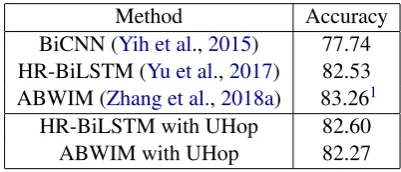
BiCNN (Yih et al.,2015) 77.74 HR-BiLSTM (Yu et al.,2017) 82.53 ABWIM (Zhang et al.,2018a) 83.261
[image:6.595.315.516.88.174.2]HR-BiLSTM with UHop 82.60 ABWIM with UHop 82.27
Table 2: Results adopting state-of-the-art models in UHop framework vs standalone versions
4.2.2 Results and Discussion
The experimental results are shown in Table2. As expected, the performance of models within the UHop framework is comparable to those indepen-dent of it, with the additional advantage of the un-restricted number of relation hops and a greatly reduced search space.
Table 3lists the average number of candidates the experimental models consider for each ques-tion when working within and independent of UHop. For a dataset based on a KB with an average of n relations connected to each entity, the approximate search space without UHop is
n(n−1)(L−1), where L is the predefined max-imum hop number; with UHop the approximate search space is reduced to n(L + 1). The spe-cific number depends on the actual number of out-bound relations connected to the entities. Table3
shows that UHop reduces the search space by 30% for WQ, which translates to lower processing time, less memory consumption, and sometimes slightly improved performance.
Train Test Without UHop 97.2 98.8 With UHop 66.7 65.6
Table 3: Number of relation candidates in WQ
4.3 More Hops: PQ/PQL Experiments
4.3.1 Baseline and Settings
Following the original paper (Zhou et al., 2018), PQ and PQL are both partitioned into train-ing/validation/testing sets at a ratio of 8:1:1. In addition to the original PQ/PQL dataset, we merge
1Note that the original paper reported 85.32, but we failed
[image:6.595.341.489.544.589.2]Method PQ2 PQ3 PQ+ PQL2 PQL3 PQL+ IRN (Zhou et al.,2018) 96 87.7 53.6 72.5 71 52.9 HR-BiLSTM (Yu et al.,2017) 100 99.62 99.72 97.5 87.92 92.92
[image:7.595.111.492.62.173.2]HR-BiLSTM with UHop 99.48 99.23 99.72 91.25 88.41 91.01 HR-BiLSTM with UHop + DQ 100 99.62 99.58 95 89.37 91.83 ABWIM (Zhang et al.,2018a) 98.95 99.81 99.72 94.37 89.37 92.64 ABWIM with UHop 97.38 99.62 99.02 91.25 88.89 91.01 ABWIM with UHop + DQ 100 99.62 99.44 97.5 89.37 92.37
Table 4: Accuracy on PathQuestion. PQ+ is mix of PQ2 and PQ3, and PQL+ contains PQL2 and PQL3. We use the accuracy reported in (Zhou et al.,2018) directly for PQ2, PQ3, PQ2L and PQ3L; for PQ+ and PQL+ we use the model released with the dataset. DQ stands for dynamic question representation.
PQ2 and PQ3, and then PQL2 and PQL3, to cre-ate the mixed datasets PQ+ and PQL+ to eval-uate if the model terminates correctly instead of always stopping on the majority of the training data length. Again we adopt HR-BiLSTM and ABWIM in this experiment. In addition, the IRN model2 proposed together with the PQ/PQL dataset was selected as one of the baselines for comparison. For this dataset containing questions of long relation paths, we also applied the dynamic question representations (DQ) in UHop.
4.3.2 Results and Discussion
Results3are shown in Table4. Both HR-BiLSTM and ABWIM either within or independent of UHop outperform IRN and perform nearly per-fectly in all datasets, which confirms that UHop is competitive even with longer relation paths. How-ever, as shown in Table5, the search space reduc-tion for PQ and PQL is not obvious. We find that the knowledge graph used in PQ/PQL (a subset of Freebase) is much smaller and less complicated than the original Freebase used in WQ, i.e., the outbound degree of nodes is relatively small. Nev-ertheless, UHop still performs comparably with previous work. This indicates that it also works well in small and simple KBs.
As all PQ/PQL questions are multi-hop ques-tions, we used dynamic question representations to better reflect transitions in the relation extrac-tion process. Table4shows that updating the ques-tion representaques-tion dynamically (+DQ) in each it-eration benefits relation extraction in most cases.
2https://github.com/zmtkeke/IRN. We consulted the
au-thors of the repository, who stated that this version is not the one in their paper, which they did not release publicly.
3Note that IRN’s performance was evaluated using final
answer prediction, which is slightly different from relation path prediction. However, finding the correct relation path should imply finding the correct answer entity.
2-hop 3-hop
Train Valid Test Train Valid Test
PQ W/o 3.53 3.65 3.90 9.77 9.63 9.61
With 3.68 3.81 3.85 9.14 9.27 9.48
PQL W/o 3.71 2.64 3.91 24.52 12.96 8.45
[image:7.595.309.525.227.295.2]With 3.94 3.23 4.29 10.11 9.28 6.98
Table 5: Candidates of PQ/PQL within and indepen-dent of the UHop framework
4.4 Very Long Paths: Grid World
4.4.1 Baseline and Settings
In the Grid World experiments, we used MIN-ERVA (Das et al., 2017) and Neural LP (Yang et al.,2017) as baselines. As understanding ques-tions is not an issue here, we randomly initialized the word embeddings and optimized them during the training process. We set the learning rate to 0.001, the hidden size to 256, the embedding size to 300, and optimized the model using the RM-Sprop (Hinton et al.,2014) Algorithm. In this ex-periment, the search space has gone too large to afford for HR-BiLSTM and ABWIM without the assistance of UHop.
Figure 2: Grid World results of state-of-the-art knowledge-based relation extraction models
4.4.2 Results and Discussion
[image:7.595.309.526.545.683.2]this problem. In the first place, compared to Neural LP and MINERVA, UHop benefits from the more powerful natural language understanding models – HR BiLSTM and ABWIM – equipped with sophisticated LSTM models, whereas Neu-ral LP and MINERVA only use multi-layer neuNeu-ral networks as the policy network. This demonstrates UHop’s merit of facilitating the use of novel mod-els. In the second place, Figure 2shows that error propagation leading to poor performance for long-path questions in Neural LP and MINERVA is mit-igated by the relation inference power of UHop: it performs well for all four buckets of questions. Also, as Grid World includes paths of up to 10 hops, conducting experiments purely by relation-chain based models themselves like HR-BiLSTM or ABWIM independent of UHop is not feasible: the number of candidate relations in the exhaus-tive search space grows exponentially. In Grid World, there are 8 directions (relations), and mod-els are allowed to go back and forth. Hence given the path length k, the approximate search space for the models working independently is8k, while for models working within UHop is 8 ×k. We observe that without UHop, the required search space would preclude experiments even on the set containing the shortest paths (Grid World [2–4]), much less the longer ones.
5 Further Discussion
5.1 Dataset Characteristics
In this section we further compare the experimen-tal multi-hop KBQA datasets WQ, PQ, and Grid World. Grid World contains questions that re-quire the longest reasoning paths. However, they are synthetic, the relations are simply direction to-kens, and the questions are just sequences of direc-tion instrucdirec-tions. Therefore in this paper, it is only used to test the model’s ability of making long se-quential decisions instead of understanding ques-tions. From experiments we have seen that deli-cate models like HR-BiLSTM and ABWIM can-not work on it without UHop, and other models such as Neural LP and MINERVA perform worse as they are rewarded only by question.
On the other hand, in WQ, questions are writ-ten in natural language and can be answered by 1-hop or 2-1-hop reasoning. However, for real-world questions, 2-hop reasoning is still overly simplis-tic. For example, although WQ questions such as “What is the name of Justin Bieber’s brother?” are
challenging for models, humans can easily answer these with a simple Internet search.
[image:8.595.317.516.583.624.2]Noting this problem, the authors of IRN (Zhou et al.,2018) propose PQ and PQL, for which ques-tions require at least 2-hop at most 3-hop relation paths. However, PQ/PQL also has its limitations. First, the KB used in PQ/PQL is smaller than that in WQ, and its relations are repetitive and show little variety. Figure3illustrates the relation distri-butions. Second, PQ/PQL questions are generated by extracting relation paths and filling templates, which can lead to questions with obvious, learn-able patterns. This can be observed by comparing results in Tables 2and 4. However, repeated re-lations could also help the model to learn better dynamic question representations with respect to these relations. Table4shows that updating ques-tion representaques-tions dynamically (DQ) does im-prove PQ/PQL performance.
Figure 3: A visualization of the KB relations that cover the dataset. The bubble’s size is proportional to the re-lation’s frequency.
5.2 Trained on 3-hop, Tested on 2-hop
To evaluate if the model halts in the search pro-cess, we conducted an experiment using PQL3 as the training/validation set and PQL2 as the test-ing set. The results are shown in Table6. Within the UHop framework, both models outperform their original version by more than 7%. However, with zero 2-hop samples, it still overfits on the 3-hop length in training data, resulting in accuracies lower than 50%.
HR-BiLSTM ABWIM Without UHop 32.18 32.94
With UHop 39.65 49.94
Table 6: Accuracies of models trained on PQL3 and tested on PQL2. The maximum length of relation paths for models without UHop is set to 3.
5.3 Error Analysis
Dataset/model 1-hop 2-hop 3-hop RE TD RE TD RE TD
WQ
1-hop H 17.46 0 - - - -A 20.95 0.1 - - -
-2-hop H 16.15 1.03 1.2 0 - -A 18.38 0.86 2.06 0.17 -
-PQ2
H 0.52 0 0 0 -
-H* 0 0 0 0 -
-A 2.09 0 0.52 0 -
-A* 0 0 0 0 -
-PQ+ 2-hop
H 0 0 0 0 -
-H* 0 0 0 0 -
-A 0 0 0.52 0 -
-A* 0 0 0 0 -
-3-hop
H 0 0 0 0 0.38 0 H* 0 0 0 0 0.58 0 A 0 0 0 0 1.15 0 A* 0 0 0 0 0.77 0
PQ3
H 0 0 0.19 0 0.58 0 H* 0 0 0 0 0.38 0 A 0 0 0 0 0.38 0 A* 0 0 0 0 0.38 0
PQL2
H 5.62 0 3.12 0 - -H* 2.5 0 2.5 0 - -A 5.0 0 3.75 0 - -A* 0 0 2.5 0 -
-PQL+ 2-hop
H 0 0 3.12 0 - -H* 0 0 3.75 0 - -A 0 0 3.75 0 - -A* 0 0 2.5 0 -
-3-hop
H 0.48 0 5.31 0 7.73 0 H* 0 0 2.9 0 8.7 0 A 0 0 3.86 1.93 7.25 0 A* 0 0 2.9 0.97 7.73 0
PQL3
H 0 0 3.86 0 7.73 0 H* 0 0 2.9 0 7.73 0 A 0 0 2.9 0.97 7.25 0 A* 0 0 2.9 0 7.73 0
Train3, Test2 H 1.13 2.95 2.7 53.58 - -A 0.25 2.38 7.4 40.03 -
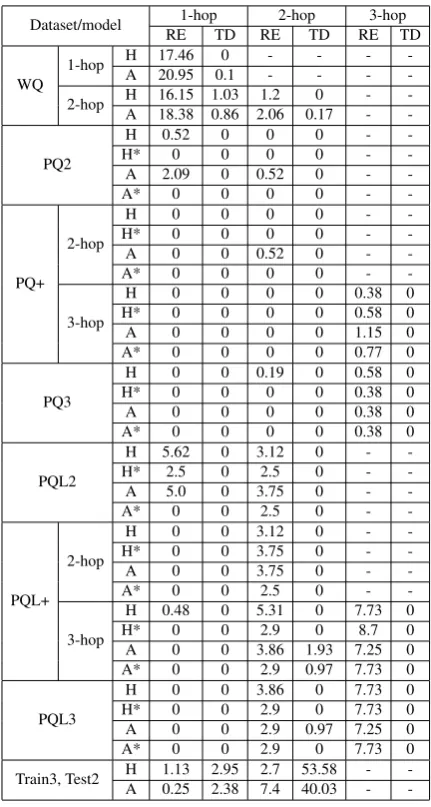
-Table 7: Distribution of error types under UHop frame-work (in percentage). H stands for HR-BiLSTM, A for ABWIM, RE for ‘Relation Extraction’, and TD for ‘Termination Decision’. * denotes the +DQ setting.
datasets. The results of HR BiLSTM and AB-WIM within the UHop framework are reported in Table7. Our observations are offered below.
First, whether for 1-hop or 2-hop WQ questions, both models suffer in relation extraction in the first hop, whereas there are fewer errors in the second hop and for the termination decision.
Second, for the PQ/PQL datasets, as with the WQ dataset, incorrect relation extraction is the major error, and surprisingly there were no er-rors for termination decision except for a few on PQL3 with ABWIM. After comparing the 2-hop testing data from PQ2/PQL2 and PQ+/PQL+, we also observe that long questions help the learning of short questions. The model predicts better on 2-hop data when trained on both 2-hop and 3-hop data than when trained on 2-hop data only. Here
the improvement in relation extraction in the first hop is the main contributor to this improved per-formance. In contrast, the performance on 3-hop data suffers when trained on 2-hop data.
Third, dynamic question representations (noted by *) significantly benefit the relation extraction (RE) for the first hop. As UHop utilizes the same model for relation selection and termination deci-sion, relieving the attention to the previous rela-tion in the later selecrela-tion process in the training phase decreases the ambiguity in the earlier selec-tion process in the testing phase.
Finally, in the experiments trained on 3-hop and tested on 2-hop, the model does not terminate cor-rectly on more than 40% of the PQL2 data even though the relation extraction for 1-hop and 2-hop are both correct. We conclude that having no samples of the predicted length for training still hurts performance. In addition, there are also a few early terminations after the first relation ex-traction. Due to the different generation processes with different templates for the 2-hop and 3-hop questions in PQL, learning from one may not ap-ply to the other.
6 Conclusion
In this paper, we propose the UHop frame-work to allow an unrestricted number of hops in knowledge-based relation extraction and to re-duce the search space. Results show that run-ning the same model in the UHop framework achieves comparable results in a reduced search space. Moreover, experiments show UHop works well for lengthy relation extraction and can be ap-plied to small, simple KBs with task-specific rela-tions. UHop even facilitates the use of most state-of-the-art models, and its transition-based design naturally supports the dynamic question represen-tation for better performance. These results attest its strong power for knowledge-based relation ex-traction. The current framework uses a greedy search for each single hop. We expect in the fu-ture that incorporating a beam search may further improve performance.
Acknowledgements
[image:9.595.73.289.60.464.2]References
Hannah Bast and Elmar Haussmann. 2015. More ac-curate question answering on Freebase. In Proceed-ings of the 24th ACM International on Conference on Information and Knowledge Management, pages 1431–1440. ACM.
Jonathan Berant, Andrew Chou, Roy Frostig, and Percy Liang. 2013. Semantic parsing on Freebase from question-answer pairs. In Proceedings of the 2013 Conference on Empirical Methods in Natural Lan-guage Processing, pages 1533–1544.
Antoine Bordes, Nicolas Usunier, Sumit Chopra, and Jason Weston. 2015. Large-scale simple question answering with memory networks. arXiv preprint arXiv:1506.02075.
Hung-Chen Chen, Zi-Yuan Chen, Sin-Yi Huang, Lun-Wei Ku, Yu-Shian Chiu, and Lun-Wei-Jen Yang. 2018a. Relation extraction in knowledge base question an-swering: From general-domain to the catering in-dustry. In HCI in Business, Government, and Or-ganizations, pages 26–41, Cham. Springer Interna-tional Publishing.
Wenhu Chen, Wenhan Xiong, Xifeng Yan, and William Yang Wang. 2018b. Variational knowledge graph reasoning. InProceedings of the 2018 Con-ference of the North American Chapter of the Asso-ciation for Computational Linguistics: Human Lan-guage Technologies, Volume 1 (Long Papers), vol-ume 1, pages 1823–1832.
Rajarshi Das, Shehzaad Dhuliawala, Manzil Zaheer, Luke Vilnis, Ishan Durugkar, Akshay Krishna-murthy, Alex Smola, and Andrew McCallum. 2017. Go for a walk and arrive at the answer: Reasoning over paths in knowledge bases using reinforcement learning.arXiv preprint arXiv:1711.05851.
Li Dong, Furu Wei, Ming Zhou, and Ke Xu. 2015. Question answering over Freebase with multi-column convolutional neural networks. In Proceed-ings of the 53rd Annual Meeting of the Association for Computational Linguistics and the 7th Interna-tional Joint Conference on Natural Language Pro-cessing (Volume 1: Long Papers), volume 1, pages 260–269.
Matt Gardner, Partha Talukdar, Jayant Krishnamurthy, and Tom Mitchell. 2014. Incorporating vector space similarity in random walk inference over knowledge bases. In Proceedings of the 2014 Conference on Empirical Methods in Natural Language Processing (EMNLP), pages 397–406.
Matt Gardner, Partha Pratim Talukdar, Bryan Kisiel, and Tom Mitchell. 2013. Improving learning and in-ference in a large knowledge-base using latent syn-tactic cues. InProceedings of the 2013 Conference on Empirical Methods in Natural Language Pro-cessing, pages 833–838.
Yanchao Hao, Yuanzhe Zhang, Kang Liu, Shizhu He, Zhanyi Liu, Hua Wu, and Jun Zhao. 2017. An end-to-end model for question answering over knowl-edge base with cross-attention combining global knowledge. In Proceedings of the 55th Annual Meeting of the Association for Computational Lin-guistics (Volume 1: Long Papers), volume 1, pages 221–231.
Geoffrey Hinton, Nitish Srivastava, and Kevin Swer-sky. 2014. Notes from Lecture 6a of Neural Net-works for Machine Learning: Overview of mini-batch gradient descent.
Mohit Iyyer, Wen-tau Yih, and Ming-Wei Chang. 2017. Search-based neural structured learning for sequen-tial question answering. InProceedings of the 55th Annual Meeting of the Association for Computa-tional Linguistics (Volume 1: Long Papers), vol-ume 1, pages 1821–1831.
Hidetaka Kamigaito, Katsuhiko Hayashi, Tsutomu Hirao, Hiroya Takamura, Manabu Okumura, and Masaaki Nagata. 2017. Supervised attention for sequence-to-sequence constituency parsing. In Pro-ceedings of the Eighth International Joint Confer-ence on Natural Language Processing (Volume 2: Short Papers), volume 2, pages 7–12.
Jayant Krishnamurthy, Pradeep Dasigi, and Matt Gard-ner. 2017. Neural semantic parsing with type con-straints for semi-structured tables. InProceedings of the 2017 Conference on Empirical Methods in Nat-ural Language Processing, pages 1516–1526.
Ni Lao, Tom Mitchell, and William W Cohen. 2011. Random walk inference and learning in a large scale knowledge base. InProceedings of the Conference on Empirical Methods in Natural Language Pro-cessing, pages 529–539. Association for Computa-tional Linguistics.
Xi Victoria Lin, Richard Socher, and Caiming Xiong. 2018. Multi-hop knowledge graph reasoning with reward shaping. In Proceedings of the 2018 Con-ference on Empirical Methods in Natural Language Processing, EMNLP 2018, Brussels, Belgium, Octo-ber 31-NovemOcto-ber 4, 2018.
Lemao Liu, Masao Utiyama, Andrew Finch, and Ei-ichiro Sumita. 2016. Neural machine translation with supervised attention. InProceedings of COL-ING 2016, the 26th International Conference on Computational Linguistics: Technical Papers, pages 3093–3102.
Haitao Mi, Zhiguo Wang, and Abe Ittycheriah. 2016. Supervised attentions for neural machine translation. In Proceedings of the 2016 Conference on Empiri-cal Methods in Natural Language Processing, pages 2283–2288.
Haoruo Peng, Ming-Wei Chang, and Wen-tau Yih. 2017. Maximum margin reward networks for learn-ing from explicit and implicit supervision. In Pro-ceedings of the 2017 Conference on Empirical Meth-ods in Natural Language Processing, pages 2368– 2378.
Jeffrey Pennington, Richard Socher, and Christo-pher D. Manning. 2014. GloVe: Global Vectors for
Word Representation. InEmpirical Methods in
Nat-ural Language Processing (EMNLP), pages 1532– 1543.
Amrita Saha, Vardaan Pahuja, Mitesh M. Khapra, Karthik Sankaranarayanan, and Sarath Chandar. 2018. Complex sequential question answering: To-wards learning to converse over linked question
an-swer pairs with a knowledge graph. InProceedings
of the Thirty-Second AAAI Conference on Artificial Intelligence, New Orleans, Louisiana, USA, Febru-ary 2-7, 2018.
Abigail See, Peter J Liu, and Christopher D Man-ning. 2017. Get to the point: Summarization with pointer-generator networks. arXiv preprint arXiv:1704.04368.
Cun Shen, Tinglei Huang, Xiao Liang, Feng Li, and Kun Fu. 2018. Chinese knowledge base question an-swering by attention-based multi-granularity model. Information, 9(4):98.
Daniil Sorokin and Iryna Gurevych. 2018. Model-ing semantics with gated graph neural networks for
knowledge base question answering. In
Proceed-ings of the 27th International Conference on Com-putational Linguistics, pages 3306–3317. Associa-tion for ComputaAssocia-tional Linguistics.
Kristina Toutanova, Danqi Chen, Patrick Pantel, Hoi-fung Poon, Pallavi Choudhury, and Michael Gamon. 2015. Representing text for joint embedding of text and knowledge bases. In Proceedings of the 2015 Conference on Empirical Methods in Natural Lan-guage Processing, pages 1499–1509.
Ronald J Williams. 1992. Simple statistical gradient-following algorithms for connectionist reinforce-ment learning. Machine learning, 8(3-4):229–256.
Wenhan Xiong, Thien Hoang, and William Yang Wang. 2017. DeepPath: A reinforcement learn-ing method for knowledge graph reasonlearn-ing. arXiv preprint arXiv:1707.06690.
Kun Xu, Siva Reddy, Yansong Feng, Songfang Huang, and Dongyan Zhao. 2016. Question answering on Freebase via relation extraction and textual evi-dence. InProceedings of the 54th Annual Meeting of the Association for Computational Linguistics (Vol-ume 1: Long Papers), volume 1, pages 2326–2336.
Fan Yang, Zhilin Yang, and William W Cohen. 2017. Differentiable learning of logical rules for knowl-edge base reasoning. InAdvances in Neural Infor-mation Processing Systems, pages 2319–2328.
Yi Yang and Ming-Wei Chang. 2015. S-MART: Novel tree-based structured learning algorithms applied to tweet entity linking. InProceedings of the 53rd An-nual Meeting of the Association for Computational Linguistics and the 7th International Joint Confer-ence on Natural Language Processing (Volume 1: Long Papers), volume 1, pages 504–513.
Wen-tau Yih, Ming-Wei Chang, Xiaodong He, and Jianfeng Gao. 2015. Semantic parsing via staged query graph generation: Question answering with knowledge base. InProceedings of the 53rd Annual Meeting of the Association for Computational Lin-guistics and the 7th International Joint Conference on Natural Language Processing (Volume 1: Long Papers), volume 1, pages 1321–1331.
Wen-tau Yih, Matthew Richardson, Chris Meek, Ming-Wei Chang, and Jina Suh. 2016. The value of se-mantic parse labeling for knowledge base question answering. InProceedings of the 54th Annual Meet-ing of the Association for Computational LMeet-inguistics (Volume 2: Short Papers), volume 2, pages 201–206.
Wenpeng Yin, Mo Yu, Bing Xiang, Bowen Zhou, and Hinrich Sch¨utze. 2016. Simple question answering by attentive convolutional neural network. In Pro-ceedings of COLING 2016, the 26th International Conference on Computational Linguistics: Techni-cal Papers, pages 1746–1756.
Mo Yu, Wenpeng Yin, Kazi Saidul Hasan, C´ıcero Nogueira dos Santos, Bing Xiang, and Bowen Zhou. 2017. Improved neural relation
detection for knowledge base question answering.
In Proceedings of the 55th Annual Meeting of the Association for Computational Linguistics, ACL 2017, Vancouver, Canada, July 30 - August 4, Volume 1: Long Papers, pages 571–581.
Yang Yu, Kazi Saidul Hasan, Mo Yu, Wei Zhang, and Zhiguo Wang. 2018. Knowledge base rela-tion detecrela-tion via multi-view matching. CoRR, abs/1803.00612.
Hongzhi Zhang, Guandong Xu, Xiao Liang, Tinglei Huang, and Kun Fu. 2018a. An attention-based word-level interaction model: Relation detection for knowledge base question answering. CoRR, abs/1801.09893.
Yuyu Zhang, Hanjun Dai, Zornitsa Kozareva, Alexan-der J. Smola, and Le Song. 2018b. Variational reasoning for question answering with knowledge
graph. In Proceedings of the Thirty-Second AAAI
Conference on Artificial Intelligence, New Orleans, Louisiana, USA, February 2-7, 2018.
Mantong Zhou, Minlie Huang, and Xiaoyan Zhu. 2018.An interpretable reasoning network for