602
Detection of Abusive Language: the Problem of Biased Datasets
Michael Wiegand∗0, Josef Ruppenhofer†‡, Thomas Kleinbauer∗
∗Spoken Language Systems, Saarland University, Saarbr¨ucken, Germany †Leibniz ScienceCampus, Heidelberg/Mannheim, Germany
‡Institute for German Language, Mannheim, Germany
[email protected] [email protected]
Abstract
We discuss the impact of data bias on abu-sive language detection. We show that clas-sification scores on popular datasets reported in previous work are much lower under realis-tic settings in which this bias is reduced. Such biases are most notably observed on datasets that are created by focused sampling instead of random sampling. Datasets with a higher proportion of implicit abuse are more affected than datasets with a lower proportion.
1 Introduction
Abusive or offensive language is commonly de-fined as hurtful, derogatory or obscene utterances made by one person to another person.1 Examples are(1)-(3). In the literature, closely related terms includehate speech(Waseem and Hovy,2016) or cyber bullying (Zhong et al.,2016). While there may be nuanced differences in meaning, they are all compatible with the general definition above.
(1) stop editing this, youdumbass.
(2) Just want to slap thestupidout of thesebimbos!!! (3) Go lick a pig you arab muslim piece ofscum.
Due to the rise of user-generated web content, in particular on social media networks, the amount of abusive language is also steadily growing. NLP methods are required to focus human review ef-forts towards the most relevant microposts.
In this paper, we examine the issue of data bias. For the creation of manually annotated datasets, randomly sampling microposts from large social media platforms typically results in a too small proportion of abusive comments (Wulczyn et al.,
2017; Founta et al., 2018). Therefore, more fo-cused sampling strategies have to be applied which
0
Present affiliation: Leibniz ScienceCampus, Heidel-berg/Mannheim, Germany
1http://thelawdictionary.org/
cause biases in the resulting datasets. We show what implications this has on classifiers trained on these datasets: Previous evaluations reported high classification performance on datasets with diffi-cult cases of abusive language, e.g. implicit abuse (§2). Contrarily, we find that the high classifica-tion scores are likely to be the result of modeling the bias in those datasets.
Although we will explicitly name shortcomings of existing individual datasets, our paper is not in-tended as a reproach of those who created them. On the contrary, we acknowledge the great ef-forts the researchers have taken to provide these resources. Without them, much existing research would not have been possible. However, we also noticed a lack of awareness of the special prop-erties of those datasets among researchers using them. As we will illustrate with specific examples, this may result in unforeseen results of particular classification approaches.
2 Explicit and Implicit Abuse
One major distinction that has been proposed in the literature is the division intoexplicitlyand im-plicitly abusive language (Waseem et al., 2017). The former are microposts that employ some abu-sive words(1)-(3) (e.g.dumbass orscum), while the latter represents the more difficult case in which the abusive nature is conveyed by other means, such as sarcasm, jokes, and particularly the usage of negative stereotypes etc.(4)-(5).
(4) i havent had an intelligent conversation with a woman. (5) Jews don’t marry children. Muslims do. All the time.
one abusive word according to the lexicon of abu-sive words fromWiegand et al.(2018a). Datasets with a high proportion of abusive words typically contain a high amount of explicitly abusive mi-croposts, whereas datasets with a low proportion contain a higher amount of implicitly abusive lan-guage. The resulting figures, of course, are only a lower bound estimate for explicit language abuse. There will also be microposts containing abusive words that are missing from the lexicon. How-ever, after manual inspection of a sample of mi-croposts, we are fairly confident that this does not significantly change therelativeorder of datasets when ranked according to their degree of explicit language abuse.
3 Datasets and Their Properties
Due to the limited space of this paper, we restrict our discussion to frequently cited (publicly avail-able) datasets and datasets from shared tasks. Sub-stantial interannotation agreement has also been reported with these datasets.
As we focus on the detection of abusive lan-guage in general, for those datasets contain-ing more fine-grained class inventories describcontain-ing subtypes of abusive language2, we conflate the
cat-egories to one general category. As a result, there are always only two categories: abuse and no-abuse. This merging removes differences between the individual annotation schemes that would oth-erwise impede a meaningful comparison.
Table 1 shows a brief summary of the differ-ent datasets. Among the properties, we list the performance of a text classifier in the right-most column. Since in previous work performance on the different datasets was reported on the basis of different types of classifiers and also varying evaluation metrics, we ran the same classifier on all datasets in order to ensure a meaningful com-parison. We chose FastText, which is an effi-cient supervised classifier known to produce state-of-the-art performance on many text classification tasks3 (Joulin et al., 2017) and whose results are easy to reproduce. Performance is evaluated in a 10-fold crossvalidation setting using the macro-average F1-score.
Table1also describes the way the datasets were sampled. Not a single dataset has been produced
2
For example,Waseem and Hovy(2016) distinguish be-tweensexismandracism.
3More involved classifiers achieve better performance, however, the relative differences between the datasets remain.
bypurerandom sampling. This would always re-sult in tiny proportions of abusive language. For example, Founta et al. (2018) estimate that on Twitter, there are only between0.1%up to at most
3% abusive tweets. What comes closest to ran-dom sampling is the procedure followed byFounta et al.(2018),Razavi et al.(2010) and the Kaggle-challenge.4 They took a random sample and ap-plied some heuristics in order to boost the propor-tion of abusive microposts. For instance, in the Kaggle-challenge, further microposts from users were added who had been blocked due to being reported to post personal attacks.
The procedures applied by other researchers are more drastic because, as we show in §4 and §5, they affect more heavily the topic distribu-tion of the dataset. These approaches do not even start with a random sample. The topic distribu-tion is mostly determined by the creators of the dataset themselves. For example, Waseem and Hovy(2016) extract tweets matching query words likely to co-occur with abusive content. Kumar et al.(2018) choose Facebook-pages covering top-ics that similarly coincide with abusive language. The resulting datasets are far from representing a natural sample of the underlying social-media sites.
Table 1 shows that datasets that apply biased sampling (Warner, Waseem, Kumar) contain a high degree of implicit abuse. Boosted random sampling, which provides a more realistic cross section of microposts, on the other hand, captures a larger amount of explicit abuse. Future work should explore whether this is due to the predom-inance of explicit abuse on social media or some other reason, for example, the fact that human an-notators more readily detect explicit abuse.
Intuitively, one would expect that the lower the proportion of explicit abuse is on the set of abu-sive microposts of a dataset, the lower the F1-score becomes because implicit abuse is not con-veyed by lexical cues that are easy to learn. Ta-ble1confirms this notion, yetWaseemis the no-table exception. We need to find an explanation for this deviation sinceWaseemis by far the most frequently used dataset for detecting abusive lan-guage (Badjatiya et al., 2017; Bourgonje et al.,
2017;Pitsilis et al., 2018;Agrawal and Awekar,
2018;Karan and Snajder,2018;Kshirsagar et al.,
name publication source microposts %abusive sampling %explicit∗ F1
Kaggle† (Wulczyn et al.,2017) Wikipedia 312,737 9.6 boosted random sampling 76.9 88.2 Founta (Founta et al.,2018) Twitter 59,357 14.1 boosted random sampling 75.9 87.3 Razavi (Razavi et al.,2010) diverse 1,525 31.9 boosted random sampling 64.7 83.3 Warner (Warner and Hirschberg,2012) diverse 3,438 14.3 biased sampling 51.3 71.8 Waseem (Waseem and Hovy,2016) Twitter 16,165 35.3 biased sampling 44.4 80.5
[image:3.595.76.525.61.126.2]Kumar (Kumar et al.,2018) Facebook 15,000 58.1 biased sampling 32.7 70.4
Table 1: Properties of the different datasets. (∗: proportion of explicitly abusive microposts among abusive micro-posts. †: This is an extension of the dataset presented inWulczyn et al.(2017). Details on the corpus creation aboutKagglecan therefore be found in that publication.)
2018; Mishra et al., 2018a,b; Park et al., 2018;
Qian et al., 2018; Sahlgren et al., 2018; Shari-firad et al., 2018; Unsv˚ag and Gamb¨ack, 2018;
Wiegand et al.,2018a). This investigation is only possible since, fortunately, Waseemis one of the datasets whose creation process has been meticu-lously documented.
4 Topic Bias
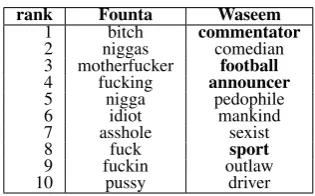
The Waseem-dataset has been sampled in such a way that it contains a high proportion of microp-osts discussing the role of women in sports, par-ticularly their suitability as football commenta-tors. Such microposts also very often coincide with sexist remarks. However, the authors did not make any attempt todebiastheir dataset. As a consequence, domain-specific expressions such asannouncer,commentator,footballorsport oc-cur very frequently and almost exclusively in abu-sive tweets. Yet intuitively these words should not be representative of abusive language. There are many texts on the web including Twitter that con-tain mentions of these expressions but that are not abusive. The current dataset, however, does not reflect that.
Table2illustrates this bias by listing the words with the highest Pointwise Mutual Information (PMI) towards abusive microposts. It compares the Founta-dataset (a dataset representing almost random sampling) with the Waseem-dataset (a dataset produced by biased sampling). We de-liberately chose two datasets sampled from the samesocial-media site, namely Twitter, as other-wise the difference we report could be ascribed to differences in the underlying text sources. Table
2shows that on theFounta-dataset, abusive words occupy the high ranks. Most of the highly ranked words of the Waseem-dataset, however, are not abusive. Similar observations can be made on the other datasets produced by biased sampling (i.e. Warner and Kumar). In the Warner-dataset, the
rank Founta Waseem
1 bitch commentator
2 niggas comedian 3 motherfucker football
4 fucking announcer
5 nigga pedophile 6 idiot mankind 7 asshole sexist
8 fuck sport
9 fuckin outlaw 10 pussy driver
Table 2: Top 10 words having strongest correla-tion with abusive microposts according to PMI on Founta (dataset representing almost random sample) andWaseem(dataset produced by biased sampling).
Feature Set Prec Rec F1
all words 80.91 80.08 80.49
(ii)query words removed 76.65 76.02 76.33
[image:3.595.337.495.192.290.2](i)topic words removed 75.07 74.41 74.72
Table 3: Impact of removing specific words from clas-sifier trained and tested onWaseem.
words CBS and Hollywood are two of the most predictive words. They refer to the anti-semitic prejudice that Jews are supposed to control most of the US media. On that dataset, the bias of iden-tity terms is also extreme: Almost 80% of the 256 mentions of the identity term Jew occur in abu-sive microposts. On theKumar-dataset, even com-mon Arabic person names, such asAzanorNahid, strongly correlate with abusive language.
In order to demonstrate the detrimental ef-fects such biases have, we now report the perfor-mance of further classifiers trained on theWassem -dataset. Similar results could be obtained on the Warner- and Kumar-dataset. Yet they are most pronounced on theWaseem-dataset, which is also the dataset on which unexpectedly high classifi-cation performance has been observed in Table1. Presumably, it is also the most biased dataset.
[image:3.595.313.518.366.402.2]racist sexist
author name freq author name freq
Vile Islam 1915 Yes You’re Sexist 1320 Yes You’re Sexist 8 Male Tears #4648 948 Standing Up 4 Trump 5 Vile Islam 50 YESMarriageEquality 1 LilBeasy91 10
[image:4.595.75.291.61.124.2]LilBeasy91 1 N!ck 9
Table 4: The 5 most sexist and racist authors on the Waseem-dataset and the number of their microposts.
sport. One would expect a low proportion of these particular tweets to be predicted as abusive. How-ever, due to the fact that the abusive training data have such a large topic bias towards sports, the proportion of tweets predicted to be abusive is un-reasonably high (i.e. 70%). Manual inspection confirmed that only a small proportion (up to5%) was actually abusive. This result shows us that classifiers trained on the Waseem-dataset hardly generalize to the concept of abusive language. Dif-ficult tweets on that dataset, e.g. instances of im-plicit abuse, may be classified correctly just be-cause biased words such asfootballorsportoccur in them.
In our second experiment, we train and test a classifier on the original Waseem-dataset in 10-fold crossvalidation. However, we remove either of the two types of biased words from the dataset:
(i) We remove 25 topic words from the 100 most correlating words that we thought bear no relation towards abusive language (e.g. an-nouncer,commentator,footballorsport). (ii) We remove the 17 words that were used as
a query byWaseem and Hovy(2016) to pro-duce the dataset.
With (i)we want to show how good classifiers are that do not have access to biased words. This would be a realistic setting since words, such as footballorsport, only have this bias towards abu-sive language on the Waseem-dataset. Such re-moval is also necessary since otherwise these bi-ased words cause a huge amount of false positives when testing on other datasets (as shown above).
With (ii) we want to show that query words themselves are biased, too. For example, we ob-served that the query word WomenAgainstFemi-nismcorrelates with abusive tweets while gamer-gatecorrelates with non-abusive tweets. The pur-pose of query words is to retrieve tweets that ad-dress specific topics. The fact that they correlate with the classes of the dataset further proves that the focused sampling process introduces data bias.
The results of these two configurations are dis-played in Table 3. It shows that the removal of a very few words (i.e.0.2%of the overall vocabu-lary) already causes the classification performance to drop notably. Please note that these experiments do not capture the full impact of the bias in this dataset. That is, there will be more biased words beyond the 25 words we identified on the list of top 100 words ranked according to PMI since the cut-off value of 100 was arbitrarily chosen.
5 Author Bias
Datasets may also be affected by author bias. By that, we mean that information relating to the au-thor of a micropost may artificially boost classi-fication performance. Author information can be explicitly derived frommeta-informationof a mi-cropost, for example, a feature that encodes the user name of a particular tweet that is to be classi-fied. However, even if we do not explicitly encode such information, a (lexical) supervised classifier, such as the FastText-classifier from Table1, may indirectly be affected by author biases. If the set of tweets belonging to a certain class predominantly comes from the same author, then a supervised classifier may largely pick up the writing style or the topics addressed by that author. Whenever the writing style or those topics are recognized, abu-sive language is predicted. This may work on a biased dataset but not beyond it.
We found that the distribution of abusive tweets on theWaseem-dataset is highly skewed towards 3 different authors as shown in Table4. More than 70% of the sexist tweets originate from the two authors Male Tears #4648 and Yes, They’re Sex-ist. 99% of the racist tweets originate from a sin-gle author (i.e. Vile Islam). If virtually all racist tweets originate from the same author, a classifier just needs to consider tweets from that author and can predict tweets from every other author as non-racist. On this particular dataset, such a strategy leads to good results: BothQian et al.(2018) and
6 How to Avoid a Biased Evaluation
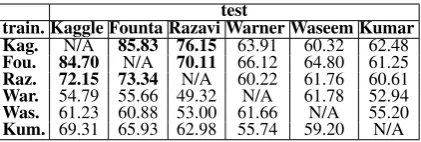
A possible way to prevent classification scores from looking unreasonably well is by applying cross-domain classification, i.e. testing a classifier on a dataset different from the one it was trained on. The specific biases we pointed out should be primarily restricted to individual datasets and not carry over to other ones. This is illustrated by Ta-ble5. Compared to in-domain classification (Ta-ble 1), all classifiers perform worse. So all clas-sifiers seem to be affected by data bias to some degree. Datasets with explicit abuse and less bi-ased sampling (Kaggle,Founta,Razavi) still per-form reasonably when trained among each other, i.e. they are not heavily affected, whereas datasets with implicit abuse and biased sampling (Warner, Waseem, Kumar) perform poorly. This time this also includesWaseemwhich implies that the good performance in in-domain classification (Table1) was indeed caused by data bias.
Of course, cross-domain classification may not always be practical, particularly if a specific sub-type of language abuse is studied for which there is only one dataset available. However, even then, simple methods such as computing the words that highly correlate with the different classes on that dataset, similar to what we did in Table 2, may already indicate that there are biases hidden in the dataset. If only a very small amount of bi-ased words is identified, then usually it suffices to manuallydebiasthe dataset. By that, one under-stands sampling additional microposts containing the words manually detected to be biased (Dixon et al.,2017;Wiegand et al.,2018b). For example, in the case of theWaseem-dataset, randomly sam-pling additional tweets matching the words an-nouncer, commentator, football or sport, would reduce the sexism bias we reported in this pa-per (simply because random tweets are unlikely to contain sexist remarks unlike the existing tweets from theWaseem-dataset).5 In order to avoid au-thor bias to interfere with classification, one could restrict the number of microposts per author. This would result in a more balanced distribution of mi-croposts per author.
5Please note, however, that in the case of the
Waseem -dataset, this form of debiasing would not completely solve the data bias since this dataset contains biased words beyond the four words mentioned above.
test
train. Kaggle Founta Razavi Warner Waseem Kumar Kag. N/A 85.83 76.15 63.91 60.32 62.48
Fou. 84.70 N/A 70.11 66.12 64.80 61.25
Raz. 72.15 73.34 N/A 60.22 61.76 60.61
War. 54.79 55.66 49.32 N/A 61.78 52.94
Was. 61.23 60.88 53.00 61.66 N/A 55.20
[image:5.595.312.523.61.132.2]Kum. 69.31 65.93 62.98 55.74 59.20 N/A
Table 5: Cross-domain classification (eval.: F1).
7 Related Work
Previous work already established that identity terms (e.g.gay,Jeworwoman) have a bias to co-occur with abusive language (Dixon et al., 2017;
Park et al.,2018). In this work, we showed that this problem is not restricted to the small set of identity terms. Most biases are introduced by the sampling method used on a dataset and they have a huge impact on classification performance.
8 Conclusion
We examined the impact of data bias on abusive language detection and showed that this problem is closely related to how data have been sampled. On the popular Waseem-dataset, we illustrated that under more realistic settings, where such bi-ases would be less prominent, classification per-formance is much lower than reported in research publications. Currently, datasets with a higher de-gree of implicit abuse are more affected by data bias. Such bias often goes unnoticed in in-domain classification which is why we recommend cross-domain classification. Our finding that under a re-alistic evaluation classification performance is ac-tually quite poor particularly on implicit abuse, is also in line with assessments from industry on the quality of the state of the art6which suggests that there is still a long way to go.
Acknowledgements
The authors were partially supported by the Ger-man Research Foundation (DFG) under grants RU 1873/2-1 and WI 4204/2-1.
References
Sweeta Agrawal and Amit Awekar. 2018. Deep Learn-ing for DetectLearn-ing CyberbullyLearn-ing Across Multiple Social Media Platforms. InProceedings of the Eu-ropean Conference in Information Retrieval (ECIR). Grenoble, France, pages 141–153.
Pinkesh Badjatiya, Shashank Gupta, Manish Gupta, and Vasudeva Varma. 2017. Deep Learning for Hate Speech Detection in Tweets. InProceedings of the International Conference on World Wide Web (WWW). Perth, Australia, pages 759–760.
Peter Bourgonje, Julian Moreno-Schneider, Ankit Sri-vastava, and Georg Rehm. 2017. Automatic Clas-sification of Abusive Language and Personal At-tacks in Various Forms of Online Communication. In Proceedings of the German Society for Com-putational Linguistics and Language Technology (GSCL). Springer, Berlin, Germany, LNAI, pages 180–191.
Lucas Dixon, John Li, Jeffrey Sorensen, Nithum Thain, and Lucy Vasserman. 2017. Measuring and Mitigat-ing Unintended Bias in Text Classification. In Pro-ceedings of the National Conference on Artificial In-telligence (AAAI). San Francisco, CA, USA.
Antigoni-Maria Founta, Constantinos Djouvas, De-spoina Chatzakou, Ilias Leontiadis, Jeremy Black-burn, Gianluca Stringhini, Athena Vakali, Michael Sirivianos, and Nicolas Kourtellis. 2018. Large Scale Crowdsourcing and Characterization of Twit-ter Abusive Behaviour. InProceedings of the Inter-national AAAI Conference on Weblogs and Social Media (ICWSM). Stanford, CA, USA.
Armand Joulin, Edouard Grave, Piotr Bojanowski, and Tomas Mikolov. 2017. Bag of Tricks for Efficient Text Classification. In Proceedings of the Confer-ence on European Chapter of the Association for Computational Linguistics (EACL). Valencia, Spain, pages 427–431.
Mladen Karan and Jan Snajder. 2018. Cross-Domain Detection of Abusive Language Online. In Proceed-ings of the Workshop on Abusive Language Online (ALW). Brussels, Belgium, pages 132–137.
Rohan Kshirsagar, Tyrus Cukuvac, Kathleeen McKe-own, and Susan McGregor. 2018. Predictive Em-beddings for Hate Speech Detection on Twitter. In Proceedings of the Workshop on Abusive Language Online (ALW). Brussels, Belgium, pages 26–32.
Ritesh Kumar, Atul Kr. Ojha, Shervin Malmasi, and Marcos Zampieri. 2018. Benchmarking Aggression Identification in Social Media. InProceedings of the Workshop on Trolling, Aggression and Cyberbully-ing (TRAC). Santa Fe, NM, USA, pages 1–11.
Pushkar Mishra, Marco Del Tredici, Helen Yan-nakoudakis, and Ekaterina Shutova. 2018a. Au-thor Profiling for Abuse Detection. InProceedings of the International Conference on Computational Linguistics (COLING). Santa Fe, NM, USA, pages 1088–1098.
Pushkar Mishra, Helen Yannakoudakis, and Ekaterina Shutova. 2018b. Neural Character-based Composi-tion Models for Abuse Detectiion. InProceedings of the Workshop on Abusive Language Online (ALW). Brussels, Belgium, pages 1–10.
Ji Ho Park, Jamin Shin, and Pascale Fung. 2018. Re-ducing Gender Bias in Abusive Language Detec-tion. In Proceedings of the Conference on Em-pirical Methods in Natural Language Processing (EMNLP). Brussels, Belgium, pages 2799–2804.
Georgios K. Pitsilis, Heri Ramampiaro, and Helge Langseth. 2018. Detecting offensive language in tweets using deep learning. InarXiv preprint arXiv: 1801.04433.
Jing Qian, Mai ElSherief, Elizabeth M. Belding, and William Yang Wang. 2018. Leveraging intra-user and inter-user representation learning for automated hate speech detection. In Proceedings of the Hu-man Language Technology Conference of the North American Chapter of the ACL (HLT/NAACL). New Orleans, LA, USA, pages 118–123.
Amir Hossein Razavi, Diana Inkpen, Sasha Uritsky, and Stan Matwin. 2010. Offensive Language Detec-tion Using Multi-level ClassificaDetec-tion. In Proceed-ings of the Canadian Conference on Artificial Intel-ligence. Ottawa, Canada, pages 16–27.
Magnus Sahlgren, Tim Isbister, and Fredrik Olsson. 2018. Learning Representations for Detecting Abu-sive Language. In Proceedings of the Workshop on Abusive Language Online (ALW). Brussels, Bel-gium, pages 115–123.
Sima Sharifirad, Borna Jafarpour, and Stan Matwin. 2018. Boosting Text Classification Performance on Sexist Tweets by Text Augmentation and Text Gen-eration Using a Combination of Knowledge Graphs. In Proceedings of the Workshop on Abusive Lan-guage Online (ALW). Brussels, Belgium, pages 107– 101.
Elise Fehn Unsv˚ag and Bj¨orn Gamb¨ack. 2018. The Ef-fects of User Features on Twitter Hate Speech De-tection. InProceedings of the Workshop on Abusive Language Online (ALW). Brussels, Belgium, pages 75–85.
William Warner and Julia Hirschberg. 2012. Detecting Hate Speech on the World Wide Web. In Proceed-ings of the Workshop on Language in Social Media (LSM). Montr´eal, Canada, pages 19–26.
Zeerak Waseem, Thomas Davidson, Dana Warmsley, and Ingmar Weber. 2017. Understanding Abuse: A Typology of Abusive Language Detection Subtasks. In Proceedings of the ACL-Workshop on Abusive Language Online. Vancouver, BC, Canada, pages 78–84.
Michael Wiegand, Josef Ruppenhofer, Anna Schmidt, and Clayton Greenberg. 2018a. Inducing a Lexi-con of Abusive Words – A Feature-Based Approach. InProceedings of the Human Language Technology Conference of the North American Chapter of the ACL (HLT/NAACL). New Orleans, LA, USA, pages 1046–1056.
Michael Wiegand, Melanie Siegel, and Josef Ruppen-hofer. 2018b. Overview of the GermEval 2018 Shared Task on the Identification of Offensive Lan-guage. InProceedings of the GermEval Workshop. Vienna, Austria, pages 1–10.
Ellery Wulczyn, Nithum Thain, and Lucas Dixon. 2017. Ex Machina: Personal Attacks Seen at Scale. In Proceedings of the International Conference on World Wide Web (WWW). Perth, Australia, pages 1391–1399.