Attaching Multiple Prepositional Phrases: Generalized
Backed-off Estimation
P a o l a
M e r l o I R C S - U . of P e n n s y l v a n i a L A T L - U n i v e r s i t y of G e n e v a2 r u e de C a n d o l l e 1204 G e n e v a , S w i t z e r l a n d
merlo~latl, unige, ch
M a t t h e w
W . C r o c k e r C e n t r e for C o g n i t i v e ScienceU n i v e r s i t y of E d i n b u r g h 2 B u c c l e u c h P l a c e , E d i n b u r g h , U K E H 8 9 L W
m w c © c o g s c i , e d . a c . u k
C a t h y B e r t h o u z o z L A T L
U n i v e r s i t y of G e n e v a 2 r u e de C a n d o l l e 1204 G e n e v a , S w i t z e r l a n d
berthouzoz~lat i. unige, ch
A b s t r a c t
There has recently been considerable inter- est in the use of lexically-based statistical techniques to resolve prepositional phrase attachments. To our knowledge, however, these investigations have only considered the problem of attaching the first PP, i.e., in a IV NP PP] configuration. In this paper, we consider one technique which has been successfully applied to this prob- lem, backed-off estimation, and demon- strate how it can be extended to deal with the problem of multiple PP attach- ment. The multiple PP attachment intro- duces two related problems: sparser data (since multiple PPs are naturally rarer), and greater syntactic ambiguity (more at- tachment configurations which must be dis- tinguished). We present and algorithm which solves this problem through re-use of the relatively rich data obtained from first PP training, in resolving subsequent PP attachments.
1 I n t r o d u c t i o n
Ambiguity is the most specific feature of natural lan- guages, which sets them aside from programming languages, and which is at the root of the difficulty of the parsing enterprise, pervading languages at all levels: lexical, morphological, syntactic, semantic and pragmatic. Unless clever techniques are devel- oped to deal with ambiguity, the number of possible parses for an average sentence (20 words) is simply intractable. In the case Of prepositional phrases, the expansion of the number of possible analysis is the Catalan number series, thus the number of possible analyses grows with a function that is exponential in the number of Prepositional Phrase (Church and Patil, 1982). One of the most interesting topics of debate at the moment, is the use of frequency in- formation for automatic syntactic disambiguation.
As argued in many pieces of work in the AI tra- dition (Marcus, 1980; Crain and Steedman, 1985; Altmann and Steedman, 1988; Hirst, 1987), the ex- act solution of the disambiguation problem requires complex reasoning and high level syntactic and se- mantic knowledge. However, current work in part- of-speech tagging has succeeded in showing that it is possible to carve one particular subproblem and solve it by a p p r o x i m a t i o n - - using statistical tech- niques - - independently of the other levels of com- putation.
In this paper we consider the problem of prepo- sitional phrase (PP) ambiguity. While there have been a number of recent studies concerning the use of statistical techniques for resolving single PP at- tachments, i.e. in constructions of the form [V NP PP], we are unaware of published work which applies these techniques to the more general, and patho- logical, problem of multiple PPs, e.g. IV NP PP1 PP2 ...]. In particular, the multiple PP attachment problem results in sparser data which must be used to resolve greater ambiguity: a strong test for any probabilistic approach.
We begin with an overview of techniques which have been used for PP attachment disambiguation, and then consider how one of the most successful of these, the backed-off estimation technique, can be applied to the general problem of multiple PP attachment.
2 E x i s t i n g M o d e l s o f A t t a c h m e n t
studies (Ford et al., 1982; Taraban and McClelland, 1988; W h i t t e m o r e et al., 1990), lexical information is one of the main cues to P P attachment disam- biguation.
In one of the earliest attempts to resolve the prob- lem of P P attachment ambiguity using lexical mea- sures, Hindle and Pmoth (1993) show that a measure of mutual information limited to lexical association can correctly resolve 80% of the cases of P P attach- ment ambiguity, confirming the initial hypothesis that lexical information, in particular co-occurrence frequency, is central in determining the choice of at- tachment.
The same conclusion is reached by Brill and Resnik (1994). T h e y apply transformation-based learning (Brill, 1993) to the problem of learning dif- ferent patterns of P P attachment. After acquiring 471 patterns of P P attachment, the parser can cor- rectly resolve approximately 80% of the ambiguity. If word classes (Resnik, 1993) are taken into account, only 266 rules are needed to perform at 80% accu- racy.
Magerman and Marcus (1991) report 54/55 cor- rect P P attachments for Pearl, a probabilistic chart parser, with Earley style prediction, that integrates lexical co-occurrence knowledge into a probabilistic context-free grammar. The probabilities of the rules are conditioned on the parent rule and on the tri- gram centered at the first input symbol that would be covered by the rule. Even if the parser has been tested only in the direction giving domain, where the behaviour of prepositions is very consistent, it shows that a mixture of lexical and structural information is needed to solve the problem successfully.
Collins and Brooks (1995) propose a 4-gram model for P P disambiguation which exploits backed-off es- timation to smooth null events (see next section). Their model achieves 84.5% accuracy. The authors point out that prepositions are the most informative element in the tuple, and that taking low frequency events into account improves performance by sev- eral percentage points. In other words, in solving the P P a t t a c h m e n t problem, backing-off is not ad- vantageous unless the tuple that is being tested is not present in the training set (it has zero counts). Moreover, tuples that contain prepositions are the most informative.
The second result is roughly confirmed by Brill and Resnik, (ignoring the importance of n2 when it is a temporal modifier, such as
yesterday, today).
In their work, the top 20 transformations learned are primarily based on specific prepositions.3 B a c k - o f f E s t i m a t i o n
The P P a t t a c h m e n t model presented by Collins and Brooks (1995) determines the most likely attach- ment for a particular prepositional phrase by esti- mating the probability of the attachment. We let C
represent the attachment event, where C = 1 indi- cates that the P P attaches to the verb, and C = 2 indicates attachment to the object NP. T h e attach- ment is conditioned by the relevant head words, a 4-gram, of the VP.
* Tuple format:
(C, v,
nl, p, n2)• S o :
John read [[the article] [about the budget]]
• Is encoded as: (2, read, article, about, budget)
Using a simple maximal likelihood approach, the best attachment for a particular input tuple (v,nl,p,n2) can now be determined from the training data via the following equation:
argmaxi 15(C = ilv,
n l , p, n2) =f(i, v, nl, p,
n2)f(v,
n l , p, n2)(1) Here f denotes the frequency with which a partic- ular tuple occurs. Thus, we can estimate the proba- bility for each configuration 1 < i < 2, by counting the number of times the four head words were ob- served in that configuration, and dividing it by the total number of times the 4-tuple appeared in the training set.
While the above equation is perfectly valid in the- ory, sparse data means it is rather less useful in prac- tice. T h a t is, for a particular sentence containing a P P attachment ambiguity, it is very likely that we will never have seen the precise (v,nl,p,n2) quadru- ple before in the training data, or that we will have only seen it rarely. 1 To address this problem, they employ backed-off estimation when zero counts oc- cur in the training data. Thus if
f(v, nl,p, n2)
is zero, they 'back-off' to an alternative estimation of /~ which relies on 3-tuples rather than 4-tuples:/Sa(C =
ilv, nl,p,
n2) =f(i, v, nl, p) + f(i, v, p,
,72) +f(i, nl, p,
n2)(2)
f(v, nl, p) + f(v, p,
n2) +f ( n l , p,
n2)Similarly, if no 3-tuples exist in the training data, they back-off further:
i52(C = i[v, nl,p, n 2 ) =
(3)f ( i , v , p ) + f(i, nl,p) + f(i,p, n2)
f(v, p) +
f ( n l ,p) + f(p,
n2)i51(C = ilv, nl, p, n2) - f(i, p)
f(v)
(4)
The above equations incorporate the proposal by Collins and Brooks that only tuples including the preposition should b e considered, following their results that the preposition is the most informa- tive lexical item. Using this technique, Collins and Brooks achieve an overall accuracy of 84.5%.
4 T h e M u l t i p l e P P A t t a c h m e n t P r o b l e m
Previous work has focussed on the problem of single P P attachment, in configurations of the form IV NP PP] where both the NP and the P P are assumed to be attached within the VP. The algorithm pre- sented in the previous section, for example, simply determines the maximally likely attachment event (to NP or VP) based on the supervised training provided by a parsed corpus. The broader value of this approach, however, remains suspect until it can be demonstrated to apply more generally. We now consider how this approach - and the use of lexical statistics in general - might be naturally extended to handle the more difficult problem of multiple P P attachment. In particular, we investigate the P P attachment problem in cases containing two PPs, [V NP PP1 PP2], and three PPs, [V NP PP1 PP2 PP3], with a view to determining whether n-gram based parse disambiguation models which use the backed-off estimate can be usefully applied. Mul- tiple P P a t t a c h m e n t presents two challenges to the approach:
1. For a single PP, the model must make a choice between two structures. For multiple PPs, the space of possible structural configurations in- creases dramatically, placing increased demands on the disambiguation technique.
2. Multiple P P structures are less frequent, and contain more words, than single P P structures. This substantially increases the sparse data problems when compared with the single P P attachment case.
4.1 M a t e r i a l s a n d M e t h o d
To carry out the investigation, training and test data were obtained from the Penn Tree-bank, using the t g r e p tools to extract tuples for 1-PP, 2-PP, and 3- P P cases. For the single P P study, VP attachment was coded as 1 and NP attachment was coded as 2. A database of quadruples of the form
(configura-
tion, v,n,p)
was then created. The table below showsthe two configurations and their frequencies in the corpus.
Configuration Structure Counts
1 [vpNP P P ]. 7740
2 [vP [NPPP ]] 12223
The same procedure was used to create a database of 6-tuples
(conflguratwn, v, nl,pl,n2,p2)
for the at- tachment of 2 PPs. The values for the configuration varies over a range 1..5, corresponding to the 5 gram- matical structures possible for 2 PPs, shown and ex- emplified below with their counts in the corpus. 22We did not consider the left-recursive NP structure for the 2 PP (or indeed 3 PP) cases. Checking the fre-
Config 1 2 3 4 5
Structure Counts
[vpV NP P P PP] 535
[veV [NpNP PP] PP] 1160
[vpV [NP[PPP [NpNP P P ]]]] 1394
[vpV NP [pp[NpNP PP]]] 1055
[vpV [NpNP P P PP]] 539
1. The agency said it will k e e p the d e b t u n d e r r e v i e w f o r possible further downgrade.
2. Penney decided to e x t e n d its i n v o l v e m e n t w i t h the s e r v i c e f o r at least five years. 3. The bill was then sent back to the House to
resolve the question of how to a d d r e s s budget l i m i t s o n credit a l l o c a t i o n s f o r the Federal Housing Administration.
4. Sears officials insist they don't intend to a b a n - d o n the everyday pricing a p p r o a c h in the f a c e o f the poor results.
5. Mr. Ridley hinted at this motive in a n s w e r - i n g q u e s t i o n s f r o m members of P a r l i a m e n t
after his announcement
Finally, a database of 8-tuples
(configura-
tion, v, nl,pl, n2,p2,n3,p3)
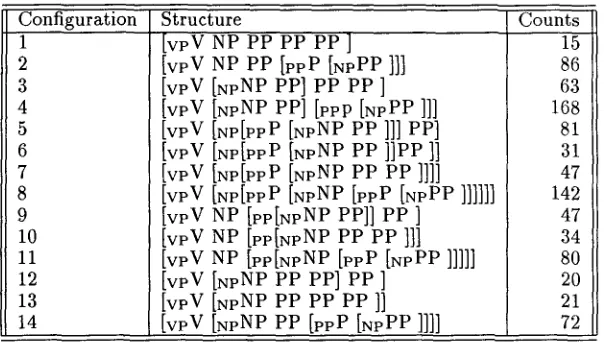
was created for 3 PPs.The value of the configuration varies over a range 1..14, corresponding to the 14 structures possible for 3 PPs, shown in Table 1 with their counts in the cor- pus.
The above datasets were then split into training and test sets by automatically extracting stratified samples. For PP1, we extracted quadruples of about 5% of the total (1014/19963). We then created a test set for PP2 which is a subset of the PP1 test set, and approximately 10% of the 2 P P tuples (464/4683). Similarly, the test set for PP3 is a subset of the PP2 test set of approximately 10% (94/907). It is impor- tant that the test sets are subsets to ensure that, e.g., a PP2 test case doesn't appear in the PP1 training set, since the PP1 data is used by our algorithm to estimate PP2 attachment, and similarly for the PP3 test set.
4.2 D o e s D i s t a n c e M a t t e r ?
In exploring multiple P P attachment, it seems natu- ral to investigate the effects of the distance of the P P from the verb. The following table reports accuracy of noun-attachment, when the a t t a c h m e n t decision is conditioned only on the preposition and on the distance - i n other words, when estimating 15(lip, d) where 1 is the coding of the attachment to the noun, p is the preposition and d = {1,2, 3}. 3
quency of their occurrences revealed that there were only 2 occurrences of [vP [NP [NP [NPPP] PP]]] structures in the
c o r p u s .
Configuration 1
2 3 4 5 6 7 8 9 10 11 12 13 14
Structure
[vpV NP P P P P P P ]
[vvV
[vvV
[veV
[vvV
[vvV
[vvV
[vvV
[vpV
[vvV
[vvV
[vwV
[vvV
[vvV
[image:4.612.166.468.73.244.2]Counts 15 NP P P [ppP [NpPP ]]]
[NpNP PP] P P P P ] [NpNP PP] [ppp [NPPP ]]] [NP[PPP [NvNF P P ]]] FP] [NP[PPP [NpNP P P ]]PP ]] [Np[ppP [NpNP P P P P ]]]] [NP[PPP [NpNP [ppP [NPPP ]]]]]] NP [pp[NpNP PP]] P P ]
NP [pp[NpNP P P P P ]]] NP [pp[NpNP [ppP [NpPP ]]]]] [NpNP P F PP] P P ]
[NpNF P P P P P P ]] [NpNP P P [ppP [NPPP ]]]]
86 63 168 81 31 47 142 47 34 80 20 21 72
Table 1: Corpus counts for the 14 structures possible for 3-PP sequences.
1 P P 2 P P 3 P P Total All
Count 20299 4711 939 25949 25949
Correct 15173 3525 755 19453 19349
% 74.7 7 4 . 8 80.4 75 74.5
It can be seen from these figures that condition- mg the a t t a c h m e n t according to both preposition and distance results in only a minor improvement in performance, mostly because separating the bi- ases according to preposition
distance
increases the sparse data problem. It must be noted, however, that counts show a steady increase in the proportion of low attachments for P P further from the verb, as shown in the table below. The simplest explanation of this fact is that more (inherently) noun-attaching prepositions must be occurring in 2nd and 3rd posi- tions. This predicts that the distribution of prepo- sition occurrences changes from PP1 to PP3, with an increase in the proportion of low attaching PPs. Globally, failure to use position results in 41.3% of correct configurations, while use of position results in 45% correct attachments.1 P P 2 P P 3 P P Total
Count 20299 4711 939 25949
Low 12223 3063 706 15992
% Low 60.2 i 65.0 75.1 61.6
Having established that the distance parameter is not as influential a factor as we hypothesized, we ex- ploit the observation t h a t attachment preferences do not significantly change depending on the distance
testing on the training data. Moreover, we are only con- sidering 2 attachment possibilities for each preposition, either it attaches to the verb or it attaches to the lowest nOlln.
of the P P from the verb. In the following section, we discuss an extension of the back-off estimation model that capitalizes on this property.
5
T h e G e n e r a l i z e d B a c k e d - O f f
A l g o r i t h m
The algorithm for attaching the first preposition is almost identical to that of Collins and Brooks (1995), and we follow them in including only tuples which contain the preposition. We do not, however, use the final noun (following the preposition) in any of our tuples, thus basing our model of P P 1 on three, rather than four, head words.
P r o c e d u r e B I :
The most likely configuration is:
arg
rnaxipl(C2 ~- ilv, n,p),
where 1 < i < 21. IF
f(v,n,p)
> 0 T H E N!(i ... p)
t h ( i l v , n , p ) = J(.,~,v)
2. ELSEIF
f(v, p) + f(n,
p) > 0 T H E Nl h ( i l v , n, p) = :(~,v,v)+.:(i,,,v) f(v,p)+J(n,p)
3. ELSEIF
f(p)
> 0 T H E Nh ( i l v , ~ , p ) =
](P)
4. ELSE
l~l(llv, n , p ) = O,l)l(21v, n , p ) = 1In this case i denotes the a t t a c h m e n t configura- tion: i = 1 is VP attachment, i = 2 is NP attach- ment. The subscript on C~ is used simply to make clear that C has 2 possible values. In the subse- quent algorithms, C5 and C14 are used to indicate the larger sets of configurations.
P r o c e d u r e B 2
T h e m o s t likely configuration is:
arg maxj/~2(C = j l v , n L p l , n 2 , p 2 ) , where 1 < j < 5
1. IF f(v, n l , p l , n 2 , p 2 ) > 0 T H E N
f(j,v ,n 1 ,pl,n2,p2)
~2(j) = f(~,,~,pl,,2,p2)
2. E L S E I F f ( n l , p l , n2,p2) + f ( v , p l , n2,p2) + f(v, n l , p l , p 2 ) > 0 T H E N
I52(j) = f(j,nl,pl,n2,p2)Tf(j,v,pl,n2,p2)+f(j,v,nl,pl,p2)
f(nl,pl,n2,p2)+l(v,pl,n2,p2)+f(v,nl,pl,p2)
3. ELSEIF f ( p l , n2, p2) + f ( v , p l , p 2 ) + f ( n l , p l , p 2 ) > 0 T H E N
132(j) = f(J'pl'n2'p2)+ f(J'v'pl'v2)+ f(j'nl'pl'v2)
f(pl,n2,p2)+f(v,pl,p2)+I(nl,pl,p2)
4. ELSE C o m p e t i t i v e Backed-off E s t i m a t e
Figure 1: Procedure B2
the five possible a t t a c h m e n t configurations outlined above.
T h e first three steps use the standard backed-off estimation, again including only those tuples con- taining bolh prepositions. However, after backing-off to three elements, we abandon the standard backed- off estimation technique. T h e combination of sparse data., and too few lexical heads, renders backed-off estimation ineffective. Rather, we propose a tech- nique which makes use of the richer d a t a available from the PP1 training set. Our hypothesis is t h a t this information will be useful in determining the a t t a c h m e n t s of subsequent P P s as well. This is mo- tivated by our observations, reported in the previ- ous section, t h a t the distribution of high-low attach- ments for specific prepositions did not vary signifi- cantly for P P s further from the verb. T h e C o m p e t - itive B a c k e d - O f f E s t i m a t e procedure, presented below, operates by initially fixing the configuration of the first preposition (to either the VP or the di- rect object NP), and then considers how the sec- ond preposition would be optimally attached into the configuration.
P r o c e d u r e C o m p e t i t i v e Backed-off E s t i m a t e
1. C~ is the most likely configuration for PP1,
arg maxi /)1(C~ = ilv, n l , p l )
2. C~' is the preferred configuration for P P 2 w.r.t n2,
arg maxi /~I(C~' = ilv, n2,p2)
3. C~" is the preferred configuration for PP2 w.r.t n l ,
max ^ I ~ , , , iJv, n l , p 2 )
a r g i Pl/t-~2 :
4. Find B e s t Configuration
First we determine C~,, on which depends the at- t a c h m e n t of p l . We then determine C~', which indi- cates the preference for p2 to attach to the VP or to n2, and C~", which is the preference for p2 to attach to the VP or to n l . Given the preferred configura- tions C~, C~', and C~", we now must determine the best of the five possible configurations, C5, for the entire VP.
P r o c e d u r e Find Best Configuration
1. I F C ~ = C 5 ~ 1 2. ELSEIF
C 5 ~ 4
3. ELSEIF C ~ 2
4. ELSEIF C 5 ~ 3
5. ELSEIF C 5 ~ 2
6.
1 and C~ I = 1 T H E N
C~ = 1 and G'~' = 2 T H E N
C~ = 2 and C~ ' = 1 and C;" = 1 T H E N
C~ = 2 and C~' = 2 and C~" = 1 T H E N
C~ = 2 and C~' = 1 and C.~" = 2 T H E N
ELSEIF C~ = 2 and C~' = 2 and
C~"
= 2 T H E Ntie-break
(a) IF f(2, v, n2,p2) < f(2, v, n l , p 2 ) T H E N C 5 ~ 5
(b) ELSE C5 ~ 3
though whether this is optimal remains an empirical question. For example, if C~' is based on 4 observa- tions, and C~" is based on 7, then the C~" preference is considered stronger.
Having constructed the algorithm to determine the best configuration for 2 PPs, we can similarly generalize the algorithm to handle three. In this case /k denotes one of fourteen possible attachment configurations shown earlier. The pseudo code for procedure B3 is shown below, simplified for reasons of space.
Procedure
B 3The most likely configuration
is:
arg m a x k p3(C14 ~- k[v, na,pl, n2,p2, n3,p3), where
1 < k < 1 4
1. IF f(v, n l , p l , n 2 , p 2 , n3,p3) > 0) T H E N
](k,v,nl@l,n2,p2,n3,p3)
2. ELSE Try backing-off to 6 or 5 items . . .
3. ELSE Competitive Backed-off Estimate:
(a) Use P r o c e d u r e B 2 to determine C~, the configuration of p l and p2
(b) C o m p u t e C~', C~", C~'", the preferred at- tachment of p3 w.r.t n l , n2, n3 respectively (c) Determine the best configuration
Again, we back-off up to two times, always in- cluding tuples which contain the three prepositions. After this, backing-off becomes unstable, so we use the C o m p e t i t i v e B a c k e d - o f f E s t i m a t e , as above, but scaled up to handle the three prepositions and fourteen possible configurations.
5.1 R e s u l t s
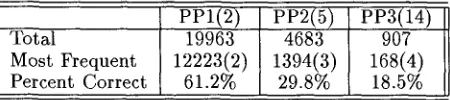
To evaluate the performance of our algorithm, we nmst first determine what the expected baseline, or lower-bound on, performance would be. Given the variation in the number of possible configurations across the three cases, the performance expected due to chance would be 50% for 1 PP, 20% for 2 PPs, and 7% for 3 PPs. A better baseline is the perfor- mance t h a t would be expected by simply adopting the most likely configuration, without regard to lexi- cal items. This is shown in the table below, with the most frequent configuration shown in parentheses.
Total
Most Frequent Percent Correct
P P i ( 2 ) 19963 12223(2)
61.2%
PP2(5) PP3(14)
4683 907
1394(3) 168(4)
29.8% 18.5%
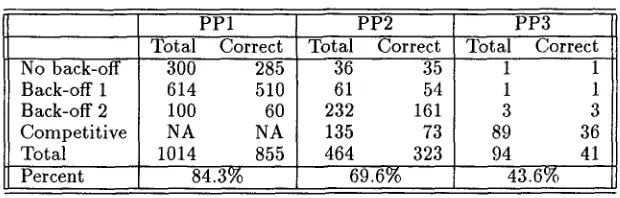
Table 2 presents the performance of the compet- itive backed-off estimation algorithm on the test
data. As can be seen, the performance for PP1 replicates the findings of Collins and Brooks, who achieved 84.5% (using 4 lexical items, compared to our three). For PP2 perfordlance is again high, re- calling that the algorithm is discriminating five pos- sible attachment configurations, and the baseline ex- pectation was only 29.8%. Similarly for PP3, our performance of 43.6% accuracy (discriminating four- teen configurations) far out strips the baseline of 18.5%.
6
C o n c l u s i o n s
The backed-off estimate has been demonstrated to work successfully for single P P attachment, but the sparse data problem renders it impractical for use in more complex constructions such as multiple P P attachment; there are too many configurations, too many head words, too few training examples. In this paper we have demonstrated, however, that the rela- tively rich training d a t a obtained for the first prepo- sition can be exploited in attaching subsequent PPs. The algorithm incrementally fixes each preposition into the configuration and the more informative PP1 training data is exploited to settle the competition for possible attachments for each subsequent prepo- sition. Performance is considerably better than both chance and the naive baseline technique. T h e gen- eralized backed-off estimation approach which we have presented constitutes a practical solution to the problem of multiple P P disambiguation. This further suggests that backed-off estimation m a y be successfully integrated into more general syntactic disambiguation systems.
A c k n o w l e d g m e n t s
We gratefully acknowledge the support of the British Council and the Swiss National Science Foundation on grant 83BC044708 to the first two authors, and on grant 12-43283.95 and fellowship 8210-46569 from the Swiss NSF to the first author. We thank the audiences at Edinburgh and Pennsylvania for their useful comments. All errors remain our responsibil- ity.
R e f e r e n c e s
Gerry Altmann and Mark Steedman. 1988. Interac- tion with context during human sentence process- ing. Cognition, 30(3):191-238.
Eric Brill and Philip Resnik. 1994. A rule-based approach to prepositional phrase a t t a c h m e n t dis- ambiguation. International Conference on Com- putational Linguistics (COLING).
Eric Brill. 1993. A Corpus-based Approach ~o Lan-
guage Learning. Ph.D. thesis, University of Penn-
[image:6.612.85.310.628.678.2]No back-off Back-off 1 Back-off 2 Competitive Total Percent
PP1 Total Correct
300 285
614 510
100 60
NA NA
1014 855
84.3%
PP2 Total Correct
PP3 Total Correct
36 35
61 54
232 161
135 73
464 323
69.6%
1 1
1 1
3 3
89 36
94 41
43.6%
Table 2: Performance of the competitive backed-off estimation algorithm on the test data.
Ken Church and R. Patil. 1982. Coping with syn- tactic ambiguity or how to put the block in the box on the table. American Journal of Computa-
tional Linguistics, 8(3-4):139-149.
Michael Collins and James Brooks. 1995. Prepo- sitional phrase attachment through a backed-off model. Third Workshop on Very Large Corpora.
Stephen Crain and Mark Steedman. 1985. On not being led up the garden path: The use of con- text by the psychological parser. In David R. Dowty, Lauri Kartunnen, and Arnold M. Zwicky, editors, Natural Language Processing: Psychologi- cal, Computational, and Theoretical Perspectives,
pages 320-358. Cambridge University Press, Cam- bridge.
Marylin Ford, Joan Bresnan, and Ron Kaptan. 1982. A competence-based theory of syntactic closure. In Joan Bresnan, editor, The Mental Represen-
tations of Grammatical Relations, pages 727-796.
MIT Press, Cambridge, MA.
Donald Hindle and Mats Rooth. 1993. Structural ambiguity and lexical relations. Computational
Linguistics, 19(1):103-120.
Graheme Hirst. 1987. Semantic Interpretation and
the Resolution of Ambiguity. Cambridge Univer-
sity Press.
Karen Jensen and Jean-Louis Binot. 1987. Disam- higuating prepositional phrase attachments by us- ing on-line dictionary definitions. Computational
Linguisticsl 13(3-4):251-260.
David Magerman and Mitch Marcus. 1991. Pearl: A probabilistic parser. In Proceedings of the Eu- ropean Chapter off the Association for Computa-
tional Linguistics, Berlin.
Mitch Marcus. 1980. A Theory of Syntactic Recog-
nition for Natural Language. MIT Press, Cam-
bridge, MA.
Philip Resnik. 1993. Selection and Information: A Class-Based Approach to Lexical Relationships.
Ph.D. thesis, University of Pennsylvania.
Roman Taraban and .]ames L. McClelland. 1988. Constituent attachment and thematic role as- signment in sentence processing: Influences of
content-based expectations. Journal of Memory
and Language, 27:597-632.
[image:7.612.136.446.73.172.2]