Contents lists available atScienceDirect
Geoforum
journal homepage:www.elsevier.com/locate/geoforum
Making visible: Interrogating the performance of food sharing across 100
urban areas
Anna R. Davies
⁎, Ferne Edwards, Brigida Marovelli, Oona Morrow, Monika Rut, Marion Weymes
Department of Geography, School of Natural Sciences, Trinity College Dublin, Ireland
A R T I C L E I N F O
Keywords: Food Urban Sharing Global ICT
Diverse economies
A B S T R A C T
Interpersonal sharing of food has been an omnipresent feature of human civilisation from hunter-gatherer so-cieties to the present, both as a mechanism through which sustenance is secured and as a means to cement social relations. While the evolutionary dynamism of this food sharing is relatively well documented, critical scho-larship has tended to examine contemporary food sharing practices beyond family and friends through case studies of individual initiatives. A broader view of food sharing practices is absent. In addition, there has been little examination of the role that emerging information and communication technologies (ICT) are having on food sharing, despite claims that such technologies offer transformative potential to achieve more secure, sus-tainable and just food systems. In response, this paper presents a novel landscape level analysis of more than 4000 ICT-mediated urban food sharing activities operating across 100 cities in six continents. Adopting con-ceptual insights from the intersection of social and economic practice-oriented approaches, the resulting food-sharing database progresses understanding of, and makes visible, the ways in which food (and food-related skills, stuffand spaces) is being shared across diverse urban settings. To conclude, it is argued that the database plays an important productive and performative role in mapping and comparing diverse food sharing economies. Importantly, it provides a springboard for further explanatory research tofine-tune our understanding of the evolution, governance and sustainability potential of urban food sharing.
1. Introduction
At the second meeting of the Milan Urban Food Pact in 2016, the Director General of the Food and Agriculture Organisation (FAO) José Graziano da Silva, called for cities, big and small, to help construct urban food systems that will be sustainable and resilient in the face of changing climates. Aligning with the aspirations of the Sustainable Development Goals to end hunger and create sustainable cities and communities, the Pact brings together mayors from across 130 cities to identify solutions to current and future food challenges in an increas-ingly urbanized world. In this quest, illustrative examples of innovative responses to local food challenges abound, including food-sharing in-itiatives beyond familial and household settings such as surplus food redistribution and community gardens, with urban areas emerging as living laboratories for sustainable food transition experiments. However, little is known about the cumulative nature of these urban food initiatives at a city, nation or aggregate level as large-n com-parative analyses are rarely developed. This means that the full range and consequence of diverse food initiatives remain largely invisible to
city governors, urban citizens and to the growing communities of practice in the urban food arena. As a result, the overall potential of such initiatives in terms of transforming urban food systems onto more sustainable and resilient trajectories is hard to discern, the international learning from experiences is limited, and novel interventions in the foodscapes of one locale are easily dismissed as interesting but rather inconsequential niche experiments in the face of systems dominated by multinational agri-food organisations.
This problem of invisibility has already been noted by those re-searching grassroots sustainability innovations (Davies and Mullin, 2011; Seyfang and Smith, 2007) and diverse economies more broadly ( Gibson-Graham, 2008), including diverse food economies (Cameron and Wright, 2014). However, significant challenges around ascertaining and ag-gregating the performance of diverse food sharing initiatives beyond one locale remain, particularly in emergent and dynamic arenas such as urban food sharing. Confronting these challenges head on, this paper reports and reflects on thefindings of an experimental process of‘making visible’the practices and economies of urban food sharing initiatives that are utilising specific forms of ICT (information and communication technologies)
http://dx.doi.org/10.1016/j.geoforum.2017.09.007
Received 13 March 2017; Received in revised form 14 August 2017; Accepted 10 September 2017
⁎Corresponding author.
E-mail addresses:[email protected](A.R. Davies),[email protected](F. Edwards),[email protected](B. Marovelli),[email protected](O. Morrow),[email protected](M. Rut), [email protected](M. Weymes).
across 100 cities, drawn from 43 countries and six continents. The focus on ICT-mediated urban food sharing emerging out of claims that we are living through a fourth industrial revolution characterized by a fusion of tech-nologies that is blurring the lines between the physical, digital, and bio-logical spheres (Schwab, 2016).
Beginning with a brief summary of the meaning, history and evo-lution of the social practice of food sharing, this paper presents a ty-pology of food sharing which helped define search terms for identifying and interrogating urban food sharing initiatives and subsequently the construction of a database. A reading of the database is then provided that explores the performance characteristics of food sharing practices. This includes their spatial orientation (wherefood sharing initiatives are located) andwhythey were established,what is being shared within them andhowthat sharing takes place. Explicitly embracing the weak theoretical stance promoted through diverse economies research (Gibson-Graham, 2008), it is argued that this descriptive process is a necessary and productive initial step in understanding the contribution food sharing makes (and might make) to broader urban foodscapes (Mikkelson, 2011). Ultimately, this paper has two functions: (1) It presents the findings of a novel international study of ICT-mediated urban food sharing and (2) it reflects critically on the limitations of the study, outlining key research questions still to be answered and illus-trating how co-ordination between multi-scalar and multi-disciplinary studies will be needed to understand how food systems in urban areas might become more resilient and ultimately more sustainable.
2. Food sharing
The sharing of food is a longstanding feature of human civilisation, both as a mechanism through which sustenance is secured and as a means to cement social relations (Kaplan and Gurven, 2005). Its evo-lutionary dynamism is relatively well documented at the kinship level, particularly in relation to the apparent decline of eating together at home in some western societies (Julier, 2013; Weinstein, 2005). Meanwhile, attempts to understand how, why and to what end people share food more broadly have a long lineage across archaeology, geo-graphy, psychology, anthropology and beyond. AsJaeggi and Gurven (2013: 186)note,‘[f]ood sharing is a fundamental form of cooperation that…is particularly noteworthy because of its central role in shaping human life history, social organization, and cooperative psychology’. Behavioural anthropologists in particular have concluded that while many other animals actively partake in food sharing,‘the patterning and complexity of food sharing among humans is truly unique’(Kaplan and Gurven, 2005: 1). However, the patterning and complexity of contemporary food sharing especially that occurring beyond the home and in urban, industrialised settings has received the limited attention to date. Given that such sharing has been further differentiated in re-cent decades through the mediating capabilities of smart and mobile information and communication technologies (ICT) that are reshaping how people connect, interact, exchange and acquire knowledge, skills, experiences, goods and services, this is an area ripe for further in-vestigation (Hearn et al., 2014).
First, it is helpful to delineate more precisely what is considered as food sharing for the purposes of this paper. Given the manifold ways in which sharing is understood, combined with a desire to begin with a broad ex-amination of food sharing across the urban food system, the Oxford English Dictionary definition of sharing is adapted to focus explicitly on food:
havinga portion [of food]withanother or others;givinga portion [of food]toothers;using, occupying or enjoyingfood [and food related spaces to include the growing, cooking and/or eating of food] jointly; possessing aninterestin foodin common; ortellingsomeone aboutfood’(Oxford University Press, 20141emphasis added).
This definition illustrates the social practices ofdoing things together around food, including but moving beyond simple commensality; the practice of eating or drinking together. Sharing then is not just what people do, it is a co-ordinated entity‘a temporally unfolding and spa-tially dispersed nexus of doings and sayings’(Schatzki, 1996) and a performance - a process of doing - through which sharing as an entity is perpetuated and potentially reshaped. Such a definition also allows attention to a wide range of things that can be shared, from the material stuffof food (e.g. unprocessed crops and seeds), to products (e.g. pro-cessed food or tools for growing and cooking) and services (e.g. systems for the provision of redistributed food), as well as capabilities (e.g. growing or cooking skills) and spaces (e.g.fields, allotments, gardens, and kitchens). It also admits, although does not prescribe, a wide variety of scales over which sharing might take place; whatAgyeman et al. (2013: 2)refer to as‘territories of sharing’.
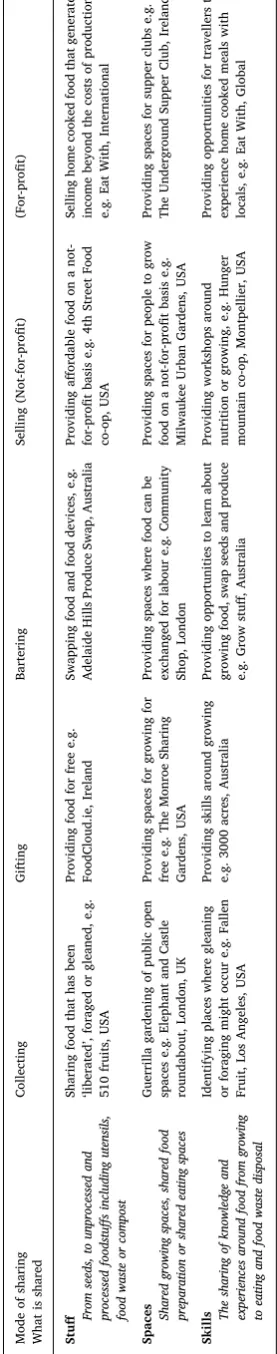
Focusing on what is shared and how it is shared provides a useful skeleton structure for demarcating realms of food sharing and this was used to develop an initial typology illustrated byTable 1., which il-lustrates the type of urban food sharing initiatives included in such a definition. For the formation of the database this typology was used alongside attention to organisational structures (for-profit, not-for-profit, social enterprise, cooperative, association, informal), modes of sharing (gifting, bartering, collecting and selling) and form of ICT (website, facebook, twitter, app) being used. The methods adopted for identifying such characteristics are outlined more fully in the mapping section of this paper.
2.1. Food sharing as social practice
While the benefits of adopting a practice orientation in relation to eating, cooking or growing food is relatively well-established (Davies, 2014; Warde, 2013; Delormier et al., 2009; Campbell et al., 2012; Meah, 2016), this approach has not been applied explicitly to food sharing. Yet, as outlined above, food sharing is undertaken for and with others; reshaping relations with both human and non-human entities and tangible and intangible resources (Hall and Ince, 2018; Agyeman et al., 2013). It is, as a result, replete with habits, routines, tools and technologies; essentially an archetypal practice that is both entity and performance. Food sharing embodies routinized ways“in which bodies are moved, objects are handled, subjects are treated, things are de-scribed and the world in understood” (Reckwitz, 2002: 250). It is“a
‘type’of behaving and understanding that appears at different locales and at different points of time and is carried out by different body/ minds”(ibid), with the performative element of food sharing practice occurring around its enactment. It is only through the performance of food sharing that the interdependencies between elements of food sharing (that is food sharing as an entity) are sustained. Individuals are the carriers of a food sharing practice which may itself evolve, with new forms of sharing appearing and others disappearing over time and across space as elements and performances are reconfigured. In essence, food sharing is a complex assemblage“of body-minds, things, knowl-edge, discourse, and structures carried by agents such as individuals, organizations and institutions” (Jones and Murphy, 2010: 371) and understanding it as such provides a frame for integrative analysis that can accommodate attention to the gamut of rules, tools, skills and un-derstandings embodied within it.
Adopting a practice approach enables examination of broad social and economic processes through the consideration of the actions and meanings associated with everyday activities such as food sharing. Indeed, the approach has been mooted as a useful bridging concept between researchers primarily associated with either social or economic concerns, particularly within human geography. As documented by Jones and Murphy (2010), there are many examples of studies where practices are used to help explain phenomena within socio-spatial economies. Certainly, there is much to be drawn from the rich epistemic history of practice-oriented studies that will be relevant for analysis of
urban food sharing, not least the attention to cultural rituals and in-dividual habits enshrined within Bourdieu’s ideas around habitus, taste and distinction (1977) that determine (in part) what is deemed ap-propriate to share in different contexts, but also through attention to the rules and forms of control - or governmentality - which shapes the ways in which food sharing takes place (Foucault, 1991). This is ex-emplified by the mundane practices of government, for example through land use planning which dictates what types of food sharing activity can take place and where. It is also visible in the ways in which environmental health and food safety regulations shape how food can be processed, prepared and delivered for consumption (Orsi, 2012).
2.2. Food sharing practices and diverse economies
Perhaps of most relevance to the emergent phenomena of urban food sharing initiatives is the practice-oriented work emerging from diverse economies scholars (such asGibson-Graham, 2008; Cameron and Wright, 2014) who emphasise both the intertwined messiness of livelihoods and economies, and their social, political and geographical constitution (Lee, 2006). According toJones and Murphy (2010: 374), these studies indicate that practiced economies are far more than just sets of social relations driven by forms of structural power,“they are instead amalgams of materials, performances, structural factors, and cognitions whose particular time-space constitution is contingent on the agency of actors and is thus open to improvisation and accident”. Usefully, for research examining urban food sharing, the weak theory dimension of diverse economies research in particular promotes at-tention to such affective assemblages. Weak theory strives towards
“mere description” and documents diverse economic practices (some desirable, others less so), without presuming the dominance of a par-ticular economic form or system (Sedgwick, 1997). This work attends to the way stuff, spaces, and skills as well as actors (and their embodied emotions), and actants with different trajectories, may come together in tentative, inconclusive or evolving ways (Wright, 2014). Where the practice-focused dimension of diverse economies research particularly resonates with the mapping of food sharing landscapes is by recognising different forms of economic organisation and exchange - such as vo-lunteering within food surplus redistribution or gifting food or skills to reduce waste or foster greater food security - which are commonly obscured in mainstream economic studies.
In contrast, critical attention to an emergent ICT-mediated‘sharing economy’ has focused primarily on providing a much-needed inter-rogation of the impacts of venture-capital-funded, for-profit sharing platforms, particularly in the mobility and accommodation sectors (Davies et al., 2017a, 2017b; Belk, 2017; Martin, 2016; Cheng, 2016). This work has rightly highlighted the ways in which popular assump-tions around the social (e.g. the view that sharing bolsters social ca-pital) and environmental (e.g. the position that sharing reduces re-source consumption) benefits of sharing are being claimed by companies who provide little in the way of concrete evidence as to whether, and to whom, such benefits accrue. Indeed, research high-lights how these sharing economy platforms are in many cases simply using new technologies to extend longstanding systems of profi t-max-imisation (Belk, 2014), raising concerns about the ways in which the technologies of sharing may facilitate increased labour exploitation, contributing to, rather than resolving, social vulnerability through in-secure working conditions under the guise of autonomy andflexibility (Bourdieu, 1998; Standing, 2011). Nonetheless, focusing only on a small number of particularly high profile cases of for-profit sharing in mobility and accommodation is problematic. It ignores the wealth of ways and sectors in which sharing is taking place, both in terms of the nature of sharing involved and the organisational models adopted to facilitate that sharing. Indeed,McLaren and Agyeman (2015)argue that the most transformative potential within urban sharing economies is unlikely to be led by commercial enterprises alone, rather by a coa-lescence of formal and informal behaviours particularly around shared
[image:3.595.70.209.65.744.2]infrastructures and public spaces. While McLaren and Agyeman focus on the capacity of collective power rather than capital to reshape pro-cesses of urbanisation, Gibson-Graham outlines how reading economic spaces for difference rather than dominance helps to make visible the diversity of relations that co-exist alongside for-profit, monetary ex-change. Elucidating the many ways in which enterprises, transactions, labour, property andfinance are organised, the goal of diverse econo-mies approaches is to unsettle the dominant economic narrative which privileges capital, markets, wages, private property and mainstream
financing, by revealing a multiplicity of already existing practices that operate differently and offer the possibility for‘new economic becom-ings’(Gibson-Graham, 2006: 76).
This diverse economies approach is already familiar to food studies scholars, with existing research including attention to foraging (McLain et al., 2014),fisheries (St. Martin, 2007; Bresnihan, 2016), community supported agriculture (White, 2013; Wilson, 2013) and community food projects (Dixon, 2011; Trauger and Passidomo, 2012), amongst many others. The majority of these studies are however highly localised empirical analyses with the notable exception of Cameron’s (2012) study of commercial international and national food retailers in New-castle, Australia. While the rich examination of food economies through localised case studies provides interesting insights, questions have been raised about the ability of such research to inform strategic planning and policy formation and address higher order challenges (Jones and Murphy, 2010; Browne et al., 2014). In response, a few diverse economies scholars have begun to include meso-level and quantitative studies to complement the rich insights provided by studies of in-dividual initiatives (Drake and Lawson, 2015; Wright, 2014), with si-milar endeavours also emerging amongst some social practice scholars (Browne et al., 2014). Following in the footsteps of these scholars and in direct response to critiques that isolated small scales studies alone will not create the necessary leverage in strategic attempts to reorient urban food systems onto more sustainable pathways, a database of ICT-mediated urban food sharing was constructed.
3. Mapping urban food sharing landscapes
As an extended reflection on the complexities and significance of constructing the database of ICT-mediated urban food sharing is pub-lished elsewhere (Davies et al., 2017a, 2017b), this section simply outlines the strategies that were developed to identify, record and classify relevant initiatives. Identification began with a scoping study that used a key word search of major internet search engines to identify ICT-mediated food sharing initiatives (Davies and Legg, 2018). The forms of ICT required for the initiative to be included in the database were: a website, a facebook page, a meet-up or twitter profile, App or platform. Including this ICT component was important for two key reasons. Conceptually, because it is the ICT component of these in-itiatives which has been mooted as revolutionising the practice of sharing (Botsman and Rogers, 2012) and pragmatically, because having one of these forms of ICT-mediation meant that online searches were in theory able to identify the entire population of activities even in loca-tions dispersed around the globe. As a proof of concept phase, a scoping study was conducted in 2014–5 using only a limited number of key-words in English. Nonetheless ICT-mediated food sharing initiatives were found across 468 urban areas and in 91 countries. These numbers gave credence to undertaking a full analysis and given the calls for practice-oriented research to have greater methodological rigour and comparability (Jones and Murphy, 2010; James, 2006; Yeung, 2003), it was then decided in 2016 to conduct a thorough, multilingual search of 100 urban areas internationally. In order to maximise the potential for identifying cities with active urban food sharingfive urban networks and indices were used to assist in this selection: The Sharing Cities Network; 100 Resilient Cities Network; The Milan Urban Food Policy Pact; A.T. Kearney Global Cities Index; and, the Economist Competitive Cities 2015 list. A total of 404 cities were identified through this
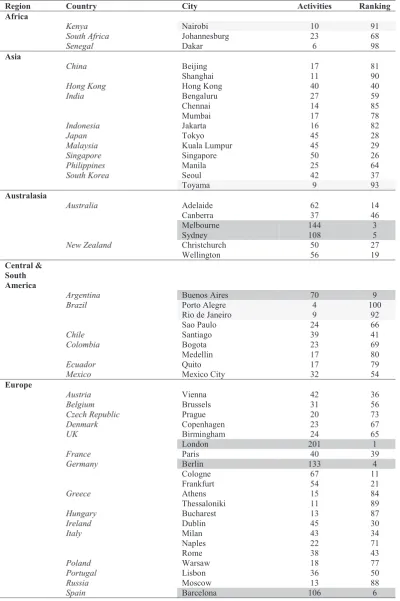
process. Thefinal selection of 100 cities includes all 54 cities involved in the Sharing Cities Network in 2016 and the top ranked cities across the remaining indices (Table 2).2
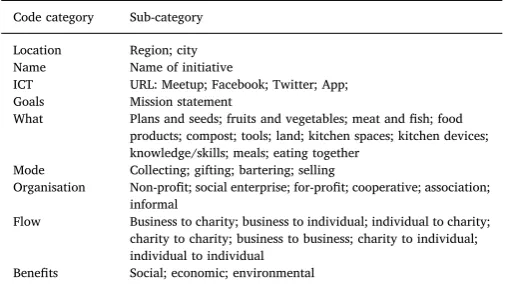
Following the city selection, 28 key search terms were identified by a core team of international researchers and food sharing networks, communities and activists. Additional native speakers were recruited to conduct and cross-check searches where needed and an excel spread-sheet was created to record key characteristics (seeTable 3).
In total, over a period offive months from April 2016 to August 2016, 4003 initiatives were identified and coded. Cross-checking with multiple coders and communities provided assurances of coverage and common quantitative coding methods focused on location, form, mode of sharing, organisation and impact ensured possibilities for compara-tive analysis. Though this approach provided an on-going dialogue between the conceptual framing of ICT-mediated food sharing and empirical observations (Downwards and Mearman, 2007; Jones and Murphy, 2010), there were limitations. One was the static nature of the data. The database presents only a snapshot of activities which are constantly evolving, with new initiatives emerging and existing ones disappearing over time. Another was the multifaceted and sometimes contested nature of urban boundaries, with diverse spatial definitions and systems of data collection being used by different organisations and cities internationally.
While the potential permutations and combinations for analysing the database are extensive,3the following section of this paper con-siders four broad areas related to the performance of sharing practices that they facilitate: (i) Drivers: why food is being shared; (ii) Geo-graphies: where sharing is occurring; (iii) Ingredients: what is being shared; and (iv) Organisation: how it is being shared.
4. The performance of urban food sharing
Initially, each initiative across the 100 urban areas was coded to record its date of establishment and its motivations and goals where these were noted on the website.Fig. 1details the establishment date of the initiatives and indicates the rapid rise in initiatives being estab-lished after 2008 when smart, mobile digital technologies became more widely accessible, affordable and easier to use. This date also coincides with the global recession that impacted economies and societies around the globe from 2007 onwards, which has been mooted as a key stimulus to the development of sharing economies alongside technological shifts, rising environmental awareness and social anomie (Botsman and Rogers, 2012). There are initiatives with establishment dates far earlier than the availability of social media, websites and Apps. These are sharing initiatives which have incorporated ICT into their operations subsequently rather than being shaped by those technologies.
4.1. Drivers: the‘why’of sharing
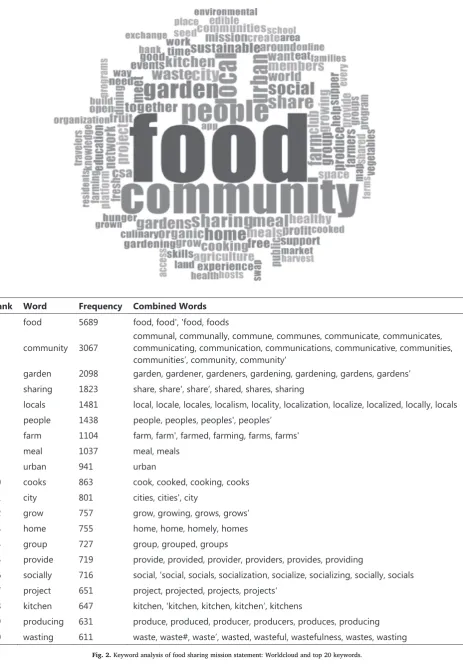
The online mission statements and initiative descriptions of the enterprises were examined as a means of identifying the key drivers for the establishment of the initiatives. These were entered into the qua-litative data analysis package NVivo in order to identify frequencies and clusters of keywords within initiatives descriptions of themselves and their goals. A word cloud and key word count produced from this process is detailed inFig. 2. Excluding the word‘food’from the ana-lysis, it is the social dimensions of food sharing that are emphasised by initiatives in their ICT profiles, with‘community’,‘local’, and‘people’ all appearing in the top ten of most frequently used terms. Terms
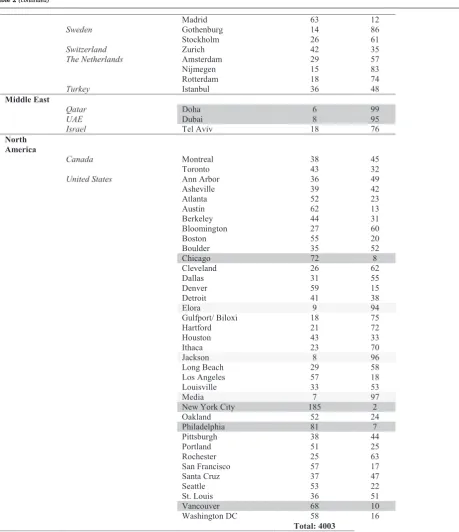
2The shading onTable 2indicates those cities who ranked in the top ten (dark grey)
and bottom ten (light grey) in terms of the number of sharing initiatives.
3Data related to location, mode and organisational form of sharing initiatives have
Table 2
List of 100 cities source:Davies et al. (2016). Key: Light grey = top 10 cities; ark grey = bottom 10 cities.
related to sociality appear at rank 16. Despite the claims of sharing economy advocates, no explicitly economic or environmental phrases feature highly, although terms related to waste and wasting appear at number 20 in the table. Despite this online analysis of the initiatives shows that that 78%4indicate economic impacts, 77% social impacts and 61% environmental impacts, while just over a third (34%) of in-itiatives explicitly seek all three. Few of the inin-itiatives provided any evidence to substantiate achievement of these impacts in their online profiles however.
4.2. Geographies: the‘where’of food sharing
[image:6.595.44.504.63.596.2]The number of initiatives identified in each of the 100 urban areas examined indicates a spectrum of activity, from London in the UK, which has more than 200 initiatives, to Porto Alegre in Brazil where just four initiatives were identified (see Table 2). The top 10 food sharing areas in the database by number of initiatives - London, New York, Melbourne, Berlin, Sydney, Barcelona, Philadelphia, Chicago, Buenos Aires and Vancouver - account for just under one third of all initiatives recorded (29%) across the 100 areas, while the ten food sharing areas with the fewest number of initiatives account for just 2%,
Table 2(continued)
suggesting a cluster of areas currently dominate the ICT mediated-urban food sharing arena. What though are the reasons for this uneven geography of ICT-mediated food sharing and what might explain the clustering of activities around a smaller number of highly active cities? Given the lack of comprehensive and consistent data at the urban level for all the areas in the database, it is not straightforward to identify whether areas exhibit particular contextual characteristics which might explain the relative incidence of ICT-mediated food sharing. For example, while the areas with the highest number of in-itiatives are predominantly large populous metropolitan areas with high levels of GDP (compared to the global average) and high levels of internet penetration, if the number of initiatives is examined per capita, the ranking looks very different. In terms of number of initiatives per capita, the highest ranked urban area with a population of over one million is Cologne (31st), while London falls to a mid-table position (54th) with one food sharing initiative for just under 43,000 people.5
On a per-capita basis the top ten are all smaller urban areas in North America: Elora, Media, Ithaca, Santa Cruz, Asheville, Berkeley, Ann Arbor, Bloomington, Boulder and Hertford. Indeed, Elora, a community in the township of Centre Wellington in Canada ranks first in this configuration with the impressive statistic of having a food sharing initiative for every 511 people. So what makes this area a hot spot of urban food sharing? There is no obvious answer, but it is an affluent community with a longstanding commitment to food and agriculture, where the population has strong links with nearby university towns such as Waterloo or Guelph for employment and farming research. Sharing in Elora also has a charismatic champion who led the formation of Elora Community Share which provides an umbrella for food sharing initiatives and sharing beyond food and which connects with interna-tional sharing networks such as Shareable through the Sharing Cities Network.
The urban areas with the highest absolute number of initiatives tend to be highly active across the networks and indices used to select the sample (detailed in the previous section). Indeed, Melbourne, New York and Chicago appear in all the networks and indices and London appears in all except the Sharing Cities Network. Meanwhile, eight of the top ten urban areas participate in the Milan Urban Food Pact and are listed in the Sustainable City Index. While it is impossible to identify a causal re-lationship between participation in these international networks and a high level of ICT-mediated food sharing, what this at least suggests is that a high level of ICT-food sharing occurs most often in cities with a broadly supportive governing structure for activities which relate to food and
sustainability. The connection between areas with lots of food sharing initiatives and presence in the competitive cities and global city indices is less obvious, although six of the top ten cities do appear in both.
The ten urban areas with least food sharing activity are more di-verse geographically than the leader cluster of urban areas, being lo-cated across Africa (Nairobi, Dakar), Asia (Toyama), South America (Rio de Janeiro, Porto Alegre) and the Middle East (Dubai, Doha), as well as North America (Elora, Jackson, Media). These areas, particu-larly the ones in North America, have far lower engagement with the international networks and indices than those at the top of table. It should be noted that all non-North American urban areas are included in either the 100 Resilient Cities Index or the Sustainable Cities Index, but only Rio de Janeiro and Nairobi are listed in the Global Cities Index and only Dubai and Doha appear in the Competitive City Index. Similarly, there is far more diversity within this cohort in relation to population, GDP and internet penetration, althoughfigures are con-sistently lower across these metrics than the top ten cities particularly in relation to internet connectivity.6
Although insufficient comparable urban-level data exists to identify a statistically significant relationship between particular cities and the nature of their food sharing, examining the extreme ends of the sample suggests that several factors may play a role in providing a supporting infrastructure which allows urban food sharing to form more readily. This includes, most obviously, the availability and accessibility of ternet connections, but also active participation or recognition in in-ternational city networks, particularly where learning can be ex-changed. This may suggest that international networking supports higher levels of city-based innovation and experimentation in areas such as ICT-mediated food sharing; a feature which has been found in relation to innovation around cities and climate change (Wang, 2012; Kern and Bulkeley, 2009; Castán Broto and Bulkeley, 2013; Davies, 2005).
[image:7.595.37.290.80.225.2]Afinal comment on the geographies of sharing relates to the ca-pacity of ICT-mediation to scale sharing beyond the face-to-face ex-changes in particular locales which have typified familial and friend-ship sharing and also for sharing initiatives to have a presence in more than one location. While online data provided by sharing initiatives does not indicate the scale of participation in sharing or indeed the location of those participants–and more on this later–what it does reveal is the emergence of translocal (active in more than one urban area) and even transnational (active in more than one country) sharing initiatives. At present evidence of such translocal sharing is limited, with just 5% of initiatives operating in more than one urban area listed in the database (although they may operate in other urban areas not incorporated in the sample), and around 1% of all initiatives active in more than one country. Of these transnational sharing initiatives there appear to be three main types of sharing that are being performed: sharing meals, eating together and mapping of food harvests. This split is reflected also in the structure and mode of sharing employed. A third of the transnational initiatives are for-profit and predominantly sell meals or host dinner parties often marketed at those seeking more au-thentic home cooking experiences when travelling or living abroad, such as Eat With Me, or Travelling Spoon. A third have no discernible organisational structure or governance code and tend to be open data mapping initiatives, such as falling fruit, that rely on voluntary, self-organised data collation and management which is provided for free through on-line repositories.
Table 3
Spreadsheet coding subcategories.
Code category Sub-category
Location Region; city
Name Name of initiative
ICT URL: Meetup; Facebook; Twitter; App;
Goals Mission statement
What Plans and seeds; fruits and vegetables; meat andfish; food
products; compost; tools; land; kitchen spaces; kitchen devices; knowledge/skills; meals; eating together
Mode Collecting; gifting; bartering; selling
Organisation Non-profit; social enterprise; for-profit; cooperative; association;
informal
Flow Business to charity; business to individual; individual to charity;
charity to charity; business to business; charity to individual; individual to individual
Benefits Social; economic; environmental
5Focusing on the frequency of urban food sharing initiative per capita has less impact
on the least active urban areas however, with the bottom ten urban areas under this configuration all also appearing in the bottom half of the original ranking. Population figures are taken from US Government Census Data for US urban areas and Eurostat for European areas. All other statistics are taken from official population data where avail-able and verifiavail-able sources elsewhere.
6Statistics do not exist at the city level for internet penetration for the cities in the
database. Country level statistics are used which is likely to be an underestimation of penetration given the density of connections in urban areas in these countries is presumed
4.3. Ingredients: the‘what’of food sharing
Given the remit of the study to examine sharing practices around growing, preparing and consuming food, sub-divisions were required to order and code the various initiatives. The following categories–plants and seeds, fruits and vegetables, meat andfish, food products, compost, tools, land, kitchen space, kitchen devices, knowledge and skills, meals, and eating together–were established through a process of trial and revision (see Davies et al., 2017a, 2017b). In many cases, multiple skills, spaces and material‘stuff’are shared within a single food sharing initiative. More than two-thirds (70%) of food sharing initiatives in the database share multiple things and more than a third (35%) of in-itiatives share three or more things. For example, the Skip Garden and Kitchen in London provides knowledge and skills around community growing and cooking to local planners and businesses as well as in-volving the local resident community in food growing in its sites. Its sharing therefore involves food, land, tools, kitchen spaces and meals in addition to skills and knowledge. We term this phenomenon the mul-tifunctionality of food sharing (Davies et al., 2017a, 2017b). Why this occurs is not directly discernible from the online material alone, but it may enable initiatives to reach wider audiences and contribute to the resilience of the initiative over time facilitating the redirection of efforts to different areas as they become more or less active or in-demand (Wilson and Dünckmann, 2010). It might also be a function of the multiple drivers behind the food sharing initiatives, for example
seeking to both reduce food waste and improve food security. Alter-natively, it could be that such multifunctionality responds to the het-erogeneity and interlinked nature of urban food systems within which the sharing is embedded, but such hypotheses need further ground-truthing through in-depth qualitative research with initiatives.
Examining the entire database, the most common entity shared (including all categories of foodstuff, spaces and skills) is that of knowledge and skills, with more than half of initiatives (54%) engaging in some form of sharing information-based qualities (seeTable 4). This category includes knowledge about growing, as for example in the Open Farm Community in Singapore or the Motoazabu Farm in Tokyo. It also involves skills sharing in relation to food preparation, as illu-strated in the activities of the Kinder Kueche in Frankfurt that focuses on teaching children how to prepare healthy meals, and the community kitchen Cozinha Popular Da Mouraria in Lisbon. Knowledge and skills sharing related to collecting, can include, for example the provision of information about how to practice urban foraging, as articulated in Lots of Food in Louisville, USA and Espigar En Madrid in Madrid, Spain. That knowledge and skills ranks highly is unsurprising as information-provision (as one form of knowledge and skills sharing) is easily dis-seminated via ICT mechanisms and can provide a one-way dissemina-tion funcdissemina-tion, without necessarily requiring interacdissemina-tion between donor and recipient (Hendricks, 1999; David, 2017). Information, unlike fruit and vegetables, or meals, is not degradable, although the relevance and accuracy of such data may still have a limited lifespan. The perishability
Fig. 1.(a) Year of food sharing initiative establishment. (b) Cumulative number of food sharing initiatives by year.
[image:8.595.36.366.55.449.2]of foodstuffhas been mooted as a reason why food sharing has been slower to scale than other sharing initiatives in mobility and accom-modation, where the entities being shared are much slower to degrade (Orsi, 2012). However, the apparent dominance of knowledge and skills sharing requires further unpicking for there was no publicly available data on the balance of activities within an initiative; that is the pro-portion of sharing within an initiative’s activities that focuses on such information exchange rather than other things. If the nine food‘stuff’ categories and the two‘space’categories are combined, knowledge and skills comprises only a quarter of activities across the 100 areas, while with the combined sharing of foodstuffmakes up 63% of everything that is shared.
Meals are the second most common quality shared entity (35%) in the database. This is a broad category that spans for-profit pop-up supper clubs where roving chefs produce meals in temporary settings for paying customers wishing to eat with others (as in the Disappearing Dining Club in London), to people providing meals for travellers in their own homes (as in the initiative Bon Appetour which connects travellers and homecooks in more than 100 cities around the world). It also in-cludes initiatives providing the infrastructures of emergency food relief such as soup kitchens (as in Hunger Free Colorado in the USA). The emphasis on commensality across diverse initiatives here is significant. It elevates the convivial benefits of eating meals together and re-em-phasises the important sociality and relationality of food sharing (Chou, 2015). Certainly, food sharing in this way is the embodiment of a‘ more-than-food’activity (Goodman, 2016).
Looking at the data regionally, there is considerable commonality around what is shared particularly when examined through the broader lens of skills, spaces and stuff. For example, while skill sharing is the lowest in the Asian based urban areas, at 20% it is only 1% lower than levels in Europe and 2% lower than North America. Meanwhile the Middle East has the largest proportion of skills sharing at 29% followed by Africa at 26%. The range in the sharing of spaces category is even narrower (from 12% to 15%), with North American urban areas ex-periencing the lowest incidence, followed by African, Asian, European areas (13%) with the Middle Eastern with Australian and New Zealand based urban areas having the highest percentage of space sharing at 15%. Within the food stuffcategory, which contains the most elements, regions range from 58% (Middle East) to 67% (Europe and North America).
While sharing in individual urban areas can vary widely, particu-larly when the incidence of initiatives is low, the proportional pat-terning amongst the categories of what is shared is remarkably con-sistent across the database. Examining the top 10 areas in the database, knowledge and skills are the most commonly shared entity, followed by fruit and vegetables and meals. Within the bottom 10 areas, knowledge and skills is also the leading entity shared, followed by meals, then fruit and vegetables. Within all the diversity then there does appear to be some commonality around the nature of food sharing, at least with respect to the most commonly shared skills, spaces and stuff.
4.4. Organisation: mediation and modes of food sharing
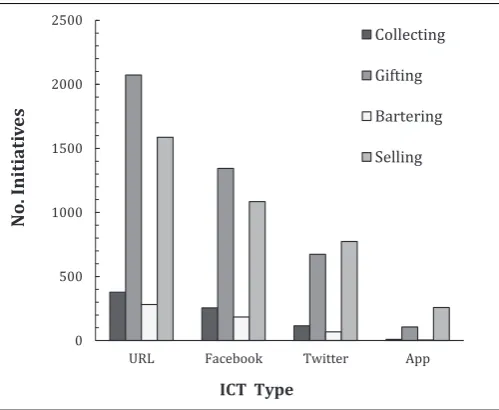
All initiatives in the database are ICT-mediated in some form as this was a necessary feature for their inclusion. However, the database is productive in revealing the diversity of ICT-mediation both across space and in relation to different types and modes of sharing (seeTable 5.). Three different classifications of ICT were used in this research: Web-site, Social Media (including Facebook, Twitter and Meet Up7) and App. These all provide online spaces where potential sharers can connect, but they also represent a spectrum of ICT in terms of resource and skill requirements (Van Deursen et al., 2014). Whilst website technologies have become much more accessible in recent years, they remain more complex systems to set up and manage than either Facebook or Twitter, with greater potential for interactive or transactional elements (such as databases or payment services) and greater requirements for main-tenance of the sites, particularly around security and management. The inclusion of sharing through an App illustrates the emergence of this new–and more technologically complex - format to deliver mobile, digital services and experiences or make connections that would have been conducted previously through web pages, texting, calling or face-to-face exchanges.
[image:10.595.38.288.80.208.2]It is clear that websites dominate the ICT characteristics of urban food sharing initiatives, with 89% of all initiatives using a dedicated website. Indeed, across the database, websites are used to mediate the sharing of every category of what is shared and every mode of sharing from gifting and bartering to collecting and selling. Far fewer, but still more than half, initiatives have a Facebook page (58%) and fewer still, just over a third (34%), have a Twitter account. Unsurprisingly, given the level of technical knowledge and skills required to construct them and also the investment required to build up users to drive the neces-sary network effects, only 9% of the initiatives had an App. While Apps form a small cohort (just 9% of all initiatives) of the overall food sharing database, they tend to garner disproportional attention in the media because of the impacts of high-profile, App-based sharing com-panies such as Uber and Airbnb (Davies et al., 2017a, 2017b). Yet food sharing Apps have struggled to replicate the successes of these ventures despite receiving venture capital investment, with a number of high profile initiatives such as Cookisto and Grub with Us being wound down
Table 5a
Number of initiatives using particular forms of ICT-mediation (disaggregated by mode of sharing).
Table 4
What is shared by initiatives (NB: a single initiatives can share more than one thing).
What is shared No. initiatives % of total initiatives
Knowledge & skills 2142 53%
Meals 1420 35%
Fruits & vegetables 1318 33%
Eating together 1050 26%
Land 928 23%
Food products 898 22%
Tools 525 13%
Plants & seeds 466 12%
Kitchen devices 303 8%
Kitchen space 291 7%
Compost 228 6%
Meat &fish 145 4%
7These particular forms of social media were used as they offer an online space for
[image:10.595.307.557.87.292.2]within a few years of establishment. It will be important to drill down into this category further in order to explore in more detail what kinds of initiatives are adopting this cutting edge technology in their prac-tices, what particular challenges they face with regards to generating participation and the impact that such technologies have on the prac-tices and performance of food sharing.
Unsurprisingly, given the higher levels of internet penetration, the bulk of the App-based sharing takes place in North America and Europe, with these regions accounting for two-thirds of all food sharing Apps. New York City is the most App-mediated food sharing area in the da-tabase with 14 initiatives, followed by Seattle on 11, with Barcelona, Berlin, Houston, and Philadelphia on 10 and Beijing, London, San Francisco and Singapore all having 8 Apps active in their environs. Only 14 areas in the database have no App-mediated food sharing initiatives. More than two-thirds (71%) of the App adopters are for-profit organi-sations which offer opportunities to share meals for money. Some of these, such as VizEat, VoulezVousDiner and Mealsharing, claim to be active across multiple areas internationally and seek foster convivial communal dining experiences. It is challenging to establish how active the Apps are in particular places, at least from publicly available online data, however media coverage suggests that generating the required levels of participation can be a challenge for such meal sharing in-itiatives (Danovich, 2016). These translocal networks sit alongside si-milar, but more place-based initiatives such as Wats Cooking in Chennai, which is an App seeking to connect locals via homemade cuisine. Apps are also used to connect producers to consumers, facil-itating shorter food value chains and promoting local produce, as ex-emplified by SEND in Tokyo.
The mobile interactive technology of Apps provides an un-precedented ability to connect strangers quickly and bring together communities across large distances and as such it is particularly useful for knowledge exchange, mapping and dissemination. However, enga-ging with strangers in this way is the most alien form of social interaction for many people and many App-reliant enterprises can deteriorate very quickly if they fail to develop a critical mass of users. Indeed, it is sug-gested that a third of initial mobile App engagements last less than a minute with people being intolerant of poor user experiences (Segrist, 2015). While Apps are the most novel ICT-mediation included in the database, they are then also the riskiest and the most resource intensive. These start-up costs and risk concerns may explain the predominance of monetary exchange when Apps are used for food sharing, however more than 100 Apps do gift food (28% of all App initiatives) and a handful of initiatives use Apps to facilitate collecting or bartering. For example, Byhøst (City Harvest) in Copenhagen, uses its App to share knowledge about urban foraging and wild plants, while Wild Food in Houston shares information about edible plants through its App.
Examining the type of sharing employed across the 100 areas re-veals that gifting is the dominant mode of sharing across the database with nearly half (49%) of initiatives using this approach. This is fol-lowed by selling (35%), which takes place in both mainstream and al-ternative markets such as Community Supported Agriculture and Cooperatives. In contrast to the multifunctionality around what is shared, the majority of initiatives adopt a singular form to organise their sharing activities, with only 21% of initiatives incorporating more
than one organisational structure. Where it does occur, including multiple structures within a single initiative is most commonly em-ployed by organisations operating outside the mainstream market economy (e.g. non-profits and cooperatives), perhaps as a means to provide multiple ways to access funding and resources and to overcome legal restrictions on certain types of activities. For-profit initiatives were meanwhile least likely to adopt multiple organisational structures. Even within this brief account of high level results from the data-base, it is clear that capitalist and market transactions do not dominate the food sharing landscape. While venture capital, supported selling, and for-profit food sharing platforms and Apps are present, the vast majority of transactions and enterprises found in food sharing are, to use the phraseology of diverse economies, alternative market, alter-native capitalist, non-market or non-capitalist (Gibson-Graham, 2008).
5. Conclusion: insights, limitations and a research agenda for urban food sharing
This paper began with the meta-societal challenge of constructing sustainable and resilient urban food systems in the face of climate change and population growth; a challenge that requires an under-standing not only of the dominant ways in which food is grown, pre-pared and ultimately consumed within cities, but also of the ways which are emergent or marginal but which may provide different means to achieve these goals if appropriately supported. As indicated by a growing body of small scale studies, ICT-mediated food sharing in-itiatives offer one such area of emergent activity ripe for exploration, but interrogation is currently hampered by a lack of international and comparable data. A fuller understanding of urban responses to un-sustainable food systems requires new forms of comparative and case-study research that covers a territorially diverse range of urban en-vironments and interventions and this paper presents thefindings of an initial attempt to do just this. The database provides, for thefirst time, consistent analysis and identification of patterns and trends in ICT-mediated urban food sharing across diverse cities, countries and con-tinents. In doing so it engages in a process of making food sharing visible within and beyond individual urban foodscapes; enacting what Fraser (2010) might call a process of scalecraft. It is a strategy re-sponding directly to the international scaling of governance around the 2030 development agenda and beyond, and the need to ensure that alternative pathways to development are critically considered from the local to the global. As noted byBoyle (2002), setting problems and solutions at certain scales can make a material difference to outcomes, including the power to generate different ecological outcomes, and such scalecraft must be approached as an“active progenitor of social pro-cesses”(Smith, 1993, 101).
[image:11.595.34.561.80.165.2]There are then conceptual reasons for considering the performance of social practices such as urban food sharing at scales beyond the local. There are also pragmatic reasons when seeking to inform systems of governance which routinely privilege quantitative and large-scale stu-dies over individual qualitative cases. The intention was to use the database as a tool to first reveal, quantify and then understand the range of ICT-mediated food sharing practice across 100 diverse cities. However, there are also challenges, particularly when exploring
Table 5b
ICT-mediation by region (% of initiatives in each region using particular forms of ICT-mediation).
URL (%) Meetup (%) Facebook (%) Twitter (%) App (%)
Africa 91 15 67 42 12
Asia 84 6 73 28 15
Australia & New Zealand 86 1 68 34 4
Central & South America 81 9 73 42 12
Europe 91 4 54 35 10
North America 91 6 55 35 8
emergent, complex and dynamic social practices such as sharing. There are concerns, for example, that using a quantitative approach might not be ontologically or epistemologically aligned with the theories of practice (Shove, 2011) that shaped the initial conception of food sharing. Yet as Browne et al. (2014) note, it is possible to using a quantitative methodology and maintain a post-positivist perspective that usesfindings in a way to enable description rather than causation (Uprichard et al., 2008). In solidarity withBrowne et al. (2014), we argue that the urban food sharing database can be seen as a form of methodological pragmatism offering a different way of exploring practices that can complement rich case studies and which can build an initial extensive (if not in-depth) body of foundational data from which is will be easier to explore how and why certain practices persist and others retreat. But what exactly did the process reveal and importantly, what questions are left unanswered?
The database is highly productive; creating a picture of the why, where, what and how of contemporary food sharing. Certainly, the diverse collection of food sharing initiatives documented provide an important counter-balance to the preoccupation with a small number of high profile, for-profit enterprises which are using ICT to link up those with idling capacity and those who wish to avail of it (Davies et al., 2017a, 2017b). A deliberately weak theoretical process, constructing and populating the database has been a means of ‘attending and at-tuning’to things (Stewart, 2008: 72), rather than closing down debates. In particular, it responds to the call by Jones and Murphy (2010)to supplement qualitative case studies, in all their richness, with a more quantitative landscape level picture that can facilitate comparative re-search and engage meta-theoretical concerns. Substantively, the data-base clearly does considerable work in making visible the number, lo-cation, actors, mode and multifunctionality, of food sharing activities in 100 cities around the world. Somefindings are clear. ICT-mediated food sharing occurs across diverse urban areas, small and large, dense or dispersed, rich and poor, Global North and South. Urban food sharing is an international phenomenon and not confined to wealthy, self-ap-pointed ‘smart cities’. However, while activity cannot simply be pre-dicted by general characteristics, it does appear that participation in transnational urban networks may be an indicator of higher levels of and diversity within urban food sharing activities and will need further exploration.
The database not only provides a foundational function on which to build more in-depth and explanatory comparative scholarly analysis, it also provides the bedrock to build capabilities and networks amongst and between sharing initiatives, nascent and active food sharers and those who seek to regulate the sharing of food. As a further means to create visibility and open up the area of food sharing for conversations between stakeholders, key data from the 100 cities in the database related to the where, what and how of ICT-mediated food sharing have been converted into an open-access, interactive online database.8 Publicised through a project website as well as sharing and urban networks, this online database was viewed more than 2670 times by 1647 unique users from 71 countries around the world–from South Korea and Mexico to Brazil and Senegal–in thefirst ten months fol-lowing its launch. It has also generated interaction between researchers and stakeholders about the classification of sharing initiatives and the coverage of urban areas (with requests for the research to be extended and expanded beyond the 100 urban areas). This interaction has also highlighted the dynamism of the sector with the establishment and disappearance of initiatives ongoing. One year on from the initial col-lection the initiatives in the database were individually rechecked and it was found that around 5% of initiatives were no longer active online. In addition, 70 enterprises have been added following recommenda-tions. The initiatives in the database will be checked annually until 2020 with a view to conducting longitudinal analysis exploring how
initiatives which facilitate food sharing practices have changed over time. Certainly, ICT-mediated food sharing initiatives are diverse and dynamic circuits under construction (Dubois et al., 2014) rather than
fixed entities. Ultimately, the database allows for more consistent and comparable analysis of how particular stuff, spaces, labour and skills around food are mobilised, appropriated, accessed,financed and dis-tributed across space; drawing attention to the more-than-human as-semblages that such initiatives embody. The ICT component in parti-cular illustrates the extent to which actors harness technology to share food, potentially reconfiguring not only the prevailing socio-economic order, but also the technical infrastructures that support it. AsFeenberg (2012: viii)has suggested,“new forms of agency have opened the way for new, mediated modes of sociality, reciprocity, participation, mobi-lization and resistance”. These are appearing in advance of governance frameworks that would help societies anticipate and shape the impact of those emerging technologies (Baller et al., 2016: xii).
However, the analysis of the database also revealed its limitations. Answers to key questions around what kind of people and how many of them are participating in food sharing initiatives, for example, were impossible to delineate from the publicly available data. Responding to such questions requires not only that initiatives collect and hold re-levant data on those who engage with their activities, but also that they are willing to share it with a third party. Such challenging issues around limited data availability are not restricted to food sharing and pre-occupy many researchers in other fields of sharing including accom-modation and mobility (Davies et al., 2017a, 2017b). Recent releases of data by organisations such as Uber through their Movement website may mark an opening up of information by the big players of the for-profit sharing economy, at least rhetorically for the benefit of public planning (Etherington, 2017), but the data provided to date is limited and highly parsed. Meanwhile other large sharing economy platforms are more resistant to such transparency, even seeking to constrain ac-cess to their publicly available data by preventing web mining activities (Slee, 2016). Nonetheless, while inevitably a snapshot of food sharing in the urban areas involved, the database does provide a springboard from which patterns and assemblages can be identified and sites and spaces–material and otherwise–where people and food stuff, spaces and skills, “come together, albeit in often tentative, inconclusive or evolving ways” (Wright, 2014: 2). In this context, we concur with Cameron and Gordon (2010: 9, emphasis added)who argue that rather than focusing on what types of economies are currently dominant, at-tention should instead by placed onto those areas ‘which are worth growing and strengthening’. As highlighted in this paper, further re-search is required in order to establish the worth of these initiatives, for whom that worth is generated and the means by which worth can be rolled out. This is particularly so in terms of understanding the wider genealogies of foodscapes within which the initiatives are embedded, but also in relation to the governing context, and the scale and impacts of existing food sharing practices.
Acknowledgements
We would like to thank the researchers who helped us capture all initiatives across the 100 urban areas in the database, particularly where we lacked the linguistic capabilities to ensure full coverage of activities. We would also like to thank the initiatives around the world who generously gave us feedback on the database and suggestions for additional initiatives. The Shareable network was invaluable for helping spread the word about our research through its blog and newsletters and special thanks go to Neal Gorenflo for his support. The research that this paper is based upon was funded by a Horizon 2020 European Research Council Consolidator Award. Title: SHARECITY: The practice and sustainability of urban food sharing. Award No: 646883. We are extremely grateful for this support without which the research could not have taken place.
References
Agyeman, J., McLaren, D., Schaefer-Borrego, A., 2013. Sharing Cities Briefing Note. Friends of the Earth, London.
Davies, A.R., 2005. Local action for climate change: transnational networks and the Irish experience. Local Environ.: Int J. Justice sustain. 10 (1), 21–40.
Davies, A.R., 2014. Co-creating sustainable eating futures: technology, ICT and citizen-consumer ambivalence. Futures.: J. Policy Planning Futures studs. 62, 181–193. Davies, A.R., Legg, R., 2018. Fare sharing: interrogating the nexus of ICT, urban food
sharing and sustainability. Food Culture Soc. 21 (1) (forthcoming).
Davies, A.R., Mullin, S., 2011. Greening the economy: interrogating sustainability in-novations beyond the mainstream. J. Econ. Geogr. 11 (5), 793–816.
Davies, A.R., Edwards, F., Marovelli, B., Morrow, O., Rut, M., Weymes, M. 2016.
SHARECITY100 Database, Trinity College Dublin, Ireland. Retrieved from: <http://
sharecity.ie/research/sharecity100-database/> .
Davies, A.R., Edwards, F., Marovelli, B., Morrow, O., Rut, M., Weymes, M., 2017a. Creative construction: crafting, negotiating and performing urban food sharing
landscapes. Area.http://dx.doi.org/10.1111/area.12340.
Davies, A.R., Gray, M., Donald, B., Knox-Hayes, J., 2017b. Sharing economies: moving beyond binaries in a digital age. CJRES 10 (2), 209–230.
Baller, S., Dutta, S., Lanvi, B. (Eds.), 2016. Global Information Technology Report 2016: Innovating in the Digital Economy. World Economic Forum, Davos.
Belk, R., 2014. Sharing versus pseudo-sharing in Web 2.0. Anthropologist 18 (1), 7–23. Belk, R., 2017. Sharing without caring. Cambr. J. Reg., Econ. Soc. 10 (2), 249–261. Botsman, R., Rogers, R., 2012. What’s Mine is Yours: The Rise of Collaborative
Consumption. Harper Collins, London.
Bourdieu, P., 1977. Outline of a Theory of Practice. Cambridge University Press, Cambridge.
Bourdieu, P., 1998. Practical Reason: On the Theory of Action. Stanford University Press, Stanford CA.
Boyle, M., 2002. Cleaning Up after the Celtic Tiger: Scalar‘Fixes’in the Political Ecology of Tiger Economies. Trans. Inst. Br. Geogr. NS 27, 172–194.
Bresnihan, P., 2016. Transforming the Fisheries: Neoliberalism, Nature and the Commons. University of Nebraska Press, Lincoln.
Browne, A., Pullinger, M., Medd, W., Anderson, B., 2014. Patterns of practice: a reflection on the development of quantitative/mixed methodologies capturing everyday life related to water consumption in the UK. Int. J. Soc. Res. Methodol. 17 (1), 27–43. Cameron, J., Gordon, R., 2010. Building sustainable and ethical food futures through
economic diversity: options for a mid-sized city. In: Paper Presented at the Policy
Workshop on The Future of Australia’s Mid-Sized Cities. Latrobe University, Bendigo,
VIC, 28 & 29 Sept <http://www.communityeconomies.org/site/assets/media/
Jenny_Cameron/Diverse_Food_Economies_For_Dist.pdf> (accessed: 9/08/2017).
Cameron, J., 2012. Take back the food economy: lessons from the hummingbird',A
Guidebook of Alternative Nows. The Journal of Aesthetics and Protest Press, Los
Angeles, CA, pp. 89–96.
Cameron, J., Wright, S., 2014. Researching diverse food initiatives: from backyard and
community gardens to international markets. Local Environ. 19 (1), 1–9.http://dx.
doi.org/10.1080/13549839.2013.835096.
Campbell, H., Rosin, C., Hunt, L., 2012. The social practice of sustainable agriculture under audit discipline: initial insights from the ARGOS project in New Zealand. J. Rural Stud. 28 (1), 129–141.
Castán Broto, V., Bulkeley, H., 2013. A survey of urban climate change experiments in 100 cities. Glob. Environ. Change 23 (2013), 92–102.
Cheng, M., 2016. Sharing economy: a review and agenda for future research. Int. J. Hospit. Manage. 57, 60–70.
Chou, C., 2015. Commensality: From Everyday Food to Feast. Bloomsbury, London.
Danovich, T., 2016. Why No Dining App is the Airbnb of Food (yet).Eater, March 31st
2016 <
https://www.eater.com/2016/3/31/11293260/airbnb-for-food-apps-eatwith-feastly> (accessed on: 9/08/2017).
David, M., 2017. Sharing: post scarcity beyond capitalism? Cambr. J. Reg., Econ. Soc. 10 (2), 311–325.
Delormier, T., Frohlich, K., Potvin, L., 2009. Food and eating as social practice– un-derstanding eating patterns as social phenomena and implications for public health. Sociol., Health Illness 31 (2), 215–228.
Dixon, J., 2011. Diverse food economies, multivariant capitalism, and the community dynamic shaping contemporary food systems. Commun. Develop. J. 46 (SUPPL. 1), 20–35.http://dx.doi.org/10.1093/cdj/bsq046.
Downwards, P., Mearman, A., 2007. Retroduction as mixed-methods triangulation in economic research: reorienting economics into social sciences. Cambr. J. Econ. 31 (1), 77–99.
Drake, L., Lawson, L.J., 2015. Results of a US and Canada community garden survey: shared challenges in garden management amid diverse geographical and
organiza-tional contexts. Agric. Hum. Values 32 (2), 241–254.http://dx.doi.org/10.1007/
s10460-014-9558-7.
Dubois, E.A., Schor, J., Carfagna, L., 2014. New cultures of connection in a Boston Time Bank. In: Schor, J. (Ed.), Sustainable Lifestyles and the Quest for Plentitude: Case Studies of the New Economy. Yale University Press, New Haven, CT, pp. 95–124. Etherington, D., 2017. Uber Debuts Movement, A New Website Offering Access to its
Traffic Data. Available from:
<https://techcrunch.com/2017/01/08/uber-debuts-movement-a-new-website-offering-access-to-its-traffic-data/>(accessed: 9/08/ 2017).
Feenberg, A., 2012. Reinventing the Internet: Critical Case Studies. Sense Publishers, Rotterdam.
Foucault, M., 1991. The Foucault Effect: Studies in Governmentality. University of Chicago Press, Chicago.
Fraser, A., 2010. The craft of scalar practices. Environ. Plan. A 42 (2), 332–346. Gibson-Graham, J.K., 2006. A Postcapitalist Politics. University of Minnesota Press,
Minneapolis.
Gibson-Graham, J.K., 2008. Diverse economies: performative practices for“other
worlds”. Prog. Hum. Geogr. 32 (5), 613–632.http://dx.doi.org/10.1177/
0309132508090821.
Goodman, M.K., 2016. Food geographies I: relational foodscapes and the busy-ness of being more-than-food. Prog. Hum. Geogr. 40 (2), 257–266.
Hall, S., Ince, A., 2018. Sharing Economies in Times of Crises. Routledge, London. Hearn, G., Collie, N., Lyle, P., 2014. Using communicative ecology theory to scope the
emerging role of social media in the evolution of urban food systems. Futures 62, 202–212.
Hendricks, P., 1999. Why share knowledge? The influence of ICT on the motivation for knowledge sharing. Knowl. Process Manage. 6 (2), 91–100.
Jaeggi, A., Gurven, M., 2013. Natural cooperators: food sharing in humans and other primates. Evol. Anthropol. 22, 186–195.
James, A., 2006. Critical moments in the production of‘rigorous’and‘relevant’cultural economic geographies. Prog. Hum. Geogr. 30 (3), 289–308.
Jones, A., Murphy, J., 2010. Theorizing practice in economic geography: foundations, challenges and possibilities. Prog. Hum. Geogr. 35 (3), 366–392.
Julier, A., 2013. Eating Together: Food, Friendship and Inequality. University of Illinois Press, Chicago.
Kaplan, H., Gurven, M., 2005. The natural history of human food sharing and coopera-tion. In: Gintis, H. (Ed.), Moral Sentiments and Material Interests: The Foundations of Cooperation in Economic Life. MIT Press, Cambridge, MA, pp. 75–113.
Kern, K., Bulkeley, H., 2009. Cities, europeanization and multi-level governance: gov-erning climate change through transnational municipal networks. JCMS. J. Common Market Stud. 47, 309–332.
Lee, R., 2006. The ordinary economy: tangled up in values and geography. Trans. Inst. Brit. Geogr. 31 (4), 413–432.
Martin, C., 2016. The sharing economy? A pathway to sustainability or a nightmarish form of neoliberal capitalism? Ecol. Econ. 121, 149–159.
McLain, R.J., Hurley, P.T., Emery, M.R., Poe, M.R., 2014. Gathering“wild”food in the
city: rethinking the role of foraging in urban ecosystem planning and management.
Local Environ. 19 (2), 220–240.http://dx.doi.org/10.1080/13549839.2013.841659.
McLaren, D., Agyeman, J., 2015. Sharing Cities. MIT Press, Boston.
Meah, A., 2016. Extending the contested spaces of the modern kitchen. Geogr. Comp. 10 (2), 41–55.
Mikkelson, B., 2011. Images of foodscapes: introduction to foodscape studies and their application in the study of healthy eating out-of-home environments. Persp. Public Health 131 (5), 209–216.
Orsi, J., 2012. Practising Law in the Sharing Economy: Helping People Build Cooperatives, Social Enterprise, and Local Sustainable Economies. American Bar Association, Chicago.
Oxford University Press, 2014. Oxford English Dictionary. Oxford University Press, Oxford.
Reckwitz, A., 2002. Toward a theory of social practices: a development in culturalist theorizing. Euro. J. Soc. Theory 5 (2), 243–263.
Schatzki, T., 1996. Social Practices: A Wittgensteinian Approach to Human Activity and the Social. Cambridge University Press, Cambridge.
Schwab, K., 2016. The fourth industrial revolution: what it is and how to respond. Global
Agenda. World Economic Forum, Davos <https://www.weforum.org/agenda/
2016/01/the-fourth-industrial-revolution-what-it-means-and-how-to-respond/ > (accessed on 9/08/2017).
Sedgwick, E., 1997. Paranoid reading and reparative reading; or, you’re so paranoid, you probably think this introduction is about you. In: Sedgwick, E. (Ed.), Novel Gazing: Queer Readings in Fiction. Duke, Durham, NC.
Segrist, P., 2015. How the rise of big data and predictive analytics are changing the Attorney’s duty of competence. North Carol. J. Law Technol. 16 (3), 527–622. Seyfang, G., Smith, A., 2007. Grassroots innovations for sustainable development:
to-wards a new research and policy agenda. Environ. Polit. 16 (4), 584–603. Shove, E., 2011. On the difference between chalk and cheese-a response to Whitmarsh
et al's comments on“Beyond the ABC: climate change policy and theories of social change”. Environ. Plan. A 43 (2), 262–264.
Slee, T., 2016. Airbnb Is Facing an Existential Expansion Problem, Harvard Business
Review, July 11, 2016. available from:
<https://hbr.org/2016/07/airbnb-is-facing-an-existential-expansion-problem>(accessed on 9/08/2017).
Smith, N., 1993. Homeless/global: scaling places. In: Bird, J., Curtis, B., Putnam, T., Roberston, G., Tickner, L. (Eds.), Mapping the Futures, Local Cultures, Global Change. Springer Verlag, Berlin, pp. 59–74.
St. Martin, K., 2007. The difference that class makes: neoliberalization and non-capitalism
in thefishing industry of New England. Antipode 3 (3), 211–549.http://dx.doi.org/
10.1111/j.1467-8330.2007.00538.x.
Standing, G., 2011. The Precariat: The New Dangerous Class. Bloomsbury, London. Stewart, K., 2008. Weak theory in an unfinished world. J. Folklore Res. 45 (1), 71–82. Trauger, A., Passidomo, C., 2012. Towards a post-capitalist-politics of food: cultivating
subjects of community economies. ACME: Int. E-J. Critical Geograph. 11(2),
282–303.
Uprichard, E., Burrows, R., Byrne, D., 2008. SPSS as an‘inscription device’: from causality to description? Sociol. Rev. 56 (4), 606–622.
Van Deursen, A., Courtois, C., Van Dijk, J., 2014. Internet skills, support sources and beneficial internet use. Int. J. Hum.-Comp. Interact. 30 (4), 278–290. Wang, R., 2012. Leaders, followers, and laggards: adoption of the US conference of
Mayors climate protection agreement in California. Environ. Plan. C: Govern. Policy 30, 1116–1128.
Sustainable Practices: Social Theory and Climate Change. Routledge, London, pp. 17–30.
Weinstein, M., 2005. The Surprising Power of Family Meals: How Eating Together Makes Us Smarter, Stronger, Healthier and Happier. Steerforth Press, Hanover, NH. White, T., 2013. Growing diverse economies through community supported agriculture.
Northeast. Geogr. 5, 1–25.
Wilson, A.D., 2013. Beyond alternative: exploring the potential for autonomous food
spaces. Antipode 45 (3), 719–737.http://dx.doi.org/10.1111/j.1467-8330.2012.
01020.x.
Wilson, G.A., Dünckmann, F., 2010. From‘weak' to‘strong' multifunctionality? A research
framework for assessing farm-level multifunctional pathways in the UK and Germany. In: Mose, I., Robinson, G.M., Schmied, D., Wilson, G.A. (Eds.), Globalization and Rural Transitions in Germany and the UK. Verlag, Gottingen, pp.
15–34.
Wright, S., 2014. More-than-human, emergent belongings: a weak theory approach. Prog. Hum. Geogr. 39 (4), 391–411.