Tagging Grammatical Functions
T h o r s t e n B r a n t s , W o j c i e c h S k u t , B r i g i t t e K r e n n U n i v e r s i t ~ t d e s S a a r l a n d e s
C o m p u t a t i o n a l L i n g u i s t i c s D - 6 6 0 4 1 S a a r b r / i c k e n , G e r m a n y
{brant s, skut,krenn}@coli.uni-sb,
deA b s t r a c t
This paper addresses issues in automated treebank construction. We show how stan- dard part-of-speech tagging techniques ex- tend to the more general problem of struc- tural annotation, especially for determi- ning grammatical functions and syntactic categories. Annotation is viewed as an in- teractive process where manual and auto- matic processing alternate. Efficiency and accuracy results are presented. We also dis- cuss further a u t o m a t i o n steps.
1 I n t r o d u c t i o n
The aim of the work reported here is to construct a corpus of G e r m a n annotated with syntactic structu- res (treebank). The required size of the treebank and granularity of encoded information make it neces- sary. to ensure high annotation efficiency and accu- racy. Annotation a u t o m a t i o n has thus become one of the central issues of the project.
In this section, we discuss the relation between au- tomatic and manual annotation. Section 2 focuses on the annotation format employed in our treebank. T h e annotation software is presented in section 3. Sections 4 and 5 deal with automatic assignment of grammatical functions and phrasal categories. Ex- periments on automating the annotation are presen- ted in section 6.
1.1 A u t o m a t i c v s . M a n u a l A n n o t a t i o n
A problem for corpus annotation is the trade-off bet- ween efficiency, accuracy and coverage. Although accuracy increases significantly as annotators gain expertise, incorrect hand-parses still occur. Their frequency depends on the granularity of the enco- ded information.
Due to this residual error rate, automatic anno- tation of frequently occurring phenomena is likely
to yield better results than even well-trained hu- man annotators. For infrequently occurring con- structions, however, manual annotation is more re- liable, as is manual annotation of phenomena invol- ving non-syntactic information (e.g., resolution of attachment ambiguities based on world knowledge). As a consequence, efficiency and reliability of an- notation can be significantly increased by combining automatic annotation with h u m a n processing skills and supervision, especially if this combination is im- plemented as an interactive process.
2 A n n o t a t i o n S c h e m e
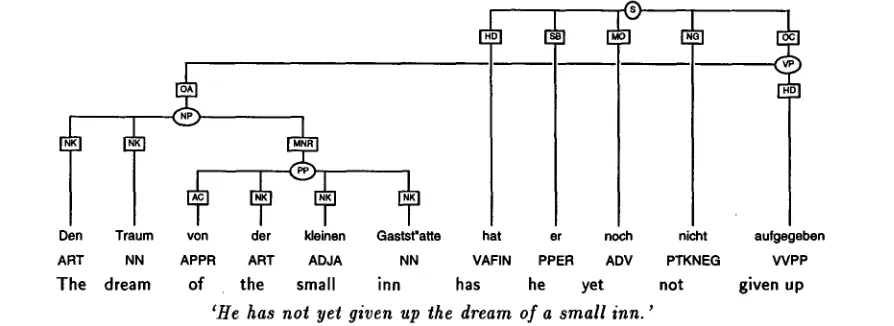
Existing treebanks of English ((Marcus et al., 1994), (Sampson, 1995), (Black et al., 1996)) contain con- ventional phrase-structure trees augmented with an- notations for discontinuous constituents. As this en- coding strategy is not well-suited to a free word or- der language like German, we have focussed on a less surface-oriented level of description, most closely re- lated to the LFG f-structure, and representations used in dependency grammar. To avoid confusion with theory-specific constructs, we use the generic term argument structure to refer to our annotation format. The main advantages of the model are: it is relatively theory-independent and closely related to semantics. For more details on the linguistic speci- fications of the annotation scheme see (Skut et al., 1997). A similar approach has been also successfully applied in the T S N L P database, cf. (Lehmann et al., 1996).
Den ART
The
Traum NN
dream
+
von
APPR
of
der k l e i n e n Gastst"atte hat er noch
ART ADJA NN VAFIN PPER ADV
the small inn has he yet
'He has not yet given up the dream of a small inn.' nicht
PTKNEG
not
aufgegeben
VVPP
given up
Figure 1: Example sentence
of non-projective phenomena see (Tapanainen and J/irvinen, 1997).
Such a representation permits clear separation of word order (in the surface string) and syntactic de- pendencies (in the hierarchical structure). Thus we avoid explicit explanatory statements about the complex interrelation between word order and syn- tactic structure in free word order languages. Such statements are generally theory-specific and there- fore are not appropriate for a descriptive approach to annotation. The relation between syntactic de- pendencies and surface order can nontheless be in- ferred from the data. This provides a promising way of handling free word order phenomena. 2.
3 A n n o t a t i o n T o o l
Since syntactic annotation of corpora is time- consuming, a partially automated annotation tool has been developed in order to increase efficiency. 3.1 T h e U s e r I n t e r f a c e
For optimal human-machine interaction, the tool supports immediate graphical representation of the structure being annotated.
Since keyboard input is most efficient for assigning categories to words and phrases, cf. (Lehmann et al., 1996; Marcus et al., 1994), and structural manipula- tions are executed most efficiently using the mouse, both an elaborate keyboard and optical interface is provided. As suggested by Robert MacIntyre 3, it is hout this paper.
2'Free' word order is a function of several interacting parameters such as category, case and topic-focus arti- culation. Varying the order of words in a sentence yields a continuum of grammaticality judgments rather than a simple right-wrong distinction.
3personal communication, Oct. 1996
most efficient to use one hand for structural com- mands with the mouse and the other hand for short keyboard input.
By additionally offering online menus for com- mands and labels, the tool suits beginners as well as experienced users. Commands such as "group words", "group phrases", "ungroup", "change la- bels", "re-attach nodes", "generate postscript out- put", etc. are available.
The three tagsets (word, phrase, and edge labels) used by the annotation tool are variable. They are stored together with the corpus, which allows easy modification and exchange of tagsets. In addition, appropriateness checks are performed automatically. Comments can be added to structures.
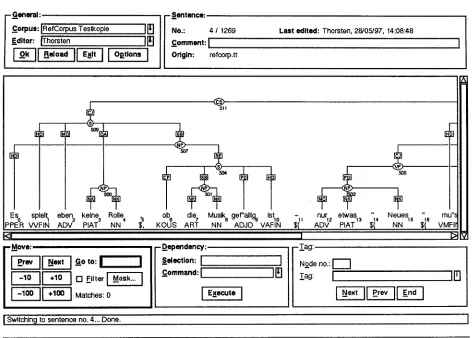
Figure 2 shows a screen dump of the graphical interface.
3.2 A u t o m a t i n g A n n o t a t i o n
Existing treebank annotation tools are characterised by a high degree of automation. The task of the annotator is to correct the output of a parser, i.e., to eliminate wrong readings, complete partial parses, and adjust partially incorrect ones.
Since broad-coverage parsers for German, espe- cially robust parsers that assign predicate-argument structure and allow crossing branches, are not availa- ble, or require an annotated traing corpus (cf. (Col- lins, 1996), (Eisner, 1996)).
[image:2.612.84.531.76.239.2]- G_enm'al:
Corpus: IRefCorpus Tes~,ople I J~]
Editor: IThorsten J~]
I-~-Ii _,,oa, li E.,t i i O~,o°. i
-Sentence:
No.: 4 / 1269 Comment: I
Odgln: refcorp.tt
Last edited: Thorsten, 28/05/97, 14:08:48
Es o spleit I ebe~ keine 3 Roll%
PPER WFIN ADV PlAT NN
I<U
511
KOUS ART NN
gef"~llg 9 iS~o ADJD VAFIN
-Move:
I .~r~, II _"..' I ~_o'o:'
,
I -,o II +,o I D ~,,,e,
I -'°° II +,oo I Mat~eo:o
i r--_Dependeney:
/ -s¢~''°n: I
_Command: I
|
i ~-"~'° I
I
IB
_
our o ,o
"°u°"' ;i'
m u ,I
i
T ag:
Node no.: I J
Zag:
I
IB
I-""' II "-'°~ I1-~-I
I Switchin~ to sentence no, 4.,. Done.
Figure 2: Screen dump of the annotation tool
predictions of the parser. The size of such 'super- vision increments' varies from local trees of depth one to larger chunks, depending on the amount of training d a t a available.
We distinguish six degrees of automation: 0) Completely manual annotation.
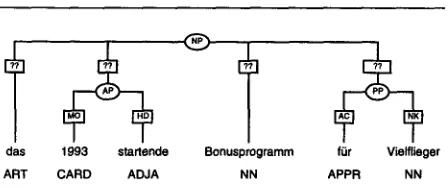
1) The user determines phrase boundaries and syntactic categories (S, NP, VP, . . . ) . The pro- gram automatically assigns grammatical func- tions. The annotator can alter the assigned tags (cf. figure 3).
2) The user only determines the components of a new phrase (local tree of depth 1), while both category and function labels are assigned auto- matically. Again, the annotator has the option of altering the assigned tags (cf. figure 4). 3) The user selects a substring and a category,
whereas the entire structure covering the sub- string is determined automatically (cf. figure 5). 4) The program performs simple bracketing, i.e.,
finds 'kernel phrases' without the user having to explicitly mark phrase boundaries. The task can be performed by a chunk parser t h a t is equipped with an appropriate finite state gram- mar (Abney, 1996).
5) The program suggests partiM or complete par- ses.
[image:3.612.73.545.77.415.2]das 1993 startende Bonusprogramm for Vielflieger ART CARD ADJA NN APPR NN
'the bonus program for .h'equent fliers starting in 1993'
Figure 3: Example for automation level 1: the user has marked das, the AP, Bonusprogramm, and the PP as a constituent of category NP, and the tool's task is to determine the new edge labels (marked with question marks), which are, from left to right,
NK, NK, NK, MNR.
das 1993 s t a r t e n d e Bonusprogramm ffir Vielflieger
ART CARD ADJA NN APPR NN
'the bonus program for frequent fliers starting in 1993'
Figure 4: Example for automation level 2: the user has marked das, the AP, Bonusprogramm and the PP as a constituent, and the tool's task is to determine the new node and edge labels (marked with question marks).
1000 words per hour.
At present, the treebank comprises 3000 sent- ences, each annotated independently by two anno- tators. 1,200 of the sentences are compared with the corresponding second annotation and are clea- ned, 1,800 are currently cleaned.
In the following sections, the automation steps 1 and 2 are presented in detail.
4 T a g g i n g G r a m m a t i c a l F u n c t i o n s 4.1 T h e T a g g e r
In contrast to a standard part-of-speech tagger which estimates lexical and contextual probabilities of tags from sequences of word-tag pairs in a corpus, (e.g. (Cutting et al., 1992; Feldweg, 1995)), the tag- ger for grammatical functions works with lexical and contextual probability measures Pq(.) depending on the category of the mother node (Q). Each phrasal category (S, VP, NP, PP etc.) is represented by a different Markov model. The categories of the dau-
+++®+ ++
das 1993 s t a r t e n d e Bonusprograrnm for VielfliegerART CARD ADJA NN APPR NN
'the bonus program for frequent fliers starting in 1993'
Figure 5: Example for automation level 3: the user has marked the words as a constituent, and the tool's task is to determine simple sub-phrases (the AP and
PP) as well as the new node and edge labels (cf. previous figures ~br the resulting structure).
Selbst
ADV
himself
l"l
besucht hat Peter
VVPP VAFIN NE
visited has Peter
+l
Sabine nie
NE ADV
Sabine never
'Peter never visited Sabine himself'
Figure 6: Example sentence
ghter nodes correspond to the outputs of the Mar- kov model, while grammatical functions correspond to states.
The structure of a sample sentence is shown in figure 6. Figure 7 shows those parts of the Markov models for sentences (S) and verb phrases (VP) that represent the correct paths for the example. 4
Given a sequence of word and phrase categories T = T1...Tk and a parent category Q, we cal- culate the sequence of grammatical functions G = G1 . . . Gk that link T and Q as
argmaxPQ(GIT ) (1)
G
Pq(a). Pq(TIC)
= argmax
a PQ(T)
= argm xPq(a).
Pq(TJG)
G
Assuming the Markov property we have
[image:4.612.64.288.65.159.2] [image:4.612.304.530.242.395.2] [image:4.612.65.292.271.362.2]VP VA FIN NE A D V
& - - @ - - ® - - - ® - - @ - - ®
O ~m m ~a
o ~ .2. ~ ~-
ADV VVPP NE
Ps(ADVIMO) 1 PVp (VVPP IHD) l Pvp(N~IOA) 1
N ~ o
o ~ d d
Figure 7: Parts of the Markov models used in Selbst besucht hat Peter Sabine hie (cf. figure 6). All unused states, transitions and outputs are omitted.
and
k
PQ(TIG)
= I I PQ(~qlG,)
(2)
i = 1
k
Pq(a) = I I P (a, lC,)
(3)
i = 1The contexts Ci are modeled by a fixed number of surrounding elements. Currently, we use two gram- matical functions, which results in a trigram model:
PO(G) = H Po(GiIGi-2, Gi-1) (4) i = 1
The contexts are smoothed by linear interpolation of unigrams, bigrams, and trigrams. Their weights are calculated by deleted interpolation (Brown et al., 1992).
T h e predictions of the tagger are correct in ap- prox. 94% of Ml cases. In section 4.3, we demons- trate how to cope with wrong predictions.
4.2 S e r i a l O r d e r
As the annotation f o r m a t permits trees with crossing branches, we need a convention for determining the relative position of overlapping sibling phrases in or- der to assign t h e m a position in a Markov model. For instance, in figure 6 the range of the terminal node positions of VP overlaps with those of the subject
$B and the finite verb HD. Thus there is no single a-priori position for the VP node 5.
The position of a phrase depends on the position of its descendants. We define the relative order of two phrases recursively as the order of their anchors, i.e., some specified daughter nodes. If the anchors are words, we simply take their linear order.
The exact definition of the anchor is based on lin- guistic knowledge. We choose the most intuitive al- ternative and define the anchor as the head of the phrase (or some equivalent function). Noun phrases do not necessarily have a unique head; instead, we use the last element in the noun kernel (elements of the noun kernel are determiners, adjectives, and nouns) to mark the anchor position. Except for NPs, we employ a default rule t h a t takes the leftmost ele- ment as the anchor in case the phrase has no (uni- que) head.
Thus the position of the VP in figure 6 is defined as equal to the string position of besucht. T h e po- sition of the VP node in figure 1 is equal to that of anfgegeben, and the position of the NP in figure 3 is equivalent to that of Bonusprograrara.
4.3 R e l i a b i l i t y
[image:5.612.84.544.63.282.2]tomatic annotation is useful only if it is absolutely correct, while wrong analyses are often difficult to detect and their correction can be time-consuming. To prevent the human annotator from missing er- rors, the tagger for grammatical functions is equip- ped with a measure for the reliability of its output.
Given a sequence of categories, the tagger cal- culates the most probable sequence of grammatical functions. In addition, it computes the probabili- ties of the second-best functions of each daughter node. If some of these probabilities are close to that of the best sequence, the alternatives are regarded as equally suited and the most probable one is not taken to be the sole winner, the prediction is marked as unreliable in the output of the tagger.
These unreliable predictions can be further classi- fied in that we distinguish "unreliable" sequences as opposed to "almost reliable" ones.
The distance between two probabilities for the best and second-best alternative, Pbest and Pse¢ond, is measured by their quotient. The classification of reliability is based on thresholds. In the current im- plementation we employ three degrees of reliability which are separated by two thresholds 01 and 02. 01 separating unreliable decisions from those conside- red almost reliable. 02 marks the difference between almost and fully reliable predictions.
U n r e l i a b l e :
Pbes---k- < 01 Pseeond
The probabilities of alternative assignments are wi- thin some small specified distance. In this case, it is the annotator who has to specify the grammatical function.
A l m o s t r e l i a b l e :
01 < Pbes_____t__ < 02 Psecond
The probability of an alternative is within some lar- ger distance. In this case, the most probable func- tion is displayed, but the annotator has to confirm it.
R e l i a b l e :
Pbes---L- __> 02 Psecond
The probabilitiesof all alternatives are much smaller than that of the best assignment, thus the latter is assigned.
For efficiency, an extended Viterbi algorithm is used. Instead of keeping track of the best path only (of. (Rabiner, 1989)), we keep track of all paths that fall into the range marked by the probability of the best path and 02, i.e., we keep track of all alternative paths with probability
Palt
for whichPbest Part _> 02 "
Suitable values for 01 and 02 were determined em- pirically (cf. section 6).
5 T a g g i n g P h r a s e C a t e g o r i e s
The second level of automation (cf. section 3) au- tomates the recognition of phrasal categories, and so frees the annotator from typing phrase labels. The task is performed by an extension of the tag- ger presented in the previous section where different Markov models for each category were introduced. The annotator determines the category of the cur- rent phrase, and the tool runs the appropriate model to determine the edge labels.
To assign the phrase label automatically, we run all models in parallel. Each model assigns gramma- tical functions and, more important for this step, a probability to the phrase. The model assigning the highest probability is assumed to be most ade- quate, and the corresponding label is assigned to the phrase.
Formally, we calculate the phrase category Q (and at the same time the sequence of grammatical func- tions G = G1 . . . Gk) on the basis of the sequence of daughters T = T1 . . . Tk with
argmax
maXPQ(G]T).
O G
This procedure is equivalent to a different view on the same problem involving one large (combined) Markov model that enables a very efficient calcula- tion of the maximum.
Let ~Q be the set of all grammatical functions that can occur within a phrase of type Q. Assume that these sets are pairwise disjoint. One can easily achieve this property by indexing all used gramma- tical functions with their associated phrases and, if necessary, duplicating labels, e.g., instead of using HD, MO, . . . , use the indexed labels HDs,
HDvp,
MONp, ...This
property makes it possible to deter- mine a phrase category by inspecting the gramma- tical functions involved.When applied, the combined model assigns gram- matical functions to the elements of a phrase (not knowing its category in advance). If transitions bet- ween states representing labels with different indices are forced to zero probability (together with smoo- thing applied to other transitions), all labels assi- gned to a phrase get the same index. This uniquely identifies a phrase category.
The two additional conditions
G e GQi :=v G ¢ GQ2 (Qi ¢ Q2)
and
are sufficient to calculate
argmax P( G[T)
G
using the Viterbi algorithm and to identify both the phrase category and the respective grammatical functions.
Again, as described in section 4, we calculate pro- babilities for alternative candidates in order to get reliability estimates.
The overall accuracy of this approach is approx. 95%, and higher if we only consider the reliable ca- ses. Details about the accuracy are reported in the next section.
6 E x p e r i m e n t s
To investigate the possibility of automating anno- tation, experiments were performed with the clea- ned part of the treebank 6 (approx. 1,200 sentences, 24,000 words). T h e first run of experiments was car- ried out to test tagging of grammatical functions, the second run to test tagging of phrase categories. 6.1 G r a m m a t i c a l F u n c t i o n s
This experiment tested the reliability of assigning grammatical functions given the category of the phrase and the daughter nodes (supplied by the an- notator).
Let us consider the sentence in figure 6: two se- quences of grammatical functions are to be determi- ned, namely the grammatical functions of the dau- ghter nodes of S and VP. The information given for selbst besucht Sabine is its category (VP) and the daughter categories: adverb (ADV), past parti- ciple
(wee),
and proper noun (NE). The task is to assign the functions modifier (MO) to ADV, head (SO) to w e e and direct (accusative) object (OA) to NE. Similarly, function tags are assigned to the components of the sentence (S).The tagger described in section 4 was used. The corpus was divided into two disjoint parts, one for training (90% of the respective corpus), and one for testing (10%). This procedure was repeated 10 times with different partitions. Then the average accuracy was calculated.
The thresholds for search beams were set to 61 = 5 and 62 = 100, i.e., a decision is classified as reliable if there is no alternative with a probability larger than 1~0 of the best function tag. The prediction is classified as unreliable if the probability of an al- ternative is larger than ~ of the most probable tag. 6The corpus is part of the German newspaper text provided on the ECI CD-ROM. It has been part-of- speech tagged and manually corrected previously, cf. (Thielen and Schiller, 1995).
Table 1: Levels of reliability and the percentage ca- ses where the tagger assigned a correct grammati- cal function (or would have assigned if a decision is forced).
reliable marked unreliable overall
cases correct 89% 96.7% 7% 84.3% 4% 57.3% 100% 94.2%
If there is an akernative between these two thres- holds, the prediction is classified as almost reliable and marked in the o u t p u t (cf. section 4.3: marked assignments are to be confirmed by the annotator, unreliable assignments are deleted, annotation is left to the annotator).
Table 1 shows tagging accuracy depending on the three different levels of reliability. T h e results con- firm the choice of reliability measures: the lower the reliability, the lower the accuracy.
Table 2 shows tagging accuracy depending on the category of the phrase and the level of reliability. The table contains the following information: the number of all mother-daughter relations (i.e., num- ber of words and phrases which are immediately do- minated by a mother node of a particular category), the overall accuracy for t h a t phrasal category and the accuraciees for the three reliability intervals. 6.2 E r r o r A n a l y s i s f o r F u n c t i o n
A s s i g n m e n t
The inspection of tagging errors reveals several sour- ces of wrong assignments. Table 3 shows the 10 most frequent errors 7 which constitute 25% of all errors (1509 errors occurred during 10 test runs).
Read the table in the following way: line 2 shows the second-most frequent error. It concerns NPs oc- curring in a sentence (S); this combination occurred 1477 times during testing. In 286 of these occur- rences the N P is assigned the grammatical function OA (accusative object) manually, but of these 286 cases the tagger assigned the function SB (subject) 56 times.
The errors fall into the following classes:
Table 2: Tagging accuracy for assigning grammatical functions depending on the category of the mother node. For each category, the first row shows the per- centage of branches that occur within this category and the overall accuracy, the following rows show the relative percentage and accuracy for different levels of reliability.
cases correct
S 26% 89.1%
decision 85% 92.7%
marked 8% 81.9%
no decision 7% 52.9%
VP 7% 90.9%
decision 97% 92.2%
marked 1% 57.7%
no decision 2% 52.3%
NP 26% 96.4%
decision 86% 98.6%
marked 10% 86.8%
no decision 4% 73.0%
PP 24% 97.9%
decision 92% 99.2%
marked 6% 85.8%
no decision 2% 75.5%
others 18% 94.7%
decision 91% 98.0%
marked 6% 82.8%
no decision 3% 22.1%
Table 3: The 10 most frequent errors in assigning grammatical functions. T h e table shows a mother and a daughter node category, the frequency of this particular combination (sum over 10 test runs), the grammatical function assigned manually (and its fre- quency) and the grammatical function assigned by the tagger (and its frequency).
phrase elem f original assigned
5. 6. 7. 8. 9. 10.
1. S 2. S
3. NP
4. S
PP VP S
S S
VP
NP 1477
NP 1477
PP 470
VP 613
PP 252
NP 286
NP 1477
NP 1477
S 186
PP 453
SB OA PG PD PG DA PD MO MO SBP
894 OA 286 SB
52 MNR 47 OC 30 MNR 32 OA 72 SB 33 SB 78 PD 21 MO
65 56 50 42 30 26 25 21 21 21
OA (accusative object) on the basis of its position, which is not very reliable in German. Missing in- formation in the labels is the main source of errors. Therefore, we currently investigate t h e benefits of a morphological component and percolation of selec- ted information to parent nodes.
2. Due to the n-gram approach, the tagger only sees a local window of the sentences.
Some linguistic knowledge is inherently global, e.g., there is at most one subject in a sentence and one head in a VP. Errors of this type m a y be reduced by introducing finite state constraints t h a t restrict the possible sequences of functions within each phrase.
3. The manual annotation is wrong, and a correct tagger prediction is counted as an error. At earlier stages of annotation, the main source of errors was wrong or missing manual annotation. In some cases, the tagger was able to abstract from these errors during the training phase and subse- quently assigned the correct tag for the test data. However, when performing a comparison against the corpus, these differences are marked as errors. Most of these errors were eliminated by comparing two independent annotations and cleaning up the data. 6.3 P h r a s e C a t e g o r i e s
In this experiment, the reliability of assigning phrase categories given the categories of the daughter nodes (they are supplied by the annotator) was tested.
[image:8.612.309.531.154.283.2] [image:8.612.77.279.261.605.2]Table 4: Levels of reliability and the percentage of cases in which the tagger assigned a correct phrase category (or would have assigned if a decision is forced).
reliable marked unreliable overall
cases correct 79% 98.5% 16% 90.4% 5% 65.9% 100% 95.4%
(VVPP), and proper noun (NE). The task is to as- sign category VP. Subsequently, S is to be assigned based on the categories of the daughters VP, VAFIN,
NE,
andADV.
The extended tagger using a combined model as described in section 5 was applied.
Again, the corpus is divided into two disjoint parts, one for training (90% of the corpus), and one for testing (10%). The procedure is repeated 10 times with different partitions. Then the average accuracy was calculated.
The same thresholds for search beams as for the first set of experiments were used.
Table 4 shows tagging accuracy depending on the three different levels of reliability.
Table 5 shows tagging accuracy depending on the category of the phrase and the level of reliability. The table contains the following information: the percentage of occurrences of the particular phrase, the overall accuracy for that phrasal category and the accuracy for each of the three reliability inter- vals.
6.4 E r r o r A n a l y s i s f o r C a t e g o r y
Assignment
When forced to make a decision (even in unrelia- ble cases) 435 errors occured during the 10 test runs (4.5% error rate). Table 6 shows the 10 most- frequent errors which constitute 50% of all errors.
The most frequent error was the confusion of S and VP. They differ in that sentences S contain fi- nite verbs and verb phrases VP contain non-finite verbs. But the tagger is trained on data that con- tain incomplete sentences and therefore sometimes erroneously assumes an incomplete S instead of a VP. To avoid this type of error, the tagger should be able to take the neighborhood of phrases into ac- count. Then, it could detect the finite verb that completes the sentence.
Adjective phrases AP and noun phrases NP are confused by the tagger (line 5 in table 6), since al- most all AP's can be NP's. This error could also
Table 5: Tagging accuracy for assigning phrase cate- gories, depending on the manually assigned category. For each category, the first row shows the percentage of phrases belongi:lg to a specific category (accor- ding to manual ~,zsignment) and the percentage of correct assignments. The following rows show the relative percentage and accuracy for different levels of reliability.
cases correct
S 20% 97.5%
decision 96% 99.7%
marked 2% 63.2%
no decision 2% 29.0%
VP 9% 93.2%
decision 71% 96.4%
marked 24% 91.3%
no decision 5% 60.9%
NP 29% 96.1%
decision 81% 99.3%
marked 13% 91.8%
no decision 6% 64.9%
PP 24% 98.7%
decision 94% 99.6%
marked 4% 92.5%
no decision 2% 70.8%
others 18% 89.0%
decision 42% 91.7%
marked 45% 90.6%
[image:9.612.318.549.267.642.2]Table 6: The 10 most frequent errors in assigning phrase categories (summed over reliability levels). The table shows the phrase category assigned manu- ally (and its frequency) and the category erroneously assigned by the tagger (and its frequency).
I°
2. 3. 4. 5. 6. 7. 8. 9. 10.
phrase f assigned
VP 828 S
NP 2812 NM NP 2812 PP NP 2812 S AP 419 NP DL 20 CS
PP 2298 NP
S 1910 NP AP 419 PP MPN 293 NP
46 32 31 25 15 15 15 15 11 11
be fixed by inspecting the context and detecting the associated NP.
As for assigning grammatical functions, insuffi- cient information in the labels is a significant source of errors, cf. the second-most frequent error. A large number of cardinal-noun pairs forms a nume- rical component (NM), like 7
Millionen, 50 Prozent,
etc
(7 million, 50 percent).
But this combination also occurs in NPs like 20Leule, 3 Monate, ... (20
people, 3 months),
which are mis-tagged since they are less frequent. This can be fixed by introducing an extra tag for nouns denoting numericals.7
Conclusion
A German newspaper corpus is currently being an- notated with a new annotation scheme especially de- signed for free word order languages.
Two levels of automatic annotation (level 1: assi- gning grammatical functions and level 2: assigning phrase categories) have been presented and evalua- ted in this paper.
The overall accuracy for assigning grammatical functions is 94.2%, ranging from 89% to 98%, de- pending on the type of phrase. The least accuracy is achieved for sentences, the best for prepositional phrases. By suppressing unreliable decisions, pre- cision can be increased to range from 92% to 99%.
The overall accuracy for assigning phrase catego- ries is 95.4%, ranging from 89% to 99%, depending the category. By suppressing unreliable decisions, precision can also be increased to range from 92% to over 99%.
In the error analysis, the following sources of mi- sinterpretation could be identified: insufficient lin- guistic information in the nodes (e.g., missing case information), and insufficient information about the
global structure of phrases (e.g., missing valency in- formation). Morphological information in the tag- set, for example, helps to identify the objects and the subject of a sentence. Using a more fine-grained tagset, however, requires methods for adjusting the granularity of the tagset to the size (and coverage) of the corpus, in order to cope with the sparse data problem.
8
A c k n o w l e d g e m e n t s
This work is part of the DFG Sonderforschungs- bereich 378
Resource-Adaptive Cognitive Processes,
Project C3
Concu rent Grammar Processing.
We wish to tl~ank the universities of Stuttgart and Tiibingen for kindly providing us with a hand- corrected part-of-speech tagged corpus. We also wish to thank Jason Eisner, Robert MacIntyre and Ann Taylor for valuable discussions on dependency parsing and the Penn Treebank annotation. Special thanks go to Oliver Plaehn, who implemented the annotation tool, and to our six fearless annotators.
References
Abney, Steven. 1996. Partial parsing via finite-state cascades. In
Proceedings of the ESSLLI'96 Robust
Parsing Workshop,
Prague, Czech Republic. Black, Ezra, Stephen Eubank, Hideki Kashioka,David Magerman, Roger Garside, and Geoffrey Leech. 1996. Beyond skeleton parsing: Producing a comprehensive large-scale general-english tree- bank with full grammaticall analysis. In
Proc. of
COLING-96,
pages 107-113, Kopenhagen, Den- mark.Brown, P. F., V. J. Della Pietra, Peter V. deSouza, Jenifer C. Lai, and Robert L. Mercer. 1992. Class- based n-gram models of natural language.
Com-
putational Linguistics,
18(4):467-479.Collins, Michael. 1996. A new statistical parser ba- sed on bigram lexical dependencies. In
Procee-
dings ofACL-96,
Sant Cruz, CA, USA.Cutting, Doug, Julian Kupiee, Jan Pedersen, and Penelope Sibun. 1992. A practical part-of-speech tagger. In
Proceedings of the 3rd Conference on
Applied Natural Language Processing (ACL),
pa- ges 133-140.Eisner, Jason M. 1996. Three new probabilistic models for dependency parsing: An exploration. In
Proceedings of COLING-96,
Kopenhagen, Den- mark. [image:10.612.59.284.141.271.2]In
Proceedings of EACL-SIGDAT-95 Workshop,
Dublin, Ireland.
Lehmann, Sabine, Stephan Oepen, Sylvie Regnier- Prost, Klaus Netter, Veronika Lux, Judith Klein, Kirsten Falkedal, Frederik Fouvry, Dominique Estival, Eva Dauphin, I-Ierv~ Compagnion, Judith Baur, Lorna Balkan, and Doug Arnold. 1996. TS-
NLP -- Test Suites for Natural Language Proces-
sing. In
Proceedings of COLING 1996,
Kopenha-gen.
Marcus, Mitchell, Grace Kim, Mary Ann Marcinkie- wicz, Robert MacIntyre, Ann Bies, Mark Fergu- son, Karen Katz, and Britta Schasberger. 1994. The penn treebank: Annotating predicate argu-
ment structure. In
Proceedings of the Human Lan-
guage Technology Workshop,
San Francisco, Mor- gan Kaufmann.Rabiner, L. R. 1989. A tutorial on hidden markov models and selected applications in speech reco-
gnition. In
Proceedings of the IEEE,
volume 77(2),pages 257-285.
Sampson, Geoffrey. 1995.
English for the Computer.
Oxford University Press, Oxford.
Skut, Wojciech, Brigitte Krenn, Thorsten Brants, and Hans Uszkoreit. 1997. An annotation scheme
for free word order languages. In
Proceedings of
ANLP-97,
Washington, DC.Tapanainen, Pasi and Timo J~irvinen. 1997. A non-
projective dependency parser. In
Proceedings of
ANLP-97,
Washington, DC.Thielen, Christine and Anne Schiller. 1995. Ein klei-
nes und erweitertes Tagset ffirs Deutsche. In
Ta-
gungsberichte des Arbeitstreffens Lezikon + Text
17./18. Februar 1994, Schlofl Hohent~bingen. Le-
zicographica Series Maior,
Tfibingen. Niemeyer.A p p e n d i x A:
T a g s e t sThis section contains descriptions of tags used in this
paper. These are
not
complete lists.ADJA attributive adjective
ADJ D adverbial adjective
ADV adverb
APPR preposition
ART article
CARD cardinal number
FM foreign material
KOKOM comparing conjunction
KOUS sub-ordinating conjunction
NE proper noun
N N common noun
PlAT indefinite pronoun
PPER personal pronoun
PTKNEG negat".~n
VAFIN finit,~ auxiliary
VMFIN finite modal verb
VVPP past participle of main verb
A.2 Phrasal Categories
AP adjective phrase
CS coordination of sentences
DI. discurse level
MPN multi-word proper noun
N M multi-token numerical
N P noun phrase
PP prepositional phrase
S sentence
VP verb phrase
A.3 G r a m m a t i c a l F u n c t i o n s
AC adpositional case marker
CJ conjunct
DA dative
HD head
JU junctor
MNR post-nominal modifier
MO modifier
NG negation
NK noun kernel
OA accusative object
OC clausal object
PD predicative
PG pseudo genitive
PNC proper noun component
SB subject
SBP passivized subject
SP subject or predicative