Electronegativity: A Mnemonic Number Code for
an Atom
P. Ramakrishnan
Chemical Engineering Department, National Institute of Technology, Rourkela, Odisha – 769008, India
Abstract: An attempt is made to substantiate that, electronegativity expressed as Hellman-Feynman force(Force by Nucleus on electron) or Ehrenfest force(Force by electron on Nucleus) will be accurate and absolute. The concept of Hellman-Feynman force as an equivalence of Born-Oppenheimer approximated energy for di-atomic system and Hartree-Fock force as an equivalence of Hartree-Fock approximated energy for polyatomic system have been critically analyzed. An extended theory of Electronegativity based on Force concept is established. Electronegativity values computed for various elements using Hellmann-Feynman force exerted on the nuclei and the Ehrenfest force exerted on the electron density are presented.
I. INTRODUCTION
All models of electronegativity are theorized by individual’s intuition. The qualitative understanding of electronegativity is not up to the mark. Universal acceptance on the common agreement of the all models till to 2019 A.D seems impossible. Force model of electronegativity was defined first by AL Allred and EG Rochow[1] with help of electrostatic field. According to this definition, electronegativity is equal to Coulomb force of attraction between the nucleus and an electron at the covalent radius.
2 *
2
AR
e
Z
r
c
º
(1)Where Z*=Z – σ, r is covalent radius for the atom(considering smaller value as well as outer radial maxima). The Coulomb force is a measure of power of an atom in a molecule that drags electron towards nucleus. Therefore, electronegativity is an absolute one.
AR
c
dimension is not straight forward as it is evaluated through eq. 1. The quantity Z*/r2 was calculated through Pauling’s work and Slater rules[2,3]. Pauling’s Scale and Allred-Rochow scale can be made to coincide by expressing the electronegativity from the electrostatic approach as the linear function of Z*/r2.Here mean radius is expressed in picometer.3590(
/ 2)
0.744
AR
z
r
EQ (2) WHERE 3590 AND 0.744 ARE NUMERICAL CONSTANTS.Introduction of the idea of force into electronegativity theory makes this scale seem quite consistent with Pauling’s definition. It also emphasizes the idea for simple calculation, because r and Z* are readily available quantities for many elements. It is to be noted that, this scale independent of electron affinities and bond dissociation energies. Slater rules for finding effective nuclear charge are empirical.
Four extension of the Allred and Rochow’s idea were reported by different authors. The first extension of Allred-Rochow scale by Huhee[4] is based on two assumptions, r of order (1/Z*) and Z*of order σ.
(
*)
2
3
0.36
0.74
H
Z
r
s
c
=
´
-
+
(3)The second extension of Allred-Rochow scale by Boyd and Markus[5]is based on non empirical approach. The empirical covalent radius is replaced by relative covalent radius obtained from the free atom wave function by density contour technique. The effective nuclear charge is obtained through integration of radial density function from nucleus to relative distance. Electrostatic electronegativity is expressed as,
2
0
1
( )
r
Z
r dr
r
c
r
é
ù
ê
ú
=
ê
-
ú
ê
ú
ë
ò
û
The radial charge density ρ(r) can be obtained from the Hartree Fock atomic orbitals data[113], [114]. The computed electronegativity values follow the general pattern of Mulliken ground state electronegativity values with an
exception for groups 2 and 3 of periodic table because ρ(r) decreases as per the expectation rule i.e.
IP
´
r
> ¥
.The third extension of the scale was made Mande et al. [6] where the value of effective nuclear (Z*) charge was obtained spectroscopic analysis. Therefore, the values become less arbitrary than that of Slater’s. This electronegativity scale is more fundamental and reliable. The correlation of the scale is excellent with that of Pauling’s scale. The electronegativity values obtained for 1st transition metals are more reasonable than Allred-Rochow scale.
The fourth extension of this scale was made by Yonghe Zhang[7] where electronegativity was calculated on the basis of electrostatic force given by,
*
2
/
z
IP
Ry
F
n
r
=
´
(5)WHERE
2 *
*
z
Z
IP
Ry
n
æ
ö
÷
ç
÷
=
ç
÷
ç
÷
è
ø
(6)Z
IP
is ultimate ionization potential for outer electron. This type of scale is based on the concept of different electron attracting power of an element in different valence state. Therefore, electronegativity is termed as a function of oxidation number. Zhang has also reported dual parameter equation[12]. Zhang electronegativity is given by,0.241
0.775
Z
F
c
=
+
(7)2
7.7
Z8.0
i
Z
Z
r
c
=
-
+
(8)In this section, an independent approach to define electronegativity is presented. The force expression based on Hellmann-Feynman theorem is proposed as electronegativity. Moreover, this force must be equivalent to the primary definition of electronegativity such as ability of an atom to attract electron towards itself. Following the proposition, the definition of electronegativity becomes ‘inherent ability of an atom to attract and hold electron’. The electronegativity in terms of Hellmann Feynman force is equal to Born Oppenheimer force for an atom in diatomic system and Hartree -Fock force of an atom in poly atomic system. Prior to the force based definition of electronegativity and relevant correlations, the four relevant force concepts are briefly discussed. Born-Oppenheimer Force within the Born-Born-Oppenheimer approximation is expressed as a balance of two opposing terms such as one from Nuclear-Nuclear repulsions and other from Electron-Nuclear attraction. The latter is conceived as the 3-D electron density.This force concept arises out of Born Oppenheimer(BO) energy approximation. M Born and J R Oppenheimer[8], [9] have contributed a celebrated paper to science. It brings the systematic correspondence of the energy of electronic motion, nuclear vibration and rotation to the terms of power series in the fourth root of electron nucleus mass ratio. Born and Oppenheimer
suggested that total wave function (
y
) can be written as the product of the nuclear wave function (y
n) and electronic wavefunction (
y
e). This approximation simplifies complicated Schrödinger equation into electronic equation (H
ey
e=
E
ey
e) and nuclear equation (H
ny
n=
E
ey
e). The equation devised by them for the rotation represents a generalization of the treatment of Kramers theorem and Pauli exclusion principle. This approximation also justifies Frank-Condon principle used in explaining the intensity of band lines. In the last several decades, rigorous mathematical work has been reported on the validity of the BO approximation. Quite a few number of papers contain the study of BO have reported that, a reduced Hamiltonian is an appreciable approximation to true molecular HamiltonianHowever, a few of those are closely related to works on semi classical Schrodinger matrix operators[10-26]. BO approximation is based on “assumption of ignoring motions of nearly stationary nuclei with much larger mass and smaller velocity with respect to motion of electron with much smaller mass and larger velocity”. The approximation holds good for the ground state of molecule and breaks down for the excited state. Complete Hamiltonian is represented as=
n e=
n e nn en ee2 2
, , ,
1
1
1
H=
2
2
A B A
A i
A i B A B A A i i A i j i j
Z Z
Z
R
R
r
R
r
r
-
Ñ -
Ñ +
-
+
-
-
-å
å
å
å
å
10Again, Molecular Hamiltonian (Hmol)
2
2 2
, , ,
1
1
1
2
2
mol A B A
A i
A i B A B A A i i A i j i j
Z Z
Z
H
R
R
r
R
r
r
l
l
= -
Ñ -
Ñ +
-
+
-
-
-å
å
å
å
å
11λ is treated as parameter and it may vary between 0 and 1. The exact solution to the electronic Schrodinger equation, obtained from
BO approximation can be reachable for one electron systems.
II. HARTREE-FOCK FORCE
This force concept arises out of Hartree-Fock energy approximation for multi electronic systems. The Hartree-Fock approximation is a good enough to approximate the energies and wave function. The electronic Hamiltonian and energy based on Hartree-Fock approximation can be written as follows .
( )
( , )
e nn
i
H
V
a b
z a
h a b
<
=
å
+
å
+
12The first term represents a one electron operator, the second term represents a two electron operator and third term is a constant for the fixed set of nuclear coordinates
1
([
|
] [
|
])
2
hf
E
a ab
a z b
a a bb
a b ba
=
å
+
å
-
13Where the first term represents one electron integral, the second term represents two electron Coulomb integral, the third term represents exchange integral. All the integrals can be computed by existing computer algorithms. The energy difference between non relativistic energy of the system and Hartree-Fock limit energy is considered as both static and dynamic electronic correlation
energy. The derivative (
- 
H
e/

V
) of electronic Hamiltonian operator w.r.t. distance of nucleus of an atom from electron can also be defined in quantum mechanics and also this represents the force on atom A due to electrons. Furthermore, within simple Born-Oppenheimer approximation and Hartree-Fock approximation, Energy (E) plays the role of potential energy for actual motion. Moreover,
E
/

V
replaces the above derivative and it is equal to the BO force (also Hartree Fock force) because nuclear coordinates are simply treated as external parameters.. This force is better to be termed as BO force in the steady state. The electronegativity will be equal to B-O force (also Hartree Fock force).III. HELLMAN-FEYNMAN FORCE
always involves an approximate charge density function. The advantage of calculating charge density is possible through molecular orbital method. The total force on a nucleus is simple sum of orbital contributions but total energy is not sum of orbital energies. The second advantage is that, force is an expectation value of one electron, momentum independent operator. It is more sensitive to any change in wave functions than energy. T Berlin[52] gave clear interpretation of this electrostatic force arising out of Hellmann Feynman theorem. This force is equivalent to infinitesimal change in energy per change in distance (parameter). Classical physics states that, a force is the negative gradient of energy. He proposed a term binding (related force acting on the nucleus) in place of bonding (related to changes in energy) in the picture of chemical bonding. He has proposed the physical partitioning of three dimensional space of electrons of diatomic system into a binding region (fi > 1), anti-binding region(fi< 1) and the nonbinding
region(fi =1) . The charge density is positive everywhere and thus the sign of contribution to force to the charge in each volume
element depends on the sign of fi. The net value of fi around 1 helps to assign the electronegativity to the concerned atom in
molecule for the diatomic system with ZB.>ZA, the anti-binding region for A is closed while anti-binding region for B in the limit
ZB>>ZA approaches a plane perpendicular to inter nuclear axis. The idea of closing of anti-binding region is used to justify to assign
more electronegativity value to B. Hellmann Feynman force equation can be written in various forms. At static equilibrium geometry, Hellman Feynman force is zero but at dynamical equilibrium geometry, this force can never be equal to zero for which the magnitude of Hellman Feynman force is reasonably to be construed as power of nucleus of an atom to attract electron towards itself.
GENERALIZED FORM OF HELLMAN FEYNMAN FORCE FOR BOTH STEADY STATE AND NON- STEADY STATE IS REPRESENTED AS,
'
/
* (
e/
)
F
V=
F
V= - 
E
¶ = -
V
ò
y y

H

V
dv
EQ 142 2
,
( )
A B A
B A
A B A i A
E
Z Z
Z
r dr
R
R
r
R
r
V

-
= -
+

å
-
ò
-
EQ 15Where the first term is independent of the electronic coordinates and is constant during integration over the coordinates. This term gives ordinary columbic force of repulsion between the nuclei. The second term represents charge density distribution due to ith electron.
,
( , )
2
A BA
B A A
A B A i A
E
Z Z
r
Z
dr
R
R
r
R
r
l
l
V

-
= -
+

å
-
å
ò
-
16Where the λ is a parameter which solves two problems. Firstly, it helps to apply simultaneously to all nuclei. Secondly it is a
continuous function between 0 and 1 so that differentiation of energy w.r.t. nuclear coordinates is made possible.
The other form of Hellmann-Feynman force equation can be written as
2
(
)
A
B i A
i A
Z
F
Z
f R
R
z
é
ù
ê
ú
=
-ê
ú
ë
å
û
17
1
( ) ( )
2
f r
r
r dr
= -
ò
WHICH IS ELECTRONIC CONTRIBUTION TO THE FORCE ON EITHER NUCLEUSThe term f(r) is called berlin quantity[52]. And also the electronic contribution in terms of the quantum mechanical average of the electric field operator is also mathematically represented as,
(
)
* 1
1
....
n
A A i A n
i
F
zZ
dr
y
r
R
-y
dr
=
é
ù
ê
ú
=
Ñ
-ê
ú
ë
å
û
The equivalence of the electron in the above equation is equivalent to n times the average force exerted on an atom by one electron so the above equation can be written in the form of electronic charge density.
(
)
1( )
A A A
F
z=
Z
ò
Ñ
r
-
R
-r
r dr
EQ. 19Where,
( )
( ) (1 2 ) 1 2
*
1 2
...
, ,..., , ,...,nn
n x x x x x x
r
n
ds
dx
dx
r
=
ò
ò
ò
y
y
Eq.20 Where ρ(r) denoteselectronic charge density in a stationary state, ρ(r) dr stands for amount of electronic charge in a volume element dv and xi
denotes the product of space co-ordinate (ri) and spin co-ordin ate(si)of the ith electron. The interpretation of ρ(r) as a physical
model of the electrons in line with the HF theorem includes the possibility of ascribing a value to the electrostatic force exerted at atom A by each and every element ρ(r) dr.
IV. EHRENFEST FORCE
The Ehrenfest force theorem, a primal force theorem involves fluxes of corresponding current density through the surface bounding the system whether this be a surface of zero-flux for an atom in a molecule or the surface bounding an infinitesimal volume element, the properties of which are described in the local form of the theorem. The atomic statement of Ehrenfest force is given as,
( )
ˆ
( ) /
(
)
( ).
s s( )
A A
m
dr j r
t
dr dr
V
dS r
r
………21sity at the point r and the left side integral in the above expression represents the rate of change of the total momentum of electron density in atomic-basin(A).The first term in the right side integral not only comes from averaging of the commutator
/ ( / 2 )
.
i
h
H P
but also represents the Ehrenfest force,F r t
( , )
N dr
V
…… ………22where
V
ˆ
is the gradient with respect to coordinates of electron located at r of total potential energy operatorV
ˆ
which speaks of all interactions within the system and
V
ˆ
is the force exerted on the electron at position r by all of remaining electrons and nuclei in the system.And also the net force exerted on the electron density distribution r(r) in a molecule at point r, i.e. the sum of the attraction forces by all the nuclei and repulsion forces by the average electron density, is the Ehrenfest force.A. Scientific Justification for correlation among Electronegativity, Hellman-Feynma & Ehrenfest Force
The Hellmann Feynman electrostatic force leads two opposing terms, one from nuclear nuclear repulsions and other from electron nuclear attractions.
The electron-nuclear attractive force is expressed in terms of three dimensional electron density. This force can be termed as charge equivalent force. This follows from the energy approximations postulated by Born Oppenheimer for di atomic system and Hartree Fock for poly atomic systems.
This is true as, the fast motion of electron allows electronic wave function and probability density for immediate adjustment to changes in nuclear configuration. The fast motion of electron causes the sluggish nuclei to see electrons as charge cloud rather than discrete particles.
This fact affirms the force as electrostatic by nature thereby ruling out the possibility of mysterious quantum mechanical force in mono atomic, di atomic as well as poly atomic systems.
Electronegativity of an atom (A) just in a bonding molecule AB may be defined as Hellmann Feynman force exerted on atom (A) due to electron. The state of molecule is conceived as dynamical equilibrium geometry where Hellman-Feynman force can never be zero but at static equilibrium geometry, this force becomes zero. The first definition of electronegativity i.e. “the power of an atom to attract electron towards itself” is construed as Hellmann-Feynman Force.
This is also equivalent to Hartree Fock force in steady and non-steady states. In steady state,
r
( )
r
may be interpreted as a number or charge density andr
( )
r dr
as amount of electronic charge in the volume element. Based on above explanation, Electronegativity=Hellmann-Feynman Force=Ehrenfest Force.A
F
VBased on the BO approximation
2 2
,
( )
A B A
A
B A
A B A i A
E
Z Z
Z
F
r dr
R
R
r
R
V
r
V

= -
= -
+

å
-
ò
-
24Based on the basis of Hartree-Fock approximation
,
( , )
2
A BA A
B A A
A B A i A
E
Z Z
r
F
Z
dr
R
R
r
R
V
r
l
l
V

= -
= -
+

å
-
å
ò
-
25First terms in eq. 24 and 25 represent classical nuclear contribution. Second terms in eq. 24 and 25 above represent electronic contribution.
V. COMPUTATION OF ELECTRONEGATIVITY AND DISCUSSION
Electronegativity in terms of energy gradient in au/picometer unit.
A. E slater hf
slater
E
r
c
-=
26B. E clementi hf
clementi
E
r
c
-=
2C. E absolute hf
absolute
E
r
c
-=
28Electronegativity in terms Coulomb force.
D. * 2
1000
slater f slater slaterZ
r
c
-=
´
2E. * 2
1000
clementi f clementi clementiZ
r
c
-=
´
30F. * 2
1000
clementi f absolute absoluteZ
r
c
-=
´
31FOR REFERENCE,
2
0
1 au of force=
e
a
æ ö
÷
ç
÷
ç
÷
ç
÷
çè ø
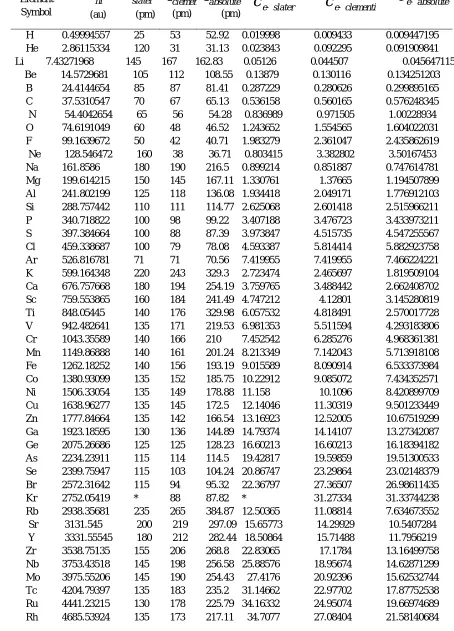
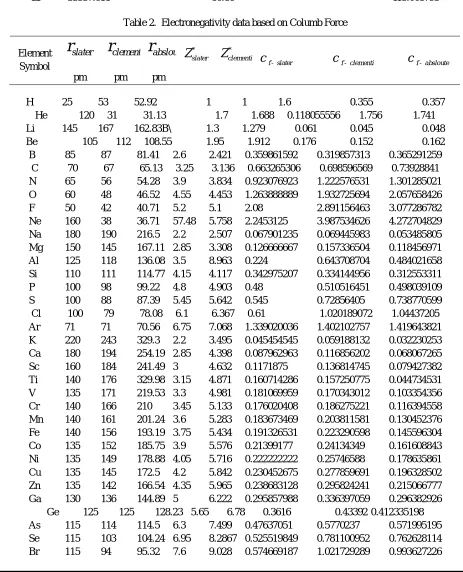
In eq.29-31, 1000 is multiplied to make the data more convincible. Electronegativity values based on energy and force from Hydrogen to Lawrencium have been computed through the above equations and are mentioned in table 1 and 2. In case of unavailability of data the spaces are ‘*’ marked.
Table 1. Electronegativity Data based on Hartree Fock Energy equivalence of Hellmann-Feynman Force
Element Symbol
hf
E
(au)
slater
r
(pm)
clementi
r
(pm)
absolute
r
(pm)
c
e slater-c
e clementi-e absolut-e
c
-H 0.49994557 25 53 52.92 0.019998 0.009433 0.009447195 He 2.86115334 120 31 31.13 0.023843 0.092295 0.091909841 Li 7.43271968 145 167 162.83 0.05126 0.044507 0.045647115
Pd 4937.9198 140 169 209.07 35.27086 29.21846 23.61850002 Ag 5197.69786 160 165 201.6 32.48561 31.5012 25.78223145 Cd 5465.1321 155 161 194.65 35.25892 33.94492 28.07671256 In 5740.10075 155 156 169.34 37.03291 36.79552 33.89689825 Sn 6022.84999 145 145 149.86 41.5369 41.5369 40.18984379 Sb 6313.48607 145 133 134.4 43.54128 47.46982 46.97534278 Te 6611.69122 140 123 121.83 47.22637 53.75359 54.2698122 I 6917.8755 140 115 111.41 49.4134 60.15544 62.09384705
Xe 7232.13748 * 108 102.63 * 66.96424 70.4680647 Cs 7553.93311 260 298 424.33 29.05359 25.34877 17.80202463 Ba 7883.54325 215 253 327.53 36.66764 31.16025 24.06968293 La 8220.95071 195 195 266.73 42.15872 42.15872 30.82124512 Ce 8566.37167 185 158 224.94 46.30471 54.21754 38.08291842 Pr 8920.39371 185 247 194.47 48.21834 36.11495 45.87028184 Nd 9283.0449 185 206 171.29 50.17862 45.06332 54.1949028 Pm 9654.39094 185 205 153.03 52.1859 47.09459 63.08822414 Sm 10034.5278 185 238 138.3 54.24069 42.16188 72.55623861 Eu 10423.5496 185 231 126.15 56.34351 45.12359 82.6282172 Gd 10820.5365 180 233 115.96 60.11409 46.44007 93.31266385 Tb 11225.8464 175 225 107.3 64.14769 49.89265 104.6211221 Dy 11640.486 175 228 99.84 66.51706 51.05476 116.5914063 Ho 12064.2689 175 226 93.35 68.93868 53.38172 129.2369459 Er 12497.2944 175 226 87.65 71.41311 55.29776 142.5817958 Tm 12939.6584 175 222 82.61 73.94091 58.28675 156.6354969 Yb 13391.4548 175 222 78.12 76.5226 60.32187 171.4215924 Lu 13851.6806 175 217 74.09 79.15246 63.83263 186.9574922 Hf 14321.0157 155 208 70.56 92.39365 68.85104 202.9622406 Ta 14799.5544 145 200 67.16 102.0659 73.99777 220.3626325 W 15287.3729 135 193 64.16 113.2398 79.20919 238.2695277 Re 15784.5427 135 188 61.41 116.9225 83.96033 257.0353802 Os 16290.4713 130 185 58.9 125.3113 88.0566 276.5784601 Ir 16805.8003 135 180 56.57 124.4874 93.36556 297.0797295 Pt 17330.8587 135 177 54.43 128.3767 97.91446 318.4063696 Au 17865.3992 135 174 52.44 132.3363 102.6747 340.6826697 Hg 18408.9902 150 171 50.6 122.7266 107.6549 363.8140356 Tl 18961.7587 190 156 186.7 99.79873 121.5497 101.562714 Pb 19523.9305 180 154 165.23 108.4663 126.7788 118.1621407 Bi 20095.5875 160 143 148.18 125.5974 140.5286 135.6160582 Po 20676.4142 190 135 134.31 108.8232 153.1586 153.945456 At 21266.7841 * 127 122.83 * 167.455 173.1399829
Rn 21866.7713 * 120 131.15 * 182.2231 166.731005 Fr 22475.8581 * * 444.79 * * 50.53139257 Ra 23094.303 215 * 343.32 107.4154 * 67.26757253 Ac 23722.0873 195 * 326.15 121.6517 * 72.73367254 Th 24359.4372 180 * 310.61 135.3302 * 78.42451048 Pa 25006.5117 180 * 227.56 138.9251 * 109.8897508
Cm 28392.6577 * * 129.6 * * 219.0791489 Bk 29099.5106 * * 112.47 * * 258.7313115 Cf 29816.6874 * * 104.65 * * 284.9181787 Es 30544.2078 * * 97.85 * * 312.1533756 Fm 31282.1408 * * 91.88 * * 340.4673574 Md 32030.5533 * * 86.59 * * 369.9105359 No 32789.5111 * * 81.88 * * 400.4581229 Lr 33557.611 * * 80.86 * * 415.008793
Table 2. Electronegativity data based on Columb Force
H 25 53 52.92 1 1 1.6 0.355 0.357
He 120 31 31.13 1.7 1.688 0.118055556 1.756 1.741 Li 145 167 162.83B\ 1.3 1.279 0.061 0.045 0.048 Be 105 112 108.55 1.95 1.912 0.176 0.152 0.162 B 85 87 81.41 2.6 2.421 0.359861592 0.319857313 0.365291259
C 70 67 65.13 3.25 3.136 0.663265306 0.698596569 0.73928841 N 65 56 54.28 3.9 3.834 0.923076923 1.222576531 1.301285021 O 60 48 46.52 4.55 4.453 1.263888889 1.932725694 2.057658426 F 50 42 40.71 5.2 5.1 2.08 2.891156463 3.077286782 Ne 160 38 36.71 57.48 5.758 2.2453125 3.987534626 4.272704829 Na 180 190 216.5 2.2 2.507 0.067901235 0.069445983 0.053485805 Mg 150 145 167.11 2.85 3.308 0.126666667 0.157336504 0.118456971 Al 125 118 136.08 3.5 8.963 0.224 0.643708704 0.484021658 Si 110 111 114.77 4.15 4.117 0.342975207 0.334144956 0.312553311 P 100 98 99.22 4.8 4.903 0.48 0.510516451 0.498039109 S 100 88 87.39 5.45 5.642 0.545 0.72856405 0.738770599 Cl 100 79 78.08 6.1 6.367 0.61 1.020189072 1.04437205 Ar 71 71 70.56 6.75 7.068 1.339020036 1.402102757 1.419643821 K 220 243 329.3 2.2 3.495 0.045454545 0.059188132 0.032230253 Ca 180 194 254.19 2.85 4.398 0.087962963 0.116856202 0.068067265 Sc 160 184 241.49 3 4.632 0.1171875 0.136814745 0.079427382 Ti 140 176 329.98 3.15 4.871 0.160714286 0.157250775 0.044734531 V 135 171 219.53 3.3 4.981 0.181069959 0.170343012 0.103354356 Cr 140 166 210 3.45 5.133 0.176020408 0.186275221 0.116394558 Mn 140 161 201.24 3.6 5.283 0.183673469 0.203811581 0.130452376 Fe 140 156 193.19 3.75 5.434 0.191326531 0.223290598 0.145596304 Co 135 152 185.75 3.9 5.576 0.21399177 0.24134349 0.161608843 Ni 135 149 178.88 4.05 5.716 0.222222222 0.25746588 0.178635861 Cu 135 145 172.5 4.2 5.842 0.230452675 0.277859691 0.196328502 Zn 135 142 166.54 4.35 5.965 0.238683128 0.295824241 0.215066777 Ga 130 136 144.89 5 6.222 0.295857988 0.336397059 0.296382926
Ge 125 125 128.23 5.65 6.78 0.3616 0.43392 0.412335198 As 115 114 114.5 6.3 7.499 0.47637051 0.5770237 0.571995195 Se 115 103 104.24 6.95 8.2867 0.525519849 0.781100952 0.762628114 Br 115 94 95.32 7.6 9.028 0.574669187 1.021729289 0.993627226 Element
Symbol
slater
r
pm
clementi
r
pm
absloute
r
pm
*
slater
Z
Z
clementi*f slater
Kr * 88 87.82 8.25 9.338 * 1.205836777 1.210784922 Rb 235 265 384.87 2.2 4.985 0.03983703 0.070986116 0.033654027
Rn * 120 131.15 8.25 8.25 * 0.572916667 0.47964217 Fr * * 444.79 2.2 2.2 * * 0.011120201 Ra 215 * 343.32 2.85 2.85 0.061654949 * 0.024179463 Ac 195 * 326.15 3 3 0.078895464 * 0.028202427 Th 180 * 310.61 3.15 3.15 0.097222222 * 0.032649737 Pa 180 * 227.56 4.3 4.3 0.132716049 * 0.083037947 U 175 * 197.67 4.95 4.95 0.161632653 * 0.126684556 Np 175 * 174.73 5.6 5.6 0.182857143 * 0.183422696 Pu 175 * 144.96 6.75 5.6 0.220408163 * 0.266496596 Am 175 * 129.15 7.4 7.4 0.241632653 * 0.443652465 Cm * * 129.6 7.55 7.55 * * 0.449507506 Bk * * 112.47 8.7 8.51 * * 0.672753816 Cf * * 104.65 9.35 9.35 * * 0.853754775
Es * * 97.85 10 10 * * 1.0444276
Fm * * 91.88 10.65 10.65 * * 1.261559199 Md * * 86.59 11.3 11.3 * * 1.507103104 No * * 81.88 11.95 11.95 * * 1.782428991 Lr * * 80.86 12.1 12.1 * * 1.850622
It is argued as to which Electronegativity-model is best approximation because no benchmark for this intuitive concept has been set up till date. Furthermore, the confusion as to what physical picture corresponds Electronegativity and even if non-agreement of proposed units such as Energy, Force and Potential. Numerical values of quantities with different units in computation are not comparable because they are conceptually different. No effort is made to compare the computed values of electronegativity with those of other scales. The computed electronegativity values reproduce the periodicity and also increase monotonically right from representative element to noble gas with maximum value.
VI. CONCLUSION
The new attempt to define electronegativity is characterized by specific physical meaning and reliable theoretical basis since it is derived from two famous mathematical formulation i.e Hellmann Feynman theorem and Born Oppenheimer (in turn conventional Hartree Fock) approximation. This definition will be acting like a bridge in between two parallel definitions of electronegativity (either in energy or force). It will be logical to consider electronegativity equalization in a diatomic as well as polyatomic system. This new approach (force approach) will be helpful to assign the more accurate electronegativity values to various elements of the periodic table and also more valuable in different areas of chemical science for example to predict the structure and property of materials. This will also help design new electrode materials efficiently, electrocatalysts with novel properties for energy conversion devices like Fuel cell, Solar cell etc.
VII. ACKNOWLEDGEMENT
The author acknowledges the financial support of the Department of Science and Technology, Government of India for pursuing Doctoral program.
A. Nomenclature
hf
E
- Hartree Fork EnergyA j
E
- One electron energy of orbital jAB
f
- Orbital multiplier if
- Atomic force or overlap force or Screening force(
)
i A
f R
- Atomic force or overlap force or Screening force atR
A(
A), (
B)
F R
F R
- Force at position of nuclei A and B( )
F
- Hellmann-Feynman force'
F
- Hellmann-Feynman force (unsteady state)A
F
- Hellmann-Feynman on atom A( )
F r
- Sum of electronic kinetic energy and electron repulsion energy functional of densitye
H
- Electronic Hamiltonian molH
- Molecular Hamiltoniann
H
- Nuclear Hamiltoniani
s
- Spin coordinateT - Kinetic energy operator
e
T
- Kinetic energy Operator(electron)n
T
- Kinetic energy operator(nucleus)ee
V
- Electron-electron repulsion termen
V
- Electron-nuclear attraction termnn
V
- Nuclear-nuclear repulsion termi
x
- Product of space coordinate ri and spin coordinate si of the ith electronB. Greek Letters
|
- One-electron integral
- Two-electron Coulomb integral
- Exchange integrall
- Parameter of value lying between 0 and 1 2A
Ñ
- Laplacian operator related to co-ordinate of nucleus A
2
i
Ñ
- Laplacian operator related to Cartesian co-ordinate of electron i
( )
z a
- One-electron operator( , )
h a b
- Two-electron operator,
- Explicit Parameters (steady and Perturbation) in HamiltonianA
V
- Parameter in Hamiltonian for a coordinate of nucleus Ay
- Wave functionn
y
- Nuclear wave function ey
- Electronic wave function*
y
- Conjugate wave function0
REFERENCES
[1] A. L. Allred and E. G. Rochow, “A scale of electronegativity based on electrostatic force,” J. Inorg. Nucl. Chem., vol. 5, no. 4, pp. 264–268, Jan. 1958. [2] L. Pauling, “Atomic Radii and Interatomic Distances in Metals,” J. Am. Chem. Soc., vol. 69, no. 3, pp. 542–553, Mar. 1947.
[3] J. C. Slater, “Atomic Shielding Constants,” Phys. Rev., vol. 36, no. 1, pp. 57–64, Jul. 1930.
[4] Housecroft C.E. and Sharpe A.G., “Electronegativity values,” in Iorganic chemistry, Pearson Education Limited, 2005, p. 38.
[5] R. J. Boyd and G. E. Markus, “Electronegativities of the elements from a nonempirical electrostatic model,” J. Chem. Phys., vol. 75, no. 11, pp. 5385–5388, Dec. 1981.
[6] C. Mande, P. Deshmukh, and P. Deshmukh, “A new scale of electronegativity on the basis of calculations of effective nuclear charges from X-ray spectroscopic data,” J. Phys. B At. Mol. Phys., vol. 10, no. 12, pp. 2293–2300, Aug. 1977
[7] Y. Zhang, “Electronegativities of Elements in Valence States and Their Applications. 2. A Scale for Strengths of Lewis Acids,” Inorg. Chem., vol. 21, no. 11, pp. 3889–3893, Nov. 1982
[8] T. Jecko, “On the mathematical treatment of the Born-Oppenheimer approximation,” J. Math. Phys., vol. 55, no. 5, p. 053504, May 2014. [9] M. Born and R. Oppenheimer, “Zur Quantentheorie der Molekeln,” Ann. Phys., vol. 389, no. 20, pp. 457–484, 1927.
[10] E. P. Gyftopoulos and G. N. Hatsopoulos, “Quantum-Thermodynamic Definition of Electronegativity,” Proc. Natl. Acad. Sci., vol. 60, no. 3, pp. 786–793, 1968.
[11] M. B. Einhorn and R. Blankenbecler, “Bounds on scattering amplitudes,” Ann. Phys. (N. Y)., vol. 67, no. 2, pp. 480–517, Oct. 1971.
[12] M. S. Gopinathan and M. A. Whitehead, “On the Dependence of Total Energy on Occupation Numbers,” Isr. J. Chem., vol. 19, no. 1–4, pp. 209–214, 1980. [13] P. Geerlings, F. De Proft, and W. Langenaeker, “Conceptual Density Functional Theory,” Chem. Rev., vol. 103, no. 5, pp. 1793–1874, May 2003. [14] C. K. Jørgensen, Orbitals in Atoms and Molecules. Academic Press Inc., New York, 1962.
[15] R. T. Sanderson, “An interpretation of bond lengths and a classification of bonds,” Science (New York, N.Y.), vol. 114, no. 2973. American Association for the Advancement of Science, pp. 670–672, 1951.
[16] R. Ferreira, “Principle of electronegativity equalization. Part 1.—Bond moments and force constants,” Trans. Faraday Soc., vol. 59, no. 0, pp. 1064–1074, Jan. 1963.
[17] N. H. March, “The ground-state energy of atomic and molecular ions and its variation with the number of electrons,” in Chemical Hardness, Berlin/Heidelberg: Springer-Verlag, 1993, pp. 71–86.
[18] T. T. Nguyen-Dang, R. F. W. Bader, and H. Essén, “Some properties of the Lagrange multiplier μ in density functional theory,” Int. J. Quantum Chem., vol. 22, no. 5, pp. 1049–1058, Nov. 1982.
[19] J. Hinze, “The concept of electronegativity of atoms in molecules,” Theor. Comput. Chem., vol. 6,212, Jan.1999.
[20] H. Chermette, “Chemical reactivity indexes in density functional theory,” J. Comput. Chem., vol. 20, no. 1, pp. 129–154, Jan. 1999. [21] P. Hohenberg and W. Kohn, “Inhomogeneous Electron Gas,” Phys. Rev., vol. 136, no. 3B, pp. B864–B871, Nov. 1964.
[22] C. F. Kammerer and V. Rousse, “Resolvent Estimates and Matrix-Valued Schrödinger Operator with Eigenvalue Crossings; Application to Strichartz Estimates,” Commun. Partial Differ. Equations, vol. 33, no. 1, pp. 19–44, Jan. 2008.
[23] E. B. Wilson, “Four Dimensional Electron Density Function,” J. Chem. Phys., vol. 36, no. 8, pp. 2232–2233, Apr. 1962. [24] R. E. Stanton, “Hellmann Feynman Theorem and Correlation Energies,” J. Chem. Phys., vol. 36, no. 5, pp. 1298–1300, Mar. 1962.
[25] R. P. Feynman, “Forces in Molecules,” Phys. Rev., vol. 56, no. 4, pp. 340–343, Aug. 1939. B. M. Deb, “Chapter 1,” in The Force concept in chemistry, Van Nostrand Reinhold, 1981, p. Page 9.
[26] D. Andrae, Ed., Hans Hellmann: Einführung in die Quantenchemie. Berlin, Heidelberg: Springer Berlin Heidelberg, 2015 [27] I. N. Levine, Quantum Chemistry, 5th ed. Pearson/Prentice Hall, 2009.
[28] P. Politzer and J. S. Murray, “The Hellmann-Feynman theorem: a perspective,” J. Mol. Model., vol. 24, no. 9, p. 266, Sep. 2018.
[29] W. Pauli, “Die allgemeinen Prinzipien der Wellenmechanik,” in Quantentheorie, Berlin, Heidelberg: Springer Berlin Heidelberg, 1933, pp. 83–272.
[30] H. Hellmann, “Zur Rolle der kinetischen Elektronenenergie für die zwischenatomaren Krӓfte,” Zeitschrift für Phys., vol. 85, no. 3–4, pp. 180–190, Mar. 1933. [31] P. Güttinger, “Das Verhalten von Atomen im magnetischen Drehfeld,” Zeitschrift für Phys., vol. 73, no. 3–4, pp. 169–184, Mar. 1932.
[32] E. Schrödinger, “Quantisierung als Eigenwertproblem,” Ann. Phys., vol. 385, no. 13, pp. 437–490, Jan. 1926.
[33] A. C. Hurley, “The Electrostatic Calculation of Molecular Energies. I. Methods of Calculating Molecular Energies,” Proc. R. Soc. A Math. Phys. Eng. Sci., vol. 226, no. 1165, pp. 170–178, Nov. 1954.
[34] A. C. Hurley, “The Electrostatic Calculation of Molecular Energies. II. Approximate Wave Functions and the Electrostatic Method,” Proc. R. Soc. A Math. Phys. Eng. Sci., vol. 226, no. 1165, pp. 179–192, Nov. 1954.
[35] A. C. Hurley, “The Electrostatic Calculation of Molecular Energies. III. The Binding Energies of Saturated Molecules,” Proc. R. Soc. A Math. Phys. Eng. Sci., vol. 226, no. 1165, pp. 193–205, Nov. 1954.
[36] A. C. Hurley, “The Electrostatic Calculation of Molecular Energies. IV. Optimum Paired-Electron Orbitals and the Electrostatic Method,” Proc. R. Soc. A Math. Phys. Eng. Sci., vol. 235, no. 1201, pp. 224–234, Apr. 1956.
[37] R. F. W. Bader, “Binding Regions in Polyatomic Molecules and Electron Density Distributions,” J. Am. Chem. Soc., vol. 86, no. 23, pp. 5070–5075, Dec. 1964.
[38] R. F. W. Bader and W. H. Henneker, “The Ionic Bond,” J. Am. Chem. Soc., vol. 87, no. 14, pp. 3063–3068, Jul. 1965.
[39] R. F. W. Bader and H. J. T. Preston, “A CRITIQUE OF PAULI REPULSIONS AND MOLECULAR GEOMETRY,” Can. J. Chem., vol. 44, no. 10, pp. 1131– 1145, May 1966.
[40] R. F. W. Bader, “THE USE OF THE HELLMANN–FEYNMAN THEOREM TO CALCULATE MOLECULAR ENERGIES,” Can. J. Chem., vol. 38, no. 11, pp. 2117–2127, Nov. 1960.
[41] R. F. W. Bader and G. A. Jones, “the Hellmann–Feynman Theorem and Chemical Binding,” Can. J. Chem., vol. 39, no. 6, pp. 1253–1265, Jun. 1961. [42] T. Koga and H. Nakatsuji, “The Hellmann-Feynman theorem applied to long-range forces,” Theor. Chim. Acta, vol. 41, no. 2, pp. 119–131, 1976.
[44] T. Koga, H. Nakatsuji, and T. Yonezawa, “Force and density study of the chemical reaction process OH 2 +H +→OH 3+,” Mol. Phys., vol. 39, no. 1, pp. 239– 249, Jan. 1980.
[45] P. Politzer, “A Study of the Bonding in the Hydrogen Molecule 1,” J. Phys. Chem., vol. 70, no. 4, pp. 1174–1178, Apr. 1966.
[46] P. Politzer and K. C. Daiker, “Molecular electrostatic potentials. Negative potentials associated with some methyl and methylene groups,” Chem. Phys. Lett., vol. 34, no. 2, pp. 294–297, Jul. 1975
[47] A. J. Coleman, “Structure of Fermion Density Matrices. II. Antisymmetrized Geminal Powers,” J. Math. Phys., vol. 6, no. 9, pp. 1425–1431, Sep. 1965. [48] A. J. Coleman, “INFINITE RANGE CORRELATION AND LARGE EIGENVALUES OF THE 2-MATRIX,” Can. J. Phys., vol. 45, no. 3, pp. 1271–1273,
Mar. 1967.
[49] A. J. Coleman, “Necessary Conditions for N Representability of Reduced Density Matrices,” J. Math. Phys., vol. 13, no. 2, pp. 214–222, Feb. 1972. [50] T. Berlin, “Binding Regions in Diatomic Molecules,” J. Chem. Phys., vol. 19, no. 2, pp. 208–213, Feb. 1951.
[51] A. Larsen, R. S. Poulsen, and T. P. Garm, “Applied Hartree-Fock methods Atomic and diatomic energy computations,” Denmark, 2015. [52] J. C. Slater, “Atomic Shielding Constants,” Phys. Rev., vol. 36, no. 1, pp. 57–64, Jul. 1930.
[53] Koga T,Tatewaki H,Shimazaki T.Chemically reliable uncontracted Gaussian-type basis sets for atoms H to Lr.Chem Phys Lett.2000;328(4-6):473-482. [54] J. C. Slater, “Atomic Radii in Crystals,” J. Chem. Phys., vol. 41, no. 10, pp. 3199–3204, No [57] E. Clementi and D. L. Raimondi,
“Atomic Screening Constants from SCF Functions,” J. Chem. Phys., vol. 38, no. 11, pp. 2686–2689, Jun. 1963. [56] J. C. Slater, “Atomic Radii in Crystals,” J. Chem. Phys., vol. 41, no. 10, pp. 3199–3204, Nov. 1964
[55] E. Clementi, D. L. Raimondi, and W. P. Reinhardt, “Atomic Screening Constants from SCF Functions. II. Atoms with 37 to 86 Electrons,” J. Chem. Phys., vol. 47, no. 4, pp. 1300–1307, Aug. 1967.
[56] Rahm M, Hoffmann R,Ashcroft NW.Atomic and Ionic Radii of Elements 1-96.Chem-A Eur J.2016;22(41)14625-14632.