A Comparative Study of Crime Investigation using
Data Mining Approaches
Sadhna Sharma1, Sanjiv Sharma2 1, 2
FDepartment of CSE & IT, Madhav Institute of Technology & Science, Gwalior (M.P), India
Abstract: In the era of technology, various kind of research work has been conducted on detecting, predicting and analysis of crime by researchers. Many researches are based on data mining (DM) for prediction of crime. Crime prediction is an effort to identify and reducing the future crime. DM has the capacity of extracting hidden patterns & beneficial information from the big crime records sets. Existing models of crime records mining detect the crime pattern using identification of crime characterization. In this paper, Literature survey reveals the proposed crime detection techniques by various researchers. Hence, this paper is based on comparative study of clustering, entity extraction, deviation detection association rule mining sequential pattern mining, social network analysis & classification strategies of DM. So it is used for crime detection & prevention. This paper provide scope for identification of limitation in proposed existing researches in the field of crime records prediction by available DM techniques & observe the strength & weakness of existing data mining algorithm.
Keywords: Crime prediction, data mining, entity extraction, association rule mining, classification, clustering, deviation detection.
I. INTRODUCTION
Criminology is an area that is focused on identifying criminal behaviour & crime & scientific study of law enforcement & crime characteristics. Crime is essentially a public social problem which affects the life, economic progress & popularity of the country . Impact & defame a crime picture of a community Many studies have proved that crime analysis & prediction is an essential activity. The analysis procedure includes reporting crime reviews & identifying rising patterns, collections & features as soon as possible. This investigation is capable of making statistics, questions & maps. Offense criminals can be activated & crime predicted due to crime in their area of comfort. If implemented, they are trying to restore wrongdoing under comparisons. The wrong act relies on a criminal insight, with more variants, including security of a region.. Criminals typically discover the same area & time for the crime next attempt.
[image:1.612.146.470.459.715.2]
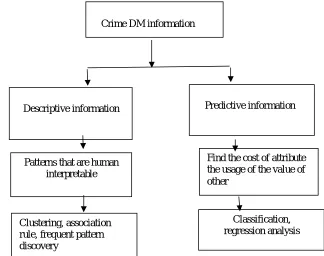
Figure 1: Crime Data Mining Information Types
Crime DM information
Predictive information Descriptive information
Find the cost of attribute the usage of the value of other
Patterns that are human interpretable
Clustering, association rule, frequent pattern discovery
The most important regions where applications (apps) of DM approaches could produce significant outcomes that is one amongst the most critical fields wherein the apps of DM approaches could produce important outcomes. Crime DM information that are described may be of various kinds as presented in the Figure 1. Various techniques [1] of DM like classification, association, clustering that utilized in the investigations of criminal.
Over the years, researchers have created several approaches to support law enforcement activities in order to avoid criminal action and discover patterns of crime. However, the main challenge before all law enforcement organizations and intelligence-gathering is to analyze the increasing amount of crime statistics precisely and efficiently. The main objective of developing a crime investigation system is:-
1) Performs crime analysis & Recognizing crime patterns.
2) Provide data to prepare the method for prevention & deduction of crime.
3) Identifying and analyzing common crime patterns to reduce incidents of similar crime.
II. BACKGROUNDANDRELATEDWORK
The prediction goal is to estimate a feature estimate depending on the other quality estimates. In prediction techniques, a model is first made based on the basis of information distribution and then the model is employed to predict the future at an unknown value.Criminal activity is growing every day, so the DM approaches used by the Regulation enforcement Corporation may be required. The development of criminal networks where they compel organizations or groups to operate diverse illegal activities. The sum of DM approaches is utilized to collect greater accuracy.
Entity extraction [2] technique used by identifying patterns to identify individuals, vehicles, texts. This is the way towards separating information through documents of text [3]. In computer forensics, it could separate hackers written plans.so, basically this is finished by combining alike programs. However, large quantities of clean data are required to produce good results. In [3], according to the Entity Extraction Approach, four key names have been explained and listed: Lexical Lookup [4], rule-based [5], statistically based [6], & machine learning (ML) [7] Therefore, techniques for unit extraction are ML, statistical based, rule based and lexical lookup.
Clustering approaches [8] help in maximize or reduce interconnect equality by grouping information items onto courses dependent into their own features. In criminal investigations, criminals could help identify criminals who follow-up a specific pattern that is set to commit crimes. Various algorithms of the cluster [9] divide the data in hierarchically or split them according to the requirements. Association rule mining technique [10] shown patterns in terms of rules by searching consistently occurring events inside a information(info) set. Figuring out this network attack is useful. It turns out to be the first means to look at thrilling co-occasions in the market statistics. It is very useful in investigating simultaneous events. In terms of support, association rule mining strength is often measured; Suitable for information set and confidence rule; the frequency of the presence of a information in the transaction, in which there is another information. It is a method that exploits the relationship between connection-related services to highlight important information hidden within large data. In [11], elementary and advanced samples of association analysis and advanced concepts and algorithms have been provided.
An Association Rule Mining algorithm [12]Customer transactions received from Allergy Retail Company were adopted using the sales information. This is intended for applications where transactions are carried out in transactions & a subset of available items is found in these transactions. In [13], two new algorithms have been compared to known algorithms, and significant improvements and Correction has been recorded by new algorithms & after that their combined Apriori hybrid algorithms [14]. The techniques for affiliation have been utilized for apps in regulations enforcement. The proposed technique basically looks for equality through a original total equality measurement with information theory based weight between the characteristics of the robbery record from the Police Department, so that events may possibly be associated.After this, Lin and Brown described a new association law, in which the outline score function was added and [15] the Richmond Police Department examined the same robbery data. The new outline-based technology improves equality-outline-based technology with promising outcomes to give increasingly helpful information for police officer.
Sequential pattern mining [16] suggests that usually there is a order of objects at various intervals of time. This network is extremely useful in detecting intrusion. For purposeful results, a huge quantity of structured information is mandatory.
various crime organizations. These are at that point sorted in predetermined classes. This approach requires a predefined classification plan.
Classification technique is extremely useful in predicting crimes & recognizing criminals within a short period of time.so, it required a predetermined policy for classification & full training with test information, as this can only result in accurate approximation results. To find a collection of rules from the dataset is the focus of classification technique. Classification can be done through deciduous trees, support vector machines, Naïve Bayes Rules or Neural Networks.
Social network analysis [20] analyzes Role and connection of nodes inside a dynamic structure. It tends to be utilized to distinguish a criminal role by making networks. It can likewise help in breaking down the stream of data between these organizations, despite the fact that it doesn't help in recognizing the genuine pioneers of the system. It uncovers the structure inside some text, by which it reveals the structure within some lessons, by presenting some interconnected institutions. The most generally utilized approaches the social network analysis are: degree; No. of nodes related with any No. of edges, node, & density in a particular region contrasted with the general no. of edges & centrality; the significance of a node inside a defined structure.
Sparrow [21] with point by point analysis and comparisons, crime analysis summarizes current ideas of network analysis.Chiu & wang [22] implemented SNA & indentified transactional network shape measurements: k-centre & core/periphery ratio to stumble on the web auction inflated-reputation traders through regular accounts. Important outcomes proved that SNA could act as an effective indictor to differentiate criminal accounts & probable prevent & decrease complex transactions & on line frauds (OAF). Qin et al. [23] exhibited an investigation network structure of Web structural mining & structure of the Global Salafi Jihad with
SNA. Outcome demonstrated the proposed approach could be an e ective device to distinguish key individuals in a terrorist
network & hence help experts create e cient & e ective problematic procedures & measures. Various research have been done in past, relating to crime pattern prediction and prevention.
Mehmet Sait, and Mustafa Gök [24] presented the criminal prediction for finding the most probable criminal of a particular incident when the suspected list of offenders are provided with the criminal data which is generated synthetically using Gaussian Mixture Model. The authors used Decision tree & Naïve Bayes Classifier for offender prediction method and compared its performance. Agarwal A, analyzed various offenses done by offenders and predict the opportunity of each offense that can again be done by that offenders. Authors used Apriori for frequent item set generation that can be done by the offenders.Ahishakiye, E., Anisha, and C. Dhanashree applied J48 base model to predict crime category or level in certain location that will occur in the future.
Emmanuel A., et al. [25]analyzed crime data by using support vector machine, naïve Bayes, neural network and J48 and contrasts the techniques by using accuracy and execution time for predicting offense level as ‘Low’, ‘Medium’, and ‘High’. As a result of the contrast the authors conclude that the decision tree (J48) consumed less execution time with 0.06 seconds and performs better with 100% accuracy for crime forecasting.
Yerpude P., et al. [26]applied data mining practices from crime data for foreseeing features that affect the high or low crime rate in certain region. The authors used Random Forest, Naïve Bayes and Linear Regression for recognizing factors that affect the high crime rate and compared its performance. As a result of the comparison the authors conclude that the Random Forest performs better with 81.35% accuracy.
Nafiz M., et al. [27] introduced CRIMECAST, a mathematical simulation tool that analyses past crime trends, patterns, features affect crime, Crime occurrence frequency, crime taken place, crime happened time, type of crime and victims from past crime data up to 30 years to forecast future crime. Tahani A., et al. [28] analyzed two different crime data using Decision Tree and Naïve Bayesian classifier to find out the most likely crime places and their time of being using the Apriori algorithm.
Rasoul K et al., [29] Criminal data analyzed using DM techniques such as K-means for grouping the similar crime patterns for identifying crime in different years based on amount of crime occurrence. During different years and recognizing the crime patterns and trends to suggest this way can be utilized to decrease & avoid crime for the future years.
Noor, N.M.M, et al. [32] Decision Support System Engineering Plan for Understanding the Bad doing Due to the inconvenience of decision making for the wrong behavior, the preferred psychological support network (DSS) & DM methods can be used to care for this problem. In this way, using the concept of using DSS concept, this concept is expressed that it can adjust the wrong information in a growing rational role.Iqbal R, murad [33] predict crime category in different states of USA.
Nasridinov A, Park YH [34] analyzed and compared different algorithm for crime data to determine which algorithm performs better crime prediction (machine learning). Martin Van Bannervale, Nahne-Le-Khak M, his poetry] [35] the growing investigator uses the NLP technique to work on a series of profitable & fast paths with a lot of literature. It exhibits as much speed around the test, is increasingly moldy & easy for experts.
Wu, J. & d. Wang [36] Precursors of premeditated work, all things have been considered, the Cranial information of their brain's science subjects is subject to criminal examination and new example data estimates depend on their mental problems. Frequency of the wrongdoing of deliberate people is the approximate separation of estimates, which are important for forecasting.
Lee, X. M. Joula [37] applied SOM to guide the countries of the wrongdoing countries. In many countries, positive cooperation of wrongdoing in some countries may be excited for negative relations in different countries. This proves that SOM can be a gadget for mappings of criminal incidents by a huge measure of a faulty device.
Tayal, D.K., A. Jain, et al. [38] Detection of crime in India and criminal recognizable proof using data mining approaches. Zhang Q, Yung P, Zhou Q, Yang Z [39] in this author introduced multiple crime enhanced category called heat levels for predicting high crime intensity regions by dividing into five heat levels. In this used LDA for feature reduction and KNN for prediction 0f high crime intensity region. Retnowardhani A, TRIANA [40] developed a web based decision support system in php that support law enforcement agency to control and help in decision making for crime prevention. Morgan Butcher, Chad Vellan [41] Social System Investigation (SNA) Imprinted as a Gadget for Criminal Knowledge.
Cocx ,Bruin & Koster et al. [42] presented a device for changing in criminal actions. Utilization of components extricated with recurrence, seriousness, term and nature is equivalent to the comparison between the pair of criminals to gauge another separation and group information as per needs.
Lianghongma, Hao Huang & Yefeng Chen[43] Two organized group counting from broad datasets is called single-mode, which results in comparative case subsets. On the Four Gazing Stage, the characteristics of characteristic properties are determined using the concept of the area (IGR) by identifying the properties of the guilty party. The response to the characteristic Gausing platform is used in the identical method to collect subsets in identical regions.
Testing papers has been shown that incorrect mining data mining methods, which are often used in the wrong place are included in Table 1 [44]. Wrong system DM & repeat publication according to various methods used in the experiment, figure 3 shows the bar chart.
Technique Description
Association Rule Mining It seeks connection between variables or objects.
This is a prominent and very much investigated technique for seeking fascinating connections between variable in large databases.
Classification Classification used to predict group membership for info instances.
This is the subordinate of the model which decides the class of an item dependent on its qualities.
Regression It is used to predict a range of numeric values (constant values), given a specific
dataset.
Clustering It is the way toward making a gathering of objects into classes of comparable
Object.
A group of information can be considered as a group.
Frequent Pattern Mining It is used to find patterns that occur frequently in a data-set.
It forms the foundation for finding inherent regularities (associations) in data.
Outlier Analysis
These are the identities of events, objects or remarks that do not affirm the expected pattern.
It is also known as anomaly detection.
These are the identities of events, objects or remarks that do not affirm the expected pattern.
[image:4.612.74.567.474.723.2]0 2 4 6 8 10 12 14 16 18
Classification Association Rule Mining Outlier Analysis Regression
R
es
ea
rch
Pa
p
er
s
[image:5.612.44.549.67.364.2]Techniques Used
Figure 3: Number Of Research Papers Published As Per The Techniques Used
III. COMPARATIVESTUDYOFAVAILABLE TECHNIQUESFORCRIMEINVESTIGATION
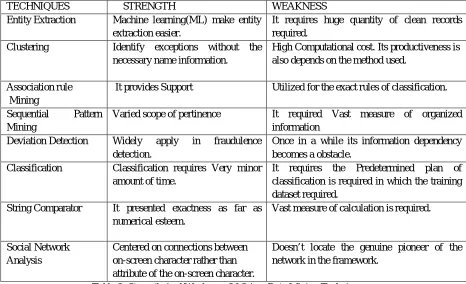
Comparative study of each technique is presented along with its quality and shortcoming. The quality and shortcoming of technique has been adopted from the literature in which researchers have described positive & negative impact of specific approaches.
TECHNIQUES STRENGTH WEAKNESS
Entity Extraction Machine learning(ML) make entity extraction easier.
It requires huge quantity of clean records required.
Clustering Identify exceptions without the
necessary name information.
High Computational cost. Its productiveness is also depends on the method used.
Association rule Mining
It provides Support Utilized for the exact rules of classification.
Sequential Pattern Mining
Varied scope of pertinence It required Vast measure of organized information
Deviation Detection Widely apply in fraudulence detection.
Once in a while its information dependency becomes a obstacle.
Classification Classification requires Very minor amount of time.
It requires the Predetermined plan of classification is required in which the training dataset required.
String Comparator It presented exactness as far as numerical esteem.
Vast measure of calculation is required.
Social Network Analysis
Centered on connections between on-screen character rather than attribute of the on-screen character.
Doesn’t locate the genuine pioneer of the network in the framework.
[image:5.612.82.548.421.705.2]The techniques which is used for the crime investigation are mentioned in the table2 along with its strength and weakness.
The entity extraction is strong with machine learning systems but polluted information can be an impediment to it. Along these lines, its shortcoming requires clean information and the quality of the grouping method is discovering plots without the need of name information, however as the procedure is costly. In this way, its prosperity depends for the most part on the strategy chose. Association rule mining is another approach that normally encourage classification and its distinctive nature towards classification is its weakness.
Sequential pattern mining technique has huge amount of appositeness in all regions and therefore, its performance requires huge amounts of data. Deviation detection technique usually apply in fraudulencedetection but still a question is remains unsolved about its data Dependency. Classification is another technique which is typical conventional technique that consumes minor time and its shortcoming is that a predetermined plan of classification is required in which the training data set required. String comparator technique presented exactness far as numerical esteem. Social network analysis centered around connections between on-screen characters as opposed to those attributes which make it more straightforward, yet wrongfully it doesn't locate the genuine pioneer of the network in the framework.
IV. CONCLUSIONS
Crime is an active area of DM and analysis research. This paper describes the use of DM crime detection approaches like clustering, association rules, sequential patterns and others and it also provide the comparative study of various techniques along with its strength and weakness. This study may be useful for new potential users in understanding the accessible available range of crime data mining detection techniques.
REFERENCES
[1] Ubon Thongsatapornwatana. “A survey of data mining techniques for analysing crime patterns”. In defence technology (ACDT), second Asian conference, IEEE, pp.123-128, 2016.
[2] Michael Chau, Jennifer J. Xu, Hsinchun Chen. “Extracting meaningful entities from police narrative reports”. In proceeding of the annual conference on digital government research, pp. 1-4, 2002.
[3] Hossein Hassani, Xu Huang Emmanuel S. Silva and Mansi Ghodsi. “A review of data mining applications in crime”. In statistical analysis and data mining: The ASA data science journal, vol. 9, pp. 139-154, 2016.
[4] Andrew Borthwick, John Sterling, Eugene Agichtein and Ralph Grishman. “NYU: description of the MENE named entity system as used in muc-7”. In proceedings of the seventh messages understanding conference, pp. 1-6, 1998.
[5] Krupka, Hausman Isoquants. “INC description of the net owl(tm) extractor system as used for muc-7”. In proceeding of the seventh message understanding conference, 1998.
[6] Ian H. Witten, Zane Bray, Malika Mahoui, W.J Teahan. “Using language models for generic entity extraction”. Unpublished.
[7] Sumeet Baluja, Vibhu O. Mittal, Rahul Sukthankar. “Applying machine learning for high performance named entity extraction”. In computational intelligence, vol. x, 2000.
[8] Roslin V Hauck, Homa Atabakhsb, Pichai Ongvasith, Harsh Gupta, Hsinchun Chen. “Using coplink to analyze criminal justice data. In IEEE, vol. 35, pp.30-37, 2002.
[9] Raymond T. Ng, Jiawei Han. “Efficient and effective clustering method of spatial data mining”. In proceeding of 20th international conference on very large data bases, pp. 144-155, 1994.
[10] Hyunyoon Yun, Danshim Ha, Buhyun Hwang, Keun Ho Ryu. “Mining association rules on significant rare data using relative support” .In journal of system and software, vol.67, pp.181-191, 2003.
[11] Pang-Ning Tan, Michael Steinbach, Vipin Kumar. “Introduction to data mining (first edition), 2006.
[12] Rakesh Agarwal, Tomasz Imielinski, Arun Swami. “A mining association rules between sets of items in large databases”. In ACM SIGMOD conference, pp. 207-216 1993.
[13] Rakesh Agarwal, Ramakrishnan Srikant. “Fast algorithm for mining association rules”. In proceeding of 20th VLDB conference Chile, pp. 487-499, 1994. [14] Donald E. Brown, Stephen Hagen. “Data association method with applications to law enforcement”. In decision support system, vol.34, pp.369-378, 2003. [15] Song Lin, Donald E. brown. “An outlier based data association method for linking criminal incidents”. In decision support system, vol. 41, pp. 604-615, 2006. [16] Wenke Lee, Salvatore Stolfo. “A data mining framework for building intrusion detection models”. In security and privacy, IEEE pp.120-132, 1999.
[17] Charu C Aggarwal, Philip S. Yu. “Outlier detection for high dimensional data”. In ACM sigmod record, pp. 37-46, 2001. [18] Deepika tyagi, Sanjiv sharma. “An expert system for credit risk stratification using data mining”. In international journal for research in applied science and
engineering, vol.6, pp.293-303, 2018.
[19] P.A. Shoemaker. “A note on least squares learning procedures and classification by neural network models”. In IEEE transaction on neural network, vol.2, pp.158-160, 1991.
[20] Kelvin Chan, Jay Liebowitz. “The synergy of social network analysis and knowledge mapping: a case study”. In international journal of management and decision making, vol.7, pp.19-35, 2005.
[21] Malcolm K. Sparrow. “The application of network analysis to criminal intelligence: an assessment of the prospects”.in social network, vol.13, pp.251-274, 1991.
[23] Jialun Qin, Jennifer J. Xu, Daning Hu, Marc Sageman, Hsinchun Chen. “Analyzing terrorist network: a case study of the global salafi jihad network”. In springer, pp.287-304, 2005.
[24] Mehmet Sait Vural, Mustafa Gok. “Criminal prediction using naïve Bayes theory”.in neural computing and application, springer, vol.28, pp.2581-2592, 2017. [25] Emmanuel Ahishakiye, Elisha Opiyo Omulo, Dansion Taremwa, Ivan Niyonzima. “Crime prediction using decision tree (j48) classification algorithm”. In
international journal of computer and information technology, vol.06, pp. 188-195, 2017.
[26] Prajakta Yerpude, Vaishnavi Gudur. “Predictive modelling of crime dataset using data mining”. In international journal of data mining & knowledge management process, vol.7, pp.43-58, 2017.
[27] Nafiz Mahmud, Khalid Lbn Zinnah, Yeasin Ar Rahman, Nasim Ahmed. “Crimecast: A crime prediction and strategy direction service”. In IEEE, Pp.414-418, 2016.
[28] Tahani Almanie, Rsha Mirza and Elizabeth Lor. “Crime prediction based on crime types and using spatial and temporal criminal hotspots”. In international journal of data mining and knowledge management, vol.5, pp.1-19, 2015.
[29] Rasoul Kiani, Siamak Mahdavi, Amin Keshavarzi. “Analysis and prediction of crimes by clustering and classification”. In international journal of advanced research in artificial intelligence, vol.4, pp.11-17, 2015.
[30] Artitayapron Rojarath, Wararat Songpan, Chakrit Pong-Inwong. “Improved ensemble learning for classification technique based on majority voting”. In IEEE, pp. 107-111,2016.
[31] Nikita Joshi, Shweta Srivastava. “Improving classification accuracy using ensemble learning technique (using different decision tree)”. In international journal of computer science and mobile computing, vol.3, pp.727-732, 2014.
[32] Noor Maizura Mohamad Noor, Astari Retnowardhani, Mohd Lazim, Abd and Md Yazid Mohd Saman. “ crime forecasting using arima model and fuzzy alphacut”.in journal of applied science,vol.13, pp.167-172,2013
[33] Rizwan Iqbal, Masrah Azrifah Azmi Murad, Aida Mustapha, Payam Hassany Shariat Panahy, and Nasim Khanahmadliravi. “An experiment study of classification algorithms for crime prediction”. In Indian journal of science and technology, vol.6 (3), pp.4220-4225, 2013.
[34] Aziz Nasridinov, Young-Ho Park. “A study on performance evaluation of machine learning algorithms for crime data sets”.in ACM, pp.90-92, 2014.
[35] Marten Van Banerveld, Nhien-An Le-Khac, M-Tahar Kechadi. “Performance evaluation of a natural language processing approach applied in white collar crime investigation”. In international conference on future data and security engineering (springer), pp.29-43, 2014.
[36] Jiang Wu, Dong Wang. “The research based on Bayesian behavior recognition technology”.in journal of applied science, applied mechanics and materials, vol.543-547, pp.2167-2170, 2014.
[37] Xingan Li, Henry Joutsijoki, Jorma Laurikkala Martti Juhola.in webology, 2015.
[38] Devendra Kumar Tayal, Arti Jain, Surbhi Arora, Surbhi Agarwal. “Crime detection and criminal identification in india using data mining technquies”. In AI & society, vol.30, pp.117-127, 2014.
[39] Qiang Zhang, Pingmei Yuan, Qiyun Zhou, Zhiming Yang. “Mixed spatial-temporal characteristics based crime hot spots prediction”.in ieee, pp. 97-101, 2016. [40] Astari Retnowardhani, Yaya Sudarya Triana. “Classify interval range of crime forecasting for crime prevention decision making”. In IEEE, pp. 1-6, 2016. [41] Morgan Burcher, Chad Whelan. “Social network analysis as a tool for criminal intelligence: understanding its potential from the perspectives of intelligence
analyst”. In trends in organize crime, springer, vol.21, pp.278-294, 2018.
[42] Hsinchun Chen, Wingyan Chung, Homa Atabakhsh. “Crime data mining: an overview and case studies”. In proceedings of the annual national conference on digital government research, 2003.
[43] Jeroen S. De Bruin, Tim K. Cocx, Walter A. Kosters, Jeroen F. J. Laros, Joost N. Kok. “Data mining approaches to criminal career analysis”. In proceeding of the sixth international conference on data mining, vol.6, and pp.171-177.
![Table 1 [44]. Wrong system DM & repeat publication according to various methods used in the experiment, figure 3 shows the bar chart](https://thumb-us.123doks.com/thumbv2/123dok_us/1238840.649708/4.612.74.567.474.723/table-wrong-repeat-publication-according-various-methods-experiment.webp)