911
©IJRASET: All Rights are Reserved
A Survey on Face Recognition based on Age
Invarient Technique
Ruchi Bhattacharya1, Sachin Harne2,
1
M.Tech , Department of Computer Science & Engineering, RSR RCET, Bhilai, Chhattisgarh,India1
2
M.Tech, Assistant Prof. Department of Computer Science & Engineering, RSR RCET, Bhilai, Chhattisgarh, India2
Abstract: Human face check is an essential point in PC vision, imaging and multimedia as it characterizes the uniqueness and passes on one's personality. Recognition of face or personality is required to get to the rendered benefits by the licit individual as it were. Applications incorporate access to PC framework, ATMs, workstations, cell phones and so forth. Verification exactness may get fizzled in the event that it experiences any of the components recorded as variety in face pose, outward appearance, illumination and maturing. This study paper presents the panoramic perspective of movement in face recognition appropriate from the customary strategies to the most developed advances. Applications in various field, for example, security, machine recognition of faces in non-law authorizations (like travel permits, picture IDs, driving licenses) has been said. It additionally features the system (parameters, methods, database, machine learning strategies and so forth).
Keywords: Face recognition, Facial Aging, Age Progression.
I. INTRODUCTION
The human face plays an essential part in our social cooperation, passing on individuals' identity. Utilizing the human face as a key to security, machine acknowledgment of faces is developing as a dynamic research zone spreading over a few disciplines, for example, image processing, computer vision, pattern recognition and neural networks.
Biometric face recognition method has gotten huge consideration both from neuroscientists and from computer vision researchers in the previous quite a long while because of its potential for a wide assortment of utilization in both law enforcement and non-law enforcement, for example, travel permits, credit cards, photo IDs, driving licenses and mug-shots to continuous coordinating of surveillance video images.
As contrasted and different biometrics frameworks utilizing fingerprint, palm print and iris, face recognition has unmistakable focal points in light of its non-contact process. Face pictures can be caught from a distance without touching the individual being distinguished and the recognizable proof does not require collaborating with the individual. Furthermore, face recognition fills the wrongdoing impediment need since face image that has been recorded and archived can later help recognize a man. Research enthusiasm for face recognition has developed essentially lately because of the accompanying certainties:
A. The expansion in accentuation on non-military personnel or commercial research projects.
B. The expanding requirement for surveillance-related applications because of drug trafficking and terrorist activities and so on.
C. The re-development of neural network classifiers with accentuation on ongoing calculation and adaptation.
D. The accessibility of real time equipment.
Facial biometric is utilized to check the character of people endeavoring access for different border administration and access control applications. Facial matching calculations make utilization of computerized photos of the face put away in a database or on an ID card.
912
©IJRASET: All Rights are Reserved
II. LITRATURESURVEY
[image:2.612.143.470.239.422.2]D. Gong et al. [1], as of late, encouraging outcomes have been appeared on face recognition inquiries about. In any case, face recognition and recovery across age is as yet difficult. Not at all like earlier techniques utilizing complex models with solid parametric suppositions to display the aging procedure, author utilize a data-driven strategy to address this issue. Author propose a novel coding system called Cross-Age Reference Coding (CARC). By utilizing a huge scale image dataset openly accessible on the Internet as a reference set, CARC can encode the low-level element of a face image with an age-invariant reference space. In the testing stage, the proposed strategy just requires a linear projection to encode the component and along these lines it is profoundly adaptable. To altogether assess our work, we present another extensive scale dataset for face recognition and recovery across age called Cross-Age Celebrity Dataset (CACD). The dataset contains more than 160,000 images of 2,000 celebrities with age running from 16 to 62. To the best of our insight, it is by a long shot the biggest freely accessible cross-age face dataset. Exploratory outcomes demonstrate that the proposed technique can accomplish best in class execution on both our dataset and additionally the other broadly utilized dataset for face recognition across age, MORPH dataset.
Fig. 2 Face Matching Process
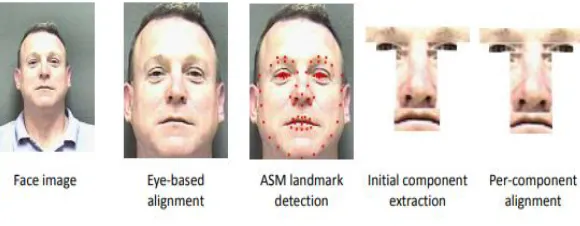
Otto et al. [2], proposes a part based strategy for age invariant face recognition. Facial segments are naturally limited in light of milestones detected utilizing an Active Shape Model. Multi-scale nearby binary pattern and scale-invariant element change highlights are then extricated from every segment, trailed by arbitrary subspace linear discriminant investigation for classification.
Fig. 3. Faces Components Extraction
[image:2.612.163.453.486.599.2]913
[image:3.612.224.385.82.331.2]©IJRASET: All Rights are Reserved
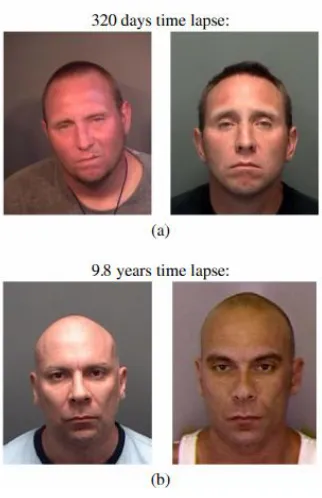
Fig. 4. Face time lapse
Ji-Xiang Du et al. [4], as of late, face recognition has been generally connected in overseeing and criminal fields. Aside from lighting, signal and appearance, varieties fit as a fiddle and surface of human faces because of aging component would likewise influence the execution of face recognition frameworks to a great degree. A facial aging recreation strategy in light of scanty obliged technique is first proposed and after that connected in the age-across face recognition. Trials demonstrate that age traverse to be sure greatly affects face recognition, however the recognition proportion is evidently enhanced subsequent to including extra virtual examples by aging recreation.
Fig. 5. Aging simulation
[image:3.612.185.425.453.585.2]914
©IJRASET: All Rights are Reserved
outcomes got in evident issues of turn invariance, where the classifier is prepared at one specific pivot edge and tried with tests from other revolution points, show that great segregation can be accomplished with the event measurements of straightforward pivot invariant neighborhood binary patterns. These administrators describe the spatial setup of neighborhood image surface and the execution can be additionally enhanced by joining them with turn invariant difference measures that portray the differentiation of nearby image surface. The joint conveyances of these orthogonal measures are appeared to be effective instruments for revolution invariant surface examination.
[image:4.612.191.418.264.478.2]R. Vinay et al. [6], as society ending up increasingly electronically associated, the ability to naturally build up a personality of people utilizing face as a biometric has turned out to be vital. Numerous applications, for example, personality check, criminal face recognition, and observation require robust and exact face recognition innovation. Face recognition has turned into an extremely difficult issue in nearness of messiness and fluctuation of the foundation, clamor and impediment, lastly speed prerequisites. This paper concentrates on building up a face recognition framework utilizing a broadened PCA algorithm. The proposed algorithm utilizes the idea of PCA and speaks to an enhanced adaptation of PCA to manage the issue of introduction and helping conditions introduce in the first PCA. The preprocessing period of the proposed algorithm underscore the proficiency of the algorithm notwithstanding when number of images per individual or the introduction is altogether different.
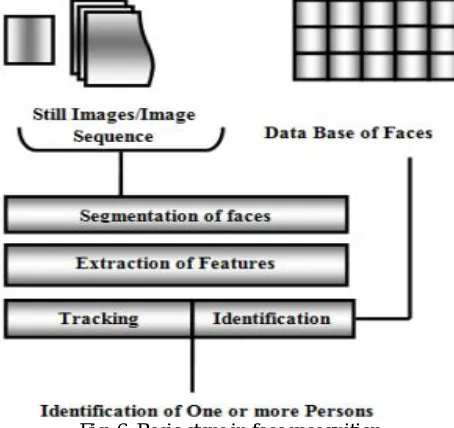
Fig. 6. Basic steps in face recognition
U. Maneesh et al. [7], Worries on boundless utilization of biometric validation frameworks are basically based on layout security, revocability, and protection. The utilization of cryptographic natives to support the verification procedure can reduce some of these worries as appeared by biometric cryptosystems. In this paper, author propose a provably secure and dazzle biometric confirmation convention, which tends to the worries of client's security, layout insurance, and confide in issues. The convention is visually impaired as in it uncovers just the personality, and no extra data about the client or the biometric to the validating server or the other way around. As the convention is in light of deviated encryption of the biometric data, it catches the advantages of biometric confirmation and additionally the security of open key cryptography. The confirmation convention can keep running over open systems and give non-reputable character check. The encryption additionally gives layout security, the capacity to deny enlisted layouts, and mitigates the worries on protection in across the board utilization of biometrics. The proposed approach makes no prohibitive suppositions on the biometric data and is subsequently relevant to multiple biometrics. Such a convention has huge advantages over existing biometric cryptosystems, which utilize a biometric to secure a mystery key, which thusly is utilized for validation. Author break down the security of the convention under different assault situations. Test comes about on four biometric datasets (face, iris, hand geometry, and unique mark) demonstrate that doing the verification in the encoded space does not influence the precision, while the encryption key goes about as an extra layer of security.
915
©IJRASET: All Rights are Reserved
the images, the current learning-based face SR strategies don't perform well on such a VLR face image. To beat this issue, this paper proposes a novel way to deal with take in the connection between the high-determination image space and the VLR image space for face SR. In view of this new approach, two requirements, specifically, new data and discriminative imperatives, are intended for good visually and face recognition applications under the VLR issue, separately. Test comes about demonstrate that the proposed SR algorithm in view of relationship learning outflanks the current algorithms in broad daylight face databases.
M. Yogesh et al. [9], Biometrics are computerized strategies for perceiving a man in light of a physiological or behavioral trademark. Among the highlights estimated are: face, fingerprints, hand geometry, handwriting, and iris and so on. Biometrics is turning into the establishment of a broad exhibit of exceedingly secure identification and individual check arrangements. As the required level of security rises, the requirement for exceptionally secure identification and individual check is additionally developing. In this paper, we propose an algorithm for robust face recognition.
[image:5.612.40.570.369.730.2]B. Nagarjun et al. [10], the face is our essential concentration of consideration in social intercourse, assuming a noteworthy part in passing on character and feeling. We can perceive a great many faces learned all through our lifetime and recognize well-known faces initially even following quite a while of partition. This expertise is very robust, in spite of extensive changes in the visual boost because of survey conditions, articulation, aging, and diversions, for example, glasses, whiskers, changes in haircut. In spite of the fact that human faces are unpredictable fit as a fiddle, face recognition isn't troublesome for a human cerebrum though for a PC this activity isn't simple. In this paper displays and breaks down the execution of Principle Component Analysis (PCA) based strategy for face recognition. We think about recognition of human faces with two outward appearances: single and differential. The images that are caught beforehand constitute the preparation set. From these images Eigen faces are ascertained. The image that will be perceived through our framework is mapped to a similar Eigen spaces. Next I utilized classification method to be specific separation based used to order the images as perceived or non-perceived. By and by Author got result for the single outward appearance now I am working for various outward appearance.
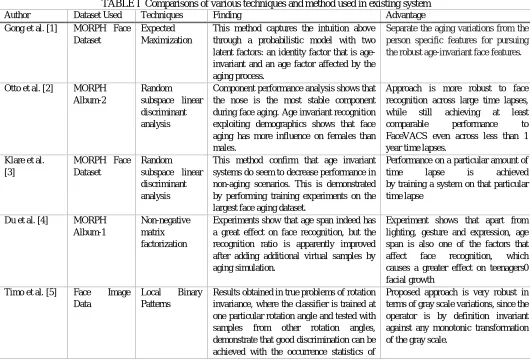
TABLE I Comparisons of various techniques and method used in existing system
Author Dataset Used Techniques Finding Advantage
Gong et al. [1] MORPH Face
Dataset
Expected Maximization
This method captures the intuition above through a probabilistic model with two latent factors: an identity factor that is age-invariant and an age factor affected by the aging process.
Separate the aging variations from the person specific features for pursuing the robust age-invariant face features.
Otto et al. [2] MORPH
Album-2
Random subspace linear discriminant analysis
Component performance analysis shows that the nose is the most stable component during face aging. Age invariant recognition exploiting demographics shows that face aging has more influence on females than males.
Approach is more robust to face recognition across large time lapses,
while still achieving at least
comparable performance to
FaceVACS even across less than 1 year time lapses.
Klare et al. [3]
MORPH Face Dataset
Random subspace linear discriminant analysis
This method confirm that age invariant systems do seem to decrease performance in non-aging scenarios. This is demonstrated by performing training experiments on the largest face aging dataset.
Performance on a particular amount of
time lapse is achieved
by training a system on that particular time lapse
Du et al. [4] MORPH
Album-1
Non-negative matrix factorization
Experiments show that age span indeed has a great effect on face recognition, but the recognition ratio is apparently improved after adding additional virtual samples by aging simulation.
Experiment shows that apart from lighting, gesture and expression, age span is also one of the factors that
affect face recognition, which
causes a greater effect on teenagers0 facial growth
Timo et al. [5] Face Image
Data
Local Binary
Patterns
Results obtained in true problems of rotation invariance, where the classifier is trained at one particular rotation angle and tested with samples from other rotation angles, demonstrate that good discrimination can be achieved with the occurrence statistics of
916
©IJRASET: All Rights are Reserved
simple rotation invariant local binary patterns.
Vinay Rishiwal [6]
Face Image
Data
Principle Component Analysis
Results shows that pre-processing greatly enhances the efficiency of the algorithm even when we have less number of images per person or the orientation is greatly different.
Pre-processing greatly
enhances the efficiency of the
algorithm even when author have less number of images per person or the orientation is greatly different. Maneesh
Upmanyu [7]
UCI
Repository –
Face Dataset
ANN Proposed method are able to achieve
classification of a strongly encrypted feature vector using generic classifiers such as neural networks and SVMs.
Primary advantage of the proposed approach is that author is able to achieve classification of a strongly encrypted feature vector using generic classifiers such as neural networks and SVMs.
Wilman W. W. Zou [8]
CAVIAR Face Database
Random subspace linear discriminant analysis
Results show that the proposed method outperforms the existing SR algorithms in terms of visual quality and recognition performance.
The proposed method outperforms the existing SR algorithms in terms of
visual quality and recognition
performance. Yogesh
Maniktala [9]
Face Database Principle Component Analysis
Results are calculated to recognize the face on bases of eigen values and calculation is done on basis of distance and time and accuracy. System give a accurate value i.e 2.0 or 0.3 that what portion of the image are matched instead of YES or NO in traditional system (PCA, LDA etc.).
Feature extraction for face recognition applied to expanding the accuracy,
capabilities and
robustness of this biometric domain,
B. Nagarjun
Singh [10] JAFFE Database Principle Component Analysis
The image that is going to be recognized through our system is mapped to the same
Eigen spaces. Next author used
classification technique namely distance based used to classify the images as recognized or non-recognized.
Distance based classification technique has been used to classify the images as
recognized or
non-recognized.
III.ACCURACYCOMPARISON
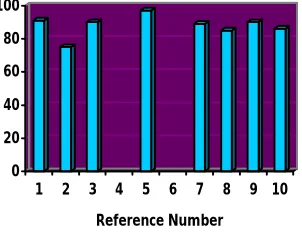
In this section we present accuracies of method adopted by different authors. Fig. 2 shows the accuracy chart.
0 20 40 60 80 100
1 2 3 4 5 6 7 8 9 10
Reference Number
[image:6.612.217.368.490.606.2]Accurcy
Fig. 7. Shows the accuracy of existing methods
Accuracy is the agreement between an experimental value, or the average of several determinations of the value, with an accepted or theoretical (“true”) value for a quantity.
Accuracy is usually expressed as a percent difference:
917
©IJRASET: All Rights are Reserved
IV.CONCLUSION
we In this paper, we have considered and analyzed different intriguing strategies and algorithms that give an answer for the face recognition of an aging issue. The examination is particularly required in building up a robust algorithm for face recognition across age progression.
Various author has proposed various mechanism in order to generate effective results. In Expected Maximization approach the major disadvantage is that it needs proper training and while classification the accuracy is reduced.
Non-Matrix factorization method do not have capability to lean and classify the aging data. While, PCA algorithm needs the input should be highly illuminated before training.
The paper survey various techniques for face recognition across an aging issue. We require a robust procedure which can enhance the execution of face recognition across aging regarding both precision and time. Face recognition across aging has numerous applications, for example, border control, forensic science, driver's permit and identification confirmation, get to control, localization of missing individuals, and so forth.
REFERENCES
[1] D. Gong, Z. Li, D. Lin, J. Liu and X. Tang, "Hidden Factor Analysis for Age Invariant Face Recognition," 2013 IEEE International Conference on Computer Vision, Sydney, NSW, 2013, pp. 2872-2879.
[2] Otto, Charles, How Does Aging Affect Facial Components, Computer Vision -- ECCV 2012. Workshops and Demonstrations: Florence, Italy, October 7-13, 2012
[3] Brendan Klare and Anil K. Jain. 2011. Face recognition across time lapse: On learning feature subspaces. In Proceedings of the 2011 International Joint Conference on Biometrics (IJCB '11). IEEE Computer Society, Washington, DC, USA, 1-8.
[4] Ji-Xiang Du, Chuan-Min Zhai, Yong-Qing Ye, Face aging simulation and recognition based on NMF algorithm with sparseness constraints, In Neurocomputing, Volume 116, 2013, Pages 250-259, ISSN 0925-2312
[5] T. Ojala, M. Pietikainen and T. Maenpaa, "Multiresolution gray-scale and rotation invariant texture classification with local binary patterns," in IEEE Transactions on Pattern Analysis and Machine Intelligence, vol. 24, no. 7, pp. 971-987, Jul 2002.
[6] Vinay Rishiwal and Ashutosh Gupta, “Improved PCA Algorithm for Face Recognition”, Special section for proceeding of International e-Conference on Computer Engineering (IeCCE) 2012.
[7] Maneesh Upmanyu, Anoop M. Namboodiri, Kannan Srinathan, and C. V. Jawahar, “Blind Authentication: A Secure Crypto-Biometric Verification Protocol”, IEEE TRANSACTIONS ON INFORMATION FORENSICS AND SECURITY, VOL. 5, NO. 2, JUNE 2010.
[8] Wilman W. W. Zou, “Very Low Resolution Face Recognition Problem”, IEEE TRANSACTIONS ON IMAGE PROCESSING, VOL. 21, NO. 1, JANUARY 2012.
[9] Yogesh Maniktala, Durgesh Srivastava and Basant Sah, “A Robust Technique of Face Recognition”, International Journal of Advanced Research in Computer Science and Software Engineering 6(6), June- 2016, pp. 782-785.