Abstract—this work establishes a way of calculating the free end point position, of a pre-curved bi-metallic strip, that is subjected to uniform heating. The prediction of the endpoint of a bimetallic strip is required during the design phase of an electronic control circuit sensor switch that uses a sensing/ activating unit containing a bimetallic strip. Bimetallic sensors are normally flat at ambient temperature, and at the required sensing temperature, the strip bends into a radius of curvature, which displaces the contact on the end of the strip, to make or break an electrical circuit. Although the normal, flat type of bimetallic sensor exists, this work concentrates on a pre- curved bimetallic sensor at ambient temperature. A curved bimetallic strip sensor provides a much larger sensing range and displacement at the free end of the strip, per degree of temperature change, than for a straight bimetallic strip. The greater sensing range is due to the arc length of the bimetallic strip being longer than the chord length of an equivalent straight bimetallic strip. The longer sensing range affords a greater flexibility in the positioning of the actual activation point. Pre-curved bimetallic test samples were subjected to heating whilst the motion of the free end point of the strip was recorded on a metal plate. As the heat applied to the samples was increased, many temperature points were recorded to generate approximate loci of points. The loci of test points compared well to theoretical curve generated by the derived formulae. Therefore the benefits of this work are that a pre-curved bimetallic strip offers a less critical sensing range, and the advantage that the mechanism can be designed to be much smaller and take less space in the product than for a comparable flat bimetallic strips sensor.
Index Terms— design, sensors, compact, bimetallic, thermal
I. INTRODUCTION
The aim of this paper is to introduce a mathematical method of predicting the end point of a pre-curved bimetallic strip that is being uniformly heated. One end of the curved bimetallic strip is rigidly fixed against displacement and rotation, and the other end, is free to move. By the application of a uniformly distributed heat to the curved strip, the strip will straighten up.
Manuscript received Feb, 2013; revised July 03, 2013. This work was supported in part by the University of Hertfordshire,
Geoff. Angel is with the University of Hertfordshire,School of Engineering and Technology, University of Hertfordshire, College Lane, Campus Hatfield, Herts. AL10 9AB,UK (e-mail: [email protected]), Tel: 01707 284586
Dr George Haritos is with the University of Hertfordshire, School of Engineering and Technology,(e-mail: [email protected])
Tel. 01707284239.
Ian Campbell is with the the University of Hertfordshire, School of Engineering and Technology,
(e-mail: [email protected]) Tel.07736 775811
If a Cartesian coordinate system is adopted, a formula can be derived to describe the theoretical locus of the end point of the strip relative to an X and Y coordinate axis system. By using Timoshenko’s Equation [1], for evaluating the bending of a bimetallic strip under heating conditions, in conjunction with the straightening formulae produced by this paper, it is possible to predict the radius of curvature and displacement of the end point of the free end, as a function of temperature. It will be shown by an actual bimetallic strip straightening test, how the locus of test points correlate to the theoretical path. This paper can be used at the design stage of a temperature controlled circuit, whereby it is necessary to know the exact position of the end of a curved bimetallic strip for a given particular temperature. With this paper it will also be possible to specify the geometric and material properties of a curved bimetallic strip necessary to achieve other critical design objectives in a temperature controlled circuit.
II. THEORY
Timoshenko is used to evaluate the radius of curvature of a straight bimetallic strip. With the addition of a correction formula, it is still possible to use Timoshenko, to evaluate the straightening of a pre-curved bimetallic strip. With the radius of curvature found, and with other formulae derived in this work, it is possible to correlate the theoretical end point position of the free end of the strip, to the actual recorded data results from the test. Consider the curved bimetallic strip that is shown in Fig.2, it is rigidly fixed at one end and free to move at the other end. When uniformly heated, it will tend to straighten up if the material side of the strip with the higher coefficient of linear expansion α2, lies on the inside surface, see Fig.1. As the free end of the strip straightens up, it will adhere to a locus predetermined by the initial pre-curved “cold” radius of curvature and material properties and make-up of the bimetallic in question.
Fig.1 Curved bimetallic strip with 2is on the inside
Straightening Locus of a Curved Bimetallic
Strip Subjected to Heating
III. EVALUATION OF THE “HOT” RADIUS OF CURVATURE
R
h Application of Timoshenko curvature equation to obtain unloaded “hot” radiusR
hAssumptions
the pre-curved bimetallic strip is rigidly fixed at one end, and free to move at the other end.
the strip is uniformly heated along the entire length of strip, and the strip remains truly circular.
no external loads are applied during heating
the material with the higher coefficient of linear thermal expansion α2 is on the inside radius R
From Timoshenko[1], the radius of curvature of a bimetallic strip is given by
2 1
2
2 2
) 1 ( ) ( ) ( 6
) 1 ( ) 1 ( ) 1 ( 3
m T
T
n m m n m m
t
C H
(1) Where ρis the radius of curvature as function of
temperature from an ambient flat strip. 2
1 t t
t total thickness of the strip, t1,t2 being the material thicknesses.
2 1 t t
m ratio of thicknesses.
2 1 E E
n ratio of Young’s Modulus.
C
H T
T & hot and cold temperatures states of the strip
E1, E2are the linear Modulus of the two separate materials. 1
2&
are the coefficients of linear thermal expansion for the two metals
Whereby α2 is assumed to be numerically larger thanα1 The
R
hcorrection equation evaluates the radius of curvature of a heated bimetallic strip from an initially pre-curved radius of curvatureR
C byadding the reciprocals of both radii 1
1
C
R
. Thus :
C C h
R R R
(2) With
R
hestablished by the application of the Timoshenko formula, the corresponding “hot” chord lengthL
h can now be found. The general chord length of any arc is generally known to be given by:)
2 sin(
2R
L (3)
Where:
L is the chord length mm
R is the radius of curvature mm
A is the arc length (in radians) part of a true circle
R A
rad.
And thus: )
2 sin( 2
H h H
R A R
L (4)
The “hot” chord length of the straightened strip.
Evaluation of angle θ as a function of hot radius of curvature
h
R
is by considering the geometry of the pre-curved bimetallic strip. From Fig.2, two Isosceles triangles exist, ∆oab and ∆odc. For both triangles, adding all the angles upto180degrees: Ry
180 and 2
180. The third relationship that can be found in Fig.2 is, y
. By manipulation and substitution of these sub-formulae, it can be shown that
2 2
(5)
with further substitution and manipulation this is equal to:
h c C
R R
A 1 1
(
2
(6) Given that
A
c
A
h the strip arc changes shape, not its length.Where:
Ac Ah is the arc length of the curved bimetallic strip. Rc is the cold radius of curvature stated previously and initially known.
R
h is the hot radius of curvature calculated by Timoshenko earlier.Hence the “hot” endpoint position can be now calculated in terms of X, Y coordinate system, see Fig.3.
1 1))
( 2 cos(
h c c h
R R A L
x
(7)
h c c H
R R A L
y (1 1
2 sin(
(8) From (2) we have the radius of curvature
R
h as a function of the temperature change from ambient, with this value entered into (7) and (8) the evaluation thex
,
y
end point position of the bimetallic strip is possible. These formulae were used to generate the theoretical curves used later on in this paper.Fig.2x& y position of heated strip
IV. TEST EQUIPMENT
Bimetallic strip used in test; Shivalik SBC-206-1 [2] which were initially 202mm long x 5mm wide x 0.4 mm thick straight bimetallic strip. Four bimetallic strip test samples were made by gently cold working the strips to form true arcs of a circle equal to D64mm, D80mm, D100mm, and D128mm. The bimetallic strips were formed with the material side with the highest coefficient of linear expansion on the inner surface. To ensure that the curved bimetallic strips conformed to a true arc during cold working, special formers were produced to check the diameter and roundness see Fig.4, the formers were held to +/- 0.25mm tolerances. The length of each test sample was cut back to equal half the circumference of the former, i.e. 100.53mm, 125.66mm, 157.07mm, 200.06mm long respectively, within a tolerance of +/- 0.25mm. Each test sample was subjected to heat treatment according to the Kanthal handbook [3], to 350 °C for a 2 hours before the actual testing took place, this was to normalize the strips from any work hardened induced stresses from the cold forming process.
Fig.4 Test samples checking for roundness & size
4-Curved bimetallic test samples, tagged as: D64, D80, D100, D128, Hanna HI 93530 K-Thermocouple Thermometer Digital: Thermocouple: positionT1. TES1319 K-Type Thermometer 2 off: Thermocouple: position’s T2 and T3.Solex, Digi-Thermo ST 4060 Digital Thermometer recording ambient temperature Ta. Each thermocouple was affixed to each test sample by a spring clip on the outside surface, and shielded by the body of the test sample from direct hot air flow.
The positioning pattern of the three thermocouples was the same for all test samples, see Fig. 6. Bosch 2.3kW GHG 660 LCD Professional ; variable flow hot air gun; adjustable heat settings in increments from 10 to 600 °C. Fan type nozzle for maximum flow spread along the test samples.50°C the lowest temperature setting output of the gun. Hot air flow rate and position of heat gun fixed for all testing.
Heat flow was perpendicular to the Aluminium Base plate for a constant uniform heating environment. A - 5mm heat stabilising plate was placed underneath the Aluminium base plate. A heat stabilising shield was placed around the test pieces during testing.
A 1mm thick sheet Aluminium base plate was used for recording locus of points during the tests. Test sample holder clamped to the Aluminium base plate using a workshop “G” clamp. The test samples were clamped in the test sample holder to 1mm depth for each strip. The test samples were measured to be 1mm parallel to, and clear of the Aluminium base plate throughout all tests. See Fig.6. A black fine felt tip pen was used for recording data points on the Aluminium base plate, see Fig.5.
V. TEST METHOD
Each test sample was clamped parallel to the Aluminum base plate within the heat stabilized zone. One end of the bimetallic strip was rigidly fixed, the other end 1mm from the plate, was free to move, see Fig 6. Each test sample was subjected to uniform heating, and as the strip straightened up, the locus of the free end point was recorded on the Aluminum base plate using the felt tipped pen, and at each point, the corresponding thermocouple temperature was recorded, see Fig. 7. The heat from the gun was increased in steps of 20°C, and an identifiable locus of points was produced for each test sample, see Fig.7.
Fig.6 Test Sample setup
Fig.7 Full set of test data points transferred to paper and X, Y, distances measured
VI. TEST RESULTS &DISCUSSION
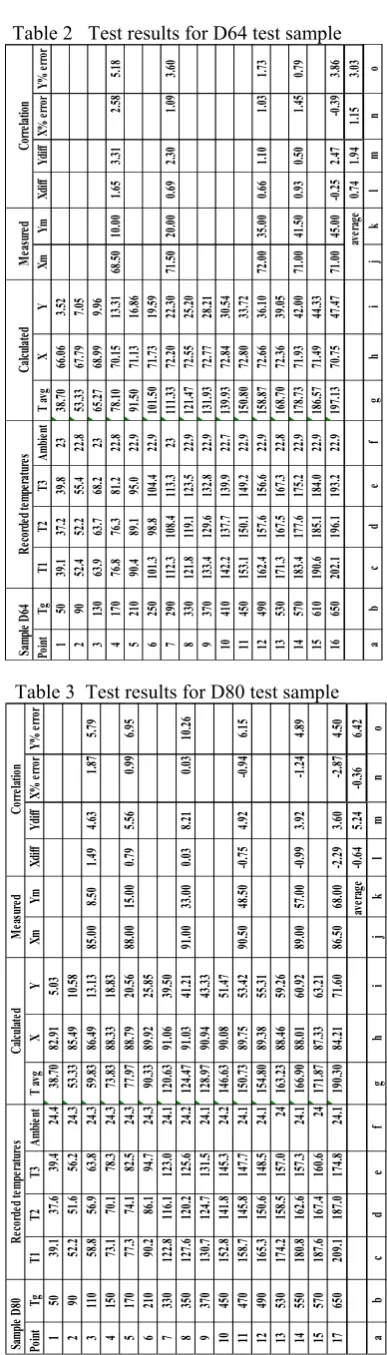
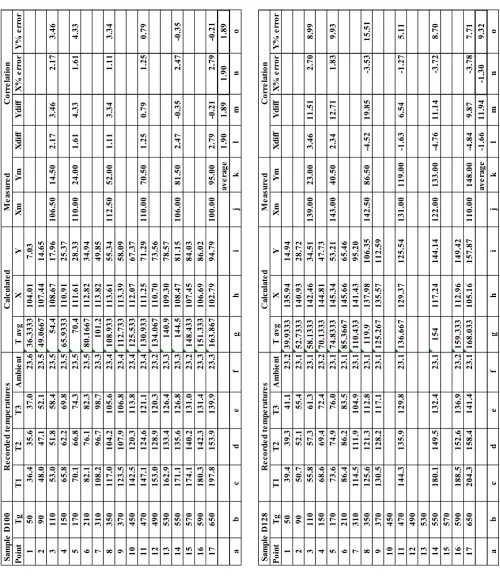
The result of heating and plotting the loci of points are shown in Fig.8.The data points were plotted onto the surface of the Aluminum base plate. The range of points were plotted for a thermocouple temperature range of up to 210 °C for an ambient room temperature in the range of 21 to 24 °C, and sufficient data points were obtained to identify the locus of the free end of the strip for each test sample. For each test sample, five to seven data points corresponding to the specific thermocouple temperatures, were measured from the best fit curve in Fig.8 and recorded in Table’s 2, 3, 4, & 5.see Appendix 3. Sample test points
were plotted against the calculated curves generated by the formulae presented in the theory section of this paper, and a good correlation was observed for the majority of the test points.
Fig.8 Comparison of theory to test data
Generation of the theoretical calculated data curves in Fig. 8, and in Tables 2, 3, 4, & 5 were computed using a Mathcad program. The properties used to calculate the theoretical values were as follows:
Thickness of each metal 0.2mm equal ; total thickness = 0.4mm, Young’s Modulus of Steel 210 GN/m2 , Young’s Modulus of Invar 36 : 145 GN/m2 , source.[4]
Coefficient of linear expansion for steel: 20 x 10-6/K. [4] Coefficient of linear expansion for Invar 36: 1.85 x 10⁻⁶/K.
VII. CONCLUSION
This work provides a means of calculating the free end point position of a curved bimetallic strip subject to uniform heating. With the aid of a Microsoft Excel work sheet or other similar electronic worksheet, the major equations can be easily evaluated for any curved bimetallic strip to provide design options in any control circuit using a bimetallic element as the sensing unit. The low overall percentage correlation error between the test data and the theory, validates the formulae derived in this paper, and indicates that they can be applied with high degree of confidence to predict the movement of the end point of the strip due to heating.
REFERENCES
[1] Timoshenko S. Analysis of Bi-metal Thermostats. JOSA. 1925;11:233-55.
[2] Shivalik S--. Bimetallic strip supplier. 2013.
[3] Kanthal. Kanthal Thermostatic Bimetal Handbook. Box 502, SE-734 27 Hallstahammar, Sweden: Kanthal; 2008.
[4] Matweb. Material Properties Data tables. 2013.
APPENDICES APPENDIX 1 KEY TO TABLES Point number recorded on Aluminum base plate Hot air gun temperature (°C).
Thermocouple T1 recorded temperature (°C). Thermocouple T2 recorded temperature (°C). Thermocouple T3 recorded temperature (°C).
Tamb. Ambient surrounding recorded temperature (°C). Average thermocouple temperature calculated (°C). X distance calculated (mm).
Y distance calculated (mm).
Xm distance measured from best fit curve in millimeters. Ym distance measured from best fit curve in millimeters. Xdiff. is the difference between data & theory in (mm). Ydiff is the difference between data & theory in (mm). X percentage error for each test sample: X diff./64*100 (e.g. for test sample D64).
Y percentage error for each test sample: Y diff./64*100 (e.g. for test sample D64).
APPENDIX 2 PERCENTAGE ERROR SUMMARY TABLE
Table 1 Summary of overall percentage error
Test Sample Ave. % Error Ave. % Error
D64 1.15 3.03
D80 ‐0.36 6.42
D100 1.90 1.89
D128 ‐1.30 9.32
Overall Ave %
Error 0.35 5.17
[image:5.595.338.532.86.765.2]
APPENDIX 3DATA TABLES
Table 2 Test results for D64 test sample
Table 3 Test results for D80 test sample
Table 4 Test results for D100 test sample
[image:6.595.46.547.62.642.2]