[ 4 6 9 ]
REPEATED PRESENTATION EXPERIMENTS AND THE
FUNCTION OF THE VERTICAL LOBE IN OCTOPUS
BY M. J. WELLS AND J. WELLS
Department of Zoology, University of Cambridge and Stazione Zoologica, Naples
{Received 25 May 1957)
INTRODUCTION
In a previous publication (Wells & Wells, 1957) it was shown that when octopuses with the vertical lobes of their brains removed are trained to make tactile discrimi-nations, they make a much higher proportion of errors than controls. The increase in errors made can be attributed to a reduction in the ability to retain memories between trials, since it is possible to compensate for removal of the vertical lobe to a very considerable extent by arranging trials at shorter intervals. The present account is of some experiments made to determine whether there are other effects of removing the vertical lobe in addition to an increased rate of fading of memories.
MATERIAL
Octopus vulgaris Lamarck of between 300 and 800 g. from the bay of Naples were
used in these experiments. The animals were caught and kept in individual tanks as described by Boycott (1954) and fed upon crabs or pieces of fish, those showing signs of damage due to rough handling at capture or failing to feed regularly being discarded. Each octopus was provided with three large bricks, piled together to form a 'home' at one end of its tank as described by Boycott & Young (1955). Animals not blinded (see next section) generally sat at the entrance to their homes, looking down the tank. Animals were not used in the experiments until they had been in captivity for several days and had ceased to react to the presence of an observer by retiring into their homes or by displaying the 'dymantic response' (Boycott, 1954). Some of the animals were then subjected to operations in which parts of their brains were removed; these animals were given a further post-operational period, during which they were fed regularly, before experiments were made with them.
OPERATIONS
Animals were anaesthetized in 3 % urethane in sea water and lesions to the central part of the brain or removal of the optic lobes carried out as described in Wells & Wells (1957). Removal of the optic lobes involves section of the optic nerves and blinds the animal; lesions to the vertical or superior frontal lobe do not. One animal (A 106 B) was blinded by section of the optic nerves as described in Wells & Wells (1956).
Animals with brain lesions were killed at the end of the experiments and the lesions checked from serial sections. The extent of the lesion to the vertical lobe in the case of each individual so operated (estimated as in Boycott & Young, 1955) is given in Tables 1 and 2 as a percentage of the lobe removed. Maps of the lesions in the case of four animals (B15NV, B16NV, B19NV and B39NSF) that were subsequently trained to make tactile discriminations are given in Wells & Wells (1957). Removal of the optic lobes was invariably complete.
EXPERIMENTAL
When an octopus touches a small movable object that it has not previously encoun-tered, it almost always grasps it and passes it to the mouth. In these experiments octopuses were required to learn not to do this with an inedible object presented to them. A series of objects of sealing-wax or Perspex were used; these objects have been fully described elsewhere (Wells & Wells, 1956) and are specified in the text, although their actual form is unimportant since the form of the objects, within wide limits, does not affect the results obtained. Animals were given no pre-experimental experience of the objects.
Function of the vertical lobe in Octopus 471
[image:3.451.65.387.203.368.2]them by sight since most animals will continue to extend their arms to touch objects presented for many trials after they have ceased to give these anything but the most cursory tactile examination (see also Goldsmith, 1917).
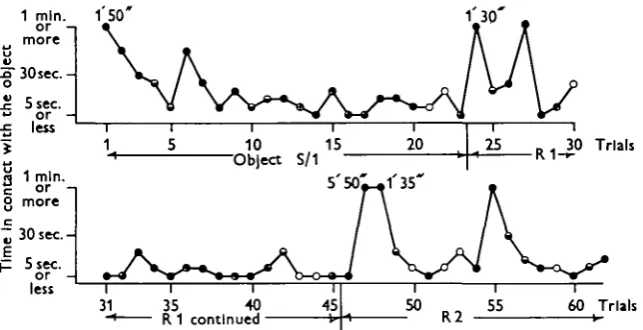
Fig. 1 shows details of the performance of one animal (A 133) under these con-ditions. This animal learned to recognize a smooth sealing-wax cyUnder (Si) 2-0 x 2-5 cm. long so that this object was neither passed to the mouth nor even pulled towards the animal when touched after the 12th trial. From trials 13 to 23 no attempt was made to take the object, although the animal always reached out and examined it when presented. At trial 24, however, a different object, R1
H
obj
e
th
e
wit
h
contac
t
c
V
E 1 mln.
or -i more
30sec.
-5 sec. or -less
1 mln. or -more
30 sec.
-5 sec. or -less
1 50
1 1
31^
<
V
1 5I 35 - R 1
i
\
10 Object
40 continued —
1 15 S/1
5'5 0 l
/
• i —
20
v
501 30 f
^ \ /
^25 „ A 30 Trials
JV.
R2
i i 55 60 Trials
y-Fig. 1. Detail of the first part of the experiment with A133 summarized in Table 1. Trials are at intervals of 2 min. 'Time in contact with the object' is the time elapsed between first contact when the animal reached out and touched the object and the final withdrawal of the arm from contact with the object. Reactions made are indicated as follows: #, object passed to the mouth; ©, object pulled towards the mouth before rejection or withdrawal; ®, withdrew (removed the arm after examining the object, leaving this where it was); O, rejected (pushed the object away to arm's length). The second line of this plot follows upon the first after the usual 2 min. interval between trials.
(which was like S1 but had deep longitudinal grooves 0-5 mm. wide cut into it at intervals of 1-5 mm.) was presented and taken at once. This object was passed under the web to the mouth 3 times in the next four trials, the octopus thereafter ceasing (with one exception at trial 33, when R i was taken but at once rejected) to take the object. At trial 45 a third object, R2 (with grooves 2-5 mm. wide 3 mm. apart) was introduced and taken twice in the next three trials before that, too, ceased to be taken when presented.
Further examples of this sort of experiment are summarized in Table 1, which shows that a change of the object to one which the animal concerned had not already learned to reject in a previous set of tests, resulted in the new object being accepted in six out of seven cases; such experiments show that the animals are really learning to recognize the objects and not merely becoming generally less reactive or fatigued.
47 M. J. WELLS AND J. WELLS
in Tables i and 2; the performance of these animals was comparable to that of unoperated animals. This confirms the results of tactile discrimination experiments reported in Wells & Wells (1957), from which it was concluded that the optic lobes play no part in tactile learning, and in Table 2 animals lacking the optic lobes are included among the controls.
When repeated presentation experiments were made with animals having their vertical lobes damaged or destroyed, it was found that these could also learn to
Table 1. Summary of' repeated presentations' experiments showing retention following breaks in the sequence of trials at short intervals
Animal
A129*
A133
A121NOL
(9 days later)
A122NOL
A128NV (100 % vertical lobe removal)
A130NV (85 % vertical lobe removal) Object used S i S I S I S I R I S i R I R 2 P 4 S i R I R 2 S i R I R 2 S i R I Rz S i S I S I R I S I R I R 2 S i S I R I S I S I S I S I S I S I S I S I R I S I S I S I S I S I S I S I No. of trials 4 9 1 3 4 S 1 7 6 1 1 23 2 2 17 5 5 S 1 2 5 5 9 3 1 1 8 1 14 1 0 S 2 0 5 1 0 5 1 0 1 0 3 8 IS 19 3 1 0 1 0 1 3° 2 4 IS 1 0
Trials at which the object was passed under the web to the
mouth
1. 2, 11, 13 — 1 — 1 — — 1
1. 2, 3, 4, s, 6
1. 2, 3, 4, 6, 7, 8, 9, 12 1. 3. 4. 10
2, 3. 10
— — — 1. 4 — 1 1 — — — 1 1 1, 4 — — — — 1, 2 1
2, 4, 8
1, 2, 5, 6, 7, 8, 10, 11, 12 1, 2, 3. 4, 5. 6, 7, 8, 9
1
1 , 6
2, 4
1
1, 4. 6, 7. 9. 11. 13. 14, IS. 21 1, 2, 3, 4, s, 6, 7, 12, 13, 14
2 , 6
1
Interval before the next series of tests if more than 2 min.
I hr. 40 min.
2 hr. 25 min.
14 hr.
— — 4 hr. — — — — — — — — 3hr. — —
24 hr.
—
16 hr.
— —
25 hr.
— —
—
3 hr. 30 min.
2 hr. 30 min.
64 m-. —
ahr. 18 hr.
—
4hr.
16 hr.
24 hr.
74 hr. —
2 hr. 30 min.
2 hr. 30 min.
64 hr. —
Function of the vertical lobe in Octopus 473
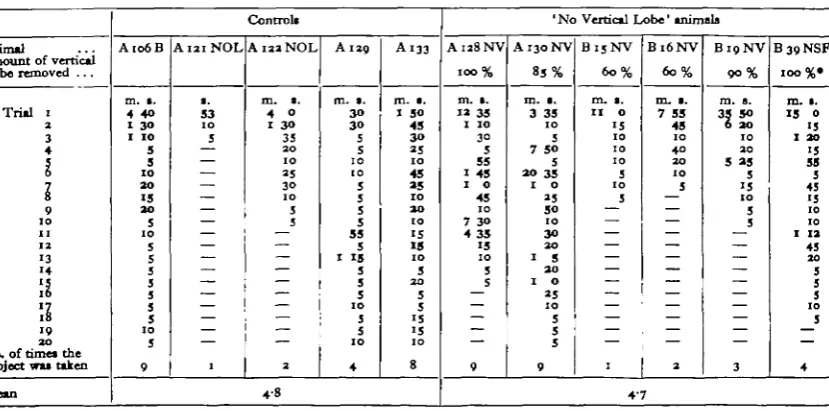
.ecognize and reject objects (Tables 1 and 2) and that, as in the case of controls, there was considerable individual variation in the number of trials required to do this. It can be seen from Table 2 that this number varies within a similar range for both controls and animals with vertical lobe lesions. It was also found that animals lacking parts of the vertical lobe tended to forget their training in the event of gaps in the sequence of trials at short intervals and were slower to relearn when training was resumed than controls which either did not forget or relearned very rapidly (Table 1). It is not possible to quantify these results because neither the number of trials nor the length of breaks in training were kept constant. A quantitative comparison between the times taken to reject the first object to be presented can, however, be made, and such measurements show that five animals having lesions to the vertical lobe* averaged 6 times as long as five controls to reject an inedible object on the first occasion that it was presented to them (average time in contact with the object 14 min. 19 sec. against 2 min. 23 sec. by controls). The movements that they made throughout this period, during most of which the object was out of sight beneath the web, indicated that they were trying to break open the object and not merely hoarding it.Table 2. Results of repeated presentations of the test object Si
(Only the first twenty trials (or less) of the first run of tests at 2 min. intervals is given. The times —to the nearest 5 sec.—given for each trial is the total time in contact with the object as in Fig. 1. Times in heavy type are occasions on which the animal passed the object under the web towards the mouth.)
mount of vertical obe removed . . .
Trial 1 2 3 4
I
7 8 9 IO 11 1 2 1 3 1 4M
17 18 1 9 2 0 0. of times the ibject was taken[ean Control* A106B m. i. 4 4O I 30 I IO 5 5 IO 2 0 1 5 2 0 S 1 0 5 5 5 5 5 5 5 1 0 5 9 A121NOL s. 53 1 0 5 — — — — — — — — — — — — — — — — 1 A122NOL m. •. 4 0 1 30 35 2 0 IO 2 5 3 0 IO 5 5 — — — — — — — — -— — 2 A 129 m. s. 3 0 3 0 5 5 IO IO 5 5 5 5 55 5 I 15 5 5 5 1 0 5 5 IO 4
A 133
m . •.
1 50 45 3 O 2 5 1 0 45 25 1 0 2 0 IO 1 5 IS IO 5 2 0 5 5 1 5 I S 1 0 8 4-8
1 No Vertical Lobe' animals
A u S N V
100% m. t. 12 35 1 10 3 0 5 55 1 45 1 0 45 1 0 7 3O 4 35 1 5 1 0 5 S — — — — — 9 A130NV 85% m. a. 3 35 1 0 5 7 SO 5 2O 35 I 0 2 5 5 0 1 0 3 0 2 0 1 S 2 0 I 0 25 1 0 5 5 5 9 B15NV
6 0 %
m. 1. 11 0 1 5 1 0 1 0 IO 5 1 0 5 — — — — — — — — — — — I B16NV
6 0 %
m. a. 7 55 45 1 0 4° 2 0 IO s — — — — — — — — — — — — — 2 B19NV
9 O %
m. a. 35 SO 6 30 1 0 2 0 5 25 5 1 5 IO 5 5 — — — — — — — — — 3 B39NSF
IOO %• m. 1. 15 0 15 1 20 15 59 5 45 15 10 10 I 12 45 2 0 5 5 5 1 0 5 — 4 4'7
* Plus one pnimai with a lesion to the superior frontal lobe, an operation which destroys most if not all of the afferent connexions to the vertical lobe (Boycott & Young, 1955) and can probably be regarded as functionally equivalent to complete removal of the vertical lobe.
DISCUSSION
The training technique used in the experiments reported in this account is subject to an important theoretical objection and to a number of practical difficulties. The use of unblinded animals in an experiment designed to test recognition of objects by touch is suspect because such animals could, in theory, learn to recognize the objects presented by sight or derive cues from watching the experimenter. In practice it can be shown that this defect in the experimental method is unimportant. It was not possible to train octopuses to distinguish by sight between two objects similar to those used in these tests (Wells & Wells, 1956), and it appears that under the conditions described in this account, octopuses learn to recognize an object by touch before learning to recognize it visually; they will continue to react by reaching out to grasp an object dropped near them for many trials after learning not to take it following subsequent tactile examination (Goldsmith, 1917, makes the same observation).
The most important practical difficulty is that of recovering the test object from the octopus's tank between trials. If the same object is to be presented after an interval during which the octopus has no possibility of experience of it, it must be removed from the aquarium when rejected. It is not always easy to do this without disturbing the animal, particularly if, as sometimes occurs, the object is rejected only to the edge of the web whence it is difficult to recover it without touching the animal. Octopuses that have become accustomed to life in aquaria tend to rush out and attack a hand, net or pincers moving in their tanks, and, disturbed by the struggle that inevitably follows, may retire home and fail to take objects presented during the next 10 or 20 min. An additional difficulty is that octopuses become very tame when kept in aquaria and rapidly learn to associate the presence of an observer with food, coming out of their homes and approaching down the tank when he appears. Animals that do this are useless for experiments that depend upon their staying in one place on the floor of their tanks. Another source of diffi-culty is the tendency of octopuses to hoard small objects, and some individuals will retain an inedible object presented to them for periods of hours or days before rejection. In such cases it is often possible to see the object held beneath the web, firmly grasped by the suckers, in the same position for hours on end.
Function of the vertical lobe in Octopus 475
evaluate the relative importance of these factors, and this was not done, the experi-mental method being abandoned in favour of a discrimination training technique that gives much more consistent results and is not subject to the same theoretical and practical objections (see Wells & Wells, 1956).Nevertheless, certain general observations on the performance of animals in these tests may be made. These are:
(1) Under these conditions octopuses very rapidly cease to repeat actions that are not rewarded. In the present instance they learned not to take an inedible object repeatedly presented to them. Learning not to do this evidently involved recognition of a specific object, since when this was changed the octopus took the new object.
(2) Having learned to recognize and reject an object presented, octopuses remem-ber for a period of hours or days, so that when the same object is again presented after such a break in training, it is either rejected at once or taken comparatively few times before the animal relearns to reject it (similar results are reported in Goldsmith, 1917).
(3) Animals lacking the vertical lobe, tested following similar breaks in training, showed comparatively poor retention of their initial training. This is in keeping with the results of comparable 'no reward' visual tests described by Boycott (1954) and with the results of tactile training experiments (Wells & Wells, 1957), both of which indicate that memory retention is comparatively poor in octopuses from which the vertical lobes have been removed.
(4) Provided that the sequence of trials at 2 min. intervals is maintained, animals lacking the vertical lobe take about as many trials as controls to learn not to take an object, but the time that they take to reject an object on the first occasion that it is presented is generally much longer.
This last result tells us something that discrimination training experiments cannot. It shows that removal of the vertical lobe has effects that cannot be attributed to a fading of memories between trials. The present data show that an animal lacking the vertical lobe must have unusually long experience of an inedible object before rejecting it on the first occasion that it is encountered and taken. This is not ex-plicable on the basis that the vertical lobe removal has interfered with essential afferent or motor pathways since subsequent trials show that such animals can identify and reject the object just as rapidly as controls (Table 2). Nor is it likely that the behaviour of animals without vertical lobes in the first trial is due to an over-all increase in the ' positiveness' of response, as has been suggested to account for the results of vertical lobe removal in visual training experiments (Sutherland, 1957), since subsequent work has shown that such animals are not more likely than controls to react positively towards objects touched or seen (Wells & Wells,
1957; Young, 1957).
The nature of the deficiency shown can perhaps best be considered in terms of the changes that must take place in an animal's nervous system during the first trial.
It can be assumed, since the animal moves the object with its arms continuously throughout this period, that the pattern of the sensory input caused by the object
remains more or less constant. The motor result of this input becomes modified during the period of the trial, so that finally rejection occurs instead of acceptance. Presumably this modification is brought about as a result of secondary sensory inputs, in the first instance from the mouth region when the animal tries to eat the object. In the case of animals lacking the vertical lobe this second input must continue for several times as long as normal before it can affect the motor consequences of the first input, implying that in the normal animal the vertical lobe serves to amplify the effects of such stimulation upon the organization of the animal's nervous system. It does this during the period in which sensory stimulation from the object is reaching the nervous system. This is of considerable importance in the interpretation of the results of discrimination experiments which indicate that the effect of each trial endures for longer if the vertical lobe is present (Boycott & Young, 1955; Wells & Wells, 1957). Such methods involve trials at each of which the animal is given a standard amount of experience (i.e. is exposed to the visual situation for 2 min., or allowed to react positively or negatively once to an object touched) and the results do not show whether vertical lobe removal decreases the effect of each trial or increases the rate of fade of this effect between trials, since in either case the deficiencies produced in training experiments would be most marked at low trial frequencies (see Wells & Wells, 1957). The present experi-ments strongly suggest that removal of the vertical lobe produces the deficiencies that it does because it renders each sensory experience less effective in the establish-ment of a memory at the time of its occurrence. If this is so, the vertical lobe in the intact animal is concerned more with the establishment of memories than with reducing the rate of fade of these memories between trials.
SUMMARY
1. When presented with a small object that it has not previously encountered, an octopus passes the object to its mouth and attempts to eat it. Inedible objects are rejected after a period of minutes, and when the same object is repeatedly presented at short intervals, the animal rapidly learns to examine and reject it without passing it to the mouth.
2. That the animal is learning to recognize a particular object and not merely becoming fatigued or generally less reactive can be demonstrated by changing the object; a new object is almost always taken, even if the animal has not taken the original for many trials.
3. After a break in training of the order of hours, the animal may accept the same object when it is presented again, but relearns not to take it in fewer trials than in the original training.
4. The performance of two animals tested after removal of the optic lobes was in all respects comparable to that of three controls (two unoperated and one with the optic nerves cut).
Function of the vertical lobe in Octopus 477
they took six times as long to examine and reject the objects in the first trial, and they showed relatively poor retention following breaks in training. The first of these differences is particularly important because it shows that removal of the vertical lobe has effects other than increasing the rate of fading of memories between trials. The significance of this in the interpretation of the function of the vertical lobe from discrimination experiments is discussed.The experiments reported in this paper were carried out at Naples at a time when M. J. W. was a member of the staff of the Stazione Zoologica di Napoli and also holding an Eli Lilly Fellowship. The work was prepared for publication in Cambridge during the tenure by M. J.W. of a Fellowship at Trinity College. The authors would like to thank Prof. J. Z. Young, F.R.S., and Mr B. B. Boycott for helpful criticism during the work and for reading the manuscript.
REFERENCES
BOYCOTT, B. B. (1954). Learning in Octopus vulgaris and other Cephalopoda. PubbL Staz. zool. Napoli, 35, 67-93.
BOYCOTT, B. B. & YOUNG, J. Z. (1955). A memory system in Octopus vulgaris Lamarck. Proc. Roy. Soc. B, 143, 449-80.
GOLDSMITH, M. (1917). Psychologic animale. Quelques reactions sensorielles chez le Poulpe. CM. Aead. Set., Paris, 164, 448-30.
SUTHERLAND, N. S. (1957). Visual discrimination of orientation by Octopus. Brit. J. Psychol. 48, 55-71.
WELLS, M. J. & WELLS, J. (1956). Tactile discrimination and the behaviour of blind Octopus. Pubbl. Stax. zool. Napoli, 38, 94-126.
WELLS, M. J. & WELLS, J. (1957). The effect of lesions to the vertical and optic lobes on tactile discrimination in Octopus. J. Exp. Biol. 34, 378-93.