Training and Development - A Study on Training
and Development at Bloom Hospital
M. Poojavarsha Anurag Group Of Institutions
Abstract: The study focuses on human resource development through employee Training and Development. The purpose of training and development programs is to improve employee capabilities and organizational capabilities. The aim of the present research is to study employee training and development practices followed by Bloom hospital.
It gives idea about various training and development programs carried in the hospital, type of training provided to hospital employees and its benefits.
It also focuses on employees’ expectation and involvement in such type of training program. The objective of the study is to analyse the implementation of training and development practices in Bloom hospital and its impact on perception of employees which leads to performance improvement and job satisfaction.
Training investment is returned in the form of more productive and effective employees. Training and development programs may be focused on individual performance or team performance. It is observed that those hospitals following systematically and scientifically training and development practices create high job satisfaction level within employees. These employees are more committed towards better performance.
The creation and implementation of training should be based on training need analysis. Information obtained could be useful for improvement of training and development practices in hospitals. Factors that can affect the effectiveness of training and development practices in the hospitals include, lack of support from top management and peers, employees’ individual attitudes, job-related factors and the deficiencies in training practice.
In era of globalization where hospital industry is booming and there is increasing demand of hospital services, all employees should be managed efficiently and effectively by implementing systematic training and development programs. As there is an urgent need to reshape training and development system in hospitals in order to have advancement in medical field and to be of world class status, Hospital organizations should design training policies, training budgets and training programs.
Keywords: Training, Development, Employee Performance improvement, Training need analysis.
I. INTRODUCTION
Training and Developmentis a subsystem of an organization which strengthen the improvement of the performance of person in individual and in groups.
Training is a continuous educational process which includes the sharpening of skills, concepts, changing attitude and gaining more knowledge to increase the performance of the employees. Good & efficient training of employees help in their skills & knowledge development, which eventually helps a company improve.
Training is all about knowing where you are in the present and after some time where will you reach with your abilities in the future. By training people can learn new information, new methodologies and can update their existing knowledge and skills. Due to this, there is much improvement and meet the effectiveness at work. The motive behind giving the training is to create an impact that lasts beyond the end time of the training itself and employee gets updated with the new phenomenon. Training can be offered as skill development for individuals and groups.
A. Methods of Training
There are two commonly used methods of training are:
1) Off the job training method.
B. Steps For Training And Development Processes Are
1) Assess the needs of Organizational Training & Development.
2) Defining the Training Objectives.
3) Designing the Training Program.
4) Adopt Training Principles for Adults.
5) Developing the Training Program.
6) Implementing the Training Program.
7) Evaluation of training Program.
II. OBJECTIVES OF THE STUDY
A. To understand the Training and Development program at Bloom Hospital.
B. To identify various Techniques adopted by Bloom to train nurses.
III. NEED FOR THE STUDY
In hospitals, Training and development of employees is a costly activity as it requires a lot of quality inputs from trainers as well as employees. But it is essential that the company revises its goals and efficiencies with the changing environment. Here are a few critical reasons why the Bloom hospital needs training and development sessions.
A. To train the nurses about the specific job responsibility.
B. When management thinks that there is a need to improve the performances of nurses.
C. To test the new methodology for increasing the productivity of the hospital.
IV. SCOPE OF THE STUDY
The scope of the study covers various practices, methods used for training the nurses in the organization (i.e. Hospital). This research also provides the feedback of people involved in the Training and development process.
V. RESEARCH METHODOLOGY
A. Data Source
There are two types of data collection method available:
1) Primary data collection method.
2) Secondary data collection method.
a) Primary Data: Primary data is obtained through observation and structured questionnaire.
b) Secondary Data: Secondary data is obtained through
i) Journals, Newspapers.
ii) Unpublished sources such as Company Internal Reports prepare by them given to their analyst and trainees for investigation.
B. Sampling Design
1) Sampling Type: Type of sampling chosen is “RANDOM SAMPLING” as the selection of items is based randomly and constitutes the samples.
2) Sampling Plan
Sample size = 80 employees. Sample area = Bloom Hospital
Tools and Techniques Analysis: Graph.
VI. REVIEW OF LITERATURE
1) Karthik R (2012): Training objectives tell the trainee that what is expected out of him at the end of the training program. Training objectives are of great significance from a no. of stakeholder perspectives; Trainer, trainee, designer, evaluator.
3) Chih , Li and Lee (2008): Training programme is dependent on the following parameters for its success (i) perceived value of leaning programme (ii) attitude to teacher (iii) response to learning conditions (iv) desire to learn: the degree to which trainees really want to Researchers World -Journal of Arts, Science & Commerce.
4) Stavrou (2004): The main goal of training is to provide, obtain and improve the necessary skills in order to help organizations achieve their goals and create competitive advantage by adding value to their key resources – i.e. managers.
5) Tan, Hall and Boyce (2003): Companies are making huge investment on training programmes to prepare them for future needs. The researchers and practitioners have constantly emphasised on the importance of training due to its role and investment.
6) Isyaku (2000): The process of training and development is a continuous one. It is an avenue to acquire more and new knowledge and develop further the skills and techniques to function effectively.
VII.DATA ANALYSIS AND INTERPRETATION
A. Objective-1
To understand the Training and Development program at Bloom Hospital.
[image:3.612.114.499.273.624.2]1) Q1. Opinion of the respondent whether the organization considers training as apart of organizational strategy.
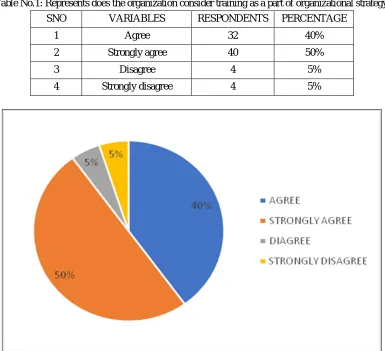
Table No.1: Represents does the organization consider training as a part of organizational strategy. SNO VARIABLES RESPONDENTS PERCENTAGE
1 Agree 32 40%
2 Strongly agree 40 50%
3 Disagree 4 5%
4 Strongly disagree 4 5%
Fig No 1: Graphical representation of does the organization consider training as apart of organizational strategy.
a) Interpretation
i) From the above figure,50% of the nurses strongly agree that their organization consider the training as an organizational strategy.
ii) 40% agree that their organization consider the training as an organizational strategy.
2) Q2. How often the training program are conducted in your organization
Table No.2: Represents how often the training program will be conducted in the organization SNO VARIABLES RESPONDENTS PERCENTAGE
1 Every month 32 40%
2 Every quarter 26 33%
3 Every year 17 21%
4 Once in a year 5 6%
Fig No 2: Graphical representation of how often the training program will be conducted in the organization
a) Interpretation
i) 40% of the nurses feels that the training program will be conducted every month in their organization.
ii) 33%of the respondents feels that every quarter the organization conduct the training program.
iii) 21% of the respondents feel that the organization conduct the training program every year.
iv) 6% of the respondents feel that their organization conduct the training program once in a year.
[image:4.612.119.486.472.725.2]3) Q3. The time duration given for training period is whether
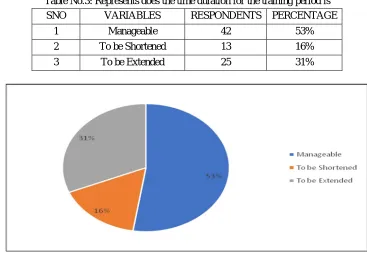
Table No.3: Represents does the time duration for the training period is SNO VARIABLES RESPONDENTS PERCENTAGE
1 Manageable 42 53%
2 To be Shortened 13 16%
3 To be Extended 25 31%
a) Interpretation
i) From the above figure,53% of the respondents feel that the time duration given for the training in their organization is manageable.
ii) 16% feel the time duration for the training must be shortened.
iii) 31% of the respondents feel that the time duration for the training must be extended in their organization.
[image:5.612.117.494.185.506.2]4) Q4. In your opinion, what do you understand by training and development.
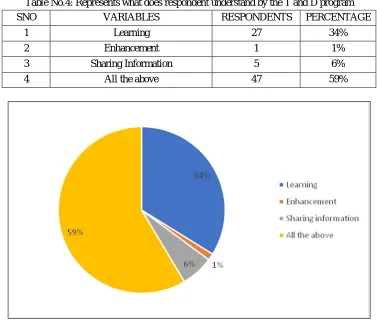
Table No.4: Represents what does respondent understand by the T and D program SNO VARIABLES RESPONDENTS PERCENTAGE
1 Learning 27 34%
2 Enhancement 1 1%
3 Sharing Information 5 6%
4 All the above 47 59%
Fig No 4: Graphical representation of what does the respondent understand by the T and D program
a) Interpretation
i) From the above figure,34% of the respondents feels that the Training and Development is a Learning.
ii) 1% feels that it is an Enhancement.
iii) 6% feels that the T and D is all about sharing the information.
iv) 59% of the respondents feels that Training and Development is learning, sharing information and enhancement.
5) Q5. To whom the training is given more in your organization.
Table No.5: Represents to whom the training is given more in bloom hospital SNO VARIABLES RESPONDENTS PERCENTAGE
1 New staff 45 56%
2 Junior staff 14 18%
3 Senior staff 7 9%
[image:5.612.94.507.644.725.2]Fig No 5: Graphical representation of the important barriers to T and D programs in bloom hospital
a) Interpretation
i) From the above figure,56% of the nurses feel that their organization provides more training to new staff. ii) 17% feel that more training is provided to junior staff.
iii) 9% feel that more training is provided to senior staff.
iv) 18% feel that training is provided based on the requirement.
B. Objective-2
To identify various Techniques adopted by Bloom to train the nurses.
1) Q6. What kind of Training methods does your organization provide to train the employee’s.
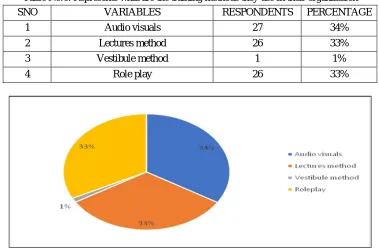
Table No.6: Represents what are the training methods they use in their organization SNO VARIABLES RESPONDENTS PERCENTAGE
1 Audio visuals 27 34%
2 Lectures method 26 33%
3 Vestibule method 1 1%
4 Role play 26 33%
Fig No 6: Graphical representation of what are the training methods they use in their organization
a) Interpretation
i) From the above figure, 34% of the respondents feel that their organization use Audio visuals as the training method.
ii) 32%feel lectures method as the training method used by their organization.
iii) Only 1% feel that their organization use the vestibule method as the training method.
[image:6.612.116.495.394.645.2]2) Q7. From the following training program which type of training program you had undergone.
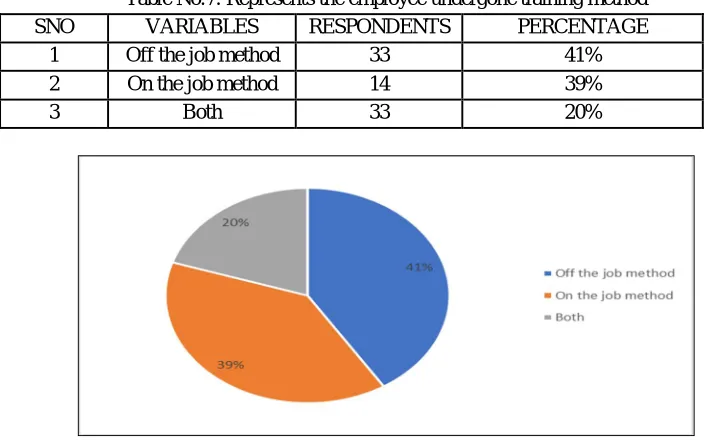
Table No.7: Represents the employee undergone training method SNO VARIABLES RESPONDENTS PERCENTAGE
1 Off the job method 33 41% 2 On the job method 14 39%
3 Both 33 20%
Fig No 7: Graphical representation of the employee undergone training method
a) Interpretation
i) From the above figure,41% of the respondents have undergone off the job training program.
ii) 39% have undergone the on the job training program.
iii) 20% have undergone both the training programs.
[image:7.612.118.491.451.654.2]3) Q8. Is induction training given to newcomers given adequate importance in your organization.
Table No.8: Represents whether induction training given to newcomers given adequate importance in Bloom hospital SNO Variable Respondent Percentage
1 Agree 48 60%
2 Disagree 32 40%
Fig No 8: Graphical representation of whether induction method is given more importance to newcomers
a) Interpretation
i) From the above figure, 60% of the respondents agree with the statement.
4) Q9. To perform other jobs in your organization, what training would you required.
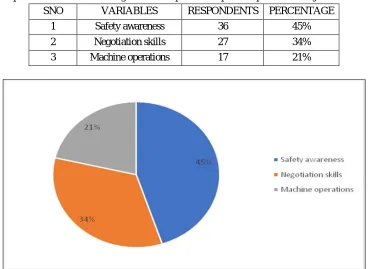
Table no.9: Represents what is the training does the respondent required to perform other jobs in their organization SNO VARIABLES RESPONDENTS PERCENTAGE
1 Safety awareness 36 45% 2 Negotiation skills 27 34% 3 Machine operations 17 21%
Fig no 9: Graphical representation of what is the training does the respondent required to perform other jobs in their organization
a) Interpretation
i) From the above figure,45% of the respondents require training in safety awareness.
ii) 34% of the respondents require training in negotiation skills to perform other jobs in their organization.
iii) 21% of the respondents require training in machine operations.
VIII. FINDINGS AND CONCLUSION
A. Findings
1) 50% of the nurses strongly agree that their organization consider the training as an organizational strategy.
2) 40% of the nurses feels that the training program will be conducted every month in bloom organization.
3) 53% of the respondents feel that the time duration given for the training in bloom hospital is manageable.
4) 34% of the respondents feels that the Training and Development is a Learning
5) 56% of the nurses feel that their organization provides more training to new staff.
6) 34% of the respondents feel that their organization use Audio visuals as the training method.
7) 32%feel lectures method as the training method used by bloom hospital.
8) 41% of the respondents have undergone off the job training program in bloom.
9) Induction training given to newcomers given adequate importance in Bloom.
10) 45% of the respondents require training in safety awareness.
11)Bloom Hospital uses Off-the-job training methods more than the on-the-job training methods.
B. Conclusion
1) The objectives of the study have achieved.
IX. QUESTIONNAIRE
Iam M. Poojavarsha pursuing MBA in Anurag Group of Institution. The present survey is purely for research purpose. All the information given by you will be kept confidential and will be used for research. Your cooperation will be highly appreciated. Kindly co-operate in filling the following questionnaire:
Thanking you.
Name: Role:
A. Your organization considers training as apart of organizational strategy. Do you agree with this statement?
1) Agree
2) Strongly agree
3) Disagree
4) Satisfied
B. How often the training program is conducted in your organization?
1) Every month
2) Every Quarter
3) Every yearly
4) Once in a year
C. The time duration given for training period is?
1) Manageable
2) To be shortened
3) To be extended
D. In your opinion, what do you understand by training and development?
1) Learning
2) Enhancement
3) Sharing information
4) All the above
E. To whom the training is given more in your organization?
1) New staff
2) Junior staff
3) Senior staff
4) Based on requirement
F. How often the training program are conducted in your organization?
1) Every month
2) Every Quarter
3) Every yearly
4) Once in a year
G. Which kind of Training methods does your organization provide to train the employees?
1) Audio visuals
2) Lectures method
3) Vestibule training
H. From the following training program which type of training program you had undergone?
1) Off the job method
2) On the job method
3) Both
I. Is induction training given to newcomers given adequate importance in your organization?
1) Agree
2) Disagree
J. To perform other jobs in your organization, what training or experience would you required?
1) Safety awareness
2) Negotiation skills
3) Machine operations
REFERENCES
Books
[1] R K Sahu, Training and Development,2006. Publisher: Excel Books (march30,2006).
[2] Raymond Noe, Employee Training and Development, TMH, 4th edition, 2008.
[3] Rolf Lynton, Udaipareek, Training and Development, Vistaar publications,2008.
Web links
[1] www.BloomHospital.com