Abstract— Uniqueness of cognitive human thinking stays a secret of unrevealed natural creation. Technological intelligence has tried to mimic or follow such operation to form an even more brilliant system. This research proposes a method of e-learning or distance learning system with dynamic content nomination for each user that correspond to their learning reaction. Done by the theory of human memory or spreading activation network—SAN, the proposed e-learning system employs this human cognitive mechanism (SAN) with the system processing scheme. The system procedure with in-time factors of users including system input, user reaction, service event, and content medium are processed in order to evaluate and provide most suitable advices, learning contents or learning activities for each user individually. While the user goes through the individually designed learning content, the system continues utilizing SAN to analyze in-time learning condition and furnish course agenda toward the learning objectives.
Index Terms—course management, computers and education, computational models of human learning, e-learning, intelligent/adaptive systems
I. INTRODUCTION
HE modernization of technologies and computers are currently utilized in branches to facilitate in our everyday life or to benefit in business, industry, and more. Technological advancements are promoted with fields of researches and experimentations to afford several developments including for education and learning industry. One among these endeavors is an effort to mimic or just follow the mystery of fussy natural intelligence—or human cognitive mental process and understanding. The study is to make compatibility between accurate yet rigid technology and human logical theory with e-learning education for the most suitability learning activity for human user. Employing with information and communication system and learning content database in forms of media, e-learning is an electrically fostered education with non classroom-liked characteristics that allows teacher and student (tutor-based learning) or system and student (individual learning) to communicate, transfer information and interact in a distance via computer, networks, Web-based systems, television, mobile phones, etc. Learning activities employed for e-learning includes online lecture and exercise, Internet, online discussion forum, and other activities.
P. Nilas Ph.D. is with Faculty of Engineering, King Mongkut's Institute of Technology Ladkrabang, Bangkok, Thailand 10520. (e-mail: [email protected])
R. Lumpuprakarn is a research associate, Faculty of Engineering, King Mongkut's Institute of Technology Ladkrabang, Bangkok, Thailand
Advantages of e-learning also offer benefits not only for non-classroom-liked education but also other alternative education including home school, distant education, specific subject with inadequacy of instructor, instant course training, etc. All of these results in increasingly importance of e-learning in the realm of education. The prior works in the field of e-learning have studied focusing on implementing learning tools to accelerate such education. For example, Rogier et al. [1] evolved Intelligent Tutoring System and online distance education [2]. Most of the former researches pointed at the main components such as learning content organizing, user interface, course delivery ordering, etc. Nevertheless, there are some drawbacks and barricades of the e-learning idea because the programmed causes or exercises are not flexible or suitable for each individual learner with different knowledge background and perception. This is why the human cognitive theory or SAN is taken into account for a non-teacher learning program. In order to follow and design particular learning program with recorded user learning profile and analyzed in-course understanding during learning state, an adaptive content nomination and associative semantic processing are involved to empower such learning system. Content configurable adaptation accelerates e-learning system to dynamically adapt course content selection to match the most suitable learning condition and each user perception in a current period. Not only does the system store user profile and content structure of learning tree but also compose with adaptive interaction to user with appropriate learning content, information, guidance, or suggestion depended on various learning situations of each user. This research paper proposes an e-learning system with dynamic semantic model depended on the nature of human cognitive theory, Spreading Activation Network: SAN. The system corresponds to individual user reaction to the current learning activities and nominates the most suitable learning content, media, or suggestion in different situation.
This paper is organized as follows: Section II presents system content nomination mechanism with user profile and preference, content relevant structure, overall course objective, etc. Section III describes in detail how associative semantic processing network works with system component employment, user capability, and SAN. Implementation and experiment details are presented in Section IV. Eventually, Section V provides the conclusion of the entire research.
Dynamic Content Selection Based On
An Associative Semantic Processing Network
P. Nilas and R. Lumpuprakarn
II. CONTENT NOMINATION MECHANISM
Utilizing Spreading Activation Network—SAN with e-learning selection system, the system considers five primary data for analyzing: the common user preference, the learning objective preference, the content-relevant structure, the user profile and historical data, and the current learning status. To formulate SAN for the system, competency node in learning topic must be activated, and then most relevant group of contents will be selected according to the number of competency node activation.
A. Common User Preference
Common user preference is a user-based algorithm that calculates user’s forthcoming activities, such as study topics or sub-topics, learning path, actions, etc. This is activated by observing or tracking user common learning activities of similar contents. The algorithm firstly calculates a learning similarity matrix (LSM) = [LSMAB], s, t = 1, 2, …, N. The similarity score (LSM) of student A and B is computed depended on the row vectors of A using a vector similarity function [4, 5]. A high similarity score LSM indicates that students A and B may have similar preferences because they have formerly study same subjects and have similar background knowledge and perception as well as common interest in the contents. The matrix of LSM•A generates potential scores of the learning topic for each student. The element at the xth row and yth column of the resulting matrix aggregates the similarity between student A and other students who have learnt subject S previously. This shows similarity that most of students who have learnt the first selected topic are likely to interest in the second selected topic.
B. Learning Objective Preference
Similar to common user preference but in term of study, learning objective preference demonstrates how common of user’s objectives are. This process investigates the similarity of learning objectives or topics that can be grouped together as relative objectives or topics. A vector similarity function is employed to compute the similarity level to form the similarity matrix [5]. The algorithm first calculates a product similarity matrix PS = (psst), s, t = 1, 2, …, N. The similarity score psst is calculated based on column vectors of matrix A. A high similarity score psst indicates that contents s and t are similar reasoned by the contents have been co-studied by many students as well as they have related topic. The matrix A•PS gives the potential scores of the contents for each student. The element at the cth row and pth column of the resulting matrix aggregates the scores of the similarities between content p and other contents previously studied by student c. The perception behind this approach is similarity of the alternative or the same content group. This approach shows the direct variation of the relation; students with more common interests in target subjects and contents tend to interest in similar forthcoming contents.
C. Content-Relevant Preference Structure
Quality of proportion, between contents and contents that
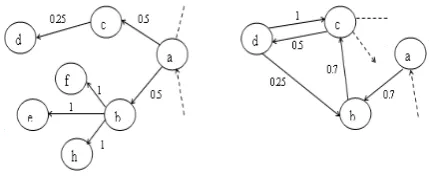
[image:2.595.307.554.138.223.2]structure. For instance, if the content A has an inbound-link from a high quality subject of content B then content A could be considers as a high-potential study-subject compared to other contents without high-quality link from outside. Figure 1 illustrates an example of the content-relevant diagram.
Fig. 1. Example of the content-relevant of the learning topic
The recommendation scores of content are calculated recursively as follows:
(1)
[image:2.595.306.555.393.565.2]where n is the total number of contents in the database collection, and c(i) is the number of inbound link to content i.
Fig. 2. Content-relevant algorithm
As shown in Figure 2, a content p will be considered a high-score content if many contents (i) link to it (relevant to content p). Moreover, high-score relevant effects in even higher score of content S. Imitated the PageRank algorithm [6], this propose content relevant scheme establishes efficient result yet courses complicated calculation because of computing iteration for each content.
D. User Profile and Historical Data
with probability P(p|z). Therefore, the possibility of perceiving an interaction between c and p is given by = Σz P(c, p) P(c)P(z | c)P( p | z).
Based on the interaction matrix A as the perceived data, the relevant possibility and conditional possibilities are evaluated using a maximum likelihood procedure called Expectation Maximization (EM). Based on the estimated probabilities, P(c, p) provides the potential score of content p for student c.
E. Current learning status
[image:3.595.325.528.64.235.2]With the Interactive window screen, the curriculum designer, user/student, and system administrator can communicate together. The event-based management system gathers events that generated on browser and transfer the events to user profile system via the learning shell system [Fig.3].
Fig. 3. User tracking scheme of the system
Input events collected to the system include mouse clicking and keyboard input that affect the on-screen tasks. User reactions—such as learning behavior, time spent in an activity, or exercise answering—are the major component to analyze how to manage learning content and type of content for each user.
III. ASSOCIATIVE SEMANTIC PROCESSING NETWORK
A. System Component and Operation
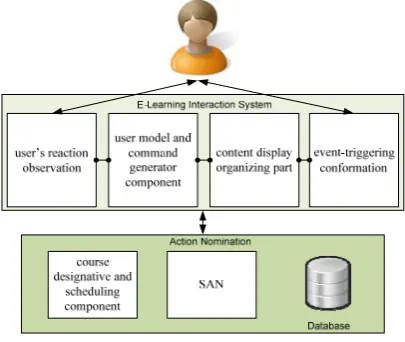
Composed of a set of processing components that perform distinct function individually, the system architecture is divided into two major parts with seven primary modules. The first major part starts with e-learning interaction system with the user’s reaction observation, the user model and command generator component, the event-triggering conformation, and content display organizing part. Another major part is action nomination with the course designative and scheduling component, the SAN, and the database.
Fig. 4. System Components Diagram
Figure 4 illustrates the two major parts with their components. In the first primary part, e-learning interaction system is composed as follows. User’s reaction observation notices and collects user’s learning activities during their learning state and analyzed the user activities while activation of command. The next user model collects user profile. The system command generator cooperates and conforms human-machine interaction and validates user to confabulate the system. The event-triggering conformation designs learning content nomination depended on event trigged by the user reaction to the system and overall course objectives. The content display organization part contributes information to user including learning content, learning state, and message sent by the system. Another primary part, action nomination contains the course designative and scheduling component, the spreading activation network or SAN, and the database. This part designs and forms the learning schedule according to course content. The SAN plays important rules by adaptively analyzing user reaction to the system—including user skills and capabilities, time spent and accuracy [7]. Lastly, the database stores course descriptions and specifications, learning contents and activities, user profile, and learning module.
B. User Capability-based Analysis
[image:3.595.49.290.309.457.2]synthesizing, evaluating, and integration. User capability- based analysis that separates course contents into different level is based on difficulty and knowledge depth of each level that avoids user confusion in contents and to develop by steps of users’ skill.
[image:4.595.59.282.335.424.2]Event-based system follows and analyzes user behavior and user in-course reaction to the learning activities. This system organizes contents from the contents pool in the competency framework. In the contents pool, contents are divided into several competencies based on course structure built by the curriculum designer. Generally, main course’s structure is combined with pre-test, learning content, post-test, and additional in-course quiz. These structures aims at knowledge and understanding transferring packed with overall course evaluation; the pre-test and post-test evaluate how much students gain from the course; learning content transfers knowledge as stated in course objectives. Quizzes or drills—a way of learning by method of repeating exercise—are required as an in-course evaluation of students’ knowledge and comprehension during study process. Figure 5 demonstrates how each sub-topic relates to others according to the learning model.
Fig. 5. Demonstration of the learning contents’ competency nodes
C. Spreading Activation Network: SAN
Although the course contents are settled with its agenda or step of learning, content nomination mechanism helps selection of suitable content topic or activity for the current state of the user and leads the user to the course objectives. To deal with this, we propose SAN as the primary mechanism for contents and learning activities nomination. The SAN selection mechanism calculates several factors for the outcome selected topic, such as user reaction and learning content relation simultaneously with course plan, agenda, and goal. Therefore, it provides the capability of both deliberative and reactive action planning.
Spreading activation network composes of competency modules that are interconnected through their states. The competency module or CM is a representation of tasks in a spreading activation network. For CM activation, pre-condition related to the CM must be satisfied. After the activation is achieved, certain conditions become true. These conditions are stated as “post-conditions”. If all pre-conditions of a competency module are satisfied in any current states; then the CM is executable. In the case that more than one CM is executed, the algorithm selects the executable CM with the highest activation and then the process of the SAN is repeated.
The prime issues about SAN automatically generating are
course objectives and user action command. Then, the system primitive learning module will formulate an action selection network (context selection network). There are four stages of SAN activation loop.
--The system obtains user input or course command and reviews regular course agenda from the database.
--Processing of stated course agenda from the database, such as learning objective, the pre and post condition, the learning module, etc.
--The system forms a table of correlation and e-learning competency module of the course that the user selects. For instance, mapping the planned command to the e-learning’s primitive content module, translates the learning condition to proposition nodes (pre and post condition), and converts the command operator (i.e. and, or, then) to the competency links (successor, or predecessor link).
--Combined with backward propagation from the mission’s goal, forward propagation from the initial state, the process of generating network merges these two propagation network to become a SAN.
D. Content Nomination
Media and information displayed on web-page includes text, still image, flash, animation, or video script; these media of learning contents are the tool used as knowledge transferring to user. With user reaction and behavior tracking and analyzing, the system can adopt suitable content for current learning states such as guidance activities and contents, suggestion, and evaluation. This procedure processing includes user reaction to the system, user profile, event-based, and learning content. The tracking system calculates along user activities and offers three learning states to the user while going through the course; the three learning states are normal state, guidance state, and suggestion state. In detail, if users can follow the offer learning content continuously and smoothly, they can continuous learning in normal state. Guidance state is adopted when the system evaluates and detects that the users get confuse or cannot pass the learning activities, quizzes, or the likes. Eventually, the system will set to suggestion state to help user achieve their current learning topic if the user is hard to follow the learning content in guidance state.
To activate any competency modules (CM), three learning condition achievement have to be done.
--Satisfaction of all the pre-conditions to execute the competency module
--Reaching of higher activation energy than standard threshold of the specific CM
[image:4.595.319.534.681.770.2]IV. IMPLEMENTATION
Developed with JAVA and PHP nude, the system is a web-based application with courses that can be dynamically utilized to suit individual user’s perception and knowledge background. The proposed method is experimented to verify and demonstrate the system’s trustworthy and efficiency. Our prototypical engineering courses compose of two learning modules; each of the modules contain pre-test, introduction to the subject, five chapters with ten topic, quizzes, post-tests, and additional guidance and suggestion information. The five chapters are the learning contents of robotics course. Time consumption spent during the training period for a course module is taken into account for an evaluation and rating of user achievement as well as the system operation. All of these contents are packed with content nomination system. The educational experiment is conducted with two groups of five users learning the same subject content: group one studied with the propose system on the computer while another group studied with normal study textbook. The experimental result explores that proposed e-learning system can help the group of students studying by the system to understand subject faster than another group studying with standard academic textbook. Moreover, the first group of students, unexpectedly, also has higher concentration on the lesson in a period than another group because of the interesting content media rather than the simple illustrations and text contents in the book.
V. CONCLUSION
Even if a large number of studies has researched through the e-learning system for educational acceleration, very few works perform the system that is complemented with human cognitive theory. Our proposed e-learning system employs spreading activation network, SAN, with the system. This creates together formation of a useful dynamic learning content nomination system for suitability for
individual users or students with different knowledge background and perception. While a user studies toward the learning objectives, the system dynamically adjusts the learning activities to display in the states of learning conditions forma network of learning module (possible learning plan). This network could explain the predictive top-down effect of course content knowledge and information. This prototypical e-learning system is appropriated to employ with the interaction between semantic and episodic memories, which often required for e-learning practical issues. Utilizing SAN with temporal logic can stimulate the higher appropriate learning module and choose the most suitable learning content in order to match various learning conditions and user states for efficiency course achievement and objectives.
REFERENCES
[1] Rogier Brussee, Alfons Salden, Piet Boekhoudt, Harry Van Vliet, “A Web-Based E-Learning Infrastructure,” Int’l. Conf. SSGRR2001, L’Aquila, August 2001.
[2] Joe Lin, Charley Ho, Wasim Sadiq, Maria E. Orlowska, “On Workflow Enabled e-Learning Services,” Proc., IEEE, ICALT2001, Madison, USA, August 2001.
[3] P. Nilas, and N. Nilas, “A Dynamic Associative E-Learning Model based on a Spreading Activation Network” IEEE Canadian Conference on Electrical and Computer Engineering, May 2006. pp:2472 – 2475
[4] D. Aswath, et al., “Boosting Item Keyword Search with Spreading Activation,” Proc., IEEE on Web Intelligence, WIC/ACM 2005, 15-22 Sept. 2005, pp.704-705.
[5] Z. Huang, “A Comparative Study of Recommendation Algorithms in E-Commerce Application,” IEEE Intelligent Systems, 2006.
[6] M. Chau, H. Chen, “Comparison of Three Vertical Search Spiders,” IEEE Computer, May 2003, pp.56-62.
[7] K. Kawamura, P. Nilas, K. Muguruma, and J. A. Adams, "An Agent-based Architecture for an Adaptive Human-Robot Interface," the HICSS 36, Hawaii International Conference on System Sciences, 2003.