Behavior in Human-Computer Spoken
Natural Language Dialogue
Ronnie W. Smith*
East Carolina University
Steven A. Gordon*
East Carolina University
This paper presents an analysis of the dialogue structure of actual human-computer interactions.
The 141 dialogues analyzed were produced from experiments with a variable initiative spoken
natural language dialogue system organized around the paradigm of the Missing Axiom Theory
for language use. Results about utterance classification into subdialogues, frequency of user-
initiated subdialogue transitions, regularity of subdialogue transitions, frequency of linguistic
control shifts, and frequency of user-initiated error corrections are presen ted. These results indicate
there are differences in user behavior and dialogue structure as a function of the computer's level
of initiative. Furthermore, they provide evidence that a spoken natural language dialogue system
must be capable of varying its level of initiative in order to facilitate effective interaction with
users of varying levels of expertise and experience.
1. Modeling Human-Computer Dialogue
It is generally acknowledged that developing a successful computational model of interactive natural language (NL) dialogue requires extensive analysis of sample dia- logues. Previous work has included analyses of (1) human-human dialogues in rele- vant task domains; (2) Wizard-of-Oz dialogues in which a human (the Wizard) simu- lates the role of the computer as a w a y of testing out an initial model; and (3) human- computer dialogues based on initial implementations of computational models. Each of these dialogue types has advantages as a model for system building, in terms of the relevance of the data to the final model. However, each also has particular disad- vantages when researchers attempt to generalize from the findings of previous work. For example, much analysis of human-human interactions has been done, such as Walker and Whittaker's (1990) analysis of mixed initiative in dialogue, or Oviatt and Cohen's (1991) comparison of interactive and non-interactive spoken modalities. Analyses of human-human dialogues are a good basis for an initial task model and a lexicon, but it is difficult to determine which aspects of these analyses will generalize to human-computer dialogues and which ones will not. Fraser and Gilbert (1991) note that "although it is certainly better to rely on analyses of human-human interactions than to rely on intuitions alone, the fact remains that human-human interactions are not the same as human-computer interactions and it would be surprising if they fol- lowed precisely the same rules" (p. 81). In addition, Oviatt and Cohen (1991) say that "... to model discourse accurately for interactive systems further research clearly will be needed on the extent to which human-computer speech differs from that between humans. At present, there is no well developed model of human-machine communi-
Computational Linguistics Volume 23, Number 1
cation . . . " (p. 323). The dilemma of researchers is nicely summarized by Fraser and Gilbert: "The designer is caught in a vicious circle it is necessary to know the char- acteristics of dialogues between people and automata in order to be able to build the system, but it is impossible to know what such dialogues would be like until such a system has been built" (p. 81).
Wizard-of-Oz (WOZ) dialogues result from an experimental technique that is one w a y of addressing this dilemma. In this methodology, human subjects are told they are interacting with a computer when they are really interacting with another human (the Wizard) who simulates the performance of the computer system. In some sim- ulations (e.g., Whittaker and Stenton [1989]), the Wizard simulates the entire system while in other cases (e.g., Dahlb~ick, J6nsson, and Ahrenberg [1993]), the Wizard makes use of partially implemented systems to assist in responding. Consequently, many initial models can be prototyped and tested before implementation, and researchers need not have a fully developed natural language interface. As other researchers have noted (Whittaker and Stenton 1989; Dahlback, J6nsson, and Ahrenberg 1993; Fraser and Gilbert 1991), when the WOZ simulations are convincing, they obtain data that are a more accurate predictor of actual human-computer interaction than human-human dialogues because speakers adapt to the perceived characteristics of their conversa- tional partners. Consequently, WOZ studies can provide an indication of the types of adaptations that humans will make in human-computer interaction. WOZ studies such as the ones cited above have been particularly useful in obtaining data on dis- course structure and contextual references. The WOZ study of M o o d y (1988) on the effects of restricted vocabulary on interactive spoken dialogue provided the data that influenced the development of our own system.
While much knowledge can be gained from WOZ studies, they are not an adequate means of studying all elements of human-computer natural language dialogue. A simulation is feasible as long as humans can use their own problem-solving skills in carrying out the simulation, but when it requires mimicking a proposed algorithm, the WOZ technique becomes impractical. For example, it is difficult to simulate and test the computer's error recovery strategies for speech recognition or natural language understanding errors, because the natural language understanding of the computer is only a simulation. If we wish to test an actual computational model for natural language processing, its complexity demands the construction of a computer program to execute it. Furthermore, an important feature of dialogue that is difficult to simulate via the WOZ paradigm is that of initiative. Depending on the interaction environment, dialogue initiative may reside with the computer, with the user, or may change during the interaction. Lacking any formal models of initiative, it w o u l d be very difficult for a Wizard to accurately simulate the response patterns a computerized conversational participant would produce in a mixed-initiative dialogue for a nontrivial domain that would be consistent from subject to subject.
Unfortunately, we can also have difficulties generalizing from analyses of human- computer dialogues, because parameters of the particular system with which the di- alogues were collected may have significantly affected the resulting dialogues. For example, if a particular system is always run with a particular speech recognizer, it may be difficult to determine what the outcome w o u l d have been with a better speech recognizer. Similarly, most human-computer dialogues are collected from systems with a particular dialogue model. Since it is well known that users adapt to the system, it will be unclear how the results from a particular set of human-computer dialogues generalize to a model of interaction based on a different dialogue model.
aspects of the system are parameterizable. We have built an integrated dialogue- processing system, the Circuit Fix-It Shop, which is parameterized for a key system behavior: initiative. 1 We have tested the system in 141 dialogues totaling 2,840 user utterances while varying levels of system initiative. The paper discusses our model of initiative and presents quantitative results from an analysis of our corpus on the effect of the computer's level of initiative on aspects of human-computer dialogue structure such as (1) utterance classification into subdialogues, (2) frequency of user-initiated subdialogue transitions, (3) regularity of subdialogue transitions, (4) frequency of lin- guistic control shifts, and (5) frequency of user-initiated error corrections. The results indicate there are differences in user behavior and dialogue structure as a function of the computer's level of initiative. Furthermore, they provide evidence that a spoken natural language dialogue system must be capable of varying its level of initiative in order to facilitate effective interaction with users of varying levels of expertise and experience.
2. A Theory of Variable Initiative Dialogue
In this section we review a theory presented in Smith and Hipp (1994). It is important to note that our focus is on task-oriented dialogues, that is, dialogues whose purpose is to discuss a task whose completion is being carried out at the same time as the dialogue. Consequently during the discussion, we make the distinction between
linguistic goals
and task goals. Linguistic goals relate to speaker intentions in making statements (e.g., to inform, command, or request), while task goals relate to specific actions that need to be carried out in the domain of interest in order to complete the task (e.g., performing a voltage measurement). As will be seen from the discussion, we take the approach that task initiative is assigned to the participant whose current task goals have priority, and the purpose of dialogue initiative is to indicate who has the task initiative.2.1 Defining Variable Initiative and Dialogue Mode
Variable initiative dialogue
is dialogue in which: (1) either dialogue participant can have control of the dialogue, (2) control can vary between participants during the dialogue, and (3) intermediate levels of control are allowed.A variable initiative dialogue system contrasts with other NL dialogue systems such as those described in Section 3.1 in which the dialogue is either purely user- controlled or purely computer-controlled. In user-controlled dialogue systems the com- puter acts as a passive agent responding to user queries. Question-answering systems are examples of user-controlled dialogue systems. 2 In computer-controlled dialogue systems, the user is totally dependent on the computer for accomplishment of the task.
The need for variable initiative dialogue arises because at some points during task completion a user may have sufficient knowledge to take control of the dialogue and accomplish several goals without much computer assistance while at other times, a user may need detailed assistance. Thus, user initiative is characterized by giving pri- ority to the user's goals of carrying out steps uninterrupted while computer initiative is characterized by giving priority to the specific goals of the computer. In general, we have observed that the level of initiative that the computer has in the dialogue is
1 Smith and Hipp (1994) presents details about the overall computational model that forms the basis of the system.
Computational Linguistics Volume 23, Number 1
primarily reflected in the degree to which it allows the user to interrupt the current subdialogue in order to discuss another task goal. When the user has control, the in- terrupt is allowed, but when the computer has control it is not. 3 However, initiative is not an all-or-nothing control mechanism. Either the user or the computer may have the initiative without having complete control of the dialogue. Based on these obser- vations, four dialogue modes were identified that characterize the level of initiative that the computer can have in a dialogue. These are described below.
.
.
.
.
Directive: The computer has complete dialogue control. It recommends a task goal for completion and will use whatever dialogue is necessary to complete this goal. No interruptions to other subdialogues are allowed. Suggestive: The computer
still
has dialogue control, but not as strongly. The computer will recommend a task goal for completion, but will allow minor interruptions to closely related subdialogues. 4Declarative: The user has dialogue control and can interrupt to any desired subdialogue at any time. However, the computer is free to mention relevant facts as a response to the user's statements. Passive: The user has complete dialogue control. Consequently, the computer will provide domain information only as a direct response to a user question.
2.2 Response Formulation in Variable Initiative Dialogue
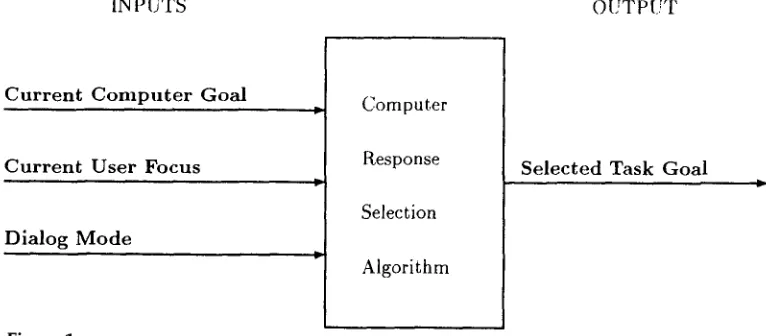
Since the degree of interruptibility allowed by the computer increases from directive to passive mode, dialogue mode has a critical effect on the computer's choice of response. As illustrated in Figure 1, response topic selection is a function of the computer's goal, the user focus (i.e., the task goal that the computer believes the user currently wants completed), and the dialogue mode. When the user focus differs from the computer's goal (i.e., an interrupt), the dialogue mode becomes the decisive factor in the selection process, as described in Figure 2. The mechanics of the response selection algorithm can be illustrated via the following situation: suppose that the user initially states, "the light is off," and suppose the computer knows that in order for the light to be lit, the switch must be turned up (i.e., state(switch, up) ~
state(light, on)).
Consequently, the computer goal of highest priority is to put the switch up, while the user focus is assumed to be on the light. 5 The selection process as a function of mode would be as follows:.
2.
Directive: User focus is ignored with no interrupts permitted. The selected goal is to put the switch up.
Suggestive: User focus is seen to be related to the computer goal via the domain fact relating the switch and the light. The selected goal is to "observe the switch position when the light is off."
3 Note that we do not consider clarification subdialogues to be interrupts, as the overall task goal remains unchanged.
4 Subdialogues about different task goals are considered closely related if the different objects of interest share a sufficiently close common ancestor in the domain-knowledge hierarchy.
INPUTS O U T P [ . q ~
C u r r e n t C o m p u t e r Goal
C u r r e n t User Focus
Dialog M o d e
Computer
Response
Selection
Algorithm
Selected Task Goal
Figure 1
Flow diagram ofthe computerresponse selection process.
IF Mode = directive THEN
select the computer goal without any regard for the user's focus ELSE IF Mode = suggestive THEN
search the domain k n o w l e d g e h i e r a r c h y for a common r e l a t i o n s h i p b e t w e e n the computer goal and the user focus
IF such a r e l a t i o n s h i p exists THEN select this as the next goal ELSE
select the computer's original goal ELSE IF Mode = d e c l a r a t i v e THEN
search the domain k n o w l e d g e h i e r a r c h y for a common r e l a t i o n s h i p b e t w e e n the computer goal and the user focus
IF such a r e l a t i o n s h i p exists THEN
select as the next goal that the user learn about this r e l a t i o n s h i p
ELSE
select as the next goal an u n c o m m u n i c a t e d fact relevant to the user focus
ELSE IF Mode = passive THEN
select as a goal that the user learn the computer has p r o c e s s e d the user's last u t t e r a n c e
Figure 2
Computerresponse selection algorithm.
.
.
Declarative: User now has control.' Consequently, the selected goal must be a relevant fact. The previous goal is converted to "user learn that the light is on when the switch is up."
Passive: User has complete control. Computer simply acknowledges processing the last user utterance.
[image:5.468.30.413.58.226.2]Computational Linguistics Volume 23, Number 1
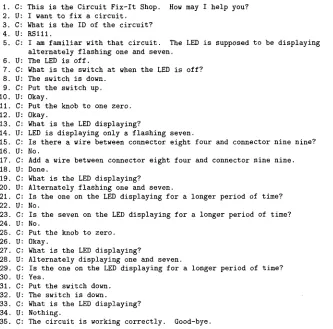
which the system was experimentally evaluated: directive and declarative. Note the following phenomena in these dialogues.
.
.
In the directive mode dialogue, the subject is performing task goals under the close guidance of the computer. There is language interaction about each task goal. 6
In the declarative mode dialogue, the subject independently carries out several task goals, known to be necessary, without any interaction. By allowing the user to arbitrarily change subdialogues, the computer is able to provide relevant assistance when a potential problem is reported without requiring language interaction for the task goals already
completed.
A variable initiative dialogue system is just the first step toward the more impor- tant objective of a mixed-initiative dialogue system. In a mixed-initiative interaction, initiative can vary between the participants throughout the dialogue. Given that our first priority in experimentally evaluating the system was to demonstrate that behavior varied as a function of initiative, it was necessary to fix the level of initiative for the duration of a session. We next review the work of others who have examined issues in mixed-initiative interaction.
2.3 Prior T h e o r e t i c a l W o r k o n M i x e d - I n i t i a t i v e
Whittaker and Stenton (1988) propose a definition for dialogue control based on the utterance type of the speaker (question, assertion, command, or prompt) as follows:
• Question: The speaker has control unless the question directly followed a question or command by the other conversant.
• Assertion: The speaker has control unless the assertion was a response to a question.
• Command: The speaker has control.
• Prompt: The listener has control because the speaker is abdicating control.
Walker and Whittaker (1990) apply these dialogue control rules to analyze how initiative affects discourse structure. Their analysis distinguishes between advisory dialogues and task-oriented dialogues, but they do not allow for the possibility that the novice in a task-oriented dialogue can gain knowledge over time and want more control of the dialogue. Their key observations include the following:
Transfer of control is often a collaborative phenomenon. Since a noncontrolling participant has the option of seizing control at any moment, then the controlling participant must have control because the noncontroller allows it.
Dialogue i (Directive Mode)
i. C: This is the Circuit Fix-lt Shop. How may I help you? 2. U: I want to fix a circuit.
3. C: What is the ID of the circuit? 4. U: RSl11.
5. C: I am familiar with that circuit. The LED is supposed to be displaying alternately flashing one and seven.
6. U: The LED is off.
7. C: What is the switch at when the LED is off? 8. U: The switch is down.
9. C: Put the switch up. 10. U: Okay.
II. C: Put the knob to one zero. 12. U: Okay.
13. C: What is the LED displaying?
14. U: LED is displaying only a flashing seven.
15. C: Is there a wire between connector eight four and connector nine nine?
1 6 . U: No.
1 7 . C: Add a w i r e b e t w e e n c o n n e c t o r e i g h t f o u r a n d c o n n e c t o r n i n e n i n e . 1 8 . U: D o n e .
1 9 . C: What i s t h e LED d i s p l a y i n g ?
2 0 . U: A l t e r n a t e l y f l a s h i n g o n e a n d s e v e n .
2 1 . C: I s t h e o n e o n t h e LED d i s p l a y i n g f o r a l o n g e r p e r i o d o f t i m e ? 2 2 . U: No.
2 3 . C: I s t h e s e v e n o n t h e LED d i s p l a y i n g f o r a l o n g e r p e r i o d o f t i m e ? 2 4 . U: No.
2 5 . C: P u t t h e k n o b t o z e r o . 2 6 . U: O k a y .
2 7 . C: What i s t h e LED d i s p l a y i n g ?
2 8 . U: A l t e r n a t e l y d i s p l a y i n g o n e a n d s e v e n .
2 9 . C: I s t h e o n e o n t h e LED d i s p l a y i n g f o r a l o n g e r p e r i o d o f t i m e ? 3 0 . U: Y e s .
3 1 . C: P u t t h e s w i t c h d o w n . 3 2 . U: The s w i t c h i s d o w n . 3 8 . C: What i s t h e LED d i s p l a y i n g ? 3 4 . U; N o t h i n g .
3 5 . C: The c i r c u i t i s w o r k i n g c o r r e c t l y . G o o d - b y e .
D i a l o g u e 2 ( D e c l a r a t i v e Mode)
1. C: T h i s i s t h e C i r c u i t F i x - I t s h o p . How may I h e l p y o u ? 2 . U: R S l l l i s n o t w o r k i n g .
3 . C: I am f a m i l i a r w i t h t h a t c i r c u i t . The LED i s s u p p o s e d t o h e d i s p l a y i n g a l t e r n a t e l y f l a s h i n g o n e a n d s e v e n .
NOTE: S u b j e c t p u t t h e s w i t c h u p a n d s e t t h e k n o b t o o n e z e r o , o b s e r v e d t h e LED d i s p l a y , a n d n o t e d t h e p o t e n t i a l p r o b l e m w i t h o u t
r e q u i r i n g a n y a s s i s t a n c e f r o m t h e c o m p u t e r .
4 . U: T h e r e i s n o w i r e f r o m c o n n e c t o r n i n e n i n e t o c o n n e c t o r e i g h t f o u r . 5 . C: T h e r e i s s u p p o s e d t o b e a w i r e b e t w e e n c o n n e c t o r n i n e n i n e a n d
c o n n e c t o r e i g h t f o u r .
NOTE: Subject then added the missing wire, and manually performed all necessary checks to verify the circuit was functioning properly.
6. U: The circuit is working.
[image:7.468.34.367.74.403.2]7. C: Glad to have been of assistance. Good-bye.
Figure 3
Computational Linguistics Volume 23, Number 1
• The expert retains more control in the task-oriented dialogues, but there are still occasional control changes when the novice has to describe problems that are occurring while completing the task.
t Summaries are more frequent in advisory dialogues due to the need for both participants to verify that they do share the mutual beliefs needed to develop the necessary plan.
In Section 6.5 we investigate the relationship of this notion of dialogue control based on linguistic goals to our task goal notion of control.
Kitano and Van Ess-Dykema (1991) extend the plan recognition model of Litman and Allen (1987) to consider mixed-initiative dialogue. Their key insight is the obser- vation that the two participants may have different domain plans that can be activated at any point in the dialogue. Thus, there are speaker-specific plans instead of simply joint plans as in the Litman and Allen model. This separation of plans permits greater flexibility in the plan recognition process. Furthermore, they extend the initiative con- trol rules proposed by Whittaker and Stenton to consider the utterance content by observing that a speaker has control when the speaker makes an utterance relevant to his or her speaker-specific domain plan. Although they do not consider a compu- tational model for participating in mixed-initiative dialogues, their observation that there are speaker-specific plans or goals underlies the model that we propose.
2.4 Theory Evaluation
While WOZ simulation of directive and passive modes is feasible, the requirements for algorithmically determining the relationship between user focus and the computer goal make WOZ simulations of suggestive and declarative modes very difficult, especially given the fast response time necessary for spoken interaction. Before the construction of the Circuit Fix-It Shop, M o o d y (1988) conducted a Wizard-of-Oz study on the effects of restricted vocabulary on interactive spoken dialogue. Her data were the basis for the formulation of the experimental Circuit Fix-It Shop system. Although she attempted to acquire information concerning user behavior when users were given the initiative, she was unable to provide much information because her subjects did not interact with the system enough to evolve from novices to experts. Her attempts to yield the initiative to users still led to statements that guided users step-by-step through the task. By direct testing of a computer system that implements our proposed model of variable initiative dialogue, we could more rigorously control the system performance and more easily run repeated tests with subjects and allow them to gain task expertise. Simultaneously, we could more readily monitor the effects of the change in initiative setting while holding other system features constant.
3. Dialogue-Processing Model: An Integrated Approach
3.1 Motivation and Overview
Most prior work on natural language dialogue has either focused on individual sub- problems such as quantification, presuppositions, ellipsis, anaphoric reference, and user modeling, or else focused on dialogue-processing issues in database query ap- plications. Examples of such dialogue systems are described in Allen, Frisch, and Litman (1982), Bobrow et al. (1977), Carberry (1988), Frederking (1988), Hafner and Godden (1985), Hendrix et al. (1978), Hoeppner et al. (1983), Jullien and Marty (1989), Kaplan (1982), Levine (1990), Peckham (1991), Seneff (1992), Waltz (1978), Wilensky et al. (1988), Young et al. (1989), and Young and Proctor (1989). However, there has been little work on integrating the various aspects of dialogue processing into a uni- fied whole (exceptions are Allen et al. [1995] and Young et al. [1989]). Consequently, we developed a dialogue-processing model for task-oriented dialogues that when im- plemented in an electronic repair domain exhibits a number of important behaviors including: (1) problem-solving; (2) coherent subdialogue movement; (3) user model usage; (4) expectation usage; and (5) variable initiative behavior. We summarize the key features of the model below.
• Theorem proving is used as the reasoning mechanism for determining when task goals are completed.
• Consequently, the purpose for language during the dialogue is to acquire the missing axioms needed for proving task goal completion (i.e., The Missing Axiom Theory [Smith 1992]).
• User model information is maintained as a set of axioms acquired from inferences based on user input. The axioms m a y then be used by the theorem prover.
• Finally, integration of theorems, the utterances relevant to these
theorems, and the expectations for responses that supply missing axioms yields a constructive method for creating and using a discourse model first proposed by Grosz and Sidner (1986), but for which they did not offer a method of dynamic construction during the course of a dialogue.
Furthermore, the model enables the system to engage in variable initiative dialogue as outlined in Section 2. The interested reader is referred to Smith, Hipp, and Biermann (1995) for further details about the overall model.
3.2
System Implementation
We constructed the Circuit Fix-It Shop based on the details of our dialogue-processing model. The system was originally implemented on a Sun 4 workstation with the ma- jority of the code written in Quintus Prolog and the parser in C. The system assists users in the repair of a Radio Shack 160 in One Electronic Proiect Kit. The system can detect errors caused by missing wires as well as a dead battery.
Speech recognition is performed by a Verbex 6000 running on an IBM PC. To improve speech recognition performance, we restrict the vocabulary to 125 words. A DECtalk DTCO1 text-to-speech converter is used to provide spoken output by the computer.
Computational Linguistics Volume 23, Number 1
be interpreted correctly. The main source of ungrammatical inputs in our experiments was the misrecognition of the user's input. An error-correcting parser was developed that finds the minimal cost set of insertions, deletions, and substitutions to transform the input into grammatical input (Smith and Hipp 1994). During our formal exper- iment, the system was able to find the correct meaning for 81.5% of the more than 2,800 input utterances even though only 50% of these inputs were correctly recognized word for word. An overview of the experimental design is presented next.
4. Experimental Design
The experimental design is discussed in great detail in Smith and Hipp (1994) and Smith (1991). Here we present an overview of the experiment sufficient for under- standing the environment in which the data were collected.
4.1 Subject Pool
The eight subjects were Duke University undergraduates who met the following cri- teria.
• They had demonstrated problem-solving skills by having successfully completed one computer science course and had taken or were taking another.
• They did not have excessive familiarity with AI and natural language processing. In particular, they had not taken a class in AI and they had not interacted with a natural language system.
• None were majoring in electrical engineering. Such individuals could probably fix the circuit without any assistance.
The subject pool consisted of six male and two female subjects. In addition, two pilot subjects, one female and one male, were run using the proposed experimental design before the formal experiment began.
4.2 Session Overview and Problem Selection
Subjects participated in the experiment in three sessions. The first and third sessions occurred a week apart, and the second session normally occurred three or four days after the first session. 7 The first session consisted of: (1) the primary speech training, lasting approximately 60 to 75 minutes; (2) approximately 20 minutes of instruction on using the system; and (3) practice using the system by attempting to solve four "warmup" problems with the system operating in directive mode, the mode where the computer has maximal control. A maximum of two and one-half hours was spent on the first session. The second and third sessions each consisted of: (1) review work with the speech recognizer; (2) a review of the instructions; and (3) usage of the system on up to 10 problems depending on h o w rapidly the problems were solved. One group of subjects worked with the system in directive mode during the second session and in declarative mode during the third session while the other group worked with the same modes, but in opposite sessions. The time allowed for the second and third sessions was two hours each.
The particular circuit being repaired is supposed to cause the LED to alternately display a 1 and a 7, and the implemented domain problem-solving component could detect errors caused by missing wires as well as a dead battery. The basic debugging process consists of the following steps:
.
2.
.
Determine if the LED display is correct.
If it is not correct, perform zero or more diagnostic steps to further isolate the problem. Possible diagnostic steps are voltage measurements or an LED observation under a different physical configuration of the circuit. Check for the absence of one or more wires until a missing wire is identified.
The wires are attached to metal spring-like connectors, which are identified by numbers on the circuit board. Thus, a wire is identified by the numbers of the two connectors to which it is connected. In order to balance the difficulty of the prob- lems between the second and third sessions, the wires were classified according to the number and type of diagnostic steps required to detect the error. Based on this classification, the assignment of missing wires to problems in each session was made as follows:
• Four wires were used in the four warmup problems of the first session. • From a set of 10 other wires, 5 were used for the first five problems of
session 2 and the other 5 were used for the first five problems of session 3. Each of these problems was balanced for difficulty. For example, problem 1 of both sessions was a power subcircuit problem, while problem 5 of both sessions was an LED subcircuit problem. Problems 2 through 4 were similarly balanced.
• Problems 6 through 8 of sessions 2 and 3 consisted of 2 missing wires for each problem. The 2 missing wires were selected from the 5 missing wires used during the first five problems of the session. Each of
problems 6 through 8 differed by one missing wire. These problems were also balanced for difficulty.
• Problems 9 and 10 of each session consisted of a missing wire that was also used during the warmup problems of session 1. Each of these 4 wires was assigned to a different problem. Consequently, sessions 2 and 3 are balanced for difficulty only through the first eight problems.
4.3 Experimental Setup
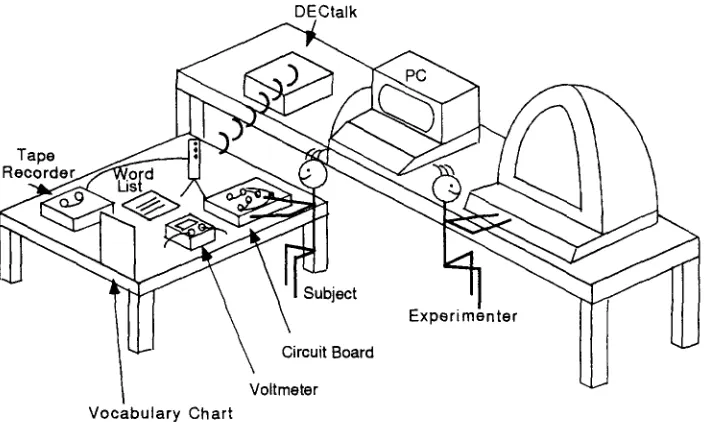
Figure 4 provides a rough sketch of the room layout. The subject was seated facing the desk containing the circuit board. Communication with the speech recognizer was performed through a telephone handset. The experimenter was seated in front of the computer console. Thus, the subject's back was to the experimenter. The experimenter had a copy of the raw data form for the session, a copy of the word list, and a guide describing the allowed experimenter interaction with the subject. Data collection mechanisms consisted of the following:
Computational Linguistics Volume 23, Number 1
EXPERIMENTAL SETUP
[image:12.468.64.417.92.303.2]Tape
Figure 4
Room setup.
DECtalk
P(
\
\
Experimenter
Circuit Board
Voltmeter
Vocabulary
Chart.
.
This logging information included the time the words were received or sent. In addition, time information was recorded for when the parser finished its processing of the input and when the computation of the input interpretation was complete.
The interaction was tape recorded in order to make a transcript that included the actual words used by the subject and the interactions that occurred between the subject and the experimenter.
The experimenter made notes about the interaction on the raw data form as well as marked occurrences of subject-experimenter interaction according to the category into which the interaction could be classified. In order to assist the experimenter in determining when a misrecognition occurred, the experimenter monitored the file where automatic logging occurred.
4.4 Experimenter Interaction
working," the speech recognizer returned the words "faster it is working." This was interpreted as the phrase faster. Consequently, the experimenter told the subject, "Due to misrecognition, your words came out as faster." It is important to note that when an utterance was misunderstood, the experimenter did not tell the subject what to do, but merely described what happened. In this way, the interaction was restricted to being between the computer and the subject as much as possible, given the quality of commercial, real-time, continuous speech recognition devices at the time of the exper- iment. Such error messages from the experimenter occurred, on average, once every
15 user-utterances throughout the experiment.
The other main source of difficulty in using the system was the enforcement of the single utterance, turn-taking protocol of the interaction. This required the user to signal the beginning of an utterance by speaking the sentinel word verbie and end the utterance with the word over. Users would sometimes forget to use the sentinel words or else would not wait for the system's response that would occasionally be delayed up to 30 seconds (normal response time was 5 to 10 seconds). In cases where the interaction protocol was violated, the experimenter would issue a warning statement such as, "Please be patient. The system is taking a long time to respond," or "Please remember to start utterances with verbie." These types of experimenter interactions occurred, on average, once every 33 user-utterances.
4.5 The Nature of the Spoken Dialogue
The limitations of real-time continuous speech recognition at the time of the experi- ments had an impact on the nature of the spoken human-computer interaction that was observed in comparison to what might be expected in a spoken human-human interaction. In particular, the restrictive 125-word vocabulary meant that speech re- pairs and disfluencies that are prevalent in human-human spoken interaction and an important area of study (Oviatt 1995; Heeman and Allen 1994) could not be processed by the system. Whenever a person misspoke, they could start over by issuing the sen- tinel word cancel, rather than over at the end of their utterance. To prevent this from happening often, subjects were instructed at the start of their participation to plan their utterance completely before speaking. Consequently, there were only 11 cancels issued in the production of the 2,840 user-utterances. Furthermore, in exit interviews conducted after they had completed participation, none of the subjects indicated any difficulty with, or dislike of, planning utterances in advance.
To summarize, the results in Section 6 on the structure of spoken natural lan- guage dialogue are based for the most part on planned speech, a consequence of the technological limitations of speech recognizers at the time. Nevertheless, we be- lieve it represents the first widely reported and analyzed spoken human-computer co-operative problem-solving dialogue, and that it is representative of such dialogue for the forseeable future.
5. Classifying Dialogue Utterances
5.1 Major Subdialogues in Repair Assistance
Computational Linguistics Volume 23, Number 1
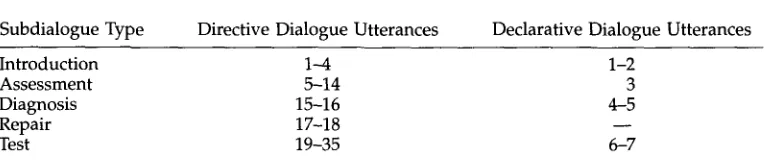
Table 1
Utterance classification into major subdialogues.
Subdialogue Type Directive Dialogue Utterances Declarative Dialogue Utterances
Introduction 1--4 1-2
Assessment 5-14 3
Diagnosis 15-16 4-5
Repair 17-18 - -
Test 19-35 6-7
tasks, she identified five primary task subdialogues:
• Introduction Subdialogue (I): Establish the purpose of the task (e.g., to fix the circuit with ID number RSl11).
• Assessment Subdialogue (A): Establish the current behavior.
• Diagnosis Subdialogue (D): Establish the cause for the errant behavior.
• Repair Subdialogue (R): Establish that the correction for the errant behavior has been made.
• Test Subdialogue (T): Establish that the behavior is now correct.
Table 1 shows the classification into the various subdialogues of the utterances from the sample dialogues of Figure 3.
5.2 S u b d i a l o g u e Transition
Another important aspect of the dialogue structure is the nature of the transitions between subdialogues. The model we present is derived from Moody's (1988) study, mentioned above. In the absence of errors in completing task actions, the natural transition from subdialogue to subdialogue is described by the following regular ex- pression:
I+A+(D+R*T+)nF
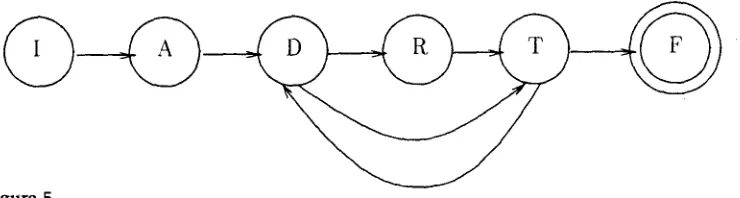
where " + " denotes that one or more utterances will be spoken in the given subdia- logue, " , " denotes that zero or more utterances will be spoken in the given subdia- logue, and n represents the number of individual repairs in the problem. 8 The letters correspond to the abbreviations given in Section 5.1, and F represents the finished state (i.e., completion of the dialogue). This transition model is also depicted in the finite-state network of Figure 5. For clarity, loop arcs (i.e., transitions from a subdia- logue back into itself) are omitted. We see from this model that dialogues normally begin with the Introduction and Assessment phases. Once the errant system behavior is described, the dialogue goes through one or more cycles of Diagnosis, Repair, and Test, until the system behavior is correct.
[image:14.468.52.434.90.171.2]Figure 5
Subdialogue transition as a finite-state network.
This model was helpful in classifying each utterance into the appropriate subdia- logue. As discussed in Section 6.4, however, not all dialogues followed this model, due to user initiative and dialogue miscommunication. Nevertheless, it provides a good first approximation of the nature of subdialogue movement.
5.3 Transcript Coding
The two authors each coded the transcripts independently. Every utterance (those spo- ken by the computer as well as those spoken by the human subject) was classified into one of these five subdialogue categories, according to two perspectives: the speaker's perspective (i.e., the task subdialogue that the speaker of the utterance believed was relevant to the statement) and the global perspective (i.e., the task subdialogue that is relevant to the utterance, based on omniscient knowledge of the task status). Nor- mally these were the same, but not always. In situations where the user carried out a repair without explicitly notifying the computer, the computer might think the task was still in one phase, when the user had actually moved the task into another phase. In the results to be presented, the current subdialogue is based on global, rather than speaker, perspective. Overall, there was a difference between speaker and global per- spective in 6.7% of the declarative mode utterances and in 1.7% of the directive mode utterances.
5.4 Coding Reliability
[image:15.468.42.412.57.156.2]Computational Linguistics Volume 23, Number 1
6. Results
6.1 Data Inclusion and Statistical Analysis
Subjects a t t e m p t e d a total of 141 dialogues, of w h i c h 118 or 84% were c o m p l e t e d successfully. 9 The average speech rate b y subjects was 2.9 sentences per minute, a n d the average task c o m p l e t i o n time for successful dialogues was 6.5 minutes. The s y s t e m h a d an average response time of 8.1 seconds d u r i n g the formal experiment. Later, a faster parsing algorithm was i m p l e m e n t e d a n d the s y s t e m was p o r t e d to a SPARC II w o r k s t a t i o n from the Sun 4 u s e d d u r i n g the experiment. D u r i n g test dialogues using the e n h a n c e d system, a v e r a g e response time was 2.2 seconds.
In general, differences in user b e h a v i o r d e p e n d i n g o n the level of c o m p u t e r initia- tive w e r e observed. W h e n the c o m p u t e r o p e r a t e d in declarative m o d e - - y i e l d i n g the initiative to h u m a n users, w h o c o u l d t h e n take a d v a n t a g e of their acquired e x p e r t i s e - - the dialogues:
• w e r e c o m p l e t e d faster (4.5 m i n u t e s v e r s u s 8.5 minutes).
• h a d f e w e r user-utterances per dialogue (10.7 v e r s u s 27.6).
• h a d users speaking longer utterances (63% of the user-utterances w e r e m u l t i w o r d v e r s u s 40% in directive mode).
While users g i v e n the initiative in the final session w e r e s o m e w h a t m o r e efficient at c o m p l e t i n g the dialogues than users given the initiative in the second session (com- pleting dialogues a p p r o x i m a t e l y 1.5 m i n u t e s faster a n d speaking o n average 2.7 f e w e r utterances), the large s t a n d a r d deviations, w h i c h r a n g e d from 50% to 90% of the asso- ciated sample means, a n d the small n u m b e r of subjects tested indicate that w e s h o u l d use caution in generalizing from o u r results.
Unless explicitly noted, the results o n h u m a n subjects' linguistic b e h a v i o r that will be r e p o r t e d t h r o u g h o u t this section are b a s e d only o n the 118 dialogues that w e r e suc- cessfully completed. While the 23 incomplete dialogues also contain interesting phe- n o m e n a , w e chose to focus the analysis on the c o m p l e t e d dialogues, as they represent the linguistic record of successful interactions w i t h the system. In reality, there are only slight differences in the results w h e n the unsuccessful dialogues are included. Further- more, a valid statistical analysis c o u l d only be p e r f o r m e d o n the c o m p l e t e d dialogues. Reporting data values f r o m only the successful dialogues maintains consistency w i t h the r e p o r t e d statistical values.
6.2 Utterance Classification into Subdialogues
6.2.1 H y p o t h e s e s . For users to take the initiative in the task d o m a i n , t h e y m u s t h a v e some expertise in the domain. Once this expertise is gained, a n d the c o m p u t e r yields task control to the h u m a n user, it is e x p e c t e d that users will exploit the situation to restrict the dialogue to specific issues of interest. Presumably, such users h a v e sub- stantial k n o w l e d g e a b o u t the general b e h a v i o r of the circuit, h o w to d e t e r m i n e w h e n
Table 2
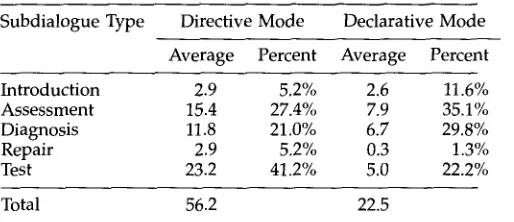
Utterance breakdown into major subdialogues.
Subdialogue T y p e Directive Mode Declarative Mode Average Percent Average Percent
Introduction 2.9 5.2% 2.6 11.6%
Assessment 15.4 27.4% 7.9 35.1%
Diagnosis 11.8 21.0% 6.7 29.8%
Repair 2.9 5.2% 0.3 1.3%
Test 23.2 41.2% 5.0 22.2%
Total 56.2 22.5
it is working, and the basic nature of repairs, but will need some assistance with di- agnosing specific problems. Consequently, we would expect the following differences between modes for users who are able to take the initiative:
• Introduction Subdialogue: The number of utterances will change little, since problem introduction seems independent of initiative.
• Assessment Subdialogue: The number of utterances will be reduced slightly in declarative mode, as users who take the initiative may exploit their control of the dialogue to carry out some preliminary steps without verbal interaction.
• Diagnosis Subdialogue: The number of utterances will change little, since all users presumably need the computer's assistance in problem
diagnosis.
• Repair Subdialogue: The change should be dependent on the task domain. If the repair process is basically the same once the error is diagnosed, few utterances will be required as repairs can be done without discussion. If the repair process is highly dependent on the type of error (e.g., debugging a program), even the skilled user m a y require significant advice from the system. For our domain, we expect a
reduction in the number of utterances spoken in declarative mode, since the repair process (adding a wire) is similar across the different problem types.
• Test Subdialogue: The number of utterances is significantly reduced (i.e., users who take the initiative can verify the circuit behavior without dialogue).
[image:17.468.31.288.87.198.2]Computational Linguistics Volume 23, Number 1
Table 3
Statistical results on utterance classification for the first five problems.
Mode Effect Subdialogue Effect Interaction Effect
F Value p F Value p F Value p
By-subjects F(1,7) = 24.93 = 0.002 F(3,21) = 17.77 < 0.001 F(3,21) = 4.93 = 0.01 By-items F(1,4) = 32.26 = 0.005 F(3,12) = 13.99 < 0.001 F(3,12) = 9.70 = 0.002
phase. A l t h o u g h w e originally e x p e c t e d little change in the n u m b e r of utterances as a function of initiative for the Diagnosis phase, the large increase in the n u m b e r of utterances s p o k e n for that p h a s e for p r o b l e m 6, d u r i n g directive m o d e interactions h a d a major impact on the overall averages. Excluding p r o b l e m 6, the a v e r a g e n u m - ber of utterances s p o k e n in the Diagnosis p h a s e was 9.4 in directive m o d e a n d 7.2 in declarative m o d e .
6.2.3 Statistical Analysis. While the first eight p r o b l e m s in each of the t w o experi- m e n t a l sessions are b a l a n c e d (Section 4.2), w e m u s t distinguish b e t w e e n the first five p r o b l e m s of each session, w h e r e there was a single missing wire in each p r o b l e m a n d p r o b l e m s 6 t h r o u g h 8 in each session, w h i c h h a v e t w o missing wires. N o t all subjects c o m p l e t e d the same n u m b e r of dialogues for p r o b l e m s 6 t h r o u g h 8 in the t w o ex- p e r i m e n t a l sessions. Consequently, including t h e m in the c o m p u t a t i o n of the a v e r a g e n u m b e r of utterances s p o k e n in a g i v e n s u b d i a l o g u e p h a s e w o u l d distort the averages u s e d in a statistical analysis} °
Therefore, w e a p p l y the statistical technique of analysis of variance (ANOVA) to the data from the first five p r o b l e m s of each session, the single-missing-wire problems. This represents a total of 60 c o m p l e t e d dialogues. A 2 X 4 design ( m o d e X s u b d i a l o g u e phase) was used (the I n t r o d u c t i o n p h a s e was omitted). 11
Table 3 s u m m a r i z e s the results of the statistical analysis. The analysis was con- d u c t e d using the averages b y subjects as well as b y items (problems). The i n d i v i d u a l main effects s h o w e d v e r y strong statistical significance u n d e r b o t h forms of analysis while the interaction effect of m o d e a n d s u b d i a l o g u e p h a s e also a p p e a r s to be statis- tically significant, b u t not quite as strongly as the m a i n effects individually. We n o w t u r n o u r attention to the o r d e r effect. Did the o r d e r in w h i c h subjects w e r e given the initiative affect their p e r f o r m a n c e ?
6.2.4 The Effects of Experience. As m e n t i o n e d in Section 4.2, w e b a l a n c e d the experi- m e n t p r o b l e m s according to type, such that p r o b l e m k of b o t h sessions 2 a n d 3 was the same type of problem. F u r t h e r m o r e , w e b a l a n c e d the subjects also. Half the subjects u s e d the s y s t e m w h e n it was operating in directive m o d e for session 2 while the other half u s e d the system w h e n it was operating in declarative m o d e for session 2. The m o d e was, of course, reversed for session 3 for b o t h groups. O n e of o u r claims has b e e n that as users gain experience a n d are given the initiative b y the system, they
10 As shown in the transition model of Figure 5, the Diagnosis, Repair, and Test subdialogue phases could occur twice in a dialogue with two missing wires.
will take advantage of that. We might expect then, that subjects given the initiative in session 3 would behave differently than subjects given the initiative in session 2. Furthermore, we might expect difficulties for subjects given the initiative in session 2 who then had to work with the system in directive mode in session 3. What do we find in the results?
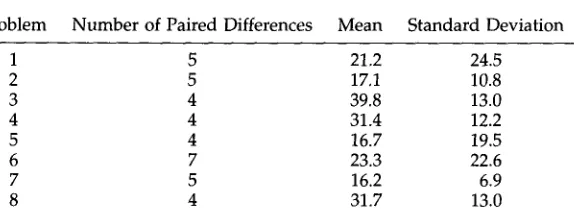
We conducted a paired t-test on the paired differences ~2 in the average number of utterances spoken per dialogue between the two modes, as a function of the problem number. Computing this test statistic for the two subdialogue phases in the domain where we would expect additional experience to have the most effect, Assessment and Diagnosis, yields the following results. For the Assessment phase, the test statistic is 0.854 with a corresponding p value of 0.42 for 7 degrees of freedom. For the Diagnosis phase, the test statistic is 0.556 with a corresponding p value of 0.60. Consequently, we do not find that the order in which a subject was given the initiative has a significant effect on the number of utterances spoken in a given subdialogue phase. We do not find this result surprising because:
Some expertise was gained during the preliminary training session, so some subjects were ready to be given initiative in session 2. In fact, the two subjects who struggled with using declarative mode in session 2 only contribute 5 of the 48 declarative mode data points used in computing the averages.
Some subjects, as part of their expertise, developed a somewhat ritualistic style of interaction with the machine, which may have lengthened their interactions.
6.3 User Initiation of Subdialogue Transitions
When the computer has total control of the dialogue, in directive mode, it is expected that the computer will initiate the transitions between subdialogues. H o w will this change when the computer operates in declarative mode and control is given back to the user?
While user control means the user's goals have priority, it does not necessarily mean the user will initiate every transition from one subdialogue to the next. The user controls the dialogue but still requires computer assistance. Consequently, it is expected that the computer will still initiate many of the transitions to the Assessment and Diagnosis phases in order to provide assistance in these areas, but that the user will be able to transition to other subdialogues as deemed appropriate. In particular, it is expected that the user will initiate most of the transitions to the final Test phase for confirming circuit behavior, since an experienced user would have learned h o w the circuit should function.
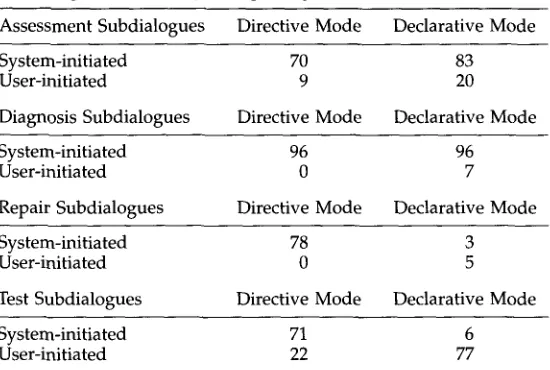
These hypotheses are generally supported by the results in Table 4. When the computer had the initiative (the directive mode dialogues), very few subdialogue transitions were ever initiated by the user other than to the final Test phase when the repair would cause the circuit to begin to function normally. When the computer yielded the initiative (the declarative mode dialogues), users initiated the transition
Computational Linguistics Volume 23, Number 1
Table 4
Subdialogues initiated by each participant.
Assessment Subdialogues Directive Mode Declarative Mode
System-initiated 70 83
User-initiated 9 20
Diagnosis Subdialogues Directive Mode Declarative Mode
System-initiated 96 96
User-initiated 0 7
Repair Subdialogues Directive Mode Declarative Mode
System-initiated 78 3
User-initiated 0 5
Test Subdialogues Directive Mode Declarative Mode
System-initiated 71 6
User-initiated 22 77
to the final stage of the dialogue almost every time. In the intermediate stages, the computer still initiated most subdialogues, but users occasionally felt compelled to cause a change to a different phase. This rarely happened when the computer had the initiative. Not counting the Introduction, which had to be initiated by the computer, only 9% of all subdialogues in directive mode were initiated by the user while 37% of the subdialogues in declarative mode were user-initiated.
6.4 General Subdialogue Transitions
As described in Section 5.2, the natural course of transition from subdialogue to sub- dialogue is described by the following regular expression:
I+A+(D+R*T+)nF
where n represents the number of individual repairs in the problem (i.e., number of missing wires in our domain). If every dialogue followed this model, then we would expect to see all transitions out of the Introduction phase go to the Assessment phase, all transitions out of the Assessment phase go to the Diagnosis phase, and all transitions out of the Repair phase go to the Test phase. However, with the potential for miscommunication as well as the potential for users to exploit their expertise and control of the dialogue to skip discussion of some task steps, it is highly unlikely that the actual results will follow the idealized model. Where might we see differences?
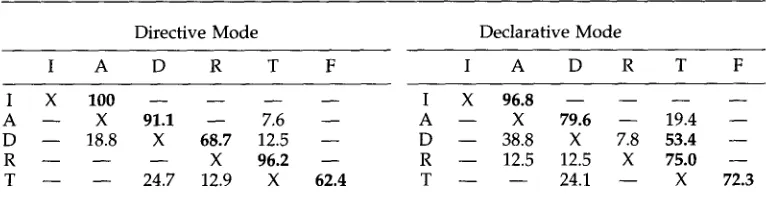
Table 5 shows the actual breakdown in percentages. The row value represents the initial subdialogue phase and the column represents the new subdialogue. The F column represents the finished state (i.e., dialogue completion). For example, the percentage of all transitions out of the Diagnosis phase that went to the Assessment phase is 18.8% in directive mode and 38.8% in declarative mode. The X entries along the main diagonal represent impossible exit transitions (i.e., there cannot be a transition from Diagnosis to Diagnosis). The " - - " entries represent values of less than 5 % . 13 If the dialogues follow the transition model, then the largest entries should be in the values
[image:20.468.55.330.83.268.2]T a b l e 5
Subdialogue transition breakdown as a function of dialogue mode.
Directive Mode Declarative Mode
I A D R T F I A D R T F
I X 1 0 0 . . . . I X 9 6 . 8 . . . .
A - - X 9 1 . 1 - - 7 . 6 - - A - - X 7 9 . 6 - - 1 9 . 4 - - D - - 1 8 . 8 X 6 8 . 7 1 2 . 5 - - D - - 3 8 . 8 X 7 . 8 5 3 . 4 - - R - - - - - - X 9 6 . 2 - - R - - 1 2 . 5 1 2 . 5 X 7 5 . 0 - - T - - - - 2 4 . 7 1 2 . 9 X 6 2 . 4 T - - - - 2 4 . 1 - - X 7 2 . 3
in the diagonal just above the main diagonal. The resulting largest entry in each row is noted in boldface.
For the most part, the percentages are consistent with the model, especially in the early phase transitions and in the transitions out of the Test subdialogue. Based on the relative number of completed dialogues that required the repair of two missing wires (17 in directive mode, 21 in declarative mode), the expected percentage of transitions from Test-to-Diagnosis would be 22.7% in directive mode and 25.9% in declarative mode. TM The actual values of 24.7% and 24.1% compare favorably with the expected
results. The large relative difference in percentages for transitions from Diagnosis to either Repair or Test in the two modes is also expected, given that users who take the initiative can make the repair themselves without discussing it with the computer. The transition percentages that are most surprising are the Diagnosis-to-Assessment transitions in both modes and the Test-to-Repair transitions in directive mode. The Diagnosis-to-Assessment transitions are indicative of attempts at error correction. That is, at some point during Diagnosis either the computer or the user becomes suspicious of the initial problem assessment and consequently moves back to Assessment to be sure that the erroneous circuit behavior is properly understood. The Test-to-Repair transition is common when the user makes the repair without mentioning it. That is, the user has prematurely moved from Repair to Test without notifying tile computer that the repair has actually been made. In directive mode dialogues, the computer will require verbal verification of the repair before transitioning to the Test phase.
In general, 64% of the dialogues in directive mode have no "unusual" transitions (where we define unusual as a transition not described by our model). In contrast, only 33% of the declarative mode dialogues had no unusual transitions, again demonstrat- ing how users felt free to skip steps without discussion. This particularly increased as users gained more experience, with only 26% of the 35 declarative dialogues of the final session containing no unusual transitions.
6 . 5 T a s k C o n t r o l v e r s u s L i n g u i s t i c C o n t r o l
As described in Section 2.1, our view of initiative concerns which participant's task goals currently have priority. Walker and Whittaker's (1990) study of mixed-initiative dialogue used a notion of control based on linguistic goals as specified in the control rules first presented in Section 2.3 and repeated below. These rules are a function of
[image:21.468.31.414.87.198.2]Computational Linguistics Volume 23, Number 1
the classification of the linguistic goal of the current utterance (Assertion, Command, Question, or Prompt) and reflect the status of initiative after the utterance was made.
.
.
3.
.
Assertion: The speaker has the initiative unless the utterance is a response to a Question.
Command: The speaker has the initiative.
Question: The speaker has the initiative unless the utterance is a response to a question or command.
Prompt: The hearer has the initiative.
We analyzed our dialogues using this notion of control with one modification-- assertions that were a continuation of the current topic left the initiative unchanged. Consider the following dialogue excerpt:
C: The LED is supposed to be displaying an alternately flashing one and seven.
U: The LED i s o f f .
C: The power is on when the switch is up. U: The switch is up.
C: The switch is connecting to the battery when there is a wire between connectors 111 and 120.
In both cases the user's assertions continue the topic introduced by the computer and do not cause a change of control. Contrast this with the following:
C: The LED is s u p p o s e d to be d i s p l a y i n g an a l t e r n a t e l y f l a s h i n g one and seven.
U: There is no wire b e t w e e n c o n n e c t o r eight four and c o n n e c t o r nine nine.
C: T h e r e is s u p p o s e d to be a wire b e t w e e n c o n n e c t o r 84 and c o n n e c t o r 99.
In this case the user's assertion does change control, as it is a change of topic. Our rule modification reflects this issue.
Table 6
Differences in linguistic control as a function of initiative.
Directive Mode Declarative Mode Percentage of total utterances 97.6
controlled by the computer
Average number of utterances 15.8 between control shifts
85.7
[image:23.468.41.328.211.321.2]3.3
Table 7
Differences in average number of utterances between control shifts.
Problem Number of Paired Differences Mean Standard Deviation
1 5 21.2 24.5
2 5 17.1 10.8
3 4 39.8 13.0
4 4 31.4 12.2
5 4 16.7 19.5
6 7 23.3 22.6
7 5 16.2 6.9
8 4 31.7 13.0
is up," from the first excerpt). The net effect s h o u l d be that user task control in declar- ative m o d e will lead to m o r e frequent linguistic control shifts a l t h o u g h the c o m p u t e r will still h a v e overall control of m o s t utterances.
Computational Linguistics Volume 23, Number 1
6.6 The Impact of Miscommunication
One important phenomenon of interactive dialogue that has recently begun to receive attention in the computational linguistics community is the handling of miscommu- nication (e.g., McRoy and Hirst [1995], Brennan and Hulteen [1995], and Lambert and Carberry [1992]). In the Circuit Fix-It Shop the computer misunderstood user- utterances 18.5% of the time. The primary cause of these misunderstandings was the misrecognition of the words spoken by the user--only 50% of the user's utterances were correctly recognized word for word. Consequently, misunderstanding occurred more often in declarative mode (24.7% of user-utterances) than directive mode (15.0% of user-utterances). This is due to the fact that, on average, users spoke longer utter- ances in declarative mode. Speech recognition technology has improved dramatically since this system was tested, but the need for handling miscommunication is still rel- evant as users and designers will continually test the performance limits of available technology. H u m a n - h u m a n communication frequently contains miscommunication, so we should expect it in human-computer dialogue as well. For the current system, how did miscommunication impact on the dialogue structure?
6.6.1 Frequency of Experimenter Interaction. As mentioned in Section 4.4, when the computer made a serious misinterpretation the experimenter was allowed to tell the user about the computer's erroneous interpretation without telling the user what to do. Computer misinterpretation of the user's utterances due to misrecognition of words can cause confusion between the user and computer, and ultimately, failure of the dialogue. With the computer running in declarative mode, the experimenter chose to make such statements once every 8.5 user-utterances, but only once every 26.5 user-utterances in directive mode. Not all misrecognitions required experimenter interaction. 15
6.6.2 User-Initiated Corrections. The previously mentioned procedure for notifying the user of a serious misrecognition leaves the responsibility with the user to try to cor- rect the computer's misunderstanding. It is hypothesized that when the computer has yielded the initiative, users are more likely to attempt to redirect the computer's focus when an error situation occurs. Conversely, users will tend to give up trying to redirect the computer's attention when the computer has the initiative because the machine will proceed on its own line of reasoning, ignoring what it perceives as user interrupts even when these interrupts are actually attempts at resolving previous miscommuni- cations. This is borne out by the results. Overall, while the computer was operating in directive mode, the user attempted to correct only 24% of the misunderstandings for which the user received notification. In contrast, while the computer was operating in declarative mode, the user attempted to correct 52% of the misunderstandings.