Hybridization of Genetic Algorithm and Linear
Programming for Solving Cell Formation Problem
with Alternative Process Routings
Shahrooz Shahparvari, Payam Chiniforooshan
Abstract— In this paper, a mathematical model is proposed to solve cell formation problem considering alternative process routings in which more than one process route for each part can be selected. The model attempts to minimize intercellular movements and incorporates several real-life production factors and practical constraints. In order to increase the flexibility provided by the multiplicity of routings, the model distributes production volume of each part among alternative routes. Also, a constraint enforcing work load balancing among machines is included in the model. Due to the complexity and combinatorial nature of this model, an enhanced algorithm comprised of a genetic algorithm (GA) and a linear programming (LP) is proposed for solving the model. At each iteration, the algorithm identifies the machine cells by GA. Consequently, the production quantity of each part in each route is determined by LP sub-problem. A numerical example is solved and compared with the solution approach from the literature that selects only one route for each part. The computational results show that the proposed approach offers better solution.
Keywords: Cell Formation; Alternative Process Routings; Hybrid Meta-heuristic; Genetic Algorithm; Linear Programming
I. INTRODUCTION
Cellular manufacturing (CM) is the practical application of group technology in which functionally dissimilar machines are grouped together to produce a family of parts. The goal of CM is to have the flexibility to produce a high variety of low demand products, while maintaining the high productivity of
Manuscript received June 17, 2012
Shahparvari. Sh is with Department of Industrial Engineering, Kish International Campus, University of Tehran, Tehran, Iran (corresponding author to provide phone: Tel: +989122392343,Fax:+982166517077; e-mail: [email protected]).
Chiniforooshan. P. is with the Department of Industrial Engineering, Science and Research Branch, Islamic Azad University, Tehran, Iran, (e-mail: [email protected]).
mass production. The main concept in CM is the achieving a decomposition of a manufacturing system into smaller subsystems (cells). The major advantages derived from CM are reduction in setup time, production lead time, work-in-process inventories, and material handling costs with increase in throughput [1].
Despite the potential advantages of CM, the dedication of machines to specific part families has one drawback: a loss of pooling flexibility, which means workload imbalances into inventory accumulation and long flow times [2,3]. The existence of alternative process routings (APR) is considered one of the basic factors that can compensate for the adverse effects of machine dedication [4,5]. Introducing highly capitalized machines capable of performing different manufacturing operations makes it possible to manufacture parts according to several alternative routes [6].
The central concerns in designing a CM system are to group machines into cells and to allocate parts to these cells in such a way to minimize the intercellular movements. This problem is referred to in the CM literature as the cell formation (CF) problem. Many researchers have addressed the CF and proposed various methods to solve this problem. Comprehensive reviews of CF strategies are provided in Singh [7] and Selim et al. [8]. Literature reveals that in majority of the methods it is assumed that each part has only one fixed process routing while in most of the manufacturing firms the parts usually have APR. In addition, it is well known that multiple routes may exist in any level of process plan for making a specific part, especially when the part is complex. [9].
production factors such as APR, operation sequence, and production volumes.
Adenso-Diaz et al. [5] studied the configuration of machine cells in the presence of APR. They proposed an efficient tabu search algorithm to selecting routes, grouping parts into families and machines into cells. Yin and Yasuda [13] developed a similarity coefficient that incorporates APR, operation sequence, processing time, and production volume factors. They also proposed a two-phase heuristic algorithm to deal with the machine capacity violated issue. Kim et al. [6] presented a two-phase heuristic algorithm to deal with the multi-objective CF problem for minimizing the total sum of intercellular movements and maximum machine workload imbalances.
These studies argued that by taking the flexibility offered by APR several benefits can be realized, such as higher machine utilization, better workload balancing, and a reduction in movement between cells. However, they only try to find the best route for each part from the available routes so as to minimize the intercellular movements. Once the best route is determined using one of the available alternate routes, the remaining are discarded and not considered further. This makes only partial use of the flexibility provided by the multiplicity of routings.
In the design of CM system, many production factors should be involved when the cells are created. Owing to the complexity of the CF problem, it is impossible to consider all the manufacturing factors in one method. Most of the CF techniques totally or partially neglect important production factors such as processing time, workload balancing and machine capacity [13].
In this paper, in order to increase the flexibility of manufacturing cells a mathematical programming model has been developed for solving a CF problem considering APR. This model can select more than one process route for each part. Also, several real-life production factors, namely operation sequence, production volume, processing time, workload balancing, machine capacity, and cell size, are considered. Due to the complexity and combinatorial nature of the proposed model, an algorithm comprised of a genetic algorithm (GA) and a linear programming (LP) is proposed for solving the model.
The organization of this paper is as follows. The problem formulation is presented in section 2. The proposed algorithm for solving the problem is illustrated in section 3. Section 4 is dedicated for numerical example. Conclusions are summarized in section 5.
II. PROBLEM FORMULATION
In this section, a mathematical model is developed to determine machine cells and production quantity of each part that will follow each process route. The objective function of the model is to minimize intercellular movement, along with satisfying the part demand and machine capacity constraints. This model can distribute the production volume among alternative routes in order to take maximum advantages of the existing flexibility and obtain a better solution.
In designing manufacturing cells, it is also considered that the workload of machines should be balanced. In this constraint, the factor q(0,1] determines the extent of the workload balance. This feature enables the system designer to set the level of workload balancing among the machines. Balancing machine workloads aims to allocate part routes to machine cells such that all workloads of machines are uniform. The mathematical model describing the characteristic of the problem can be formulated based on following variables and parameters:
A. Notation
M Number of machines
N Number of parts
C Number of cells
Vi Production volume for part i
Qi Number of routings for part i
U Maximum number of machines in each cell
Kij Number of machines in routing j of part i
Tik Processing time for part i on machine k
Ek Capacity of machine k
uij (k)
Machine's index in routing j of part i
q Workload balancing factor
Pij Proportion of the total demand of part i in the jth route
B. Mathematical Model N i i Q j ij K k C
l k l
ij u Y l k ij u Y ij P MinZ 1 1 1
1 1 ( 1)
1 ) ( (1) Subject to: i Q j i V ij P 1
i= 1,2,…,N (2)
k E N
i i uijk
T i Q j ij P
1 1 ( ( ))
k= 1,2,…M (3)
M k N i i Q j ik T ij P M q N i ik T i Q j ij P
1 1 1
1 1
k= 1,2,…M (4)
M k U kl Y 1
l= 1,2,…,C (5)
C l kl Y 1
1 k= 1,2,…,M (6)
0
ij
P
i= 1,2,…,N,
j= 1,2,…,Qi
0,1 kl
Y
k= 1,2,…M,
l= 1,2,…,C
The objective function (1) minimizes total intercellular movement. Constraints (2) ensure that all the part demand requirements are met. Constraints (3) ensure that the machine capacities are respected. Constraints (4) enforce workload balancing among cells where q(0,1] . Constraints (5) impose a maximum number of machines in each cell. Constraints (6) impose that each machine to be assigned to only one cell.
III. SOLUTIONALGORITHM
The CF problem is NP-complete and involves complicated combinatorial optimization [14]. Therefore, it is impossible to obtain solution for a large-sized problem in a reasonable amount of time. A practical approach for this issue is to look for an approximate solution that can be computed in polynomial time. This idea has led to the development of a considerable number of heuristic methods within the last three decades [9].
GA has been widely used in the field of CM system design. Pierrevala et al. [15] reviewed the implementations of GAs in CM. GA is capable of searching large regions of the solution’s space while being less susceptible to getting trapped in local optima [16]. These features enable GAs to tackle NP-complete problems successfully [17].
In this section, an enhanced algorithm comprised of a genetic algorithm and a linear programming is developed to efficiently solve the model presented in the previous section. The mathematical formulation involves both binary and continuous variables. At each iteration, GA searches over the binary variables to assign machines into machine cells. Afterwards, for each binary solution visited, the corresponding values of the continuous variables (production quantity of each part in each route) and the value of the objective function are obtained by a LP sub-problem. One of the advantages of embedding a LP sub-problem in the GA is that the LP sub-problem satisfies several constraints having continuous variables which may be difficult to satisfy by using genetic search alone.
A. Representation
The representation scheme for the decision variables is the first step in applying GA to solve an optimization problem. This representation decides how the problem will be shown in the GA. The chromosome is designed for machine groups, in which the genes will be assigned a cell number ranged from 1 to C. For example, consider there are ten machines numbered from 1 to 10, and three cells identified by integers 1, 2 and 3, then the chromosome (3 3 2 1 2 1 3 1 2 2) indicates that machines 1 and 2 are in cell 3, machine 3 is in cell 2, and so on.
B. Initialization
The second step in GA is to initialize the population of chromosomes. In this paper, an initial population of desired size is generated randomly with the chromosome generated with no empty cell. The operation is given as follows:
Step 1. Decide about the number of cells (C).
Step 2. Select C machines and group these machines one by one into C cells randomly (this step ensures that each cell must contain at least one machine). Step 3. Group the remaining M – C machines into C cells
randomly.
Step 4. Steps 1-3 above are repeated until a population of the required size is produced.
C. A linear programming sub-problem
sub-problem is to minimize the intercellular movements subject to constraints (2) – (4).
N
i i Q
j ij
P ij n
MinZ' 1 1
(7)
Subject to:
i Q
j i
V ij P
1
i= 1,2,…,N (2)
k E N
i i uijk
T i Q
j ij
P
1 1 ( ( ))
k= 1,2,…M (3)
M
k N
i i Q
j ik
T ij P M
q N
i ik
T i Q
j ij
P
1 1 1
1 1
k= 1,2,…M (4)
0
ij
P i= 1,2,…,N,
j= 1,2,…,Qi
Where nij is the number of intercellular movements along route j of part i.
D. Evaluation
The purpose of the evaluation is to measure the fitness of candidate solutions in the population with respect to the objective functions and constraints of the model. In this study, the fitness value is calculated by the sum of the objective function of the LP sub-problem (Eq. (7)) and the penalty terms of constraint violations. The penalty term is to enforce the cell size constraints (Constraints (5)).
E. Selection Strategy
The purpose of selection is to ensure that the fittest individuals have more opportunities to produce children. In this step, each chromosome is assigned a probability of being selected based on its fitness value and the chosen selection strategy. In this study, Tunnukij and Hicks’s [17] rank based roulette elitist strategy is adopted, which combines the elitist strategy with rank based roulette wheel approach. The elitism strategy is used to select successive chromosomes by copying the best chromosomes from the previous generation to the next generation and the roulette wheel approach is used to select other successive chromosomes. It was found that the rank based roulette wheel strategy with 10% of the best chromosomes surviving to the next generation
produced the best results. It was therefore chosen for the proposed GA.
F. Crossover and Mutation
Crossover combines information from two parents so that the two children have a resemblance to each parent. The proposed GA employs the standard single-point crossover operator. This operator randomly generates a single crossover point along the length of the chromosome. The crossover point divides each of the parent chromosomes into two segments. Children are then created by exchanging the right-hand side segments of the parents.
The mutation operators act on a single chromosome to alter the information contained in the genes. Swap mutation is employed in this study. In swap mutation two random points are found and the two digits swapped at these positions.
It is possible that the new children violate the constraints of the model. There are basically two strategies to deal with this problem. The first one consists of penalizing the infeasible solution in such a way that they will hardly propagate to the next generations. The Second is to try to correct the chromosomes that violate the constraints. The first strategy is used in the suggested algorithm.
G. Termination Condition
The generation will keep on evolving until the specified stopping condition has been fulfilled. In this research, the termination criterion monitors improvement from generation to generation. The algorithm stops when there is no change in the best objective function for a specific number of consecutive generations.
IV. NUMERICALEXAMPLE
In order to demonstrate the efficiency of the proposed model and solution algorithm, our proposed approach is applied to a numerical example presented by Kim et al. [6] with 10 machines, 10 parts, and 25 alternative routes. The maximum number of machines in each cell is restricted to 5. The genetic parameters for example problem are as follows: crossover rate, pc = 0.8, Mutation rate, pm = 0.2; population size, pop size = 200. If the same fitness function value is obtained for 20 times in consecutive generations, the algorithm terminates. The proposed algorithm are coded in MATLAB 7 and run on an Intel Core2, 2GHz CPU with 1 GB RAM.
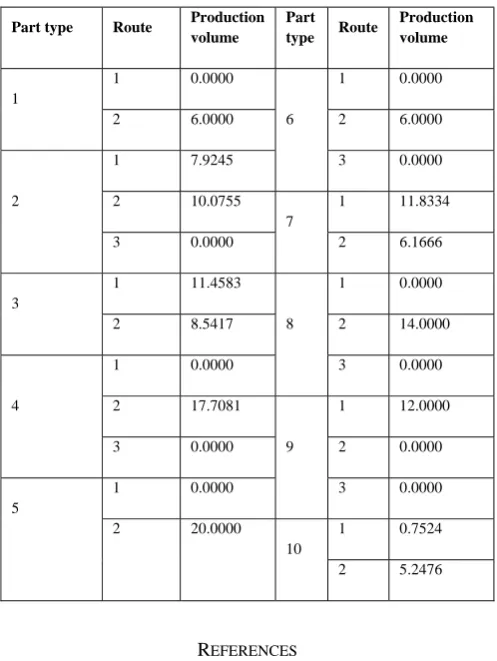
Experiments indicated that a value of q = 0.9 in our algorithm gives a better value of objective function. The comparison results are summarized in Table I. In addition, Experiments with other values of q are tested. Table II shows the results of the proposed algorithm for other values of q. The results of our algorithm with q = 0.9 are presented in detail in Table III. The algorithm required less than 1 minute computational time in all experiments.
TABLE I. SUMMARY OF COMPARISONS
Method Intercellular
Movements
Workload
Imbalance Total
Kim et al.’s
algorithm 88 118 206
Zhao and Wu’s
GA algorithm 82 112 194
Our algorithm 80.29 68.09 148.38
[image:5.595.303.552.201.528.2]From Table I, it can be observed that the proposed approach offers better solution for CF problem. Due to the increase in flexibility, allowing more than one route for each part reduces the intercellular movements and workload imbalance. In fact, such flexibility does not exist if in the manufacturing cell design for each part only one route is selected among its alternative routes.
TABLE II. RESULTS OF OUR ALGORITHM USING OTHER VALUES OF q
q Intercellular Movements Workload Variations Total
0.6 64 146.54 210.54
0.7 64 143.96 207.96
0.8 69.9 117.92 187.82
0.9 80.29 68.09 148.38
1 156.65 58.59 215.24
V. CONCLUSION
In this paper, the cell formation problem in the presence of alternative process routings in which more than one process route for each part can be selected was considered. This problem was formulated as a mathematical model that determines machine cells and the production quantity of each part that will follow each alternative route such that total intercellular movements are minimized. The mathematical formulation of the problem involves both binary and continuous variables. Manufacturing cells were designed based on several real-life production factors, namely operation sequence, production volume, processing time, machine capacities, and cell size. Also, it was considered that the workload of machines should be balanced.
Due to the complexity of the problem, an algorithm comprised of a genetic algorithm and a linear programming
was proposed for solving the model. At each iteration, GA searches over the binary variables to assign machines into machine cells. For each binary solution visited, the production quantity of each part in each route and the value of the objective function are obtained by a linear programming sub-problem. The results show that in order to take maximum advantages of the existing flexibility more than one route for each part should be selected.
TABLE III. RESULTS OF PROBLEM WITH q=0.9
Part type Route Production
volume
Part
type Route
Production volume
1
1 0.0000 6
1 0.0000
2 6.0000 2 6.0000
2
1 7.9245 3 0.0000
2 10.0755 7
1 11.8334
3 0.0000 2 6.1666
3
1 11.4583 8
1 0.0000
2 8.5417 2 14.0000
4
1 0.0000 3 0.0000
2 17.7081 9
1 12.0000
3 0.0000 2 0.0000
5
1 0.0000 3 0.0000
2 20.0000 10
1 0.7524
2 5.2476
REFERENCES
[1] U.J. Wemmerlov, and D.J. Johnson, “Cellular manufacturing at 46 user plants: Implementation experiences and Performance Improvements”, International Journal of Production Research, Vol. 35, No. 1, 1997, pp. 24-49.
[2] J.S. Morris, and R.J. Tersine, “A simulation analysis of factors influencing the attractiveness of group technology layouts”, Management Science, Vol. 36, No. 12, 1990, pp. 1567-1578.
[3] N.C. Suresh, and J.R. Meredith, “Coping with the loss of pooling synergy in cellular manufacturing systems”, Management Science, Vol. 40, No. 4, 1994, pp. 466-483.
[4] J.B. Jensen, M.K. Malhotra, and P.R. Philipoom, “Machine dedication and process flexibility in a group technology enviroment”, Journal of Operations Management, Vol. 14, 1996, pp. 19-39.
[5] B. Adenso-Diaz, S. Lozano, J. Racero, and F. Guerrero, “Machine cell formation in generalized group technology”, Computers & Industrial engineering, Vol. 41, 2001, pp. 227-240.
[6] C.O. Kim, J.G. Baek, and J.K. Baek, “A two-phase heuristic algorithm for cell formation problems considering alternative part routes and machine sequences”, International Journal of Production Research, Vol. 42, No. 18, 2004, pp. 3911-3927.
[image:5.595.52.285.220.299.2] [image:5.595.48.287.445.586.2][8] H.M. Selim, R.G. Askin, and A.J. Vakharia, “Cell formation in group technology: review, evaluation and direction for future research”, Computers & Industrial Engineering, Vol. 34, No. 3, 1998, pp. 3-20. [9] C. Liu, K. Yasuda, Y. Yin, and K. Tanaka, “Uncertain association rule
mining algorithm for the cell formation problem in cellular manufacturing systems” International Journal of Production Research, Vol. 47, No. 3, 2009, pp. 667-685.
[10] H. Hwang, and P. Ree, “Routes selection for the cell formation problem with alternate part process plan”, Computers & Industrial Engineering, Vol. 30, No. 3, 1996, pp. 423-431.
[11] C. Caux, R. Bruniaux, and H. Pierreval, “Cell formation with alternative process plans and machine capacity constraints: A new combined approach”, International Journal of Production Economics, Vol. 64, 2000, pp. 279-284.
[12] C. Zhao, and Z. Wu, “A genetic algorithm for manufacturing cell formation with multiple routes and multiple objectives” International Journal of Production Research, Vol. 38, No. 2, 2000, pp. 385–395.
[13] Y. Yin, and K. Yasuda, “Manufacturing cells’ design in consideration of various production factors”, International Journal of Production Economics, Vol. 40, No. 4, 2002, pp. 885-906.
[14] C. Dimopoulos, and A.M. Zalzala, “Recent developments in evolutionary computation for manufacturing optimization: problems, solutions, and comparison." IIE Transactions on Evolutionary Computation, Vol. 4, No. 2, 2000, pp. 93-113.
[15] H. Pierreval, C. Caux, J.L. Pairs, and F. Viguier, “Evolutionary approaches to the design and organization of manufacturing systems”, Computers & Industrial Engineering, Vol. 44, 2003, pp. 339-364. [16] L. Hu, and K. Yasuda, “Minimising material handling cost in cell
formation with alternative processing routes by grouping genetic algorithm”, International Journal of Production Research, Vol. 44, No. 11, 2006, pp. 2133-2167.