Retrieving Collocations from Text: Xtract
F r a n k S m a d j a * Columbia University
Natural languages are full of collocations, recurrent combinations of words that co-occur more often than expected by chance and that correspond to arbitrary word usages. Recent work in lexicography indicates that collocations are pervasive in English; apparently, they are common in all types of writing, including both technical and nontechnical genres. Several approaches have been proposed to retrieve various types of collocations from the analysis of large samples of textual data. These techniques automatically produce large numbers of collocations along with statistical figures intended to reflect the relevance of the associations. However, noue of these techniques provides functional information along with the collocation. Also, the results produced often contained improper word associations reflecting some spurious aspect of the training corpus that did not stand for true collocations.
In this paper, we describe a set of techniques based on statistical methods for retrieving and identifying collocations from large textual corpora. These techniques produce a wide range of collocations and are based on some original filtering methods that allow the production of richer and higher-precision output. These techniques have been implemented and resulted in a lexicographic tool, Xtract. The techniques are described and some results are presented on a 10 million-word corpus of stock market news reports. A lexicographic evaluation of Xtract as a collocation retrieval tool has been made, and the estimated precision of Xtract is 80%.
1. Introduction
Consider the following sentences:
1. "The D o w Jones average of 30 industrials rose 26.28 points to 2,304.69 on Tuesday." 2. "The D o w average rose 26.28 points to 2,304.69
on Tuesday."
3. " T h e D o w i n d u s t r i a l s rose 26.28 points to 2,304.69 on Tuesday."
4. "The D o w Jones industrial rose 26.28 points to 2,304.69 on Tuesday."
. 5 . "The Jones industrials rose 26.28 points to 2,304.69 on Tuesday."
Computational Linguistics Volume 19, Number 1
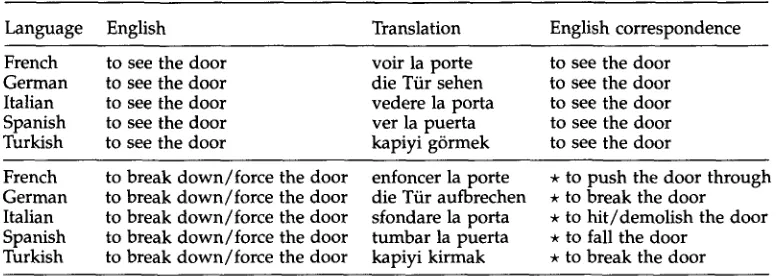
Table 1
Cross linguistic comparisons of collocations.
Language English Translation English correspondence
French to see the door voir la porte to see the door German to see the door die Ttir sehen to see the door Italian to see the door vedere la porta to see the door Spanish to see the door ver la puerta to see the door Turkish to see the door kapiyi g6rmek to see the door French to break down/force the door enfoncer la porte
German to break down/force the door die Ttir aufbrechen Italian to break down/force the door sfondare la porta Spanish to break down/force the door tumbar la puerta Turkish to break down/force the door kapiyi kirmak
* to push the door through , to break the door , to hit/demolish the door * to fall the door
, to break the door
, 6 . " T h e i n d u s t r i a l D o w rose 26.28 points to 2,304.69 on Tuesday."
* 7. " T h e D o w of 30 i n d u s t r i a l s rose 26.28 points to 2,304.69 o n Tuesday."
8. " T h e D o w i n d u s t r i a l rose 26.28 points to 2,304.69 on Tuesday."
The a b o v e sentences contain expressions that are difficult to h a n d l e for nonspecial- ists. For example, a m o n g the eight different expressions referring to the f a m o u s Wall Street index, only those u s e d in sentences 1--4 are correct. The expressions u s e d in the starred sentences 5-8 are all incorrect. The rules violated in sentences 5--8 are neither rules of syntax n o r of semantics b u t p u r e l y lexical rules. The w o r d combinations u s e d in sentences 5-8 are invalid simply because they do not exist; similarly, the ones u s e d in sentences 1-4 are correct because t h e y exist.
Expressions such as these are called collocations. Collocations v a r y t r e m e n d o u s l y in the n u m b e r of w o r d s involved, in the syntactic categories of the words, in the syntactic relations b e t w e e n the w o r d s , a n d in h o w rigidly the i n d i v i d u a l w o r d s are u s e d together. For example, in some cases, the w o r d s of a collocation m u s t be adjacent, as in sentences 1-5 above, while in others they can be s e p a r a t e d b y a v a r y i n g n u m b e r of other words. Unfortunately, w i t h few exceptions (e.g., Benson, Benson, a n d Ilson 1986a) collocations are generally unavailable in c o m p i l e d form. This creates a p r o b l e m for persons not familiar with the s u b l a n g u a g e 1 as well as for several m a c h i n e applications such as language generation.
In this p a p e r w e describe a set of techniques for automatically retrieving such collocations from naturally occurring textual corpora. These techniques are b a s e d on statistical methods; they h a v e b e e n i m p l e m e n t e d in a tool, Xtract, w h i c h is able to retrieve a w i d e r a n g e of collocations w i t h high p e r f o r m a n c e . P r e l i m i n a r y results ob- tained with parts of Xtract h a v e b e e n described in the past (e.g., Smadja a n d M c K e o w n 1990); this p a p e r gives a c o m p l e t e description of the s y s t e m a n d the results obtained.
[image:2.468.45.437.89.227.2]Frank Smadja Retrieving Collocations from Text: Xtract
"Our firm made/did a deal with them" "The swimmer had/got a cramp" "Politicians are always on/in the firing lane" "These decisions are to be m a d e / t a k e n rapidly"
"The children usually set/lay the table" "You have to break in/run in your new car" Figure 1
British English or American English? from Benson (1990).
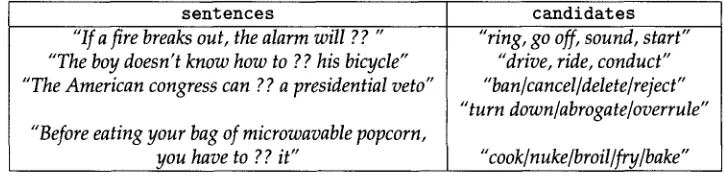
sentences candidates
"If a fire breaks out, the alarm will ?? " "The boy doesn't know how to ? ? his bicycle" "The American congress can ?? a presidential veto"
"Before eating your bag of microwavable popcorn, you have to ? ? it"
"ring, go off, sound, start" "drive, ride, conduct" "ban~cancel~delete~reject" "turn down~abrogate~overrule"
"cook/nuke/broil/fry/bake"
Figure 2
Fill-in-the-blank test, from Benson (1990).
Xtract now works in three stages. In the first stage, pairwise lexical relations are re- trieved using only statistical information. This stage is comparable to Church and Hanks (1989) in that it evaluates a certain word association between pairs of words. As in Church and Hanks (1989), the words can appear in any order and they can be separated by an arbitrary number of other words. However, the statistics we use provide more information and allow us to have more precision in our output. The out- put of this first stage is then passed in parallel to the next two stages. In the second stage, multiple-word combinations and complex expressions are identified. This stage produces output comparable to that of Choueka, Klein, and Neuwitz (1983); however the techniques we use are simpler and only produce relevant data. Finally, by com- bining parsing and statistical techniques the third stage labels and filters collocations retrieved at stage one. The third stage has been evaluated to raise the precision of Xtract from 40% to 80% with a recall of 94%.
Section 2 is an introductory section on collocational knowledge, Section 3 describes the type of collocations that are retrieved by Xtract, and Section 4 briefly surveys re- lated efforts and contrasts our work to them. The three stages of Xtract are then in- troduced in Section 5 and described respectively in Sections 6, 7, and 8. Some results obtained by running Xtract on several corpora are listed and discussed in Section 9. Qualitative and quantitative evaluations of our methods and of our results are dis- cussed in Sections 10 and 11. Finally, several possible applications and tasks for Xtract are discussed in Section 12.
2. W h a t A r e C o l l o c a t i o n s ?
[image:3.468.45.407.187.275.2]Computational Linguistics Volume 19, Number 1
been used can be found in the lexicographic work of Benson and his colleagues (Benson 1990). The definition is the following:
Definition
A collocation is an arbitrary and recurrent word combination (Benson 1990).
This definition, however, does not cover some aspects and properties of colloca- tions that have consequences for a number of machine applications. For example, it has been shown that collocations are difficult to translate across languages--this fact obviously has a direct application for machine translation. Many properties of col- locations have been identified in the past; however, the tendency was to focus on a restricted type of collocation. In this section, we present four properties of collocations that we have identified and discuss their relevance to computational linguistics.
2.1 Collocations Are Arbitrary
Collocations are difficult to produce for second language learners (Nakhimovsky and Leed 1979). In most cases, the learner cannot simply translate word-for-word what s / h e would say in h e r / h i s native language. As we can see in Table 1, the word-for- word translation of "to open the door" works well in both directions in all five languages. In contrast, translating word-for-word the expression: "to break down~force the door" is a poor strategy in both directions in all five languages. The co-occurrence of "door" and "open" is an open or free combination, whereas the combination "door" and "break down" is a collocation. Learners of English would not produce "to break down a door" whether their first language is French, German, Italian, Spanish, or Turkish, if they were not aware of the construct.
Figure 1 illustrates disagreements between British English and American English. Here the problem is even finer than in Table I since the disagreement is not across two different languages, but across dialects of English. In each of the sentences given in this figure, there is a different word choice for the American (left side) and the British English (right side). The word choices do not correspond to any syntactic or semantic variation of English but rather to different word usages in both dialects of English.
Translating from one language to another requires more than a good knowledge of the syntactic structure and the semantic representation. Because collocations are arbitrary, they must be readily available in both languages for effective machine trans- lation.
2.2 Collocations Are D o m a i n - D e p e n d e n t
Frank Smadja Retrieving Collocations from Text: Xtract
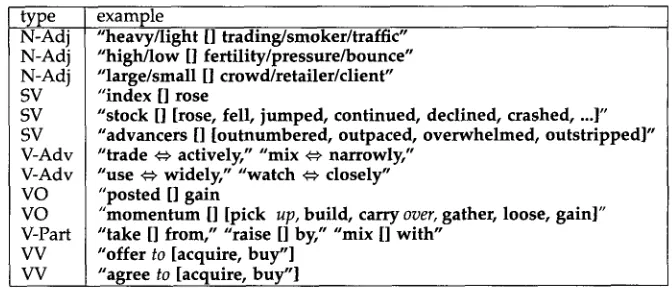
type N-adj N-Adj N-Adj SV SV SV V-Adv V-Adv VO VO V-Part VV VV
example
"heavy/light [] trading/smoker/traffic" "high/low [] fertility/pressure/bounce" "large/small [] crowd/retailer/client" "index [] rose
"stock [] [rose, fell, jumped, continued, declined, crashed .... ]" "advancers [] [outnumbered, outpaced, overwhelmed, outstripped]" "trade 4=~ actively," "mix 4=~ narrowly,"
"use ~=~ widely," "watch ~=~ closely" "posted [] gain
"momentum [] [pick up, build, carry over, gather, loose, gain]" "take [] from," "raise [] by," "mix [] with"
"offer to [acquire, buy"] "agree to [acquire, buy"] Figure 3
Some examples of predicative collocations.
Linguistically mastering a d o m a i n such as the d o m a i n of sailing thus requires more than a glossary, it requires knowledge of d o m a i n - d e p e n d e n t collocations.
2.3 Collocations Are Recurrent
The recurrent property simply means that these combinations are not exceptions, but rather that they are very often repeated in a given context. Word combinations such as "to make a decision, to hit a record, to perform an operation" are typical of the language, a n d collocations such as "to buy short," "to ease the jib" are characteristic of specific domains. Both types are repeatedly used in specific contexts.
2.4 Collocations Are Cohesive Lexical Clusters
By cohesive 2 clusters, we m e a n that the presence of one or several words of the collo- cations often implies or suggests the rest of the collocation. This is the property mostly used b y lexicographers w h e n compiling collocations (Cowie 1981; Benson 1989a). Lexi- cographers use other people's linguistic j u d g m e n t for deciding w h a t is a n d w h a t is not a collocation. They give questionnaires to people such as the one given in Figure 2. This questionnaire contains sentences used by Benson for compiling collocational knowl- edge for the BBI (Benson 1989b). Each sentence contains an e m p t y slot that can easily be filled in by native speakers. In contrast, second language speakers w o u l d not find the missing words automatically but w o u l d consider a long list of words having the ap- propriate semantic and syntactic features such as the ones given in the second column. As a consequence, collocations have particular statistical distributions (e.g., Hal- liday 1966; Cruse 1986). This means that, for example, the probability that a n y two adjacent words in a sample will be "red herring" is considerably larger than the prob- ability of "red" times the probability of "herring." The words cannot be considered as i n d e p e n d e n t variables. We take advantage of this fact to develop a set of statistical techniques for retrieving and identifying collocations from large textual corpora. 3. Three Types of Collocations
Collocations come in a large variety of forms. The n u m b e r of words involved as well as the w a y they are involved can vary a great deal. Some collocations are
[image:5.468.57.393.51.200.2]Computational Linguistics Volume 19, Number 1
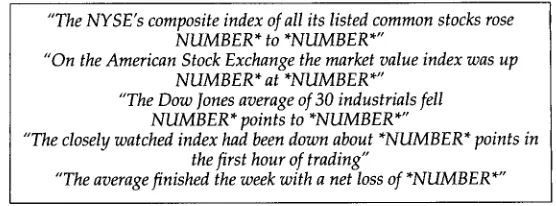
"The NYSE's composite index of all its listed common stocks rose NUMBER* to *NUMBER*"
"On the American Stock Exchange the market value index was up NUMBER* at *NUMBER*"
"The Dow Jones average of 30 industrials fell NUMBER* points to *NUMBER*"
"The closely watched index had been down about *NUMBER* points in the first hour of trading"
"The average finished the week with a net loss of *NUMBER*"
Figure 4
Some examples of phrasal templates.
v e r y rigid, w h e r e a s others are v e r y flexible. For example, a collocation such as the one linking "to make" a n d "decision" can a p p e a r as "to make a decision," "decisions to be made," "made an important decision," etc. In contrast, a collocation such as "The New York Stock Exchange" can only a p p e a r u n d e r one form; it is a v e r y rigid collocation, a fixed expression. We have identified three types of collocations: rigid noun phrases, predicative relations, and phrasal templates. We discuss the three types in turn, a n d give some examples of collocations.
3.1 Predicative Relations
A predicative relation consists of two w o r d s r e p e a t e d l y used together in a similar syntactic relation. These lexical relations are the most flexible t y p e of collocation. T h e y are hard to identify since they often c o r r e s p o n d to i n t e r r u p t e d w o r d sequences in the corpus. For example, a n o u n a n d a verb will f o r m a predicative relation if they are r e p e a t e d l y u s e d together with the n o u n as the object of the verb. "Make-decision" is a g o o d e x a m p l e of a predicative relation. Similarly, an adjective r e p e a t e d l y m o d i f y i n g a given n o u n such as "hostile-takeover" also f o r m s a predicative relation. Examples of automatically extracted predicative relations are given in Figure 3. 3 This class of collocations is related to Mel'~uk's lexical functions (Mel'~uk 1981), and Benson's L- type relations (Benson, Benson, a n d Ilson 1986b).
3.2 Rigid N o u n Phrases
Rigid n o u n phrases involve u n i n t e r r u p t e d sequences of w o r d s such as "stock market," "foreign exchange," "New York Stock Exchange," "The Dow Jones average of 30 industrials." T h e y can include n o u n s a n d adjectives as well as closed class w o r d s , a n d are similar to the t y p e of collocations retrieved b y C h o u e k a (1988) and A m s l e r (1989). T h e y are the most rigid t y p e of collocation. Examples of rigid n o u n phrases are: 4 "The NYSE's composite index of all its listed common stocks," "The N A S D A Q composite index for the over the counter market," "levera ged buyout ," "the gross national product," "White House spokesman Marlin Fitzwater."
In general, rigid n o u n phrases cannot be b r o k e n into smaller f r a g m e n t s w i t h o u t losing their meaning; they are lexical units in a n d of themselves. Moreover, t h e y often refer to i m p o r t a n t concepts in a d o m a i n , a n d several rigid n o u n phrases can be u s e d to express the same concept. In the N e w York Stock Exchange d o m a i n , for example, "The
3 In the examples, the "[]" sign represents a gap of zero, one or several words. The "4=~" sign means that the two words can be in any order.
[image:6.468.100.378.61.164.2]Frank Smadja Retrieving Collocations from Text: Xtract
Dow industrials," "The Dow Jones average of 30 industrial stocks," "the Dow Jones industrial
average,"
and"The Dow Jones industrials"
represent several ways to express a single concept. As we have seen before, these rigid noun phrases do not seem to follow any simple construction rule, as, for example, the examples given in sentences 6-8 at the beginning of the paper are all incorrect.3.3 Phrasal Templates
Phrasal templates consist of idiomatic phrases containing one, several, or no empty slots. They are phrase-long collocations. Figure 4 lists some examples of phrasal tem- plates in the stock market domain. In the figure, the empty slots must be filled in by a number (indicated by
*NUMBER*
in the figure). More generally, phrasal templates specify the parts of speech of the words that can fill the empty slots. Phrasal templates are quite representative of a given domain and are very often repeated in a rigid w a y in a given sublanguage. In the domain of weather reports, for example, the sentence"Temperatures indicate previous day's high and overnight low to 8 a.m."
is actually repeated before each weather report, sUnlike rigid noun phrases and predicative relations, phrasal templates are specif- ically useful for language generation. Because of their slightly idiosyncratic structure, generating them from single words is often a very difficult task for a language gener- ator. As pointed out by Kukich (1983), in general, their usage gives an impression of fluency that could not be equaled with compositional generation alone.
4. Related Work
There has been a recent surge of research interest in corpus-based computational lin- guistics methods; that is, the study and elaboration of techniques using large real text as a basis. Such techniques have various applications. Speech recognition (Bahl, Jelinek, and Mercer 1983) and text compression (e.g., Bell, Witten, and Cleary 1989; Guazzo 1980) have been of long-standing interest, and some new applications are currently being investigated, such as machine translation (Brown et al. 1988), spelling correction (Mays, Damerau, and Mercer 1990; Church and Gale 1990), parsing (Debili 1982; Hindle and Rooth 1990). As pointed out by Bell, Witten, and Cleary (1989), these applications fall under two research paradigms: statistical approaches and lexical ap- proaches. In the statistical approach, language is modeled as a stochastic process and the corpus is used to estimate probabilities. In this approach, a collocation is simply considered as a sequence of words (or n-gram) among millions of other possible se- quences. In contrast, in the lexical approach, a collocation is an element of a dictionary among a few thousand other lexical items. Collocations in the lexicographic meaning are only dealt with in the lexical approach. Aside from the work we present in this paper, most of the work carried out within the lexical approach has been done in computer-assisted lexicography by Choueka, Klein, and Neuwitz (1983) and Church and his colleagues (Church and Hanks 1989). Both works attempted to automatically acquire true collocations from corpora. Our work builds on Choueka's, and has been developed contemporarily to Church's.
Choueka, Klein, and Neuwitz (1983) proposed algorithms to automatically retrieve idiomatic and collocational expressions. A collocation, as defined by Choueka, is a se- quence of adjacent words that frequently appear together. In theory the sequences can be of any length, but in actuality, they contain two to six words. In Choueka
Computational Linguistics Volume 19, Number 1
(1988), experiments performed on an 11 million-word corpus taken from the
New
York Times
archives are reported. Thousands of commonly used expressions such as"fried chicken," "casual sex," "chop
suey,""home run,"
and"Magic Johnson"
were retrieved. Choueka's methodology for handling large corpora can be considered as a first step toward computer-aided lexicography. The work, however, has some limitations. First, by definition, only uninterrupted sequences of words are retrieved; more flexible col- locations such as"make-decision,"
in which the two words can be separated by an arbitrary number of words, are not dealt with. Second, these techniques simply ana- lyze the collocations according to their observed frequency in the corpus; this makes the results too dependent on the size of the corpus. Finally, at a more general level, although disambiguation was originally considered as a performance task, the collo- cations retrieved have not been used for any specific computational task.Church and Hanks (1989) describe a different set of techniques to retrieve col- locations. A collocation as defined in their work is a pair of correlated words. That is, a collocation is a pair of words that appear together more often than expected. Church et al. (1991) improve over Choueka's work as they retrieve interrupted as well as uninterrupted sequences of words. Also, these collocations have been used by an automatic parser in order to resolve attachment ambiguities (Hindle and Rooth 1990). They use the notion of mutual information as defined in information theory (Shannon 1948; Fano 1961) in a manner similar to what has been used in speech recognition (e.g., Ephraim and Rabiner 1990), or text compression (e.g., Bell, Witten, and Cleary 1989), to evaluate the correlation of common appearances of pairs of words. Their work, however, has some limitations too. First, by definition, it can only retrieve col- locations of length two. This limitation is intrinsic to the technique used since mu- tual information scores are defined for two items. The second limitation is that many collocations identified in Church and Hanks (1989) do not really identify true collo- cations, but simply pairs of words that frequently appear together such as the pairs
"doctor-nurse," "doctor-bill," "doctor-honorary," "doctors-dentists," "doctors-hospitals," etc.
These co-occurrences are mostly due to semantic reasons. The two words are used in the same context because they are of related meanings; they are not part of a single collocational construct.The work we describe in the rest of this paper is along the same lines of research. It builds on Choueka's work and attempts to remedy the problems identified above. The techniques we describe retrieve the three types of collocations discussed in Section 2, and they have been implemented in a tool, Xtract. Xtract retrieves interrupted as well as uninterrupted sequences of words and deals with collocations of arbitrary length (1 to 30 in actuality). The following four sections describe and discuss the techniques used for Xtract.
5. Xtract: Introduction
Xtract consists of a set of tools to locate words in context and make statistical observa- tion to identify collocations. In the upgraded version we describe here, Xtract has been extended and refined. More information is computed and an effort has been made to extract more functional information. Xtract now works in three stages.
Frank Smadja Retrieving Collocations from Text: Xtract
stage, described in Section 7, Xtract uses the o u t p u t bigrams to p r o d u c e collocations involving m o r e than two w o r d s (or n-grams). It analyzes all sentences containing the bigram and the distribution of w o r d s and parts of speech for each position a r o u n d the pair. It retains w o r d s (or parts of speech) o c c u p y i n g a position with probability greater than a given threshold. For example, the b i g r a m "average-industrial" p r o d u c e s the n- g r a m "the D o w Jones industrial average," since the w o r d s are always used within rigid n o u n phrases in the training corpus. In the third stage, described in Section 8, Xtract a d d s syntactic i n f o r m a t i o n to collocations retrieved at the first stage a n d filters out i n a p p r o p r i a t e ones. For example, if a b i g r a m involves a n o u n and a verb, this stage identifies it either as a subject-verb or as a verb-object collocation. If no such consistent relation is observed, then the collocation is rejected.
6. Xtract Stage One: Extracting Significant Bigrams
According to Cruse's definition (Cruse 1986), a syntagmatic lexical relation consists of a pair of w o r d s w h o s e c o m m o n a p p e a r a n c e s within a single phrase structure are correlated. In other words, those two w o r d s a p p e a r together within a single syntactic construct m o r e often than expected b y chance. The first stage of Xtract attempts to identify such pairwise lexical relations a n d p r o d u c e statistical i n f o r m a t i o n on pairs of w o r d s i n v o l v e d together in the corpus.
Ideally, in o r d e r to identify lexical relations in a corpus one w o u l d n e e d to first parse it to verify that the w o r d s are used in a single p h r a s e structure. H o w e v e r , in practice, free-style texts contain a great deal of n o n s t a n d a r d features o v e r w h i c h automatic parsers w o u l d f a i l . 6 Fortunately, there is strong lexicographic evidence that most syntagmatic lexical relations relate w o r d s separated b y at most five other w o r d s (Martin, A1, and Van Sterkenburg 1983). In other words, most of the lexical relations involving a w o r d w can be retrieved b y examining the n e i g h b o r h o o d of w, w h e r e v e r it occurs, within a span of five ( - 5 a n d +5 a r o u n d w) words. 7 In the w o r k p r e s e n t e d here, we use this simplification and consider that t w o w o r d s co-occur if they are in a single sentence and if there are f e w e r than five w o r d s b e t w e e n them.
In this first stage, w e thus use only statistical m e t h o d s to identify relevant pairs of words. These techniques are based on the assumptions that if two w o r d s are i n v o l v e d in a collocation then:
• the w o r d s m u s t a p p e a r together significantly m o r e often than expected b y chance.
• because of syntactic constraints the w o r d s should a p p e a r in a relatively rigid way. 8
These two assumptions are used to analyze the w o r d distributions, and w e base o u r filtering techniques on them.
6.1 Presentation of the Method
In this stage as well as in the two others, we often n e e d part-of-speech information for several purposes. Stochastic part-of-speech taggers such as those in C h u r c h (1988) and
6 This fact is being seriously challenged by current research (e.g., Abney 1990; Hindle 1983), and might not be true in the near future.
7 Not crossing sentence boundaries.
Computational Linguistics Volume 19, Number 1
Garside and Leech (1987) have been shown to reach 95-99% performance on free-style text. We preprocessed the corpus with a stochastic part-of-speech tagger developed at Bell Laboratories by Ken Church (Church 1988). 9
In the rest of this section, we describe the algorithm used for the first stage of
Xtract
in some detail. We assume that the corpus is preprocessed by a part of speech tagger and we note wi a collocate of w if the two words appear in a common sentence within a distance of 5 words.Step 1.1: Producing Concordances
Input:
The tagged corpus, a given word w.Output:
All the sentences containing w.Description:
This actually encompasses the task of identifying sentence boundaries, and the task of selecting sentences containing w. The first task is not simple and is still an open problem. It is not enough to look for a period followed by a blank space as, for example, abbreviations and acronyms such as S.B.F., U.S.A., and A.T.M. often pose a problem. The basic algorithm for isolating sentences is described and implemented by a finite-state recognizer. Our implementation could easily be improved in m a n y ways. For example, it performs poorly on acronyms and often considers them as end of sentences; giving it a list of currently used acronyms such as N.B.A., E.I.K., etc., would significantly improve its performance.Step 1.2: Compile and Sort
Input:
Output of Step 1.1, i.e., a set of tagged sentences containing w.Output:
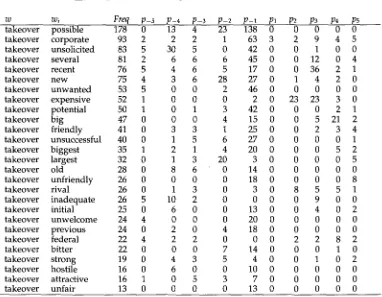
A list of words wi with frequency information on how w and wi co-occur. This includes the raw frequency as well as the breakdown into frequencies for each possible position. See Table 2 for example outputs.Description:
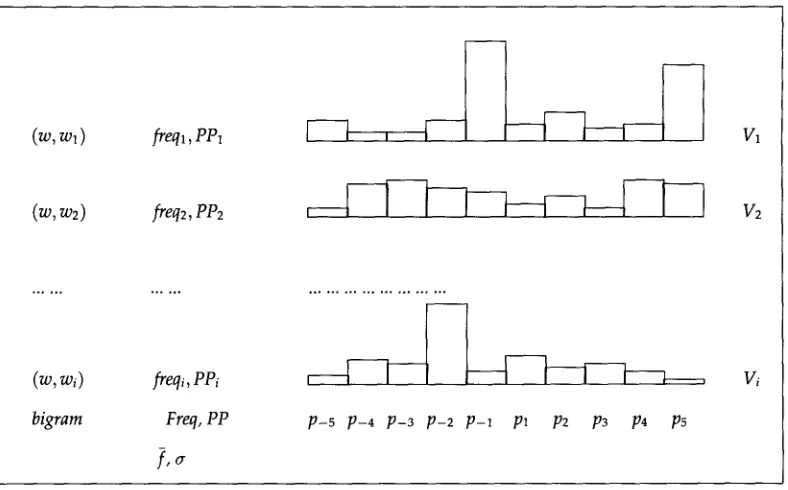
For each input sentence containing w, we make a note of its collocates and store them along with their position relative to w, their part of speech, and their frequency of appearance. More precisely, for each prospective lexical relation, or for each potential collocate wi, we maintain a data structure containing this information. The data structure is shown in Figure 5. It contains freqi, the frequency of appearance of wi with w so far in the corpus, PP, the part of speech of wi, and p~, ( - 5 _< j < 5, j ~ 0), the frequency of appearance of wi with w such that they are j words apart. The p~s represent the histogram of the frequency of appearances of w and wi in given positions. This histogram will be used in later stages.As an example, if sentence (9) is the current input to step 1.2 and w = takeover, then, the prospective lexical relations identified in sentence (9) are as shown in Table 3.
9. "The pill would make a takeover attempt more expensive by allowing the retailer's shareholders to . . . "
In Table 3, distance is the distance between "takeover" and wi, and PP is the part of speech of wi. The closed class words are not considered at this stage and the other
Frank Smadja Retrieving Collocations from Text: Xtract
(w, wl ) freql, PP1
(w, w2) freq2, PP2
(w, wi ) freqi, PPi
bigram Freq, PP
f, (7"
p-5 p-4 p-3 p-2 p-1 p~ p2 p3 p4 p5
[image:11.468.38.432.61.306.2]V~
Figure 5
Data structure maintained at stage one by Xtract.
words, such as "shareholders," are rejected because they are more than five words away from "takeover." For each of the above word pairs, we maintain the associated data structure as indicated in Figure 5. For takeover pill, for example, we would increment freqpill, and the p4 column in the histogram. Table 2 shows the output for the adjective collocates of the word "takeover."
Step 1.3: Analyze
Input:
Output of Step 1.2, i.e., a list of words wi with information on how often and how w and wi co-occur. See Table 2 for an example input.Output:
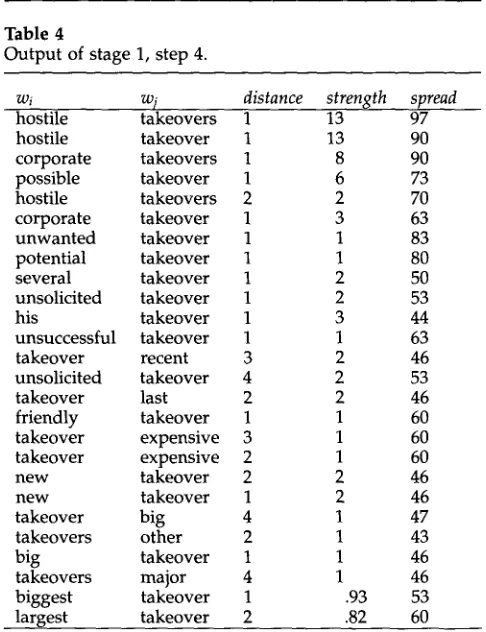
Significant word pairs, along with some statistical information describing how strongly the words are connected and how rigidly they are used together. A separate (but similar) statistical analysis is done for each syntactic category of collocates. See Table 4 for an example output.Description:
At this step, the statistical distribution of the collocates of w is analyzed, and the interesting word pairs are automatically selected. If part of speech information is available, a separate analysis is made depending on the part of speech of the collo- cates. This balances the fact that verbs, adjectives, and nouns are simply not equally frequent.For each word w, we first analyze the distribution of the frequencies freqi of its collocates wi, and then compute its average frequency f and standard deviation cr around f. We then replace freqi by its associated z - s c o r e
ki. ki
is called the strength ofC o m p u t a t i o n a l Linguistics Volume 19, N u m b e r 1
Table 2
O u t p u t of stage 1, step 3. N o u n - a d j e c t i v e associations.
W Wi Freq p-s p-4 p-3 p-2 p-1 pl p2 p3 p4 p5
takeover takeover takeover takeover takeover takeover takeover takeover takeover takeover takeover takeover takeover takeover takeover takeover takeover takeover takeover takeover takeover takeover takeover takeover takeover takeover takeover possible corporate unsolicited several recent new u n w a n t e d expensive potential big friendly unsuccessful biggest largest old unfriendly rival inadequate initial u n w e l c o m e previous federal bitter strong hostile attractive unfair
178 0 13 4 23 138 0 0 0 0 0
93 2 2 2 1 63 3 2 9 4 5
83 5 30 5 0 42 0 0 1 0 0
81 2 6 6 6 45 0 0 12 0 4
76 5 4 6 5 17 0 0 36 2 1
75 4 3 6 28 27 0 1 4 2 0
53 5 0 0 2 46 0 0 0 0 0
52 1 0 0 0 2 0 23 23 3 0
50 1 0 1 3 42 0 0 0 2 1
47 0 0 0 4 15 0 0 5 21 2
41 0 3 3 1 25 0 0 2 3 4
40 0 1 5 6 27 0 0 0 0 1
35 1 2 1 4 20 0 0 0 5 2
32 0 1 3 20 3 0 0 0 0 5
28 0 8 6 0 14 0 0 0 0 0
26 0 0 0 0 18 0 0 0 0 8
26 0 1 3 0 3 0 8 5 5 1
26 5 10 2 0 0 0 0 9 0 0
25 0 6 0 0 13 0 0 4 0 2
24 4 0 0 0 20 0 0 0 0 0
24 0 2 0 4 18 0 0 0 0 0
22 4 2 2 0 0 0 2 2 8 2
22 0 0 0 7 14 0 0 0 1 0
19 0 4 3 5 4 0 0 1 0 2
16 0 6 0 0 10 0 0 0 0 0
16 1 0 5 3 7 0 0 0 0 0
13 0 0 0 0 13 0 0 0 0 0
Table 3
The collocates of "takeover" as retrieved from sentence (9).
w wi distance PP
takeover pill 4 N
takeover make 2 V
takeover attempt -1 N
takeover expensive -3 J
takeover allowing -5 V
a v e r a g e o f t h e f r e q u e n c y of t h e w o r d p a i r w a n d wi a n d is d e f i n e d as:
ki - freqi - f ( l a )
O"
T h e n , w e a n a l y z e t h e d i s t r i b u t i o n o f t h e p)s a n d p r o d u c e t h e i r a v e r a g e
]~i
a n d v a r i a n c eUi a r o u n d ]~i. I n F i g u r e 4 spread r e p r e s e n t s Ui o n a s c a l e o f 1 to 100. Ui c h a r a c t e r i z e s
[image:12.468.53.435.91.388.2]Frank Smadja Retrieving Collocations from Text: Xtraet
which means that
wi
can be used equivalently in almost any position around w. In contrast, ifUi
is large, then the histogram will tend to have peaks, which means thatwi
can only be used in one (or several) specific position aroundw. Ui
is defined by:10 (lb)
These analyses are then used to sort out the retrieved data. First, using (la), collo- cates with
strength
smaller than a given threshold/co are eliminated. Then, using (lb), we filter out the collocates having a varianceUi
smaller than a given threshold U0. Finally, we keep the interesting collocates by pulling out the peaks of thep'j
distri- butions. These peaks correspond to the js such that the z-score ofp~j
is bigger than a given threshold kl. These thresholds have to be determined by the experimenter and are dependent on the use of the retrieved collocations. As described in Smadja (1991), for language generation we found that (k0, kl, U0) = (1, 1, 10) gave good results, but for other tasks different thresholds might be preferable. In general, the lower the thresh- old the more data are accepted, the higher the recall, and the lower the precision of the results. Section 10 describes an evaluation of the results produced with the above thresholds.More formally, a peak, or lexical relation containing w, at this point is defined as a tuple
(wi, distance, strength, spread,j)
verifying the following set of inequalities:(c)
strength = #eq~-f > ko
spread >_ Uo
(C1) }
(C2)
P~ ~ ]~i q- (kl x v/-~)
(C3)
Some example results are given in Table 4.
As shown in Smadja (1991), the whole first stage of Xtract as described above can be performed in
O(S
log S) time, in which S is the size of the corpus. The third step of counting frequencies and maintaining the data structure dominates the whole process and as pointed out by Ken Church (personal communication), it can be reduced to a sorting problem.6.2 What Exactly Is Filtered Out?
The inequality set (C) is used to filter out irrelevant data, that is pairs of words sup- posedly not used consistently within a single syntactic structure. This section discusses the importance of each inequality in (C) on the filtering process.
strength - freq - f >_ ko
(C1)
(Y
Computational Linguistics Volume 19, Number 1
Table 4
Output of stage 1, step 4.
wi
w~
distance strength spread
hostile takeovers 1 13 97
hostile takeover 1 13 90
corporate takeovers 1 8 90
possible takeover 1 6 73
hostile takeovers 2 2 70
corporate takeover 1 3 63
unwanted takeover 1 1 83
potential takeover 1 1 80
several takeover 1 2 50
unsolicited takeover 1 2 53
his takeover 1 3 44
unsuccessful takeover 1 1 63
takeover recent 3 2 46
unsolicited takeover 4 2 53
takeover last 2 2 46
friendly takeover 1 1 60
takeover expensive 3 1 60
takeover expensive 2 1 60
new takeover 2 2 46
new takeover 1 2 46
takeover big 4 1 47
takeovers other 2 1 43
big takeover 1 1 46
takeovers major 4 1 46
biggest takeover 1 .93 53
largest takeover 2 .82 60
collocates of
"takeover"
h a s a large kurtosis. 1° A m o n g the e l i m i n a t e d collocates w e r e"dormant, dilute, ex., defunct,"
w h i c h o b v i o u s l y are not typical of a takeover. A l t h o u g h these rejected collocations m i g h t b e useful for a p p l i c a t i o n s s u c h as s p e e c h recognition, for e x a m p l e , w e do not consider t h e m a n y f u r t h e r here. We are l o o k i n g for r e c u r r e n t c o m b i n a t i o n s a n d not casual ones.spread >>_ Uo
(C2)C o n d i t i o n
(C2)
requires that the h i s t o g r a m of the 10 relative frequencies of a p p e a r a n c e ofwi
w i t h i n five w o r d s of w (or p}s) h a v e at least o n e spike. If the h i s t o g r a m is flat, it will be rejected b y this condition. For e x a m p l e , in Figure 5, the h i s t o g r a m associated w i t h w2 w o u l d be rejected, w h e r e a s the o n e associated w i t h Wl or wi w o u l d b e accepted. In Table 2, the h i s t o g r a m for"takeover-possible"
is clearly a c c e p t e d (there is a spike for p - l ) , w h e r e a s the o n e for"takeover-federal"
is rejected. The a s s u m p t i o n here is that, if the t w o w o r d s are r e p e a t e d l y u s e d t o g e t h e r w i t h i n a single syntactic construct, t h e n t h e y will h a v e a m a r k e d p a t t e r n of c o - a p p e a r a n c e , i.e., t h e y will not a p p e a r in all the possible positions w i t h an e q u a l probability. This actually eliminates pairs s u c h as"telephone-television," "bomb-soldier,
. . . .trouble-problem," "big-small,"
a n d [image:14.468.119.362.62.378.2]Frank Smadja Retrieving Collocations from Text: Xtract
"doctor-nurse" where the two words co-occur with no real structural consistency. The two words are often used together because they are associated with the same context rather than for pure structural reasons. Many collocations retrieved in Church and Hanks (1989) were of this type, as they retrieved doctors-dentists, doctors-nurses, doctor- bills, doctors-hospitals, nurses-doctor, etc., which are not collocations in the sense defined above. Such collocations are not of interest for our purpose, although they could be useful for disambiguation or other semantic purposes. Condition (C2) filters out exactly this type of collocations.
p~ ~ ]~i q-
(kl x V~i)(C3)
Condition (C3) pulls out the interesting relative positions of the two words. Conditions (C2) and (C1) eliminate rows in the output of Step 1.2. (See Figure 2). In contrast, Condition (C3) selects columns from the remaining rows. For each pair of words, one or several positions might be favored and thus result in several PI selected. For example, the pair "expensive-takeover" produced two different peaks, one with only one word in between "expensive" and "takeover," and the other with two words. Example sentences containing the two words in the two possible positions are:
" The provision is aimed at making a hostile takeover
prohibitively
expensive by enabling Borg Warner's stockholders to buy t h e . . . ""The pill would make a takeover attempt more expensive by allowing the retailer's shareholders to buy more company stock..."
Let us note that this filtering method is an original contribution of our work. Other works such as Church and Hanks (1989) simply focus on an evaluation of the correlation of appearance of a pair of words, which is roughly equivalent to condition (C1). (See next section). However, taking note of their pattern of appearance allows us to filter out more irrelevant collocations with (C2) and (C3). This is a very important point that will allow us to filter out many invalid collocations and also produce more functional information at stages 2 and 3. A graphical interpretation of the filtering method used for Xtract is given in Smadja (1991).
7. Xtract Stage Two: From 2-Grams to N-Grams
The role of the second stage of Xtract is twofold. It produces collocations involving more than two words, and it filters out some pairwise relations. Stage 2 is related to the work of Choueka (1988), and to some extent to what has been done in speech recognition (e.g., Bahl, Jelinek, and Mercer 1983; Merialdo 1987; Ephraim and Rabiner 1990).
7.1 Presentation of the Method
In this second stage, Xtract uses the same components used for the first stage but in a different way. It starts with the pairwise lexical relations produced in stage 1 and produces multiple word collocations, such as rigid noun phrases or phrasal templates, from them. To do this, Xtract studies the lexical relations in context, which is exactly what lexicographers do. For each bigram identified at the previous stage, Xtract ex- amines all instances of appearance of the two words and analyzes the distributions of words and parts of speech in the surrounding positions.
Computational Linguistics Volume 19, Number 1
Output:
Sequences of w o r d s and parts of speech. See Figure 8. Stage 2 has three steps:Step 2.1: Produce Concordances
Identical to Stage 1, Step 1.1. G i v e n a pair of w o r d s w a n d wi, a n d an integer specifying the distance of the two words, n This step p r o d u c e s all the sentences containing t h e m in the given position. For example, given the b i g r a m takeover-thwart and the distance 2, this step p r o d u c e s sentences like:
"Under the recapitalization plan it proposed to thwart the takeover."
Step 2.2: Compile and Sort
Identical to Stage 1, Step 1.2. We c o m p u t e the f r e q u e n c y of a p p e a r a n c e of each of the collocates of w b y maintaining a data structure similar to the one given in Figure 5,
Step 2.3: Analyze and Filter
Input:
O u t p u t of Step 2.2.Output:
N - g r a m s such as in Figure 8.Discussion:
Here, the analyses are simpler t h a n for Stage 1. We are only interested in percentage frequencies a n d w e only c o m p u t e the m o m e n t of o r d e r 1 of the f r e q u e n c y distributions.Tables p r o d u c e d in Step 2.2 (such as in Figure 5) are u s e d to c o m p u t e the f r e q u e n c y of a p p e a r a n c e of each w o r d in each position a r o u n d w. For each of the possible relative distances from w, w e a n a l y z e the distribution of the w o r d s and only keep the w o r d s o c c u p y i n g the position with a probability greater than a given threshold T. 12 If part of speech i n f o r m a t i o n is available, the same analysis is also p e r f o r m e d with parts of speech instead of actual words. In short, a w o r d w or a part of speech pos is kept in the final n - g r a m at position i if and only if it satisfies the following inequation:
p(word[i] = Wo) > T (4a)
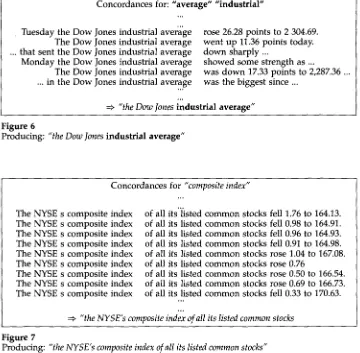
p(e) d e n o t e s the probability of e v e n t e. C o n s i d e r the examples given in Figures 6 and 7 that s h o w the concordances ( o u t p u t of step 2.1) for the i n p u t pairs: "average- industrial" a n d "index-composite."
In Figure 6, the same w o r d s are always u s e d f r o m position - 4 to position 0. H o w e v e r , at position +1, the w o r d s used are always different. "Dow" is u s e d at position - 3 in m o r e than 90% of the cases. It is thus part of the p r o d u c e d rigid n o u n phrases. But "down" is only u s e d a couple of times (out of several h u n d r e d ) at position +1,
11 The distance is actually optional and can be given in various ways. We can specify the word order, the maximum distance, the exact distance, etc.
Frank Smadja Retrieving Collocations from Text: Xtract
Concordances for: "average" "industrial"
Tuesday the Dow Jones industrial average The Dow Jones industrial average ... that sent the Dow Jones industrial average Monday the Dow Jones industrial average The Dow Jones industrial average ... in the Dow Jones industrial average
rose 26.28 points to 2 304.69. went up 11.36 points today. down sharply ...
showed some strength as ...
was down 17.33 points to 2,287.36 ... was the biggest since ...
[image:17.468.33.390.52.199.2]=~ "the Dow Jones industrial average" Figure 6
Producing: "the Dow Jones industrial average"
Concordances for "composite index"
The NYSE s composite index The NYSE s composite index The NYSE s composite index The NYSE s composite index The NYSE s composite index The NYSE s composite index The NYSE s composite index The NYSE s composite index The NYSE s composite index
of all its'l'isted common stocks fell 1.76 to 164.13. of all its listed common stocks fell 0.98 to 164.91. of all its listed common stocks fell 0.96 to 164.93. of all its listed common stocks fell 0.91 to 164.98. of all its listed common stocks rose 1.04 to 167.08. of all its listed common stocks rose 0.76
of all its listed common stocks rose 0.50 to 166.54. of all its listed common stocks rose 0.69 to 166.73. of all its listed common stocks fell 0.33 to 170.63.
"the NYSE's composite index of all its listed common stocks Figure 7
Producing: "the NYSE's composite index of all its listed common stocks"
a n d will not be part of the p r o d u c e d rigid n o u n phrases. F r o m those concordances,
Xtract p r o d u c e d the five-word rigid n o u n phrases: "The Dow Jones Industrial Average."
Figure 7 s h o w s that from position - 3 to position + 7 the w o r d s used are always
the same. In all the example sentences in w h i c h "composite" a n d "index" are adjacent,
the t w o w o r d s are u s e d within a bigger construct of 11 w o r d s (also called an 11-gram). H o w e v e r , if w e look at position + 8 for example, w e see that a l t h o u g h the w o r d s used are different, in all the cases they are verbs. Thus, after the 11-gram we expect to find
a verb. In short, Figure 7 helps us p r o d u c e both the rigid n o u n phrases "The NYSE's
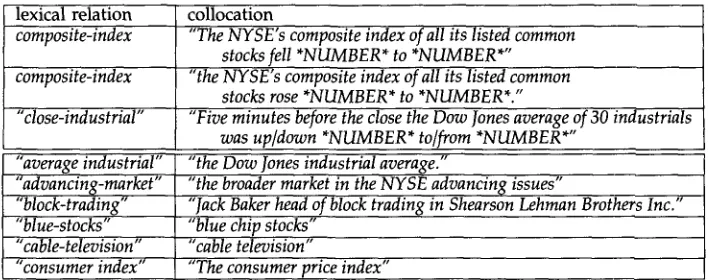
composite index of all its listed common stocks," as well as the phrasal template "The NYSE's composite index of all its listed common stocks *VERB* *NUMBER* to *NUMBER*."
Figure 8 s h o w s s o m e sample phrasal templates a n d rigid n o u n phrases that were p r o d u c e d at this stage. The leftmost c o l u m n gives the i n p u t lexical relations. Some other examples are given in Figure 3.
7.2 Discussion
[image:17.468.32.392.56.409.2]Computational Linguistics Volume 19, Number 1
lexical relation
composite-index composite-index "close-industrial"
collocation
"The NYSE's composite index of all its listed common stocks fell *NUMBER* to *NUMBER*" "the NYSE's composite index of all its listed common
stocks rose *NUMBER* to *NUMBER*."
"Five minutes before the close the Dow Jones average of 30 industrials was up/down *NUMBER* to/from *NUMBER*"
"average industrial" "advancing-market" "block-trading" "blue-stocks" "cable-television" "consumer index"
"the Dow Jones industrial average."
"the broader market in the NYSE advancing issues"
"Jack Baker head of block trading in Shearson Lehman Brothers Inc." "blue chip stocks"
"cable television"
"The consumer price index" Figure 8
Example output collocations of stage two.
and respectively replaced by: "blue chip stocks," "air traffic controllers," and "the broader market in the NYSE advancing issues."
Thus stage 2 produces n-word collocations from two-word associations. Producing n-word collocations has already been done (e.g., Choueka 1988). 13 The general method used by Choueka is the following: for each length n, (1 < n < 6), produce all the word sequences of length n and sort them by frequency. On a 12 million-word corpus, Choueka retrieved 10 collocations of length six, 115 collocations of length five, 1,024 collocations of length four, 4,777 of length three, and some 15,973 of length two. The threshold imposed was 14. The method we presented in this section has three main advantages when compared to a straight n-gram method like Choueka's.
1. Stage 2 retrieves phrasal templates in addition to simple rigid noun phrases. Using part of speech information, we allow categories and words in our templates, thus retrieving a more flexible type of collocation. It is not clear how simple n-gram techniques could be adapted to obtain the same results.
2. Stage 2 gets rid of subsumed m-grams of a given n-gram (m < n). Since stage 2 works from bigrams, and produces the biggest n-gram containing it, there is no m-gram (m < n) produced that is subsumed by it. For example, although "shipments of arms to Iran" is a collocation of length five, "arms to Iran" is not an interesting collocation. It is not opaque, and does not constitute a modifier-modified syntactic relation. A straight n-gram method would retrieve both, as well as many other subsumed m-grams, such as "of arms to Iran." A sophisticated filtering method would then be necessary to eliminate the invalid ones (See Choueka 1988). Our method avoids this problem and only produces the biggest possible n-gram, namely: "shipment of arms to Iran."
3. Stage 2 is a simple w a y of compiling n-gram data. Retrieving an 11-gram by the methods used in speech, for example, would require a great deal
[image:18.468.67.421.57.197.2]Frank Smadja Retrieving Collocations from Text: Xtract
of CPU time and space. In a 10 million-word corpus, with about 60,000 different words, there are about 3.6 x 10⁹ possible bigrams, 2.16 x 10¹⁴
trigrams, and 3 x 1033 7-grams. This rapidly gets out of hand. Choueka, for example, had to stop at length six. In contrast, the rigid noun phrases we retrieve are of arbitrary length and are retrieved very easily and in o n e pass. The method we use starts from bigrams and produces the
biggest possible subsuming n-gram. It is based on the fact that if an n-gram is statistically significant, then the included bigrams must also be significant. For example, to identify "The Dow Jones average of 30
industrials," a traditional n-gram method would compare it to the other 7-grams and determine that it is significant. In contrast, we start from an included significant bigram (for example, "Dow-30") and we directly retrieve the surrounding n-grams. 14
8. Xtract Stage Three: Adding Syntax to the Collocations
The collocations as produced in the previous stages are already useful for lexicography. For computational use, however, functional information is needed. For example, the collocations should have some syntactic properties. It is not enough to say that "make" goes with "decision"; we need to know that "decision" is used as the direct object of the verb.
The advent of robust parsers such as Cass (Abney 1990) and Fidditch (Hindle 1983) has made it possible to process large text corpora with good performance and thus combine statistical techniques with more symbolic analysis. In the past, some similar attempts have been done. Debili (1982) parsed corpora of French texts to iden- tify nonambiguous predicate argument relations. He then used these relations for disambiguation. Hindle and Rooth (1990) later refined this approach by using bigram statistics to enhance the task of prepositional phrase attachment. Church et al. (1989, 1991) have yet another approach; they consider questions such as what does a boat typ- ically do? They are preprocessing a corpus with the Fidditch parser (Hindle 1983) in order to produce a list of verbs that are most likely associated with the subject "boat." Our goal here is different, as we analyze collocations automatically produced by the first stage of Xtract to either add syntactic information or reject them. For example, if a lexical relation identified at stage 1 involves a noun and a verb, the role of stage 3 is to determine whether it is a subject-verb or a verb-object collocation. If no such consistent relation is observed, then the collocation is rejected. Stage 3 uses a parser but it does not require a complete parse tree. Given a number of sentences, Xtract only needs to know pairwise syntactic (modifier-modified) relations. The parser we used in the experiment reported here is Cass (Abney 1989, 1990), a bottom-up incremental parser. Cass 15 takes input sentences labeled with part of speech and attempts to identify syntactic structure. One of the subtasks performed by Cass is to identify predicate argument relations, and this is the task we are interested in here. Stage 3 works in the following three steps.
14 Actually, this 7-gram could be retrieved several times, one for each pair of open class word it contains. But a simple sorting algorithm gets rid of such repetitions.
Computational Linguistics Volume 19, Number 1
label bigram
VO faced test SV investors awaited N N year market N N stock traders
JN old market JN last selloff
label bigram VO awaited signs
SV Street faced N N week selloff N N bull market
[image:20.468.123.358.60.150.2]JN major test JN epic selloff Figure 9
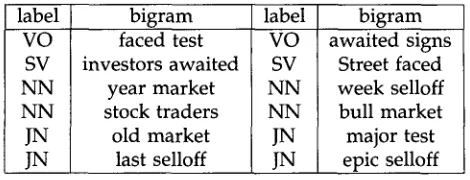
All the syntactic labels produced by Cass on sentence (10).
Step 3.1: Produce Tagged Concordances
Identical to what we did at Stage 2, Step 2.1. Given a pair of words w and
wi, a
distance of the two words (optional), and a tagged corpus, Xtract produces all the (tagged) sentences containing them in the given position specified by the distance. Step 3.2: ParseInput: Output of Step 3.1. A set of tagged sentences each containing both w and
wi.
Output: For each sentence, a set of syntactic labels such as those shown in Figure 9. Discussion: Cass is called on the concordances. From Cass output, we only retrieve binary syntactic relations (or labels) such as"verb-object"
or"verb-subject," "noun-
adjective,"
and"noun-noun."
To simplify, we abbreviate them respectively: VO, SV, NJ, NN. For sentence (10) below, for example, the labels produced are shown in Figure 9.10.
"Wall Street faced a major test with stock traders returning to action for the first
time since last week's epic selloff and investors awaited signs of life from the
5-year-old bull market."
Step 3.3: Label Sentences
Input: A set of sentences each associated with a set of labels as shown in Figure 9. Output: Collocations with associated syntactic labels as shown in Figure 10.
Frank Smadja Retrieving Collocations from Text: Xtract
Some Concordances for (rose, prices) label ... w h e n they rose pork prices 1.1 percent ... VO Analysts said stock prices rose because of a rally in Treasury bonds. SV Bond prices rose because m a n y traders took the report as a signal ... SV Stock prices rose in moderate trading t o d a y with little news ... SV Bond prices rose in quiet trading SV Stock prices rose sharply Friday in response to a rally in ... SV ... soft drink prices rose 0.5 percent ... SV Stock prices rose broadly in early trading t o d a y as a rising dollar ... SV Figure 10
Producing the "prices [] rose," SV predicative relation at stage 3.
Step 3.4: Filter and Label Collocation
Input: A set of sentences containing w and wi each associated with a label as s h o w n in Figure 10.
Output: Labeled collocations as s h o w n in Figure 11.
Discussion on Step 3.4: At this step, we count the frequencies of each possible label identified for the bigram (w} wi) and perform a statistical analysis of order two for this distribution. We compute the average frequency for the distribution of labels: ~ and the standard deviation crt. We finally apply a filtering m e t h o d similar to (C2). Let t be a possible label. We keep t if and only if it satisfies inequality (4b) similar to (4a) given before:
p(labelIi ] = t) ~ T (4b)
A collocation is thus accepted if a n d only if it has a label g satisfying inequality (4b), a n d g # U. Similarly, a collocation is rejected if no label satisfies inequality (4b) or if U satisfies it.
Figure 10 shows part of the o u t p u t of Step 3.3 for w = "rose" and wi = "prices." As s h o w n in the figure, SV labels are a large majority. Thus, we w o u l d label the relation price-rose as an SV relation. An example o u t p u t of this stage is given in Figure 11. The bigrams labeled U were rejected at this stage.
Stage 3 thus produces very useful results. It filters out collocations a n d rejects more than half of them, thus improving the quality of the results. It also labels the collocations it accepts, thus producing a more functional and usable type of knowledge. For example, if the first two stages of Xtract produce the collocation "make-decision," the third stage identifies it as a verb-object collocation. If no such relation can be observed, then the collocation is rejected. The produced collocations are not simple w o r d associations but complex syntactic structures. Labeling and filtering are two useful tasks for automatic use of collocations as well as for lexicography. The whole of stage 3 (both as a filter a n d as a labeler) is an original contribution of our work. Retrieving syntactically labeled collocations is a relatively n e w concern. Moreover, filtering greatly improves the quality of the results. This is also a possible use of the emerging n e w parsing technology.
8.1 Xtract: The Toolkit
[image:21.468.44.406.58.175.2]Computational Linguistics Volume 19, Number 1
W W i
savings savings savings savings savings savings savings manufacturing manufacturing securities label
ailing U
appears U
continue U
dip U
dipped U
failing U
fell SV
[image:22.468.73.404.59.199.2]sector N N sector N N business N N
Figure 11
Some examples of syntactically labeled bigrams.
W W i
securities denominated securities securities securities securities securities securities securities securities dealer securities firms fixed fraud industry law lawmakers lawyer lawyers
l a b e l U VO N N U N N N N N N U N N N N
to make Xtract efficient in terms of computing resources, the first stage as well as the second stage of Xtract only takes a few minutes to run on a ten-megabyte (pre-tagged) corpus. Xtract is currently being used at Columbia University for various lexical tasks. And it has been tested on many corpora, among them: several ten-megabyte corpora of news stories, a corpus, consisting of some twenty megabytes of N e w York Times
articles, which has already been used by Choueka (1988), the Brown corpus (Francis and Ku~era 1982), a corpus of the proceedings of the Canadian Parliament, also called the Hansards corpus, which amounts to several hundred megabytes. We are currently working on packaging Xtract to make it available to the research community. The packaged version will be portable, reusable, and faster than the one we used to write this paper. 16
We evaluate the filtering power of stage 3 in the evaluation section, Section 10. Section 9 presents some results that we obtained with the three stages of Xtract.
9. Some Results
Results obtained from The Jerusalem Post corpus have already been reported (e.g., Smadja 1991). Figure 12 gives some results for the three-stage process of Xtract on a 10 million-word corpus of stock market reports taken from the Associated Press newswire. The collocations are given in the following format. The first line contains the bigrams with the distance, so that "sales fell - 1 " says that the two words under consideration are "sales" and "fell," and that the distance we are considering is -1. The first line is thus the output of stage 1. The second line gives the output of stage 2, i.e., the n-grams. For example, "takeover-thwart" is retrieved as "44 . . . to thwart A T takeover N N . . . " AT stands for article, N N stands for nouns, and 44 is the number of times this collocation has been retrieved in the corpus. The third line gives the retrieved tags for this collocation, so that the syntactic relation between "takeover" and
"thwart" is an SV relation. And finally, the last line is an example sentence containing the collocation. Output of the type of Figure 12 is automatically produced. This kind of output is about as far as we have gone automatically. Any further analysis a n d / o r use of the collocations would probably require some manual intervention.