An Efficient Implementation of the
Head-Corner Parser
G e r t j a n v a n N o o r d " Rijksuniversiteit Groningen
This paper describes an efficient and robust implementation of a bidirectional, head-driven parser for constraint-based grammars. This parser is developed for the OVIS system: a Dutch spoken
dialogue system in which information about public transport can be obtained by telephone. After a review of the motivation for head-driven parsing strategies, and head-corner parsing in particular, a nondeterministic version of the head-corner parser is presented. A memorization technique is applied to obtain a fast parser. A goal-weakening technique is introduced, which greatly improves average case efficiency, both in terms of speed and space requirements.
I argue in favor of such a memorization strategy with goal-weakening in comparison with ordinary chart parsers because such a strategy can be applied selectively and therefore enormously reduces the space requirements of the parser, while no practical loss in time-efficiency is observed. On the contrary, experiments are described in which head-corner and left-corner parsers imple- mented with selective memorization and goal weakening outperform "standard" chart parsers. The experiments include the grammar of the OV/S system and the Alvey NL Tools grammar.
Head-corner parsing is a mix of bottom-up and top-down processing. Certain approaches to robust parsing require purely bottom-up processing. Therefore, it seems that head-corner parsing is unsuitable for such robust parsing techniques. However, it is shown how underspecification (which arises very naturally in a logic programming environment) can be used in the head-corner parser to allow such robust parsing techniques. A particular robust parsing model, implemented in OVIS, is described.
1. Motivation
In this paper I discuss in full detail the implementation of the head-corner parser. But first I describe the motivations for this approach. I will start with considerations that lead to the choice of a head-driven parser; I will then argue for Prolog as an appropriate language for the implementation of the head-corner parser.
1.1 Head-driven Processing
Lexicalist grammar formalisms, such as Head-driven Phrase Structure Grammar (HPSG), have two characteristic properties: (1) lexical elements and phrases are as- sociated with categories that have considerable internal structure, and (2) instead of construction-specific rules, a small set of generic rule schemata is used. Consequently, the set of constituent structures defined by a grammar cannot be read off the rule set directly, but is defined by the interaction of the rule schemata and the lexical cate- gories. Applying standard parsing algorithms to such grammars is unsatisfactory for a number of reasons. Earley parsing is intractable in general, as the rule set is simply too general. For some grammars, naive top-down prediction may even fail to terminate.
Computational Linguistics Volume 23, Number 3
Shieber (1985) therefore proposes a modified version of the Earley parser, using re- stricted top-down prediction. While this modification often leads to better termination properties of the parsing method, in practice it easily leads to a complete trivialization of the top-down prediction step, thus leading to inferior performance.
Bottom-up parsing is far more attractive for lexicalist formalisms, as it is driven by the syntactic information associated with lexical elements, but certain inadequacies remain. Most importantly, the selection of rules to be considered for application may not be very efficient. Consider, for instance, the following Definite Clause Grammar (DCG) rule:
s([] ,Sem) --> Arg, vp([Arg] ,Sem). (1)
A parser in which application of a rule is driven by the left-most daughter, as it is for instance in a standard bottom-up active chart parser, will consider the application of this rule each time an arbitrary constituent Arg is derived. For a bottom-up active chart parser, for instance, this m a y lead to the introduction of large numbers of active items. Most of these items will be useless. For instance, if a determiner is derived, there is no need to invoke the rule, as there are simply no VP's selecting a determiner as subject. Parsers in which the application of a rule is driven by the right-most daughter, such as shift-reduce and inactive bottom-up chart parsers, encounter a similar problem for rules such as:
vp(As,Sem) --> vp([ArgIAs],Sem), Arg. (2)
Each time an arbitrary constituent Arg is derived, the parser will consider applying this rule, and a search for a matching VP-constituent will be carried out. Again, in many cases (if Arg is instantiated as a determiner or preposition, for instance) this search is doomed to fail, as a VP subcategorizing for a category Arg m a y simply not be derivable by the grammar. The problem may seem less acute than that posed by uninstantiated left-most daughters for an active chart parser, as only a search of the chart is carried out and no additional items are added to it. Note, however, that the amount of search required m a y grow exponentially, if more than one uninstantiated daughter is present:
vp(As) --> vp([AI,A21As]), AI, A2. (3)
or if the number of daughters is not specified by the rule:
vp([AO]) --> vp([AO ... An]), A1 ... An. (4)
as appears to be the case for some of the rule-schemata used in HPSG.
van Noord Efficient Head-Corner Parsing
head, important information about the remaining daughters is obtained. Furthermore, since the head is to a large extent identical to the mother category, effective top-down identification of a potential head should be possible.
In Kay (1989) two different head-driven parsers are presented. First, a head-driven shift-reduce parser is presented, which differs from a standard shift-reduce parser in that it considers the application of a rule (i.e., a reduce step) only if a category matching the head of the rule has been found. Furthermore, it may shift onto the parse-stack elements that are similar to the active items (or "dotted rules") of active chart parsers. By using the head of a rule to determine whether a rule is applicable, the head-driven shift-reduce parser avoids the disadvantages of parsers in which either the left-most or right-most daughter is used to drive the selection of rules. Kay also presents a head-corner parser. The striking property of this parser is that it does not parse a phrase from left to right, but instead operates bidirectionally. It starts by locating a potential head of the phrase and then proceeds by parsing the daughters to the left and the right of the head. Again, this strategy avoids the disadvantages of parsers in which rule selection is uniformly driven by either the left-most or right- most daughter. Furthermore, by selecting potential heads on the basis of a head-corner table (comparable to the left-corner table of a left-corner parser) it may use top-down filtering to minimize the search-space. This head-corner parser generalizes the left- corner parser. Kay's presentation is reminiscent of the left-corner parser as presented by Pereira and Shieber (1987), which itself is a version without memorization of the BUP parser (Matsumoto et al. 1983).
Head-corner parsing has also been considered elsewhere. In Satta and Stock (1989), Sikkel and op den Akker (1992, 1993), and Sikkel (1993), chart-based head-corner parsing for context-free grammar is considered. It is shown that, in spite of the fact that bidirectional parsing seemingly leads to more overhead than left-to-right parsing, the worst-case complexity of a head-corner parser does not exceed that of an Earley parser. Some further variations are discussed in Nederhof and Satta (1994).
In van Noord (1991, 1993) I argue that head-corner parsing is especially useful for parsing with nonconcatenative grammar formalisms. In Lavelli and Satta (1991) and van Noord (1994) head-driven parsing strategies for Lexicalized Tree Adjoining Grammars are presented.
The head-corner parser is closely related to the semantic-head-driven generation algorithm (see Shieber et al. [1990] and references cited there), especially in its purely bottom-up incarnation.
1.2 Selective Memorization
The head-corner parser is in many respects different from traditional chart parsers. An important difference follows from the fact that in the head-corner parser only larger chunks of computation are memorized. Backtracking still plays an important role for the implementation of search.
This may come as a surprise at first. Common wisdom is that although small grammars may be successfully treated with a backtracking parser, larger grammars for natural languages always require the use of a data structure such as a chart or a table of items to make sure that each computation is only performed once. In the case of constraint-based grammars, however, the cost associated with maintaining such a chart should not be underestimated. The memory requirements for an implementation of the Earley parser for a constraint-based grammar are often outrageous. Similarly, in an Earley deduction system too much effort may be spent on small portions of computation, which are inexpensive to (re-)compute anyway.
Computational Linguistics Volume 23, Number 3
which only large chunks of computation are memorized. In linguistic terms, I will ar- gue for a model in which only maximal projections are memorized. The computation that is carried out in order to obtain such a chunk uses a depth-first backtrack search procedure. This solution dramatically improves upon the (average case) memory re- quirements of a parser; moreover it also leads to an increase in (average case) time efficiency, especially in combination with
goal weakening,
because of the reduced overhead associated with the administration of the chart. In each of the experiments discussed in Section 7, the use of selective memorization with goal weakening out- performs standard chart-parsers.1.3 Why Prolog
Prolog is a particularly useful language for the implementation of a head-corner parser for constraint-based grammars because:
• Prolog provides a built-in unification operation.
• Prolog provides a built-in backtrack search procedure; memorization can be applied selectively.
• Underspecification can be exploited to obtain results required by certain techniques for robust parsing.
• Prolog is a high-level language; this enables the application of partial evaluation techniques.
The first consideration does not deserve much further attention. We want to exploit the fact that the primary data structures of constraint-based grammars and the cor- responding information-combining operation can be modeled by Prolog's first order terms and unification.
As was argued above, Prolog backtracking is not used to simulate an iterative procedure to build up a chart via side-effects. On the contrary, Prolog backtracking is used truly for search. Of course, in order to make this approach feasible, certain well- chosen search goals are memorized. This is clean and logically well-defined (consider, for example, Warren [1992]), even if our implementation in Prolog uses extra-logical predicates.
The third consideration is relevant only for robust parsing. In certain methods in robust parsing, we are interested in the partial results obtained by the parser. To make sure that a parser is complete with respect to such partial results, it is often assumed that a parser must be applied that works exclusively bottom-up. In Section 6 it will be shown that the head-corner parser, which uses a mixture of bottom-up and top-down processing, can be applied in a similar fashion by using underspecification in the top goal. Clearly, underspecification is a concept that arises naturally in Prolog.
The fact that Prolog is a high-level language has a number of practical advantages related to the speed of development. A further advantage is obtained because tech- niques such as
partial evaluation
can be applied. For example, I have successfully applied the Mixtus partial evaluator (Sahlin 1991) to the head-corner parser discussed below, to obtain an additional 20% speed increase. In languages such as C, partial evaluation does not seem to be possible because the low-levelness of the language makes it impossible to recognize the concepts that are required.1.4 Left-Corner Parsing and Head-Corner Parsing
van Noord Efficient Head-Corner Parsing
of the techniques that will be described in the following sections can be applied to a left-corner parser as well.
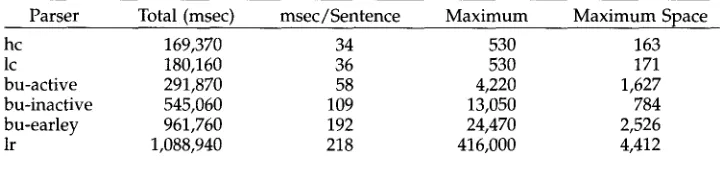
A head-corner parser for a grammar in which for each rule the left-most daughter is considered to be the head, will effectively function as a left-corner parser. In such cases, the head-corner parser can be said to run in left-corner mode. Of course, in a left- corner parser, certain simplifications are possible. Based on the experiments discussed in Section 7, it can be concluded that a specialized left-corner parser is only about 10% faster than a head-corner parser running in left-corner mode. This is an interesting result: a head-corner parser performs at least almost as well as a left-corner parser, and, as some of the experiments indicate, often better.
1.5 Practical Relevance of Head-Corner Parsing: Efficiency and Robustness
The head-corner parser is one of the parsers that is being developed as part of the NWO Priority Programme on Language and Speech Technology. An overview of the Programme can be found in Boves et al. (1995). An important goal of the Programme is the implementation of a spoken dialogue system for public transport information (the OVIS system). The language of the system is Dutch.
In the context of the OVIS system, it is important that the parser can deal with input from the speech recognizer. The interface between the speech recognizer and the parser consists of word-graphs. In Section 5, I show how the head-corner parser is generalized to deal with word-graphs.
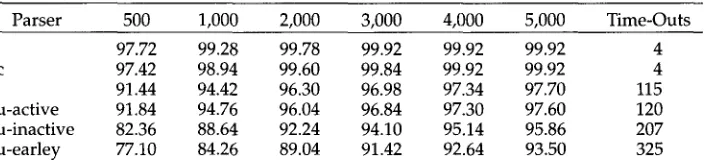
Moreover, the nature of the application also dictates that the parser proceeds in a robust way. In Section 6, I discuss the OVIS Robustness component, and I show that the use of a parser that includes top-down prediction is not an obstacle to robustness. In Section 7, I compare the head-corner parser with the other parsers implemented in the Programme for the OVIS application and show that the head-corner parser op- erates much faster than implementations of a bottom-up Earley parser and related chart-based parsers. Moreover, the space requirements are far more modest. The dif- ference with a left-corner parser, which was derived from the head-corner parser, is small.
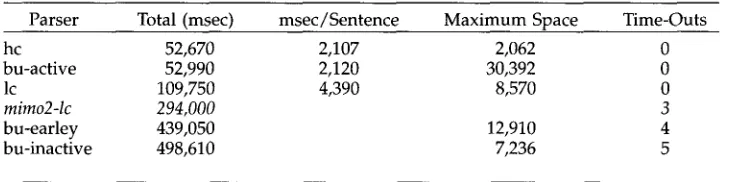
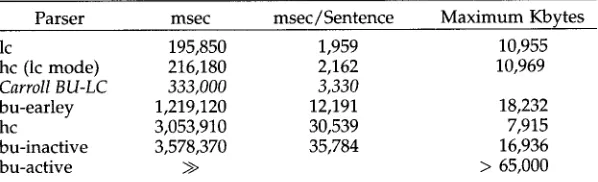
We performed similar experiments for the Alvey NL Tools grammar of English (Grover, Carroll, and Briscoe 1993), and the English grammar of the MiMo2 system (van Noord et al. 1991). From these experiments it can be concluded that selective memorization with goal-weakening (as applied to head-corner and left-corner parsing) is substantially more efficient than conventional chart parsing. We conclude that at least for some grammars, head-corner parsing is a good option.
2. A Specification of the Head-Corner Parser
Head-corner parsing is a radical approach to head-driven parsing in that it gives up the idea that parsing should proceed from left to right. Rather, processing in a head-corner parser is bidirectional, starting from a head outward (island-driven). A head-corner parser can be thought of as a generalization of the left-corner parser (Rosenkrantz and Lewis 1970; Matsumoto et al. 1983; Pereira and Shieber 1987). As in the left-corner parser, the flow of information in a head-corner parser is both bottom-up and top- down.
Computational Linguistics Volume 23, Number 3
goal
.
[image:6.468.63.390.64.172.2]lex Figure 1
The head-corner parser.
g? l
goal
entries). The grammar thus consists of a set of rules and a set of lexical entries• For each rule an element of the right-hand side is identified as the head of that rule. The head-relation of two categories h, m holds with respect to a grammar iff the grammar contains a rule with left-hand side m and head daughter h. The relation head-corner is the reflexive and transitive closure of the head relation.
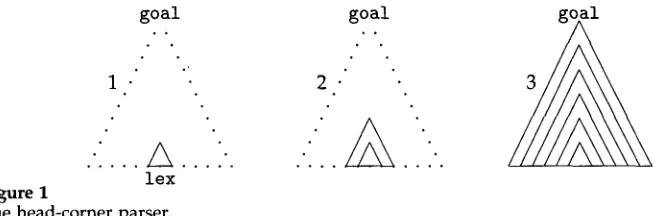
The basic idea of the head-corner parser is illustrated in Figure 1. The parser selects a word (1), and proves that the category associated with this word is the head-corner of the goal. To this end, a rule is selected of which this category is the head daughter• Then the other daughters of the rule are parsed recursively in a bidirectional fashion: the daughters left of the head are parsed from right to left (starting from the head), and the daughters right of the head are parsed from left to right (starting from the head). The result is a slightly larger head-corner (2). This process repeats itself until a head-corner is constructed that dominates the whole string (3).
Note that a rule is triggered only with a fully instantiated head daughter. The generate-and-test behavior discussed in the previous section (examples 1 and 2) is avoided in a head-corner parser, because in the cases discussed there, the rule would be applied only if the VP is found, and hence arg is instantiated. For example if arg = np(sg3, [] ,Subj), the parser continues to search for a singular NP, and need not consider other categories•
To make the definition of the parser easier, and to make sure that rules are indexed appropriately, grammar rules are represented by the predicate headod_rulo/4 in which the first argument is the head of the rule, the second argument is the mother node of the rule, the third argument is the reversed list of daughters left of the head, and the fourth argument is the list of the daughters right of the head. 1 This representation of a grammar will in practice be compiled from a friendlier notation•
As an example, the DCG rule
x(A,E) --> a(A), b(B,A), x(C,B), d(C,D), e(D,E).
of which the third daughter constitutes the head, is represented now as: headed_rule(x(C,B), x(A,E), [b(B,A), a(A)], [d(C,D), e(D,E)]).
It is assumed furthermore that lexical lookup has been performed already by an- other module. This module has asserted clauses for the predicate lexieal_analysis/3 where the first two arguments are the string positions and the third argument is the
van Noord Efficient Head-Comer Parsing
% parse(?Cat,+PO,+P)
% there is a category Cat from PO to P
parse(Cat,PO,P) :- parse(Cat,PO,P,PO,P).
% parse(?Cat,?PO,?P,+E0,+E)
% there is a category Cat from PO to P within the interval E0-E
parse(Cat,P0,P,E0,E) :-
predict(Cat,PO,P,E0,E,SmallCat,Q0,Q), head_corner(SmallCat,QO,~,Cat,PO,P,EO,E).
% head_corner(?Small,+QO,+Q,?Cat,?PO,?P,+EO,+E) Small from QO-Q is a head-corner of Cat from PO-P where PO-P occurs within EO-E
head_corner(Cat,PO,P,Cat,PO,P .... ).
head_corner(Small,QO,Q,Cat,PO,P,EO,E) :-
headed_rule(Small,Mother,RevLeftDs,RightDs), head_link(Cat,PO,P,Mother,QL,QR),
parse_left_ds(RevLeftDs,QL,QO,EO), parse_right_ds(RightDs,Q,QR,E),
head_corner(Mother,QL,QR,Cat,PO,P,EO,E).
% parse_left_ds(+RevLeftDs,-Q0,+Q,+E0) % there are categories LeftDs from QO to Q
s.t. RevLeftDs is reverse of LeftDs, and E0=<~0. parse left_ds([],Q,Q,_).
parse left_ds([HIT],QO,Q,EO) "-
parse(H,QI,Q,E0,Q), parse_left_ds(T,Q0,QI,E0).
% parse_right_ds(+RightDs,+Q0,-Q,+E)
% there are categories RightDs from Q0 to Q s.t. Q =< E. parse_right_ds([],Q,Q,_).
parse right_ds([HIT],Q0,Q,E) "-
parse(H,QO,Ql,@0,E), parse_right ds(T,QI,Q,E).
% predict(+Cat,?PO,?P,+EO,+E,-Small,-QO,-Q)
% Small from QO-Q (within EO-E) is a lexical category and possible % head-corner for Cat from PO-P.
predict(Cat,PO,P,EO,E,Small,QO,Q) :-
lex_head_link(Cat,PO,P,Small,QO,Q), lexical_analysis(QO,Q,Small), smaller_equal(EO,QO),
smaller_equal(Q,E).
Figure 2
Definite clause specification of the head-corner parser.
(lexical) category. For an input sentence Timeyqies like an arrow this module m a y produce the following set of clauses:
l e x i c a l _ a n a l y s i s (0, I, verb). (5)
l e x i c a l _ a n a l y s i s (0,2 ,noun).
l e x i e a l _ a n a l y s i s (i, 2, verb).
l e x i c a l _ a n a l y s i s (2,3, verb).
l e x i c a l _ a n a l y s i s (4,5, noun).
A simple definite-clause specification of the head-corner parser is given in Figure 2. The predicate visible to the rest of the world will be the predicate parse/3. This
l e x i c a l _ a n a l y s i s ( O , l , n o u n ) .
l e x i c a l _ a n a l y s i s ( 1 , 2 , n o u n ) .
l e x i c a l _ a n a l y s i s ( 2 , 3 , p r e p ) .
Computational Linguistics Volume 23, Number 3
predicate is defined in terms of the p a r s e / 5 predicate. The extra arguments introduce a pair of indices representing the extreme positions between which a parse should be found. This will be explained in more detail below. A goal category can be parsed if a predicted lexical category can be shown to be a head-corner of that goal. The head- corner predicate constructs (in a bottom-up fashion) larger and larger head-corners. To parse a list of daughter categories, each daughter category is parsed in turn. A predicted category must be a lexical category that lies somewhere between the extreme positions. The predicate s m a l l e r _ e q u a l is true if the first argument is a smaller or equal integer than the second. The use of the predicates head_link and lex_head_link is explained below.
Note that unlike the left-corner parser, the head-corner parser m a y need to con- sider alternative words as a possible head-corner of a phrase, for example, when parsing a sentence that contains several verbs. This is a source of inefficiency if it is difficult to determine what the appropriate lexical head for a given goal category is. This problem is somewhat reduced because of:
• the use of extremes
• the use of top-down information
2.1 The Use of Extremes
The main difference between the head-corner parser in the previous paragraph and the left-corner parser is--apart from the head-driven selection of rules--the use of two pairs of indices, to implement the bidirectional w a y in which the parser proceeds through the string.
Observe that each parse-goal in the left-corner parser is provided with a category and a left-most position. In the head-corner parser, a parse-goal is provided either with a begin or end position (depending on whether we parse from the head to the left or to the right) but also with the extreme positions between which the category should be found. In general, the parse predicate is thus provided with a category and two pairs of indices. The first pair indicates the begin and end position of the category, the second pair indicates the extreme positions between which the first pair should lie. In Figure 3 the motivation for this technique is illustrated with an example.
2.2 Adding Top-Down Filtering
2.2.1 Category Information. As in the left-corner parser, a linking table is maintained, which represents important aspects of the head-corner relation. For some grammars, this table simply represents the fact that the HEAD features of a category and its head- corner are shared. Typically, such a table makes it possible to predict that in order to parse a finite sentence, the parser should start with a finite verb; to parse a singular noun-phrase the parser should start with a singular noun, etc.
The table is defined by a number of clauses for the predicate head_link/2 where the first argument is a category for which the second argument is a possible head- corner. A sample linking table m a y be:
head_link(s,verb).
head_link( s, vp).
head_link(pp,prep).
head_link( X, X).
head_link( vp, verb).
head_link( np, noun).
head_link(sbar, comp).
van Noord Efficient Head-Corner Parsing
vp
v np
[image:9.468.68.184.60.230.2]5 6 7 8
Figure 3
This example illustrates how the use of two pairs of string positions reduces the number of possible lexical head-corners for a given goal. Suppose the parser predicted (for a goal category s) a category v from position 5 to 6. In order to construct a complete tree s for this head-corner, a rule is selected that dictates that a category np should be parsed to the right, starting from position 6. To parse np, the category n from 7 to 8 is predicted. Suppose furthermore that in order to connect n to np a rule is selected that requires a category adjp to the left of n. It will be clear that this category adjp should end in position 7, but can never start before position 6. Hence the only candidate head-corner of this phrase is to be found between 6 and 7.
2.2.2 String Position Information. The h e a d - c o r n e r table also includes i n f o r m a t i o n a b o u t b e g i n a n d e n d positions, following a n idea in Sikkel (1993). For e x a m p l e , if the goal is to p a r s e a p h r a s e w i t h c a t e g o r y s b a r f r o m p o s i t i o n 7, a n d w i t h i n positions 7 a n d 12, t h e n for s o m e g r a m m a r s it can be c o n c l u d e d that the o n l y possible lexical h e a d - corner for this goal s h o u l d be a c o m p l e m e n t i z e r starting at position 7. Such i n f o r m a t i o n is r e p r e s e n t e d in the table as well. This can be d o n e b y defining the h e a d relation as a relation b e t w e e n t w o triples, w h e r e each triple consists of a c a t e g o r y a n d t w o indices (representing the b e g i n a n d e n d position). The h e a d relation ((Cm, pm, qm), (Ch, ph, qh)) h o l d s iff there is a g r a m m a r rule w i t h m o t h e r Cm a n d h e a d Ch. Moreover, if the list of d a u g h t e r s left of the h e a d of that rule is empty, then the b e g i n positions are identical, i.e., Ph = Pro. Similarly, if the list of d a u g h t e r s right of the h e a d is empty, t h e n qh = qm. As before, the h e a d - c o r n e r relation is the reflexive a n d transitive closure of the h e a d relation.
The p r e v i o u s e x a m p l e n o w becomes: head_link( s ... verb .... ).
head_link( s,_,P, vp,_,P).
head_link(pp,P,_, prep,P,_).
head_link( X,P,Q, X,P,Q).
head_link( vp,P,_, verb,P,_).
head_link( np ... noun .... ).
head_link(sbar,P,_, comp,P,_).
(7)
Computational Linguistics Volume 23, Number 3
2.2.3 I n t e g r a t i n g the H e a d - C o r n e r Table. The linking table i n f o r m a t i o n is used to restrict w h i c h lexical entries are e x a m i n e d as candidate h e a d s d u r i n g prediction, a n d to check w h e t h e r a rule that is selected can in fact be u s e d to reach the current goal. To distinguish the two uses, w e use the relation l e x _ h e a d _ l i n k , w h i c h is a subset of the h e a d _ l i n k relation in w h i c h the h e a d category is a possible lexical category. An e x a m p l e m i g h t be the following (where w e a s s u m e that the category vp is n e v e r assigned to a lexical entry), w h i c h is a subset of the table in 7.
lex_head_link( s ...
lex_head link( np ...
lex_head link(sbar,P,_,
verb .... ).
noun,_,_).
comp,P,_).
lex_head_link(vp,P,_, verb,P,_).
lex_head_link(pp,P,_, prep,P,_).
lex_head_link( X,P,Q, X,P,Q).
(8)
A few potential p r o b l e m s arise in c o n n e c t i o n w i t h the use of linking tables. Firstly, for constraint-based g r a m m a r s of the type a s s u m e d here the n u m b e r of possible non- terminals is infinite. Therefore, w e generally c a n n o t use all i n f o r m a t i o n available in the g r a m m a r b u t rather w e s h o u l d c o m p u t e a " w e a k e n e d " version of the linking table. This can be accomplished, for example, b y replacing all t e r m s b e y o n d a certain d e p t h b y a n o n y m o u s variables, or b y other restrictors (Shieber 1985).
Secondly, the use of a linking table m a y give rise to s p u r i o u s ambiguities. C o n s i d e r the case in w h i c h the category w e are trying to p a r s e can be m a t c h e d against t w o different items in the linking table, b u t in w h i c h case the p r e d i c t e d h e a d - c a t e g o r y m a y t u r n out to be the same.
Fortunately, the m e m o r i z a t i o n technique discussed in Section 3 takes care of this problem. A n o t h e r possibility is to use the linking table o n l y as a check, b u t not as a source of information, b y encapsulating the call within a d o u b l e negation. 2
The solution i m p l e m e n t e d in the h e a d - c o r n e r p a r s e r is to use, for each pair of functors of categories, the generalization of the h e a d - c o r n e r relation. Such functors typically are major a n d m i n o r syntactic category labels such as NP, VP, S, S-bar, verb, . . . . As a result there will always be at m o s t one m a t c h i n g clause in the linking table for a given goal category a n d a given h e a d category (thus there is no risk of obtaining s p u r i o u s ambiguities). Moreover, this a p p r o a c h allows a v e r y efficient i m p l e m e n t a t i o n technique, as described below.
2.2.4 I n d e x i n g of the H e a d - C o r n e r Table. In the i m p l e m e n t a t i o n of the h e a d - c o r n e r parser, w e use an efficient i m p l e m e n t a t i o n of the h e a d - c o r n e r relation b y exploiting Prolog's first a r g u m e n t indexing. This technique ensures that the l o o k u p of the h e a d - corner table can be d o n e in (essentially) constant time. The i m p l e m e n t a t i o n consists of two steps. In the first step, the h e a d - c o r n e r table is w e a k e n e d such that for a given goal category a n d a g i v e n h e a d category at m o s t a single m a t c h i n g clause exists. In the second step, this table is e n c o d e d in such a w a y that first a r g u m e n t indexing ensures that table l o o k u p is efficient.
As a first step w e m o d i f y the h e a d - c o r n e r relation to m a k e sure that for all pairs of functors of categories, there will be at m o s t one m a t c h i n g clause in the h e a d - c o r n e r table. This is illustrated with an example. S u p p o s e a h y p o t h e t i c a l h e a d - c o r n e r table
van Noord Efficient Head-Corner Parsing
contains the following two clauses relating categories with functor x/4 and y/4: h e a d _ l i n k (x (A, B .... ) ... y(A,B .... ) .... ).
h e a d _ l i n k ( x ( _ , B , C , _ ) ... y(_,B,C,_) .... ).
In this case, the modified head-corner relation table will consist of a single clause relating x/4 and y/4 by taking the generalization (or "anti-unification") of the two clauses:
h e a d _ l i n k ( x ( _ ,B .... ) ... y(_ ,B .... ) .... ).
A s a result, for a given goal a n d h e a d category, table lookup is deterministic.
In the second a n d final step of the modification w e re-arrange the information in the table such that for each possible goal category functor
g/n,
there will be a clause:h e a d _ l i n k ( g ( A l . . A n ) ,Pg,Qg,Head,Ph,Qh) :-
h e a d _ l i n k _ G _ N (Head, Ph, Qh, g (AI.. An), Pg, Qg).
Moreover, all the relations head_link_G_N n o w contain the relevant information f r o m the h e a d - c o m e r table. Thus, for clauses of the form:
h e a d _ l i n k (x (_, B .... ) ... y(_,B .... ) .... ) .
w e n o w have:
h e a d _ l i n k _ x 4(y(_,B .... ) ... x(_,B .... ) .... ).
First a r g u m e n t indexing n o w ensures that table lookup is efficient.
T h e s a m e technique is applied for the lex_head_link relation. This technique sig- nificantly improves the practical time efficiency of the parser (especially if the resulting code is compiled).
2.3 Dealing with Epsilon Rules
In the preceding paragraphs we have said nothing about empty productions (epsilon rules). A possible approach is to compile the grammar into an equivalent grammar in which no such epsilon rules are defined. It is also possible to deal with epsilon rules in the head-corner parser directly. For example, we could assert empty productions as possible lexical analyses. In such an approach, the result of lexical analysis may contain clauses such as those in (9), in case there is a rule np/np --+ [].
l e x i c a l _ a n a l y s i s (0, O, np/np), l e x i c a l _ a n a l y s i s (i, I, np/np) . (9)
l e x i c a l _ a n a l y s i s (2,2, np/np), l e x i c a l _ a n a l y s i s (3,3,np/np).
l e x i c a l _ a n a l y s i s (4,4, np/np).
There are two objections to this approach. The first objection may be that this is a task that can hardly be expected from a lexical lookup procedure. The second, more important, objection is that empty categories are hypothesized essentially everywhere. In the general version of the head-corner parser, gaps are inserted by a special clause for the p r e d i c t / 8 predicate (10), where shared variables are used to indicate the corresponding string positions. The gap_head_link relation is a subset of the head_link relation in which the head category is a possible gap.
predict (Cat, PO, P, _EO, _E, Small, Q, Q) • - (10)
g a p _ h e a d _ l i n k (Cat, PO, P, Small, Q, 6)),
Computational Linguistics Volume 23, Number 3
For this approach to work, other predicates must expect string positions that are not instantiated. For example, Prolog's built-in comparison operator cannot be used, since that operator requires that its arguments are ground. The definition of the smaller_equal predicate therefore reflects the possibility that a string position is a variable (in which case, calls to this predicate should succeed).
For some grammars it turns out that a simplification is possible. If it is never possible that a gap can be used as the head of a rule, then we can omit this new clause for the p r e d i c t predicate, and instead use a new clause for the p a r s e / S predicate, as follows:
parse (Small, Q, Q, _EO, _E) :-
gap(Small).
(11)
This will typically be much more efficient because in this case gaps are hypothesized in a purely top-down manner.
It should be noted that the general version of the head-corner parser is not guaran- teed to terminate, even if the grammar defines only a finite number of derivations for all input sentences. Thus, even though the head-corner parser proceeds in a bottom-up direction, it can run into left-recursion problems (just as the left-corner parser can). This is because it may be possible that an empty category is predicted as the head, after which trying to construct a larger projection of this head gives rise to a parse-goal for which a similar empty category is a possible candidate head . . . . This problem is sometimes called "hidden left-recursion" in the context of left-corner parsers.
This problem can be solved in some cases by a good (but relatively expensive) implementation of the memorization technique, e.g., along the lines of Warren (1992) or Johnson and DOrre (1995). The simplified (and more efficient) memorization technique that I use (see Section 3), however, does not solve this problem.
A quite different solution, which is often applied for the same problem if a left- corner parser is used, is to compile the grammar into an equivalent grammar without gaps. For left-corner parsers, this can be achieved by partially evaluating all rules that can take gap(s) as their left-most daughter(s). Therefore, the parser only needs to consider gaps in non-left-most position, by a clause similar to the clause in (11). Obviously, the same compilation technique can be applied for the head-corner parser. However, there is a problem: it will be unclear what the heads of the newly created rules will be. Moreover, and more importantly, the head-corner relation will typically become much less predictive. For example, if there is a rule vp --> np verb where verb can be realized as a gap, then after compilation, a rule of the form vp --> np will exist. Therefore, an np will be a possible head-corner of vp. The effect will be that head-corners are difficult to predict, and hence efficiency will decrease.
van Noord Efficient Head-Corner Parsing
3. Selective Memorization and Goal-Weakening
3.1 Selective Memorization
The basic idea behind memorization is simple: do not compute things twice. In Prolog, we can keep track of each goal that has already been searched and keep a list of the corresponding solution(s). If the same goal needs to be solved later, then we can skip the computation and simply do a table lookup. Maintaining a table and doing the table lookup is rather expensive. Therefore, we should modify the slogan "do not compute things twice" to do not compute expensive things twice.
In the head-corner parser it turns out that the p a r s e / 5 predicate is a very good candidate for memorization. The other predicates are not. This implies that each max- imal projection is computed only once; partial projections of a head can be constructed during a parse any number of times, as can sequences of categories (considered as sisters to a head). Active chart parsers memo everything (including sequences of cat- egories); inactive chart parsers only memo categories, but not sequences of categories. In our proposal, we memo only those categories that are maximal projections, i.e., pro- jections of a head that unify with the top category (start symbol) or with a nonhead daughter of a rule.
The implementation of memorization uses Prolog's internal database to store the tables. The advantage of this technique is that we use Prolog's first argument indexing for such tables. Moreover, during the consultation of the table we need not worry about modifications to it (in contrast to an approach in which the table would be maintained as the value of a Prolog variable). On the other hand, the use of the internal database brings about a certain overhead. Therefore, it may be worthwhile to experiment with a meta-interpreter along the lines of the XOLDT system (Warren 1992) in which the table is maintained dynamically.
Memorization is implemented by two different tables. The first table encodes which goals have already been searched. Items in the first table are called goal items. The second table represents all solved (i.e., instantiated) goals. Items in this second table are called result items. It might be tempting to use only the second table, but in that case, it would not be possible to tell the difference between a goal that has already been searched, but did not result in a solution ("fail-goal") and a goal that has not been searched at all. If we have two tables, then we can also immediately stop working on branches in the search-space for which it has already been shown that there is no solution. The distinction between these two kinds of item is inherited from BUP (Matsumoto et al. 1983). The memorized version of the parse predicate can be defined as in (12).
parse(Cat,PO,P,EO,E) :-
( in_tablel(Cat,PO,P,E0,E) -> true
; (
assert_table2(Cat,P0,P),
fail
; assert_tablel(Cat,PO,P,E0,E)
) ),
in_table2(Cat,P0,P,EO,E).
done before?
then don't search
predict(Cat,PO,P,E0,E,SmCat,Q0,Q), ~ otherwise find all
head_corner(SmCat,Q0,Q,Cat,PO,P,EO,E), ~ results and assert
these
Z goal is now done
pick a solution
[image:13.468.52.405.517.660.2]Computational Linguistics Volume 23, Number 3
The first table is r e p r e s e n t e d b y the predicate ' GOAL_ITEM'. This predicate sim- ply consists of a n u m b e r of unit-clauses indicating all goals that h a v e b e e n searched completely. Thus, before we try to a t t e m p t to solve Goal, w e first check w h e t h e r a goal item for that goal already exists. G i v e n the fact that Goal m a y contain vari- ables, w e s h o u l d be a bit careful here. Unification is clearly not appropriate, since it m a y result in a situation in w h i c h a m o r e general goal is not searched because a m o r e specific variant of that goal h a d b e e n solved. We w a n t exactly the opposite: if a m o r e general version of Goal is i n c l u d e d in the goal table, then w e can c o n t i n u e to look for a solution in the result table. It is useful to consider the fact that if w e h a d p r e v i o u s l y solved, for example, the goal p a r s e ( s , 3, X, 3 , 1 2 ) , t h e n if w e later en- c o u n t e r the goal p a r s e ( s , 3 , Y , 3 , 1 0 ) , w e can also use the second table immediately: the w a y in w h i c h the extreme positions are u s e d ensures that the f o r m e r is m o r e gen- eral than the latter. The predicates for the m a i n t e n a n c e of the goal table are d e f i n e d in (13).
in_tablel (Cat, P0, P, E0, E) • - (13)
'GOAL_ITEM'(Cat_d,P0_d,P_d,E0_d,E_d), Z goal exists which is
subsumes chk((Cat_d,P0_d,P_d), (Cat,P0,P)), Z more general and within
smaller_equal(E0_d,E0), °h a larger interval
smaller_equal (E, E_d).
assert_tablel(Cat,PO,P,EO,E) :- assertz('GOAL_ITEM'(Cat,PO,P,EO,E)).
The second table is r e p r e s e n t e d b y the predicate 'RESULT_ITEM'. It is d e f i n e d b y unit-clauses that each represent an instantiated goal (i.e., a solution). Each time a result is found, the table is checked to see w h e t h e r that result is already available. If it is, the n e w e r result is ignored. If no (more general version of the) result exists, t h e n the result is a d d e d to the table. Moreover, m o r e specific results that m a y h a v e b e e n p u t on the table p r e v i o u s l y are marked. These results n e e d not be u s e d a n y m o r e . 3 This is not strictly necessary b u t is often useful because it decreases the size of the tables; in this approach, tables are r e d u n d a n c y free a n d hence minimal. Moreover, n o f u r t h e r w o r k will be d o n e based on those results. N o t e that result items do not keep track of the e x t r e m e positions. This implies that in o r d e r to see w h e t h e r a result item is applicable, w e check w h e t h e r the interval c o v e r e d b y the result item lies w i t h i n the extreme positions of the current goal. The predicates dealing w i t h the result table are defined in (14).
in_table2(Cat,P0,P,E0,E) "-
clause('RESULT_ITEM'(Cat,P0,P),Ref),
\+ 'REPLACED_ITEM'(Ref,_),
smaller_equal(EO,PO), smaller_equal(P,E).
(14) result exists, not
replaced by general
result
within desired interval
van Noord Efficient Head-Corner Parsing
assert_table2(Cat,P0,P):-
( 'RESULT_ITEM'(Cat_d,P0_d,P_d),
subsumes_chk((Cat_d,P0_d,P_d),(Cat,P0,P)
-> true
; assertz('RESULT_ITEM'(Cat,P0,P),Ref),
mark_item('RESULT_ITEM'(Cat,P0,P),Ref)
).
% if r e s u l t e x i s t s
% w h i c h is m o r e g e n e r a l
t h e n o k
o t h e r w i s e a s s e r t it, a n d
m a r k m o r e s p e c i f i c i t e m s
m a r k _ i t e m ( C a t , N e w R e f ) "-
( c l a u s e ( S p e c i f i c , _ , R e f ) ,
\+ R e f = N e w R e f ,
s u b s u m e s _ c h k ( C a t , S p e c i f i c ) ,
a s s e r t z ( ' R E P L A C E D _ I T E M ' ( R e f , N e w R e f ) ) ,
f a i l
; t r u e
).
% item exists
not the one just added
and it's more specific
then mark it
% do this for all such
% items
The implementation uses a faster implementation of memorizating in which both goal items and result items are indexed by the functor of the category and the string positions.
In the head-corner parser, parse-goals are memorized. Note that nothing would prevent us from memoing other predicates as well, but experience suggests that the cost of maintaining tables for the head_corner relation, for example, is (much) higher than the associated profit. The use of memorization for only the p a r s e / 5 goals implies that the memory requirements of the head-corner parser in terms of the number of items being recorded is much smaller than in ordinary chart parsers. Not only do we refrain from asserting so-called active items, but we also refrain from asserting inactive items for nonmaximal projections of heads. In practice the difference in space requirements can be enormous. This difference is a significant reason for the practical efficiency of the head-corner parser.
3.2 The Occur Check
It turns out that the use of tables defined in the previous subsection can lead to a problem with cyclic unifications. If we assume that Prolog's unification includes the occur check then no problem would arise. But since most versions of Prolog do not implement the occur check it is worthwhile investigating this potential problem.
The problem arises because cyclic solutions can be constructed that would not have been constructed by ordinary SLD-resolution. Furthermore, these cyclic structures lead to practical problems because items containing such a cyclic structure may have to be put in the table. In SICStus Prolog, this results in a crash.
An example may clarify the problem. Suppose we have a very simple program containing the following unit clause:
Computational Linguistics Volume 23, Number 3
Furthermore suppose that in the course of the computation a goal of the form ?- x(f(x) ,x)
is attempted. This clearly succeeds. Furthermore an item of that form is added to the table. Later on it m a y be the case that a goal of the form
7- x(Y,Y)
is attempted. Clearly this is not a m o r e specific goal than w e solved before, so w e need to solve this goal afresh. This succeeds too. N o w w e can continue by picking u p a solution from the second table. However, if w e pick the first solution then a cyclic term results.
A possible approach to deal with this situation is to index the items of the second table with the item of the first table from which the solution w a s obtained. In other words, if y o u w a n t to select a solution from the second table, it must not only be the case that the solution matches your goal, but also that the corresponding goal of the solution is m o r e general than your current goal. This strategy works, but turns out to be considerably slower than the original version given above. The reason seems to be that the size of the second table is increased quite drastically, because solutions m a y n o w be added to the table m o r e than once (for all goals that could give rise to that solution).
An improvement of the head-corner parser using a goal-weakening technique of- ten eliminates this occur check problem. Goal weakening is discussed in the following subsection.
3.3 Goal Weakening
The insight behind goal weakening (or abstraction [Johnson and D6rre 1995]) in the context of memorization is that we may combine a number of slightly different goals into a single, more general, goal. Very often it is much cheaper to solve this single (but more general) goal than to solve each of the specific goals in turn. Moreover, the goal table will be smaller (both in terms of number of items, and the size of individual items), which can have a positive effect on the amount of memory and CPU-time required for the administration of the table. Clearly, one must be careful not to remove essential information from the goal (in the worst case, this may even lead to nontermination of otherwise well-behaved programs).
Depending on the properties of a particular grammar, it may, for example, be worthwhile to restrict a given category to its syntactic features before attempting to solve the parse-goal of that category. Shieber's (1985) restriction operator can be used here. Thus we essentially throw some information away before an attempt is made to solve a (memorized) goal. For example, the category
x(A, B, f (A, B), g(A,h(B, i (C)) ) )
may be weakened into: x(A,B,f (_,_) ,g(_,_))
If we assume that the predicate weaken/2 relates a term t to a weakened version tw, such that tw subsumes t, then (15) is the improved version of the parse predicate:
parse_with_weakening (Cat, P0, P, E0, E) • - (15)
weaken(Cat,WeakenedCat),
parse(WeakenedCat,P0,P,E0,E),
van Noord Efficient Head-Corner Parsing
Note that goal weakening is sound. An answer a to a weakened goal g is only considered if a and g unify. Also note that goal weakening is complete in the sense that for an answer a to a goal g there will always be an answer a t to the weakening of g such that a t subsumes a.
For practical implementations the use of goal weakening can be extremely im- portant. It is my experience that a well-chosen goal-weakening operator may reduce parsing times by an order of magnitude.
The goal-weakening technique can also be used to eliminate typical instances of the problems concerning the occur check (discussed in the previous subsection). Coming back to the example in the previous subsection, if our first goal
x(f (x) ,x)
were weakened into x ( f (_) ,_)
then the problem would not occur. If we want to guarantee that no cyclic structures can be formed, then we would need to define goal weakening in such a way that no variable sharing occurs in the weakened goal.
An important question is how to come up with a good goal-weakening operator. For the experiments discussed in the final section all goal-weakening operators were chosen by hand, based on small experiments and inspection of the goal table and item table. Even if goal weakening is reminiscent of Shieber's (1985) restriction operator, the rules of the game are quite different: in the case of goal weakening, as much infor- mation as possible is removed without risking nontermination of the parser, whereas in the case of Shieber's restriction operator, information is removed until the resulting parser terminates. For the current version of the grammar of OVIS, weakening the goal category in such a way that all information below a depth of 6 is replaced by fresh variables eliminates the problem caused by the absence of the occur check; moreover, this goal-weakening operator reduces parsing times substantially. In the latest version, we use different goal-weakening operators for each different functor.
An interesting special case of goal weakening is constituted by a goal-weakening operator that ignores all feature constraints, and hence only leaves the functor for each goal category. In this case the administration of the goal table can be simplified considerably (the table consists of ground facts, hence no subsumption checks are required). This technique is used in the MiMo2 grammar and the Alvey NL Tools grammar, both discussed in Section 7.
4. Compact Representation of Parse Trees
Often a distinction is made between
recognition and parsing.
Recognition checks whether a given sentence can be generated by a grammar. Usually recognizers can be adapted to be able to recover the possible parse trees of that sentence (if any).In the context of Definite Clause Grammar this distinction is often blurred because it is possible to build up the parse tree as part of the complex nonterminal symbols. Thus the parse tree of a sentence may be constructed as a side effect of the recognition phase. If we are interested in logical forms rather than in parse trees, a similar trick may be used. The result of this, however, is that as early as the recognition phase, ambiguities will result in a (possibly exponential) increase of processing time.
Computational Linguistics Volume 23, Number 3
112:s-adv-s
/ \
46 s-np-vp
/ \
87 v p - v p - n p - p p
v p - v 121 125
[image:18.468.180.297.68.203.2]give22
Figure 4
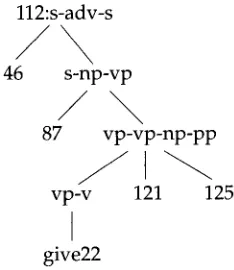
Example of a partial derivation tree projected by a history item.
techniques. The result of the parser will be a p a r s e forest: a c o m p a c t r e p r e s e n t a t i o n of all possible parse trees rather than an e n u m e r a t i o n of all parse trees.
The structure of the parse forest in the h e a d - c o r n e r parser is rather unusual, a n d therefore w e will take some time to explain it. Because the h e a d - c o r n e r p a r s e r uses selective m e m o r i z a t i o n , c o n v e n t i o n a l a p p r o a c h e s to constructing parse forests (Billot a n d Lang 1989) are not applicable. The h e a d - c o r n e r parser maintains a table of partial d e r i v a t i o n trees, each of w h i c h represents a successful p a t h from a lexical h e a d (or gap) u p to a goal category. The table consisting of such partial parse trees is called the history table; its items are h i s t o r y items.
More specifically, each history item is a triple consisting of a result item reference, a rule name, a n d a list of triples. The rule n a m e is always the n a m e of a rule w i t h o u t d a u g h t e r s (i.e., a lexical e n t r y or a gap): the (lexical) head. Each triple in the list of triples represents a local tree. It consists of the rule name, a n d t w o lists of result item references (representing the list of d a u g h t e r s left of the h e a d in reverse, and the list of d a u g h t e r s right of the head). An e x a m p l e will clarify this. S u p p o s e w e h a v e a history item:
' H I S T O R Y _ I T E M ' ( 112, g i v e 2 2 ,
[ r u l e ( v p _ v , [] , [] ) ,
r u l e ( s _ n p _ v p , [87] , [] ) ,
r u l e ( v p _ v p _ n p _ p p , [] , [ 1 2 1 , 1 2 5 ] ),
r u l e ( s _ a d v _ s , [46] , [] )] ).
(16)
This item indicates that there is a possible d e r i v a t i o n of the category defined in result item 112 of the form illustrated in Figure 4. In this figure, the labels of the interior n o d e s are rule names, a n d the labels of the leaves are references to result items. The h e a d - c o r n e r leaf is special: it is a reference to either a lexical e n t r y or an epsilon rule. The root n o d e is special too: it has b o t h an associated rule n a m e a n d a reference to a result item. The latter indicates h o w this partial d e r i v a t i o n tree c o m b i n e s w i t h other partial trees.
The history table is a lexicalized tree substitution grammar, in w h i c h all n o d e s (except substitution nodes) are associated with a rule identifier (of the original gram- mar). This g r a m m a r derives exactly all d e r i v a t i o n trees of the input. 4 As an example,
van Noord Efficient Head-Corner Parsing
nt5:I nt0:a ntl:4 nt2:3
/ \
r
ntO m a n h o m e
nt3:6
/ \
at nt2 nt4:5 nt6:l/\
/\
4 nt3 nt5 7
/ \
/\
nt0 m a n see nt4
nt6:2
/ \
1 nt3/ \
nt5 7/ \
see n t l Figure 5
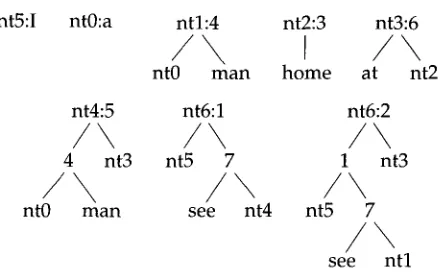
Tree substitution grammar that derives each of the two derivation trees of the sentence I see a man at home, for the grammar of Billot and Lang (1989). The start symbol of this grammar is nt6. Note that all nodes, except for substitution nodes, are associated with a rule (or lexical entry) of the original grammar. Root nodes have a nonterminal symbol before the colon, and the corresponding rule identifier after the colon. The set of derived trees for this tree
substitution grammar equals the set of derivation trees of the parse (ignoring the nonterminal symbols of the tree substitution grammar).
consider the g r a m m a r u s e d b y Tomita (1987) a n d Billot a n d L a n g (1989), g i v e n here in (17) a n d (18).
(I) s - - > np, vp. (2) s --> s, pp. (3) n p - - > n.
(4) n p - - > det, n. (5) n p - - > rip, pp. (6) p p - - > p r e p , rip. (7) v p - - > v, rip.
(17)
n - - > ['I'] . n - - > [man] . v - - > [see] . (18) p r e p - - > [at]. d e t - - > [a]. n - - > [ h o m e ] .
The sentence I see a m a n at h o m e has t w o derivations, a c c o r d i n g to this g r a m m a r . The lexicalized tree substitution g r a m m a r in Figure 5, w h i c h is c o n s t r u c t e d b y the h e a d - corner parser, d e r i v e s exactly these t w o derivations.
N o t e that the i t e m references are u s e d in the s a m e m a n n e r as the c o m p u t e r gener- ated n a m e s of n o n t e r m i n a l s in the a p p r o a c h of Billot a n d L a n g (1989). Because w e use c h u n k s of p a r s e trees, less p a c k i n g is possible t h a n in their a p p r o a c h . C o r r e s p o n d i n g l y , the theoretical worst-case space r e q u i r e m e n t s are also worse. In practice, h o w e v e r , this does n o t s e e m to be problematic: in o u r e x p e r i m e n t s , the size of the h i s t o r y table is a l w a y s m u c h smaller t h a n the size of the other tables (this is e x p e c t e d b e c a u s e the latter tables h a v e to record c o m p l e x c a t e g o r y information).
Let us n o w look at h o w the p a r s e r of the p r e v i o u s section can be a d a p t e d to be able to assert h i s t o r y items. First, w e a d d a n (output-) a r g u m e n t to the p a r s e predicate. This sixth a r g u m e n t is the reference to the result i t e m that w a s actually used. The predicates to p a r s e a list of d a u g h t e r s are a u g m e n t e d w i t h a list of s u c h references. This enables the construction of a t e r m for each local tree in the head_corner p r e d i c a t e consisting of the n a m e of the rule that w a s a p p l i e d a n d the list of references of the result items
[image:19.468.120.340.64.202.2]Computational Linguistics Volume 23, Number 3
used for the left and right daughters of that rule. Such a local tree representation is an element of a list that is maintained for each lexical head upward to its goal. Such a list thus represents in a bottom-up fashion all rules and result items that were used to show that that lexical entry indeed was a head-corner of the goal. If a parse goal has been solved then this list containing the history information is asserted in a new kind of table: the 'HISTORY_ITEM'/3 table. 5
We already argued above that parse trees should not be explicitly defined in the grammar. Logical forms often implicitly represent the derivational history of a cate- gory. Therefore, the common use of logical forms as part of the categories will imply that you will hardly ever find two different analyses for a single category, because two different analyses will also have two different logical forms. Therefore, no packing is possible and the recognizer will behave as if it is enumerating all parse trees. The solution to this problem is to delay the evaluation of semantic constraints. During the first phase, all constraints referring to logical forms are ignored. Only if a parse tree is recovered from the parse forest we add the logical form constraints. This is similar to the approach worked out in CLE (Alshawi 1992).
This approach may lead to a situation in which the second phase actually filters out some otherwise possible derivations, in case the construction of logical forms is not
compositional
in the appropriate sense. In such cases, the first phase m a y be said to be unsound in that it allows ungrammatical derivations. The first phase combined with the second phase is of course still sound. Furthermore, if this situation arose very often, then the first phase would tend to be useless, and all work would have to be done during the recovery phase. The present architecture of the head-corner parser embodies the assumption that such cases are rare, and that the construction of logical forms is(grosso modo)
compositional.The distinction between semantic and syntactic information is compiled into the grammar rules on the basis of a user declaration. We simply assume that in the first phase the parser only refers to syntactic information, whereas in the second phase both syntactic and semantic information is taken into account.
If we assume that the grammar constructs logical forms, then it is not clear that we are interested in parse trees at all. A simplified version of the recover predicate may be defined in which we only recover the semantic information of the root category, but in which we do not build parse trees. The simplified version may be regarded as the run-time version, whereas parse trees will still be very useful for grammar development.
5. Parsing Word-Graphs with Probabilities
The head-corner parser is one of the parsers developed within the NWO Priority Programme on Language and Speech Technology. In this program a spoken dialog system is developed for public transportation information (Boves et al. 1995).
In this system the input for the parser is not a simple list of words, as we have assumed up to now, but rather a word-graph: a directed, acyclic graph where the states are points in time and the edges are labeled with word hypotheses and their corresponding acoustic score. Thus, such word-graphs are acyclic weighted finite-state automata.
In Lang (1989) a framework for processing ill-formed input is described in which
van Noord Efficient Head-Corner Parsing
certain c o m m o n errors are m o d e l e d as (weighted) finite-state transducers. The c o m p o - sition of an i n p u t sentence with these transducers p r o d u c e s a (weighted) finite-state a u t o m a t o n , w h i c h is then i n p u t for the parser. In such an approach, the n e e d to gen- eralize from i n p u t strings to i n p u t finite-state a u t o m a t a is also clear.
The generalization from strings to w e i g h t e d acyclic finite-state a u t o m a t a intro- duces essentially two complications: we cannot use string indices a n y m o r e a n d w e n e e d to keep track of the acoustic scores of the w o r d s used in a certain derivation. 5.1 From String Positions to State Names
Parsing on the basis of a finite-state a u t o m a t o n can be seen as the c o m p u t a t i o n of the intersection of that a u t o m a t o n with the grammar. If the definite clause g r a m m a r is off-line parsable, a n d if the finite-state a u t o m a t o n is acyclic, then this c o m p u t a t i o n can be g u a r a n t e e d to terminate (van N o o r d 1995). This is obvious because an acyclic finite-state a u t o m a t o n defines a finite n u m b e r of strings. More importantly, existing techniques for parsing based on strings can be generalized easily b y using the n a m e s of states in the a u t o m a t o n instead of the usual string indices.
In the h e a d - c o r n e r parser, this leads to an alternative to the predicate s m a l l e r _ e q u a l / 2 . Rather than a simple integer comparison, w e n o w n e e d to check that a derivation from P0 to P can be e x t e n d e d to a derivation from E0 to E b y checking that there are p a t h s in the w o r d - g r a p h from E0 to P0 a n d from P to E.
The predicate c o n n e c t i o n / 2 is true if there is a p a t h in the w o r d - g r a p h from the first a r g u m e n t to the second argument. It is a s s u m e d that state n a m e s are integers; to rule out cyclic w o r d - g r a p h s w e also require that, for all transitions from P0 to P, it is the case that P0 < P. Transitions in the w o r d - g r a p h are r e p r e s e n t e d b y clauses of the form w o r d g r a p h : t r a n s (P0, Sym, P, S c o r e ) , w h i c h indicate that there is a transition from state P0 to P with s y m b o l Sym a n d acoustic score Score. The connection predicate can be specified simply as the reflexive a n d transitive closure of the transition relation b e t w e e n states:
c o n n e c t ion (A, A) . (19)
c o n n e c t i o n ( A O , A ) "-
w o r d g r a p h : t r a n s (AO, _, A i, _),
c o n n e c t i o n (AI, A).
The i m p l e m e n t a t i o n allows for the possibility that state n a m e s are not instantiated (as required b y the treatment of gaps). M o r e o v e r it uses m e m o r i z a t i o n , a n d it ensures that the predicate succeeds at most once:
c o n n e c t i o n ( A , B ) : -
( var(A) -> t r u e
; var(B) -> t r u e
; A = : = B -> t r u e
; B < A -> fail
; o k _ c o n n ( A , B ) -> t r u e
; f a i l _ c o n n ( A , B ) -> f a i l
; w o r d g r a p h : t r a n s ( A , _ , X , _ ) ,
c o n n e c t i o n ( X , B )
% w o r d - g r a p h s are a c y c l i c
-> a s s e r t z ( o k _ c o n n ( A , B ) )