Remote Controlled Mechtronics System
A. Satya Dinesh1
1
Assistant Professor, Mechanical Engineering, Chaitanya Bharathi Institute of Technology, Proddatur
Abstract: This paper presents controlling of mechatronics system using remote operated. This system has a special feature of smart video transfer and capture feature. The images are transferred to the monitor by the surveillance system. The system is always controlled by the remote operated by human.The remote controlled mechatronics system is aim to use in the situation like natural calamities, to inspect and navigate from remote location and collect the video without wires. It Just by throwing from window the ball can send the images inside the room and also can navigate the video ball from one room to another room to look for people. This is perfect for changeable lighting conditions. High-resolution security cameras have additional light sensors on their digital chips. This includes augment the effective image quality. These cameras are effectual only with high-resolution monitors. Small in size and Simpler to setup. The Wireless digital cameras give sharper effects. In video ball the encoders are given as an input and the decoders are the output. The program is given to the system it transmits by the transmitter and the monitor receive the images by receiver. The wireless video transmit the signal and at remote location the live video issued to inspect the areas where are accessible and non accessible.
Keywords: Remote controlled Mechatronics system, Video surveillance system, Video ball, Microcontroller, Encoder, Decoder.
I. INTRODUCTION
Observing or analyzing a particular site for safety and business purposes is known as video surveillance. Security and crime control concerns are the motivating factors for the deployment of video surveillance cameras. Video surveillance cameras are used in shopping centers, public places, banking institutions, companies and ATM machines. Nowadays, researches experience continuous growth in network surveillance. The reason being is the instability incidents that are happening all around the world. Therefore, there is a need of a smart surveillance system for intelligent monitoring that captures data in real time, transmits, processes and understands the information related to those monitored. The video data can be used as a forensic tool for after-crime inspection. Hence, these systems ensure high level of security at public places which is usually an extremely complex challenge hence video surveillance systems have become more popular. Video surveillance systems have wide range of applications like traffic monitoring [1] and human activity understanding [2]. Presently, the surveillance systems used requires constant human vigilance. However, the humans have limited abilities to perform in real-time which reduce the actual usability of such surveillance systems [3 -5]. Also such surveillance systems are not reliable for real time threat detection. From the perspective of forensic investigation, a large amount of video data obtained from surveillance video tapes need to be analyzed and this task is very tedious and error prone for a human investigator [6-9]. To overcome this drawback, automatic video analysis system is developed that continuously monitors a given situation and reacts in real-time [10]. The proposed system has an ability to sense intrusion and respond to it in real time. The location recognition technology has been so far studied and developed mainly with single interesting object for tracking human and things, mobile asset management, security and etc. Such location recognition technology provides accuracy in interior space within two to three meters without obstacles, but with obstacles, larger range of error is appeared, thus research for recognition of more accurate interior location has conducted. Not only that, interest in location recognition of multiple objects in environment is increased, not in environment with single object location recognition. The requirement to get valid images is very important at the video security surveillance system. Thus, research in video surveillance systems are multidisciplinary field associated to image analyzing and processing, pattern recognition, signal processing, embedded computing, and communication. In this paper presents the working of remote controlled mechatronics system.
II. LITERATURE SURVEY
III. METHODOLOGY
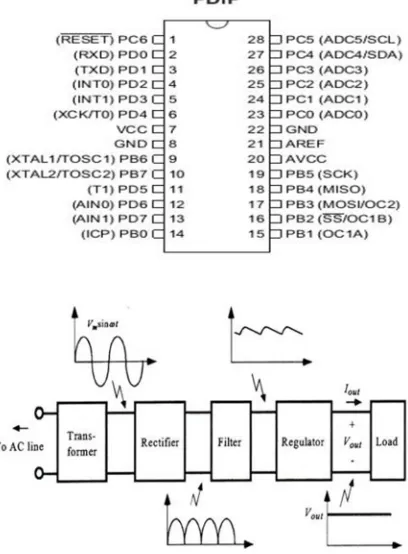
[image:2.612.194.398.324.601.2]In designing of remote controlled mechatronics system and installing the necessary equipment, the organization should consider the reception equipment such as video cameras, or audio or other devices should only be installed in identified public areas where video surveillance is necessary to protect public safety, detect or deter, and assist in the investigation of criminal activity. Mechatronics, Micro controller, Power Electronics, Digital Transmission and reception, Video transmission technologies are used. In this present system consist of Atmega 8 microcontroller, 4MHz crystal, HT12E (Encoder), HT12D (Decoder), L293D motor driver, IRFZ44N, RF Modules (receiver and transmitter), 12V DC motors, Video Camera. The ATmega8 micro controller is the main part of entire system. The ATmega8 is a low-power CMOS 8-bit microcontroller based on the AVR RISC architecture. By executing powerful instructions in a single clock cycle, the ATmega8achieves throughputs approaching 1 MIPS per MHz, allowing the system designed to optimize power consumption versus processing speed. The ATmega -8 Microcontroller as shown in fig 1.The power supplies are designed to convert high voltage AC mains electricity to a suitable low voltage supply for electronic circuits and other devices. A power supply can by broken down into a series of blocks, each of which performs a particular function. A DC power supply which maintains the output voltage constant irrespective of AC mains fluctuations or load variations is known as Regulated D.C Power Supply. A transformer is an electrical device which is used to convertNelectrical power from one Electrical circuit to another without change in frequency. Transformers convert AC electricity from one voltage to another with little loss of power. Transformers work only with AC and this is one of the reasons why mains electricity is AC. Step-up transformers increase in output voltage, step-down transformers decrease in output voltage. Most power supplies use a step-down transformer to reduce the dangerously high mains voltage to a safer low voltage. The regulated power supply system as shown in fig 2.
Fig. 2: Components of typical power supply
Fig. 3: ATmega -8 Microcontrollers pin diagram
[image:3.612.197.412.233.316.2]
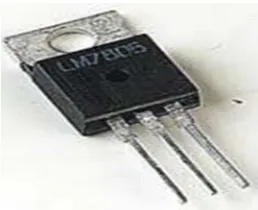
Fig. 4: Three Terminal Voltage Regulator
DC is known as rectifier. A bridge rectifier makes use of four diodes in a bridge arrangement to achieve full- wave rectification. This is a widely used configuration, both with individual diodes wired and with single component bridges where the diode bridge is wired internally. A bridge rectifier makes use of four diodes in a bridge arrangement as shown in fig 4.
IV. RESULTS & DISCUSSION
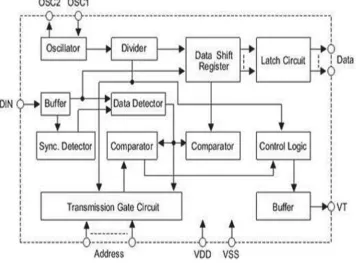
The program is given to the system it transmits by the transmitter and the monitor receive the images by receiver. The HT12 encoders are a series of remote control system applications. They are capable of encoding information which consists of N address bits and 12N data bits. Each address/data input can be set to one of the two logic states. The programmed addresses/data are transmitted together with the header bits via an RF or an infrared transmission medium upon receipt of a trigger signal. The capability to select a TE trigger on the HT12E or a DATA trigger on the HT12A further enhances the application flexibility of the 212 series of encoders. The HT12A additionally provides a 38kHz carrier for infrared systems. The input of microcontroller HT12E encoder as shown in fig 5. The decoders are a series of remote control system applications. They are paired with Holtech212 series of encoders (refer to the encoder/de-coder cross reference table). For proper operation, a air of encoder/decoder with the same number of ad-dresses and data format should be chosen. The encoders receive serial addresses and data from a programmed 212 series of encoders that are transmitted by a carrier using an RF or an IR transmission medium.
[image:3.612.180.422.550.717.2]They compare the serial input data three times continuously with their local addresses. If no error or un-matched codes are found, the input data codes are decoded and then transferred to the output pins. The VT pin also goes high to indicate a valid transmission. The 212 series of decoders are capable of decoding information that consists of N bits of address and 12N bits of data. Of this series, the HT12D is arranged to pro-vide 8 address bits and 4 data bits, and HT12F is used to decode 12 bits of address information. The HT12D decoder as shown in fig 6.
Fig. 6: Output of Microcontroller (HT 12D Decoder)
The wireless 433MHz encoder and decoder signals from the remote unit to navigate the video ball. The wireless video transmit the signal and at remote location the live video issued to inspect the areas where are critical & non-accessible and dangerous. To control the ball robotic moment’s forward/reverse & left/right buttons are held on the remote controller. It is shown in fig 7.
F B
LR
Fig. 7: Remote controller (keys)
V. CONCLUSIONS
REFERENCES
[1] D. Koller, K. Daniilidis, H. H. Nagel, Model-based object tracking in monocular sequences of road traffic scenes. International Journal of Computer Vision, Vol. 10, 1993, pp. 257-281.
[2] Yuri A. Ivanov and Aaron F. Bobick, Recognition of Multi-Agent Interaction in Video Surveillance, {ICCV} (1), pp. 169-176, 1999.
[3] J.R. Agustina, G.G. Clavell, “The impact of CCTV on fundamental rights and crime prevention strategies: The case of the Catalan Control Commission of Video surveillance Devices. computer law & security review”, Vol. 27, 2011,pp 168-74
[4] W.R. Webster, E Töpfer, F.R. Klauser, C.D. Raab, “Revisiting the surveillance camera revolution: Issues of governance and public policy. Introduction to part one
[5] M.J.H. Loomans, J. C. Koeleman, With, P.H.N.d,” Low-Complexity Wavelet-Based Scalable Image & Video Coding for Home-Use Surveillance. IEEE Transactions on Consumer Electronics”, Vol.57, 2011, pp 507-15.
[6] Y.W. Bai, Z.L. Xie, Z.H Li, “Design and Implementation of a Home Embedded Surveillance System with Ultra-Low Alert Power. IEEE Transactions on Consumer Electronics”, Vol. 75, 2011, pp 153-9.
[7] J.Jeong, Gu, Y., He, T., Du, D.H.C.” Virtual Scanning Algorithm for Road Network Surveillance. IEEE Transactions On Parallel And Distributed Systems”Vol. 21, 2010, pp 1734-49.
[8] C.Rougier, J.Meunier, A.St-Arnaud, Rousseau, J. Robust,” Video Surveillance for Fall Detection Based on Human Shape Deformation. IEEE Transactions on Circuits and Systems for Video Technology”, Vol.21, 2011, pp 611-22.
[9] P.C. Su, C.-Y Wu, “A Joint Watermarking and ROI Coding Scheme for Annotating Traffic Surveillance Videos. EURASIP Journal on Advances in Signal
Processing”, Vol. 28, 2010, pp 1-14.