Learning Word Representations with Regularization
from Prior Knowledge
Yan Song Tencent AI Lab [email protected]
Chia-Jung Lee Microsoft
Fei Xia
University of Washington [email protected]
Abstract
Conventional word embeddings are train-ed with specific criteria (e.g., bastrain-ed on language modeling or co-occurrence) in-side a single information source, disre-garding the opportunity for further calibra-tion using external knowledge. This paper presents a unified framework that lever-ages pre-learned or external priors, in the form of a regularizer, for enhancing con-ventional language model-based embed-ding learning. We consider two types of regularizers. The first type is derived from topic distribution by running latent Dirich-let allocation on unlabeled data. The sec-ond type is based on dictionaries that are created with human annotation efforts. To effectively learn with the regularizers, we propose a novel data structure, trajectory softmax, in this paper. The resulting em-beddings are evaluated by word similarity and sentiment classification. Experimental results show that our learning framework with regularization from prior knowledge improves embedding quality across multi-ple datasets, compared to a diverse collec-tion of baseline methods.
1 Introduction
Distributed representation of words (or word em-bedding) has been demonstrated to be effec-tive in many natural language processing (NLP) tasks (Bengio et al., 2003; Collobert and We-ston, 2008; Turney and Pantel, 2010; Collobert et al., 2011; Mikolov et al., 2013b,d; Weston et al., 2015). Conventional word embeddings are trained with a single objective function (e.g., lan-guage modeling (Mikolov et al., 2013c) or word co-occurrence factorization (Pennington et al.,
2014)), which restricts the capability of the learned embeddings from integrating other types of knowledge. Prior work has leveraged relevant sources to obtain embeddings that are best suited for the target tasks, such as Maas et al. (2011) us-ing a sentiment lexicon to enhance embeddus-ings for sentiment classification. However, learning word embeddings with a particular target makes the ap-proach less generic, also implying that customized adaptation has to be made whenever a new knowl-edge source is considered.
Along the lines of improving embedding qual-ity, semantic resources have been incorporated as guiding knowledge to refine objective functions in a joint learning framework (Bian et al., 2014; Xu et al., 2014; Yu and Dredze, 2014; Nguyen et al., 2016), or used for retrofitting based on word re-lations defined in the semantic lexicons (Faruqui et al., 2015; Kiela et al., 2015). These approaches, nonetheless, require explicit word relations de-fined in semantic resources, which is a difficult prerequisite for knowledge preparation.
Given the above challenges, we propose a novel framework that extends typical context learning by integrating external knowledge sources for en-hancing embedding learning. Compared to a well known work by Faruqui et al. (2015) that focused on tackling the task using a retrofitting1
frame-work on semantic lexicons, our method has an emphasis on joint learning where two objectives are considered for optimization simultaneously. In the meantime, we design a general-purpose infras-tructure which can incorporate arbitrary external sources into learning as long as the sources can be encoded into vectors of numerical values (e.g. multi-hot vector according to the topic distribu-tions from a topic model). In prior work by Yu and Dredze (2014) and Kiela et al. (2015), the
ex-1In their study, joint learning was reported to be less ef-fective than retrofitting.
ternal knowledge has to be clustered beforehand according to their semantic relatedness (e.g.,cold,
icy, winter, frozen), and words of similar mean-ings are added as part of context for learning. This may set a high bar for preparing external knowl-edge since finding the precise word-word relations is required. Our infrastructure, on the other hand, is more flexible as knowledge that is learned else-where, such as from topic modeling or even a sen-timent lexicon, can be easily encoded and incor-porated into the framework to enrich embeddings. The way we integrate external knowledge is performed by the notion of a regularizer, which is an independent component that can be connected to the two typical architectures, namely, continu-ous bag-of-words (CBOW) and skip-gram (SG), or used independently as a retrofitter. We construct the regularizers based on the knowledge learned from both unlabeled data and manually crafted information sources. As an example of the for-mer, a topic model from latent Dirichlet allocation (LDA) (Blei et al., 2003) is first generated from a given corpus, based on which per-word topical distributions are then added as extra signals to aid embedding learning. As an example of the latter, one can encode a dictionary into the regularizer and thus adapt the learning process with the en-coded knowledge.
Another contribution of this paper is that we propose a novel data structure, trajectory softmax, to effectively learn prior knowledge in the regu-larizer. Compared to conventional tree based hi-erarchical softmax, trajectory softmax can greatly reduce the space complexity when learning over a high-dimension vector. Our experimental results on several different tasks have demonstrated the effectiveness of our approach compared to up-to-date studies.
The rest of the paper is organized as follows. In section 2, we describe in detail our framework and show how we learn the regularizer in section 3. Section 4 presents and analyzes our experimental results and section 5 surveys related work. Finally, conclusions and directions of future work are dis-cussed in section 6.
2 Approach
Conventionally word embeddings are learned from word contexts. In this section, we describe our method of extending embedding learning to incorporate other types of information sources.
Previous work has shown that many different sources can help learn better embeddings, such as semantic lexicons (Yu and Dredze, 2014; Faruqui et al., 2015; Kiela et al., 2015) or topic distribu-tions (Maas et al., 2011; Liu et al., 2015b). To provide a more generic solution, we propose a uni-fied framework that learns word embeddings from context (e.g., CBOW or SG) together with the flex-ibility of incorporating arbitrary external knowl-edge using the notion of a regularizer. Details are unfolded in following subsections.
2.1 The Proposed Learning Framework Preliminaries: The fundamental principle for learning word embeddings is to leverage word context, with a general goal of maximizing the likelihood that a word is predicted by its context. For example, the CBOW model can be formulated as maximizing
L= |V1|
|V|
X
i=1
logp(wi |
X
0<|j|≤c
υi+j), ∀wi∈V
(1) whereυi+j refers to the embedding of a word in
wi+ci−c, andcdefines the window size of words ad-jacent to the wordwi. The optimization forLover
the entire corpus is straightforward.
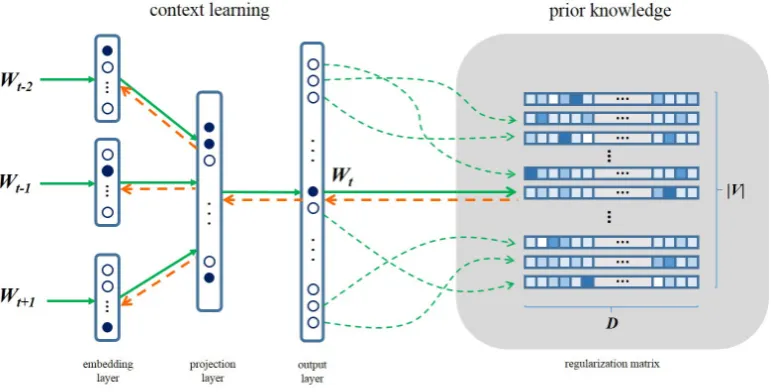
The left part of Figure 1 illustrates the con-cept of such context learning. It is a typical ob-jective function for language modeling, wherewi
is learned by the association with its neighboring words. Since context greatly affects the choice of the current word, this modeling strategy can help finding reasonable semantic relationships among words.
Regularizer: To incorporate additional sources for embedding learning, we introduce the notion of a regularizer, which is designed to encode in-formation from arbitrary knowledge corpora.
Given a knowledge resource Ψ, one can en-code the knowledge carried by a word w with ψ(w), whereψ can be any function that mapsw to the knowledge it encapsulates. For example, a word has a topic vector ψ(w) = −−→e(wi)Φ
[1:K,:],
resulting ψ(w) = −→Φw = (φ1,w, φ2,w, ..., φK,w),
where Φ[1:K,:] is the topic distribution matrix for
Figure 1: Illustration of joint learning word embeddings with context and regularization from prior knowledge. The green lines refer to the prediction and the red dotted lines refer to the updating process. a knowledge source can be conceptually used to
maximize Pw∈V R(υ), where R is the regular-izer, defined as a function of the embeddingυof a given wordwand formulated as:
R(υ) = logp(ψ(w)|υ), ∀w∈V,Ψ (2) The right part of Figure 1 shows an instantiation of a regularizer that encodes prior knowledge of vocabulary size|V|, each withDdimensions.
Joint Learning: To extend conventional embed-ding learning, we combine context learning from an original corpus with external knowledge en-coded by a regularizer, where the shared vocabu-lary set forms a bridge connecting the two spaces. In particular, the objective function for CBOW with integrating the regularizer can be formulated as maximizing
L= 1 |V|
|V|
X
i=1
logp(wi, ψ(wi) |
X
0<|j|≤c
υi+j) (3)
where not onlywi, but alsoR(wi)is predicted by
the context wordswi+jvia their embeddingsυi+j.
Figure 1 as a whole illustrates this idea. Re-call that each row of the matrix corresponds to a vector of a word in V, representing prior knowl-edge across D dimensions (e.g., semantic types, classes or topics). When learning/predicting a word within this framework, the model needs to predict not only the correct word as shown in the context learning part in the figure, but also the cor-rect vector in the regularizer. In doing so, the prior knowledge will be carried to word
embed-dings from regularization to context learning by back-propagation through the gradients obtained from the learning process based on the regulariza-tion matrix.
Retrofitting: With joint learning as our goal, we should emphasize that the proposed frame-work supports simultaneous context learning and prior knowledge retrofitting with a unified objec-tive function. This means that the retrofitters can be considered as a stand-alone component at dis-posal, where the external knowledge vectors are regarded as supervised-learning target and the em-beddings are updated through the course of fitting to the target. In §4, we will evaluate the perfor-mance of both joint learner and retrofitter in detail.
2.2 Parameter Estimation
As shown in Equation 3, prior knowledge par-ticipates in the optimization process for predict-ing the current word and contributes to embeddpredict-ing updating during training a CBOW model. Using stochastic gradient descent (SGD), embeddings can be easily updated by both objective functions for language modeling and regularization through: υ?
i+j =υi+j−λ∇υ[logp(wi|
X
0<|j|≤c
υi+j)+R(υ?i)]
(4) whereRis defined as in Eq.2 for ψ(wi). For SG
model, prior knowledge is introduced in a similar way, with the difference being that context words are predicted instead of the current word.
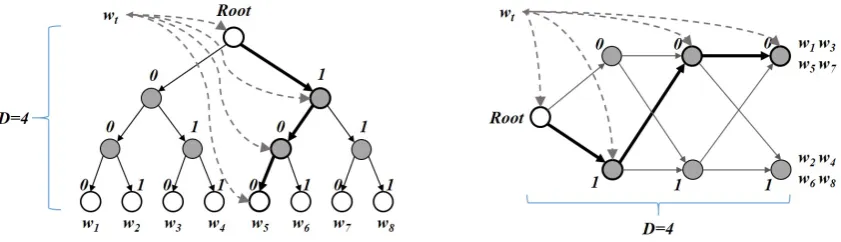
em-Figure 2: Comparison of hierarchical softmax (left) and trajectory softmax (right) based on an example of eight words in binary coding. The bold arrow lines refer to the path for encodingw5in both hierarchical
and trajectory softmax.
beddings are updated in the same way as in nor-mal CBOW and SG models. When learned from the regularizer, embeddings are updated via a su-pervised learning overΨ, on the condition thatΨ is appropriately encoded byψ. The details of how it is performed will be illustrated in the next sub-section.
2.3 Trajectory Softmax
Hierarchical softmax is a good choice for reducing the computational complexity when training prob-abilistic neural network language models. There-fore, for context learning on the left part of Fig-ure 1, we continue using hierarchical softmax based on Huffman coding tree (Mikolov et al., 2013a). Typically to encode the entire vocabulary, the depth of the tree falls in a manageable range around 15 to 18.
However, different from learning context words, to encode a regularizer as shown on the right part of Figure 1, using hierarchical softmax is intractable due to exponential space demand. Con-sider words expressed withD-dimensional vectors in a regularizer, a tree-based hierarchical softmax may require 2D −1 nodes, as illustrated in the
left hand side of Figure 2. Since each node con-tains ad-dimensional “node vector” that is to be updated through training, the total space required isO(2D·d)for hierarchical softmax to encode the
regularizer. WhenDis very large, such asD= 50 meaning that tree depth is 50, the space demand tends to be unrealistic as the number of nodes in the tree grows to250.
To avoid the exponential requirement in space, in this work, we propose a trajectory softmax acti-vation to effectively learn over theD-dimensional vectors. Our approach follows a grid hierarchical
structure along a path when conducting learning in the regularizer. From the right hand side of Fig-ure 2, we see that the same regularizer entry is en-coded with a path ofDnodes, using a grid struc-ture instead of a tree one. Consequently the total space required will be reduced toO(2·D·d).
As a running example, Figure 2 shows that when D = 4, the conventional hierarchical soft-max needs at least 15 nodes to perform softsoft-max over the path, while trajectory softmax greatly re-duces space to only 7 nodes. Compared to tree-based hierarchical softmax, the paths in trajectory softmax are not branches of a tree, but a fully connected grid of nodes with space complexity of D× |C|in general. Here|C|refers to the num-ber of choices on the paths for a node to the next node, and thus |C| = 2 is the binary case. In Figure 2, we see an activation trajectory for a se-quence of “Root→100” for encoding wordw5.wt
is then learned and updated through the nodes on the trajectory when w5 is predicted by wt. The
learning and updating are referred by the dashed arrow lines. Overall, trajectory softmax greatly re-duces the space complexity than hierarchical soft-max, especially when words sharing similar infor-mation, in which case the paths of these words will be greatly overlapped.
More formally, learning with trajectory softmax in the binary case is similar to hierarchical soft-max, which is to maximizep over the path for a vector encoded inψ(w), wherepis defined below with an input vectorυ:
p(ψ(w)|υ) =
D−1Y
i=1
σ(Jn(i+ 1)K·υi>υ) (5)
where υi is the inner vector in i-th node on the
[image:4.595.75.496.66.187.2]node is encoded with0or1, respectively. The final update to word embeddingυwith the regularizer is conducted by:
υ∗=υ−γ(σ(υi>υ)−ti)·υi (6)
which is applied to i = 1,2, ..., D − 1, where σ(x) = exp(x)/(1 + exp(x));ti = Jn(i+ 1)K;
γis a discount learning rate.
Since the design of trajectory softmax is com-patible with the conventional hierarchical softmax, one can easily implement the joint learning by concatenating itsRoot with the terminal node in the hierachical tree. The learning process is thus to traverse all the nodes from the hierarchical tree and the trajectory path.
3 Constructing Regularizers
We consider two categories of information sources for constructing regularizers. The first type of reg-ularizer is built based on resources without anno-tation. On the contrary, the second type uses text collections with annotation. For brevity, through-out the paper we refer to the former as unannotated regularizer whereas the latter is recognized as an-notated regularizer.
3.1 Unannotated Regularizer
The unannotated regularizer constructs its regular-ization matrix based on an LDA learned topic dis-tribution, which reflects topical salience informa-tion of a given word from prior knowledge. Us-ing LDA not only serves our purpose of learn-ing accordlearn-ing to word semantics reflected by co-occurrences but can also bring in knowledge inex-pensively (i.e., no annotations needed).
To start, a classic LDA is first performed on an arbitrary base corpus for retrieving word topical distribution, resulting in a topic model withK top-ics. All the units in the corpus are then assigned with a word-topic probabilityφi corresponding to
topick, based on which a matrix is formed with all −
→
Φw, as described in§2.1. Next we convert each
−
→Φ into a 0-1 vector based on the maximum val-ues in−→Φ. In particular, positions with maximum values are set to 1 and the rest are set to 0 (e.g. [0.1, 0.1, 0.4, 0.4]→[0, 0, 1, 1]). This converted matrix functions as the final regularization matrix as shown in right hand side of Figure 1. We set K = 50in our experiments.2 An in-house LDA 2We experimented with other numbers forK, and their performance didn’t vary too much whenK >40. We didn’t include this comparison due to the similar results.
implementation3is used for trainingΦ
[1:K,:], with
1,000 iterations.
3.2 Annotated Regularizer
We use three sources for training annotated regu-larizers in this work. Two of the sources are se-mantic lexicons, namely, the Paraphrase Database (PPDB)4(Ganitkevitch et al., 2013) and synonyms
in the WordNet (WNsyn)5 (Miller, 1995). They
are used in the word similarity task. The third source is a semantic dictionary, SentiWordNet 3.0 (SWN) (Baccianella et al., 2010), which is used in the sentiment classification task. All of the three sources were created with annotation efforts, where either lexical or semantic relations were provided by human experts beforehand.
Before constructing the regularizer, we need en-code each word in the sources as a vector accord-ing to its relations to other words or predefined in-formation. For PPDB and WNsyn, we use them in
different ways for joint learning and retrofitting. In order to optimize the efficiency in joint learn-ing, we compress the word relations with topic representations. We use an LDA learner to get topic models for the lexicons6, with K = 50.
Therefore, the word relations are transferred into topic distributions that are learned from their co-occurrences defined in the lexicon. The way we construct regularization matrix may be lossy, risk-ing losrisk-ing information that is explicitly delivered in the lexicon. However, it provides us effective encodings for words, and also yields better learn-ing performance empirically in our experiments. In retrofitting, we directly use words’ adjacent ma-trices extracted from their relations defined in the lexicons, then take the adjacent vector for each word as the regularization vector.
The SWN includes 83K words (147K words and phrases in total). Every word in SWN has two scores for its degree towards positive and negative polarities. For example, the word “pretty” receives 0.625 and 0 for positive and negative respectively, which means it is strongly associated with positive sentiment. The scores range from 0 to 1 with step
3It is a Markov Chain Monte Carlo (MCMC) based LDA using Gibbs sampling.
4We use PPDB-XL in this paper. 5We use WN
syn because in our experiment only using synonyms perform better than using synonyms, hypernyms and hyponyms.
Embeddings γMEN-3kρ SimLex-999γ ρ WordSim-353γ ρ
LDA 57.17 58.86 20.39 22.12 55.48 54.81
CBOW 62.93 65.84 28.34 28.31 68.50 66.67 Yu and Dredze (2014) +PPDB+WN 65.35 65.84 35.56 33.30 72.75 72.43
syn 65.20 65.74 36.15 33.65 72.79 72.58
This work +LDA+PPDB 67.33 69.5165.25 66.87 29.79 29.78 71.19 69.5836.43 33.28 69.45 68.89 +WNsyn 64.42 66.98 33.86 33.69 66.13 67.11
SG 64.79 66.71 26.97 26.59 68.88 67.80
Kiela et al. (2015) +PPDB+WN 61.13 60.04 36.47 34.29 70.14 68.76
syn 57.02 59.84 29.02 29.99 63.61 61.22
[image:6.595.107.487.61.277.2]This work +LDA+PPDB 65.02 65.32 25.19 24.04 66.16 69.2170.83 71.35 37.10 35.72 73.94 73.11 +WNsyn 66.58 68.14 36.72 35.91 68.50 67.90
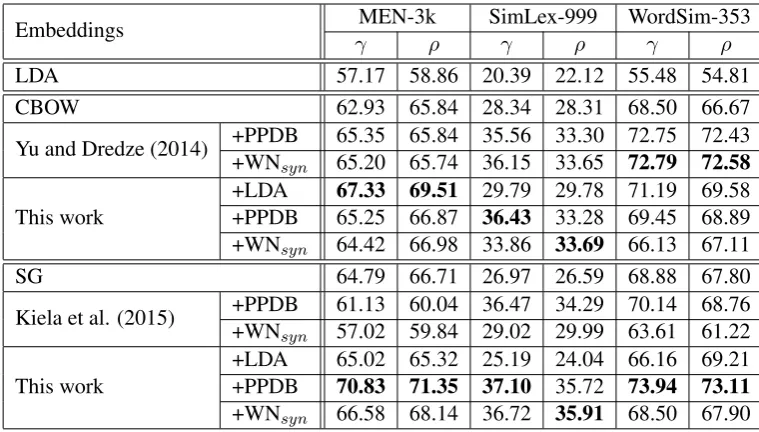
Table 1: Word similarity results forjoint learningon three datasets in terms of Pearson’s coefficient cor-relation (γ) and Spearman’s rank correlation (ρ) in percentages. Higher score indicates better correlation of the model with respect to the gold standard. Bold indicates the highest score for each embedding type.
of 0.125 for both positive and negative polarities. Therefore there are 9 different degrees for a word to be annotated for the two sentiments. For en-coding this dictionary, we design a 18-dimension vector, in which the first 9 dimension represents the positive sentiment while the last 9 for negative sentiment. A word is thus encoded into a binary form where the corresponding dimension is set to 1 with others 0. For the aforementioned word “pretty”, its encoded vector will be “000001000 000000000”, in which the score 0.625 of positive activates the 6th dimension in the vector. In doing so, we form a83K×18regularization matrix for the SWN dictionary.
4 Experiments
The resulting word embeddings based on joint learning as well as retrofitting are evaluated in-trinsically and exin-trinsically. For intrinsic evalu-ation, we use word similarity benchmark to di-rectly test the quality of the learned embeddings. For extrinsic evaluation, we use sentiment analy-sis as a downstream task with different input em-beddings. Regularizers based on LDA, PPDB and WNsyn are used in word similarity experiment,
while SentiWordNet regularization is used in sen-timent analysis. The experimental results will be discussed in§4.1 and§4.2.
We experiment with three learning paradigms, namely CBOW, SG and GloVe. GloVe is only tested in retrofitting since our regularizer is not
compatible with GloVe learning objective in joint learning. In all of our retrofitting experiments, we only train the regularizer with one iteration, con-sistent with Kiela et al. (2015).
The base corpus that we used to train ini-tial word embeddings is from the latest articles dumped from Wikipedia and newswire7, which
contains approximately 8 billion words. When training on this corpus, we set the dimension of word embeddings to be 200 and cutoff threshold of word frequency threshold to be 5 times of oc-currence. These are common setups shared across the following experiments.
4.1 Word Similarities Evaluation
We use the MEN-3k (Bruni et al., 2012), SimLex-999 (Hill et al., 2015) and WordSim-353 (Finkel-stein et al., 2002) datasets to perform quantitative comparisons among different approaches to gen-erating embeddings. The cosine scores are com-puted between the vectors of each pair of words in the datasets8. The measures adopted are Pearson’s
coefficient of product-moment correlation (γ) and Spearman’s rank correlation (ρ), which reflect how
7This corpus is constructed by the script demo-train-big-model-v1.sh from https://storage.googleapis.com/google- code-archive-source/v2/code.google.com/word2vec/source-archive.zip
Embeddings γMEN-3kρ SimLex-999γ ρ WordSim-353γ ρ GloVe 66.84 66.97 28.87 27.52 59.78 61.46 Faruqui et al. (2015) +PPDB+WN 66.98 67.04 29.25 28.25 61.44 63.35
syn 64.29 63.92 27.32 24.39 57.40 58.88
This work +LDA+PPDB 59.65 60.23 22.25 22.70 55.65 57.5768.99 68.99 31.35 29.85 62.31 63.96 +WNsyn 66.72 66.84 29.78 28.47 59.62 61.34
CBOW 62.93 65.84 28.34 28.31 68.50 66.67 Yu and Dredze (2014) +PPDB+WN 65.08 65.52 36.16 34.01 72.75 72.39
syn 65.34 65.77 35.68 33.33 72.72 72.74
Faruqui et al. (2015) +PPDB+WN 65.07 67.55 37.07 35.02 71.76 71.18
syn 63.71 66.44 30.15 29.83 71.24 69.39
This work +LDA+PPDB 50.07 56.64 21.47 23.01 41.56 47.2765.30 67.68 37.34 35.74 72.01 72.05 +WNsyn 63.89 66.74 33.96 33.82 68.70 66.91
SG 64.79 66.71 26.97 26.59 68.88 67.80
Kiela et al. (2015) +PPDB+WN 67.38 69.05 32.49 31.84 71.59 69.82
syn 64.58 67.02 29.43 28.12 69.15 68.36
Faruqui et al. (2015) +PPDB+WN 65.44 67.02 34.12 33.72 71.24 70.31
syn 65.65 66.71 28.25 27.61 70.21 69.47
[image:7.595.107.483.60.400.2]This work +LDA+PPDB 64.02 65.33 24.64 24.28 59.43 60.6067.17 69.09 34.93 34.57 72.63 71.15 +WNsyn 65.62 67.38 29.96 29.82 69.70 68.91
Table 2: Word similarity results forretrofittingon three datasets in terms of Pearson’s coefficient corre-lation (γ) and Spearman’s rank correlation (ρ) in percentages. Higher score indicates better correlation of the model with respect to the gold standard. Bold indicates the highest score for each embedding type.
close the similarity scores to human judgments. For both joint learning and retrofitting, we test our approach with using PPDB and WNsynas the
prior knowledge applied to our regularizer. Con-sidering that LDA can be regarded as soft cluster-ing for words, it is very hard to present words with deterministic relations like in PPDB and WNsyn,
therefore we do not apply retrofitting on LDA re-sults for previous studies.
The evaluation results are shown in Table 1 and Table 2 for joint learning and retrofitting, respec-tively. Each block in the tables indicates an em-bedding type and its corresponding enhancement approaches. For comparison, we also include the results from the approaches proposed in previous studies, i.e., Yu and Dredze (2014)9 for CBOW,
Kiela et al. (2015)10 for SG and Faruiqui et al.
(2015)11for all initial embeddings. Their settings
are equal to that used in our approach.
9https://github.com/Gorov/JointRCM
10We re-implemented their approach in our own code. 11https://github.com/mfaruqui/retrofitting
Table 1 shows that directly using LDA topic dis-tributions as embeddings can give reasonable re-sults for word similarities. Because LDA captures word co-occurrences globally so that words share similar contexts are encoded similarly via topic distributions. This is a good indication showing that LDA could be a useful guidance to help our regularize to incorporate global information.
For other joint learning results in Table 1, our approach shows significant gain over the base-lines, the same for the approaches from previ-ous studies (Yu and Dredze, 2014; Faruqui et al., 2015). However, using WNsyn in Kiela et al.
(2015) does not help, this may owe to the fact that using the words defined in WNsynas contexts will
For retrofitting, Table 2 shows that our approach demonstrates its effectiveness for enhancing ini-tial embeddings with prior knowledge. It performs consistently better than all other approaches in a wide range of settings, including three embedding types on three datasets, with few exceptions. Since retrofitting only updates those words in the exter-nal sources, e.g., LDA word list or lexicons, it is very sensitive to the quality of the corresponding sources. Consequently, it can be observed from our experiment that unannotated knowledge, i.e., topic distributions, is not an effective source as a good guidance. In contrast, PPDB, which is of high quality of semantic knowledge, outperforms other types of information in most cases.
4.2 Sentiment Classification Evaluation We perform sentiment classification on the IMDB review data set (Maas et al., 2011), which has 50K labeled samples with equal number of positive and negative reviews. The data set is pre-divided into training and test sets, with each set containing 25K reviews. The classifier is based on a bi-directional LSTM model as described in Dai and Le (2015), with one hidden layer of 1024 units. Embeddings from different approaches are used as inputs for the LSTM classifier. For determining the hyper-parameters (e.g., training epoch and learning rate), we use 15% of the training data as the validation set and we apply early stopping strategy when the error rate on the validation set starts to increase. Note that the final model for testing is trained on the entire training set.
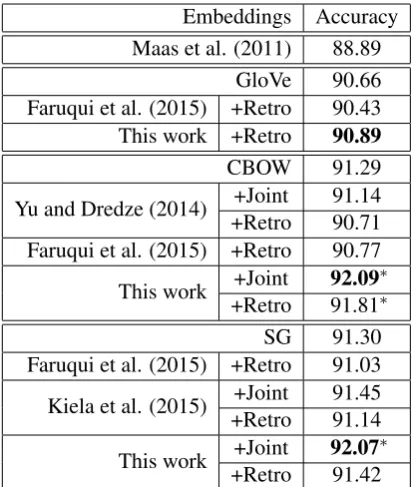
As reported in Table 3, the embeddings trained by our approach work effectively for sentiment classification. Both joint learning and retrofitting with our regularizer outperform other baseline ap-proaches from previous studies, with joint learn-ing belearn-ing somewhat better than retrofittlearn-ing. Over-all, our joint learning with CBOW achieves the best performance on this task. A ten-partition two-tailed paired t-test atp < 0.05 level is performed on comparing each score with the baseline result for each embedding type. Considering that sen-timent is not directly related to word meaning, the results indicate that our regularizer is capa-ble of incorporating different type of knowledge for a specific task, even if it is not aligned with the context learning. This task demonstrates the potential of our framework for encoding external knowledge and using it to enrich the
representa-Embeddings Accuracy Maas et al. (2011) 88.89
GloVe 90.66 Faruqui et al. (2015) +Retro 90.43 This work +Retro 90.89 CBOW 91.29 Yu and Dredze (2014) +Joint+Retro 91.1490.71 Faruqui et al. (2015) +Retro 90.77 This work +Joint+Retro 92.0991.81∗∗
SG 91.30 Faruqui et al. (2015) +Retro 91.03 Kiela et al. (2015) +Joint+Retro 91.4591.14
[image:8.595.313.520.61.305.2]This work +Joint+Retro 92.0791.42∗
Table 3: Sentiment classification results on IMDB data set (Maas et al., 2011). Bold indicates the highest score for each embedding type. * indi-cates t-test significance at p < 0.05 level when compared with the baseline.
tions of words, without the requirement to build a task-specific, customized model.
5 Related Work
semantic information. Wieting et al. (2015) im-proves embeddings by leveraging paraphrase pairs from the PPDB for learning phrase embeddings in the paraphrasing task. In a similar way, Hill et al. (2016) uses learned word embeddings as super-vised knowledge for learning phrase embeddings. Although our approach is conceptually similar to previous work, it is different in several ways. For leveraging unlabeled data, the regularizer in this work is different from applying topic distri-butions as word vectors (Maas et al., 2011) or treating topics as conditional contexts (Liu et al., 2015b). For leveraging semantic knowledge, our regularizer does not require explicit word relations as used in previous studies (Yu and Dredze, 2014; Faruqui et al., 2015; Kiela et al., 2015), but takes encoded information of words. Moreover, in order to appropriately learn the encoded information, we use trajectory softmax to perform the regulariza-tion. As a result, it provides a versatile data struc-ture to incorporate any vectorized information into embedding learning. The above novelties make our approach versatile so that it can integrate dif-ferent types of knowledge.
6 Conclusion and Future Work
In this paper we proposed a regularization frame-work for improving the learning of word embed-dings with explicit integration of prior knowl-edge. Our approach can be used independently as a retrofitter or jointly with CBOW and SG to encode prior knowledge. We proposed trajectory softmax for learning over the regularizer, which can greatly reduce the space complexity compared to hierarchical softmax using the Huffman coding tree, which enables the regularizer to learn over a long vector. Moreover, the regularizer can be constructed from either unlabeled data (e.g., LDA trained from the base corpus) or manually crafted resources such as a lexicon. Experiments on word similarity evaluation and sentiment classification show the benefits of our approach.
For the future work, we plan to evaluate the ef-fectiveness of this framework with other types of prior knowledge and NLP tasks. We also want to explore different ways of encoding external knowledge for regularization.
References
Stefano Baccianella, Andrea Esuli, and Fabrizio Sebas-tiani. 2010. SentiWordNet 3.0: An Enhanced
Lex-ical Resource for Sentiment Analysis and Opinion Mining. In Proceedings of the Seventh conference on International Language Resources and Evalua-tion (LREC’10). European Language Resources As-sociation (ELRA), Valletta, Malta.
Yoshua Bengio, R´ejean Ducharme, Pascal Vincent, and Christian Janvin. 2003. A neural probabilistic lan-guage model.J. Mach. Learn. Res.3:1137–1155. Jiang Bian, Bin Gao, and Tie-Yan Liu. 2014.
Knowledge-Powered Deep Learning for Word Em-bedding. In Proceedings of the European Confer-ence on Machine Learning and Knowledge Discov-ery in Databases - Volume 8724. New York, NY, USA, ECML PKDD 2014, pages 132–148.
David M. Blei, Andrew Y. Ng, and Michael I. Jordan. 2003. Latent Dirichlet Allocation. Journal of Ma-chine Learning Research3:993–1022.
Elia Bruni, Gemma Boleda, Marco Baroni, and Nam Khanh Tran. 2012. Distributional Semantics in Technicolor. In Proceedings of the 50th Annual Meeting of the Association for Computational Lin-guistics (Volume 1: Long Papers). Jeju Island, Ko-rea, pages 136–145.
Ronan Collobert and Jason Weston. 2008. A unified architecture for natural language processing: Deep neural networks with multitask learning. In Pro-ceedings of the 25th International Conference on Machine Learning. ACM, New York, NY, USA, ICML ’08, pages 160–167.
Ronan Collobert, Jason Weston, L´eon Bottou, Michael Karlen, Koray Kavukcuoglu, and Pavel Kuksa. 2011. Natural Language Processing (Almost) from Scratch. Journal of Machine Learning Research 12:2493–2537.
Andrew M. Dai and Quoc V. Le. 2015. Semi-supervised Sequence Learning. In Advances in Neural Information Processing Systems 28: Annual Conference on Neural Information Processing Sys-tems 2015, December 7-12, 2015, Montreal, Que-bec, Canada. pages 3079–3087.
Manaal Faruqui, Jesse Dodge, Sujay Kumar Jauhar, Chris Dyer, Eduard Hovy, and Noah A. Smith. 2015. Retrofitting word vectors to semantic lexicons. In Proceedings of the 2015 Conference of the North American Chapter of the Association for Computa-tional Linguistics: Human Language Technologies. Denver, Colorado, pages 1606–1615.
Lev Finkelstein, Evgeniy Gabrilovich, Yossi Matias, Ehud Rivlin, Zach Solan, Gadi Wolfman, and Ey-tan Ruppin. 2002. Placing Search in Context: the Concept Revisited. ACM Transaction on Informa-tion Systems20(1):116–131.
Computational Linguistics: Human Language Tech-nologies. Atlanta, Georgia, pages 758–764.
Felix Hill, KyungHyun Cho, Anna Korhonen, and Yoshua Bengio. 2016. Learning to Understand Phrases by Embedding the Dictionary. Transac-tions of the Association for Computational Linguis-tics4:17–30.
Felix Hill, Roi Reichart, and Anna Korhonen. 2015. Simlex-999: Evaluating Semantic Models with Gen-uine Similarity Estimation. Computational Linguis-tics41(4):665–695.
Douwe Kiela, Felix Hill, and Stephen Clark. 2015. Specializing word embeddings for similarity or re-latedness. InProceedings of the 2015 Conference on Empirical Methods in Natural Language Process-ing. Lisbon, Portugal, pages 2044–2048.
Quan Liu, Hui Jiang, Si Wei, Zhen-Hua Ling, and Yu Hu. 2015a. Learning semantic word embed-dings based on ordinal knowledge constraints. In Proceedings of the 53rd Annual Meeting of the Association for Computational Linguistics and the 7th International Joint Conference on Natural Lan-guage Processing (Volume 1: Long Papers). Beijing, China, pages 1501–1511.
Yang Liu, Zhiyuan Liu, Tat-Seng Chua, and Maosong Sun. 2015b. Topical Word Embeddings. In Pro-ceedings of the Twenty-Ninth AAAI Conference on Artificial Intelligence. AAAI’15, pages 2418–2424. Andrew L. Maas, Raymond E. Daly, Peter T. Pham, Dan Huang, Andrew Y. Ng, and Christopher Potts. 2011. Learning Word Vectors for Sentiment Anal-ysis. In Proceedings of the 49th Annual Meeting of the Association for Computational Linguistics: Human Language Technologies. Portland, Oregon, USA, pages 142–150.
Tomas Mikolov, Kai Chen, Greg Corrado, and Jef-frey Dean. 2013a. Efficient Estimation of Word Representations in Vector Space. arXiv preprint abs/1301.3781.
Tomas Mikolov, Quoc V. Le, and Ilya Sutskever. 2013b. Exploiting Similarities among Lan-guages for Machine Translation. arXiv preprint abs/1309.4168.
Tomas Mikolov, Ilya Sutskever, Kai Chen, Greg S Cor-rado, and Jeff Dean. 2013c. Distributed representa-tions of words and phrases and their composition-ality. In C.J.C. Burges, L. Bottou, M. Welling, Z. Ghahramani, and K.Q. Weinberger, editors, Ad-vances in Neural Information Processing Systems 26, pages 3111–3119.
Tomas Mikolov, Wen-tau Yih, and Geoffrey Zweig. 2013d. Linguistic Regularities in Continuous Space Word Representations. InProceedings of the 2013 Conference of the North American Chapter of the Association for Computational Linguistics: Human Language Technologies. Association for Computa-tional Linguistics, Atlanta, Georgia, pages 746–751.
George A. Miller. 1995. WordNet: A Lexical Database for English.Commun. ACM38(11):39–41.
Kim Anh Nguyen, Sabine Schulte im Walde, and Ngoc Thang Vu. 2016. Integrating distributional lexical contrast into word embeddings for antonym-synonym distinction. InProceedings of the 54th An-nual Meeting of the Association for Computational Linguistics (Volume 2: Short Papers). Berlin, Ger-many, pages 454–459.
Jeffrey Pennington, Richard Socher, and Christopher Manning. 2014. Glove: Global Vectors for Word Representation. In Proceedings of the 2014 Con-ference on Empirical Methods in Natural Language Processing (EMNLP). Doha, Qatar, pages 1532– 1543.
David E. Rumelhart, Geoffrey E. Hinton, and Ronald J. Williams. 1986. Learning Representations by Back-propagating Errors. Naturepages 533–536.
Peter D. Turney and Patrick Pantel. 2010. From Fre-quency to Meaning: Vector Space Models of Se-mantics. Journal of Artificial Intelligence Research 37(1):141–188.
Jason Weston, Antoine Bordes, Sumit Chopra, and Tomas Mikolov. 2015. Towards AI-Complete Ques-tion Answering: A Set of Prerequisite Toy Tasks. arXiv preprintabs/1502.05698.
John Wieting, Mohit Bansal, Kevin Gimpel, and Karen Livescu. 2015. From Paraphrase Database to Com-positional Paraphrase Model and Back. Transac-tions of the Association for Computational Linguis-tics3:345–358.
Chang Xu, Yalong Bai, Jiang Bian, Bin Gao, Gang Wang, Xiaoguang Liu, and Tie-Yan Liu. 2014. RC-NET: A General Framework for Incorporating Knowledge into Word Representations. In Proceed-ings of the 23rd ACM International Conference on Conference on Information and Knowledge Man-agement. ACM, New York, NY, USA, CIKM ’14, pages 1219–1228.