Temporal Information Extraction from Korean Texts
Young-Seob Jeong, Zae Myung Kim, Hyun-Woo Do, Chae-Gyun Lim, and Ho-Jin Choi
School of Computing
Korea Advanced Institute of Science and Technology 291 Daehak-ro, Yuseong-gu, Daejeon 305-701, South Korea
{pinode,zaemyung,realstorm103,rayote,hojinc}@kaist.ac.kr
Abstract
As documents tend to contain temporal information, extracting such information is attracting much research interests re-cently. In this paper, we propose a hybrid method that combines machine-learning models and hand-crafted rules for the task of extracting temporal information from unstructured Korean texts. We address Korean-specific research issues and pro-pose a new probabilistic model to generate complementary features. The performance of our approach is demonstrated by exper-iments on the TempEval-2 dataset, and the Korean TimeBank dataset which we built for this study.
1 Introduction
Due to the increasing number of unstructured documents available on the Web and from other sources, developing techniques that automatically extract knowledge from the documents has been of paramount importance. Among many aspects of extracting knowledge from documents, the ex-traction of temporal information is recently draw-ing much attention, since the documents usually incorporate temporal information that is useful for further applications such as Information Re-trieval (IR) and Question Answering (QA) sys-tems. Given a simple question, “who was the pres-ident of the U.S. 8 years ago?”, for example, a QA system may have a difficulty in finding the right answer without the correct temporal informa-tion about when the quesinforma-tion is posed and what ‘8 years ago’ refers to.
There have been many studies for temporal in-formation extraction, but most of them are appli-cable only to their target languages. The main rea-son for this limitation is that some parts of tem-poral information are difficult to predict without
the use of language-specific processing. For ex-ample, the normalized value ‘1983-03-08’ can be represented by ‘March 8, 1983’ in English, while it can be represented by ‘1983년삼월8일’ in Ko-rean. The order of date representation in Korean is usually different from that of English, and the digit expression in Korean is more complex than that of English. This implies that it is necessary to inves-tigate language-specific difficulties for developing a method to extract temporal information.
In this paper, we propose a method for tem-poral information extraction from Korean texts. The contributions of this paper are as follows: we (1) show how the Korean-specific issues (e.g., morpheme-level tagging, various ways of digit ex-pression, uses of lunar calendar, and so on) are ad-dressed, (2) propose a hybrid method that com-bines a set of hand-crafted rules and machine-learning models, (3) propose a data-driven proba-bilistic model to generate complementary features, and (4) create a new dataset, the Korean Time-Bank, that consists of more than 3,700 manually annotated sentences.
The rest of the paper is organized as follows. Section 2 describes the background of the re-search. Section 3 presents the details of the pro-posed method, the Korean TimeBank dataset, and how we apply the probabilistic model for generat-ing features. Section 4 shows experimental results, and Section 5 concludes the paper.
2 Background
TempEval is a series of shared tasks for temporal information extraction (Verhagen et al., 2009; Ver-hagen et al., 2010; UzZaman et al., 2013). There have been many studies related to the shared tasks (Chambers et al., 2007; Yoshikawa et al., 2009; UzZaman and Allen, 2010; Ling and Weld, 2010; Mirroshandel and Ghassem-Sani, 2012; Bethard, 2013b), which are based on the Time Mark-up Language (TimeML) (Pustejovsky et al., 2003).
The shared tasks can be summarized into three ex-traction tasks: (1) exex-traction oftimex3tags, (2) ex-traction of event and makeinstance tags, and (3) extraction of tlink tags. The timex3 tag is asso-ciated with expressions of temporal information such as ‘May 1973’ and ‘today’. The event tag andmakeinstancetag represent some eventual ex-pressions which can be related to temporal infor-mation. The makeinstance tag is an instance of the event tag. For example, the sentence, “I go to school on Mondays and Tuesdays”, contains oneevent tag on ‘go’ and twomakeinstancetags as the action ‘go’ occurs twice on Mondays and Tuesdays. The tlink tag represents a linkage be-tween two tags. Thetlinkcan be a linkage between twotimex3tags (TTtlink), twomakeinstancetags (MMtlink), a timex3 tag and amakeinstancetag (TM tlink), or Document Creation Time and a makeinstance tag (DM tlink). Note that the tlink takesmakeinstancetags as arguments, but not the eventtags, as theevent tags are merely templates for them. For the above sentence, there will be two TMtlinks: go-Tuesdays and go-Mondays. The TT tlinkis assumed to be easy to extract, so TempEval does not incorporate the TT tlinkinto the task of extractingtlinktags.
Among many related studies, there are sev-eral leading ones. HeidelTime is proposed for extraction of timex3 tags (Strotgen and Gertz, 2010). It strongly depends on hand-crafted rules, and showed the best performance in TempEval-2. Llorens et al. (2010) proposed TIPSem for all of the three extraction tasks. It employs Con-ditional Random Fields (CRF) (Lafferty et al., 2001) for capturing patterns of texts, and defines a set of hand-crafted rules for determining sev-eral attributes of the tags. ClearTK is another work proposed for all three extraction tasks (Bethard, 2013a); it utilizes machine-learning models such as Support Vector Machines (SVM) (Boser et al., 1992; Cortes and Vapnik, 1995) and Logistic Re-gressions (LR), and shows the best performance in TempEval-3.
Although the existing approaches show good re-sults, most of them are applicable only to their target languages. The first reason is that there are several attributes which are difficult to pre-dict without the use of language-specific process-ing. For instance, the attribute value of timex3 tag has a normalized form of time (e.g., 1999-04-12) following ISO-8601. This is not accurately
predictable by relying solely on data-driven ap-proaches. The second reason is that they depend on some language-specific resources (e.g., Word-Net) or tools. Unless the same quality of resources or tools is achieved for other languages, the exist-ing works would not be available to the other lan-guages. To alleviate this limitation, a language in-dependent parser for extractingtimex3tags is pro-posed (Angeli and Uszkoreit, 2013). Its portability is demonstrated by experiments with TempEval-2 dataset of six languages: English, Spanish, Ital-ian, Chinese, Korean, and French. However, the performance in English and Spanish datasets are about twice as high as the other languages, since the method highly depends on the feature defi-nition and language-specific preprocessing (e.g., morphological analysis). This implies that it is necessary to address language-specific difficulties in order to achieve high performance.
Korean language has many subtle rules and ex-ceptions on word spacing. Korean is an aggluti-native language, where verbs are formed by at-taching various endings to the stem. There are usually multiple morphemes for each token, and empty elements appear very often because sub-jects and obsub-jects are dropped to avoid duplication. Temporal expressions often take the lunar calendar representation as a tradition. Moreover, the same temporal information can have various forms due to a complex system of digit expression. For in-stance, a digit 30 can be represented as ‘30’, ‘삼십 [sam-sib]’, or ‘서른[seo-run]’. Most of these
is-sues stem from the Chinese language, as a large number of Chinese words and letters have become an integral part of Korean vocabulary due to his-torical contact. All these issues hinder the perfor-mance of the existing approaches when applied to Korean documents.
In this paper, we show how these issues are ad-dressed in our Korean-specific hybrid method. To the best of our knowledge, this is the first Korean-specific study which addresses all of the three ex-traction tasks.
3 Proposed Method
3.1 Korean TimeBank
Figure 1: Example of extent representation by to-ken indices and letter indices.
merged into one. Please refer to the examples in the 11th sentence of the 2nd training document of the TempEval-2 Korean dataset. Thus, we con-structed a new dataset called Korean TimeBank.
The new dataset is based on TimeML but with several differences. The tags of the new dataset are represented using a stand-off scheme, keep-ing the original sentences unharmed. As there are often multiple morphemes within each token in Korean, the tags are annotated in letter-level. The letter-level annotation allows multiple annotations to appear within a single token. This also makes the dataset independent of morphological analy-sis, so it is not required to update the dataset when the morphological analyzer is updated. To enable the letter-level annotation, we introduce several at-tributes fortimex3 tag and event tag:text, begin, end,e begin, ande end. The attributese beginand e endindicate token indices, whilebeginandend indicate letter indices of the extent. The attribute textcontains the string of the extent. For example, the sentence, “I work today” in Fig. 1, contains one timex3tag whosetextis ‘today’, wheree begin=2, e end=2,begin=0, andend=4.
Since temporal expressions following the lunar calendar representation appear often in Korean, we add an attributecalendar. The value of the cal-endarcan be LUNAR or other types of calendar, and its default value is GREGORIAN when it is not explicitly clarified. We also add two values for the attributemodoftimex3tag: START OR MID and MID OR END, as these expressions appear often in Korean. For example, ‘초중반 [cho-joong-ban]’ represents beginning or middle phase of a period, and ‘중후반[joong-hoo-ban]’ represents middle or ending phase of a period.
The source of the Korean TimeBank includes Wikipedia documents and hundreds of manually generated question-answer pairs. The domains of the Wikipedia documents are personage, music, university, and history. The documents are anno-tated by two trained annotators and a supervisor, all majoring in computer science. The annotated tags of each document is saved in an XML file.
Figure 2: Overall process of temporal information extraction from Korean texts.
3.2 Temporal Information Extraction from Korean Texts
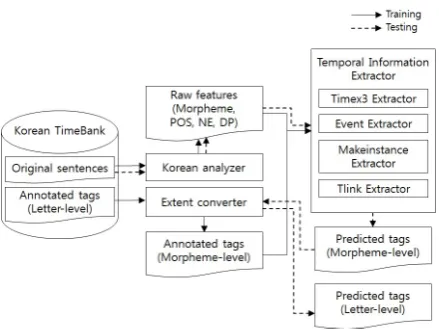
Our proposed method addresses all of the three tasks: (1) extraction oftimex3tags, (2) extraction ofeventandmakeinstancetags, and (3) extraction of tlink tags. The proposed method also extracts additional attributes oftimex3tag, such asfreq, be-ginPoint,endPoint,mod, andcalendar. The over-all process is depicted in Fig. 2, where the solid line represents training process and the dotted line represents testing process. The Korean analyzer at the center of the figure takes Korean texts as an input and generates several raw features as an output, such as results of morphological analysis, Part-Of-Speech (POS) tags, Named-Entity (NE) tags, and results of dependency parsing (Lim et al., 2006). The number of possible POS tags is 45, which follows the definition of Sejong Tree-bank1. The number of possible NE tags is 178, where each of them belongs to one of 15 super NE tags.
The generated raw features are used to define a set of features for machine-learning models and a set of hand-crafted rules. The rules are designed by examining the training dataset and the errors that the proposed method generates with the valida-tion dataset. We employ several machine-learning methods that have shown the best performance in the TempEval shared tasks, such as Maximum Entropy Model (MEM), Support Vector Machine (SVM), Conditional Random Fields (CRF), and Logistic Regression (LR).
Fig. 2 introduces Temporal Information Extrac-tor (TIE) which consists of four sub-extracExtrac-tors:
[image:3.595.82.285.63.106.2]timex3extractor,eventextractor,makeinstance ex-tractor, and tlink extractor. The timex3 extrac-tor and the event extractor work independently, and themakeinstanceextractor uses the predicted event tags. The tlink extractor makes use of the predictedmakeinstancetags and predictedtimex3 tags. Thus, the performance of timex3 extractor andeventextractor will strongly influence the per-formance ofmakeinstanceextractor andtlink ex-tractor. These four sub-extractors as a whole give predicted tags as an output, where the tags are rep-resented in morpheme-level. The extent converter at the center of the figure changes the morpheme-level tags into letter-morpheme-level and vice versa by check-ing ASCII values of each letter and each mor-pheme. In training process, the annotated tags of Korean TimeBank are converted into morpheme-level through the extent converter, and used to train the TIE.
3.2.1 Timex3 extractor
The goal oftimex3extractor is to predict whether each morpheme belongs to the extent of atimex3 tag or not, and finds appropriate attributes of the tag. There are five types of timex3 tag: DATE, TIME, DURATION, SET, and NONE. The NONE represents that the corresponding morpheme does not belong to the extent of a timex3 tag, and the other four types follow the same definition of TimeML. This is essentially a morpheme-level classification over 5 classes.
We basically take two approaches: a set of 100 hand-crafted rules and machine-learning models. Examples of the rules for extent andtypeare listed in Table 1. In the second rule of the table, the first condition is satisfied when the sequence of two morphemes is a digit followed by a morpheme ‘월
[wol]’(month), ‘일[il]’(day), or ‘주[joo]’(week). The various ways of digit expressions are also con-sidered. The second condition is satisfied when the morpheme next to the extent is ‘에[eh]’(at) or ‘마
다[ma-da]’(every) followed by ‘번[beon]’(times) or ‘회[hoi]’(times), and there must be no other
tags between the two morphemes. If these two conditions are satisfied, then the sequence of mor-phemes becomes the extent of timex3 tag whose type is SET. If one of the rules is satisfied, then the remaining rules are skipped for the target mor-pheme.
[image:4.595.314.516.100.173.2]We compare two machine-learning models, CRF and MEM, fortimex3tag by experiments. We defined a set of features based on the raw features
Table 1: Examples of the rules for extent andtype oftimex3tags.
Type Conditions
DATE Extent=(digit,년)
SET Extent=(digit,
월∨일∨주), Next morps=
(에∨마다,no other tags,번∨회)
Table 2: Examples of the rules forvalueoftimex3 tag.
Operations Conditions
Month=digit Context updated
Type=DATE∨TIME Surrounding morps=
(digit,월)
Year=context Type=DATE∨TIMESurrounding morps= (올해∨이번해)
obtained from the Korean analyzer. The defined features include morphemes, POS tags, NE tags, morpheme-level features of dependency parsing, given a particular window size. The morpheme-level features of dependency parsing are generated by following approaches in Sang and Buchholz (2000).
To predict other attributes of each predicted timex3tag, we also define sets of rules: 112 rules forvalue, 7 rules forbeginPoint/endPoint, 9 rules for freq, 10 rules for mod, and 1 rule for calen-dar. Especially, the rules for value and freqtake a temporal context into account. For instance, the sentence “We go there tomorrow”, makes it hard to predictvalueof ‘tomorrow’ without considering the temporal context. We assume that the temporal context of each sentence depends on the previous sentence. For each document, the temporal con-text is initialized with Document Creation Time (DCT), and the context is updated when a normal-izedvalueappears in a certain condition.
Examples of the rules are described in Table 2. If the first rule in the table is satisfied, then the month of value is changed to the corresponding digit and the temporal context is updated.
for seconds or minutes are listed before the rules for hours or days. This allowsvalueto be changed from smaller temporal unit to bigger unit, thereby avoiding overwriting wrong value. The rules for different attributes are listed in separate files, and are written in a systematic way similar to regular expressions. Such format enables rules to be easily manipulated.
3.2.2 Event extractor
The goal of event extractor is to predict whether each morpheme belongs to the extent of anevent tag or not, and finds appropriate classof the tag. There are 7classes ofeventtag: OCCURRENCE, PERCEPTION, REPORTING, STATE, I STATE, I ACTION, and NONE. The NONE represents that the corresponding morpheme does not be-long to the extent, and the other classes follow the same definition of TimeML. Similar to the timex3extractor, we take two approaches: a set of 26 rules and machine-learning models (e.g., CRF and MEM), based on the set of features used in the timex3extractor.
There are several verbs that often appear within the extents of event tags, although they do not carry any meaning. For example, in the sen-tence, “나는공부를하다”(I study), the verb ‘하 [ha]’(do) has no meaning while the noun ‘공부 [gong-bu]’(study) has eventual meaning. We de-fine a set of such verbal morphemes (e.g., ‘위 하[wi-ha]’(for), and ‘통하[tong-ha]’(through)), to avoid generating meaninglesseventtags.
3.2.3 Makeinstance extractor
The goal ofmakeinstanceextractor is to generate at least one makeinstancetag for each event tag, and find appropriate attributes. As we observed that there is only one makeinstance tag for each eventtag in most cases, themakeinstanceextractor simply generates one makeinstance tag for each event tag. For the attribute POS, we simply take the POS tags obtained from the Korean analyzer. We define a set of 5 rules for the attribute tense, and 2 rules for the attributepolarity.
3.2.4 Tlink extractor
The goal oftlinkextractor is to make a linkage be-tween two tags, and find appropriate types of the links. For each pair of tags, it determines whether there must be a linkage between them, and finds the most appropriate relType. There are 11 rel-Types: BEFORE, AFTER, INCLUDES,
DUR-Table 3: Features in the two kinds of classifiers.
Features for TMtlink
Surrounding morphemes of the argument tags Linear order of the argument tags
Attributetypeoftimex3tag Attributeclassofeventtag
Attributepolarityofmakeinstancetag Attributetenseofmakeinstancetag
Whethertlinktag is non-consuming tag or not Doestimex3tag exist between argument tags? Doeseventtag exist between argument tags? Iseventtag an objective of othereventtag in dependency tree?
Features for MMtlink
Surrounding morphemes ofeventtags Linear order ofeventtags
Attributeclassofeventtags
Attributepolarityofmakeinstancetags Attributetenseofmakeinstancetags Doestimex3tag exist betweeneventtags? Doeseventtag exist betweeneventtags?
ING, DURING INV, SIMULTANEOUS, IDEN-TITY, BEGINS, ENDS, OVERLAP, and NONE. The NONE represents that there is no linkage be-tween the two argument tags, and the OVERLAP means that the temporal intervals of two tags are overlapping. The other relTypes follow the same definition of TimeML. Thus, it is essentially a classification over 11 classes for each pair of two argument tags.
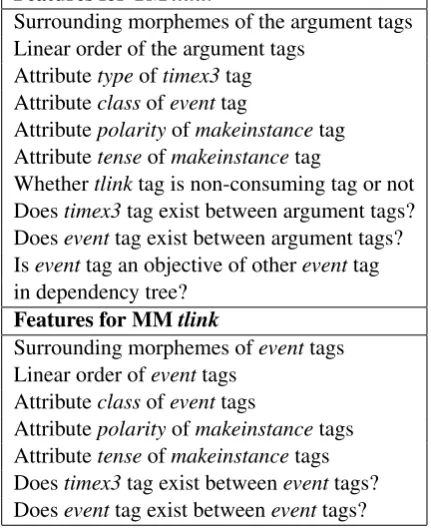
The tlink extractor generates intra-sentence tlinks and inter-sentence tlinks. For the intra-sentence tlinks, we take two approaches: a set of 19 rules and machine-learning models (e.g., SVM and LR). Among the four kinds of tlinks (e.g., TTtlink, TMtlink, MMtlink, and DMtlink), our tlink extractor generates the first three kinds of tlinks. The reason for excluding DMtlink is that we maintain the temporal context initialized with DCT in thetimex3extractor, so it is not necessary to generate DMtlinks. The TTtlinks are extracted by comparing normalized values of two timex3 tags. Two models are independently trained for predicting TMtlinks and MMtlinks, respectively. We tried many possible combinations of features to reach better performance, and obtained sets of features as described in Table 3.
[image:5.595.309.525.96.362.2]eventtags are linked withtimex3tags. Thus, firstly we predict TT tlinks, and thereafter predict TM tlinks and MMtlinks. For the inter-sentencetlinks, we generate MM tlinks between adjacent sen-tences when there is a particular expression at the beginning of a sentence, such as ‘그 후
[geu-hoo]’(afterward), ‘그 전[geu-jeon]’(beforehand), or ‘그다음[geu-da-eum]’(thereafter).
3.3 Online LIFE
As the performance of the Korean analyzer is not stable, we need complementary features to make better classifiers. Jeong and Choi (2015) proposed Language Independent Feature Extractor (LIFE) which generates a pair of class label and topic la-bel for each Letter-Sequence (LS), where LS rep-resents frequently appeared letter sequence. The class labels can be used as syntactic features, while the topic labels can be used as semantic features. The concept of LS makes it language indepen-dent, so it is basically applicable to any language. This is especially helpful to some languages that have no stable feature extractors. Korean is one of such languages, so we employ the LIFE to gener-ate complementary features.
The temporal information extractor must work online because it usually takes a stream of docu-ments as an input. However, as the LIFE is origi-nally designed to work offline, we propose an ex-tended version of the LIFE, namely, Online LIFE (O-LIFE), whose parameters are estimated incre-mentally. When we design O-LIFE, the LS con-cept of LIFE becomes a problem because the LS dictionary changes. For example, if the LS dictio-nary has only one LS goes and a new token go comes in, then the LS dictionary may containgo and es. Note that the LS goes does not exist in the new dictionary. This issue is addressed by our proposed algorithm which basically distributes the values of previously estimated parameters to new prior parameters of overlapping LSs. For the above example,φk,‘goes0 will be distributed toβk,‘go0 and βk,‘es0, wherekis a topic index.
The formal algorithm of O-LIFE is shown in Al-gorithm 1, whereCis the number of classes andT is the number of topics.Sstream is the number of streams, andSs iss-th stream ofDs documents. The four parametersa,bt,gandbcare default val-ues of the priorsα,β,γandδ. The three threshold parameterst1,t2, and t3 are used to generate LS dictionary.
Algorithm 1Online LIFE
1: INPUT:a;bt;g;bc;wp;Ss;t1;t2;t3 2: fors=1 toSstream do
3: Dics= DictionaryGenerator(t1,t2,t3) 4: ifs=1then
5: βs
t=bt,1≤t≤T
6: δcs=bc,1≤c≤C 7: else
8: βs
t,w=bt,w∈Dics
9: δc,ws =bc,w∈Dics
10: foreach itemwi ∈Dics−1do 11: ifwi∈Dicsthen
12: βt,ws i+=Bst,w−1iwp,1≤t≤T 13: δc,ws i+=Dsc,w−1iwp,1≤c≤C
14: end if
15: foreachw0i∈Dicsdo
16: βt,ws 0
i+=B s−1
t,wiwp,1≤t≤T
17: δc,ws 0
i+=D s−1
c,wiwp,1≤c≤C
18: end for
19: foreachw00i ∈Dicsdo 20: r=|woverlap|/|wi|
21: βs
t,w00 i+=B
s−1
t,wirwp,1≤t≤T
22: δs
c,w00 i+=D
s−1
c,wirwp,1≤c≤C
23: end for
24: end for
25: end if
26: αsd=a,1≤d≤Ds 27: γcs=g,1≤c≤C
28: initilizeφs,ηs,πs, andθsto zeros
29: initilize class/topic assignments 30: [φs,ηs,πs,θs] =
31: ParameterEstimation(Ss,αs,βs,γs,δs)
32: Bst=Bst−1Sφst,1≤t≤T 33: Dst=Dst−1Sηsc,1≤c≤C 34: end for
The LS dictionary of O-LIFE is updated as it reads data. That is, |Dicprev| ≤ |Diccur| and Dicprev 6⊆ Diccur, where Dicprev is the pre-vious dictionary andDiccuris the current dictio-nary. To handle this change in dictionary, the two parameters (e.g., β,δ) are updated by four steps, based on an assumption that every unique LS wi of the previous dictionary should contribute to the new dictionary as much as possible. Firstly, as de-scribed in 8th line of the algorithm, the two pa-rameters are initialized with default values. Sec-ondly, if a particular LS wi of the previous dic-tioanry exists in the new dictionary, then the two parameters increase byBst,w−1iwp andDs−1
re-Table 4: The statistics of Korean TimeBank, where the digits represent the number of corresponding items.
Training Validation Test
documents 536 131 173
sentences 2357 466 879
timex3 1245 253 494
event 6594 1145 2609
makeinstance 6615 1155 2613
tlink 1295 374 674
spectively. Bst−1 denotes an evolutionary matrix whose columns are LS-topic distribution φs−1
t , and Ds−1
c means an evolutionary matrix whose columns are LS-class distributionηts−1. By multi-plying them with the weight vectorwp, the contri-bution in initializing priors is determined for each time slice. We call this value, the weighted con-tribution. Thirdly, for everyw0
iwhich containswi, the two parameters increase by the weighted con-tribution. Lastly, for everyw00
i which overlaps with wi, the two parameters increase byr times of the weighted contribution, wherewoverlapis the over-lapping part.
The class labels and topic labels are converted to morpheme-level features by concatenating la-bels of LSs overlapping with a given morpheme. We call these features asLIFE features, and these are used to train machine-learning models, to-gether with the features based on the raw features.
4 Experiments
The Korean TimeBank is divided into a training dataset, a validation dataset, and a test dataset. The statistics of the dataset are described in Table 4. As shown in the table, only onemakeinstancetag ex-ists for eacheventtag in most cases, which follows the assumption ofmakeinstanceextractor.
4.1 Timex3 prediction
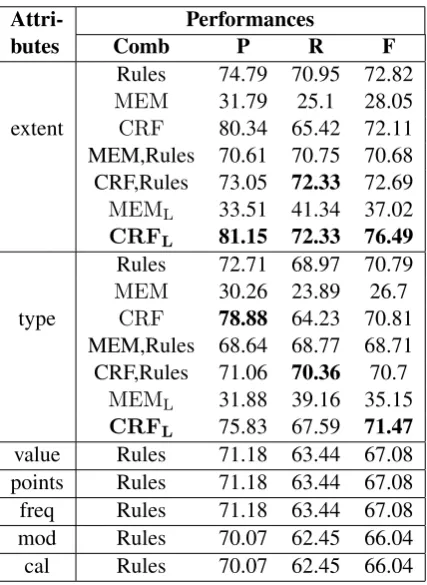
For the extent andtypeprediction, only the exactly predicted extents andtypesare regarded as correct, and the results are summarized in Table 5, where MEM is trained only with the features generated from raw features, andMEMLis trained with both of the features and LIFE features. We employ the CRF++ library2 and MEM toolkit3. The optimal 2http://crfpp.googlecode.com/svn/trunk/doc/index.html 3http://homepages.inf.ed.ac.uk/lzhang10/maxent toolkit
parameter settings are found by a grid search with the validation set. The optimal setting for CRF is as follows: L1-regularization, c=0.6, and f=1. The MEM shows its best performance without Gaus-sian prior smoothing. Both models give generally better performance when window size is 2. The parameter setting for O-LIFE is as follows:a=0.1, bt=0.1, g=0.1, bc=0.1, wp=(1), C=10, T=10, t1=0.4, t2=0.4, t3=0.7, and the number of iter-ations for estimation is 1000.
As shown in the table, CRF gives generally bet-ter performance than MEM and rules. We tried a combination of the rules and machine-learning models, and the combination led to an increase in the performance. For example, the combination of CRF and rules gives better performance than us-ing only CRF. This can be explained that there are some patterns that the machine-learning mod-els could not capture, so the combination with the rules can deal with the patterns. Note that using the LIFE features dramatically increases the perfor-mance. We believe that this is due to the raw fea-tures of Korean (e.g., POS tagger) being unstable. The LIFE features complement these unstable fea-tures by capturing syntactic/semantic patterns that are inherent in the given documents. Furthermore, we observed that the combination of the rules and machine-learning models trained with LIFE features does not contribute to the performance. This implies that using LIFE features allows the machine-learning models to capture the patterns that could not be captured by the machine-learning models without LIFE features. TheCRFL is dis-covered to be the best, and the other remaining at-tributes are predicted using the rules. The perfor-mance is measured in a sequential manner, so the performance generally decreases from the top to bottom of the table.
Table 5: Timex3 prediction results, where P repre-sents precision, R means recall, F reprerepre-sents F1 score, points represent beginPoint/endPoint, and cal representscalendar.
Attri-butes Comb PerformancesP R F
extent
Rules 74.79 70.95 72.82 MEM 31.79 25.1 28.05 CRF 80.34 65.42 72.11 MEM,Rules 70.61 70.75 70.68 CRF,Rules 73.05 72.33 72.69 MEML 33.51 41.34 37.02 CRFL 81.15 72.33 76.49
type
Rules 72.71 68.97 70.79 MEM 30.26 23.89 26.7
CRF 78.88 64.23 70.81 MEM,Rules 68.64 68.77 68.71 CRF,Rules 71.06 70.36 70.7
MEML 31.88 39.16 35.15 CRFL 75.83 67.59 71.47 value Rules 71.18 63.44 67.08 points Rules 71.18 63.44 67.08 freq Rules 71.18 63.44 67.08 mod Rules 70.07 62.45 66.04 cal Rules 70.07 62.45 66.04
Table 6: Results of timex3 prediction with TempEval-2 Korean dataset, where the digits rep-resent accuracy.
Attributes Angeli’s method Our method
type 82.0 100.0
value 42.0 100.0
used for this experiment. As shown in the table, our method gives much better accuracy than the existing method.
4.2 Event prediction
The results ofeventprediction are summarized in Table 7, which are similar to the results oftimex3 prediction. By a grid search, the optimal param-eter settings are found to be the same as that of thetimex3extractor. Employing the LIFE features again increases the performance, and theCRFLis discovered to be the best.
Table 7: Event prediction results.
Attri-butes Comb PerformancesP R F
extent
Rules 75.62 44.0 55.63 MEM 33.22 15.07 20.73 CRF 45.33 35.72 39.96 MEM,Rules 43.57 47.15 45.29 CRF,Rules 72.67 64.32 68.24 MEML 37.49 56.34 45.02 CRFL 86.49 78.5 82.3
class
Rules 63.97 37.22 47.06 MEM 31.11 14.12 19.41 CRF 34.63 27.29 30.53 MEM,Rules 36.91 39.94 38.37 CRF,Rules 61.15 54.12 57.42 MEML 34.74 51.46 41.48 CRFL 78.63 71.37 74.82
Table 8: Makeinstance prediction results.
Attri-butes PPerformancesR F
eventID 86.28 78.19 82.03 polarity 93.59 73.17 82.13 tense 71.03 51.97 60.02
4.3 Makeinstance prediction
All the attributes ofmakeinstancetag are predicted through hand-crafted rules. The performance is summarized in Table 8. The measurement of the attributePOSis excluded because we simply take the results of the Korean analyzer.
4.4 Tlink prediction
By performing a grid search with the validation set, we found that Support Vector Machine (SVM) of C-SVC type with Radial Basis Function (RBF) gives the best performance whenΓof kernel func-tion is 1/number of features. It is also found that the L1-regularized Logistic Regression (LR) with C=1 gives the best performance. We observed that both models give better performance when a win-dow size is 1.
[image:8.595.75.289.126.419.2]combina-Table 9: Tlink prediction results given correct timex3,event, andmakeinstancetags.
Attri-butes Comb PerformancesP R F
link-age
SVM 63.84 16.72 26.49 LR 20.02 63.91 30.49 Rules 39.11 59.76 47.28
SVM,Rules 39.04 61.69 47.82
LR,Rules 21.13 77.22 33.19
rel-Type
SVM 63.84 16.72 26.49 LR 19.18 61.24 29.22 Rules 37.27 56.95 45.06
SVM,Rules 37.27 58.88 45.64
[image:9.595.330.501.115.172.2]LR,Rules 20.2 73.82 31.72
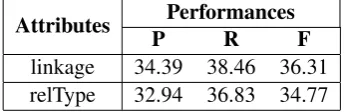
Table 10: Tlink prediction results of the combina-tion of SVM and rules, given timex3, event, and makeinstancetags which are predicted using LIFE features.
Attributes PPerformancesR F
linkage 34.39 38.46 36.31 relType 32.94 36.83 34.77
tion of the rules and machine-learning models, and the combination of SVM and rules performed the best. Note that we do not use the LIFE fea-tures fortlinkprediction because we observed that the LIFE features do not contribute to the perfor-mance fortlinkprediction. We believe that this is because the LIFE features represent only the syn-tactic/semantic patterns of the given terms, but not arbitrary relations between the terms.
The results of the second case are obtained us-ing the best combination, and are shown in Ta-ble 10. Note that thetlinktags are predicted with-out the LIFE features, while the other tags (e.g., timex3, event, makeinstance) are obtained using the LIFE features. To measure the impact of the LIFE features, we also conduct the experiment of the second case given the predicted tags without using the LIFE features, and the results are shown in Table 11. As shown in Table 10 and Table 11, using the LIFE features increases the F1 score about 6 percents.
Table 11: Tlink prediction results of the combina-tion of SVM and rules, given the tags predicted without using the LIFE features.
Attributes PPerformancesR F
linkage 25.41 36.69 30.02 relType 24.18 34.91 28.57
5 Conclusion
We introduced a new method for extracting tem-poral information from unstructured Korean texts. Korean language has a complex grammar, so there were many research issues to address prior to achieving our goal. We presented such issues and our solutions to them. Experimental results il-lustrated the effectiveness of our method, espe-cially when we adopted the extended probabilis-tical model, Online LIFE (O-LIFE), to gener-ate complementary features for training machine-learning models. In addition, as there were no suf-ficient data for this study, we have manually con-structed the Korean TimeBank consisting of more than 3,700 annotated sentences. We will extend our study to interact with Knowledge-Base for achieving better prediction of temporal informa-tion.
Acknowledgments
[image:9.595.95.268.369.425.2]References
Gabor Angeli and Jakob Uszkoreit. 2013. Language-independent discriminative parsing of temporal ex-pressions. InProceedings of the 51th Annual Meet-ing of the Association for Computational LMeet-inguis- Linguis-tics, Sofia, Bulgaria.
Steven Bethard. 2013a. Cleartk-timeml: A minimalist approach to tempeval 2013. InProceedings of the Seventh International Workshop on Semantic Evalu-ation, pages 10–14, Atlanta, Georgia, USA.
Steven Bethard. 2013b. A synchronous context free grammar for time normalization. In Proceedings of the Conference on Empirical Methods in Natu-ral Language Processing, pages 821–826, Seattle, USA.
Bernhard E. Boser, Isabelle M. Guyon, and Vladimir N. Vapnik. 1992. A training algorithm for optimal margin classifiers. In Proceedings of the fifth An-nual Workshop on Computational Learning Theory, pages 144–152, Pittsburgh, PA, USA.
Nathanael Chambers, Shan Wang, and Dan Juraf-sky. 2007. Classifying temporal relations between events. InProceedings of the 45th Annual Meeting of the ACL on Interactive Poster and Demonstration Sessions, pages 173–176, Prague, Czech Republic.
Corinna Cortes and Vladimir Vapnik. 1995. Support-vector networks. Machine Learning, 20(3):273– 297.
Young-Seob Jeong and Ho-Jin Choi. 2015. Language independent feature extractor. InProceedings of the Twenty-Ninth AAAI Conference on Artificial Intelli-gence, pages 4170–4171, Texas, USA.
John D. Lafferty, Andrew McCallum, and Fernando C. N. Pereira. 2001. Conditional random fields: Probabilistic models for segmenting and labeling se-quence data. InProceedings of the Eighteenth In-ternational Conference on Machine Learning, pages 282–289, Williamstown, USA.
Soojong Lim, ChangKi Lee, Jeong Hur, and Myoung-Gil Jang. 2006. Syntax analysis of enumera-tion type and parallel type using maximum en-tropy model. InProceedings of the Korea Human-Computer Interaction Conference, pages 1240– 1245.
Xiao Ling and Daniel S. Weld. 2010. Temporal in-formation extraction. InProceedings of the Twenty-Fourth AAAI Conference on Artificial Intelligence, Atlanta, Georgia, USA.
Hector Llorens, Estela Saquete, and Borja Navarro. 2010. Tipsem (english and spanish): Evaluating crfs and semantic roles in tempeval-2. InProceedings of the Fifth International Workshop on Semantic Eval-uation, pages 284–291, Uppsala, Sweden.
Seyed Abolghasem Mirroshandel and Gholamreza Ghassem-Sani. 2012. Towards unsupervised learn-ing of temporal relations between events. Journal of Artificial Intelligence Research, 45(1):125–163. James Pustejovsky, Jose Castano, Robert Ingria, Roser
Sauri, Robert Gaizauskas, Andrea Setzer, and Gra-ham Katz. 2003. Timeml: Robust specification of event and temporal expressions in text. InNew Di-rections in Question Answering, pages 28–34, Stan-ford, USA.
Erik F. Tjong Kim Sang and Sabine Buchholz. 2000. Introduction to the conll-2000 shared task: chunk-ing. InProceedings of the 2nd workshop on Learn-ing language in logic and the 4th conference on Computational natural language learning, pages 127–132, Lisbon, Portugal.
Jannik Strotgen and Michael Gertz. 2010. Heideltime: High quality rule-based extraction and normaliza-tion of temporal expressions. InProceedings of the Fifth International Workshop on Semantic Evalua-tion, pages 321–324, Uppsala, Sweden.
Naushad UzZaman and James Allen. 2010. Event and temporal expression extraction from raw text: First step towards a temporally aware system. Inter-national Journal of Semantic Computing, 4(4):487– 508.
Naushad UzZaman, Hector Llorens, Leon Derczyn-ski, Marc Verhagen, James Allen, and James Puste-jovsky. 2013. Semeval-2013 task 1: Tempeval-3: Evaluating time expressions, events, and temporal relations. In Proceedings of the Seventh Interna-tional Workshop on Semantic Evaluation, pages 1–9, Atlanta, Georgia, USA.
Marc Verhagen, Robert J. Gaizauskas, Frank Schilder, Mark Hepple, Jessica Moszkowicz, and James Pustejovsky. 2009. The tempeval challenge: Iden-tifying temporal relations in text. Language Re-sources and Evaluation, 43(2):161–179.
Marc Verhagen, Roser Sauri, Tommaso Caselli, and James Pustejovsky. 2010. Semeval-2010 task 13: Tempeval-2. In Proceedings of the Fifth Interna-tional Workshop on Semantic Evaluation, pages 57– 62, Uppsala, Sweden.