Abstract
—Complex numbers play a very important
role in various applications of electrical and computer
engineering. These days, arithmetic operations dealing
with these numbers rely on a “divide-and-conquer”
technique wherein a complex number is broken into its
real and imaginary parts and then, after representing
each part in binary number system, operation is carried
out on each part as if part of the real arithmetic. In an
effort to reduce the number of arithmetic operations
within the realm of complex arithmetic, binary number
system with base (
−
1+j), called complex binary number
system (CBNS), has been proposed in the literature. This
number system allows a complex number to be
represented as single-unit instead of two separate units as
in the traditional base-2 binary number system.
Arithmetic circuits to perform addition, subtraction,
multiplication, shift-left, and shift-right operations on
complex numbers represented in CBNS have been
previously presented in the literature. In this paper, we
have presented the design procedure for a divider circuit
involving CBNS.
Index Terms
—Arithmetic circuits, complex binary number
system, complex number, division.
I.
I
NTRODUCTIONComplex numbers play a very important role in engineering
applications such as digital signal processing and image
processing. Thus design of an efficient approach to handle
complex arithmetic will result in better performance in such
applications. These days, arithmetic operations dealing with
complex numbers involve, to a large extent, application of a
“divide-and-conquer” technique, whereby a complex number
is broken up into its real and imaginary parts and then
operations are carried out on each part as if it were part of the
real-arithmetic. Finally, the overall result of the complex
operation is obtained by accumulation of the individual
results. Efforts in defining binary numbers with bases other
than 2, which facilitate one-unit representation of complex
numbers, include work by Knuth [1], Penney [2], and
Stepanenko [3]. Jamil
[4] has presented a detailed analysis of
(
−
1+j)-base complex binary number system and elaborated
Tariq Jamil is an assistant professor in the Department of Electrical and Computer Engineering at Sultan Qaboos University, Oman.
(Telephone: +968-24142515, Facsimilie: +968-24413454, Email: [email protected]).
Said S. Al-Abri is a demonstrator in the Department of Electrical and Computer Engineering at Sultan Qaboos University, Oman. (Telephone: +968-24142578, Facsimilie: +968-24413454, Email: [email protected]).
on how addition, subtraction, multiplication, and division of
two such complex binary numbers can be accomplished.
Designs of adder circuit [5], subtractor circuit [6], and
multiplier circuit [7] have been previously presented in the
literature. In this paper, we have outlined the procedure for
the design of a nibble-size CBNS divider circuit.
This paper is organized as follows: In Section II, we
present a brief introduction to (
−
1+j)-base complex binary
number system. This is followed, in Section III, by the
description of division algorithm for CBNS. The truth table
for the CBNS divider circuit is presented in Section IV and,
in Section V, we have listed the minterms for the outputs of
the divider circuit. Finally, summary and conclusion are
given in Section VI, which is followed by Acknowledgment
and References.
II.
(
−
1+
J)-
BASEC
OMPLEXB
INARYN
UMBERS
YSTEMThe value of an n-bit binary number with base (–1+j) can
be written in the form of a power series as follows:
a
n-1(–1+j)
n-1+ a
n-2(–1+j)
n-2+ … + a
1(–1+j)
1+a
0(–1+j)
0where the coefficients a
n-1,a
n-2,…,a
1,a
0are binary (either 0 or
1). Using the algorithms presented in [4], we are able to
represent a given complex number in CBNS format, e.g.
2010+j2010 = 1110100000001110100010001000
base(–1+j)III.
D
IVISIONA
LGORITHM FORCBNS
The division algorithm is based on determining the
reciprocal of the divisor (denominator) and then multiplying
it with the dividend (numerator) according to the
multiplication algorithm of CBNS [4]. The multiplication of
two complex binary numbers is similar to multiplying two
ordinary base-2 binary numbers, the only difference being in
adding the intermediate results of multiplication wherein we
follow the following rules for CBNS addition: 0+0=0;
0+1=1; 1+0=1; 1+1=1100 (note that 2
10= 1100
base(–1+j)). The
zero rule (11+111=0) plays an important role in reducing the
number of summands resulting from intermediate
multiplications.
Thus (a+jb)÷ (c+jd) =(a+jb)(c+jd)
–1= (a+jb)z where z = w
–1and w = c+jd. We start with our initial approximation of z
setting z
0= (–1+j)
–kwhere k is obtained from the
representation of w such that
∑
−∞ =
−
+
−
=
ki
i
i
j
a
w
(
1
)
in which
a
k≡
1
and
a
i≡
0
for
i
f
k
. The successive
approximations are then obtained by
z
i+1=
z
i(
2
−
wz
i)
.
If the values of z do not converge, we correct our initial
Design of a Divider Circuit
for Complex Binary Numbers
approximation to z
0= j(–1+j)
–kwhich will definitely
converge[8]. Having calculated the value of z, we just
multiply it with (a+jb) to obtain the result of division. In the
following examples, for the sake of clarity, decimal numbers
have been used to explain the converging process of the
division algorithm.
Let (a + jb) = 1 + j2, and w = 1 + j3. Our calculations for
approximation of z = w
–1then begin as follows[4]:
1 + j3 = 1010
base(–1+j)= 1.(–1 + j)
3+ 0.(–1+j)
2+ 1.(–1 + j)
1+
0.(–1+j)
0⇒
k = 3. Therefore,
z
0=(–1+j)
–3= 0.25–j0.25
z
1= 0.125–j0.375
z
2= 0.09375–j0.28125
z
3= 0.09960–j0.2988
z
4= 0.0999–j0.2999
z
5= 0.1–j0.3 (converging)
Now, 0.1–j0.3 = 0.001111001011110010111100...
base(–1+j)So (1+j2) ÷ (1+j3) = (1+j2) x (1+j3)
-1= 1110101
base(–1+j)x 0.00111100101111001011110...
base(–1+j)= 1.11111001011110010111100...
base(–1+j)= 0.7–j0.1
As another example, let w = –28–j15, then
–28–j15 = 11011010011
base(–1+j)= 1.(–1+j)
10+1.(–1+j)
9+0.(–1+j)
8+1.(–1+j)
7+1.(–1+j)
6+
0.(–1+j)
5+1.(–1+j)
4+0.(–1+j)
3+0.(–1+j)
2+1.(–1+j)
1+ 1.(–1+j)
0⇒
k = 10. We begin by choosing z
0= (–1+j)
–10= j0.03125 and
find after nine iterations that it is not converging. So we
correct our initial approximation to z
0= j(–1+j)
-10= –0.03125
and find after five iterations that it converges to
z
5:=0.02+j0.014. The converging value of z
5can then be
represented in CBNS and the result of division obtained as in
previous example.
IV.
T
RUTHT
ABLE FORCBNS
D
IVIDERC
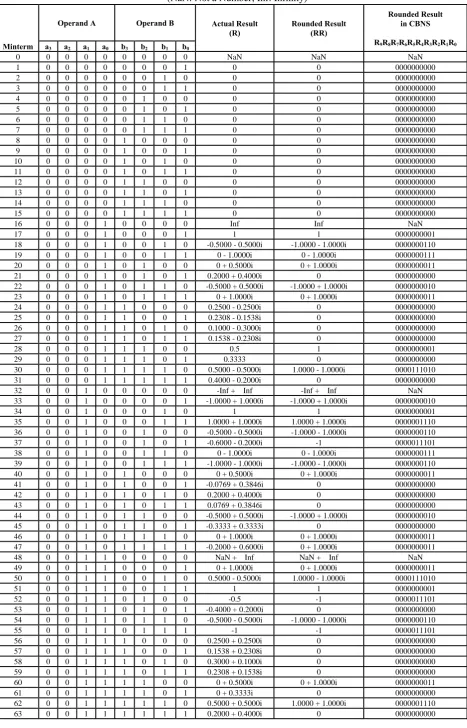
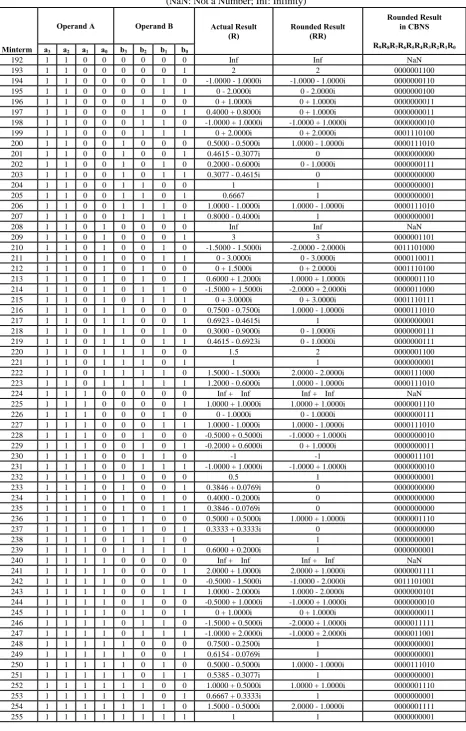
IRCUITThe first step in designing any digital circuit is to obtain
its truth table. For the divider circuit, we have assumed
nibble size operands: 4-bit size dividend or numerator
(operand A = a
3a
2a
1a
0in the truth table) and 4-bit size
divisor or denominator (operand B = b
3b
2b
1b
0in the truth
table). The division algorithm was programmed in
MATLAB and the result of division is listed in the column
labeled “R” in the truth table. Since the result of division
operation contained small fractions for some sets of
operands, we decided to round the result (RR column in the
truth table) by converging numbers less than 0.5 to 0 and
numbers greater than or equal to 0.5 to 1. This step was
necessary in order to avoid representing fractional numbers
in CBNS. Obviously, this procedure has produced some
degree of error in the final result and, therefore, the
resulting circuit can best be described as an approximate
divider circuit. The rounded result (RR) was then
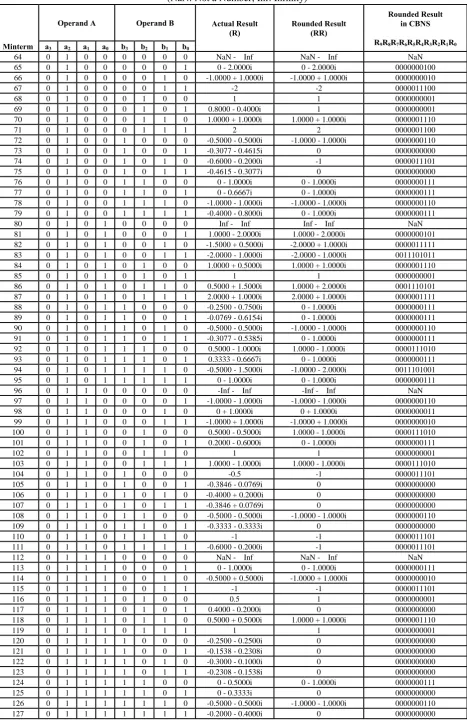
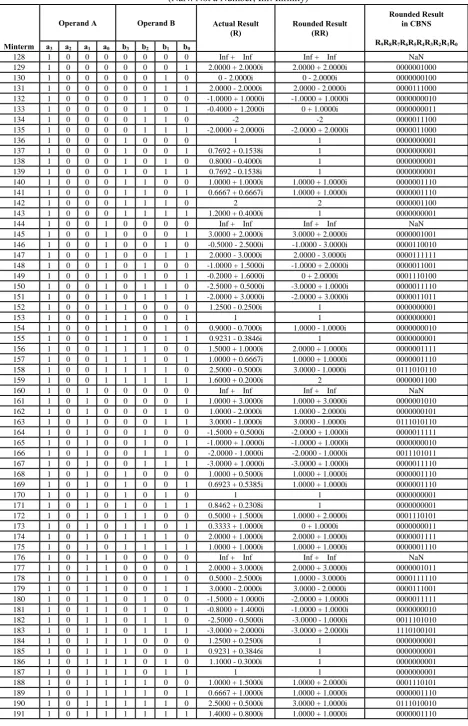
represented in CBNS. The complete truth table for the
approximate divider circuit is given in Table I.
V.
B
OOLEANE
XPRESSIONS FORD
IVIDERO
UTPUTSAs can be seen for CBNS representation of the result
obtained from division operation (Table I), we have a 10-bit
output which has been labeled as R
9R
8R
7R
6R
5R
4R
3R
2R
1R
0.
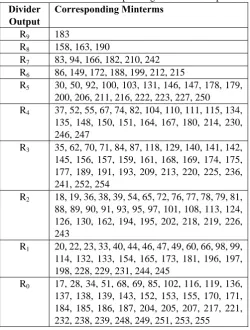
[image:2.595.305.556.154.485.2]The Boolean expression for each output is a function of
(a
3,a
2,a
1,a
0,b
3,b
2,b
1,b
0) and consists of minterms listed in
Table II.
VI.
S
UMMARY ANDC
ONCLUSIONWe have outlined the division algorithm for CBNS and
presented a complete truth table of a nibble-size divider
circuit. From the truth table, we have obtained Boolean
expressions in sum-of-minterms form for the outputs of this
circuit. This circuit can now be implemented in the hardware
and, in combination with adder, subtractor and multiplier
circuits presented earlier in scientific literature, can assist in
the design and implementation of an arithmetic unit for
CBNS.
Table II. Minterms corresponding to Divider Outputs
Divider
Output
Corresponding Minterms
R
9183
R
8158, 163, 190
R
783, 94, 166, 182, 210, 242
R
686, 149, 172, 188, 199, 212, 215
R
530, 50, 92, 100, 103, 131, 146, 147, 178, 179,
200, 206, 211, 216, 222, 223, 227, 250
R
437, 52, 55, 67, 74, 82, 104, 110, 111, 115, 134,
135, 148, 150, 151, 164, 167, 180, 214, 230,
246, 247
R
335, 62, 70, 71, 84, 87, 118, 129, 140, 141, 142,
145, 156, 157, 159, 161, 168, 169, 174, 175,
177, 189, 191, 193, 209, 213, 220, 225, 236,
241, 252, 254
R
218, 19, 36, 38, 39, 54, 65, 72, 76, 77, 78, 79, 81,
88, 89, 90, 91, 93, 95, 97, 101, 108, 113, 124,
126, 130, 162, 194, 195, 202, 218, 219, 226,
243
R
120, 22, 23, 33, 40, 44, 46, 47, 49, 60, 66, 98, 99,
114, 132, 133, 154, 165, 173, 181, 196, 197,
198, 228, 229, 231, 244, 245
R
017, 28, 34, 51, 68, 69, 85, 102, 116, 119, 136,
137, 138, 139, 143, 152, 153, 155, 170, 171,
184, 185, 186, 187, 204, 205, 207, 217, 221,
232, 238, 239, 248, 249, 251, 253, 255
A
CKNOWLEDGMENTWe gratefully acknowledge the financial support provided
by Sultan Qaboos University (Oman) for CBNS project
through various internal research grants.
R
EFERENCES[1] D. Knuth, “An imaginary number system,” Communications of the
ACM, 1960, pp. 245-247.
[2] W. Penney, “A binary system for complex numbers” Journal of the
ACM, April 1965, pp. 247-248.
[3] V. Stepanenko, “Computer arithmetic for complex numbers,”
Cybernetics and System Analysis,” Vol. 32, No. 4, 1996, pp. 585-591. [4] T. Jamil, “The complex binary number system, ” IEEE Potentials, December 2001/January 2002, pp. 39-41.
[5] T. Jamil, B. Arafeh, and A. AlHabsi, “ Hardware implementation and performance evaluation of complex binary adder designs,”
Proceedings of the 7th World Multiconference on Systemics, Cybernetics, and Informatics, Vol. II, July 27-30, 2003, pp. 68-73. [6] T. Jamil, A. Abdulghani, and A. Al-Maashari, “Design of a nibble-size
subtractor for (–1+j)-base complex binary numbers,” WSEAS Transactions on Circuits and Systems, Vol. 3, No. 5, July 2004, pp. 1067-1072.
[7] T. Jamil, A. Al-Maashari, and A. Abdulghani, “Design and implementation of a nibble-size multiplier for (–1+j)-base complex binary numbers,” WSEAS Transactions on Circuits and Systems,
Vol. 4, No. 11, November 2005, pp. 1539-1544.
[image:2.595.305.556.154.485.2]Table I. Truth Table for a Nibble-Size Divider Circuit for Complex Binary Numbers
(NaN: Not a Number; Inf: Infinity)
Minterm
Operand A Operand B Actual Result
(R)
Rounded Result (RR)
Rounded Result in CBNS
R9R8R7R6R5R4R3R2R1R0
a3 a2 a1 a0 b3 b2 b1 b0
0 0 0 0 0 0 0 0 0 NaN NaN NaN
1 0 0 0 0 0 0 0 1 0 0 0000000000
2 0 0 0 0 0 0 1 0 0 0 0000000000
3 0 0 0 0 0 0 1 1 0 0 0000000000
4 0 0 0 0 0 1 0 0 0 0 0000000000
5 0 0 0 0 0 1 0 1 0 0 0000000000
6 0 0 0 0 0 1 1 0 0 0 0000000000
7 0 0 0 0 0 1 1 1 0 0 0000000000
8 0 0 0 0 1 0 0 0 0 0 0000000000
9 0 0 0 0 1 0 0 1 0 0 0000000000
10 0 0 0 0 1 0 1 0 0 0 0000000000
11 0 0 0 0 1 0 1 1 0 0 0000000000
12 0 0 0 0 1 1 0 0 0 0 0000000000
13 0 0 0 0 1 1 0 1 0 0 0000000000
14 0 0 0 0 1 1 1 0 0 0 0000000000
15 0 0 0 0 1 1 1 1 0 0 0000000000
16 0 0 0 1 0 0 0 0 Inf Inf NaN
17 0 0 0 1 0 0 0 1 1 1 0000000001
18 0 0 0 1 0 0 1 0 -0.5000 - 0.5000i -1.0000 - 1.0000i 0000000110
19 0 0 0 1 0 0 1 1 0 - 1.0000i 0 - 1.0000i 0000000111
20 0 0 0 1 0 1 0 0 0 + 0.5000i 0 + 1.0000i 0000000011
21 0 0 0 1 0 1 0 1 0.2000 + 0.4000i 0 0000000000
22 0 0 0 1 0 1 1 0 -0.5000 + 0.5000i -1.0000 + 1.0000i 0000000010
23 0 0 0 1 0 1 1 1 0 + 1.0000i 0 + 1.0000i 0000000011
24 0 0 0 1 1 0 0 0 0.2500 - 0.2500i 0 0000000000
25 0 0 0 1 1 0 0 1 0.2308 - 0.1538i 0 0000000000
26 0 0 0 1 1 0 1 0 0.1000 - 0.3000i 0 0000000000
27 0 0 0 1 1 0 1 1 0.1538 - 0.2308i 0 0000000000
28 0 0 0 1 1 1 0 0 0.5 1 0000000001
29 0 0 0 1 1 1 0 1 0.3333 0 0000000000
30 0 0 0 1 1 1 1 0 0.5000 - 0.5000i 1.0000 - 1.0000i 0000111010
31 0 0 0 1 1 1 1 1 0.4000 - 0.2000i 0 0000000000
32 0 0 1 0 0 0 0 0 -Inf + Inf -Inf + Inf NaN
33 0 0 1 0 0 0 0 1 -1.0000 + 1.0000i -1.0000 + 1.0000i 0000000010
34 0 0 1 0 0 0 1 0 1 1 0000000001
35 0 0 1 0 0 0 1 1 1.0000 + 1.0000i 1.0000 + 1.0000i 0000001110
36 0 0 1 0 0 1 0 0 -0.5000 - 0.5000i -1.0000 - 1.0000i 0000000110
37 0 0 1 0 0 1 0 1 -0.6000 - 0.2000i -1 0000011101
38 0 0 1 0 0 1 1 0 0 - 1.0000i 0 - 1.0000i 0000000111
39 0 0 1 0 0 1 1 1 -1.0000 - 1.0000i -1.0000 - 1.0000i 0000000110
40 0 0 1 0 1 0 0 0 0 + 0.5000i 0 + 1.0000i 0000000011
41 0 0 1 0 1 0 0 1 -0.0769 + 0.3846i 0 0000000000
42 0 0 1 0 1 0 1 0 0.2000 + 0.4000i 0 0000000000
43 0 0 1 0 1 0 1 1 0.0769 + 0.3846i 0 0000000000
44 0 0 1 0 1 1 0 0 -0.5000 + 0.5000i -1.0000 + 1.0000i 0000000010
45 0 0 1 0 1 1 0 1 -0.3333 + 0.3333i 0 0000000000
46 0 0 1 0 1 1 1 0 0 + 1.0000i 0 + 1.0000i 0000000011
47 0 0 1 0 1 1 1 1 -0.2000 + 0.6000i 0 + 1.0000i 0000000011
48 0 0 1 1 0 0 0 0 NaN + Inf NaN + Inf NaN
49 0 0 1 1 0 0 0 1 0 + 1.0000i 0 + 1.0000i 0000000011
50 0 0 1 1 0 0 1 0 0.5000 - 0.5000i 1.0000 - 1.0000i 0000111010
51 0 0 1 1 0 0 1 1 1 1 0000000001
52 0 0 1 1 0 1 0 0 -0.5 -1 0000011101
53 0 0 1 1 0 1 0 1 -0.4000 + 0.2000i 0 0000000000
54 0 0 1 1 0 1 1 0 -0.5000 - 0.5000i -1.0000 - 1.0000i 0000000110
55 0 0 1 1 0 1 1 1 -1 -1 0000011101
56 0 0 1 1 1 0 0 0 0.2500 + 0.2500i 0 0000000000
57 0 0 1 1 1 0 0 1 0.1538 + 0.2308i 0 0000000000
58 0 0 1 1 1 0 1 0 0.3000 + 0.1000i 0 0000000000
59 0 0 1 1 1 0 1 1 0.2308 + 0.1538i 0 0000000000
60 0 0 1 1 1 1 0 0 0 + 0.5000i 0 + 1.0000i 0000000011
61 0 0 1 1 1 1 0 1 0 + 0.3333i 0 0000000000
62 0 0 1 1 1 1 1 0 0.5000 + 0.5000i 1.0000 + 1.0000i 0000001110
Table I. Truth Table for a Nibble-Size Divider Circuit for Complex Binary Numbers (
continued)
(NaN: Not a Number; Inf: Infinity)
Minterm
Operand A Operand B Actual Result
(R)
Rounded Result (RR)
Rounded Result in CBNS
R9R8R7R6R5R4R3R2R1R0
a3 a2 a1 a0 b3 b2 b1 b0
64 0 1 0 0 0 0 0 0 NaN - Inf NaN - Inf NaN
65 0 1 0 0 0 0 0 1 0 - 2.0000i 0 - 2.0000i 0000000100
66 0 1 0 0 0 0 1 0 -1.0000 + 1.0000i -1.0000 + 1.0000i 0000000010
67 0 1 0 0 0 0 1 1 -2 -2 0000011100
68 0 1 0 0 0 1 0 0 1 1 0000000001
69 0 1 0 0 0 1 0 1 0.8000 - 0.4000i 1 0000000001
70 0 1 0 0 0 1 1 0 1.0000 + 1.0000i 1.0000 + 1.0000i 0000001110
71 0 1 0 0 0 1 1 1 2 2 0000001100
72 0 1 0 0 1 0 0 0 -0.5000 - 0.5000i -1.0000 - 1.0000i 0000000110
73 0 1 0 0 1 0 0 1 -0.3077 - 0.4615i 0 0000000000
74 0 1 0 0 1 0 1 0 -0.6000 - 0.2000i -1 0000011101
75 0 1 0 0 1 0 1 1 -0.4615 - 0.3077i 0 0000000000
76 0 1 0 0 1 1 0 0 0 - 1.0000i 0 - 1.0000i 0000000111
77 0 1 0 0 1 1 0 1 0 - 0.6667i 0 - 1.0000i 0000000111
78 0 1 0 0 1 1 1 0 -1.0000 - 1.0000i -1.0000 - 1.0000i 0000000110
79 0 1 0 0 1 1 1 1 -0.4000 - 0.8000i 0 - 1.0000i 0000000111
80 0 1 0 1 0 0 0 0 Inf - Inf Inf - Inf NaN
81 0 1 0 1 0 0 0 1 1.0000 - 2.0000i 1.0000 - 2.0000i 0000000101
82 0 1 0 1 0 0 1 0 -1.5000 + 0.5000i -2.0000 + 1.0000i 0000011111
83 0 1 0 1 0 0 1 1 -2.0000 - 1.0000i -2.0000 - 1.0000i 0011101011
84 0 1 0 1 0 1 0 0 1.0000 + 0.5000i 1.0000 + 1.0000i 0000001110
85 0 1 0 1 0 1 0 1 1 1 0000000001
86 0 1 0 1 0 1 1 0 0.5000 + 1.5000i 1.0000 + 2.0000i 0001110101
87 0 1 0 1 0 1 1 1 2.0000 + 1.0000i 2.0000 + 1.0000i 0000001111
88 0 1 0 1 1 0 0 0 -0.2500 - 0.7500i 0 - 1.0000i 0000000111
89 0 1 0 1 1 0 0 1 -0.0769 - 0.6154i 0 - 1.0000i 0000000111
90 0 1 0 1 1 0 1 0 -0.5000 - 0.5000i -1.0000 - 1.0000i 0000000110
91 0 1 0 1 1 0 1 1 -0.3077 - 0.5385i 0 - 1.0000i 0000000111
92 0 1 0 1 1 1 0 0 0.5000 - 1.0000i 1.0000 - 1.0000i 0000111010
93 0 1 0 1 1 1 0 1 0.3333 - 0.6667i 0 - 1.0000i 0000000111
94 0 1 0 1 1 1 1 0 -0.5000 - 1.5000i -1.0000 - 2.0000i 0011101001
95 0 1 0 1 1 1 1 1 0 - 1.0000i 0 - 1.0000i 0000000111
96 0 1 1 0 0 0 0 0 -Inf - Inf -Inf - Inf NaN
97 0 1 1 0 0 0 0 1 -1.0000 - 1.0000i -1.0000 - 1.0000i 0000000110
98 0 1 1 0 0 0 1 0 0 + 1.0000i 0 + 1.0000i 0000000011
99 0 1 1 0 0 0 1 1 -1.0000 + 1.0000i -1.0000 + 1.0000i 0000000010
100 0 1 1 0 0 1 0 0 0.5000 - 0.5000i 1.0000 - 1.0000i 0000111010
101 0 1 1 0 0 1 0 1 0.2000 - 0.6000i 0 - 1.0000i 0000000111
102 0 1 1 0 0 1 1 0 1 1 0000000001
103 0 1 1 0 0 1 1 1 1.0000 - 1.0000i 1.0000 - 1.0000i 0000111010
104 0 1 1 0 1 0 0 0 -0.5 -1 0000011101
105 0 1 1 0 1 0 0 1 -0.3846 - 0.0769i 0 0000000000
106 0 1 1 0 1 0 1 0 -0.4000 + 0.2000i 0 0000000000
107 0 1 1 0 1 0 1 1 -0.3846 + 0.0769i 0 0000000000
108 0 1 1 0 1 1 0 0 -0.5000 - 0.5000i -1.0000 - 1.0000i 0000000110
109 0 1 1 0 1 1 0 1 -0.3333 - 0.3333i 0 0000000000
110 0 1 1 0 1 1 1 0 -1 -1 0000011101
111 0 1 1 0 1 1 1 1 -0.6000 - 0.2000i -1 0000011101
112 0 1 1 1 0 0 0 0 NaN - Inf NaN - Inf NaN
113 0 1 1 1 0 0 0 1 0 - 1.0000i 0 - 1.0000i 0000000111
114 0 1 1 1 0 0 1 0 -0.5000 + 0.5000i -1.0000 + 1.0000i 0000000010
115 0 1 1 1 0 0 1 1 -1 -1 0000011101
116 0 1 1 1 0 1 0 0 0.5 1 0000000001
117 0 1 1 1 0 1 0 1 0.4000 - 0.2000i 0 0000000000
118 0 1 1 1 0 1 1 0 0.5000 + 0.5000i 1.0000 + 1.0000i 0000001110
119 0 1 1 1 0 1 1 1 1 1 0000000001
120 0 1 1 1 1 0 0 0 -0.2500 - 0.2500i 0 0000000000
121 0 1 1 1 1 0 0 1 -0.1538 - 0.2308i 0 0000000000
122 0 1 1 1 1 0 1 0 -0.3000 - 0.1000i 0 0000000000
123 0 1 1 1 1 0 1 1 -0.2308 - 0.1538i 0 0000000000
124 0 1 1 1 1 1 0 0 0 - 0.5000i 0 - 1.0000i 0000000111
125 0 1 1 1 1 1 0 1 0 - 0.3333i 0 0000000000
126 0 1 1 1 1 1 1 0 -0.5000 - 0.5000i -1.0000 - 1.0000i 0000000110
Table I. Truth Table for a Nibble-Size Divider Circuit for Complex Binary Numbers (
continued)
(NaN: Not a Number; Inf: Infinity)
Minterm
Operand A Operand B Actual Result
(R)
Rounded Result (RR)
Rounded Result in CBNS
R9R8R7R6R5R4R3R2R1R0
a3 a2 a1 a0 b3 b2 b1 b0
128 1 0 0 0 0 0 0 0 Inf + Inf Inf + Inf NaN
129 1 0 0 0 0 0 0 1 2.0000 + 2.0000i 2.0000 + 2.0000i 0000001000
130 1 0 0 0 0 0 1 0 0 - 2.0000i 0 - 2.0000i 0000000100
131 1 0 0 0 0 0 1 1 2.0000 - 2.0000i 2.0000 - 2.0000i 0000111000
132 1 0 0 0 0 1 0 0 -1.0000 + 1.0000i -1.0000 + 1.0000i 0000000010
133 1 0 0 0 0 1 0 1 -0.4000 + 1.2000i 0 + 1.0000i 0000000011
134 1 0 0 0 0 1 1 0 -2 -2 0000011100
135 1 0 0 0 0 1 1 1 -2.0000 + 2.0000i -2.0000 + 2.0000i 0000011000
136 1 0 0 0 1 0 0 0 1 1 0000000001
137 1 0 0 0 1 0 0 1 0.7692 + 0.1538i 1 0000000001
138 1 0 0 0 1 0 1 0 0.8000 - 0.4000i 1 0000000001
139 1 0 0 0 1 0 1 1 0.7692 - 0.1538i 1 0000000001
140 1 0 0 0 1 1 0 0 1.0000 + 1.0000i 1.0000 + 1.0000i 0000001110
141 1 0 0 0 1 1 0 1 0.6667 + 0.6667i 1.0000 + 1.0000i 0000001110
142 1 0 0 0 1 1 1 0 2 2 0000001100
143 1 0 0 0 1 1 1 1 1.2000 + 0.4000i 1 0000000001
144 1 0 0 1 0 0 0 0 Inf + Inf Inf + Inf NaN
145 1 0 0 1 0 0 0 1 3.0000 + 2.0000i 3.0000 + 2.0000i 0000001001
146 1 0 0 1 0 0 1 0 -0.5000 - 2.5000i -1.0000 - 3.0000i 0000110010
147 1 0 0 1 0 0 1 1 2.0000 - 3.0000i 2.0000 - 3.0000i 0000111111
148 1 0 0 1 0 1 0 0 -1.0000 + 1.5000i -1.0000 + 2.0000i 0000011001
149 1 0 0 1 0 1 0 1 -0.2000 + 1.6000i 0 + 2.0000i 0001110100
150 1 0 0 1 0 1 1 0 -2.5000 + 0.5000i -3.0000 + 1.0000i 0000011110
151 1 0 0 1 0 1 1 1 -2.0000 + 3.0000i -2.0000 + 3.0000i 0000011011
152 1 0 0 1 1 0 0 0 1.2500 - 0.2500i 1 0000000001
153 1 0 0 1 1 0 0 1 1 1 0000000001
154 1 0 0 1 1 0 1 0 0.9000 - 0.7000i 1.0000 - 1.0000i 0000000010
155 1 0 0 1 1 0 1 1 0.9231 - 0.3846i 1 0000000001
156 1 0 0 1 1 1 0 0 1.5000 + 1.0000i 2.0000 + 1.0000i 0000001111
157 1 0 0 1 1 1 0 1 1.0000 + 0.6667i 1.0000 + 1.0000i 0000001110
158 1 0 0 1 1 1 1 0 2.5000 - 0.5000i 3.0000 - 1.0000i 0111010110
159 1 0 0 1 1 1 1 1 1.6000 + 0.2000i 2 0000001100
160 1 0 1 0 0 0 0 0 Inf + Inf Inf + Inf NaN
161 1 0 1 0 0 0 0 1 1.0000 + 3.0000i 1.0000 + 3.0000i 0000001010
162 1 0 1 0 0 0 1 0 1.0000 - 2.0000i 1.0000 - 2.0000i 0000000101
163 1 0 1 0 0 0 1 1 3.0000 - 1.0000i 3.0000 - 1.0000i 0111010110
164 1 0 1 0 0 1 0 0 -1.5000 + 0.5000i -2.0000 + 1.0000i 0000011111
165 1 0 1 0 0 1 0 1 -1.0000 + 1.0000i -1.0000 + 1.0000i 0000000010
166 1 0 1 0 0 1 1 0 -2.0000 - 1.0000i -2.0000 - 1.0000i 0011101011
167 1 0 1 0 0 1 1 1 -3.0000 + 1.0000i -3.0000 + 1.0000i 0000011110
168 1 0 1 0 1 0 0 0 1.0000 + 0.5000i 1.0000 + 1.0000i 0000001110
169 1 0 1 0 1 0 0 1 0.6923 + 0.5385i 1.0000 + 1.0000i 0000001110
170 1 0 1 0 1 0 1 0 1 1 0000000001
171 1 0 1 0 1 0 1 1 0.8462 + 0.2308i 1 0000000001
172 1 0 1 0 1 1 0 0 0.5000 + 1.5000i 1.0000 + 2.0000i 0001110101
173 1 0 1 0 1 1 0 1 0.3333 + 1.0000i 0 + 1.0000i 0000000011
174 1 0 1 0 1 1 1 0 2.0000 + 1.0000i 2.0000 + 1.0000i 0000001111
175 1 0 1 0 1 1 1 1 1.0000 + 1.0000i 1.0000 + 1.0000i 0000001110
176 1 0 1 1 0 0 0 0 Inf + Inf Inf + Inf NaN
177 1 0 1 1 0 0 0 1 2.0000 + 3.0000i 2.0000 + 3.0000i 0000001011
178 1 0 1 1 0 0 1 0 0.5000 - 2.5000i 1.0000 - 3.0000i 0000111110
179 1 0 1 1 0 0 1 1 3.0000 - 2.0000i 3.0000 - 2.0000i 0000111001
180 1 0 1 1 0 1 0 0 -1.5000 + 1.0000i -2.0000 + 1.0000i 0000011111
181 1 0 1 1 0 1 0 1 -0.8000 + 1.4000i -1.0000 + 1.0000i 0000000010
182 1 0 1 1 0 1 1 0 -2.5000 - 0.5000i -3.0000 - 1.0000i 0011101010
183 1 0 1 1 0 1 1 1 -3.0000 + 2.0000i -3.0000 + 2.0000i 1110100101
184 1 0 1 1 1 0 0 0 1.2500 + 0.2500i 1 0000000001
185 1 0 1 1 1 0 0 1 0.9231 + 0.3846i 1 0000000001
186 1 0 1 1 1 0 1 0 1.1000 - 0.3000i 1 0000000001
187 1 0 1 1 1 0 1 1 1 1 0000000001
188 1 0 1 1 1 1 0 0 1.0000 + 1.5000i 1.0000 + 2.0000i 0001110101
189 1 0 1 1 1 1 0 1 0.6667 + 1.0000i 1.0000 + 1.0000i 0000001110
190 1 0 1 1 1 1 1 0 2.5000 + 0.5000i 3.0000 + 1.0000i 0111010010
Table I. Truth Table for a Nibble-Size Divider Circuit for Complex Binary Numbers (
continued)
(NaN: Not a Number; Inf: Infinity)
Minterm
Operand A Operand B Actual Result
(R)
Rounded Result (RR)
Rounded Result in CBNS
R9R8R7R6R5R4R3R2R1R0
a3 a2 a1 a0 b3 b2 b1 b0
192 1 1 0 0 0 0 0 0 Inf Inf NaN
193 1 1 0 0 0 0 0 1 2 2 0000001100
194 1 1 0 0 0 0 1 0 -1.0000 - 1.0000i -1.0000 - 1.0000i 0000000110
195 1 1 0 0 0 0 1 1 0 - 2.0000i 0 - 2.0000i 0000000100
196 1 1 0 0 0 1 0 0 0 + 1.0000i 0 + 1.0000i 0000000011
197 1 1 0 0 0 1 0 1 0.4000 + 0.8000i 0 + 1.0000i 0000000011
198 1 1 0 0 0 1 1 0 -1.0000 + 1.0000i -1.0000 + 1.0000i 0000000010
199 1 1 0 0 0 1 1 1 0 + 2.0000i 0 + 2.0000i 0001110100
200 1 1 0 0 1 0 0 0 0.5000 - 0.5000i 1.0000 - 1.0000i 0000111010
201 1 1 0 0 1 0 0 1 0.4615 - 0.3077i 0 0000000000
202 1 1 0 0 1 0 1 0 0.2000 - 0.6000i 0 - 1.0000i 0000000111
203 1 1 0 0 1 0 1 1 0.3077 - 0.4615i 0 0000000000
204 1 1 0 0 1 1 0 0 1 1 0000000001
205 1 1 0 0 1 1 0 1 0.6667 1 0000000001
206 1 1 0 0 1 1 1 0 1.0000 - 1.0000i 1.0000 - 1.0000i 0000111010
207 1 1 0 0 1 1 1 1 0.8000 - 0.4000i 1 0000000001
208 1 1 0 1 0 0 0 0 Inf Inf NaN
209 1 1 0 1 0 0 0 1 3 3 0000001101
210 1 1 0 1 0 0 1 0 -1.5000 - 1.5000i -2.0000 - 2.0000i 0011101000
211 1 1 0 1 0 0 1 1 0 - 3.0000i 0 - 3.0000i 0000110011
212 1 1 0 1 0 1 0 0 0 + 1.5000i 0 + 2.0000i 0001110100
213 1 1 0 1 0 1 0 1 0.6000 + 1.2000i 1.0000 + 1.0000i 0000001110
214 1 1 0 1 0 1 1 0 -1.5000 + 1.5000i -2.0000 + 2.0000i 0000011000
215 1 1 0 1 0 1 1 1 0 + 3.0000i 0 + 3.0000i 0001110111
216 1 1 0 1 1 0 0 0 0.7500 - 0.7500i 1.0000 - 1.0000i 0000111010
217 1 1 0 1 1 0 0 1 0.6923 - 0.4615i 1 0000000001
218 1 1 0 1 1 0 1 0 0.3000 - 0.9000i 0 - 1.0000i 0000000111
219 1 1 0 1 1 0 1 1 0.4615 - 0.6923i 0 - 1.0000i 0000000111
220 1 1 0 1 1 1 0 0 1.5 2 0000001100
221 1 1 0 1 1 1 0 1 1 1 0000000001
222 1 1 0 1 1 1 1 0 1.5000 - 1.5000i 2.0000 - 2.0000i 0000111000
223 1 1 0 1 1 1 1 1 1.2000 - 0.6000i 1.0000 - 1.0000i 0000111010
224 1 1 1 0 0 0 0 0 Inf + Inf Inf + Inf NaN
225 1 1 1 0 0 0 0 1 1.0000 + 1.0000i 1.0000 + 1.0000i 0000001110
226 1 1 1 0 0 0 1 0 0 - 1.0000i 0 - 1.0000i 0000000111
227 1 1 1 0 0 0 1 1 1.0000 - 1.0000i 1.0000 - 1.0000i 0000111010
228 1 1 1 0 0 1 0 0 -0.5000 + 0.5000i -1.0000 + 1.0000i 0000000010
229 1 1 1 0 0 1 0 1 -0.2000 + 0.6000i 0 + 1.0000i 0000000011
230 1 1 1 0 0 1 1 0 -1 -1 0000011101
231 1 1 1 0 0 1 1 1 -1.0000 + 1.0000i -1.0000 + 1.0000i 0000000010
232 1 1 1 0 1 0 0 0 0.5 1 0000000001
233 1 1 1 0 1 0 0 1 0.3846 + 0.0769i 0 0000000000
234 1 1 1 0 1 0 1 0 0.4000 - 0.2000i 0 0000000000
235 1 1 1 0 1 0 1 1 0.3846 - 0.0769i 0 0000000000
236 1 1 1 0 1 1 0 0 0.5000 + 0.5000i 1.0000 + 1.0000i 0000001110
237 1 1 1 0 1 1 0 1 0.3333 + 0.3333i 0 0000000000
238 1 1 1 0 1 1 1 0 1 1 0000000001
239 1 1 1 0 1 1 1 1 0.6000 + 0.2000i 1 0000000001
240 1 1 1 1 0 0 0 0 Inf + Inf Inf + Inf NaN
241 1 1 1 1 0 0 0 1 2.0000 + 1.0000i 2.0000 + 1.0000i 0000001111
242 1 1 1 1 0 0 1 0 -0.5000 - 1.5000i -1.0000 - 2.0000i 0011101001
243 1 1 1 1 0 0 1 1 1.0000 - 2.0000i 1.0000 - 2.0000i 0000000101
244 1 1 1 1 0 1 0 0 -0.5000 + 1.0000i -1.0000 + 1.0000i 0000000010
245 1 1 1 1 0 1 0 1 0 + 1.0000i 0 + 1.0000i 0000000011
246 1 1 1 1 0 1 1 0 -1.5000 + 0.5000i -2.0000 + 1.0000i 0000011111
247 1 1 1 1 0 1 1 1 -1.0000 + 2.0000i -1.0000 + 2.0000i 0000011001
248 1 1 1 1 1 0 0 0 0.7500 - 0.2500i 1 0000000001
249 1 1 1 1 1 0 0 1 0.6154 - 0.0769i 1 0000000001
250 1 1 1 1 1 0 1 0 0.5000 - 0.5000i 1.0000 - 1.0000i 0000111010
251 1 1 1 1 1 0 1 1 0.5385 - 0.3077i 1 0000000001
252 1 1 1 1 1 1 0 0 1.0000 + 0.5000i 1.0000 + 1.0000i 0000001110
253 1 1 1 1 1 1 0 1 0.6667 + 0.3333i 1 0000000001
254 1 1 1 1 1 1 1 0 1.5000 - 0.5000i 2.0000 - 1.0000i 0000001111