The CLaC Discourse Parser at CoNLL-2015
Majid Laali Elnaz Davoodi Leila Kosseim
Department of Computer Science and Software Engineering, Concordia University, Montreal, Quebec, Canada
{m laali, e davoo, kosseim}@encs.concordia.ca
Abstract
This paper describes our submission ( kos-seim15) to the CoNLL-2015 shared task on shallow discourse parsing. We used the UIMA framework to develop our parser and used ClearTK to add machine learn-ing functionality to the UIMA framework. Overall, our parser achieves a result of 17.3 F1 on the identification of discourse relations on the blind CoNLL-2015 test set, ranking in sixth place.
1 Introduction
Today, discourse parsers typically consist of sev-eral independent components that address the fol-lowing problems:
1. Discourse Connective Classification: The concern of this problem is the identification of discourse usage of discourse connectives within a text.
2. Argument Labeling: This problem focuses on labeling the text spans of the two discourse arguments, namely ARG1 and ARG2.
3. Explicit Sense Classification: This problem can be reduced to the sense disambiguation of the discourse connective in an explicit dis-course relation.
4. Non-Explicit Sense Classification: The target of this problem is the identification of im-plicit discourse relations between two con-secutive sentences.
To illustrate these tasks, consider Example (1):
(1) We would stop index arbitrage when the market is under stress.1
1The example is taken from the CoNLL 2015 trial dataset.
The task of Discourse Connective Classification
is to determine if the marker “when” is used to mark a discourse relation or not. Argument La-beling should segment the two arguments ARG1
and ARG2 (in this example, ARG1 is italicized
while ARG2 is bolded). Finally, Explicit Sense Classificationshould identify which discourse re-lation is signaled by“when”- in this case CON -TINGENCY.CONDITION.
In this paper, we report on the development and results of our discourse parser for the CoNLL 2015 shared task. Our parser, named CLaC Dis-course Parser, was built from scratch and took about 3 person-month to code. The focus of the CLaC Discourse Parser is the treatment of explicit discourse relations (i.e. problem 1 to 3 above).
2 Architecture of the CLaC Discourse Parser
We developed our parser based on the UIMA framework (Ferrucci and Lally, 2004) and we used ClearTK (Bethard et al., 2014) to add machine learning functionality to the UIMA framework. The parser was written in Java and its source code is distributed under the BSD license2.
Figure 1 shows the architecture of the CLaC Discourse Parser. Motivated by Lin et al. (2014), the architecture of the CLaC Discourse Parser is a pipeline that consists in five components: CoNLL Syntax Reader, Discourse Connective Annotator,
Argument Labeler, Discourse Sense Annotator
andCoNLL JSON Exporter. Due to lack of time, we did not implement a Non-Explicit Classifica-tion in our pipeline and only focused on explicit discourse relations.
The CoNLL Syntax Reader and the CoNLL JSON Exporter were added to the CLaC Dis-course Parser in order for the input and the output of the parser to be compatible with the CoNLL 2All the source codes can be downloaded from https://github.com/mjlaali/CLaCDiscourseParser.git
Figure 1: Components of the CLaC Discourse Parser
2015 Shared Task specifications. The CoNLL Syntax Reader parses syntactic information (i.e. POS tags, constituent parse trees and dependency parses). CoNLL organisers and adds this syntac-tic information to the documents in the UIMA framework. To create a stand-alone parser, the
CoNLL Syntax Readercan be easily replaced with
the cleartk-berkeleyparser component
in the CLaC discourse Parser pipeline. This com-ponent is a wrapper around the Berkeley syntac-tic parser (Petrov and Klein, 2007) and distributed with ClearTK. The Berkeley syntactic parser was actually used in the CoNLL shared task to parse texts and generate the syntactic information.
The CoNLL JSON Exporter reads the output discourse relations annotated in the UIMA doc-uments and generates a JSON file in the format required for the CoNLL shared task. We will dis-cuss the other components in details in the next sections.
2.1 Discourse Connective Annotator
To annotate discourse connectives, theDiscourse Connective Annotatorfirst searches the input texts for terms that match a pre-defined list of discourse connectives. This list of discourse connectives was built solely from the CoNLL training dataset of around 30K explicit discourse relations and con-tains 100 discourse connectives. Each match of discourse connective is then checked to see if it occurs in discourse usage or not.
Inspired by (Pitler et al., 2009), we built a bi-nary classifier with six local syntactic and lexical-ized features of discourse connectives to classify discourse connectives as discourse usage or non-discourse usage. These features are listed in Ta-ble 1 in the row labeledConnective Features.
2.2 Argument Labeler
When ARG1 and ARG2 appear in the same
sen-tence, we can exploit the syntactic tree to label boundaries of the discourse arguments. Motivated by (Lin et al., 2014), we first classify each con-stituent in the parse tree into to three categories: part of ARG1, part of ARG2 or NON (i.e. is not
part of any discourse argument). Then, all con-stituents which were tagged as part of ARG1 or
as part of ARG2 are merged to obtain the actual
boundaries of ARG1 and ARG2.
Previous studies have shown that learning an ar-gument labeler classifier when all syntactic con-stituents are considered suffers from many in-stances being labeled as NON(Kong et al., 2014).
In order to avoid this, we used the approach pro-posed by Kong et al. (2014) to prune constituents with a NON label. This approach uses only the
nodes in the path from the discourse connective (orSelfCatsee Table 1) to the root of the sentence (Connective-Root path nodes) to limit the number of the candidate constituents. More formally, only constituents that are directly connected to one of theConnective-Root path nodesare considered for the classification.
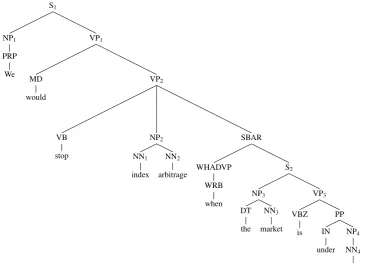
For example, consider the parse tree of Exam-ple (1) shown in Figure 2. The path from the dis-course connective“when”to the root of the sen-tence contains these nodes: {WRB, WHADVP, SBAR, VP2, VP1, S1}. Therefore, we only con-sider{S2, NP2, VB, MD, NP1}for obtaining dis-course arguments.
If the classifier does not classify any constituent as a part of ARG1, we assume that the ARG1 is
not in the same sentence as ARG2. In such a
sce-nario, we consider the whole text of the previous sentence as ARG1.
In the current implementation, we made the assumption that discourse connectives cannot be multiword expressions. Therefore, the Argument Labeler cannot identify the arguments of paral-lel discourse connectives (e.g. either..or, on one hand..on the other hand, etc.)
We used a sub-set of 9 features proposed by Kong et al. (2014) for the Argument Labeler clas-sifier. The complete list of features is listed in Ta-ble 1.
2.3 Discourse Sense Annotator
S1
NP1
PRP
We
VP1
MD
would
VP2
VB
stop
NP2
NN1
index NN2
arbitrage
SBAR
WHADVP
WRB
when
S2
NP3 DT
the NN3
market
VP3
VBZ
is
PP IN
under NP4
NN4
[image:3.595.117.485.62.325.2]stress
Figure 2: The Parse Tree Provided by CoNLL 2015 for Example (1)
Category Description Example
Connective Features
1. The discourse connective text in lowercase. when
2. The categorization of the case of the connective:
all lowercase,all uppercaseandinitial uppercase all lowercase
3. The highest node in the parse tree that covers the
connective words but nothing more WRB
4. The parent ofSelfCat WHADVP
5. The left sibling ofSelfCat null 6. The right sibling ofSelfCat S Syntactic
Node Features
7. The path from the node to theSelfCatnode in the
parser tree SW HADV P↑ SBAR ↓
8. The context of the node in the parse tree. The context of a node is defined by its label the label of its parent, the label of left and right sibling in the parse tree.
S-SBAR-WHADVP-null
9. The position of the node relative to the SelfCat
node:leftorright left
Table 1: Features Used in the CLaC Discourse Parser
frequent relation performs rather well. Accord-ing to Pitler et al. (2009), such an approach can achieve an accuracy of 85.86%. Due to lack of time, we implemented this na¨ıve approach for the Discourse Sense Annotator, using the 100 con-nectives mined from the dataset (see Section 2.1) and their most frequent relation as mined from the CoNLL training dataset.
3 Experiments and Results
As explained in Section 2, the CLaC Discourse Parser contains two main classifiers, one for the
Discourse Connective Annotator and one for the
[image:3.595.90.509.366.605.2]us-Discourse Connective Classifier
Argument Labeler
Discourse Parsing (explicit only)
Discourse Parsing (explicit and implicit)
Best Result 91.86% 41.35% 30.58% 24.00%
CLaC Parser 90.19% 36.60% 27.32% 17.38%
Average 74.20% 23.89% 18.28% 13.25%
[image:4.595.84.512.61.155.2]Standard deviation 23.24% 13.01% 9.93% 6.41%
Table 2: Summary of the Results of the CLaC Discourse Parser in the CoNLL 2015 Shared Task.
ing the CoNLL training dataset.
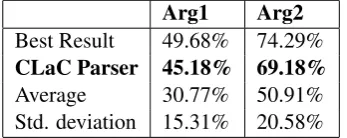
Although the CLaC discourse parser only con-siders explicit discourse relations (which only ac-counts for about half of the relations), the parser ranked 6th among the 17 submitted discourse parsers. The overall F1 score of the parser and the individual performance of theDiscourse Con-nective Classifierand theArgument Labelerin the blind CoNLL test data are shown in Table 2. As Table 2 shows, the performance of the parser is consistently above the average. In addition, the performance of theDiscourse Connective Classi-fieris very close to the best result.
Note that all numbers presented in Table 2 were obtained when errors propagate through the pipeline. That is to say, if a discourse connective is not correctly identified by theDiscourse Connec-tive Classifierfor example, the arguments of this discourse connective will not be identified. Thus, the recall of theArgument Labelerwill be affected. The CoNLL 2015 results of the submitted parsers show that the identification of ARG1 is
more difficult than ARG2. In line with this,
the CLaC Discourse Parser performed better on the identification of ARG2 (with the F1 score
of 69.18%) than ARG1 (with the F1 score of
45.18%). Table 3 provides a summary of the re-sults for the identification of Arg1 and Arg2. An important source of errors in the identification of ARG1 is thatattribute spansare contained within
ARG1. For example in (2), the CLaC Discourse
Parser incorrectly includes the text “But the RTC also requires “working” capital” within ARG1.
Arg1 Arg2
Best Result 49.68% 74.29%
CLaC Parser 45.18% 69.18%
[image:4.595.94.268.662.731.2]Average 30.77% 50.91% Std. deviation 15.31% 20.58%
Table 3: Results of the Identification of ARG1 and
ARG2.
(2) But the RTC also requires “working” capi-talto maintain the bad assets of thrifts that are solduntilthe assets can be sold sepa-rately.3
With regards to the identification of ARG2, we
ob-served that subordinate and coordinate clauses are an important source of errors. For example in (3), the subordinate clause “before we can move for-ward” is erroneously included in the ARG2 span
when the CLaC Discourse Parser parses the text. The cause of such errors are usually rooted in an incorrect syntax parse tree that was fed to the parser. For instance in (3), the text “we have col-lected on those assets before we can move for-ward” was incorrectly parsed as a single clause covered by an S node with the subordinate “before we can move forward” as a child of this S node. However, in the correct parse tree the subordinate clause should be a sibling of the S node.
(3) We would have to waituntilwe have col-lected on those assetsbefore we can move forward.3
4 Conclusion
In this paper, we described the CLaC Discourse Parser which was developed from scratch for the CoNLL 2015 shared task. This 3 person-month effort focused on the task of the Discourse Con-nective ClassificationandArgument Labeler. We used a na¨ıve approach for sense labelling and consider only explicit relations. Yet, the parser achieves an overall F1 measure of 17.38%, rank-ing in 6th place out of the 17 parsers submitted to the CoNLL 2015 shared task.
5 Acknowledgement
work was financially supported by NSERC.
References
[Bethard et al.2014] Steven Bethard, Philip Ogren, and Lee Becker. 2014. ClearTK 2.0: Design patterns for machine learning in UIMA. LREC.
[Ferrucci and Lally2004] David Ferrucci and Adam Lally. 2004. UIMA: An architectural approach to unstructured information processing in the corporate research environment. Natural Language Engineer-ing, 10(3-4):327–348.
[Hall et al.2009] Mark Hall, Eibe Frank, Geoffrey Holmes, Bernhard Pfahringer, Peter Reutemann, and Ian H. Witten. 2009. The WEKA data mining software: An update. ACM SIGKDD explorations newsletter, 11(1):10–18.
[Kong et al.2014] Fang Kong, Hwee Tou Ng, and Guodong Zhou. 2014. A Constituent-Based Ap-proach to Argument Labeling with Joint Inference in Discourse Parsing. InProceedings of the 2014 Con-ference on Empirical Methods in Natural Language Processing (EMNLP), pages 68–77, Doha, Qatar, October.
[Lin et al.2014] Ziheng Lin, Hwee Tou Ng, and Min-Yen Kan. 2014. A PDTB-styled end-to-end discourse parser. Natural Language Engineering, 20(02):151–184.
[Petrov and Klein2007] Slav Petrov and Dan Klein. 2007. Improved Inference for Unlexicalized Pars-ing. In Proceedings of NAACL HLT 2007, page 404–411, Rochester, NY, April.
[Pitler et al.2009] Emily Pitler, Annie Louis, and Ani Nenkova. 2009. Automatic sense prediction for im-plicit discourse relations in text. InProceedings of the 47th Annual Meeting of the ACL and the 4th IJC-NLP of the AFIJC-NLP, page 683–691, Suntec, Singa-pore, August.