Abstract—Context prediction systems use users' context information acquired from many sensors to predict their next situation and provide them with the most suitable services. However sometimes users change their actions so to predict their next situation is not simple. Furthermore, these systems have no enough context information to predict accurately. For these reason, it is very difficult to provide users with suitable services to their needs and their next situation. In this paper, we solved the problem of the change of users' actions by using our user's habits-based context prediction algorithm to predict users' next locations. To solve the problem of lack of context information, we built our system based on hybrid P2P technique to share and learn context information from other members. And in order to provide users with suitable services, we utilized their locations information, habits, acquired context information and their behavior when they received services to predict their needs. As the result of experiments, prediction time and prediction accuracy of our system improved as compared with context prediction by alignment methods where prediction is based on observed time series.
Index Terms—Context Awareness, Context Prediction, P2P, Context Share, Smart Building
I. INTRODUCTION
Human create habits and also change their habits. And they usually act through their habits. For this reason, context prediction systems can use users' habits information to predict users' situation and provide users with suitable services to their needs. And recently many architectures for context prediction were researched [1][2].
In order to build a users' habits-based context prediction system, we have to solve following problems. First, users usually act through their habits but sometimes they change them temporarily or permanently so users' habits-based context prediction systems have to adapt with the changes of users' habits to make decision accurately. Second, users' devices (mobile devices) have limited memory, processing power so they cannot store a lot of information, use powerful algorithms. In addition, these devices have no context information enough so the result of prediction can be inexact. Third, it is how to provide suitable services for users' needs and their situation.
In the paper, we would like to build a users' habits-based context prediction system that can monitor users' locations,
S. Y. Lee is with the Kongju National University, ChungNam, Korea. (e-mail: sylee@ kongju.ac.kr).
D. L. Tran was with Kongju National University, ChungNam, Korea. He is now with the Department of Artificial Intelligent, Kongju National University, ChungNam, Korea. (e-mail: dolong@ kongju.ac.kr).
learn their habits and predict their next locations in a building based on acquired context information, habits information and behavior in the past. By means of their locations information, behavior and habits information, the most suitable services can be provided for users in real time. But first, to solve three problems mentioned above, we propose the following methods.
First, in order to solve the problem of changes of users' habits, we proposed a new algorithm to adapt with these changes. This algorithm will learn users' habits and make prediction based on them. Second, to solve the problem of limitation of users' devices and lack of context information, we used hybrid P2P to learn and share context classes. And third, to provide suitable services for users, we relied on users' locations information, habits, acquired context information and their behavior in the past to make decision.
II. RELATED WORKS
A. Smart Building
Buildings of 21st century will integrate the current digital technology with other building systems to create a "smart building" [3]. The smart building will anticipate the needs of users to provide improved comfort, greater user’s control, and better energy efficiency. The smart building optimizes four basic components: structure, systems (security, air conditioning, and power supply), services (e-mails, video conferences, telecommunications, etc.) and management (energy, monitoring, maintenance, accounting, etc.). The main advantage of a smart building is the ability to control easily and rapidly all aspects of telecommunication and building management, while increasing comfort and safety for those living and working in the building.
B. Context Prediction Algorithms
[image:1.595.303.549.691.758.2]The algorithms play an important role in systems, especially in context prediction systems because they need powerful algorithms but these algorithms have to be suitable for mobile devices.
TABLE 1. COMPARISON BETWEEN ALGORITHMS [4-9]
Algorithm Comparison Context prediction by alignment method One-level Two-state Context Predictors Global two-level Context Predictors with Two-state Prediction by Partial Matching
Speed Normal High Slow Normal
Prediction Probability High Low Normal Normal
Users' Habits-based Context Prediction
applied to Smart Buildings
As table 1 showed, One-level two-state context prediction algorithm only depends on users’ one past state to predict a next room so speed is very high but prediction probability is very low. While global two-level context prediction with two-state lists all possible cases and results of prediction so the prediction space for possible cases, results and the same results will be very large so speed is slow and prediction probability is normal. Prediction by partial matching was extended from two-level context prediction and improved search speed. Context prediction by alignment methods uses users' behavior in the past to predict act. It means that prediction process depends on much different context information so its prediction probability is high but its speed is normal.
C. P2P System
A P2P computer network exploits diverse connectivity between participants in a network and the cumulative bandwidth of network participants [10][11]. A P2P network has some advantages such as: All clients provide resources including bandwidth, storage space, and computing power, and it increases robustness in case of failures by replicating data over multiple peers and enabling peers to find the data without relying on a centralized index server. P2P networks are classified as pure P2P and hybrid P2P by their degree of centralization. In this paper, we used hybrid P2P technique.
III. USER’S HABITS-BASED CONTEXT PREDICTION
A. Context Awareness
Context information is any information that can be used to characterize the situation of an entity, where an entity is a person, place, or object that is considered relevant to the interaction between a user and an application, including the user and application themselves [12].
Context information is divided into static context and dynamic context. Static context information does not change or changes very slowly. Inversely, dynamic context information changes much more often.
Objects in computing environment can be described with three elements: Entity, Property and Relation. The entity is the same as users, computing devices. The property is features, attributes. And the relation defines relationship between the object with other objects. The relationship of a context object with other context objects can derive from based operators: Or, And, Xor. And these operators can be taken place of algorithms.
B. Context Prediction
In order to solve the problem of changes of users' habits, we proposed a new algorithm to adapt with these changes. And to decrease time of prediction process, prediction is not performed in requesters' devices but it is performed in devices from that requesters want to get information. And after prediction process is over, requested devices will send results to requesters' devices instead of sending all of acquired context information to requesters' devices for prediction process.
[image:2.595.313.544.163.361.2]In this paper, except for users' locations information, other context information is received from their own devices such as time, scheduled tasks, timetable, and date. Then the acquired context information is assigned with different priorities, and information received from scheduled tasks, timetable, dates have the highest priority and users' locations information, habits have the lower priority. The prediction also depends on the priorities to make final decisions.
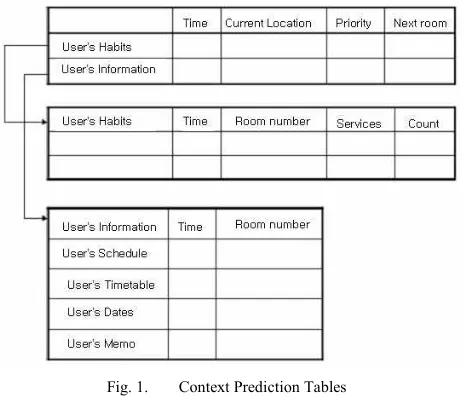
Fig. 1. Context Prediction Tables
Figure 1 shows context prediction tables in our context prediction algorithm. In first table there are user's habits information and user's information that are referenced to user's habits table and user's information table.
Prediction process is performed as following steps: ● Step 1: Get user's current position value. Go to step 2. ● Step 2: Check the current position value. If its value is different from null value, then send results to requesters' devices. Conversely, go to 3.
● Step 3: Get users' information (scheduled tasks, timetable, time, etc.). Go to step 4.
● Step 4: Check users' information, if their values are different from null value and comparison their time with current time are true, then send results to requesters' devices. Inversely, go to 5.
● Step 5: Get user's habits information and go to step 6. ● Step 6: Search the most suitable habits depending on priorities of habits information and current time. If results are found, then send them to requesters' devices. if not, go to 7.
● Step 7: Send results to requesters' devices
C. Context Share
Fig. 2. Context-sharing Structure
Context-sharing system consists of Peers, Peers Groups and Local Servers. And each local server includes parts: sharing database, information management, Peer Group management and P2P agent manager. P2P agent manager manages peers in region. It is in charge of managing creation and extinction of users' P2P agent. Peer Group management manages updating, creating necessary peers groups and classifies them as groups by their preference. Information management has responsibility for managing local information services and in case it is short of necessary information services, it can get them from different local servers. Sharing database manages records and classifies local information services and information of peer groups.
IV. SYSTEM DESIGN
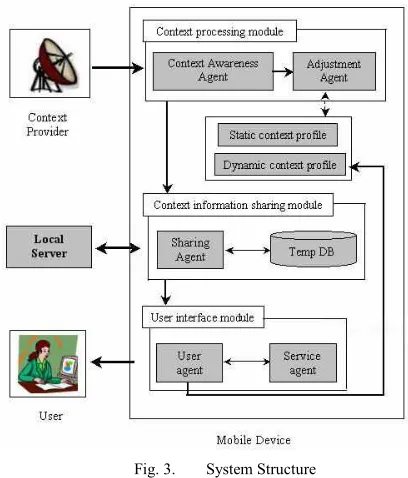
[image:3.595.308.541.209.596.2]Our system structure consists of context providers, local servers, users and mobile devices. Among them, mobile device are structured by three modules: user interface module, context processing module, context information sharing module. Figure 3 shows our system structure.
Fig. 3. System Structure
● User interface module is responsible for communicating with users, searching and providing services that are suitable to users' situation based on users' habits, behavior in the past and acquired context information. It is structured by Service agent and User agent.
● Context processing module is in charge of collecting, being aware users' context information and analyzing new context information. This module is composed of awareness agent and adjustment agent. And figure 4, 5 describe their structures.
● Context information-sharing module manages communication with local servers, and communicates with Adjustment agent to receive high-level context information. And in this module, the sharing agent that plays the most important role consists of Peer communication controller, Peer management, Cache, Learning engine. Figure 6 shows structure of sharing agent.
Fig. 4. Awareness Agent Structure
[image:3.595.312.541.452.578.2]Fig. 5. Adjustment Agent Structure
Fig. 6. Sharing Agent Structure
[image:3.595.56.260.468.707.2]Fig. 7. Share Agent Structure
V. EXPERIMENT AND RESULTS
[image:4.595.48.279.49.137.2]We use C# language to write applicable programs. C# language and Pocket PC emulator 2003 are included in Visual Studio.Net tool. Figure 8 and Table 2 show the applicable environment and experimental environment.
[image:4.595.57.280.267.395.2]Fig. 8. Application Environment
TABLE 2. EXPERIMENTAL ENVIRONMENT
Characteristics P2P Server User device emulator
CPU PIV 3.0 GHz Intel Pentium mobile 2.0 GHz
RAM 512 MB 1 GB
Operating System Windows XP Windows XP
Tool Visual studio .net 2003 &
SQL Server 2000
Visual studio .net 2003 & SQL Server 2000
Programming Language C# C#
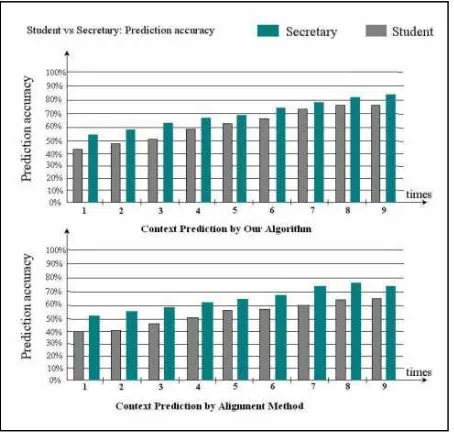
For evaluation we have recorded the movements of 30 students, 3 secretaries over several weeks in our building. We present here two movement sequences, one of the student and one of the secretaries. Figure 9 and table 3 compare prediction accuracy and prediction time between students and secretaries, between our algorithm and alignment method. We recognize that secretaries' prediction accuracy is mostly better than students'. And our algorithm is also better than the alignment method. An explanation for the better prediction accuracy of the secretaries' movements is that the secretaries visited less people than the students, they usually act through timetable. Meanwhile, the students usually change more their habits than the secretaries. Our algorithm has better prediction accuracy and prediction time than the alignment method because alignment method monitors users' behavior and aligns them through time series and makes prediction based on these time series. Meanwhile, our algorithm does not only monitor users' behavior but also learns users' habits from acquired information to predict the next location of users based on their habits, acquired context information.
Fig. 9. Our Algorithm vs. Alignment Method in Accuracy
TABLE 3. OUR ALGORITHM VS.ALIGNMENT METHOD IN TIME
VI. CONCLUSION
Context prediction systems in ubiquitous environment predict the next situation of users and provide them with suitable services for user based on acquired context information, predicted information. However, context prediction systems have no enough context information and sometimes users change their habits so prediction is inexact. And these systems cannot provide users with suitable services.
In this paper, in order to solve problems, we proposed an algorithm to make the context prediction system adapt the change of users' habits. We used hybrid P2P to learn and share acquired context information. And providing users with suitable services is based on acquired context information, users' habits and their behavior in the past.
As the result of an experiment, our algorithm has better prediction accuracy and prediction time than the alignment method.
REFERENCES
[1] R. Mayrhofer, "An Architecture for Context Prediction," PhD thesis, Johannes Kepler University of Linz, Austria, 2004.
[2] H. Radi, "Adding Smartness to Mobile Devices-Recognizing Context by Learning from User Habits," Master’s thesis, 2006.
[3] L. Hovesstadt, "The way smart buildings will flourish," Swiss Federal Institute of Technology, Swizerland. 2006.
[4] S. Sigg, S. Haseloff, K. David, "Prediction of Context Time Series," In Proceedings of the 5th Workshop on Applications of Wireless Communications, Finland, pp. 31-45, 2007.
First Time Second Time Third Time Fourth Time
Our Algorithm
Student 6.21(s) 5.64(s) 5.22(s) 4.25(s)
Secretary 4.93(s) 4.23(s) 3.56(s) 2.98(s)
Alignment Method
Student 6.42(s) 6.12(s) 5.67(s) 4.78(s)
[image:4.595.51.288.425.523.2][5] S. Sigg, S. Haseloff, K. David. "Context Prediction by Alignment Methods," In Poster and Demo Abstracts of ACM MobiSys Uppsala, Sweden. ACM, 2006
[6] J. Petzold, F. Bagci, W. Trumler, and L. Vintan. Global State Context Prediction Techniques Applied to a Smart Office Building, 2004. [7] J. Petzold, F. Bagci. "Global and Local State Context Prediction,"
University of Augsburg, Germany, 2003
[8] J. G. Cleary, I.H.,. Witten, "Data compression using adaptive coding and partial string matching", IEEE Transactions on Communications, 32(4), pp. 396-402. 1984.
[9] A. Moat. "Implementing the PPM data compression scheme," IEEE Trans-actions on Communications, 38(11), pp. 1917-1921. 2005. [10] A. Wild, "Apeer-to-peerImplementations" [Online]. Available:
http://www.ida.liu.se/conferences/p2p/p2p2001/
[11] Keith W.Ross, " P2P Systems," Columbia University, 2004. [12] A. K. Dey and G. D. Abowd, "Towards a better understanding of
![TABLE 1. COMPARISON BETWEEN ALGORITHMS [4-9]](https://thumb-us.123doks.com/thumbv2/123dok_us/1296845.659060/1.595.303.549.691.758/table-comparison-between-algorithms.webp)